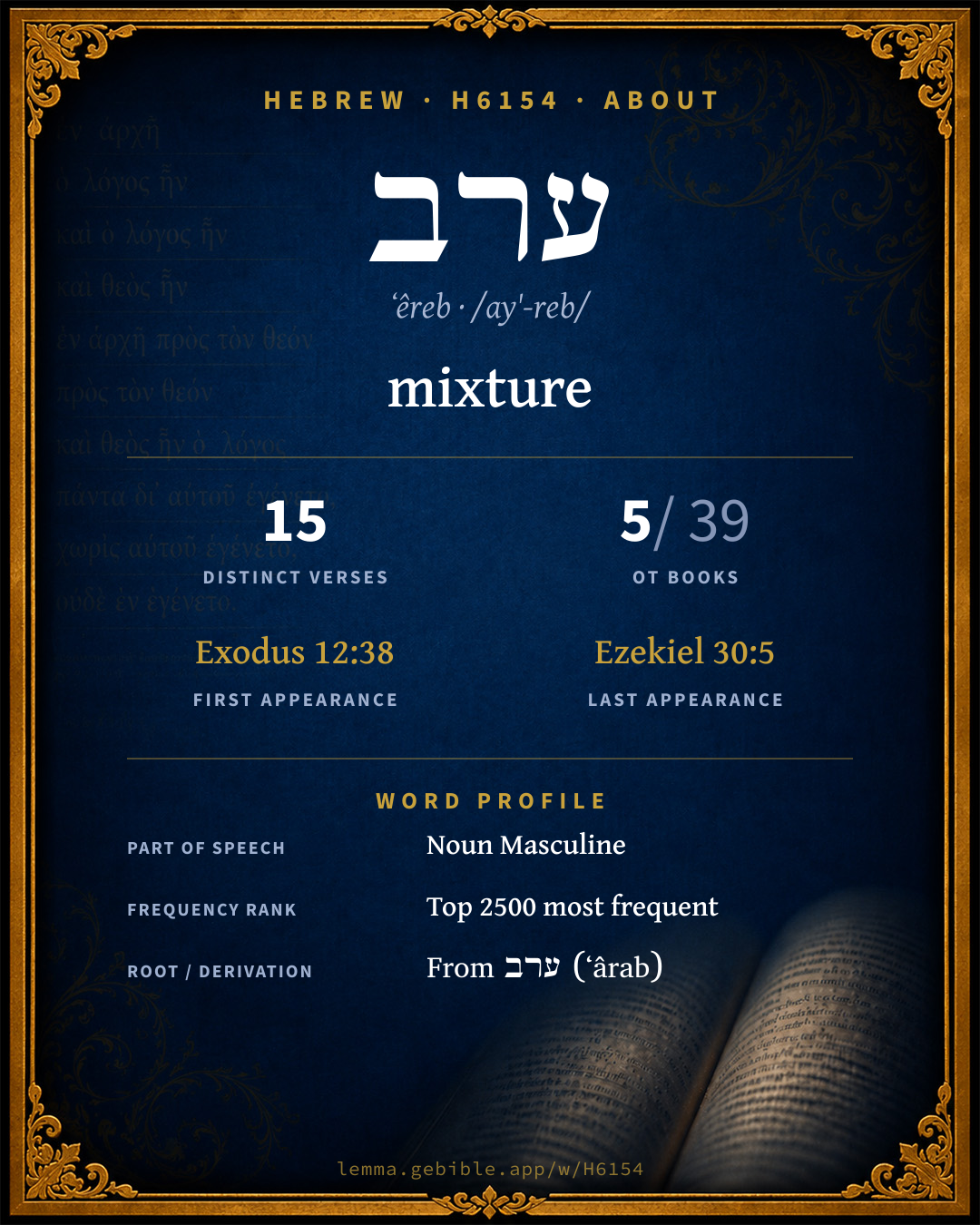
עֵ֫רֶב
mixture
‘mixture’ is one of 2 main senses fuller range ↓
Full lexicon entry — Brown-Driver-Briggs (BDB)
From Brown-Driver-Briggs (BDB)
Where this word appears
Grammar key — what these labels mean
Part of speech
- Noun
- A naming word — a person, place, thing, or idea.
Noun type
- Common
- A common noun — a general class of person, place, or thing (“king,” “city,” “water”), not a specific name.
State
- Absolute
- The independent form of a noun, not bound to a following word.
Gender
- Masculine
- Grammatically masculine.
Number
- Singular
- One.
Every verse where H6154 appears — 15 distinct verses across 5 books. Click any verse to open its interlinear word-by-word view. Verse text shown in the World English Bible for context — . Each verse’s Hebrew form is shown with its reference; the English is not keyword-highlighted, since the data carries no word-level English alignment. Use “Compare translations” on any verse to read it across multiple English versions. This concordance covers the Hebrew Bible; Septuagint (Greek Old Testament) occurrences are not indexed here.
Exodus 1 verse
Leviticus 9 verses
- Leviticus 13:48 בְ/עֵ֔רֶב prep + n c ms whether it is in warp, or woof; of linen, or of wool; whether in a skin, or in anything made of skin;
- Leviticus 13:49 בָ/עֵ֨רֶב֙ prep det + n c ms if the plague is greenish or reddish in the garment, or in the skin, or in the warp, or in the woof, or in anything made of skin; it is the plague of leprosy, and shall be shown to the priest.
- Leviticus 13:51 בָ/עֵ֨רֶב֙ prep det + n c ms He shall examine the plague on the seventh day. If the plague has spread in the garment, either in the warp, or in the woof, or in the skin, whatever use the skin is used for, the plague is a destructive mildew. It is unclean.
- Leviticus 13:52 הָ/עֵ֗רֶב ptcl def.art + n c ms He shall burn the garment, whether the warp or the woof, in wool or in linen, or anything of skin, in which the plague is: for it is a destructive mildew. It shall be burned in the fire.
- Leviticus 13:53 בָ/עֵ֑רֶב prep det + n c ms "If the priest examines it, and, behold, the plague hasn't spread in the garment, either in the warp, or in the woof, or in anything of skin;
- Leviticus 13:56 הָ/עֵֽרֶב ptcl def.art + n c ms If the priest looks, and, behold, the plague has faded after it is washed, then he shall tear it out of the garment, or out of the skin, or out of the warp, or out of the woof:
- Leviticus 13:57 בָ/עֵ֨רֶב֙ prep det + n c ms and if it appears again in the garment, either in the warp, or in the woof, or in anything of skin, it is spreading. You shall burn with fire that in which the plague is.
- Leviticus 13:58 הָ/עֵ֜רֶב ptcl def.art + n c ms The garment, either the warp, or the woof, or whatever thing of skin it is, which you shall wash, if the plague has departed from them, then it shall be washed the second time, and it will be clean."
- Leviticus 13:59 הָ/עֵ֔רֶב ptcl def.art + n c ms This is the law of the plague of mildew in a garment of wool or linen, either in the warp, or the woof, or in anything of skin, to pronounce it clean, or to pronounce it unclean.
Nehemiah 1 verse
Jeremiah 3 verses
- Jeremiah 25:20 הָ/עֶ֔רֶב ptcl def.art + n c ms and all the mixed people, and all the kings of the land of the Uz, and all the kings of the Philistines, and Ashkelon, and Gaza, and Ekron, and the remnant of Ashdod;
- Jeremiah 25:24 הָ/עֶ֔רֶב ptcl def.art + n c ms and all the kings of Arabia, and all the kings of the mixed people who dwell in the wilderness;
- Jeremiah 50:37 הָ/עֶ֛רֶב ptcl def.art + n c ms A sword is on their horses, and on their chariots, and on all the mixed people who are in the midst of her; and they shall become as women: a sword is on her treasures, and they shall be robbed.
Ezekiel 1 verse
About this entry
At a glance — auto-summarized from this page’s data, not written by a person. Every figure links to its source below. This summary describes the numbers; it doesn’t interpret them.
The Hebrew noun ערב centers on the idea of “mixture.” Leviticus dominates its distribution — 9 of 15 verses. The Hebrew Bible uses it across 15 verses — uncommon. First canonically at Exodus 12:38, it enters the text early. Its meaning spans more than one sense — see its full sense range. For the data behind this summary, explore the sense tree and the renderings breakdown below.
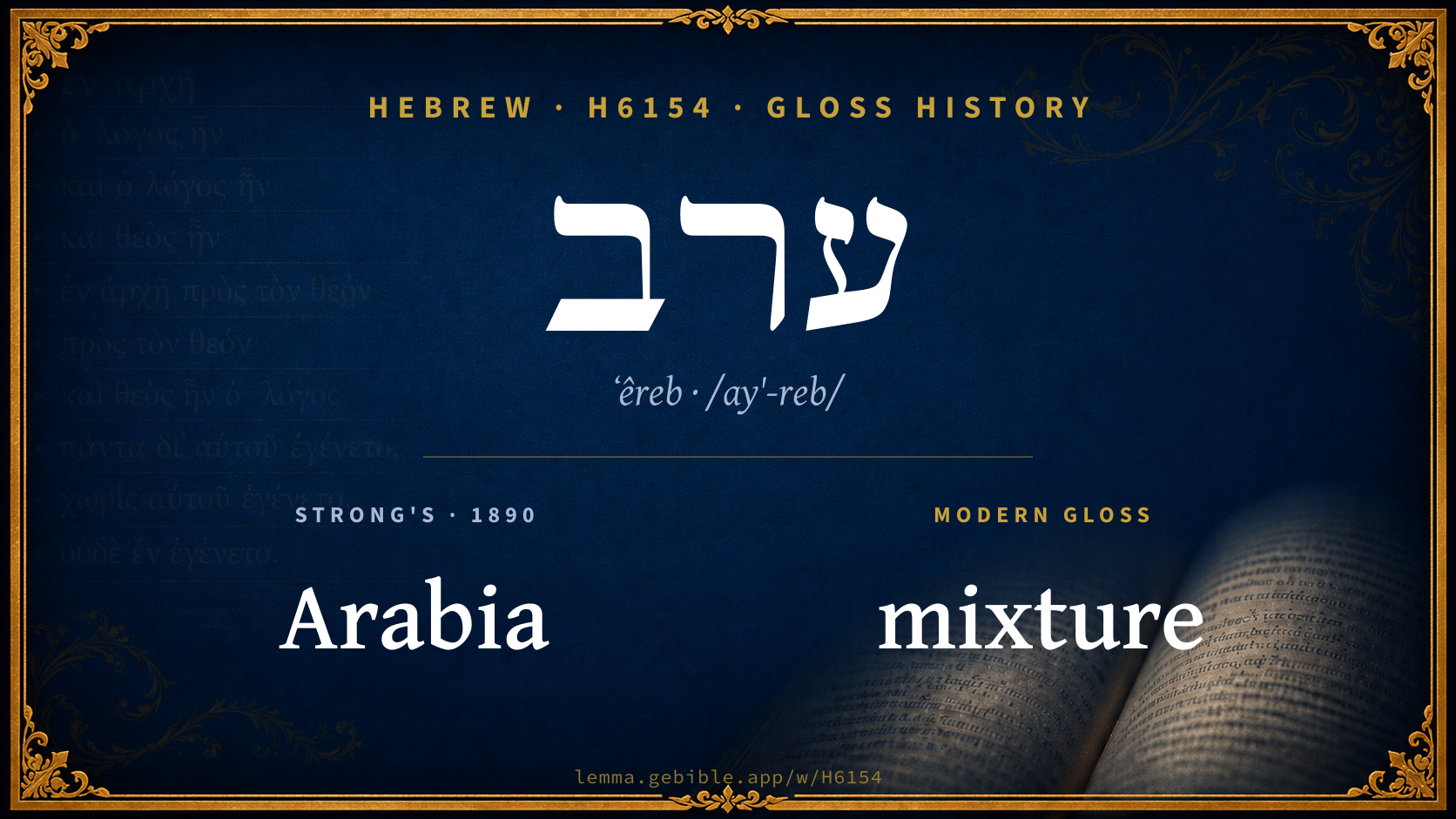
Gloss history
Strong's 1890 vs modern scholarship
About this word
Strong's H6154 catalogs a Hebrew word from the Hebrew Old Testament.
These counts are not copied from any lexicon or concordance. They are computed here, from the morphology-tagged Hebrew Old Testament. What Lemma adds →
- 15
- distinct verses
- The word appears in 15 distinct verses.
- 5 / 39
- OT books
- The word appears in 5 of 39 Old Testament books.
- #1,836
- by frequency
- Top 2500 most frequent Hebrew words (rank 1,836 of 8,640 Hebrew words by occurrence).
View all 15 occurrences in the concordance →
By section of the Old Testament
By traditional corpus
Conventional, traditional groupings — biblical authorship is debated, so this is a traditional corpus grouping, not an authorship claim. Each share is this word’s portion of its verses in that division of the Hebrew canon. Each figure is a share of the word’s 15 distinct verses.
- Torah (Pentateuch) 10 verses · 67%
- Prophets (Nevi'im) 4 verses · 27%
- Writings (Ketuvim) 1 verse · 7%
How translations render this word
Counts come from each version’s own published word-to-Strong’s tagging or interlinear alignment — an approximate guide to how each version renders this word, not a word-level alignment the data otherwise carries. Because each total is that version’s own tagged count, the per-version totals vary from one another and need not match the appearance or distinct-verse counts above. These counts may also differ from a printed concordance because Lemma counts each distinctly tagged rendering and does not collapse phrase taggings into a single head-word total. This is a fixed set of word-tagged versions (KJV, ASV, BSB, ULT) and does not change with the reading translation you choose elsewhere. Each version’s license is shown beside its name below (and on Sources).
BDB lists this Strong’s number as 3 distinct words (homographs). Each count above pools all of them and is not split by sense — see the Senses section below. A low-frequency rendering may belong to a different one of those words, not the primary meaning.
- King James Version†: Or woof 4×, Or in the woof 3×
- American Standard Version†: Or in the woof 3×, Or the woof 3×
- Berean Standard Bible†: Knit 9×, Mixed tribes 2×
- unfoldingWord Literal Text†: Woof 9×
King James Version Public Domain
Renders H6154 across 11† tagged occurrences — most commonly:
Plus 4 renderings that appear only once — usually multi-word phrases or single function words the recovered tagging swept in, not distinct renderings.
American Standard Version Public Domain
Renders H6154 across 11† tagged occurrences — most commonly:
Plus 5 renderings that appear only once — usually multi-word phrases or single function words the recovered tagging swept in, not distinct renderings.
Berean Standard Bible Public Domain
Renders H6154 across 15† tagged occurrences — most commonly:
Plus 4 renderings that appear only once — usually multi-word phrases or single function words the recovered tagging swept in, not distinct renderings.
unfoldingWord Literal Text CC BY-SA 4.0
Renders H6154 across 14† tagged occurrences — most commonly:
Plus 5 renderings that appear only once — usually multi-word phrases or single function words the recovered tagging swept in, not distinct renderings.
Senses in the full BDB
What do BDB’s symbols mean?
BDB uses these scholarly abbreviations:
| Symbol | Meaning |
|---|---|
| 𝔊 | the Septuagint (the ancient Greek translation, LXX) |
| 𝔙 | the Vulgate (the Latin translation) |
| 𝔖 | the Syriac version (the Peshitta) |
| 𝔗 | the Targum (the Aramaic translation) |
| ψ | the Psalms |
| √ | root (the underlying root or stem) |
| ‖ | parallel passage (a synonymous or contrasted parallel) |
| † | the dagger: every passage where the word occurs is cited |
The 4 senses and sub-senses the full Brown-Driver-Briggs lexicon distinguishes for this word, in lexicon order (not ranked by frequency), with BDB’s own verbatim wording and sub-sense lettering. Shown in Hebrew script with BDB’s own scholarly abbreviations. The condensed entry is in the Lexicon Entry tab. See also the Forms in the corpus table below.
ערב I
- 1.
- a. evening, orig. sunset, and hence perhaps לְעֵת ע׳ at the time of sunset †Gn 8:11 (J), 24:11 (J; ‖ לְעֵת צֵאת הַשֹּׁאֲבֹת), 2 S 11:2 Is 17:14 and (of the day of י׳) Zc 14:7, עֵת הָע׳ Jos 8:29 (JE)†; usually ע׳ alone = time of sunset, evening: בָּע׳ in the evening Gn 19:1 (J), 29:23 (E), Ex 12:18 (P), Dt 16:6 (+ כְּבוֹא שֶׁמֶשׁ), 1 K 22:35 (cf. ‖ 2 Ch 18:34 where + לְעֵת בּוֹא הַשֶּׁמֶשׁ) + 20 times + בָּע(־)בָּע׳ 2 Ch 13:11(×2) = every evening; לָע׳ at evening only late: †1 Ch 16:40; 23:30; 2 Ch 2:3; Ezr 3:3 ψ 59:7, 1R; 90:6; Ec 11:6†; לִפְנוֹת ע׳ at the turn of evening †Gn 24:63 (J), Dt 23:12; ע׳ as adv. acc. Ex 16:6 (P), ψ 55:18; as marking duration of impurity, in phr. עַד־הָע׳ Lv 11:24 + 30 times P + Lv 22:6 (H); of Day of Atonement מֵע׳ עַד־ע׳ 23:32 (P). e.g. Genesis 8:11
- b. du. in phrase (only P) בֵּין הָעַרְבַּיִם between the two evenings, i.e. prob. between sunset and dark (v. Thes [various views fully given]; otherwise Di Ex 12:6; on form as poss. only expanded pl. v. Ges§ 88 c), †Ex 12:6; 16:12; 29:39, 41; 30:8; Lv 23:5; Nu 9:3, 5, 11; 28:4, 8†. e.g. Exodus 12:6
- c. other phrases are: צִלְלֵי ע׳ Je 6:4 (dist. from צָהֳרָ֑יִם and לָ֑יְלָה v 5), מִנְחַת (הָ)ע׳ †2 K 16:15; Ezr 9:4, 5 ψ 141:2 Dn 9:21†; זְאֵבֵי ע׳ v. 1. זְאֵב; for all combin. with בֹּקֶר morning, v. ב׳ 1 d, e. e.g. Jeremiah 6:4
- 2. (late poet.) = night, עָ֑רֶב Jb 7:4; cf. בְּנֶשֶׁף בְּעֶרֶב יוֹם Pr 7:9 (‖ בְּאִישׁוֹן לַיְלָה וַאֲפֵלָה). e.g. Job 7:4
ערב II Ex 12, 38 mixture, mixed company
ערב III [m.] woof (as mixed, interwoven, with warp)
Senses from the full Brown-Driver-Briggs lexicon (Brown, Driver, Briggs; Oxford 1906 — public domain), digitized via Sefaria, supplemented by the OpenScriptures HebrewLexicon (CC BY 4.0). Full attribution on Sources.
Word origin
I. n.[m. 1 S 20:5 del. הַשְּׁלִישִׁית v. We Dr al.] (sun)set, evening;—abs. ע׳ 2 K 2:16 +, עָ֑רֶב Ex 12:18 +; cstr. עֶרֶב Pr 7:9; du. עַרְבַּיִם Ex 30:8 + 4 times, -בָּ֑יִם 12:6 + 5 times (all P);—
I. n.m. Ex 12, 38 mixture, mixed company;—heterogeneous body attached to a people; to Israel Ex 12:38 (E), Ne 13:3; to Egyptians Je 25:20 (𝔙 joins to v 19, so Gie); to Chaldeans 50:37; in Je 25:24 del. וְאֵת … הָעֶרֶב as doublet (so Gie, cf. 𝔊); in 1 K 10:15 read עֲרָב (as ‖ 2 Ch 9:14, so Benz Kit al.); Ez 30:5 read prob. id. (Co).
II. n.[m.] woof (as mixed, interwoven, with warp);—Lv 13:48 + 8 times 13 (all opp. שְׁתִי warp), cf. GFMPAOS 1889, clxxviii.
— Brown-Driver-Briggs (Oxford 1906, public domain), digitized via Sefaria, supplemented by the OpenScriptures HebrewLexicon (CC BY 4.0). See Sources.
Derived from ערב (ʻârab) (H6148) — to pledge.
Jastrow Dictionary
A second Hebrew/Aramaic lexicon for comparison, covering Aramaic and post-biblical (Talmudic, Targumic, Midrashic) usage that the biblical-Hebrew BDB does not. Matched by lemma rather than by Strong’s number, so a lemma may carry more than one Jastrow headword (shown separately below), and the entries cover usage well beyond the Bible.
עָרַב I
- [to insert, press into, interweave,]
- 1. to mix, confuse. Yalk. Deut. 808 עָרְבוּ את העיסה (or עֵרְבוּ Pi.; not ערכו), v. עִיסָה.
- 2. [to substitute, put in place of,] to vouch for. Cant. R. to I, 4 אבותינו עוֹרְבִים אותנו let our ancestors be our surety (for our observance of the Law); Yalk. Cant. 982. Deut. R. s. 3 מבקשים אתם שנַעֲרוֹב אתכס וכ׳ do you want us to guarantee to you that, if you separate your tithes properly, the mice will not attack your grain any more? Ib. ע׳ אותן והלכו he did guarantee to them, and the mice went &c. Tanḥ. Vayigg. 5 מפני מה לא עָרַבְתָּ את וכ׳ why didst thou not pledge thyself for thy brother &c?; a. fr.
- 1. to mix. Gitt. 52ᵇ שמואל אמר מְעָרֵב Samuel explains (המנסך ib. V, 4, v. נָסַךְ), he who mixes forbidden wine with his neighbor’s permitted wine. Koh. R. to IX, 13, a. e. המערב מים ביין וכ׳ who puts water into wine &c., v. גְּלַבְקְיָא. M. Kat. 8ᵇ אין מְעָרְבִין שמחה בשמחה you must not mix one rejoicing with another (e.g. celebrate a wedding during the Festive Week); Gen. R. s. 70. Y. Ber. II, 4ᵈ top; Y. Meg. I, 71ᶜ עי׳ את האותיות if one made the letters of a word of uneven sizes (so that they are not in a line). Gen. R. s. 15 שלא לעָרֵב את האותיות he said המוציא in order not to confound the letters (by saying העולם מוציא); Y. Ber. VI, 10ᵃ bot. ראשי אותיות; a. fr.—Part. pass. מְעוּרָב; f. מְעוּרֶבֶת; pl. מְעוּרָבִים, מְעוּרָבִין; מְעוּרָבוֹת. Yalk. Deut. 808 וראה הפת מע׳ קיבר and saw that the bread was mixed with coarse flour. Erub. 27ᵃ כשקרבי דגים מע׳ בהן when entrails of fish are mixed up with the brine; a. e.—Lev. R. s. 20 (in Chald. dict.) מעורב, v. עַרְבֵּב.
- 2. (denom. of עֵירוּב 2) to lay an ʿErub, to create a symbolical community of residence or continuity of action. Erub. III, 1 מערבין לנזיר ביין you may use wine for an ʿErub for the benefit of a Nazarite. Ib. 84ᵇ; 87ᵇ עד שיְעָרְבוּ until they connect them symbolically by an ʿErub; a. v. fr.—Part. pass. as ab. Sabb. XVI, 3 חצר המע׳ a court which has been made available for Sabbath movements by means of an ʿErub; a. e.
- 3. to pledge. Part. pass. as ab. Esth. R. to I, 1 (ref. to בני התערבות, II Chr. XXV, 24) שהיו מְעוּרָבוֹתֵיהֶן של אבותיהן they were the hostages for their fathers. e.g. 2 Chronicles 25:24
- to be mixed. Ḥull. VI, 5 דם שנ׳ במים if blood (which requires covering up, v. כִּיסּוּי) has been mixed with water. Tosef. Ter. V, 15 פרוסות … שנִתְעָרְבוּ וכ׳ if pieces of show-bread have become mixed up with a hundred times as many pieces of secular bread; Yeb. 81ᵇ פרוסה … שנִתְעָרְבָה וכ׳; Y. Orl. II, 61ᵈ bot. Cant. R. to I, 3 מה השמן הזה אין מִתְעָרֵב … אין מִתְעָרְבִים וכ׳ as oil cannot be mixed with other liquids, so Israel should not be mixed with the nations of the world; a. fr.
עֲרַב
- 1. to vouch for, be surety for. Targ. Prov. VI, 1. Targ. Job XVII, 3; a. e.—Y. Dem. I, 22ᵃ top אמרו ליה עוֹרְבָן ועַרְבוֹן וכ׳ they said to him, pledge thyself to us (that the mice will not attack our produces, if we separate the tithes properly, v. preced.), and he did pledge himself to them, and they suffered no longer (v. נְכֵי). Y. Kil. IX, 32ᶜ bot ריגלוי … עַרְבוּנֵיה למיקמתיה וכ׳ (not ערבתיה) man’s feet are pledged to place him where he is wanted (to die); Succ. 53ᵃ רגלוהי … אינון עַרְבִין ביה וכ׳. Bekh. 48ᵇ מכדי נכסוהי … ערבין ביה is a man’s property pledged for his personal debts (that you can seize it, even if it is sold)?; B. Bath. 174ᵃ ניכסי … ערבין ביה Ms. M. (ed. מערבין יתיה) a man’s property is pledged for him (you can attach it without previous summons); a. e.
- 2. to mix, v. infra, a. עָרִיב.
- 3. to combine. B. Kam. 65ᵇ עַרְבֵיה, v. פְּסַק Af
- 1. to mix; to mix up, confound. Targ. O. Gen. XXX, 40 (Bxt. עֲ׳ Pe.; Y. עַרְבֵּיב׳). Targ. Y. I Deut. VII, 23 (ed. Vien. וִיעַרְבִּ׳ Pe.; Y. II ויערבב׳); a. e.—Ḥull. 6ᵃ כמאן דע׳ בידים דמי it is as if he had mixed it (added leaven and spices) with his own hands. Ab. Zar. 39ᵇ דילמא מייתי ומְעָרֵב ביה lest he bring (unclean milk) and mix it with the clean milk; a. e.—Part. pass. מְעָרַב, מְעַרַב; pl. מְעַרְבִין, מְעַרְבֵי. Targ. Y. Lev. XVI, 18 (not מְעַרְבּ׳, מֵ׳). Targ. Ex. XXX, 35 (ed. Vien. מַעֲרַב Af.) well-mixed, seasoned (h. text מְמֻלָּח). Targ. Is. I, 22 (ed. Wil. מַעֲרָב Af.); a. e.—Sabb. 85ᵇ והא קא מערבי להדי הדדי Ms. M. (ed. מִיתְעָרְבֵי בהדדי, Ithpa.) but will not the leaves of the seeds grow into each other?
- 2. to lay an ʿErub (v. preced. Pi. 2). Targ. Y. Ex. XVI, 5 וִיעָ׳ (ed. Vien. ויעַ׳, corr. acc.).—Y. Bets. I, 61ᵇ top אנשינן מְעָרְבָה we forgot to make ʿErub Tabshilin (v. עֵירוּב); a. e.
- 3. to vouch, be surety. Part. pass. as ab. Targ. O. Gen. XLIV, 32 מְעָרַב (not מְעָרֵב).
- 1. to be mixed. Targ. Josh. XXIII, 7. Targ. Y. II, Deut. VII, 3 (h. text תתחתן); a. e.—Sabb. l. c., v. supra.—Ab. Zar. l. c. אי משום אִיעֲרוּבֵי shall we apprehend an admixture (of wine in the honey)? Zeb. 76ᵃ סוף סוף איערובי מִיעֲרַב at the end it is mixed up. Ib. דאיע׳ when it became mixed; ib. 75ᵇ דאִיעֲרוּב Ms. M. (ed. דאיעבד) when things have become mixed; a. e.—[Ab. Zar. l. c. ולא מיערב, read מְעָרֵב.]
עָרַב II
- v. preced.; cmp. Assyr. ʿerêbu to go in, Del. Assyr. Handw., p. 126) to go in, (cmp. בּוֹא) to set.—Denom. עֶרֶב.
- 1. same. Neg. XIV, 3 ה׳ שמשו when his (the leper’s seventh day’s) sun has set; Yeb. 74ᵇ; Pes. 35ᵃ; a. e.—V. הַעֲרֵב.
- 2. (denom. of עֶרֶב) to be late, to do late in the day. Lev. R. s. 19, beg. (play on שחרות כעורב, Cant. V, 11) מי שמשחיר ומַעֲרִיב בהן who works at them (studies the words of the Law) early and late; ע"י שהשחיר והע׳ בתורה because he was engaged in the Law early and late; Cant. R. to l. c.; Midr. Sam. ch. V; a. e.—V. הַעֲרָבָה. e.g. Song of Solomon 5:11
- 3. to cause the evening to come. Ber. 12ᵃ, a. e. מַעֲרִיב עֲרָבִים (‘blessed be thou, O Lord,) who causest the evenings to advance’, name of one of the benedictions preceding the recitation of the evening Sh’mʿa.
עֲרַב ²
- Ithpe. אִיעְרַב to set. Ber. 2ᵇ אי׳ שמשא וכ׳ when the sun is set, the day is gone (v. דְּכִי). Ib. וכי תימא מכי אי׳ שמשא וכ׳ Ms. M. (ed. עַרְבָא שמשא) and if you say, when the sun sets, we call it night &c.; Meg. 20ᵇ מכי ערבא וכ׳ (missing in Ms. M.).
עָרֵב I
- [to be well-mixed, seasoned, cmp. esp. Targ. Ex. XXX, 35,] to be sweet, pleasant. Lam. R. to I, 9 יֶעֱרַב לך, v. בָּסֵם. Deut. R. s. 8 יערב עליכם much good may it do you; a. fr.
- to sweeten; to gladden, humor. Sifré Deut. 306 מְעָרְבִים וכ׳, v. עָדַן.—Part. pass. מְעוּ֫רָב; f. מְעוּרֶבֶת. Keth. 17ᵃ לעולם תהא דעתו של אדם מע׳ עם הבריות at all times man’s disposition should be sweet in associating with men, i.e. sympathize with their feelings; Treat. Der. Er. ch. VI.
- to cause to be sweet, pleasing. Ber. 11ᵇ הַעֲרֶב נא וכ׳ let, I pray thee, the words of thy Law be sweet in our mouths &c.
עָרִב II
- preced.) spiced, sweet; pleasing. Dem. I, 3 שמן ע׳ spiced (perfumed) oil; Tosef. Shebi. VI, 8. Cant. R. to IV, 4 שקולו ע׳ because his voice is sweet; a. fr.—Pl. עֲרֵבִים, עֲרֵבִין, עֲרֵי׳. Gen. R. s. 50 בשעה … ע׳ להם היו אומרים לו גש הלאה וכ׳ when he spoke to them words that pleased them, they said, come near &c. Ab. Zar. 35ᵃ (ref. to Cant. I, 2) ע׳ עלי דברי דודיך וכ׳ the words of thy friends (the scholars) are sweeter to me than the wine of the Law; a. fr.—Fem. עֲרֵבָה, עֲרֵי׳. Cant. R. to I, 2 [read:] מה מים … אינן ערבין בגופי כך תורה … אינה ע׳ בגופו as water does not taste well, if one is not thirsty, so it is with the Law, unless a man wearies himself in studying it, he does not get the taste of it; a. fr.—Pl. עֲרֵבוֹת, עֲרֵי׳. Ib. to V, 11 (play on כעֹרֵב, ib.) ע׳ הן עלי they are pleasing to me. e.g. Song of Solomon 1:2
עָרֵּב
- ch., v. עָרִיב
עָרֵב III
- (עָרַב I, 2) bondsman, surety. Cant. R. to I, 4 הבא לי ע׳ וכ׳ bring me one to go security, and I shall lend thee. Ib. כשאין … הלא הע׳ if he has nothing to pay with, who is seized but the surety? Midr. Till. to Ps. VIII (ref. to Prov. VI, 1) בשעה שהזקן … עד שלא נתמנית לא היית ע׳ על וכ׳ when a man is appointed an elder, the Lord says to him, before thou wast appointed, thou wast not responsible for the community, now that thou hast been appointed &c. B. Bath. X, 7 המלוה … על ידי ע׳ לא יפרע מן הע׳ he who loans money to his neighbor through a surety, cannot collect from the surety (before having sued the debtor). Ib. 8 איזהו ע׳ שהוא חייב וכ׳ what guarantor is responsible? He who says, ‘lend him, and I shall pay thee’ (i.e. who guaranteed before the loan was consummated); a. fr.—Pl. עֲרֵבִים, עֲרֵבִין, עֲרֵי׳. Cant. R. l. c. בשעה שעמדו … הביאו לי ע׳ טובים וכ׳ when the Israelites were standing before mount Sinai to receive the Law, the Lord said … bring me good sureties (to vouch for you) that you will guard it; ib. אבותיכם צריכין ע׳ your ancestors need sureties themselves; ib. הא ודאי ע׳ וכ׳ these (your children) are certainly good sureties, and on their account I will give you the Law; Midr. Till. l. c. Ib. ע׳ אתם על אבותיכם שאם וכ׳ will you vouch for your fathers, so that you be seized, if they do not observe the Law? Ib. שהיו ע׳ זה לזה they made themselves responsible for one another. Snh. 27ᵇ bot. (ref. to Lev. XXVI, 37) מלמד שכל ישראל ע׳ זה בזה Ms. M. (ed. שכולן) this intimates that all Israelites are responsible for one another (bound to prevent wrongdoing); Shebu. 39ᵃ bot.; a. fr. e.g. Proverbs 6:1
עֹרֵב
- , v. עוֹרֵב
עֶרֶב
- 1. sunset, evening. Ber. I, 3, sq. בָּעֶ׳ in the evening (at prayer); a. v. fr.—Trnsf. decline. Gen. R. s. 50 בָּעֶרֶב בָּא עַרְבָהּ של סדום baʿereb (Gen. XIX, 1), the evening of Sodom has come. Esth. R. introd. מי יתן ערבה, v. בֹּקֶר; a. fr. e.g. Genesis 19:1
- 2. entrance, the day preceding a certain day, the year preceding a certain period, eve. Sabb. II, 7 ע׳ שבת (abbrev. ע"ש) on Friday. Pes. 99ᵇ ע׳ הפסח the eve of the Passover. Taan. IV, 7 ע׳ תשעה באב the day preceding the ninth of Ab. Shebi. I, 1 ע׳ שביעית the year preceding the Sabbatical year; a. v. fr.—Du. עַרְבַּיִם. Ber. 26ᵇ, a. fr. בין הע׳ the time between the beginning of the decline of the sun and sunset (v. מִנְחָה), afternoon.—Pl. עֲרָבִים, constr. עַרְבֵי. Ber. 12ᵃ, v. עָרַב II. [עֲרָבִין, v. עַרְבִית.]—Pes. X, 1 ערבי פסחים (Bab. ed. 99ᵇ ערב, Ms. M. ערבי). Ib. 99ᵇ ע׳ שבתות וימים טובים the eves of Sabbaths and Festivals; a. v. fr.
עֲרָב I
- (b. h.)
- 1. pr. n. m. ʿÃrab, son of Ishmael. Targ. Y. Gen. XXV, 13 (h. text קדר).
- 2. Arabia. Targ. Jer. XXV, 24.
עֲרָב II
- ʿÃrab, near Sepphoris in Upper Galilee (v. Neub. Géogr. p. 204). Sabb. XVI, 7. Y. ib. XVI, end, 15ᵈ שמונה … יתיב בהדא ע׳ וכ׳ (not יהיב) eighteen years he (R. Joh. ben Zaccai) dwelled in that place ʿĂrab, and only those two cases came before him. Y. Taan. IV, 67ᶜ bot. Tosef. B. Kam. VI, 22; Y. ib. VI, 5ᶜ
עֵרֶב
- 1. woof, opp. שתי warp. Kel. I, 5 חוט ע׳ a thread of the woof (thicker than that of the warp). Nidd. 25ᵇ כשל ע׳ as thick as a thread of the woof; a. fr.—Trnsf. the latitudinal direction, opp. to שתי longitudinal direction. Sabb. 85ᵇ אם היו זרועין שתי זורען ע׳ if the beds (in a square) were planted lengthwise, he must plant (on the interspaces) crosswise. Ḥull. 109ᵇ קורעו שתי וע׳ he tears it (the udder) lengthwise and crosswise. Y. Ter. III, 42ᵃ bot. משהילכו בהן שתי וע׳ as soon as they trod on them (the grapes) once lengthwise and crosswise; a. fr.—[In later Hebrew שתי וע׳ cross, emblem of Christianity.]
- 2. mixture; ע׳ רב (= ערברב) mixed multitude. Tanḥ. Ki Thissa 30. Bets. 32ᵇ הני מע׳ רב וכ׳ they are descendants of the mixed multitude (that came from Egypt); a. e., v. עֵירַבְרְבִין.
עָרוֹב
- various kinds of wild beasts. Ex. R. s. 11 (interch. with חיות מעורבבות); Tanḥ. Vaëra 14; a. e.—[LXX עָרֹב gadfly.]—V. עִרְבּוּב ch.
A Dictionary of the Targumim, the Talmud Babli and Yerushalmi, and the Midrashic Literature (Marcus Jastrow; London, Luzac, 1903) — Public Domain. Digitized via Sefaria. Digitized via Sefaria. Full attribution on Sources.
Forms in the corpus
The 12 distinct written forms H6154 takes in the Hebrew Bible, most frequent first — each parse links to that state’s occurrences in the concordance. Hebrew forms include their vowel points and cantillation, so a single lemma takes many written forms.
| Form | Parsing | Example | Uses |
|---|---|---|---|
| בָ/עֵ֨רֶב֙ | Noun, Common, Masculine, Singular, Absolute | Leviticus 13:49 | 3 |
| הָ/עֶ֔רֶב | Noun, Common, Masculine, Singular, Absolute | Jeremiah 25:20 | 2 |
| בְ/עֵ֔רֶב | Noun, Common, Masculine, Singular, Absolute | Leviticus 13:48 | 1 |
| בָ/עֵ֑רֶב | Noun, Common, Masculine, Singular, Absolute | Leviticus 13:53 | 1 |
| הָ/עֵ֔רֶב | Noun, Common, Masculine, Singular, Absolute | Leviticus 13:59 | 1 |
| הָ/עֵ֗רֶב | Noun, Common, Masculine, Singular, Absolute | Leviticus 13:52 | 1 |
| הָ/עֵ֜רֶב | Noun, Common, Masculine, Singular, Absolute | Leviticus 13:58 | 1 |
| הָ/עֵֽרֶב | Noun, Common, Masculine, Singular, Absolute | Leviticus 13:56 | 1 |
| הָ/עֶ֛רֶב | Noun, Common, Masculine, Singular, Absolute | Jeremiah 50:37 | 1 |
| הָ/עֶ֣רֶב | Noun, Common, Masculine, Singular, Absolute | Ezekiel 30:5 | 1 |
| עֵ֖רֶב | Noun, Common, Masculine, Singular, Absolute | Nehemiah 13:3 | 1 |
| עֵ֥רֶב | Noun, Common, Masculine, Singular, Absolute | Exodus 12:38 | 1 |
Same root — word family
Other BDB entries built from the same root as H6154, grouped by Strong’s listed origin. These share a root / origin per the lexicon — not necessarily a shared meaning. Each links to that word’s own entry.
Derives from
Shares the same root
- מערב maʻărâb H4627 merchandise
- ערב ʻârab H6150 to become evening
- ערב ʻărab H6151 to mix
- ערב ʻârâb H6155 poplar
- ערב ʻârôb H6157 swarm
- ערבון ʻărâbôwn H6162 security
- תערבה taʻărubâh H8594 pledge
Compare all same-root words → Showing 4 of 9 — not the complete family. They share a root, not necessarily a meaning.
Septuagint verse parallels
This word appears in 12 verses that also exist in the Greek Old Testament (Septuagint), out of the 15 Hebrew verses it occurs in. You can read those verses in Greek by switching the Old Testament edition to the Septuagint.
Read these verses in the Septuagint
This is a verse-level parallel only — the same verses exist in both the Hebrew and Greek Old Testaments. No word-level Hebrew↔Greek correspondence is claimed: the data carries no such alignment, so no Greek word is shown as this Hebrew word’s translation. Coverage is not total — the Septuagint omits the deuterocanon and renumbers the Psalms, so some Hebrew verses have no direct Greek parallel.