
Jeremiah 16:2

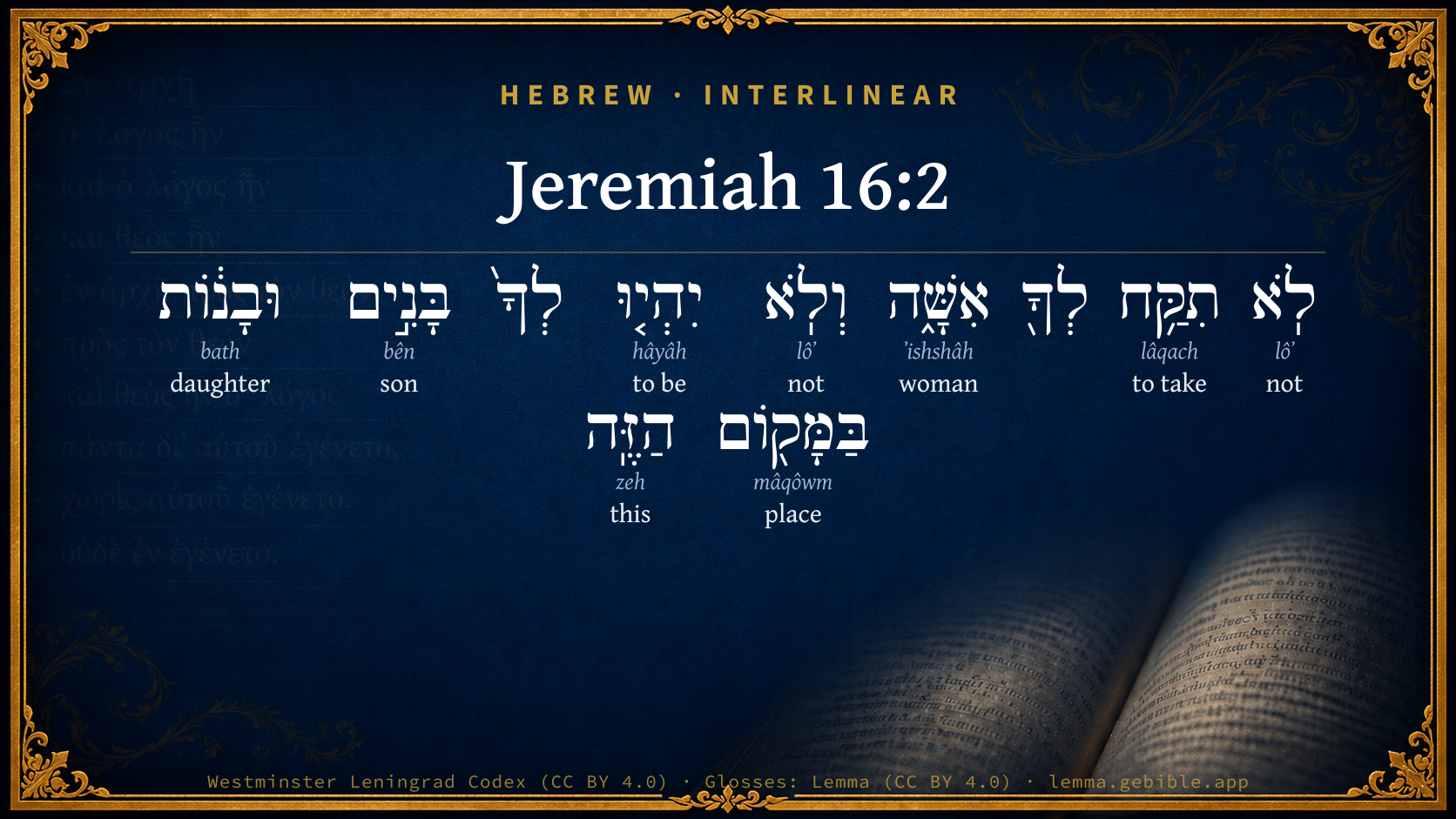
Hebrew (Westminster Leningrad Codex) Jeremiah 16:2 appears in the Hebrew Old Testament. The text above is from the Westminster Leningrad Codex. Each word links to its Strong’s number, a concise gloss, and parsing drawn from the Open Scriptures Hebrew Bible morphology. Click any word for its full Brown-Driver-Briggs (BDB) entry.
Download image
Cite this verse

Jeremiah 16:2 (World English Bible). Public Domain. Lemma interlinear Bible study tool, https://lemma.gebible.app/v/jeremiah/16/2.

Show BibTeX & RIS
BibTeX
RIS
English Translation
You shall not take a wife, neither shall you have sons or daughters, in this place.
World English Bible · Public Domain
Download a study sheet

One document with this verse’s original text, its word-by-word gloss line, the meaning frame, cross-references with their text, attributed commentary, and full source and license credits — printable, and it pastes into notes with its structure intact.

This verse Autodidact and up

Study sheet (.html) Plain text (.txt)

A passage Seminary Student

Up to 50 verses in one chapter. A passage sheet keeps up to 6 commentary sources and 12 cross-references per verse, in the order this page ranks them, and says so on the sheet whenever that leaves anything out. Ask for a single verse and you get the Autodidact verse sheet above.

Everything on this page stays free to read, with no account — the sheet is a download of what is already on screen, not access to it.

Want to remove ads? Support Godless Engineer
Compare translations 3

The same verse in 3 English versions, stacked beneath the original-language interlinear above. Click any original word for its lexicon entry.

Each is an independent rendering of the whole verse — the interlinear is not word-aligned to these translations.

Highlighted words mark where these versions differ — a whole-verse word diff, not a word-by-word alignment.

  • World English Bible Public Domain
    You shall not take a wife, neither shall you have sons or daughters, in this place.
  • King James Version Public Domain
    Thou shalt not take thee a wife, neither shalt thou have sons or daughters in this place.
  • unfoldingWord Literal Text CC BY-SA 4.0
    “You shall not take to you a wife and there shall not be to you sons or daughters in this place.

unfoldingWord Literal Text — © unfoldingWord, licensed CC BY-SA 4.0. Word-aligned USFM3 via Door43 (git.door43.org/unfoldingWord/en_ult).

Versions to compare (up to 4)

3 of 4 selected

Show all 18 translations

Every available English version of this verse, each an independent rendering of the whole verse.

  • World English Bible Public Domain
    You shall not take a wife, neither shall you have sons or daughters, in this place.
  • Berean Standard Bible Public Domain
    “You must not marry or have sons or daughters in this place.”
  • Majority Standard Bible Public Domain
    “You must not marry or have sons or daughters in this place.”
  • King James Version Public Domain
    Thou shalt not take thee a wife, neither shalt thou have sons or daughters in this place.
  • American Standard Version (1901) Public Domain
    Thou shalt not take thee a wife, neither shalt thou have sons or daughters, in this place.
  • Revised Version (1885) Public Domain
    Thou shalt not take thee a wife, neither shalt thou have sons or daughters in this place.
  • Geneva Bible (1599) Public Domain
    Thou shalt not take thee a wife, nor haue sonnes nor daughters in this place.
  • Douay-Rheims (1899) Public Domain
    Thou shalt not take thee a wife, neither shalt thou have thee sons and daughters in this place.
  • Young's Literal Translation Public Domain
    Thou dost not take to thee a wife, Nor hast thou sons and daughters in this place.
  • Literal Standard Version CC BY-SA 4.0
    “You do not take a wife to yourself, || Nor do you have sons and daughters in this place.”
  • Unlocked Literal Bible CC BY-SA 4.0
    “Do not take a wife for yourself, and do not have sons or daughters for yourself in this place.
  • unfoldingWord Literal Text CC BY-SA 4.0
    “You shall not take to you a wife and there shall not be to you sons or daughters in this place.
  • Darby Bible Public Domain
    Thou shalt not take thee a wife, and thou shalt not have sons nor daughters in this place.
  • World Messianic Bible Public Domain
    “You shall not take a wife, neither shall you have sons or daughters, in this place.”
  • Webster's Bible Public Domain
    Thou shalt not take thee a wife, neither shalt thou have sons nor daughters in this place.
  • Free Bible Version CC BY-SA 4.0
    Don't marry or have children here.
  • Bible in Basic English Public Domain
    You are not to take a wife for yourself or have sons or daughters in this place.
  • JPS Tanakh (1917) Public Domain
    Thou shalt not take thee a wife, neither shalt thou have sons or daughters in this place.

Literal Standard Version (2020), Covenant Press — licensed CC BY-SA 4.0. Text via the HelloAO Bible API (eBible.org). Unlocked Literal Bible (unfoldingWord) — licensed CC BY-SA 4.0. Text via the HelloAO Bible API (eBible.org). unfoldingWord Literal Text — © unfoldingWord, licensed CC BY-SA 4.0. Word-aligned USFM3 via Door43 (git.door43.org/unfoldingWord/en_ult). Free Bible Version, Dr. Jonathan Gallagher — licensed CC BY-SA 4.0. Text via the HelloAO Bible API (eBible.org).

Word by word

More ways to search: Search by grammar → Find every occurrence → Compare this word →

Practice this passage: Drill this verse → Learn its vocabulary →

בַּמָּק֖וֹם
mâqôwm
H4725
“in/at the · place”
Preposition, Determined + Noun, Common, Masculine, Singular, Absolute
Part of Speech
Preposition + Noun
Type
Common
Gender
Masculine
Number
Singular
State
Absolute
Full BDB Definition

Origin: from H6965

TWOT: 1999h

standing place, place - standing place, station, post, office - place, place of human abode - city, land, region - place, locality, spot - space, room, distance - region, quarter, direction - give place to, instead of
  1. לֹֽא lôʼ H3808 “not” Particle, Negative
  2. תִקַּ֥ח lâqach H3947 “to take” Verb, Qal, Imperfect, 2nd Person, Masculine, Singular
  3. אִשָּׁ֑ה ʼishshâh H802 “woman” Noun, Common, Feminine, Singular, Absolute
  4. וְלֹֽא lôʼ H3808 “and · not” Conjunction + Particle, Negative
  5. יִהְי֤וּ hâyâh H1961 “to be” Verb, Qal, Imperfect, 3rd Person, Masculine, Plural
  6. בָּנִ֣ים bên H1121 “sons” Noun, Common, Masculine, Plural, Absolute
  7. וּבָנ֔וֹת bath H1323 “and · daughters” Conjunction + Noun, Common, Feminine, Plural, Absolute
  8. הַזֶּֽה zeh H2088 “the · this” Particle, Definite Article + Pronoun, Demonstrative, Masculine, Singular

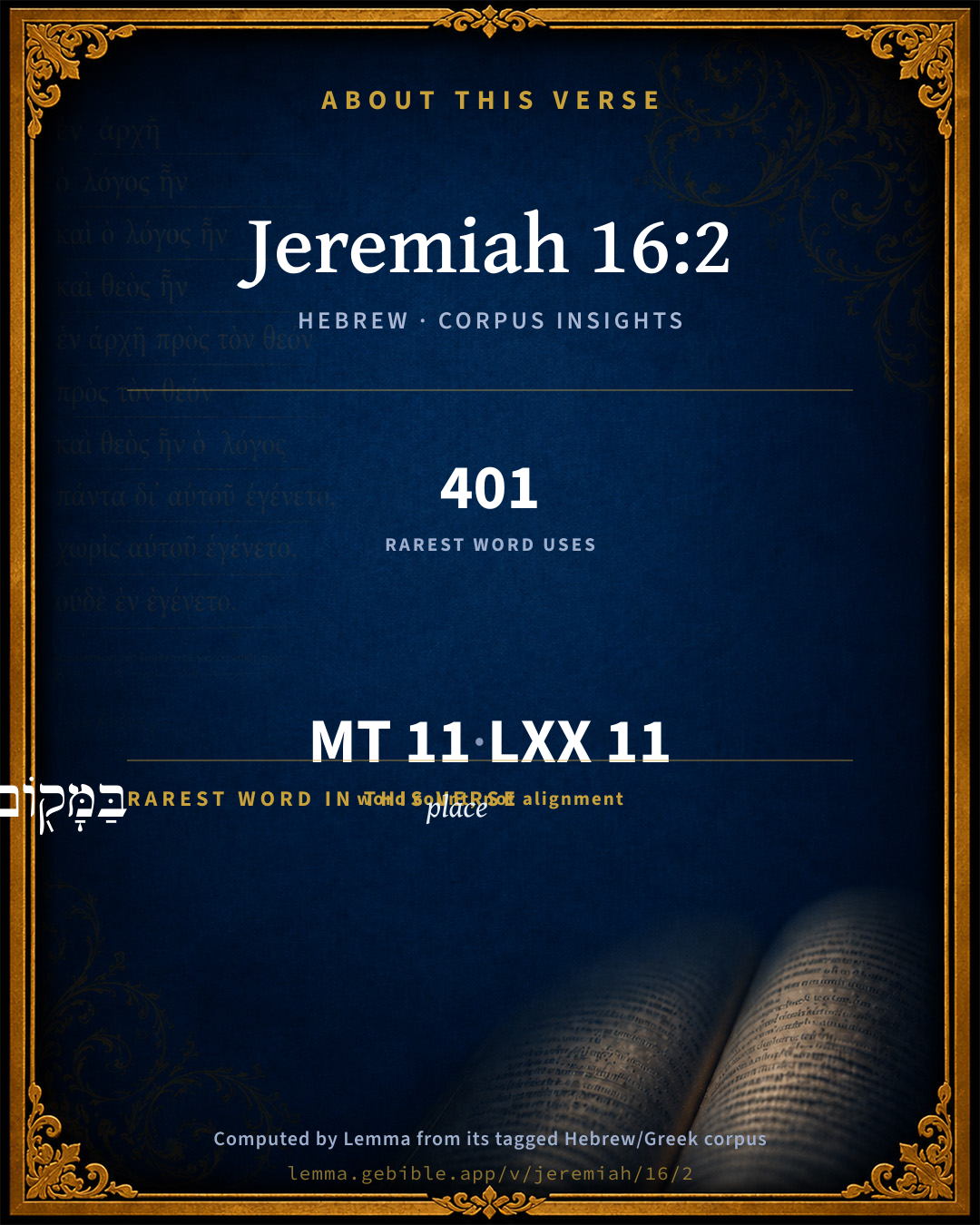
About this verse

These counts appear in no published source. They are computed here, from the morphology-tagged text and Lemma’s own curated glosses. What Lemma adds →

11
words
8
distinct lemmas
Prophets
section

Grammatical profile

  • 2 verbs
  • 4 nouns
  • 1 pronoun
  • 2 prepositions
  • 2 particles

Verb forms

  • תִקַּ֥ח Qal · Imperfect
  • יִהְי֤וּ Qal · Imperfect

Repetition

A word recurs within this verse — often emphatic in Hebrew:

Hebrew & Septuagint length

In the original languages it is 11 Hebrew tokens and 11 Greek tokens — but the two are counted differently (Hebrew bundles its prefixes and suffixes into one token; the Greek is in lemma form), so that isn’t a like-for-like length.

Cross-references

5

Topical passages linked to Jeremiah 16:2 in the Treasury of Scripture Knowledge — connected by theme and wording, ordered by reader-vote popularity; previews shown in the World English Bible.

  • Genesis 19:14 Lot went out, and spoke to his sons-in-law, who were pledged to marry his daughters, and said, "Get up! Get out of this place, for Yahweh will destroy the city." But he seemed to his sons-in-law to be joking.
  • Luke 21:23 Woe to those who are pregnant and to those who nurse infants in those days! For there will be great distress in the land, and wrath to this people.
  • Luke 23:29 For behold, the days are coming in which they will say, 'Blessed are the barren, the wombs that never bore, and the breasts that never nursed.'
  • 1 Corinthians 7:26–27 I think that it is good therefore, because of the distress that is on us, that it is good for a man to be as he is.
  • Matthew 24:19 But woe to those who are with child and to nursing mothers in those days!

Cross-references courtesy of OpenBible.info (CC BY 4.0).

Hebrew and Greek witnesses Masoretic Hebrew ↔ Greek Septuagint

The same verse in the two great witnesses to the Old Testament, shown verse-for-verse.

These are two independent witnesses, not word-aligned to each other, and the Septuagint is shown in lemma (dictionary) form.

Hebrew Jeremiah 16:2 Masoretic · Westminster Leningrad Codex

לֹֽא תִקַּ֥ח לְךָ֖ אִשָּׁ֑ה וְלֹֽא יִהְי֤וּ לְךָ֙ בָּנִ֣ים וּבָנ֔וֹת בַּמָּק֖וֹם הַזֶּֽה

You shall not take a wife, neither shall you have sons or daughters, in this place.

World English Bible · Public Domain

Greek LXX Structure differs

In the Septuagint, Jeremiah is about an eighth shorter than the Hebrew and arranges its material differently — the Oracles Against the Nations (Hebrew chapters 46–51) appear in the middle of the Greek book, after 25:13. Because the chapter and verse boundaries do not line up, a verse-for-verse comparison with the Hebrew is not shown.

A verse-for-verse comparison isn’t shown here because the chapters and verses don’t line up. Switch to the LXX edition with the MT / LXX toggle above to read the Greek directly.

Hebrew: Westminster Leningrad Codex (CC BY 4.0). Greek: Septuagint (public domain); English from a public-domain English Septuagint. How the Septuagint differs from the Hebrew →

Targum (Aramaic paraphrase)

1

The Targum is the ancient Jewish Aramaic paraphrase of the Hebrew Scriptures — an interpretive translation, not the Hebrew text itself. Onkelos (literal) and Pseudo-Jonathan (expansive) render the Torah, and Jonathan the Prophets. Coverage is partial: where no permissively-licensed English translation exists for a verse, only the Aramaic is shown. This is verse-level text, not a word-by-word alignment to the Hebrew.

  1. Targum Jonathan Prophets (Joshua–Malachi)
    לָא תִסַב לָךְ אִתְּתָא וְלָא יְהוֹן לָךְ בְּנִין וּבְנָן בְּאַתְרָא הָדֵין:

    (no public-domain English translation for this verse)

    Targum Jonathan — Aramaic: “Mikraot Gedolot” (public domain). English: “Sefaria Community Translation” (CC0 1.0 (public-domain dedication)); “London "Chaldee Paraphrase," 1871” (public domain). Text via Sefaria.

Commentary

Notes on Jeremiah 16:2 from classic Christian and Jewish commentators (each source and its license shown beneath its notes). The classic Christian expositions comment on the surrounding passage and are grouped to its opening verse, so a note may address several verses; the Jewish commentaries on the Tanakh (Rashi and others) are per-verse, so they appear only where the commentator wrote on this verse.

Lemma curates 59 commentaries, every one of them public domain or Creative Commons licensed, each selected and text-cleaned for this edition rather than reprinted as found. About our sources →

Trapp's Complete Commentary

John Trapp

Jer 16:2 Thou shalt not take thee a wife, neither shalt thou have sons or daughters in this place.

Ver. 2. Thou shalt not take thee a wife, &c.] It is very likely that this befell the prophet in a vision. Or, if otherwise, it was but for a sign, and in regard of the great calamity impendent, that he is here forbidden marriage, otherwise lawful enough, and in some cases necessary. The contrary doctrine (such as was that of the Tatian heretics and Popish canonists) is a doctrine of devils. {1Ti 4:1}

John Trapp, A Commentary or Exposition upon All the Books of the Old and New Testament (1647–1656) — public domain. Text from a community e-Sword module.

Geneva Bible (1599)

Geneva Bible translators

Meaning, that the affliction should be so horrible in Jerusalem, that wife and children should but increase his sorrow.

Geneva Bible (1599) marginal notes — public domain. Text via Bolls.life.

Adam Clarke's Commentary

Verse 2. Those shalt not take thee a wife] As it would be very inconvenient to have a family when the threatened desolations should come on the place. The reason is given in the following verses.

Adam Clarke's Commentary on the Bible (1810–1826) — public domain. Text from a community e-Sword/MySword module.

John Calvin's Commentaries

This is a new discourse, which yet is not unlike many others, except in this particular, that the Prophet was not to marry a wife nor beget children in the land But as to the general subject, he repeats now what he had often said before and confirmed in many places. But the prohibition to marry was full of meaning; it was to shew that the people were wholly given up to destruction. The law of man’s creation, we know, was this,

“Increase and multiply.” (Genesis 1:22; Genesis 8:17; Genesis 9:1, 7)

As then mankind are perpetuated by marriage, here on the contrary God shews that that land was unworthy of this common and even general blessing enjoyed by the whole race of man. It is the same as if he had said, “They indeed as yet live, but a quick destruction awaits them, for I will deprive them of the universal favor which I have hitherto shewed to all mankind.”

Marriage is the preservation of the human race: Take not to thee a wife and beget no children We hence see that in the person of Jeremiah God intended to shew the Jews that they deserved to be exterminated from the earth. This is the import of this prophecy.

It may however be asked, whether the Prophet was unmarried? But this has nothing to do with the subject, for he received this command in a vision; and though he might not have been unmarried, he might still have proclaimed this prophecy, that God had forbidden him to marry and to beget children. At the same time, I think it were probable that the Prophet. was not married, for as he walked naked, and as he carried on his neck a yoke, so also his celibacy might have been intended to be, as it were, a living representation, in order to produce an effect on the Jews. But, as I have already said, we need not contend about this matter. Every one then is at liberty to judge as he pleases, only I suggest what I deem most probable.

John Calvin's Commentaries (1540-1563) — public domain. Text from the Calvin Translation Society English edition (1840s-50s) via the Christian Classics Ethereal Library (ccel.org). Calvin's coverage is partial (roughly two-thirds of the Bible); uncommented books and verses are honest gaps, never fabricated. The 19th-century editor's footnotes and remarks are omitted so the notes are faithfully Calvin's own voice.

Ellicott's Commentary for English Readers

(2) Thou shalt not take thee a wife . . .—The words came to an Israelite and to a priest with a force which we can hardly understand. With them marriage, and the hopes which it involved, was not only a happiness but a duty, and to be cut off from it was to renounce both, because the evil that was coming on the nation was such as to turn both into a curse. We may compare cur Lord’s words in Mat_24:19 and those spoken to the daughters of Jerusalem (Luk_23:29), and what, in part at least, entered into St. Paul’s motives for a like abstinence on account of “the present distress” (1Co_7:26).

A Bible Commentary for English Readers, edited by Charles John Ellicott (1878–1897) — public domain. Text from a community e-Sword module.

The Cambridge Bible for Schools and Colleges

gen. ed. J. J. S. Perowne

2. Thou shall not take thee a wife] Marriage was a state of life in special favour with the Jews. By his act of self-denial therefore Jeremiah was to shew his full submission to the will of God, while it would at the same time be a forcible mode of conveying the message of coming woes which he was charged to deliver to the people.

The Cambridge Bible for Schools and Colleges (gen. ed. J. J. S. Perowne; Cambridge University Press, 1878–1918) — public domain. Text from a community e-Sword module.

John Gill's Exposition

For thus saith the Lord concerning the sons and concerning the daughters that are born in this place,..... This is a reason given why the prophet should not have, and why he should not be desirous to have, sons and daughters in such a place and country, devoted to destruction:

and concerning their mothers that bare them, and concerning their fathers that begat them in this land: the land of Judea; which shows what is meant by the place before mentioned; both the one and the other, parents and children, should die there; this is what was determined by the Lord concerning them; and therefore it could not be a desirable thing for a man to have wife and children, whom he must part with in such an uncomfortable manner, as is after described; and to show the certainty of which the prophet is forbid to do as above.

John Gill's Exposition of the Whole Bible (1746–1763) — public domain (CC PDM 1.0). Text via the HelloAO Bible API.

Albert Barnes' Notes on the Bible

As marriage was obligatory upon the Jews, the prohibition of it to Jeremiah was a sign that the impending calamity was so great as to override all ordinary duties. Jeremiah was unmarried, but the force of the sign lay in its being an exception to the ordinary practice of the prophets.

In this place - The whole of Judaea.

Albert Barnes' Notes on the Bible (1834–1885) — public domain. Text from a community e-Sword/MySword module.

Haydock's Catholic Bible Commentary

Place. It was going to be destroyed, and the cares of a family might interrupt the prophet. The Fathers believe that Jeremias never married, (see St. Jerome in chap. xxii. Isidor.) which was then a rare example. (Calmet) --- He always lived a single life, and not only in time of tribulation. (St. Jerome, contra Jov. 1.) (Worthington) --- The Church enforces this law of God for her sacred ministers, in subdeacons and the higher orders. St. Paul shews the propriety of such a regulation, (1 Corinthians vii.) which innovators deem unnatural and tyrannical. How then could God enforce it once? With his grace we may observe celibacy like Jeremias. (Haydock)

George Leo Haydock (1774–1849), Haydock's Catholic Family Bible and Commentary, 1859 edition — public domain. Excludes Psalms (Douay-Rheims chapter numbering differs from Protestant) and Deuterocanonical books (Catholic canon only).

Matthew Poole's English Annotations

It is uncertain whether what we have in this chapter be a new revelation, or a continuance of his former prophecy. God commandeth the prophet in it under certain types to foretell their utter ruin and destruction. First he commandeth him to marry no wife, nor have sons or daughters. He expoundeth this command Jer 16:3,4.

Matthew Poole's English Annotations on the Holy Bible (1683–1685) — public domain. Text from a community e-Sword/MySword module.

Whedon's Commentary on the Bible

Daniel D. Whedon

2. Not take thee a wife — Marriage was in the general obligatory, and this prohibition was clearly exceptional. So far, then, from favouring clerical celibacy the bearing of the passage is distinctly against it. With this prohibition should be compared 1Co_7:26, and Eze_24:15-27. This command is enforced by the universal catastrophe which was before the people.

Daniel D. Whedon (gen. ed.), Commentary on the Old and New Testaments (1874–1909) — public domain. Text from a community e-Sword module.

The Pulpit Commentary

Thou shalt not take thee a wife. So St. Paul, "I think therefore that this is good by reason of the present distress, namely, that it is good for a man to be as he is; (1Co_7:26, Revised Version) and Hosea has already drawn an awful picture of "Ephraim bringing forth his children to the murderer". (Hos_9:9) In ordinary times it was a kind of unwritten law among the Israelites to marry and beget children. Most of the prophets (e.g. Isaiah) appear to have been married. In this place; i.e. in the land of Judah. A Jeremianic phrase. (comp. Jer_7:3)

Ver. 2. "Forbidding to marry.

I CELIBACY IS NOT A SCRIPTURAL VIRTUE. Marriage is a Divine institution. It is natural, and God is the Author of nature; it is recognized and regulated by inspired teaching and blessed by Christ; it is a means of human welfare.

II CELIBACY MAY BE WISELY OBSERVED IN CIRCUMSTANCES OF PECULIAR TROUBLE. Such were the circumstances of Judah in the clays of Jeremiah; such, in the opinion of St. Paul, were the circumstances of his own time. (1Co_7:26) Those were not times for wedding festivities; the married would be encumbered and hindered from doing their best for the public weal, and children born then would be born only to a heritage of misery. Similar circumstances may recur.

III CELIBACY MAY BE WISELY OBSERVED BY MEN WHO ARE CONTEMPLATING TASKS OF PECULIAR LONELINESS DANGER OR DIFFICULTY. There are risks that a man may encounter for himself which he should avoid if others would be seriously involved in his fate. There is work which precludes the enjoyment of domestic life. It is not right to undertake obligations to another that cannot be fulfilled. The pioneer of dangerous travel, the John the Baptist of wilderness missions, is better unmarried.

IV CELIBACY IS A DUTY FOR ALL UNTIL THEY ARE ABLE TO PROVIDE A SUITABLE MAINTENANCE FOR A FAMILY. It is not heroic but selfish to bring a family into a life of certain hardship and misery. The principle which applied to the public circumstances of distress in Jeremiah"s age applies to the private circumstances of distress which are met with in every age.

The Pulpit Commentary (1880–1919), ed. H.D.M. Spence-Jones & Joseph S. Exell — public domain. Text from a community e-Sword module.

Lesson kit

Teaching starters — assembled from the data on this page, not authored interpretation. Every prompt links to the verse data it draws on. Edit before teaching.

Jeremiah, in the Prophets, opens this verse with 11 words (8 distinct Hebrew lemmas). Its most distinctive word is mâqôwm (“place”). A historical commentator’s framing appears above. Read the whole chapter for the surrounding context.

Discussion questions

  1. What does “place” (mâqôwm) contribute to the verse as a whole?
  2. Genesis 19:14 shares this passage’s theme. How do the two illuminate each other?
  3. “not” occurs 2× in this one verse. What is the effect of the repetition?
  4. These translations render this verse differently; the difference is in the English rendering, not the original. What questions does that raise?
  5. The verb «תִקַּ֥ח» is Qal Imperfect. How does its form color the action?
  6. Reading how Trapp's Complete Commentary and Geneva Bible (1599) read this verse, where do the two commentators agree and where do they part?

Things to notice

Reading settings

Reading text

Shown beneath each verse's original-language words.

Old Testament
Old Testament edition

Read the OT as the Masoretic Hebrew (MT) or the Greek Septuagint (LXX).

English shown for the Greek Septuagint (in the Hebrew ↔ Greek comparison).

Comparing translations? Open the Compare panel on any verse page to stack up to four side by side.