Zechariah 12:5

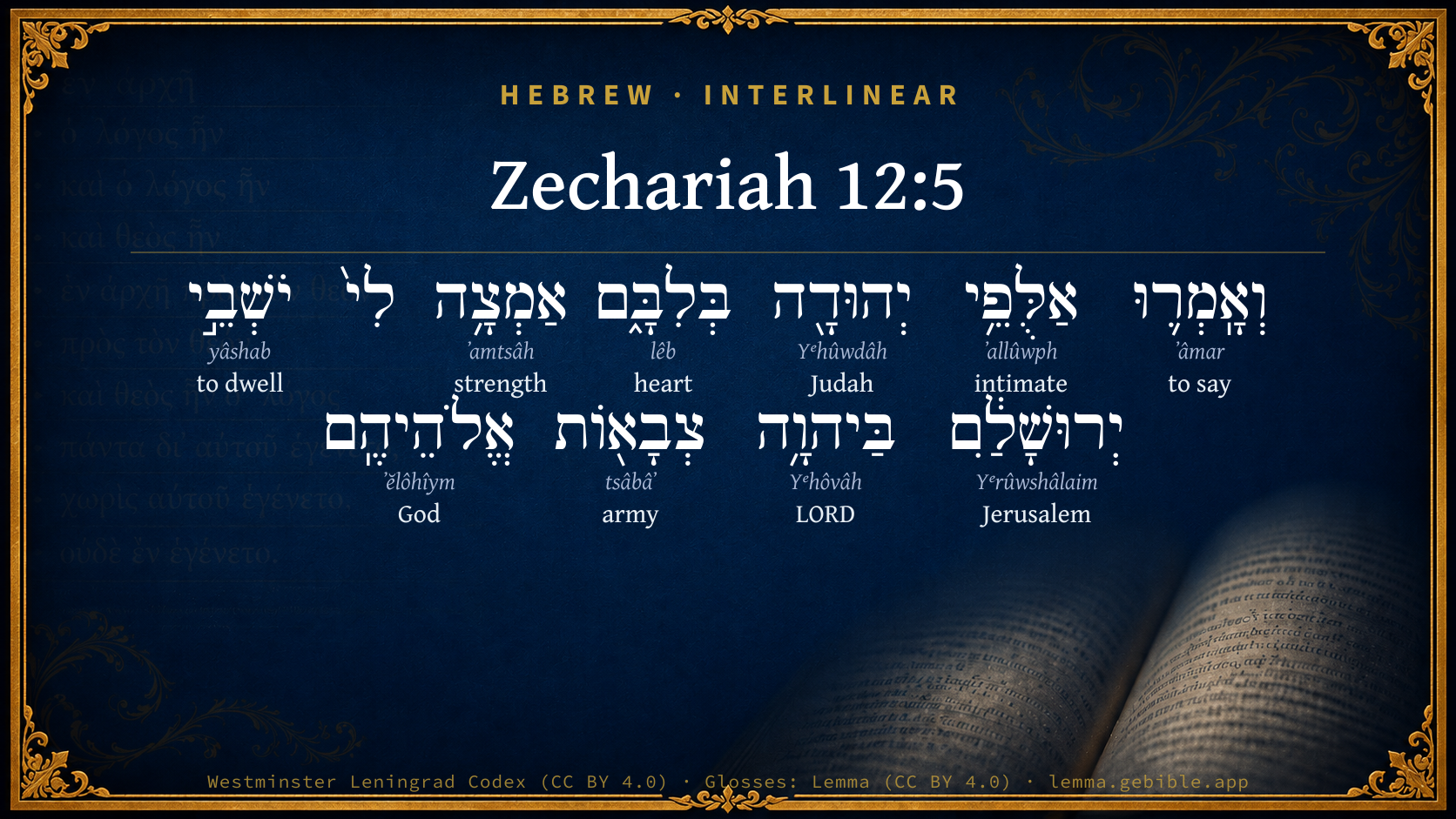
Hebrew (Westminster Leningrad Codex) Zechariah 12:5 appears in the Hebrew Old Testament. The text above is from the Westminster Leningrad Codex. Each word links to its Strong’s number, a concise gloss, and parsing drawn from the Open Scriptures Hebrew Bible morphology. Click any word for its full Brown-Driver-Briggs (BDB) entry.
Download image
Cite this verse

Zechariah 12:5 (World English Bible). Public Domain. Lemma interlinear Bible study tool, https://lemma.gebible.app/v/zechariah/12/5.

Show BibTeX & RIS
BibTeX
RIS
English Translation
The chieftains of Judah will say in their heart, 'The inhabitants of Jerusalem are my strength in Yahweh of Hosts their God.'
World English Bible · Public Domain
Highlights
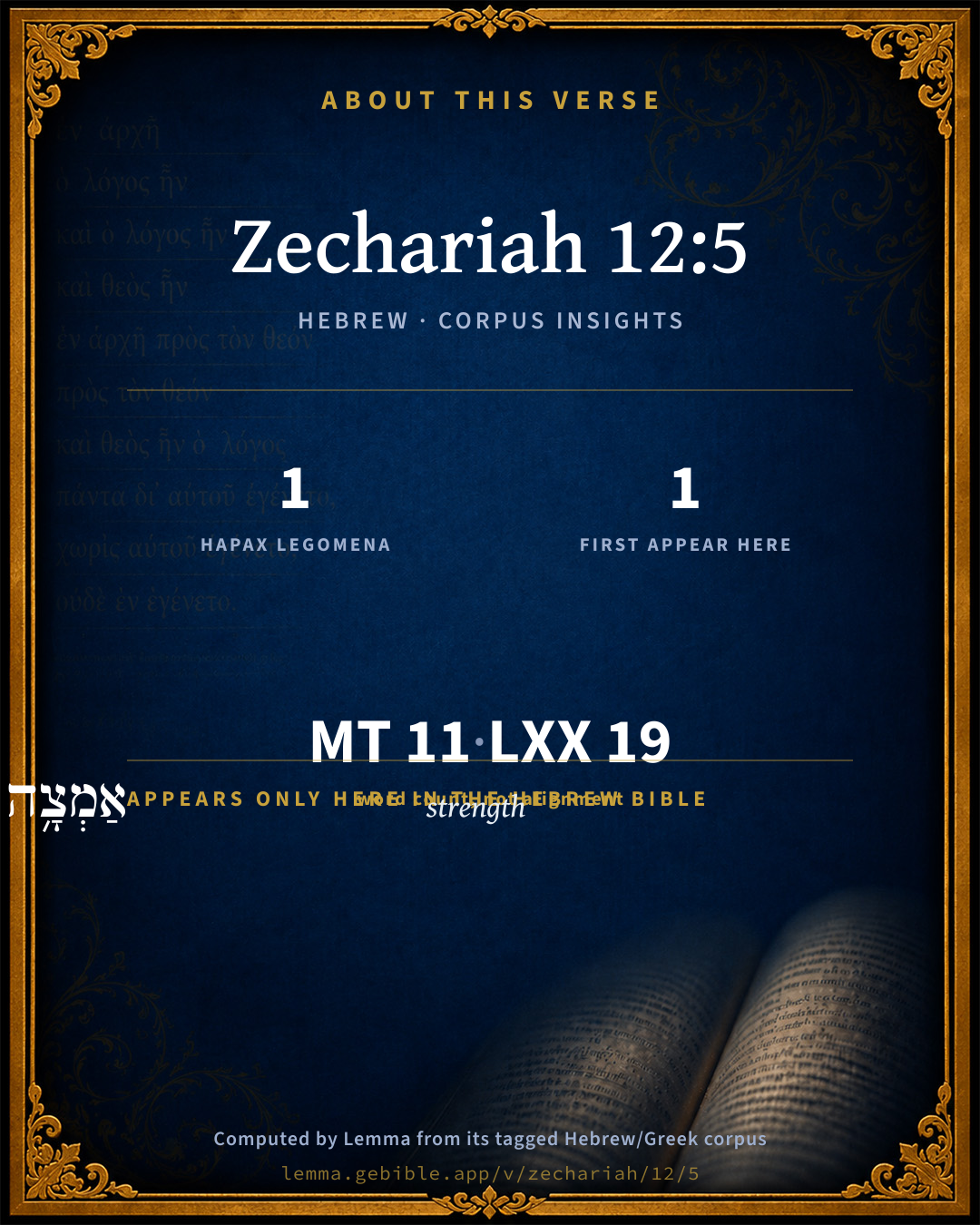
  • 1 hapax legomenon — only here in the Hebrew Bible
  • 1 first appearance in the Hebrew Bible
Full analysis ↓
Download a study sheet

One document with this verse’s original text, its word-by-word gloss line, the meaning frame, cross-references with their text, attributed commentary, and full source and license credits — printable, and it pastes into notes with its structure intact.

This verse Autodidact and up

Study sheet (.html) Plain text (.txt)

A passage Seminary Student

Up to 50 verses in one chapter. A passage sheet keeps up to 6 commentary sources and 12 cross-references per verse, in the order this page ranks them, and says so on the sheet whenever that leaves anything out. Ask for a single verse and you get the Autodidact verse sheet above.

Everything on this page stays free to read, with no account — the sheet is a download of what is already on screen, not access to it.

Want to remove ads? Support Godless Engineer
Compare translations 3

The same verse in 3 English versions, stacked beneath the original-language interlinear above. Click any original word for its lexicon entry.

Each is an independent rendering of the whole verse — the interlinear is not word-aligned to these translations.

Highlighted words mark where these versions differ — a whole-verse word diff, not a word-by-word alignment.

  • World English Bible Public Domain
    The chieftains of Judah will say in their heart, 'The inhabitants of Jerusalem are my strength in Yahweh of Hosts their God.'
  • King James Version Public Domain
    And the governors of Judah shall say in their heart, The inhabitants of Jerusalem shall be my strength in the LORD of hosts their God.
  • unfoldingWord Literal Text CC BY-SA 4.0
    Then the leaders of Judah will say in their hearts, ‘The inhabitants of Jerusalem our strength because of Yahweh of hosts, their God.’

unfoldingWord Literal Text — © unfoldingWord, licensed CC BY-SA 4.0. Word-aligned USFM3 via Door43 (git.door43.org/unfoldingWord/en_ult).

Versions to compare (up to 4)

3 of 4 selected

Show all 18 translations

Every available English version of this verse, each an independent rendering of the whole verse.

  • World English Bible Public Domain
    The chieftains of Judah will say in their heart, 'The inhabitants of Jerusalem are my strength in Yahweh of Hosts their God.'
  • Berean Standard Bible Public Domain
    Then the leaders of Judah will say in their hearts: ‘The people of Jerusalem are my strength, for the LORD of Hosts is their God.’
  • Majority Standard Bible Public Domain
    Then the leaders of Judah will say in their hearts: ‘The people of Jerusalem are my strength, for the LORD of Hosts is their God.’
  • King James Version Public Domain
    And the governors of Judah shall say in their heart, The inhabitants of Jerusalem shall be my strength in the LORD of hosts their God.
  • American Standard Version (1901) Public Domain
    And the chieftains of Judah shall say in their heart, The inhabitants of Jerusalem are my strength in Jehovah of hosts their God.
  • Revised Version (1885) Public Domain
    And the chieftains of Judah shall say in their heart, The inhabitants of Jerusalem are my strength in the LORD of hosts their God.
  • Geneva Bible (1599) Public Domain
    And the princes of Iudah shall say in their hearts, The inhabitants of Ierusalem shall be my strength in the Lord of hostes their God.
  • Douay-Rheims (1899) Public Domain
    And the governors of Juda shall say in their heart: Let the inhabitants of Jerusalem be strengthened for me in the Lord of hosts, their God.
  • Young's Literal Translation Public Domain
    And leaders of Judah have said in their heart, `Strength to me `are' the inhabitants of Jerusalem, In Jehovah of Hosts their God.'
  • Literal Standard Version CC BY-SA 4.0
    And leaders of Judah have said in their heart, || The inhabitants of Jerusalem [are] strength to me, || In YHWH of Hosts their God.
  • Unlocked Literal Bible CC BY-SA 4.0
    Then the leaders of Judah will say in their hearts, 'The inhabitants of Jerusalem are our strength because of Yahweh of hosts, their God.'
  • unfoldingWord Literal Text CC BY-SA 4.0
    Then the leaders of Judah will say in their hearts, ‘The inhabitants of Jerusalem our strength because of Yahweh of hosts, their God.’
  • Darby Bible Public Domain
    And the leaders of Judah shall say in their heart, The inhabitants of Jerusalem shall be my strength through Jehovah of hosts their God.
  • World Messianic Bible Public Domain
    The chieftains of Judah will say in their heart, ‘The inhabitants of Jerusalem are my strength in the LORD of Hosts their God.’
  • Webster's Bible Public Domain
    And the governors of Judah shall say in their heart, The inhabitants of Jerusalem shall be my strength in the LORD of hosts their God.
  • Free Bible Version CC BY-SA 4.0
    Then the families of Judah will say to themselves, the people of Jerusalem are strong in their God, the Lord Almighty.
  • Bible in Basic English Public Domain
    And the families of Judah will say in their hearts, The people of Jerusalem have their strength in the Lord of armies, their God.
  • JPS Tanakh (1917) Public Domain
    And the chiefs of Judah shall say in their heart: 'The inhabitants of Jerusalem are my strength through the LORD of hosts their God.'

Literal Standard Version (2020), Covenant Press — licensed CC BY-SA 4.0. Text via the HelloAO Bible API (eBible.org). Unlocked Literal Bible (unfoldingWord) — licensed CC BY-SA 4.0. Text via the HelloAO Bible API (eBible.org). unfoldingWord Literal Text — © unfoldingWord, licensed CC BY-SA 4.0. Word-aligned USFM3 via Door43 (git.door43.org/unfoldingWord/en_ult). Free Bible Version, Dr. Jonathan Gallagher — licensed CC BY-SA 4.0. Text via the HelloAO Bible API (eBible.org).

Word by word

More ways to search: Search by grammar → Find every occurrence → Compare this word →

Practice this passage: Drill this verse → Learn its vocabulary →

אַמְצָ֥ה
ʼamtsâh
H556
“strength”
Noun, Common, Feminine, Singular, Absolute
Part of Speech
Noun
Type
Common
Gender
Feminine
Number
Singular
State
Absolute
Full BDB Definition

Origin: from H553

TWOT: 117b

strength
  1. וְאָֽמְר֛וּ ʼâmar H559 “and · to say” Conjunction + Verb, Qal, Sequential Perfect, 3rd Person, Common, Plural
  2. אַלֻּפֵ֥י ʼallûwph H441 “intimates of” Noun, Common, Masculine, Plural, Construct
  3. יְהוּדָ֖ה Yᵉhûwdâh H3063 “Judah” Noun, Proper
  4. בְּלִבָּ֑ם lêb H3820 “in/at · heart · their” Preposition + Noun, Common, Masculine, Singular, Construct + Suffix, Personal, 3rd Person, Masculine, Plural
  5. יֹשְׁבֵ֣י yâshab H3427 “dwelling” Verb, Qal, Participle Active, Masculine, Plural, Construct
  6. יְרוּשָׁלִַ֔ם Yᵉrûwshâlaim H3389 “Jerusalem” Noun, Proper
  7. בַּיהוָ֥ה Yᵉhôvâh H3068 “in/at · LORD” Preposition + Noun, Proper
  8. צְבָא֖וֹת tsâbâʼ H6635 “armies” Noun, Common, Both, Plural, Absolute
  9. אֱלֹהֵיהֶֽם ʼĕlôhîym H430 “God(s) · their” Noun, Common, Masculine, Plural, Construct + Suffix, Personal, 3rd Person, Masculine, Plural

About this verse

These counts appear in no published source. They are computed here, from the morphology-tagged text and Lemma’s own curated glosses. What Lemma adds →

11
words
10
distinct lemmas
Prophets
section

Notable vocabulary

1 hapax legomenon — a word that appears only here in the entire Hebrew Bible:

  • אַמְצָ֥ה strength H556

First appearance in Scripture

This word makes its first canonical appearance in the Hebrew Bible here:

  • אַמְצָ֥ה strength H556

Grammatical profile

  • 2 verbs
  • 8 nouns
  • 1 preposition

Verb forms

  • וְאָֽמְר֛וּ Qal · Sequential Perfect
  • יֹשְׁבֵ֣י Qal · Participle Active

Hebrew & Septuagint length

In English translation the verse runs 22 words from the Hebrew and 27 from the Septuagint (LXX English) — closely comparable.

A rough comparison of the two English renderings, which tokenize alike — not a word-level alignment.

Word counts can differ between the Hebrew and the Greek without any difference in meaning — e.g. the Hebrew direct-object marker אֵת has no separate Greek word, and Greek often adds the article ὁ.

In the original languages it is 11 Hebrew tokens and 19 Greek tokens — but the two are counted differently (Hebrew bundles its prefixes and suffixes into one token; the Greek is in lemma form), so that isn’t a like-for-like length.

Cross-references

24

Topical passages linked to Zechariah 12:5 in the Treasury of Scripture Knowledge — connected by theme and wording, ordered by reader-vote popularity; previews shown in the World English Bible.

  • Psalms 18:32 The God who arms me with strength, and makes my way perfect?
  • Joel 3:16 Yahweh will roar from Zion, And thunder from Jerusalem; And the heavens and the earth will shake; But Yahweh will be a refuge to his people, And a stronghold to the children of Israel.
  • Zechariah 10:12 I will strengthen them in Yahweh; And they will walk up and down in his name," says Yahweh.
  • Psalms 18:39 For you have girded me with strength to the battle. You have subdued under me those who rose up against me.
  • Psalms 144:1 Blessed be Yahweh, my rock, Who teaches my hands to war, And my fingers to battle:
  • Psalms 20:6–7 Now I know that Yahweh saves his anointed. He will answer him from his holy heaven, With the saving strength of his right hand.
  • Psalms 46:1 God is our refuge and strength, A very present help in trouble.
  • Isaiah 28:6 and a spirit of justice to him who sits in judgment, and strength to those who turn back the battle at the gate.
  • Isaiah 41:10–16 Don't you be afraid, for I am with you; don't be dismayed, for I am your God; I will strengthen you; yes, I will help you; yes, I will uphold you with the right hand of my righteousness.
  • 2 Corinthians 12:9–10 He has said to me, "My grace is sufficient for you, for my power is made perfect in weakness." Most gladly therefore I will rather glory in my weaknesses, that the power of Christ may rest on me.
  • Judges 5:9 My heart is toward the governors of Israel, Who offered themselves willingly among the people: Bless you Yahweh.
  • Psalms 68:34–35 Ascribe strength to God! His excellency is over Israel, His strength is in the skies.
  • Psalms 118:10–14 All the nations surrounded me, But in the name of Yahweh, I cut them off.
  • Isaiah 1:10 Hear the word of Yahweh, you rulers of Sodom! Listen to the law of our God, you people of Gomorrah!
  • Isaiah 1:23 Your princes are rebellious, and companions of thieves. Everyone loves bribes, and follows after rewards. They don't judge the fatherless, Neither does the cause of the widow come to them.
  • Isaiah 1:26 I will restore your judges as at the first, And your counselors as at the beginning. Afterward you shall be called 'The city of righteousness, A faithful town.'
  • Isaiah 29:10 For Yahweh has poured out on you the spirit of deep sleep, and has closed your eyes, the prophets; and your heads, the seers, has he covered.
  • Isaiah 32:1 Behold, a king shall reign in righteousness, and princes shall rule in justice.
  • Isaiah 60:17 For brass I will bring gold, and for iron I will bring silver, and for wood brass, and for stones iron. I will also make your officers peace, and righteousness your ruler.
  • Jeremiah 30:21 Their prince shall be of themselves, and their ruler shall proceed from the midst of them; and I will cause him to draw near, and he shall approach to me: for who is he who has had boldness to approach to me? says Yahweh.
  • Jeremiah 33:26 then will I also cast away the seed of Jacob, and of David my servant, so that I will not take of his seed to be rulers over the seed of Abraham, Isaac, and Jacob: for I will cause their captivity to return, and will have mercy on them.
  • Ezekiel 45:8–9 In the land it shall be to him for a possession in Israel: and my princes shall no more oppress my people; but they shall give the land to the house of Israel according to their tribes.
  • Zechariah 10:6 "I will strengthen the house of Judah, And I will save the house of Joseph, And I will bring them back; For I have mercy on them; And they will be as though I had not cast them off: For I am Yahweh their God, and I will hear them.
  • Zechariah 12:6 In that day I will make the chieftains of Judah like a pan of fire among wood, and like a flaming torch among sheaves; and they will devour all the surrounding peoples, on the right hand and on the left; and Jerusalem will yet again dwell in their own place, even in Jerusalem.

Cross-references courtesy of OpenBible.info (CC BY 4.0).

Hebrew and Greek witnesses Masoretic Hebrew ↔ Greek Septuagint

The same verse in the two great witnesses to the Old Testament, shown verse-for-verse.

These are two independent witnesses, not word-aligned to each other, and the Septuagint is shown in lemma (dictionary) form.

Hebrew Zechariah 12:5 Masoretic · Westminster Leningrad Codex

וְאָֽמְר֛וּ אַלֻּפֵ֥י יְהוּדָ֖ה בְּלִבָּ֑ם אַמְצָ֥ה לִי֙ יֹשְׁבֵ֣י יְרוּשָׁלִַ֔ם בַּיהוָ֥ה צְבָא֖וֹת אֱלֹהֵיהֶֽם

The chieftains of Judah will say in their heart, 'The inhabitants of Jerusalem are my strength in Yahweh of Hosts their God.'

World English Bible · Public Domain

Greek LXX Zechariah 12:5 Septuagint · lemma form

καί εἶπον ὁ χιλίαρχος ιουδα ἐν ὁ καρδία αὐτός εὑρίσκω ἑαυτοῦ ὁ καταοἰκέω ἰερουσαλήμ ἐν κύριος παντοκράτωρ θεός αὐτός

And the captains of thousands of Juda shall say in their hearts, We shall find for ourselves the inhabitants of Jerusalem in the Lord Almighty their God.

LXX2012 (modern English Septuagint) · Public Domain

On this verse, Haydock's Catholic Bible Commentary discusses the Septuagint’s reading. Read the note in Commentary ↓

Hebrew: Westminster Leningrad Codex (CC BY 4.0). Greek: Septuagint (public domain); English from LXX2012 (modern English Septuagint) (Public Domain). How the Septuagint differs from the Hebrew →

Targum (Aramaic paraphrase)

1

The Targum is the ancient Jewish Aramaic paraphrase of the Hebrew Scriptures — an interpretive translation, not the Hebrew text itself. Onkelos (literal) and Pseudo-Jonathan (expansive) render the Torah, and Jonathan the Prophets. Coverage is partial: where no permissively-licensed English translation exists for a verse, only the Aramaic is shown. This is verse-level text, not a word-by-word alignment to the Hebrew.

  1. Targum Jonathan Prophets (Joshua–Malachi)
    וְיֵימְרוּן רַבְרְבֵי יְהוּדָה בְּלִבְּהוֹן אִשְׁתְּכַח פוּרְקַן לְיַתְבֵי יְרוּשְׁלֵם בְּמֵימְרָא דַייָ צְבָאוֹת אֱלָהָהוֹן:

    (no public-domain English translation for this verse)

    Targum Jonathan — Aramaic: “Mikraot Gedolot” (public domain). English: “Sefaria Community Translation” (CC0 1.0 (public-domain dedication)); “London "Chaldee Paraphrase," 1871” (public domain). Text via Sefaria.

Commentary

Notes on Zechariah 12:5 from classic Christian and Jewish commentators (each source and its license shown beneath its notes). The classic Christian expositions comment on the surrounding passage and are grouped to its opening verse, so a note may address several verses; the Jewish commentaries on the Tanakh (Rashi and others) are per-verse, so they appear only where the commentator wrote on this verse.

Lemma curates 59 commentaries, every one of them public domain or Creative Commons licensed, each selected and text-cleaned for this edition rather than reprinted as found. About our sources →

Trapp's Complete Commentary

John Trapp

Zec 12:5 And the governors of Judah shall say in their heart, The inhabitants of Jerusalem [shall be] my strength in the LORD of hosts their God.

Ver. 5. And the governors of Judah] The dukes or chieftains ( אלפי); meaning the Maccabees, who wear not any kingly crown, but were only governors, rulers, commanders-in-chief, such as went before others; like as in the alphabet Aleph is the first letter; so,

“ Omega nostrorum Mors est, Mars Alpha malorum, ”

saith the poet wittily.

Shall say in their hearts] i.e. Shall say heartily, from the root of the heart, and not from the roof of the mouth only. Profession of the truth and prayer (for so some make this verse to be) are not a labour of the lips, but a travail of the heart. The voice which is made in the mouth is nothing so sweet as that which comes from the depth of the breast. As in instrument music, the deeper and hollower the belly of the lute or viol, the pleasanter is the sound; the fleeter, the more grating and harsh in our ears.

The inhabitants of Jerusalem shall be my strength] Though now there be few found in it; yet it shall be much repeopled and fortified; so that, under God, it shall be a fortress to the whole country; and the governors shall so take it to be: or thus,

There is strength to me and to the inhabitants of Jerusalem in the Lord of hosts their God] Every governor shall say so for his own particular (and this seems to me to be the better reading). The Maccabees did so, as appeared by their posy (whereof before), their prayers, and their singular success, as appears by their history and by Josephus. Deo confisi, nunquam confusi, They that trust in God shall never be confounded. "Our fathers trusted in thee, and they were delivered. O trust ye in the Lord for ever; for in the Lord Jehovah is everlasting strength." Look not down on the rushing and roaring streams, lest ye grow giddy; but look up to the heavens from whence comes your help, and fasten by faith on God’s power and promises. Faith unfeigned breeds hope unfailable, such as never miscarrieth. "O trust in him at all times, ye people," Psa 62:8, for with God is wisdom and strength, Job 12:13. Plutarch saith of the Scythians that they have neither wine nor music; but they have gods. Say that the saints have neither power nor policy as their enemies, yet they have all in God, who is more than all.

John Trapp, A Commentary or Exposition upon All the Books of the Old and New Testament (1647–1656) — public domain. Text from a community e-Sword module.

Whedon's Commentary on the Bible

Daniel D. Whedon

As Zec_12:5 stands now it seems to describe the effect produced upon the inhabitants of Judah by the divine manifestation against the enemies. They will be inspired with new hope and courage.

Governors — R.V., “chieftains.” See on Zec_9:7. Here as there it seems to denote the divisions rather than the leaders.

The inhabitants of Jerusalem shall be my strength in Jehovah of hosts their God — Jehovah has chosen Jerusalem as his dwelling place, hence he cannot permit the hostile nations to occupy it; to prevent its capture he strengthens the inhabitants so that they may drive off the enemy. The inhabitants of the country regions know that Jerusalem is closely united with the rest of Judah, therefore any assistance given to Jerusalem is assistance given to all Judah. In these thoughts the divisions of Judah find their strength and inspiration. The Hebrew is peculiar. A very slight change would give, “Strength is to the inhabitants of Jerusalem in Jehovah of hosts, their God”; and this is preferable.

Daniel D. Whedon (gen. ed.), Commentary on the Old and New Testaments (1874–1909) — public domain. Text from a community e-Sword module.

The Preacher's Complete Homiletical Commentary

Joseph S. Exell (gen. ed.)

CRITICAL NOTES.]

Zec_12:5. Judah] Chiefs of Judah will see the foe smitten with madness, and recognize in the repulse of the enemy by the metropolis Divine security for the country.

Zec_12:6. Sheaf] In consequence of this trust in God the leaders consume their foes on every hand, as a basin of fire devours faggots, or a torch consumes sheaves. Jerusalem] i.e. the inhabitants. Again] After complete rout of the enemy shall dwell in (Jerusalem) peace.

Zec_12:7. Tents], shifting and insecure, and spread over the country, first saved; to prevent pride and self-exaltation in the inhabitants of the fortified and well-defended metropolis.

Zec_12:8. Defend] God’s people will be exalted to a degree of strength and glory surpassing anything in their experience. Even the stumbler, one who can scarce hold himself up, much less attack a foe, the feeble, shall be heroes like David; David’s house shall exceed its ancient fame, become like God; yea, like the angel] that guarded Israel in the wilderness; the highest type of glory and strength (Exo_23:20; Exo_32:34). This climax proves the beautiful style of the prophet, and contains stimulating consolation as a promise.

Zec_12:9. Seek] expresses the energetic purpose of the speaker, more humano [cf. Lange].

HOMILETICS

THE ENERGY OF ZION’S LEADERS.—Zec_12:5-7

God will not only preserve Israel, but raise up and qualify rulers to manage their affairs—holy men, putting confidence in the people, and rejoicing in the welfare of the country. Notice the energy of spiritual leaders.

I. Its elements are the unity and affection of the people. “The princes of Judah shall say in their heart, (lit.) ‘The inhabitants of Jerusalem strength to me.’ The princes recognize in the unity and love to God found in the people their strength to endure and defend. The poor and weak are held in highest estimation, and confessed to be the hope of the nation, not as a matter of expediency nor policy, but from deep conviction.” In their heart the rulers confess this. God’s people may be ignored by worldly rulers, but they are the defence and glory of an empire.

II. Its origin is found in Divine grace. “In the Lord of Hosts, their God.” Few or many, holy or unholy people have no inherent worth. Rulers have no energy without God. Jehovah makes Jerusalem “a cup and a stone.” “On human principles, or according to the ordinary operation of cause and effect, the world would prevail. Often every advantage is on its side—arms, wealth, influence, state-craft, learning, prestige, and numbers. Yet the few, the weak, the unlettered, the lowly, the things that are not, brought to nought the things that are. The excellency of the power is not in man, but of God. The Lord will not give his glory to another. ‘Were not the Ethiopians and the Lubians a huge host, with very many chariots and horsemen? yet because thou didst rely upon the Lord, He delivered thee’ ” [Lange]. This should—

1. Aid the weak. “The Lord shall save the tents of Judah first.”

2. Humble the strong. That “the glory of the inhabitants do not magnify themselves against Judah.”

THE DANGER AND THE DEFENCE OF ZION.—Zec_12:6-7

The Church is looked upon by many as troublesome. They have spared no effort to destroy it. God has defended Zion, the city of our solemnities.

I. The danger of Zion. A mighty confederacy is formed against it. “All the people of the earth” (Zec_12:3) gathered to besiege Zion. “They shall be in the siege” (Zec_12:2). “To cut off the name of Israel, that it should be no more in remembrance.” Gathered against a defenceless people. In Zec_9:13 we have the bow, the sword, and the valour of the Maccabees under the direction of God; but here we have tents shifting and insecure.

II. The defence of Zion. The people and the princes make common cause, become one-minded, and each exalt the strength which the other was to him in Jehovah.

1. God helps them to defend themselves. Self-help first, and then help from others. “For they can conquer who believe they can,” says Virgil. “Our remedies oft in ourselves do lie which we ascribe to heaven” [Shakspeare].

2. God helps them by his own power. “The Lord shall save.” The defenceless first. The country people were more exposed, and needed greater protection. They might be forgotten or despised by the citizens of Jerusalem; but God specially protected them. This was to teach the great men—men of influence and position—“not to magnify themselves against Judah.” None must assume anything to himself. All, the meanest and mightiest are equal in the sight of God, and saved by grace Divine. Hence in every civil and religious community there should be no ill-feeling in the low towards the high, and no disrespect in the rich towards the poor. “He that glorieth, let him glory in the Lord.”

“Praise is only praise when well addressed” [Gay].

SPIRITUAL HEROISM.—Zec_12:8-9

As a consequence of Divine protection, the weak would be strengthened, the mighty endowed with supernatural vigour, and all their enemies would be scattered.

I. Spiritual heroism is Divine in its source. The strength is “as the Angel of the Lord before them.” “The Angel of Jehovah,” known as the manifestation of Deity in their history. The might of God in Christ Jesus. “I can do all things through Christ, who strengtheneth me.”

II. Spiritual heroism is different in its degrees. We have two classes mentioned—

1. The feeble become powerful. “He that is feeble among them at that day shall be as David.” He that stumbles and is ready to fall shall become a hero, a mighty man of valour. His feebleness and unskilfulness shall merge into strength, and God shall teach his hands to war and his fingers to fight. “Let the weak say, I am strong.”

2. The strong shall be more powerful. David’s house shall eclipse its former splendour, and be “as God.” He shall possess a superhuman courage and decision, perform exploits, and resemble God, seen marching in the front of his conquering hosts.

III. Spiritual heroism is gradual in its growth. “From strength to strength,” by strenuous effort and perseverance. Faith is gained by experience, and courage strengthened by trial. “Tried grace is growing grace.” The sapling once bending before the blast has become the sturdy oak by the tossing storm No degree of strength is impossible, but the steps to attain it are gradual. “The righteous also shall hold (take firm hold) on his way, and he that hath clean hands be stronger and stronger (add strength)” (Job_17:9).

HOMILETIC HINTS AND SUGGESTIONS

Zec_12:5. Strength to me.

1. The piety and unity of a people the strength of the leaders.

2. The confidence of the leaders in the people a necessity to success. Without concurrent aid, skill and valour of little avail. In times of danger there should be full co-operation, reliance one upon another, and hope in God. “This union and valour would be the ‘strength’ of their leaders; without which they must find themselves utterly powerless. A divided, dispirited, heartless, dastardly soldiery or populace is weakness, disappointment, and discomfiture to the best-conceived plans of the most bold, prudent, and experienced leaders” [Wardlaw].

Zec_12:6. The pot of fire. The governors of a united and brave people, when trusting to God, are—

1. Destructive. “Like a hearth of fire (a fire-pot) among wood, or like a torch of fire in a sheaf.”

2. Very destructive. “They shall devour all the people round about, on the right hand and on the left.” The idea conveyed is destruction most terrible and complete—most easily and most certainly accomplished.

3. Very destructive only through God. “I will make,” &c. Jehovah speaks, infatuates and exposes the enemy, and makes the chiefs of Judah a consuming fire. “The fire could not kindle the wood or the sheaf of itself, unless applied to it. All is of the agency of God: I will make” [Pusey].

Notice—First, the destruction of the enemy; second, the restoration of the city. “Jerusalem shall be inhabited again.” The people shall yet dwell in their own city. “It shall not be a new city in some new territory; but Jerusalem, the city of their fathers, the city of their God; On the same spot, hallowed by all the ancient associations of their history and religion. The language pointedly and strongly expresses reoccupancy and permanent possession” [Wardlaw]. Literally, Jerusalem shall dwell still under herself, i.e. the Church will not rely on earthly powers, which will be opposed to her, but she will dwell in continual stability, dependent upon herself (cf. Zec_6:12, out of his place; lit. from under himself), and on her own spiritual strength, derived from her Divine Head, Christ [Wordsw.].

Zec_12:7.

1. The certainty of salvation. “The Lord also shall save.”

2. The method of salvation. “Judah first.”

3. The design in the salvation “That the glory of the house of David … do not magnify themselves.” No local or personal supremacy then. In the Christian Church all are equal; nothing is due to learning, wealth, or merit, and none should domineer over the rest.

Zec_12:8-9. Zion’s conquest over her enemies—all of God, yet achieved through human agency.

1. By defending the helpless;

2. Aiding the stumbler; and

3. Elevating the mighty. The strongest have need of more strength, and this strength is only found in Jehovah. Hence the promise of defence added to that of strength.

Zec_12:9.

1. God’s people have many enemies. “All the nations that come against Jerusalem.”

2. These enemies will be discovered. “I will seek.” Secret plotters and open enemies will be found, however distant their dwelling or daring their enterprise.

3. These enemies will be destroyed. “I will seek to destroy.” This the end of all persecutors, the issue of all opposition to God. “God will seek to destroy them, not as if at a loss for ways and means (infinite wisdom was never nonplussed), but his seeking intimates earnestness and intent upon it, and that he overrules means and instruments, all motions and second causes, to accomplish it.”

ILLUSTRATIONS TO CHAPTER 12

Zec_12:5. My strength. The multitude which does not reduce itself to unity is confusion; the unity which does not depend upon the multitude is tyranny [Pascal].

Zec_12:6-7. Fire came down from heaven, therefore restlessly works itself through all combustibles till it returns thither again [W. Seker]. The wrath of man is the rage of man, but the wrath of God is the reason of God [Bishop Reynolds].

Zec_12:8-9. Heroism, the Divine relation which in all times unites a great man to other men [Carlyle].

Feeble.

“Tis not enough to help the feeble up,

But to support him after” [Shakespeare].

The Preacher's Complete Homiletical Commentary (gen. ed. Joseph S. Exell; Funk & Wagnalls, c. 1892) — public domain (pre-1929). A full-Bible homiletical/sermon-outline anthology covering 65 of 66 books (2 John is absent from the source module). Text from a community e-Sword module.

Keil & Delitzsch

C. F. Keil & F. Delitzsch

Zac 12:5. "And the princes of Judah will say in their hearts, The inhabitants of Jerusalem are strength to me, in Jehovah of hosts their God. Zac 12:6. On that day will I make the princes of Judah as a basin of fire under logs of wood, and like a torch of fire under sheaves; and they will devour all nations round about, on the right and on the left; and Jerusalem will dwell still further in its place, at Jerusalem. Zac 12:7. And Jehovah will save the tents of Judah first, that the splendour of the house of David and the splendour of the inhabitants of Jerusalem may not lift itself up over Judah." The princes of Judah are mentioned as the leaders of the people in war. What they say is the conviction of the whole nation ('allūph, as in Zac 9:7). אמצה (in this form ἁπ. λεγ.) is a substantive = אמץ, strength (Job 17:9). The singular lı̄ (to me) expresses the fact that every individual says or thinks this, as with the expression "should I weep" in Zac 7:3. The princes of Judah recognise in the inhabitants of Jerusalem their strength or might, not in this sense, that Judah, being crowded together before Jerusalem, expects help against the foe from the strength of the city and the assistance of its inhabitants, as Hofmann and Koehler maintain, for "their whole account of the inhabitants of the land being shut up in the city (or crowded together before the walls of Jerusalem, and covered by them) is a pure invention" (Koehler), and has no foundation in the text; but in this sense, that the inhabitants of Jerusalem are strong through Jehovah their God, i.e., through the fact that Jehovah has chosen Jerusalem, and by virtue of this election will save the city of His sanctuary (compare Zac 10:12 with Zac 3:2; Zac 1:17; Zac 2:12). Because the princes of Judah put their trust in the divine election of Jerusalem, the Lord makes them into a basin of fire under logs of wood, and a burning torch under sheaves, so that they destroy all nations round about like flames of fire, and Jerusalem therefore remains unconquered and undestroyed in its place at Jerusalem. In this last sentence Jerusalem is first of all the population personified as a woman, and in the second instance the city as such. From the fact that Jerusalem is still preserved, in consequence of the destruction of the enemy proceeding from the princes of Judah it is very evident that the princes of Judah are the representatives of the whole nation, and that the whole of the covenant nation (Judah with Jerusalem) is included in the house of Judah in Zac 12:4. And Zac 12:7 may easily be reconciled with this. The statement that the Lord will "save the tents of Judah first, that the splendour of the house of David may not lift itself up above Judah," contains the simple thought that the salvation will take place in such a manner that no part of the nation will have any occasion to lift itself up above another, and that because the salvation is effected not by human power, but by the omnipotence of God alone. "The tents of Judah, i.e., its huts, form an antithesis to the splendid buildings of the capital, and probably (?) also point to the defenceless condition of Judah, through which it was absolutely cast upon the help of God"

(Note: Calvin observes: "In my opinion, the prophet applies the term 'tents' to huts which cannot protect their guests or inhabitants. We have thus a tacit contrast between huts and fortified cities.")

(Hengstenberg). תּפארת, the splendour or glory, not the boasting. The house of David is the royal line, which was continued in Zerubbabel and his family, and culminated in Christ. Its splendour consists in the glorification promised in Zac 4:6-10 and Zac 4:14, and Hag 2:23; and the splendour of the inhabitants of Jerusalem is the promises which this city received through its election to be the city of God, in which Jehovah would be enthroned in His sanctuary, and also through the future glorification predicted for it in consequence (Zac 1:16-17; Zac 2:8, Zac 2:12, ff.). The antithesis between Jerusalem and the house of David on the one hand, and the tents of Judah on the other, does not serve to express the thought that "the strong ones will be saved by the weak, in order that the true equilibrium may arise between the two" (Hengst.), for Judah cannot represent the weak ones if its princes consume the enemy like flames of fire; but the thought is simply this: At the deliverance from the attack of the foe, Jerusalem will have no pre-eminence over Judah; but the promises which Jerusalem and the house of David have received will benefit Judah, i.e., the whole of the covenant nation, in like manner. This thought is expressed in the following way: The defenceless land will be delivered sooner than the well-defended capital, that the latter may not lift itself up above the former, but that both may humbly acknowledge "that the victory in both cases is the Lord's" (Jerome); for, according to Zac 12:8, Jerusalem will enjoy in the fullest measure the salvation of God.

Keil & Delitzsch — Biblical Commentary on the Old Testament (1861–1891) — public domain (CC PDM 1.0). Text via the HelloAO Bible API. (Old Testament only.)

Tyndale Open Study Notes

Tyndale Open Resources

12:5 the Lord of Heaven’s Armies: This title emphasizes God’s irrepressible power (see study note on 1:3). The frequent repetition of this title in Zechariah’s second oracle (chs 12–14) assured his audience that the divine promises concerning Judah’s victory would certainly be fulfilled (12:7).

Tyndale Open Study Notes — © Tyndale Open Resources, licensed CC BY-SA 4.0. Text via the HelloAO Bible API.

Geneva Bible (1599)

Geneva Bible translators

Every captain, that had many under him afore, shall now think that the small power of Jerusalem shall be sufficient to defend them against all enemies, because the Lord is among them.

Geneva Bible (1599) marginal notes — public domain. Text via Bolls.life.

Jamieson, Fausset & Brown

Robert Jamieson, A. R. Fausset & David Brown

shall say--when they see the foe divinely smitten with "madness."

Judah . . . Jerusalem--here distinguished as the country and the metropolis. Judah recognizes her "strength" to be "Jerusalem and its inhabitants" as the instrument, and "Jehovah of hosts their God" (dwelling especially there) as the author of all power (Joe 3:16). My strength is the inhabitants of Jerusalem, who have the Lord their God as their help. The repulse of the foe by the metropolis shall assure the Jews of the country that the same divine aid shall save them.

Jamieson, Fausset & Brown — Commentary Critical and Explanatory on the Whole Bible (1871) — public domain (CC PDM 1.0). Text via the HelloAO Bible API.

Adam Clarke's Commentary

Verse 5. The governors of Judah] This supposes a union between the two kingdoms of Israel and Judah.

Adam Clarke's Commentary on the Bible (1810–1826) — public domain. Text from a community e-Sword/MySword module.

John Calvin's Commentaries

He still continues the same subject — that however small and feeble the flock of God would be, it would yet have sufficient strength; for the Lord would stand on the side of those who fled to him. Though then Jerusalem was not as yet filled with citizens, and though there was but one city, yet Zechariah testifies that its strength would be invincible; but he speaks of the chiefs of Judah comparatively. Formerly, we know, it had a great number of men, and great armies were raised from that one tribe and the half tribe of Benjamin. Though then there were formerly many provinces, though the country was full of populous towns, yet almost Jerusalem alone had then begun to be inhabited: but the Prophet says here, that though the whole Church was gathered within the narrow bounds of one city, it would yet have sufficient strength to resist all the attacks of enemies.

Say then shall the chiefs of Judah; that is, though formerly the governors or commanders of thousands had forces in their several towns, yet now all would look to one city; for the land was nearly forsaken and without inhabitants; at the same time they were to entertain hope, for their strength was to be in the Lord. Some insert a conjunction, “Strength will be to me and to the citizens of Jerusalem;” but they pervert the meaning; for the Prophet meant to say in one sentence what I have stated — that the eyes of all would be directed to one city only, and that yet there would be sufficient ground for hope and confidence, for they would become strong, not in themselves, but in their God.

There is a change of number, when he says, a strength to me, for he had spoken of chiefs; it ought then to have been לנו, lanu, to us. But he now introduces each of them as speaking, as though he had said, “No one of the chiefs shall look to his own land, but, on the contrary, direct his eyes to the holy city, and be content with the defense of a few men.” Hence he says, In Jehovah of hosts, their God; for he means that God would be then the protector of that people whom he had for a time forsaken. And he calls him again the Jehovah of hosts, in order to set forth his invincible power, lest the minds of the godly should fail through fear, on seeing themselves far unequal to their enemies. It follows —

John Calvin's Commentaries (1540-1563) — public domain. Text from the Calvin Translation Society English edition (1840s-50s) via the Christian Classics Ethereal Library (ccel.org). Calvin's coverage is partial (roughly two-thirds of the Bible); uncommented books and verses are honest gaps, never fabricated. The 19th-century editor's footnotes and remarks are omitted so the notes are faithfully Calvin's own voice.

Ellicott's Commentary for English Readers

(5) For shall be, read are. The strength of the fortress of Jerusalem should be the saving of Judah, but that strength would depend on the protection of “the Lord of Hosts, their God.”

A Bible Commentary for English Readers, edited by Charles John Ellicott (1878–1897) — public domain. Text from a community e-Sword module.

The Cambridge Bible for Schools and Colleges

gen. ed. J. J. S. Perowne

5. the governors] chieftains, R. V., and so in Zec_12:6.

shall be] Rather, are. When they see the rout and discomfiture of her enemies around the walls of Jerusalem (Zec_12:2-4), the rulers of the land, speaking as the mouthpiece of the people at large, shall joyfully acknowledge her to be the strength of the country by the help of Jehovah, her God.

The Cambridge Bible for Schools and Colleges (gen. ed. J. J. S. Perowne; Cambridge University Press, 1878–1918) — public domain. Text from a community e-Sword module.

John Gill's Exposition

And the governors of Judah shall say in their heart,.... The governors of the rest of the cities in Judea, besides Jerusalem, when they shall observe the armies of the people, their horses and their riders, smitten by the Lord, as above, shall take heart, and be of good courage: and secretly say within themselves,

The inhabitants of Jerusalem shall be my strength in the Lord of hosts their God; that is, they, in the strength of the Lord, shall overcome their enemies, and so be the means of preserving and securing the other cities of Judah from destruction: the governors do not place their strength and confidence in the inhabitants of Jerusalem, but as they are strengthened in and by the Lord their God, from whom all strength, safety, and salvation come. In this and the following verse Zac 12:6, by "the governors of Judah" are not meant Judas Maccabeus, and his brethren, as some think; for though there are some things in the context that seem to agree with them, and they may be an emblem of the governors in the times referred to, for their courage, bravery, and success; yet the thread of history, and series of prophecy, will not admit such a sense.

John Gill's Exposition of the Whole Bible (1746–1763) — public domain (CC PDM 1.0). Text via the HelloAO Bible API.

Albert Barnes' Notes on the Bible

And the princes of Judah - He pictures the onemindedness of the Church. No one shall assume anything to himself; each shall exalt the strength which the other was to him; but all, “in the Lord. The princes of Judah” shall say “in their heart,” not outwardly or politically, but in inward conviction, “strength to me” (all speak as one) “are the inhabitants of Jerusalem in the Lord of hosts their God.” The highest in human estimation acknowledge that their strength is in those who are of no account in this world; as, in fact the hearts of the poor are evermore the strength of the Church; but that, “in the Lord of hosts;” in Him, in whose hands are the powers of heaven and earth, over against the petty turmoil on earth. God had chosen Jerusalem Zec 1:17; Zec 2:12; Zec 3:2; therefore she was invincible. “That most glorious prince of Judah, Paul, said, ‘I can do all things in Christ who instrengtheneth me. ‘“

Albert Barnes' Notes on the Bible (1834–1885) — public domain. Text from a community e-Sword/MySword module.

Haydock's Catholic Bible Commentary

Let. Septuagint, "We shall find for us the inhabitants of Jerusalem, in the Lord Almighty, their God." (Haydock) --- Judas always exhorted his men to trust in the Lord, 1 Machabees iii. 18. (Calmet) --- Mocbai, the initials of "who is like thee among the strong, (Alim) O Lord," (Exodus xv. 11.; Haydock) is supposed to have been his motto, (Calmet) written on his banners; and some assert, that it occasioned the appellation of Machabees. (Haydock) --- "Strengthen for me." (Aquila)

George Leo Haydock (1774–1849), Haydock's Catholic Family Bible and Commentary, 1859 edition — public domain. Excludes Psalms (Douay-Rheims chapter numbering differs from Protestant) and Deuterocanonical books (Catholic canon only).

Matthew Poole's English Annotations

The governors of Judah, the counsellors and rulers at home, and the leaders and captains abroad, the Maccabees and others, every one for himself,

shall say in their heart; shall think, believe, and reckon upon it, and be hearty in it.

The inhabitants of Jerusalem, though but few and poor, yet they shall be my strength: and these shall be ready and forward to go forth against their enemies, with a handful of men to encounter mighty and numerous armies, because their strength and help lieth in the name of the Lord of hosts; not in their own power, but in the power of the almighty sovereign Lord of all, who can save by few as by many. And because

their God he will give them victory.

Matthew Poole's English Annotations on the Holy Bible (1683–1685) — public domain. Text from a community e-Sword/MySword module.

The Pulpit Commentary

The governors (chieftains) of Judah shall say in their heart. The leaders of Judah have a profound, settled conviction that Jehovah is on his people"s side. The inhabitants of Jerusalem shall be (are ) my strength. When they see the enemy discomfited (vers. 2-4) each of them shall have confidence in the Divine election of Jerusalem, foregoing their former jealousy, and see in her success a token of God"s protection and their own final victory.

Vers. 5-8. A wonderful people.

"And the governors of Judah shall say in their heart, The inhabitants of Jerusalem shall be my strength," etc. In the preceding verses the dominant idea is that of Jerusalem as a city besieged. In these we have a vision of it as a city inhabited (note end of ver. 6, and the thrice-recurring expression, "the inhabitants of Jerusalem"). And there are three aspects in which, when so regarded, we seem called upon to admire it, viz.

(1) as perfectly safe;

(2) as properly humble; and

(3) as amazingly strong.

I JERUSALEM SAFE. See:

1. In the end of ver. 6, how this condition of safety is described. Jerusalem is spoken of as "inhabited again;" not deserted, i.e. as previously, because of the attacks of its foes. Also as "inhabited again in her own place, even in Jerusalem;" as now, therefore, not even claimed as belonging to any but those who had been identified with it for so many generations.

2. How this description of safety is justified.

(1) It is so if we take ver. 5 as it stands, by the thorough confidence of the "governors" in the people of Jerusalem. They acknowledge this people to be their "strength" not with their lips only, but in their "heart.

(2) Such confidence is a great element of safety, especially when combined, as in this instance, with an equal amount of confidence, on the part of both rulers and ruled, in Jehovah himself (see end of ver. 5).

(3) For such a combination renders those rulers, like that famous general who spoke of his well tried army as "able to go anywhere and do anything," an amazing power to their city in the way of protection and defence. At any rate, so it was God made them to be in this instance. Like flame when applied to things most inflammable, so would he make them amidst the foes of his people, viz. equally sure and equally swift to consume. How safe a city when all those who threaten it can thus effectually be destroyed!

II JERUSALEM HUMBLE. See:

1. Why this humility was secured; viz. because of its vital importance. If either the leaders ("the house of David") or the people should begin to "magnify themselves" on account of those effectual means of defence just described, they would at once be in danger again. (Pro_28:26 Jer_17:5, Jer_17:6, etc.)

2. How this humility was secured. The beginning of deliverance was to be in something apart from Jerusalem, as it were. In something, also, that at first sight she might be inclined to despise. Such deliverance will, therefore, be like a "soldiers" victory" in its way. Rather, like that deliverance we read of in 2Ki 7, which began with certain despised outsiders, and was clearly not their work, but God"s. "The Lord shall save the tents of Judah first. " Observe the triple emphasis in these words.

III JERUSALEM STRONG. Strong:

1. Because of the gracious continuance of Gods care, Whatever he had already done for his people, so long as they are enabled to remain truly humble and trustful, that he will go on to do still. (see Hos_13:1 Pro_18:12 Isa_66:2)

2. Because of the abundant results of God"s blessing. The very feeblest amongst them should be made, in desire and intention, like the very strongest, in that way, previously known. (1Sa_13:14 1Ki_9:4 1Ki_15:3, etc.) The leaders amongst them should be leaders Judaea persons deserving to be followed as closely and fully as the Angel-Jehovah, of whom we afterwards read, as in 1Pe_2:21, 22Jo 13:15 Php_2:5 1Co_11:1, etc. This state of things (apparently) the complete fulfilment of Deu_33:29.

Three things, as illustrated here concerning the prophetical Scriptures generally, may be noticed to conclude.

1. Their obscurity in many points. On the one hand, e.g. the specially distinctive mention both of "Jerusalem" and of "Judah," and the singularly local complexion of the end of ver. 6, point us to a literal view of the whole. On the other, the mention of the house of David, which has so long since vanished from sight, and the apparent connection of it with our Divine Redeemer as the true New Testament "David", (Eze 34 Eze 37 Act_2:29-31) point us almost as strongly to a figurative and spiritual interpretation, Who can decide confidently between them till all is decided by the actual fulfilment of the prophecy?

2. Their plainness in others. That some exceedingly blessed and glorious condition of things, either in the literal or the spiritual Jerusalem or, it may be, in both together is here fore-described, who can doubt? What this condition of things is to depend on, and how to be brought about, also seem very plain. This whole prophecy, in short, is at present, as are so many others, like a "proof before letters." We can only guess at present about the name of the landscape which it sets before us, but we can appreciate its loveliness to the full.

3. Their profitableness in all. So far as obscure, they serve to teach us the three great Christian duties of patience before God, humility as to ourselves, and forbearance towards others. So far as plain, they are fitted to animate our hope and sustain our courage and direct both our faith and our walk. (2Th_3:5 2Pe_3:14 Rom_15:4, etc.)

The Pulpit Commentary (1880–1919), ed. H.D.M. Spence-Jones & Joseph S. Exell — public domain. Text from a community e-Sword module.

John Wesley's Explanatory Notes

The inhabitants of Jerusalem - Though but few, and poor, yet they shall be my strength. Not in their own power, but in the power of the Almighty Lord of all.

John Wesley, Explanatory Notes Upon the Whole Bible (1754–1765) — public domain. Text via the GEBible commentary corpus.

Rashi

Rabbi Shlomo Yitzchaki (Rashi)

And the princes of Judah shall say to themselves when they see that the others who were gathered are plagued with this plague, and they are saved.

The inhabitants of Jerusalem were my strength, etc. The inhabitants of Jerusalem, who know that we came upon them against our will, strengthened my help with their prayer by the Lord, their God.

Rashi on the Tanakh — English translations: “The Judaica Press complete Tanach with Rashi, translated by A. J. Rosenberg” (CC BY 4.0); “Pentateuch with Rashi's commentary by M. Rosenbaum and A.M. Silbermann, 1929-1934” (public domain); “The Metsudah Tanach series, Lakewood, N.J” (CC BY 4.0); and “The Book of Joshua, Metsudah Publications, 1997” (CC BY 4.0). Text via Sefaria.

Lesson kit

Teaching starters — assembled from the data on this page, not authored interpretation. Every prompt links to the verse data it draws on. Edit before teaching.

Zechariah, in the Prophets, opens this verse with 11 words (10 distinct Hebrew lemmas). Its most distinctive word is ʼamtsâh (“strength”). A historical commentator’s framing appears above. Read the whole chapter for the surrounding context.

Discussion questions

  1. How does “strength” (ʼamtsâh) shape what this verse is saying?
  2. 1 word here appears nowhere else in the Hebrew Bible. Why might the author reach for such rare wording?
  3. This is the first place “strength” appears in Scripture (first appears here). What does its debut here establish?
  4. How does Psalms 18:32, which shares this passage’s theme, read alongside this verse?
  5. The translations on this page render this verse differently — a whole-verse word diff, not a word-by-word alignment. What might account for the different wordings?
  6. «וְאָֽמְר֛וּ» is a Qal Sequential Perfect verb. How does that grammatical form shape the action described?
  7. Compare how Trapp's Complete Commentary and Whedon's Commentary on the Bible read this verse. Where do they agree or differ?

Things to notice

Reading settings

Reading text

Shown beneath each verse's original-language words.

Old Testament
Old Testament edition

Read the OT as the Masoretic Hebrew (MT) or the Greek Septuagint (LXX).

English shown for the Greek Septuagint (in the Hebrew ↔ Greek comparison).

Comparing translations? Open the Compare panel on any verse page to stack up to four side by side.