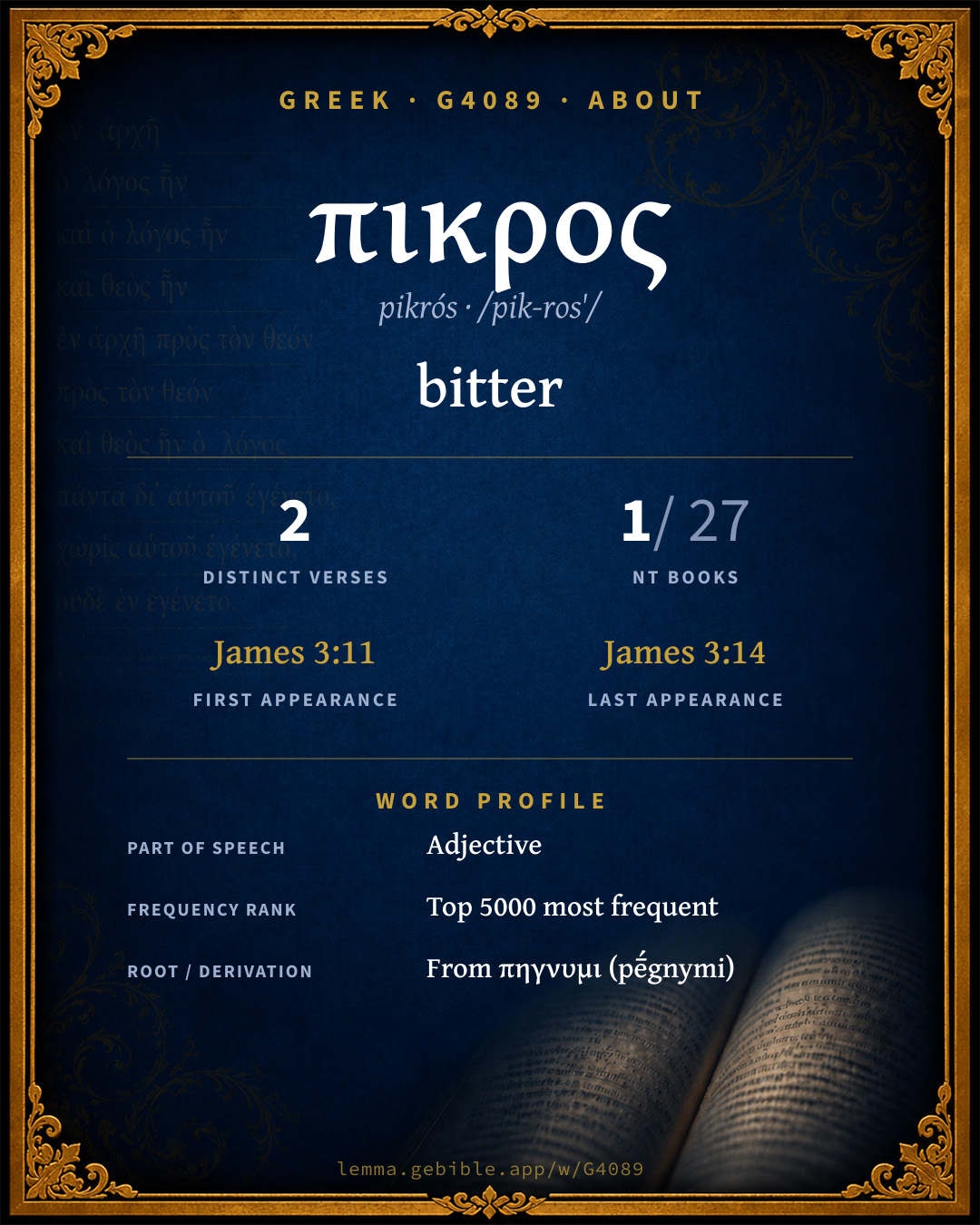
πικρός
bitter
‘bitter’ is one of 2 main senses fuller range ↓
Full lexicon entry — Thayer's Greek Lexicon
From Thayer's Greek Lexicon
Where this word appears
Grammar key — what these labels mean
Part of speech
- Adjective
- A word that describes or qualifies a noun.
Case
- Accusative
- The case of the direct object and of extent.
Gender
- Masculine
- Grammatically masculine.
- Neuter
- Grammatically neuter.
Number
- Singular
- One.
Grammatical forms
- Adjective, Accusative, Singular, Masculine 1 time (50%)
- Adjective, Accusative, Singular, Neuter 1 time (50%)
Parsed forms decoded from the imported morphology (Robinson–Tischendorf, public domain), counted across 2 parsed occurrences — not distinct verses.
Every verse where G4089 appears — 2 distinct verses across 1 book. Click any verse to open its interlinear word-by-word view. Verse text shown in the World English Bible for context — . Each verse’s Greek form is shown with its reference; the English is not keyword-highlighted, since the data carries no word-level English alignment. Use “Compare translations” on any verse to read it across multiple English versions. This concordance covers the Greek New Testament; Septuagint (Greek Old Testament) occurrences of this word are not indexed here.
James 2 verses
About this entry
At a glance — auto-summarized from this page’s data, not written by a person. Every figure links to its source below. This summary describes the numbers; it doesn’t interpret them.
πικρος — transliterated pikrós — is a Greek adjective carrying the sense “bitter.” It is rare — just 2 verses in the entire Greek New Testament. More than three-quarters of its appearances fall in James. Its earliest occurrence is James 3:11. Thayer's distinguishes 2 senses for it. See the sense tree, 2-verse concordance, and the renderings breakdown below.
Gloss history
Strong's 1890 vs modern scholarship
About this word
Strong's G4089 catalogs a Greek word from the Greek New Testament.
These counts are not copied from any lexicon or concordance. They are computed here, from the morphology-tagged Greek New Testament. What Lemma adds →
- 2
- distinct verses
- The word appears in 2 distinct verses.
- 1 / 27
- NT books
- The word appears in 1 of 27 New Testament books.
- #2,678
- by frequency
- Top 5000 most frequent Greek words (rank 2,678 of 5,347 Greek words by occurrence).
View all 2 occurrences in the concordance →
Most concentrated in
- James 2 verses 100%
By section of the New Testament
By traditional corpus
Conventional, traditional groupings — biblical authorship is debated, so this is a traditional corpus grouping, not an authorship claim. Some books belong to more than one corpus (Luke is in both the Gospels and the Lukan corpus, and so on), so these shares overlap and need not total 100%. Each figure is a share of the word’s 2 distinct verses.
- General (Catholic) Epistles 2 verses · 100%
How translations render this word
Counts come from each version’s own published word-to-Strong’s tagging or interlinear alignment — an approximate guide to how each version renders this word, not a word-level alignment the data otherwise carries. Because each total is that version’s own tagged count, the per-version totals vary from one another and need not match the appearance or distinct-verse counts above. These counts may also differ from a printed concordance because Lemma counts each distinctly tagged rendering and does not collapse phrase taggings into a single head-word total. This is a fixed set of word-tagged versions (KJV, ASV, BSB, ULT) and does not change with the reading translation you choose elsewhere. Each version’s license is shown beside its name below (and on Sources).
- King James Version: Bitter 2×
- American Standard Version: Bitter 2×
- Berean Standard Bible: Bitter 1×, Salt 1×
- unfoldingWord Literal Text: Bitter 2×
King James Version Public Domain
Renders G4089 across 2 tagged occurrences — most commonly:
American Standard Version Public Domain
Renders G4089 across 2 tagged occurrences — most commonly:
Berean Standard Bible Public Domain
Renders G4089 across 2 tagged occurrences — most commonly:
unfoldingWord Literal Text CC BY-SA 4.0
Renders G4089 across 2 tagged occurrences — most commonly:
Senses in Thayer's
The 2 senses Thayer's distinguishes for this word, in lexicon order (not ranked by frequency or importance). The full entry — with sub-senses — is in the Lexicon Entry tab.
- bitter
- metaph. harsh, virulent
Word origin
Derived from πηγνυμι (pḗgnymi) (G4078) — to fasten.
Perhaps from G4078 (through the idea of piercing ); sharp ( pungent ) that is acrid (literally or figuratively): - bitter.
— Strong’s Exhaustive Concordance (1890), public domain.
Forms in the corpus
The 2 distinct written forms G4089 takes in the Greek New Testament, most frequent first — each parse links to that case’s occurrences in the concordance.
| Form | Parsing | Example | Uses |
|---|---|---|---|
| πικρόν pikrón | Adjective, Accusative, Singular, Neuter | James 3:11 | 1 |
| πικρὸν pikròn | Adjective, Accusative, Singular, Masculine | James 3:14 | 1 |
Same root — word family
Other Thayer's entries built from the same root as G4089, grouped by Strong’s listed origin. These share a root / origin per the lexicon — not necessarily a shared meaning. Each links to that word’s own entry.
Derives from
Shares the same root
- παγις pagís G3803 snare
- παχυνω pachýnō G3975 to make fat
- πηγανον pḗganon G4076 rue
- πηγη pēgḗ G4077 fountain
Derived from this word
Proper names from this root
People and places named from this root — a name, not an additional meaning of the word.
Compare all same-root words → Showing 4 of 10 — not the complete family. 1 of the same-root words is a proper name (a person or place). They share a root, not necessarily a meaning.
Septuagint usage
The same Greek word πικρος appears 20 times in the Greek Old Testament (Septuagint), across 19 verses in 14 books.
- 20
- LXX occurrences
- Tagged occurrences of this Greek word in the Septuagint.
- 19
- verses
- Distinct Septuagint verses containing this word.
- 14 / 39
- OT books
- The word appears in 14 of the 39 Old Testament books.
Sample Septuagint occurrences
- Genesis 27:34 πικρός
- Exodus 15:23 πικρός
- Judges 18:25 πικρός
- 1 Samuel 15:32 πικρός
- 2 Samuel 2:26 πικρός
- 2 Kings 14:26 πικρός
- Psalms 63:4 πικρός
- Proverbs 5:4 πικρός
- Ecclesiastes 7:26 πικρός
- Isaiah 5:20 πικρός
- Jeremiah 2:19 πικρός
- Ezekiel 27:30 πικρός
Septuagint occurrences (same lexeme)
Every verse where the same Strong’s number (G4089) appears in the Greek Septuagint. Verse text shown in the World English Bible for context; the Greek form is the matched word — the English is not keyword-highlighted.
- Genesis 27:34 πικρός When Esau heard the words of his father, he cried with an exceeding great and bitter cry, and said to his father, "Bless me, even me also, my father."
- Exodus 15:23 πικρός When they came to Marah, they couldn't drink from the waters of Marah, for they were bitter. Therefore the name of it was called Marah.
- Judges 18:25 πικρός The children of Dan said to him, "Don't let your voice be heard among us, lest angry fellows fall on you, and you lose your life, with the lives of your household."
- 1 Samuel 15:32 πικρός Then said Samuel, Bring you here to me Agag the king of the Amalekites. Agag came to him cheerfully. Agag said, Surely the bitterness of death is past.
- 2 Samuel 2:26 πικρός Then Abner called to Joab, and said, "Shall the sword devour forever? Don't you know that it will be bitterness in the latter end? How long shall it be then, before you bid the people return from following their brothers?"
- 2 Kings 14:26 πικρός For Yahweh saw the affliction of Israel, that it was very bitter; for there was none shut up nor left at large, neither was there any helper for Israel.
- Psalms 63:4 πικρός So I will bless you while I live. I will lift up my hands in your name.
- Proverbs 5:4 πικρός But in the end she is as bitter as wormwood, And as sharp as a two-edged sword.
- Proverbs 27:7 πικρός A full soul loathes a honeycomb; But to a hungry soul, every bitter thing is sweet.
- Ecclesiastes 7:26 πικρός I find more bitter than death the woman whose heart is snares and traps, whose hands are chains. Whoever pleases God shall escape from her; but the sinner will be ensnared by her.
- Isaiah 5:20 πικρός Woe to those who call evil good, and good evil; Who put darkness for light, And light for darkness; Who put bitter for sweet, And sweet for bitter!
- Isaiah 24:9 πικρός They shall not drink wine with a song; strong drink shall be bitter to those who drink it.
- Jeremiah 2:19 πικρός Your own wickedness shall correct you, and your backsliding shall reprove you: know therefore and see that it is an evil thing and a bitter, that you have forsaken Yahweh your God, and that my fear is not in you, says the Lord, Yahweh of Hosts.
- Jeremiah 4:18 πικρός Your way and your doings have procured these things to you; this is your wickedness; for it is bitter, for it reaches to your heart.
- Jeremiah 20:8 πικρός For as often as I speak, I cry out; I cry, Violence and destruction! because the word of Yahweh is made a reproach to me, and a derision, all the day.
- Jeremiah 23:15 πικρός Therefore thus says Yahweh of Hosts concerning the prophets: Behold, I will feed them with wormwood, and make them drink the water of gall; for from the prophets of Jerusalem is ungodliness gone forth into all the land.
- Ezekiel 27:30 πικρός and shall cause their voice to be heard over you, and shall cry bitterly, and shall cast up dust on their heads, they shall wallow themselves in the ashes:
- Habakkuk 1:6 πικρός For, behold, I raise up the Chaldeans, that bitter and hasty nation, that march through the breadth of the earth, to possess dwelling places that are not theirs.
- Zephaniah 1:14 πικρός The great day of Yahweh is near. It is near, and hurries greatly, the voice of the day of Yahweh. The mighty man cries there bitterly.
These are occurrences of the same Greek lexeme (G4089) in the Septuagint — not a translation of any one Hebrew word. The store carries no word-level Hebrew↔Greek alignment, so no Hebrew original is asserted here. Counts come from the recovered LXX Strong's tagging — high-frequency vocabulary is well covered, while rare or late forms may be untagged — so they reflect tagged occurrences and may slightly undercount.