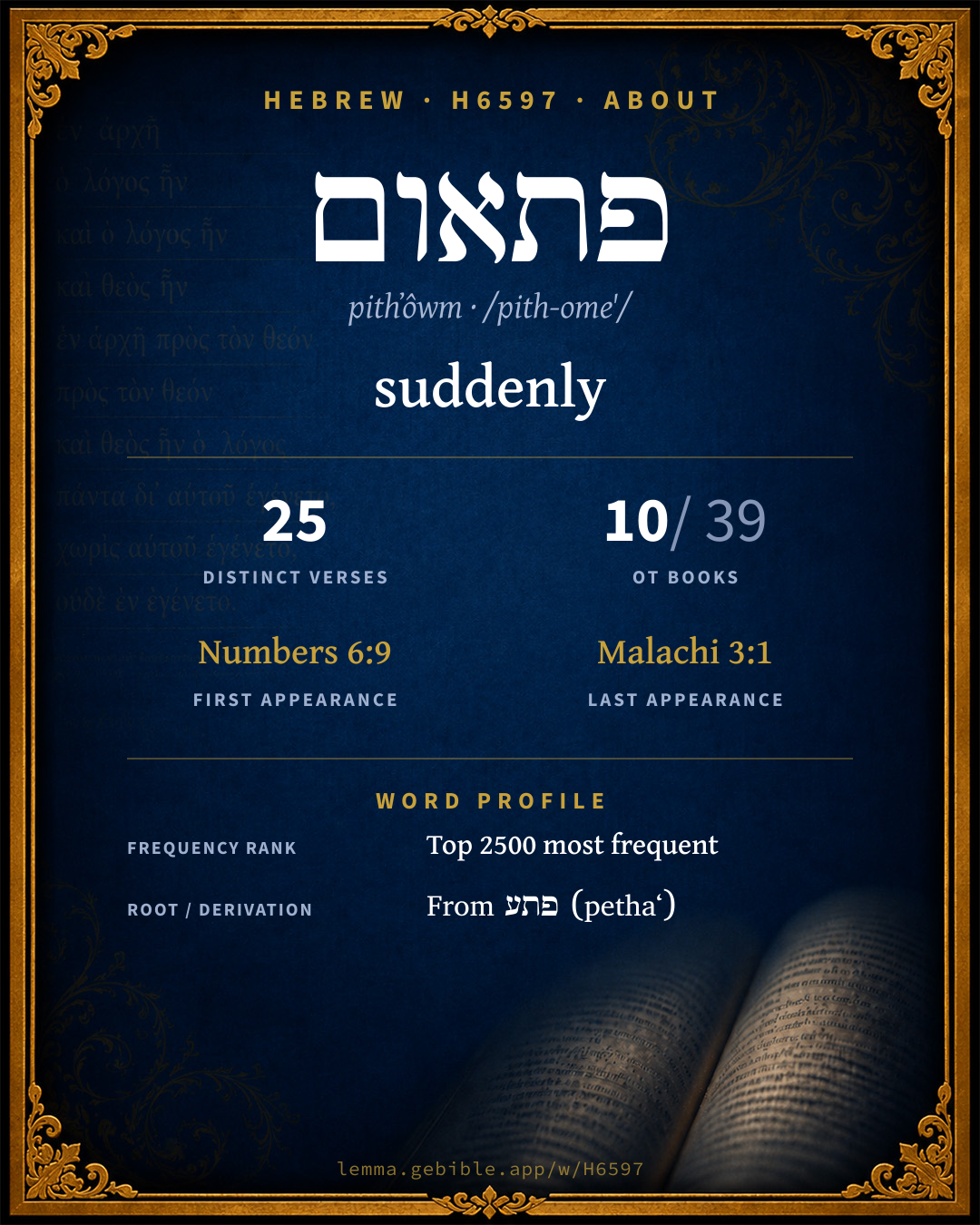
פִּתְאֹם
suddenly
‘suddenly’ is one of 2 main senses fuller range ↓
Full lexicon entry — Brown-Driver-Briggs (BDB)
From Brown-Driver-Briggs (BDB)
Where this word appears
Grammar key — what these labels mean
Part of speech
- Adverb
- A word that modifies a verb, adjective, or other adverb.
Every verse where H6597 appears — 25 distinct verses across 10 books. Click any verse to open its interlinear word-by-word view. Verse text shown in the World English Bible for context — . Each verse’s Hebrew form is shown with its reference; the English is not keyword-highlighted, since the data carries no word-level English alignment. Use “Compare translations” on any verse to read it across multiple English versions. This concordance covers the Hebrew Bible; Septuagint (Greek Old Testament) occurrences are not indexed here.
Numbers 2 verses
- Numbers 6:9 פִּתְאֹ֔ם adv "If any man dies very suddenly beside him, and he defiles the head of his separation; then he shall shave his head in the day of his cleansing. On the seventh day he shall shave it.
- Numbers 12:4 פִּתְאֹ֗ם adv Yahweh spoke suddenly to Moses, and to Aaron, and to Miriam, Come out you three to the tent of meeting. They three came out.
Joshua 2 verses
2 Chronicles 1 verse
Job 3 verses
Psalms 2 verses
Proverbs 4 verses
- Proverbs 3:25 פִּתְאֹ֑ם adv Don't be afraid of sudden fear, Neither of the desolation of the wicked, when it comes:
- Proverbs 6:15 פִּ֭תְאֹם adv Therefore his calamity will come suddenly. He will be broken suddenly, and that without remedy.
- Proverbs 7:22 פִּ֫תְאֹ֥ם adv He followed her immediately, As an ox goes to the slaughter, As a fool stepping into a noose.
- Proverbs 24:22 פִ֭תְאֹם adv For their calamity will rise suddenly; The destruction from them both--who knows?
Ecclesiastes 1 verse
Isaiah 4 verses
- Isaiah 29:5 פִּתְאֹֽם adv But the multitude of your foes shall be like small dust, and the multitude of the awesome ones as chaff that passes away: yes, it shall be in an instant suddenly.
- Isaiah 30:13 פִּתְאֹ֥ם adv therefore this iniquity shall be to you as a breach ready to fall, swelling out in a high wall, whose breaking comes suddenly in an instant.
- Isaiah 47:11 פִּתְאֹ֛ם adv Therefore shall evil come on you; you shall not know the dawning of it: and mischief shall fall on you; you shall not be able to put it away: and desolation shall come on you suddenly, which you don't know.
- Isaiah 48:3 פִּתְאֹ֥ם adv I have declared the former things from of old; yes, they went forth out of my mouth, and I shown them: suddenly I did them, and they happened.
Jeremiah 5 verses
- Jeremiah 4:20 פִּתְאֹם֙ adv Destruction on destruction is cried; for the whole land is laid waste: suddenly are my tents destroyed, [and] my curtains in a moment.
- Jeremiah 6:26 פִתְאֹ֔ם adv Daughter of my people, gird you with sackcloth, and wallow yourself in ashes: make you mourning, as for an only son, most bitter lamentation; for the destroyer shall suddenly come on us.
- Jeremiah 15:8 פִּתְאֹ֔ם adv Their widows are increased to me above the sand of the seas; I have brought on them against the mother of the young men a destroyer at noonday: I have caused anguish and terrors to fall on her suddenly.
- Jeremiah 18:22 פִּתְאֹ֑ם adv Let a cry be heard from their houses, when you shall bring a troop suddenly on them; for they have dug a pit to take me, and hid snares for my feet.
- Jeremiah 51:8 פִּתְאֹ֛ם adv Babylon is suddenly fallen and destroyed: wail for her; take balm for her pain, if so be she may be healed.
Malachi 1 verse
About this entry
At a glance — auto-summarized from this page’s data, not written by a person. Every figure links to its source below. This summary describes the numbers; it doesn’t interpret them.
פתאום (pithʼôwm) is a Hebrew word most often rendered “suddenly.” Scripture first uses it in Numbers 6:9. Spanning 25 verses in 10 books, it ranks among the uncommon words of the Hebrew Bible. Ranging over 2 senses, it is not a single-sense word. For the data behind this summary, explore the sense tree and the renderings breakdown below.
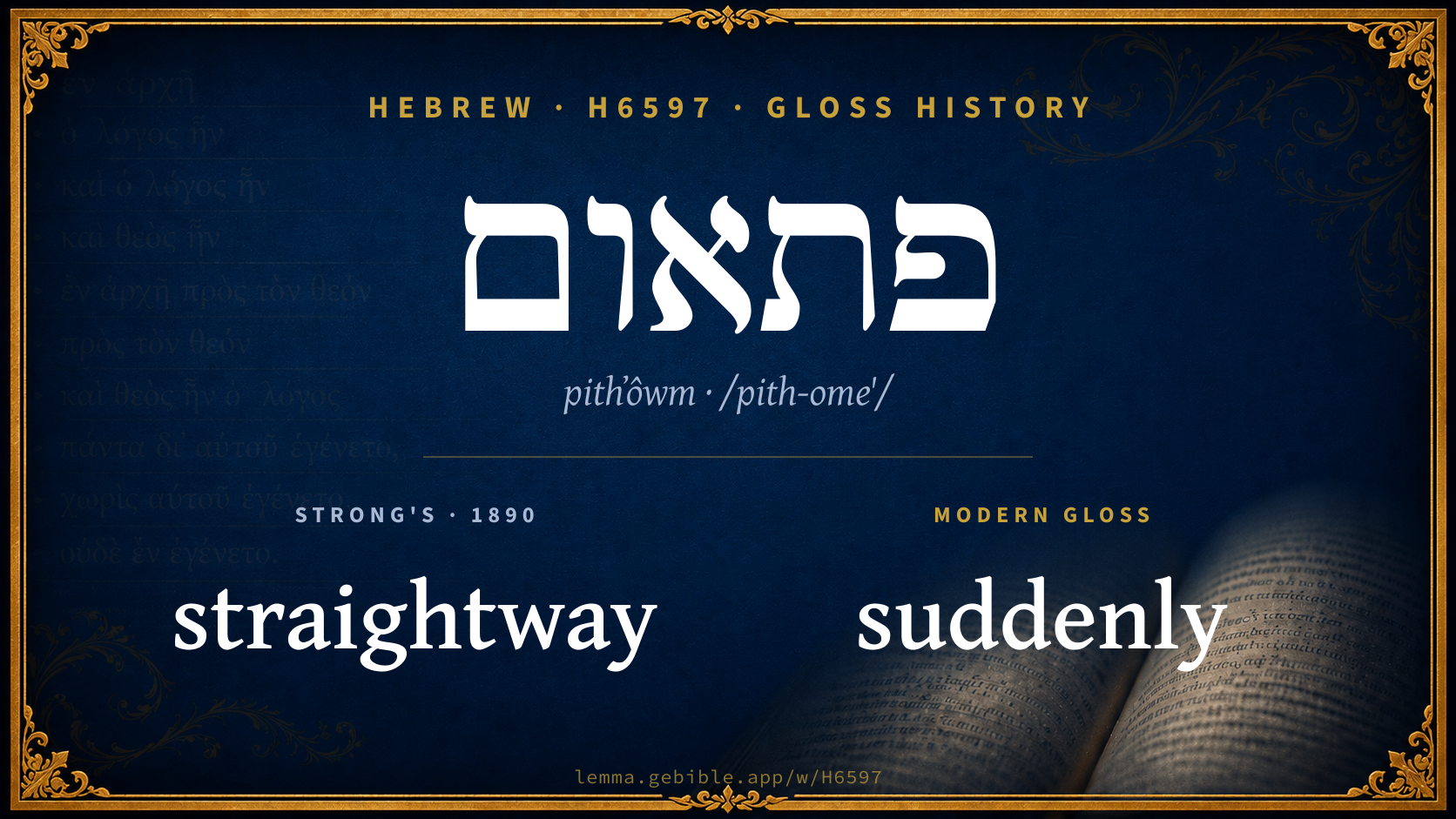
Gloss history
Strong's 1890 vs modern scholarship
About this word
Strong's H6597 catalogs a Hebrew word from the Hebrew Old Testament.
These counts are not copied from any lexicon or concordance. They are computed here, from the morphology-tagged Hebrew Old Testament. What Lemma adds →
- 25
- distinct verses
- The word appears in 25 distinct verses.
- 10 / 39
- OT books
- The word appears in 10 of 39 Old Testament books.
- #1,282
- by frequency
- Top 2500 most frequent Hebrew words (rank 1,282 of 8,640 Hebrew words by occurrence).
View all 25 occurrences in the concordance →
By section of the Old Testament
By traditional corpus
Conventional, traditional groupings — biblical authorship is debated, so this is a traditional corpus grouping, not an authorship claim. Each share is this word’s portion of its verses in that division of the Hebrew canon. Each figure is a share of the word’s 25 distinct verses.
- Prophets (Nevi'im) 12 verses · 48%
- Writings (Ketuvim) 11 verses · 44%
- Torah (Pentateuch) 2 verses · 8%
How translations render this word
Counts come from each version’s own published word-to-Strong’s tagging or interlinear alignment — an approximate guide to how each version renders this word, not a word-level alignment the data otherwise carries. Because each total is that version’s own tagged count, the per-version totals vary from one another and need not match the appearance or distinct-verse counts above. These counts may also differ from a printed concordance because Lemma counts each distinctly tagged rendering and does not collapse phrase taggings into a single head-word total. This is a fixed set of word-tagged versions (KJV, ASV, BSB, ULT) and does not change with the reading translation you choose elsewhere. Each version’s license is shown beside its name below (and on Sources).
- King James Version: Suddenly 17×, Shall suddenly 2×
- American Standard Version: Suddenly 13×
- Berean Standard Bible: Suddenly 13×, Sudden 3×
- unfoldingWord Literal Text: Suddenly 20×
King James Version Public Domain
Renders H6597 across 25 tagged occurrences — most commonly:
Plus 6 renderings that appear only once — usually multi-word phrases or single function words the recovered tagging swept in, not distinct renderings.
American Standard Version Public Domain
Renders H6597 across 26 tagged occurrences — most commonly:
Plus 13 renderings that appear only once — usually multi-word phrases or single function words the recovered tagging swept in, not distinct renderings.
Berean Standard Bible Public Domain
Renders H6597 across 24 tagged occurrences — most commonly:
Plus 8 renderings that appear only once — usually multi-word phrases or single function words the recovered tagging swept in, not distinct renderings. Not rendered by a distinct English word in 1 further occurrence.
unfoldingWord Literal Text CC BY-SA 4.0
Renders H6597 across 24 tagged occurrences — most commonly:
Plus 4 renderings that appear only once — usually multi-word phrases or single function words the recovered tagging swept in, not distinct renderings.
Senses in BDB
The 2 senses BDB distinguishes for this word, in lexicon order (not ranked by frequency or importance). The full entry — with sub-senses — is in the Lexicon Entry tab.
- suddenly, surprisingly (adverb)
- suddenness (substantive)
Word origin
once ψ 64:8 (v. Baer) פִּתְאוֹם subst. suddenness, usually as adv.acc. suddenly (from פֶּתַע, with the term. -ם (cf. שִׁלְשֹׁם), and with ע weakened to א: Sta§ 295 Köii. 255 f. BaNB § 216 b);—Nu 12:4 ויאמר י׳ פ׳ אל־משׁה, Jos 10:9; 11:7; especially of calamity, invasion, etc., coming suddenly, Is 47:11; 48:3; Je 4:20 פ׳ שֻׁדְּדוּ אֹהָלַי, 6:26; 15:8; 18:22; 51:8 ψ 64:5 פ׳ יֹרֻהוּ וְלֹא יִירָ֑אוּ, v 8 Jb 5:3; 9:23; Ec 9:12; Pr 6:15; 24:22; also 7:22; Mal 3:1; thrice with פֶּתַע (q.v.). As a gen. †Pr 3:25 אל־תירא מִפַּחַד פ׳ of the terror of suddenness, i.e. the sudden terror, Jb 22:10; and with בְּ, in suddenness, †2 Ch 29:36 בפ׳ היה הדבר.
— Brown-Driver-Briggs (Oxford 1906, public domain), digitized via Sefaria, supplemented by the OpenScriptures HebrewLexicon (CC BY 4.0). See Sources.
Derived from פתע (pethaʻ) (H6621) — suddenness.
Jastrow Dictionary
A second Hebrew/Aramaic lexicon for comparison, covering Aramaic and post-biblical (Talmudic, Targumic, Midrashic) usage that the biblical-Hebrew BDB does not. Matched by lemma rather than by Strong’s number, so a lemma may carry more than one Jastrow headword (shown separately below), and the entries cover usage well beyond the Bible.
פִּתְאוֹם
- adv. (b. h.; unawares, suddenly. Nidd. 16ᵇ הנכנס לבית חבירו פ׳ who enters his neighbor’s house without notice. Ib. ארבעה … והנכנס לביתו פ׳ וכ׳ four the Lord hates, and I do not love: him who enters his own house suddenly (after a long absence), not to speak of him who enters his neighbor’s house &c.; Lev. R. s. 21; Yalk. Ex. 382; Pesik. Aḥăré, p. 177ᵃ. Ib.; Lev. R. l. c. אל תכנס לעיר פ׳ do not enter a city (in official capacity) without notice. Num. R. s. 10 (ref. to בפתע פתאם, Num. VI, 9) בפ׳ זה שוגג … פ׳ זה אונס b’fethʿa means unintentionally, as in Num. XXXV, 22, pithom means an unavoidable accident; דבר אחר פ׳ זה מזיד וכ׳ another explanation: pithom means in heat (being carried away by passion, as פתאים (Prov. XXII, 3). Num. R. s. 16 אני משלח להם מלאכי פ׳ I will send them my messenger suddenly (by surprise); a. e. e.g. Numbers 6:9
A Dictionary of the Targumim, the Talmud Babli and Yerushalmi, and the Midrashic Literature (Marcus Jastrow; London, Luzac, 1903) — Public Domain. Digitized via Sefaria. Digitized via Sefaria. Full attribution on Sources.
Forms in the corpus
The 15 distinct written forms H6597 takes in the Hebrew Bible, most frequent first — each parse links to that state’s occurrences in the concordance. Hebrew forms include their vowel points and cantillation, so a single lemma takes many written forms.
| Form | Parsing | Example | Uses |
|---|---|---|---|
| פִּתְאֹ֑ם | Adverb | Jeremiah 18:22 | 5 |
| פִּתְאֹ֥ם | Adverb | Isaiah 30:13 | 3 |
| פִּתְאֹֽם | Adverb | Ecclesiastes 9:12 | 3 |
| פִּתְאֹ֔ם | Adverb | Jeremiah 15:8 | 2 |
| פִּתְאֹ֛ם | Adverb | Isaiah 47:11 | 2 |
| בְּ/פִתְאֹ֖ם | Adverb | 2 Chronicles 29:36 | 1 |
| וּ/פִתְאֹם֩ | Adverb | Malachi 3:1 | 1 |
| פִ֭תְאֹם | Adverb | Proverbs 24:22 | 1 |
| פִתְאֹ֔ם | Adverb | Jeremiah 6:26 | 1 |
| פִתְאֹֽם | Adverb | Job 5:3 | 1 |
| פִּ֫תְאֹ֥ם | Adverb | Proverbs 7:22 | 1 |
| פִּ֭תְאֹם | Adverb | Proverbs 6:15 | 1 |
| פִּתְא֑וֹם | Adverb | Psalms 64:7 | 1 |
| פִּתְאֹ֗ם | Adverb | Numbers 12:4 | 1 |
| פִּתְאֹם֙ | Adverb | Jeremiah 4:20 | 1 |
Septuagint verse parallels
This word appears in 25 verses that also exist in the Greek Old Testament (Septuagint), out of the 25 Hebrew verses it occurs in. You can read those verses in Greek by switching the Old Testament edition to the Septuagint.
Read these verses in the Septuagint
- Numbers 6:9
- Joshua 10:9
- 2 Chronicles 29:36
- Job 5:3
- Psalms 64:4
- Proverbs 3:25
- Ecclesiastes 9:12
- Isaiah 29:5
- Jeremiah 4:20
- Malachi 3:1
This is a verse-level parallel only — the same verses exist in both the Hebrew and Greek Old Testaments. No word-level Hebrew↔Greek correspondence is claimed: the data carries no such alignment, so no Greek word is shown as this Hebrew word’s translation. Coverage is not total — the Septuagint omits the deuterocanon and renumbers the Psalms, so some Hebrew verses have no direct Greek parallel.