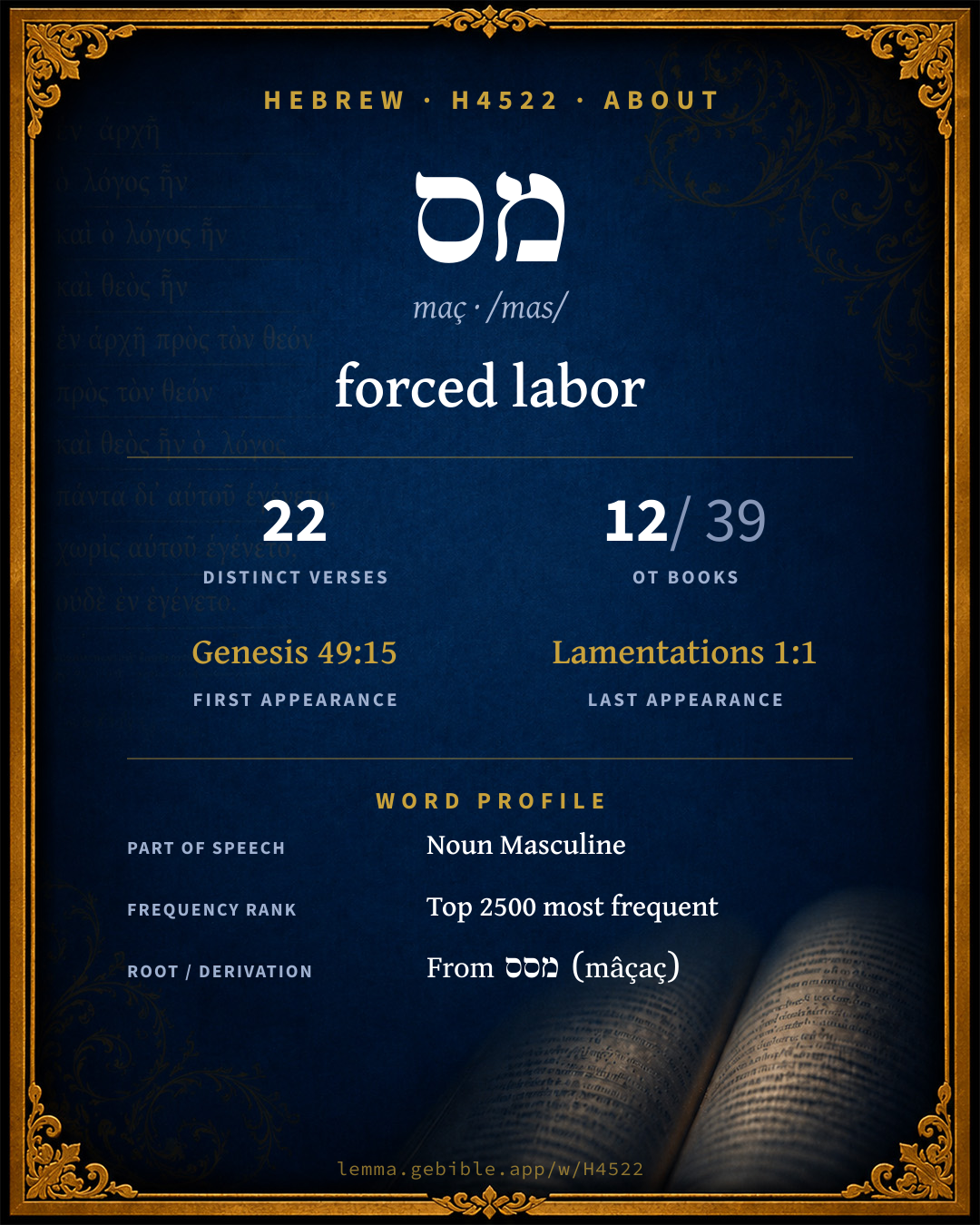
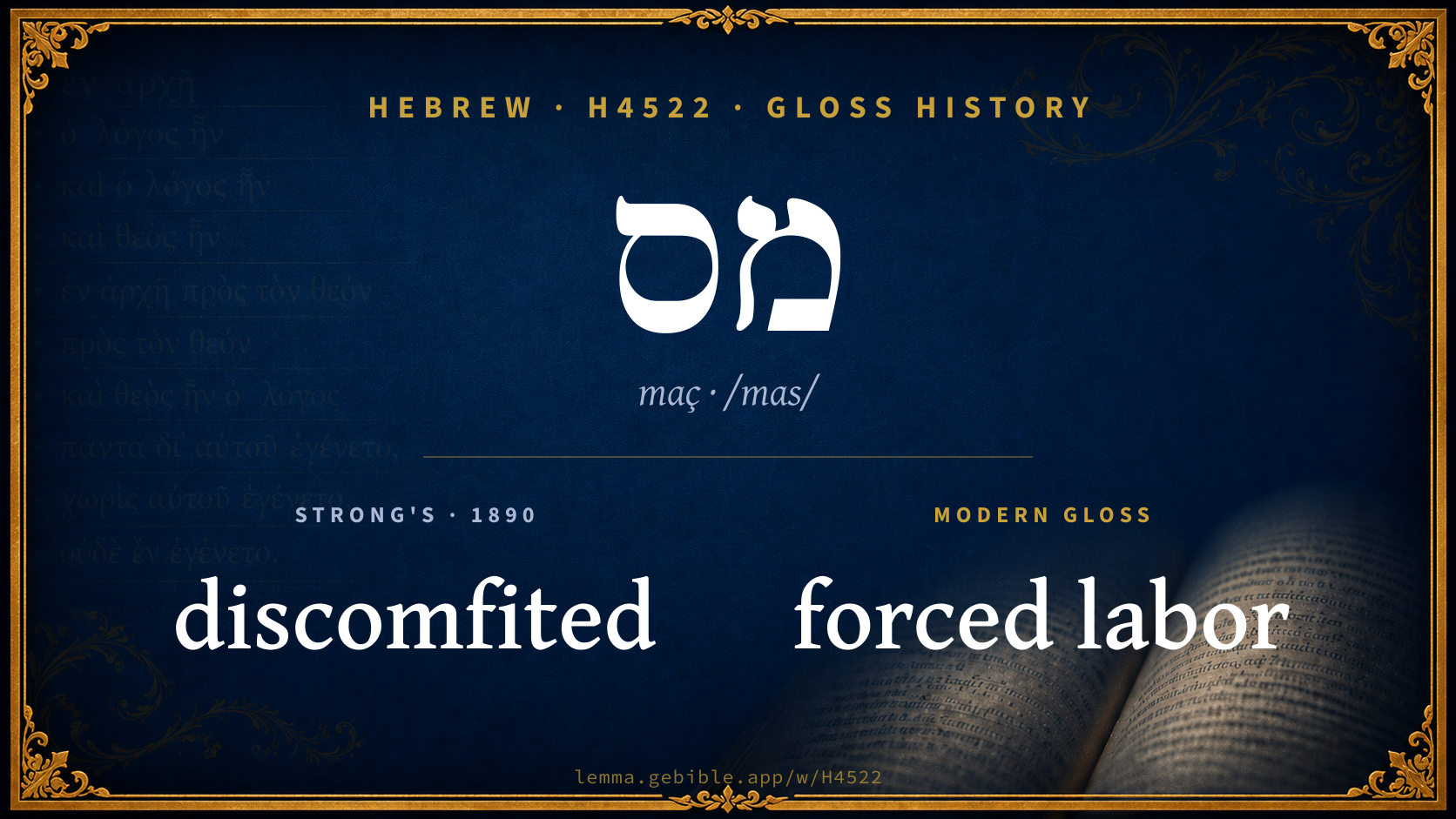
מַס
forced labor
‘forced labor’ is one of 4 main senses fuller range ↓
Full lexicon entry — Brown-Driver-Briggs (BDB)
From Brown-Driver-Briggs (BDB)
Where this word appears
See every Absolute-state word in the Hebrew Bible →
Grammar key — what these labels mean
Part of speech
- Noun
- A naming word — a person, place, thing, or idea.
Noun type
- Common
- A common noun — a general class of person, place, or thing (“king,” “city,” “water”), not a specific name.
State
- Absolute
- The independent form of a noun, not bound to a following word.
- Construct
- A noun bound to a following noun in a possessive / “of” relationship (the construct chain).
Gender
- Masculine
- Grammatically masculine.
Number
- Singular
- One.
- Plural
- More than one (in Hebrew, generally three or more).
Grammatical forms
- Noun, Common, Masculine, Singular, Absolute 19 times (83%)
- Noun, Common, Masculine, Singular, Construct 3 times (13%)
- Noun, Common, Masculine, Plural, Absolute 1 time (4%)
Parsed forms decoded from the imported morphology (morphhb / Westminster Leningrad Codex — WLC text public domain, morphhb tagging CC BY 4.0), counted across 23 parsed occurrences — not distinct verses.
Every verse where H4522 appears — 22 distinct verses across 12 books. Click any verse to open its interlinear word-by-word view. Verse text shown in the World English Bible for context — . Each verse’s Hebrew form is shown with its reference; the English is not keyword-highlighted, since the data carries no word-level English alignment. Use “Compare translations” on any verse to read it across multiple English versions. This concordance covers the Hebrew Bible; Septuagint (Greek Old Testament) occurrences are not indexed here.
Genesis 1 verse
Exodus 1 verse
Deuteronomy 1 verse
Joshua 2 verses
- Joshua 16:10 לְ/מַס prep + n c ms cs They didn't drive out the Canaanites who lived in Gezer: but the Canaanites dwell in the midst of Ephraim to this day, and are become servants to do forced labor.
- Joshua 17:13 לָ/מַ֑ס prep + n c ms It happened, when the children of Israel had grown strong, that they put the Canaanites to forced labor, and didn't utterly drive them out.
Judges 4 verses
- Judges 1:28 לָ/מַ֑ס prep + n c ms It happened, when Israel had grown strong, that they put the Canaanites to forced labor, and did not utterly drive them out.
- Judges 1:30 לָ/מַֽס prep + n c ms Zebulun didn't drive out the inhabitants of Kitron, nor the inhabitants of Nahalol; but the Canaanites lived among them, and became subject to forced labor.
- Judges 1:33 לָ/מַֽס prep + n c ms Naphtali didn't drive out the inhabitants of Beth-shemesh, nor the inhabitants of Beth Anath; but he lived among the Canaanites, the inhabitants of the land: nevertheless the inhabitants of Beth-shemesh and of Beth Anath became subject to forced labor.
- Judges 1:35 לָ/מַֽס prep + n c ms but the Amorites would dwell in Mount Heres, in Aijalon, and in Shaalbim: yet the hand of the house of Joseph prevailed, so that they became subject to forced labor.
2 Samuel 1 verse
1 Kings 6 verses
- 1 Kings 4:6 הַ/מַּֽס ptcl def.art + n c ms and Ahishar was over the household; and Adoniram the son of Abda was over the men subject to forced labor.
- 1 Kings 5:13 מַ֖ס הַ/מַּ֔ס n c ms ptcl def.art + n c ms King Solomon raised a levy out of all Israel; and the levy was thirty thousand men.
- 1 Kings 5:14 הַ/מַּֽס ptcl def.art + n c ms He sent them to Lebanon, ten thousand a month by courses; a month they were in Lebanon, and two months at home; and Adoniram was over the men subject to forced labor.
- 1 Kings 9:15 הַ/מַּ֜ס ptcl def.art + n c ms This is the reason of the levy which king Solomon raised, to build the house of Yahweh, and his own house, and Millo, and the wall of Jerusalem, and Hazor, and Megiddo, and Gezer.
- 1 Kings 9:21 לְ/מַס prep + n c ms cs their children who were left after them in the land, whom the children of Israel were not able utterly to destroy, of them did Solomon raise a levy of bondservants to this day.
- 1 Kings 12:18 הַ/מַּ֔ס ptcl def.art + n c ms Then king Rehoboam sent Adoram, who was over the men subject to forced labor; and all Israel stoned him to death with stones. King Rehoboam made speed to get him up to his chariot, to flee to Jerusalem.
2 Chronicles 2 verses
- 2 Chronicles 8:8 לְ/מַ֔ס prep + n c ms of their children who were left after them in the land, whom the children of Israel didn't consume, of them did Solomon raise a levy [of bondservants] to this day.
- 2 Chronicles 10:18 הַ/מַּ֔ס ptcl def.art + n c ms Then king Rehoboam sent Hadoram, who was over the men subject to forced labor; and the children of Israel stoned him to death with stones. King Rehoboam made speed to get him up to his chariot, to flee to Jerusalem.
Esther 1 verse
Proverbs 1 verse
Isaiah 1 verse
Lamentations 1 verse
About this entry
At a glance — auto-summarized from this page’s data, not written by a person. Every figure links to its source below. This summary describes the numbers; it doesn’t interpret them.
“forced labor” is the headline sense of the Hebrew noun מס (maç). Where the King James Version says “tribute,” newer translations reach for “forced labor” (Berean Standard Bible); the renderings breakdown has the detail. The Hebrew Bible uses it across 22 verses — uncommon. More than a quarter of its appearances fall in 1 Kings. Carrying more than one sense, it rewards its full sense range. The sections below give every sense, occurrence, and version rendering.
Gloss history
Strong's 1890 vs modern scholarship
About this word
Strong's H4522 catalogs a Hebrew word from the Hebrew Old Testament.
These counts are not copied from any lexicon or concordance. They are computed here, from the morphology-tagged Hebrew Old Testament. What Lemma adds →
- 22
- distinct verses
- The word appears in 22 distinct verses.
- 12 / 39
- OT books
- The word appears in 12 of 39 Old Testament books.
- #1,368
- by frequency
- Top 2500 most frequent Hebrew words (rank 1,368 of 8,640 Hebrew words by occurrence).
View all 22 occurrences in the concordance →
By section of the Old Testament
By traditional corpus
Conventional, traditional groupings — biblical authorship is debated, so this is a traditional corpus grouping, not an authorship claim. Each share is this word’s portion of its verses in that division of the Hebrew canon. Each figure is a share of the word’s 22 distinct verses.
- Prophets (Nevi'im) 14 verses · 64%
- Writings (Ketuvim) 5 verses · 23%
- Torah (Pentateuch) 3 verses · 14%
How translations render this word
Counts come from each version’s own published word-to-Strong’s tagging or interlinear alignment — an approximate guide to how each version renders this word, not a word-level alignment the data otherwise carries. Because each total is that version’s own tagged count, the per-version totals vary from one another and need not match the appearance or distinct-verse counts above. These counts may also differ from a printed concordance because Lemma counts each distinctly tagged rendering and does not collapse phrase taggings into a single head-word total. This is a fixed set of word-tagged versions (KJV, ASV, BSB, ULT) and does not change with the reading translation you choose elsewhere. Each version’s license is shown beside its name below (and on Sources).
BDB lists this Strong’s number as 2 distinct words (homographs). Each count above pools all of them and is not split by sense — see the Senses section below. A low-frequency rendering may belong to a different one of those words, not the primary meaning.
- King James Version†: Tribute 6×, Was over the tribute 4×, Levy 3×
- American Standard Version†: Levy 5×, Was over the men subject to taskwork 5×, Taskwork 2×
- Berean Standard Bible†: Forced labor 11×, Forced laborers 3×
- unfoldingWord Literal Text†: Forced labor 16×, Forced laborer 3×
King James Version Public Domain
Renders H4522 across 23† tagged occurrences — most commonly:
Plus 8 renderings that appear only once — usually multi-word phrases or single function words the recovered tagging swept in, not distinct renderings.
American Standard Version Public Domain
Renders H4522 across 23† tagged occurrences — most commonly:
Plus 11 renderings that appear only once — usually multi-word phrases or single function words the recovered tagging swept in, not distinct renderings.
Berean Standard Bible Public Domain
Renders H4522 across 21† tagged occurrences — most commonly:
Plus 7 renderings that appear only once — usually multi-word phrases or single function words the recovered tagging swept in, not distinct renderings. Not rendered by a distinct English word in 2 further occurrences.
unfoldingWord Literal Text CC BY-SA 4.0
Renders H4522 across 24† tagged occurrences — most commonly:
Plus 5 renderings that appear only once — usually multi-word phrases or single function words the recovered tagging swept in, not distinct renderings.
Senses in the full BDB
What do BDB’s symbols mean?
BDB uses these scholarly abbreviations:
| Symbol | Meaning |
|---|---|
| 𝔊 | the Septuagint (the ancient Greek translation, LXX) |
| 𝔙 | the Vulgate (the Latin translation) |
| 𝔖 | the Syriac version (the Peshitta) |
| 𝔗 | the Targum (the Aramaic translation) |
| ψ | the Psalms |
| √ | root (the underlying root or stem) |
| ‖ | parallel passage (a synonymous or contrasted parallel) |
| † | the dagger: every passage where the word occurs is cited |
The 5 senses and sub-senses the full Brown-Driver-Briggs lexicon distinguishes for this word, in lexicon order (not ranked by frequency), with BDB’s own verbatim wording and sub-sense lettering. Shown in Hebrew script with BDB’s own scholarly abbreviations. The condensed entry is in the Lexicon Entry tab. See also the Forms in the corpus table below.
מס I
- 1. labour-band, labour-gang, body of task-workers for public service, formed by levy upon the people by Sol. וַיַּ֫עַל הַמֶּלֶךְ שׁלֹמֹה מַס מִכָּל־יִשְׂרָאֵל 1 K 5:27, amounting to 30,000 men v 27; הַמּ׳ אֲשֶׁר הֶעֱלָה 9:15; וַיַּעֲלֵם שׁ׳ לְמַס עֹבֵד v 21 and Sol. levied them for a toiling labour-band (cf. Gn 49:15 Jos 16:10)=וַיַּעֲלֵם שׁ׳ לְמַס 2 Ch 8:8; appar. instituted, earlier, by David, cf. וַאֲדֹרָם עַל־הַמַּ֑ס 2 S 20:24, i.e. had charge of the body of labourers, so 1 K 4:6; 5:28; 12:18=2 Ch 10:18. e.g. 1 Kings 5:27
- 2.
- a. of labour-bands, slave-gangs of Isr. in Egypt, only שָׁרֵי מִסִּים Ex 1:11 (J) gang-overseers. e.g. Exodus 1:11
- b. of conquered populations, subject to forced labour: יִהְיוּ לְךָ לָמַס וַעֲבָדוּךָ Dt 20:11 cf. Ju 1:30, 33, 35 (v. GFM), Is 31:8 La 1:1; so ויהי לְמַס עֹבֵד Jos 16:10 (cf. Gn 49:15 1 K 9:21); וַיִּתְּנוּ אֶת־הַכְּנַעֲנִי לָמַ֑ס Jos 17:13, cf. (וַיָּ֫שֶׁם וגו׳) Ju 1:28. e.g. Deuteronomy 20:11
- 3. in gen.: וַיְהִי לְמַס־עֹבֵד Gn 49:15 and he (Issachar) became a slaving labour-band (poem in J; cf. Jos 16:10 1 K 9:21); cf. רְמִיָּה תִּהְיֶה לָמַ֑ס Pr 12:24 (here appar. of individ.) e.g. Genesis 49:15
- 4. forced service, serfdom (or poss. (in late passage) tribute=enforced payment, cf. NH, 𝔗, v. supr.), only of Ahasuerus: וַיָּשֶׂם הַמֶּלָךְ מַס עַל־הָאָרֶץ וגו׳ Est 10:1. e.g. Esther 10:1
מס II despairing (lit. melting, i.e. failing, collapsing)
Senses from the full Brown-Driver-Briggs lexicon (Brown, Driver, Briggs; Oxford 1906 — public domain), digitized via Sefaria, supplemented by the OpenScriptures HebrewLexicon (CC BY 4.0). Full attribution on Sources.
Word origin
I. n.m. 1 K 5:27 usually coll. body of forced labourers, task-workers, labour-band or gang, also (late) forced service, task-work, serfdom (𝔗 מִסָּא, especially in phr. מַסְּקֵי מִיסִּין (implying late and [for BH] false sense ‘tribute,’ so NH מַעֲלֵי מִסִּים; √ unknown, prob. loan-wd.; follows anal. of ע׳׳ע);—abs. מ׳ 1 K 5:27 +; לָמַ֑ס Jos 17:13 +, הַמַּ֑ס 2 S 20:24 +; pl. מִסִּים Ex 1:11;—
III. adj. despairing (lit. melting, i.e. failing, collapsing);—לַמָּס Jb 6:14 to him who despaireth belongeth kindness, etc.
— Brown-Driver-Briggs (Oxford 1906, public domain), digitized via Sefaria, supplemented by the OpenScriptures HebrewLexicon (CC BY 4.0). See Sources.
Derived from מסס (mâçaç) (H4549) — to melt.
Jastrow Dictionary
A second Hebrew/Aramaic lexicon for comparison, covering Aramaic and post-biblical (Talmudic, Targumic, Midrashic) usage that the biblical-Hebrew BDB does not. Matched by lemma rather than by Strong’s number, so a lemma may carry more than one Jastrow headword (shown separately below), and the entries cover usage well beyond the Bible.
מַס I
- (מָסַס)
- 1. (cmp. מִסְמֵס II) juice. Num. R. s. 14 (play on כמ̇שמ̇ר̇ו̇ת̇, Koh. XII, 11) כמ̇ס̇ מ̇ר̇ו̇ת̇ (bitter) as the juice of bitter things, v. מִסְמֵס II. e.g. Ecclesiastes 12:11
- 2. melting, fainting. Lam. R. to I, 1 שרתי, v. לָמַס.
מַס II
- (b. h.; = מנס; נסה = נשא) impost, tribute, tax. Lam. R. to I, 1 שרתי, v. לָמַס a. מַסָּא I.—Pl. מִסִּים, מִסִּין. Y. Dem. II, 22ᵈ top מעלי מ׳ כמי שנתכבשו the places which were made tributary (under Joshua) are considered as conquered (belonging to the Holy Land); Y. Shebi. VI, 36ᶜ bot. בעלי סיסין (corr. acc.); Gen. R. s. 98. Lev. R. s. 33, end לא למסגד אלא למפלח במ׳ וכ׳ (this ועבדתם, Deut. IV, 28) does not mean ‘to worship’ but ‘to serve’ by paying imposts, annonae &c. Ib.; Cant. R. to II, 14 אם למ׳ … את מלך עלינו וכ׳ (some ed. לפסים) if it be a question of taxes … thou art king over us … (we recognize thy sovereignty) …, but &c. e.g. Deuteronomy 4:28
A Dictionary of the Targumim, the Talmud Babli and Yerushalmi, and the Midrashic Literature (Marcus Jastrow; London, Luzac, 1903) — Public Domain. Digitized via Sefaria. Digitized via Sefaria. Full attribution on Sources.
Forms in the corpus
The 13 distinct written forms H4522 takes in the Hebrew Bible, most frequent first — each parse links to that state’s occurrences in the concordance. Hebrew forms include their vowel points and cantillation, so a single lemma takes many written forms.
Same root — word family
Other BDB entries built from the same root as H4522, grouped by Strong’s listed origin. These share a root / origin per the lexicon — not necessarily a shared meaning. Each links to that word’s own entry.
Derives from
Shares the same root
Compare all same-root words → They share a root, not necessarily a meaning.
Septuagint verse parallels
This word appears in 21 verses that also exist in the Greek Old Testament (Septuagint), out of the 22 Hebrew verses it occurs in. You can read those verses in Greek by switching the Old Testament edition to the Septuagint.
Read these verses in the Septuagint
- Genesis 49:15
- Exodus 1:11
- Deuteronomy 20:11
- Joshua 16:10
- Judges 1:28
- 2 Samuel 20:24
- 1 Kings 4:6
- 2 Chronicles 8:8
- Esther 10:1
- Proverbs 12:24
- Isaiah 31:8
- Lamentations 1:1
This is a verse-level parallel only — the same verses exist in both the Hebrew and Greek Old Testaments. No word-level Hebrew↔Greek correspondence is claimed: the data carries no such alignment, so no Greek word is shown as this Hebrew word’s translation. Coverage is not total — the Septuagint omits the deuterocanon and renumbers the Psalms, so some Hebrew verses have no direct Greek parallel.