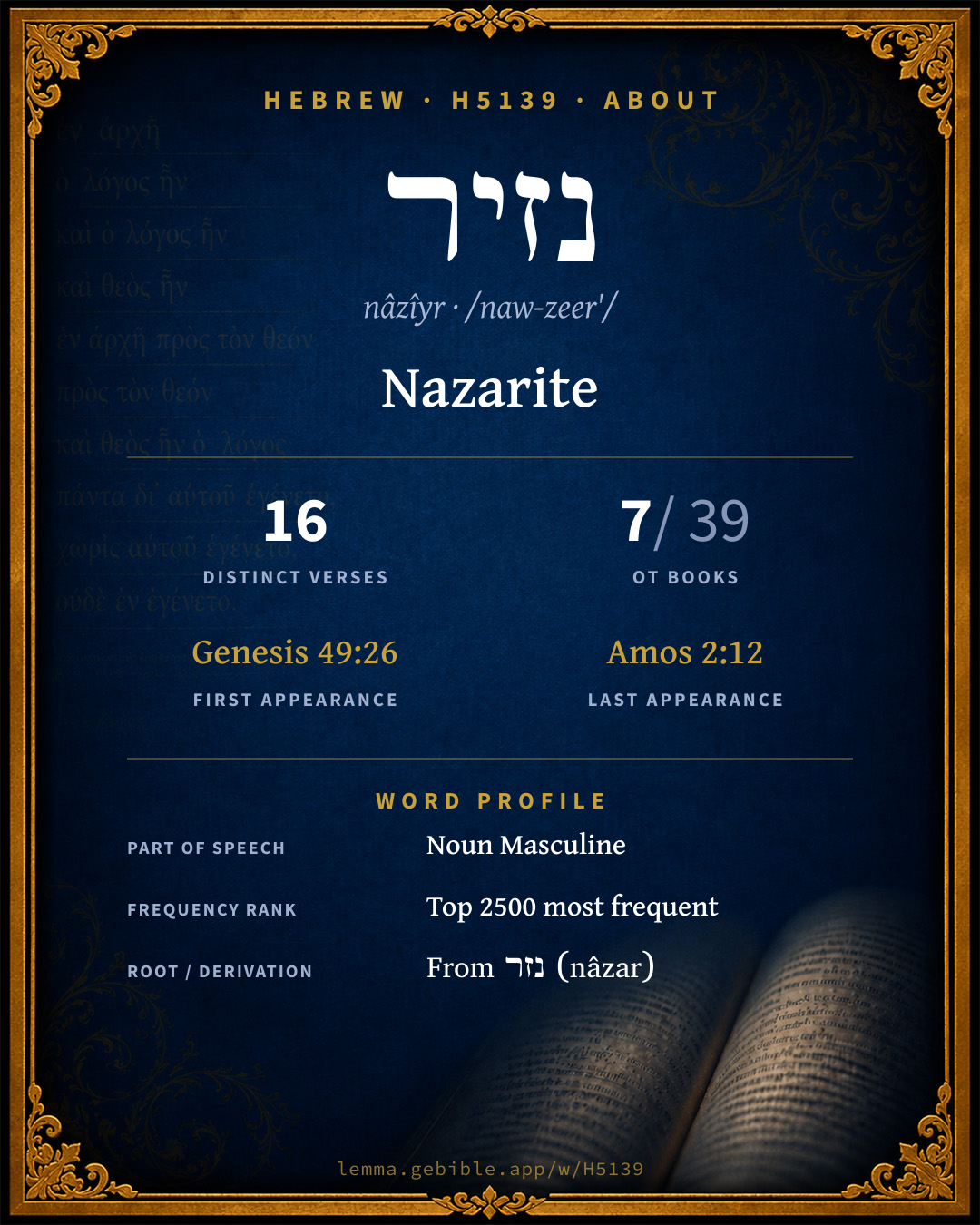
נָזִיר
Nazarite
BDB lists 4 entries for ‘Nazarite’ fuller range ↓
Full lexicon entry — Brown-Driver-Briggs (BDB)
From Brown-Driver-Briggs (BDB)
Where this word appears
See every Absolute-state word in the Hebrew Bible →
Grammar key — what these labels mean
Part of speech
- Noun
- A naming word — a person, place, thing, or idea.
Noun type
- Common
- A common noun — a general class of person, place, or thing (“king,” “city,” “water”), not a specific name.
State
- Construct
- A noun bound to a following noun in a possessive / “of” relationship (the construct chain).
- Absolute
- The independent form of a noun, not bound to a following word.
Gender
- Masculine
- Grammatically masculine.
Number
- Singular
- One.
- Plural
- More than one (in Hebrew, generally three or more).
Grammatical forms
- Noun, Common, Masculine, Singular, Absolute 6 times (38%)
- Noun, Common, Masculine, Singular, Construct 5 times (31%)
- Noun, Common, Masculine, Plural, Construct 3 times (19%)
- Noun, Common, Masculine, Plural, Absolute 2 times (13%)
Parsed forms decoded from the imported morphology (morphhb / Westminster Leningrad Codex — WLC text public domain, morphhb tagging CC BY 4.0), counted across 16 parsed occurrences — not distinct verses.
Every verse where H5139 appears — 16 distinct verses across 7 books. Click any verse to open its interlinear word-by-word view. Verse text shown in the World English Bible for context — . Each verse’s Hebrew form is shown with its reference; the English is not keyword-highlighted, since the data carries no word-level English alignment. Use “Compare translations” on any verse to read it across multiple English versions. This concordance covers the Hebrew Bible; Septuagint (Greek Old Testament) occurrences are not indexed here.
Genesis 1 verse
Leviticus 2 verses
- Leviticus 25:5 נְזִירֶ֖/ךָ n c mp cs + sfx pers 2ms What grows of itself in your harvest you shall not reap, and the grapes of your undressed vine you shall not gather. It shall be a year of solemn rest for the land.
- Leviticus 25:11 נְזִרֶֽי/הָ n c mp cs + sfx pers 3fs That fiftieth year shall be a jubilee to you. In it you shall not sow, neither reap that which grows of itself, nor gather from the undressed vines.
Numbers 6 verses
- Numbers 6:2 נָזִ֔יר n c ms "Speak to the children of Israel, and tell them: When either man or woman shall make a special vow, the vow of a Nazirite, to separate himself to Yahweh,
- Numbers 6:13 הַ/נָּזִ֑יר ptcl def.art + n c ms "This is the law of the Nazirite: when the days of his separation are fulfilled, he shall be brought to the door of the Tent of Meeting,
- Numbers 6:18 הַ/נָּזִ֗יר ptcl def.art + n c ms The Nazirite shall shave the head of his separation at the door of the Tent of Meeting, and shall take the hair of the head of his separation, and put it on the fire which is under the sacrifice of peace offerings.
- Numbers 6:19 הַ/נָּזִ֔יר ptcl def.art + n c ms The priest shall take the boiled shoulder of the ram, and one unleavened cake out of the basket, and one unleavened wafer, and shall put them on the hands of the Nazirite, after he has shaved the head of his separation;
- Numbers 6:20 הַ/נָּזִ֖יר ptcl def.art + n c ms and the priest shall wave them for a wave offering before Yahweh. This is holy for the priest, together with the breast that is waved and the thigh that is offered. After that the Nazirite may drink wine.
- Numbers 6:21 הַ/נָּזִיר֮ ptcl def.art + n c ms "This is the law of the Nazirite who vows, and of his offering to Yahweh for his separation, besides that which he is able to get. According to his vow which he vows, so he must do after the law of his separation."
Deuteronomy 1 verse
Judges 3 verses
- Judges 13:5 נְזִ֧יר n c ms cs for, behold, you shall conceive, and bear a son; and no razor shall come on his head; for the child shall be a Nazirite to God from the womb: and he shall begin to save Israel out of the hand of the Philistines.
- Judges 13:7 נְזִ֤יר n c ms cs but he said to me, Behold, you shall conceive, and bear a son; and now drink no wine nor strong drink, and eat not any unclean thing; for the child shall be a Nazirite to God from the womb to the day of his death.
- Judges 16:17 נְזִ֧יר n c ms cs He told her all his heart, and said to her, "No razor has ever come on my head; for I have been a Nazirite to God from my mother's womb. If I am shaved, then my strength will go from me, and I will become weak, and be like any other man."
Lamentations 1 verse
Amos 2 verses
- Amos 2:11 לִ/נְזִרִ֑ים prep + n c mp I raised up some of your sons for prophets, And some of your young men for Nazirites. Isn't this true, You children of Israel?" says Yahweh.
- Amos 2:12 הַ/נְּזִרִ֖ים ptcl def.art + n c mp "But you gave the Nazirites wine to drink, And commanded the prophets, saying, 'Don't prophesy!'
About this entry
At a glance — auto-summarized from this page’s data, not written by a person. Every figure links to its source below. This summary describes the numbers; it doesn’t interpret them.
נזיר (nâzîyr) is a Hebrew name most often rendered “Nazarite.” It first appears in Genesis 49:26. The Hebrew Bible uses it across 16 verses — uncommon. Numbers dominates its distribution — 6 of 16 verses. The sections below give every occurrence and version rendering.
Gloss history
Strong's 1890 vs modern scholarship
About this word
Strong's H5139 catalogs a Hebrew word from the Hebrew Old Testament.
These counts are not copied from any lexicon or concordance. They are computed here, from the morphology-tagged Hebrew Old Testament. What Lemma adds →
- 16
- distinct verses
- The word appears in 16 distinct verses.
- 7 / 39
- OT books
- The word appears in 7 of 39 Old Testament books.
- #1,752
- by frequency
- Top 2500 most frequent Hebrew words (rank 1,752 of 8,640 Hebrew words by occurrence).
View all 16 occurrences in the concordance →
By section of the Old Testament
By traditional corpus
Conventional, traditional groupings — biblical authorship is debated, so this is a traditional corpus grouping, not an authorship claim. Each share is this word’s portion of its verses in that division of the Hebrew canon. Each figure is a share of the word’s 16 distinct verses.
- Torah (Pentateuch) 10 verses · 63%
- Prophets (Nevi'im) 5 verses · 31%
- Writings (Ketuvim) 1 verse · 6%
How translations render this word
Counts come from each version’s own published word-to-Strong’s tagging or interlinear alignment — an approximate guide to how each version renders this word, not a word-level alignment the data otherwise carries. Because each total is that version’s own tagged count, the per-version totals vary from one another and need not match the appearance or distinct-verse counts above. These counts may also differ from a printed concordance because Lemma counts each distinctly tagged rendering and does not collapse phrase taggings into a single head-word total. This is a fixed set of word-tagged versions (KJV, ASV, BSB, ULT) and does not change with the reading translation you choose elsewhere. Each version’s license is shown beside its name below (and on Sources).
- King James Version: Nazarite 6×, Nazarites 2×, Shall be a nazarite 2×
- American Standard Version: Nazirite 6×, Was separate 2×
- Berean Standard Bible: Nazirite 9×, Prince 2×, Untended vines 2×
- unfoldingWord Literal Text: Nazirite 6×, Nazirites 3×, Nazirite of 2×
King James Version Public Domain
Renders H5139 across 16 tagged occurrences — most commonly:
Plus 6 renderings that appear only once — usually multi-word phrases or single function words the recovered tagging swept in, not distinct renderings.
American Standard Version Public Domain
Renders H5139 across 16 tagged occurrences — most commonly:
Plus 8 renderings that appear only once — usually multi-word phrases or single function words the recovered tagging swept in, not distinct renderings.
Berean Standard Bible Public Domain
Renders H5139 across 16 tagged occurrences — most commonly:
Plus 3 renderings that appear only once — usually multi-word phrases or single function words the recovered tagging swept in, not distinct renderings.
unfoldingWord Literal Text CC BY-SA 4.0
Renders H5139 across 19 tagged occurrences — most commonly:
Plus 4 renderings that appear only once — usually multi-word phrases or single function words the recovered tagging swept in, not distinct renderings.
Senses in the full BDB
What do BDB’s symbols mean?
BDB uses these scholarly abbreviations:
| Symbol | Meaning |
|---|---|
| 𝔊 | the Septuagint (the ancient Greek translation, LXX) |
| 𝔙 | the Vulgate (the Latin translation) |
| 𝔖 | the Syriac version (the Peshitta) |
| 𝔗 | the Targum (the Aramaic translation) |
| ψ | the Psalms |
| √ | root (the underlying root or stem) |
| ‖ | parallel passage (a synonymous or contrasted parallel) |
| † | the dagger: every passage where the word occurs is cited |
The 3 senses and sub-senses the full Brown-Driver-Briggs lexicon distinguishes for this word, in lexicon order (not ranked by frequency), with BDB’s own verbatim wording and sub-sense lettering. Shown in Hebrew script with BDB’s own scholarly abbreviations. The condensed entry is in the Lexicon Entry tab. See also the Forms in the corpus table below.
- 1. of prince, ruler, as consecrated: נְזִיר אֶחָיו Gn 49:26 (poem in J), one consecrated among his brethren, = Dt 33:16; cf. נְזִירֶיהָ La 4:7 her princes. e.g. Genesis 49:26
- 2. specif. of one dedicated to י׳ by vow involving abstinence from intoxicants, from touching corpse, and from cutting hair (cf. נֵזֶר 2), devotee (GFM), Nazirite: נ׳ אֱלֹהִים God’s devotee, of Samson Ju 13:5, 7; 16:17 (exceptionally, from birth); usually voluntary Am 2:11, 12, and for limited time, cf. נֶדֶר נ׳ Nu 6:2 (of man or woman; cf. PeritzJBL xvii (1898), 128), תּוֹרַת נ׳ v 13, 21, also v 18, 19, 20 (all P; cf. also נֵזֶר).—On Naz. v. GFM Ju 13:5 Dr Am 2, 11, especially GrillJPTh 1880, 645–680 NowArch. ii, § 97 BenzArch. 429 f. GrayJThS Jan. 1900, 201 ff. e.g. Judges 13:5
- 3. = untrimmed vine (like Nazirite with unshorn hair) Lv 25:5, 11 (HP). e.g. Leviticus 25:5
Senses from the full Brown-Driver-Briggs lexicon (Brown, Driver, Briggs; Oxford 1906 — public domain), digitized via Sefaria, supplemented by the OpenScriptures HebrewLexicon (CC BY 4.0). Full attribution on Sources.
Word origin
n.m. Gn 49:26 one consecrated, devoted (נזיר י׳ Ecclus 46:13 c (of Samuel); cf. Syriac ܢܙܝܺܪ RSSem i. 463, 2d ed. 483);—נ׳ abs. Nu 6:2 + 5 times; cstr. נְזִיר Gn 49:26 + 4 times; sf. נְזִירֶ֑ךְ Lv 25:5; pl. נְזִרִים Am 2:11, 12; sf. נְזִרֶיהָ Lv 25:11, נְזִירֶיהָ La 4:7;—
— Brown-Driver-Briggs (Oxford 1906, public domain), digitized via Sefaria, supplemented by the OpenScriptures HebrewLexicon (CC BY 4.0). See Sources.
Derived from נזר (nâzar) (H5144) — to consecrate.
Jastrow Dictionary
A second Hebrew/Aramaic lexicon for comparison, covering Aramaic and post-biblical (Talmudic, Targumic, Midrashic) usage that the biblical-Hebrew BDB does not. Matched by lemma rather than by Strong’s number, so a lemma may carry more than one Jastrow headword (shown separately below), and the entries cover usage well beyond the Bible.
נְזֵיר
- , v. נְזַר
נָזִיר
- v. נָזִר)
- 1. abstinent. Naz. II, 3 הריני נ׳ ממנו I will abstain from this (cup); a. e.—Pl. נְזִירִים, נְזִירִין. Lev. R. s. 24, end, opp. שכורים.—Esp. nazir, Nazarite, one bound by a vow to be set apart for the service of God, and as such to abstain from grapes and all productions of the vine and from intoxicating drinks, and to let his hair grow (Num. VI, 1–21). Naz. I, 1, a. fr. הרי זה נ׳ he is a Nazarite (his words mean the vow of nazaritism). Ib. 2 נְ׳ שמשון a Nazarite like Samson; נְ׳ עולם a nazarite for life; a. v. fr.—Pl. as ab. Ib. V, 5; a. fr.—Fem. נְזִירָה. Ib. III, 6. Ib. II, 2 אמר אמרה פרה זו הריני נ׳ וכ׳ if he said, this cow thinks I will be a nazir, if I stand up … he is a Nazarite by implication (it being his meaning that he will be a Nazarite if the cow gets up); a. fr. e.g. Numbers 6:1
- 2. guarded. Sifra B’har ch. I; Y. Shebi. VIII, 38ᵇ top. (expl. נזירך, Lev. XXV, 5) מן השמור בארץ וכ׳ of that which is guarded in the ground &c. (v. Rashi to Lev. l. c.), opp. מובקר.—Nazir, name of a treatise, of the Order of Nashim, of Mishnah, Talmud Babli and Y’rushalmi (in Tosefta N’ziroth). e.g. Leviticus 25:5
נָזִיר ²
- same,
- 1. Nazarite. Targ. Num. VI, 18; a. fr.—Num. R. s. 10 (ref. to the precautions prescribed for the Nazarite, Num. VI, 3) מתלא אמר לך לך אמרין (ל)נ׳ סחור וכ׳ the proverb says, go, go, they say (to the) Nazarite, go all around that thou mayest not come near the vineyard; Sabb. 13ᵃ, a. fr. משום לך לך אמרי נ׳ וכ׳ as a measure of precaution; a. e.—Pl. נְזִירִין, נְזִירַיָּא. Y. Naz. V, end, 54ᵇ; Gen. R. s. 91; a. fr. e.g. Numbers 6:3
- 2. crowned, nobleman. Pl. as ab. Targ. Lam. IV, 7.
נְזַר
- , to abstain; to vow, observe nazariteship. Targ. O. Num. VI, 3 יִזַּר (ed. Berl. יַזַּר Af.; Y. II יִתְנְזַר Ithpe.). Targ. O. ib. 5 דִּנְזִיר ed. Berl. (Var. דִּנְזַר, דְּיַנְזַר, v. Berl. Targ. O. II, p. 40).
- , אַנְזַר same. Ib. 12; v. supra.
- to abstain, v. supra.
A Dictionary of the Targumim, the Talmud Babli and Yerushalmi, and the Midrashic Literature (Marcus Jastrow; London, Luzac, 1903) — Public Domain. Digitized via Sefaria. Digitized via Sefaria. Full attribution on Sources.
Forms in the corpus
The 14 distinct written forms H5139 takes in the Hebrew Bible, most frequent first — each parse links to that state’s occurrences in the concordance. Hebrew forms include their vowel points and cantillation, so a single lemma takes many written forms.
Same root — word family
Other BDB entries built from the same root as H5139, grouped by Strong’s listed origin. These share a root / origin per the lexicon — not necessarily a shared meaning. Each links to that word’s own entry.
Derives from
Shares the same root
Compare all same-root words → Showing 4 of 5 — not the complete family. They share a root, not necessarily a meaning.
Bible dictionary
Public-domain dictionary articles matched to this entry by name (Nazarite). A biblical name can be shared by more than one person or place, so an article may treat several.
Easton's Bible Dictionary · M. G. Easton, 1897
(Heb. form Nazirite), the name of such Israelites as took on them the vow prescribed in Num. 6:2-21. The word denotes generally one who is separated from others and consecrated to God. Although there is no mention of any Nazarite before Samson, yet it is evident that they existed before the time of Moses. The vow of a Nazarite involved these three things, (1) abstinence from wine and strong drink, (2) refraining from cutting the hair off the head during the whole period of the continuance of the vow, and (3) the avoidance of contact with the dead.
When the period of the continuance of the vow came to an end, the Nazarite had to present himself at the door of the sanctuary with (1) a he lamb of the first year for a burnt-offering, (2) a ewe lamb of the first year for a sin-offering, and (3) a ram for a peace-offering. After these sacrifices were offered by the priest, the Nazarite cut off his hair at the door and threw it into the fire under the peace-offering.
For some reason, probably in the midst of his work at Corinth, Paul took on himself the Nazarite vow. This could only be terminated by his going up to Jerusalem to offer up the hair which till then was to be left uncut. But it seems to have been allowable for persons at a distance to cut the hair, which was to be brought up to Jerusalem, where the ceremony was completed. This Paul did at Cenchrea just before setting out on his voyage into Syria (Acts 18:18).
On another occasion (Acts 21:23-26), at the feast of Pentecost, Paul took on himself again the Nazarite vow. "The ceremonies involved took a longer time than Paul had at his disposal, but the law permitted a man to share the vow if he could find companions who had gone through the prescribed ceremonies, and who permitted him to join their company. This permission was commonly granted if the new comer paid all the fees required from the whole company (fee to the Levite for cutting the hair and fees for sacrifices), and finished the vow along with the others. Four Jewish Christians were performing the vow, and would admit Paul to their company, provided he paid their expenses. Paul consented, paid the charges, and when the last seven days of the vow began he went with them to live in the temple, giving the usual notice to the priests that he had joined in regular fashion, was a sharer with the four men, and that his vow would end with theirs. Nazarites retired to the temple during the last period of seven days, because they could be secure there against any accidental defilement" (Lindsay's Acts).
As to the duration of a Nazarite's vow, every one was left at liberty to fix his own time. There is mention made in Scripture of only three who were Nazarites for life, Samson, Samuel, and John the Baptist (Judg. 13:4, 5; 1 Sam. 1:11; Luke 1:15). In its ordinary form, however, the Nazarite's vow lasted only thirty, and at most one hundred, days. (See RECHABITES.)
This institution was a symbol of a life devoted to God and separated from all sin, a holy life.
Smith's Bible Dictionary · William Smith, 1863
more properly Naz'irite (one separated), one of either sex who was bound by a vow of a peculiar kind to be set apart from others for the service of God. The obligation was either for life or for a defined time. There is no notice in the Pentateuch of Nazarites for life; but the regulations for the vow of a Nazarite of days are given. (Numbers 6:1-21) The Nazarite, during-the term of has consecration, was bound to abstain from wine grapes, with every production of the vine and from every kind of intoxicating drink. He was forbidden to cut the hair of his head, or to approach any dead body, even that of his nearest relation. When the period of his vow was fulfilled he was brought to the door of the tabernacle, and was required to offer a he lamb for a burnt offering, a ewe lamb for a sin offering, and a ram for a peace offering, with the usual accompaniments of peace offerings, (Leviticus 7:12,13) and of the offering made at the consecration of priests. (Exodus 29:2; Numbers 6:15) He brought also a meat offering and a drink offering, which appear to have been presented by themselves as a distinct act of service. ver. (Numbers 6:17) He was to cut off the hair of "the head of his separation "(that is, the hair which had grown during the period of his consecration) at the door of the tabernacle, and to put it into the fire under the sacrifice on the altar. Of the Nazarites for life three are mentioned in the Scriptures--Samson, Samuel and St. John the Baptist. The only one of these actually called a Nazarite is Samson. We do not know whether the vow for life was ever voluntarily taken by the individual. In all the cases mentioned in the sacred history, it was made by the parents before the birth of the Nazarite himself. The consecration of the Nazarite bore a striking resemblance to that of the nigh priest. (Leviticus 21:10-12) The meaning of the Nazarite vow has been regarded in different lights. It may be regarded as an act of self-sacrifice, That it was essentially a sacrifice of the person to the Lord is obviously in accordance with the terms of the law. (Numbers 6:2) As the Nazarite was a witness for the straitness of the law, as distinguished from the freedom of the gospel, his sacrifice of himself was a submission to the letter of the rule. Its outward manifestations were restraints and eccentricities. The man was separated from his brethren that he might be peculiarly devoted to the Lord. This was consistent with the purpose of divine wisdom for the time for which it was ordained.
Hitchcock's Bible Names Dictionary · Roswell D. Hitchcock, 1869
one chosen or set apart
Classic public-domain reference works; full attribution on Sources.
Septuagint verse parallels
This word appears in 16 verses that also exist in the Greek Old Testament (Septuagint), out of the 16 Hebrew verses it occurs in. You can read those verses in Greek by switching the Old Testament edition to the Septuagint.
Read these verses in the Septuagint
This is a verse-level parallel only — the same verses exist in both the Hebrew and Greek Old Testaments. No word-level Hebrew↔Greek correspondence is claimed: the data carries no such alignment, so no Greek word is shown as this Hebrew word’s translation. Coverage is not total — the Septuagint omits the deuterocanon and renumbers the Psalms, so some Hebrew verses have no direct Greek parallel.