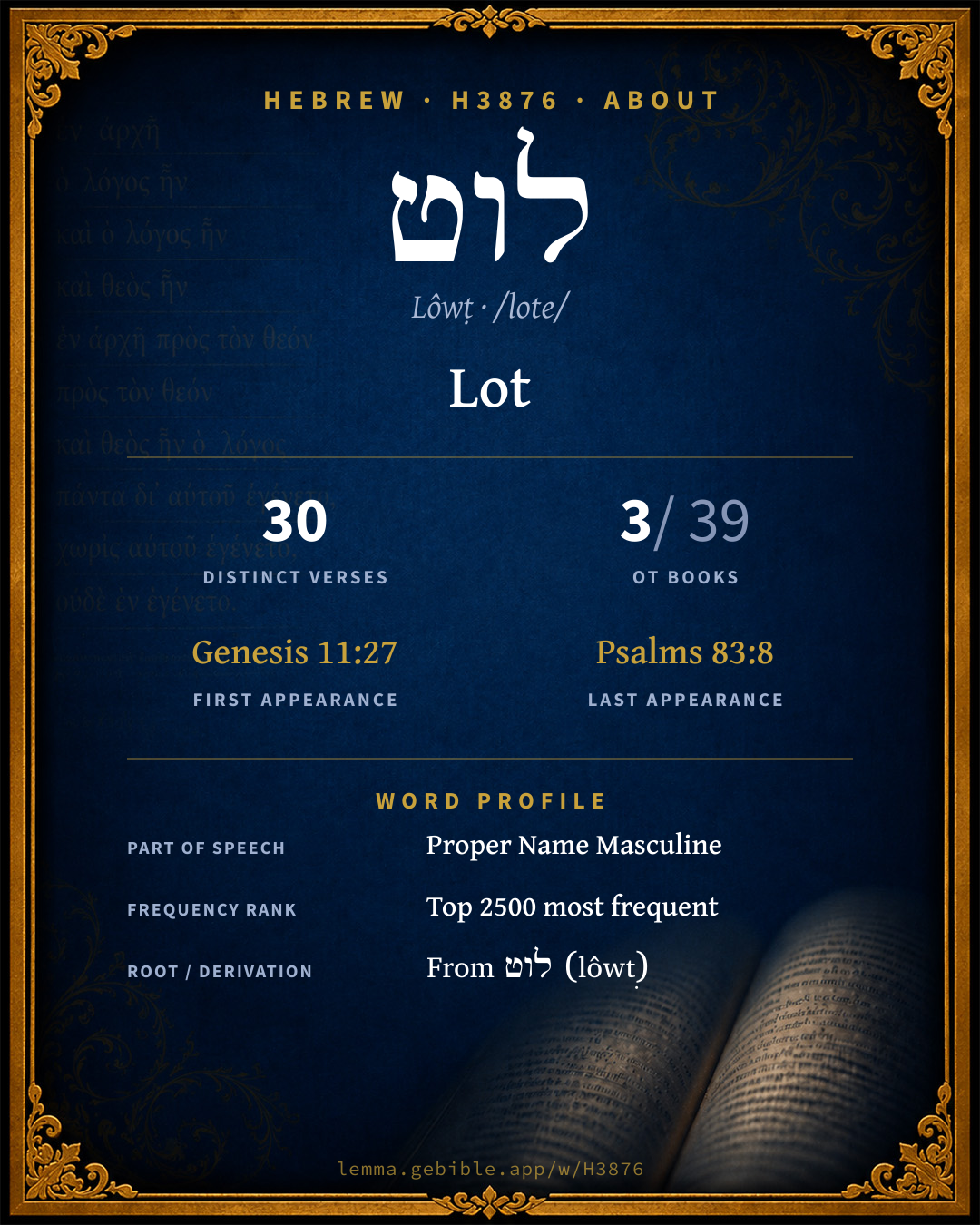
לוֹט
Lot
BDB lists 2 entries for ‘Lot’ fuller range ↓
Full lexicon entry — Brown-Driver-Briggs (BDB)
From Brown-Driver-Briggs (BDB)
Where this word appears
Grammar key — what these labels mean
Part of speech
- Noun
- A naming word — a person, place, thing, or idea.
Noun type
- Proper
- A name of a specific person, place, or people (e.g. Abraham, Zion, Israel).
Every verse where H3876 appears — 30 distinct verses across 3 books. Click any verse to open its interlinear word-by-word view. Verse text shown in the World English Bible for context — . Each verse’s Hebrew form is shown with its reference; the English is not keyword-highlighted, since the data carries no word-level English alignment. Use “Compare translations” on any verse to read it across multiple English versions. This concordance covers the Hebrew Bible; Septuagint (Greek Old Testament) occurrences are not indexed here.
Genesis 27 verses
- Genesis 11:27 לֽוֹט n Proper Now this is the history of the generations of Terah. Terah became the father of Abram, Nahor, and Haran. Haran became the father of Lot.
- Genesis 11:31 ל֤וֹט n Proper Terah took Abram his son, Lot the son of Haran, his son's son, and Sarai his daughter-in-law, his son Abram's wife. They went forth from Ur of the Chaldees, to go into the land of Canaan. They came to Haran, and lived there.
- Genesis 12:4 ל֑וֹט n Proper So Abram went, as Yahweh had spoken to him. Lot went with him. Abram was seventy-five years old when he departed out of Haran.
- Genesis 12:5 ל֣וֹט n Proper Abram took Sarai his wife, Lot his brother's son, all their substance that they had gathered, and the souls who they had gotten in Haran; and they went forth to go into the land of Canaan. Into the land of Canaan they came.
- Genesis 13:1 וְ/ל֥וֹט conj + n Proper Abram went up out of Egypt: he, his wife, all that he had, and Lot with him, into the South.
- Genesis 13:5 לְ/ל֔וֹט prep + n Proper Lot also, who went with Abram, had flocks, and herds, and tents.
- Genesis 13:7 ל֑וֹט n Proper There was a strife between the herdsmen of Abram's cattle and the herdsmen of Lot's cattle: and the Canaanite and the Perizzite lived then in the land.
- Genesis 13:8 ל֗וֹט n Proper Abram said to Lot, "Please, let there be no strife between me and you, and between my herdsmen and your herdsmen; for we are relatives.
- Genesis 13:10 ל֣וֹט n Proper Lot lifted up his eyes, and saw all the plain of the Jordan, that it was well watered every where, before Yahweh destroyed Sodom and Gomorrah, like the garden of Yahweh, like the land of Egypt, as you go to Zoar.
- Genesis 13:11 ל֗וֹט ל֖וֹט n Proper n Proper So Lot chose the Plain of the Jordan for himself. Lot traveled east, and they separated themselves the one from the other.
- Genesis 13:12 וְ/ל֗וֹט conj + n Proper Abram lived in the land of Canaan, and Lot lived in the cities of the plain, and moved his tent as far as Sodom.
- Genesis 13:14 ל֣וֹט n Proper Yahweh said to Abram, after Lot was separated from him, "Now, lift up your eyes, and look from the place where you are, northward and southward and eastward and westward,
- Genesis 14:12 ל֧וֹט n Proper They took Lot, Abram's brother's son, who lived in Sodom, and his goods, and departed.
- Genesis 14:16 ל֨וֹט n Proper He brought back all the goods, and also brought back his relative, Lot, and his goods, and the women also, and the people.
- Genesis 19:1 וְ/ל֖וֹט לוֹט֙ conj + n Proper n Proper The two angels came to Sodom at evening. Lot sat in the gate of Sodom. Lot saw them, and rose up to meet them. He bowed himself with his face to the earth,
- Genesis 19:5 לוֹט֙ n Proper They called to Lot, and said to him, "Where are the men who came in to you this night? Bring them out to us, that we may have sex with them."
- Genesis 19:6 ל֖וֹט n Proper Lot went out to them to the door, and shut the door after him.
- Genesis 19:9 בְּ/לוֹט֙ prep + n Proper They said, "Stand back!" They said, "This one fellow came in to live as a foreigner, and he appoints himself a judge. Now will we deal worse with you, than with them!" They pressed hard on the man, even Lot, and drew near to break the door.
- Genesis 19:10 ל֛וֹט n Proper But the men put forth their hand, and brought Lot into the house to them, and shut the door.
- Genesis 19:12 ל֗וֹט n Proper The men said to Lot, "Do you have anybody else here? Sons-in-law, your sons, your daughters, and whoever you have in the city, bring them out of the place:
- Genesis 19:14 ל֜וֹט n Proper Lot went out, and spoke to his sons-in-law, who were pledged to marry his daughters, and said, "Get up! Get out of this place, for Yahweh will destroy the city." But he seemed to his sons-in-law to be joking.
- Genesis 19:15 בְּ/ל֣וֹט prep + n Proper When the morning arose, then the angels hurried Lot, saying, "Arise, take your wife, and your two daughters who are here, lest you be consumed in the iniquity of the city."
- Genesis 19:18 ל֖וֹט n Proper Lot said to them, "Oh, not so, my lord.
- Genesis 19:23 וְ/ל֖וֹט conj + n Proper The sun was risen on the earth when Lot came to Zoar.
- Genesis 19:29 לוֹט֙ לֽוֹט n Proper n Proper It happened, when God destroyed the cities of the plain, that God remembered Abraham, and sent Lot out of the midst of the overthrow, when he overthrew the cities in which Lot lived.
- Genesis 19:30 ל֨וֹט n Proper Lot went up out of Zoar, and lived in the mountain, and his two daughters with him; for he was afraid to live in Zoar. He lived in a cave with his two daughters.
- Genesis 19:36 ל֖וֹט n Proper Thus both of Lot's daughters were with child by their father.
Deuteronomy 2 verses
- Deuteronomy 2:9 ל֔וֹט n Proper Yahweh said to me, Don't bother Moab, neither contend with them in battle; for I will not give you of his land for a possession; because I have given Ar to the children of Lot for a possession.
- Deuteronomy 2:19 ל֖וֹט n Proper and when you come near over against the children of Ammon, don't bother them, nor contend with them; for I will not give you of the land of the children of Ammon for a possession; because I have given it to the children of Lot for a possession.
Psalms 1 verse
About this entry
At a glance — auto-summarized from this page’s data, not written by a person. Every figure links to its source below. This summary describes the numbers; it doesn’t interpret them.
“Lot” is the headline sense of the Hebrew name לוט (Lôwṭ). It clusters heavily in Genesis, which alone accounts for 90% of its uses. With 30 verses in 3 books, it is a moderately common word in the Hebrew Bible. Scripture first uses it in Genesis 11:27. The sections below give every occurrence and version rendering.
Gloss history
Strong's 1890 vs modern scholarship
About this word
Strong's H3876 catalogs a Hebrew word from the Hebrew Old Testament.
These counts are not copied from any lexicon or concordance. They are computed here, from the morphology-tagged Hebrew Old Testament. What Lemma adds →
- 30
- distinct verses
- The word appears in 30 distinct verses.
- 3 / 39
- OT books
- The word appears in 3 of 39 Old Testament books.
- #1,064
- by frequency
- Top 2500 most frequent Hebrew words (rank 1,064 of 8,640 Hebrew words by occurrence).
View all 30 occurrences in the concordance →
Most concentrated in
- Genesis 27 verses 90%
- Deuteronomy 2 verses 7%
- Psalms 1 verse 3%
By section of the Old Testament
By traditional corpus
Conventional, traditional groupings — biblical authorship is debated, so this is a traditional corpus grouping, not an authorship claim. Each share is this word’s portion of its verses in that division of the Hebrew canon. Each figure is a share of the word’s 30 distinct verses.
- Torah (Pentateuch) 29 verses · 97%
- Writings (Ketuvim) 1 verse · 3%
How translations render this word
Counts come from each version’s own published word-to-Strong’s tagging or interlinear alignment — an approximate guide to how each version renders this word, not a word-level alignment the data otherwise carries. Because each total is that version’s own tagged count, the per-version totals vary from one another and need not match the appearance or distinct-verse counts above. These counts may also differ from a printed concordance because Lemma counts each distinctly tagged rendering and does not collapse phrase taggings into a single head-word total. This is a fixed set of word-tagged versions (KJV, ASV, BSB, ULT) and does not change with the reading translation you choose elsewhere. Each version’s license is shown beside its name below (and on Sources).
BDB lists this Strong’s number as 2 distinct words (homographs). Each count above pools all of them and is not split by sense — see the Senses section below. A low-frequency rendering may belong to a different one of those words, not the primary meaning.
- King James Version†: Lot 31×
- American Standard Version†: Lot 31×
- Berean Standard Bible†: Lot 28×
- unfoldingWord Literal Text†: Lot 33×
King James Version Public Domain
Renders H3876 across 33† tagged occurrences — most commonly:
Plus 2 renderings that appear only once — usually multi-word phrases or single function words the recovered tagging swept in, not distinct renderings.
American Standard Version Public Domain
Renders H3876 across 33† tagged occurrences — most commonly:
Plus 2 renderings that appear only once — usually multi-word phrases or single function words the recovered tagging swept in, not distinct renderings.
Berean Standard Bible Public Domain
Renders H3876 across 31† tagged occurrences — most commonly:
Plus 3 renderings that appear only once — usually multi-word phrases or single function words the recovered tagging swept in, not distinct renderings. Not rendered by a distinct English word in 2 further occurrences.
unfoldingWord Literal Text CC BY-SA 4.0
Renders H3876 across 33† tagged occurrences — most commonly:
Senses in the full BDB
What do BDB’s symbols mean?
BDB uses these scholarly abbreviations:
| Symbol | Meaning |
|---|---|
| 𝔊 | the Septuagint (the ancient Greek translation, LXX) |
| 𝔙 | the Vulgate (the Latin translation) |
| 𝔖 | the Syriac version (the Peshitta) |
| 𝔗 | the Targum (the Aramaic translation) |
| ψ | the Psalms |
| √ | root (the underlying root or stem) |
| ‖ | parallel passage (a synonymous or contrasted parallel) |
| † | the dagger: every passage where the word occurs is cited |
The 0 senses and sub-senses the full Brown-Driver-Briggs lexicon distinguishes for this word, in lexicon order (not ranked by frequency), with BDB’s own verbatim wording and sub-sense lettering. Shown in Hebrew script with BDB’s own scholarly abbreviations. The condensed entry is in the Lexicon Entry tab. See also the Forms in the corpus table below.
לוט I envelope, covering
לוט II m. Lot son of Haran, and nephew of Abram
Senses from the full Brown-Driver-Briggs lexicon (Brown, Driver, Briggs; Oxford 1906 — public domain), digitized via Sefaria, supplemented by the OpenScriptures HebrewLexicon (CC BY 4.0). Full attribution on Sources.
Word origin
I. n.m. envelope, covering;—Is 25:7 v. sub vb. supr.
II. n.pr.m. Lot son of Haran, and nephew of Abram; 𝔊 Λωτ;—Gn 11:27, 31; 12:4, 5; 13:1, 5, 7, 8, 10, 11(×2), 12, 14; 14:12, 16 + 15 times Gn 19; †בְּנֵי לוֹט = Moabites Dt 2:9; = Ammonites Dt 2:19; = both, ψ 83:9.
— Brown-Driver-Briggs (Oxford 1906, public domain), digitized via Sefaria, supplemented by the OpenScriptures HebrewLexicon (CC BY 4.0). See Sources.
Derived from לוט (lôwṭ) (H3875) — covering.
Jastrow Dictionary
A second Hebrew/Aramaic lexicon for comparison, covering Aramaic and post-biblical (Talmudic, Targumic, Midrashic) usage that the biblical-Hebrew BDB does not. Matched by lemma rather than by Strong’s number, so a lemma may carry more than one Jastrow headword (shown separately below), and the entries cover usage well beyond the Bible.
לוֹט I
- (b. h.) Lot, the nephew of Abraham. Ber. 54ᵃ הרואה … אשתו של ל׳ he who sees … Lot’s wife (the pillar of salt, Gen. XIX, 26). Erub. 65ᵃ הגיע לשכרותו של ל׳ who is as drunk (unconscious) as Lot. Gen. R. s. 44 (play on the name) לוט לוטא וכ׳ cursed Lot shall not be Abram’s heir; a. fr. e.g. Genesis 19:26
לוֹט II
- lotus. Gen. R. s. 91, end, expl. מַסְטִיכִי q. v.
לוּט
- (v. next w.) to curse. Part. לָט, f. לָטָה, Pl. לָטוֹת. Num. R. s. 9 (ed. Wil. p. 56) הכל נשבעות בך ול׳ זו וכ׳ all (women) shall swear by thee and curse each other saying, if thou hast done this, may thy end be &c.
לוּט ²
- [to cover, talk secretly; cmp. לחש,] to curse. Perf. לָט, לְוַט. Targ. Lev. XX, 9. Targ. I Kings II, 8 לְוָטַנִי; a. fr.—Part. לָאֵיט, לָאט, לָיֵיט, לָיֵט, לוּט. Targ. Y. I Num. XXIII, 8, Targ. Y. II, Num. XXIII, 8. Targ. Gen. XXVII, 29; a. fr.—Part. pass. לִיט, לוּט, לְווּט. Ib. III, 14; a. fr. Gen. R. s. 44 לוֹט לוטא; Yalk. ib. 76 ליטא, v. לוֹט I.—Snh. 49ᵃ top (prov.) תהא לוּטָא ולא תהא לָאטָה ed. (Ms. M. לָיְטָא, v. Rabb. D. S. a. l. note, Rashi ולא לטה) be cursed rather than cursing. Ib. 111ᵃ מֵילַט קא לַיְיטַת לי wilt thou curse me?—Ib. 113ᵃ [read:] ודילמא כי לט יהושע הכי לט (v. Rabb. D. S. a. l. note) is it so that when Joshua cursed (Jericho) he meant &c.?—Lev. R. s. 17 לְווּט ביתא באילין לְווּטַיָּא (בגוה) (Yalk. ib. 563 לִיט) cursed (with leprosy) is the house with such accursed inmates (who refuse favors to their neighbors); ib. (play on שקערורת, Lev. XIV, 37, as if שקע ארר) שקיע ביתא באילין לוו׳ to ruin goes the house with such &c. e.g. Leviticus 14:37
לְוָט
- (preced.) curse. Targ. Is. XIII, 1. Targ. Num. V, 21. Targ. Ex. IX, 28 קלין דל׳ (h. text קלת); Y. ib. 34; a. fr.—Pl. לְוָטִין, לְוָטַיָּא, לְוָו׳. Targ. Gen. XXVII, 12, sq.; a. e.
A Dictionary of the Targumim, the Talmud Babli and Yerushalmi, and the Midrashic Literature (Marcus Jastrow; London, Luzac, 1903) — Public Domain. Digitized via Sefaria. Digitized via Sefaria. Full attribution on Sources.
Forms in the corpus
The 18 distinct written forms H3876 takes in the Hebrew Bible, most frequent first — each parse links to that state’s occurrences in the concordance. Hebrew forms include their vowel points and cantillation, so a single lemma takes many written forms.
| Form | Parsing | Example | Uses |
|---|---|---|---|
| ל֖וֹט | Noun, Proper | Deuteronomy 2:19 | 5 |
| ל֣וֹט | Noun, Proper | Genesis 12:5 | 4 |
| ל֗וֹט | Noun, Proper | Genesis 13:8 | 3 |
| לוֹט֙ | Noun, Proper | Genesis 19:1 | 3 |
| וְ/ל֖וֹט | Noun, Proper | Genesis 19:1 | 2 |
| ל֑וֹט | Noun, Proper | Genesis 12:4 | 2 |
| ל֨וֹט | Noun, Proper | Genesis 14:16 | 2 |
| לֽוֹט | Noun, Proper | Genesis 11:27 | 2 |
| בְּ/ל֣וֹט | Noun, Proper | Genesis 19:15 | 1 |
| בְּ/לוֹט֙ | Noun, Proper | Genesis 19:9 | 1 |
| וְ/ל֗וֹט | Noun, Proper | Genesis 13:12 | 1 |
| וְ/ל֥וֹט | Noun, Proper | Genesis 13:1 | 1 |
| ל֔וֹט | Noun, Proper | Deuteronomy 2:9 | 1 |
| ל֛וֹט | Noun, Proper | Genesis 19:10 | 1 |
| ל֜וֹט | Noun, Proper | Genesis 19:14 | 1 |
| ל֤וֹט | Noun, Proper | Genesis 11:31 | 1 |
| ל֧וֹט | Noun, Proper | Genesis 14:12 | 1 |
| לְ/ל֔וֹט | Noun, Proper | Genesis 13:5 | 1 |
Same root — word family
Other BDB entries built from the same root as H3876, grouped by Strong’s listed origin. These share a root / origin per the lexicon — not necessarily a shared meaning. Each links to that word’s own entry.
Derives from
Proper names from this root
People and places named from this root — a name, not an additional meaning of the word.
Compare all same-root words → 2 of the same-root words are proper names (people or places). They share a root, not necessarily a meaning.
Bible dictionary
Public-domain dictionary articles matched to this entry by name (Lot). A biblical name can be shared by more than one person or place, so an article may treat several.
Easton's Bible Dictionary · M. G. Easton, 1897
(Heb. goral, a "pebble"), a small stone used in casting lots (Num. 33:54; Jonah 1:7). The lot was always resorted to by the Hebrews with strictest reference to the interposition of God, and as a method of ascertaining the divine will (Prov. 16:33), and in serious cases of doubt (Esther 3:7). Thus the lot was used at the division of the land of Canaan among the serveral tribes (Num. 26:55; 34:13), at the detection of Achan (Josh. 7:14, 18), the election of Saul to be king (1 Sam. 10:20, 21), the distribution of the priestly offices of the temple service (1 Chr. 24:3, 5, 19; Luke 1:9), and over the two goats at the feast of Atonement (Lev. 16:8). Matthias, who was "numbered with the eleven" (Acts 1:24-26), was chosen by lot.
This word also denotes a portion or an inheritance (Josh. 15:1; Ps. 125:3; Isa. 17:4), and a destiny, as assigned by God (Ps. 16:5; Dan. 12:13).
Lot, (Heb. lot), a covering; veil, the son of Haran, and nephew of Abraham (Gen. 11:27). On the death of his father, he was left in charge of his grandfather Terah (31), after whose death he accompanied his uncle Abraham into Canaan (12:5), thence into Egypt (10), and back again to Canaan (13:1). After this he separated from him and settled in Sodom (13:5-13). There his righteous soul was "vexed" from day to day (2 Pet. 2:7), and he had great cause to regret this act. Not many years after the separation he was taken captive by Chedorlaomer, and was rescued by Abraham (Gen. 14). At length, when the judgment of God descended on the guilty cities of the plain (Gen. 19:1-20), Lot was miraculously delivered. When fleeing from the doomed city his wife "looked back from behind him, and became a pillar of salt." There is to this day a peculiar crag at the south end of the Dead Sea, near Kumran, which the Arabs call Bint Sheik Lot, i.e., Lot's wife. It is "a tall, isolated needle of rock, which really does bear a curious resemblance to an Arab woman with a child upon her shoulder." From the words of warning in Luke 17:32, "Remember Lot's wife," it would seem as if she had gone back, or tarried so long behind in the desire to save some of her goods, that she became involved in the destruction which fell on the city, and became a stiffened corpse, fixed for a time in the saline incrustations. She became "a pillar of salt", i.e., as some think, of asphalt. (See SALT.)
Lot and his daughters sought refuge first in Zoar, and then, fearing to remain there longer, retired to a cave in the neighbouring mountains (Gen. 19:30). Lot has recently been connected with the people called on the Egyptian monuments Rotanu or Lotanu, who is supposed to have been the hero of the Edomite tribe Lotan.
Smith's Bible Dictionary · William Smith, 1863
(literally a pebble). The custom of deciding doubtful questions by lot is one of great extent and high antiquity. Among the Jews lots were used with the expectation that God would so control them as to give a right direction to them. They were very often used by God's appointment. "As to the mode of casting lots, we have no certain information. Probably several modes were practiced." "Very commonly among the Latins little counters of wood were put into a jar with so narrow a neck that only one could come out at a time. After the jar had been filled with water and the contents shaken, the lots were determined by the order in which the bits of wood, representing the several parties, came out with the water. in other cases they were put into a wide open jar, and the counters were drawn out by the hand. Sometimes again they were cast in the manner of dice. The soldiers who cast lots for Christ's garments undoubtedly used these dice."--Lyman Abbott.
(veil or covering), the son of Haran, and therefore the nephew of Abraham. (Genesis 11:27,31) (B.C. before 1926-1898.) His sisters were Milcah the wife of Nahor, and Iscah, by some identified with Sarah. haran died before the emigration of Terah and his family from Ur of the Chaldees, ver. 28, and Lot was therefore born there. He removed with the rest of his kindred to Charran, and again subsequently with Abraham and Sarai to Canaan. ch. (Genesis 12:4,5) With them he took refuge in Egypt from a famine, and with them returned, first to the "south," ch. (Genesis 13:1) and then to their original settlement between Bethel and Ai. vs. (Genesis 13:3,4) But the pastures of the hills of Bethel, which had with ease contained the two strangers on their first arrival, were not able any longer to bear them, so much had their possessions of sheep, goats and cattle increased. Accordingly they separated, Lot choosing the fertile plain of the Jordan, and advancing as far as Sodom. (Genesis 13:10-14) The next occurrence in the life of Lot is his capture by the four kings of the east and his rescue by Abram. ch. (Genesis 13:14) The last scene preserved to us in the history of Lot is too well known to need repetition. He was still living in Sodom, (Genesis 19:1) ... from which he was rescued by some angels on the day of its final overthrow. he fled first to Zoar, in which he found a temporary refuge during the destruction of the other cities of the plain. Where this place was situated is not known with certainty. [Zoar] The end of Lot's wife is commonly treated as one of the difficulties of the Bible; but it surely need not be so. It cannot be necessary to create the details of the story where none are given. On these points the record is silent. The value and the significance of the story to us are contained in the allusion of Christ. (Luke 17:32) Later ages have not been satisfied so to leave the matter, but have insisted on identifying the "pillar" with some one of the fleeting forms which the perishable rock of the south end of the Dead Sea is constantly assuming in its process of decomposition and liquefaction. From the incestuous intercourse between Lot and his two daughters sprang the nations of Moab and Ammon.
Hitchcock's Bible Names Dictionary · Roswell D. Hitchcock, 1869
Lotan, wrapt up; hidden; covered; myrrh; rosin
Classic public-domain reference works; full attribution on Sources.
Septuagint verse parallels
This word appears in 30 verses that also exist in the Greek Old Testament (Septuagint), out of the 30 Hebrew verses it occurs in. You can read those verses in Greek by switching the Old Testament edition to the Septuagint.
Read these verses in the Septuagint
This is a verse-level parallel only — the same verses exist in both the Hebrew and Greek Old Testaments. No word-level Hebrew↔Greek correspondence is claimed: the data carries no such alignment, so no Greek word is shown as this Hebrew word’s translation. Coverage is not total — the Septuagint omits the deuterocanon and renumbers the Psalms, so some Hebrew verses have no direct Greek parallel.