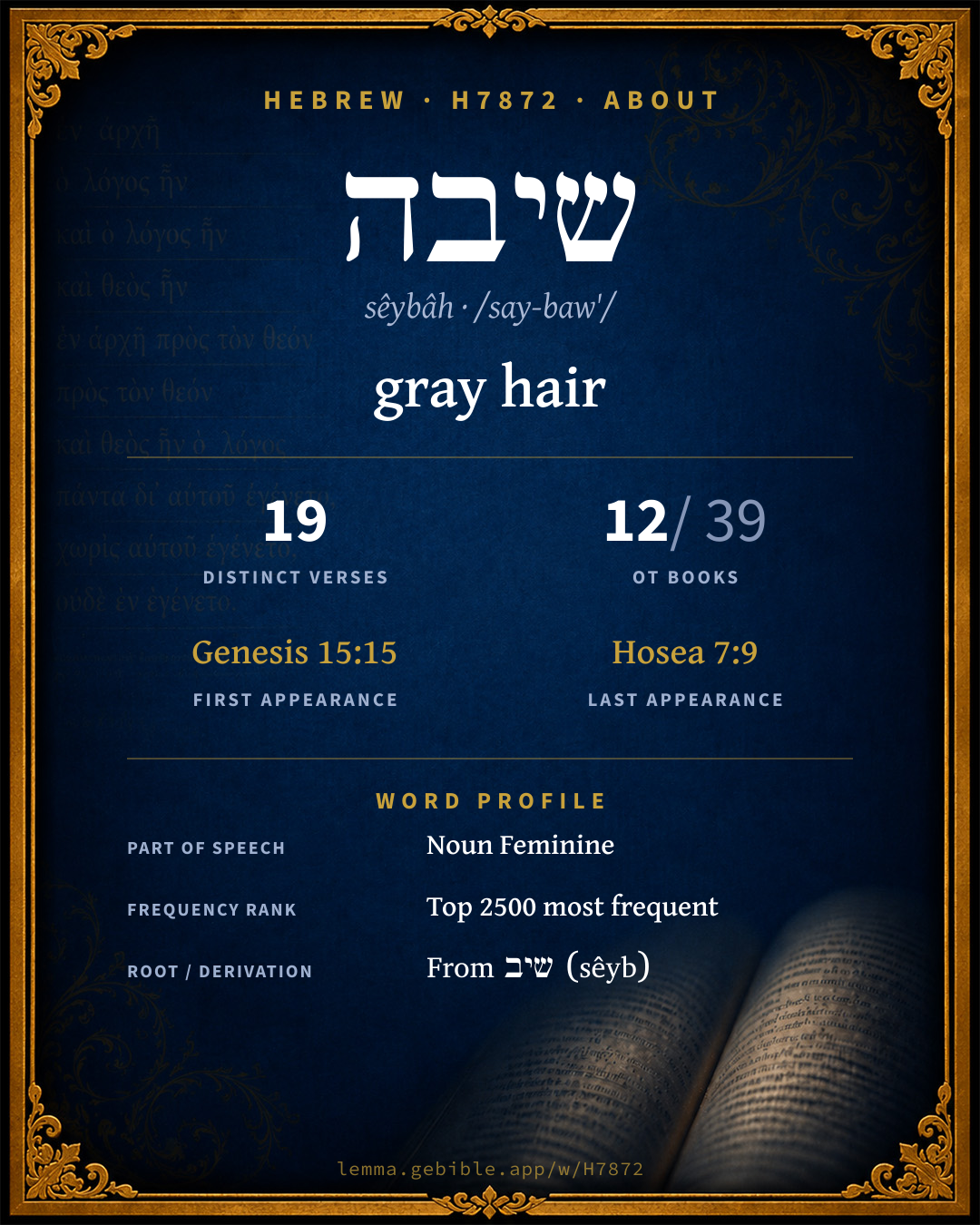
שֵׂיבָה
gray hair
also: age, hoary head, old age fuller range ↓
Full lexicon entry — Brown-Driver-Briggs (BDB)
From Brown-Driver-Briggs (BDB)
Where this word appears
See every Absolute-state word in the Hebrew Bible →
Grammar key — what these labels mean
Part of speech
- Noun
- A naming word — a person, place, thing, or idea.
Noun type
- Common
- A common noun — a general class of person, place, or thing (“king,” “city,” “water”), not a specific name.
State
- Absolute
- The independent form of a noun, not bound to a following word.
- Construct
- A noun bound to a following noun in a possessive / “of” relationship (the construct chain).
Gender
- Feminine
- Grammatically feminine.
Number
- Singular
- One.
Grammatical forms
- Noun, Common, Feminine, Singular, Absolute 13 times (68%)
- Noun, Common, Feminine, Singular, Construct 6 times (32%)
Parsed forms decoded from the imported morphology (morphhb / Westminster Leningrad Codex — WLC text public domain, morphhb tagging CC BY 4.0), counted across 19 parsed occurrences — not distinct verses.
Every verse where H7872 appears — 19 distinct verses across 12 books. Click any verse to open its interlinear word-by-word view. Verse text shown in the World English Bible for context — . Each verse’s Hebrew form is shown with its reference; the English is not keyword-highlighted, since the data carries no word-level English alignment. Use “Compare translations” on any verse to read it across multiple English versions. This concordance covers the Hebrew Bible; Septuagint (Greek Old Testament) occurrences are not indexed here.
Genesis 5 verses
- Genesis 15:15 בְּ/שֵׂיבָ֥ה prep + n c fs But you will go to your fathers in peace. You will be buried in a good old age.
- Genesis 25:8 בְּ/שֵׂיבָ֥ה prep + n c fs Abraham gave up the spirit, and died in a good old age, an old man, and full of years, and was gathered to his people.
- Genesis 42:38 שֵׂיבָתִ֛/י n c fs cs + sfx pers 1cs He said, "My son shall not go down with you; for his brother is dead, and he only is left. If harm happens to him by the way in which you go, then you will bring down my gray hairs with sorrow to Sheol."
- Genesis 44:29 שֵׂיבָתִ֛/י n c fs cs + sfx pers 1cs If you take this one also from me, and harm happens to him, you will bring down my gray hairs with sorrow to Sheol.'
- Genesis 44:31 שֵׂיבַ֨ת n c fs cs it will happen, when he sees that the boy is no more, that he will die. Your servants will bring down the gray hairs of your servant, our father, with sorrow to Sheol.
Leviticus 1 verse
Deuteronomy 1 verse
Judges 1 verse
Ruth 1 verse
1 Kings 2 verses
- 1 Kings 2:6 שֵׂיבָת֛/וֹ n c fs cs + sfx pers 3ms Do therefore according to your wisdom, and don't let his gray head go down to Sheol in peace.
- 1 Kings 2:9 שֵׂיבָת֛/וֹ n c fs cs + sfx pers 3ms Now therefore don't hold him guiltless, for you are a wise man; and you will know what you ought to do to him, and you shall bring his gray head down to Sheol with blood.
1 Chronicles 1 verse
Job 1 verse
Psalms 2 verses
- Psalms 71:18 וְ/שֵׂיבָה֮ conj + n c fs Yes, even when I am old and gray-haired, God, don't forsake me, Until I have declared your strength to the next generation, Your might to everyone who is to come.
- Psalms 92:14 בְּ/שֵׂיבָ֑ה prep + n c fs They will still bring forth fruit in old age. They will be full of sap and green,
Proverbs 2 verses
Isaiah 1 verse
Hosea 1 verse
About this entry
At a glance — auto-summarized from this page’s data, not written by a person. Every figure links to its source below. This summary describes the numbers; it doesn’t interpret them.
“gray hair” is the headline sense of the Hebrew noun שיבה (sêybâh). The King James Version usually renders it “old age,” while modern versions prefer “gray hair” (unfoldingWord Literal Text) — see the renderings breakdown. With 19 verses in 12 books, it is an uncommon word in the Hebrew Bible. It concentrates in Genesis, which alone accounts for 26% of its uses. Not a single-sense word: its full sense range also takes in “age”, “hoary head”, and “old age”. See the sense tree, 19-verse concordance, and the renderings breakdown below.
Gloss history
Strong's 1890 vs modern scholarship
About this word
Strong's H7872 catalogs a Hebrew word from the Hebrew Old Testament.
These counts are not copied from any lexicon or concordance. They are computed here, from the morphology-tagged Hebrew Old Testament. What Lemma adds →
- 19
- distinct verses
- The word appears in 19 distinct verses.
- 12 / 39
- OT books
- The word appears in 12 of 39 Old Testament books.
- #1,563
- by frequency
- Top 2500 most frequent Hebrew words (rank 1,563 of 8,640 Hebrew words by occurrence).
View all 19 occurrences in the concordance →
By section of the Old Testament
By traditional corpus
Conventional, traditional groupings — biblical authorship is debated, so this is a traditional corpus grouping, not an authorship claim. Each share is this word’s portion of its verses in that division of the Hebrew canon. Each figure is a share of the word’s 19 distinct verses.
- Torah (Pentateuch) 7 verses · 37%
- Writings (Ketuvim) 7 verses · 37%
- Prophets (Nevi'im) 5 verses · 26%
How translations render this word
Counts come from each version’s own published word-to-Strong’s tagging or interlinear alignment — an approximate guide to how each version renders this word, not a word-level alignment the data otherwise carries. Because each total is that version’s own tagged count, the per-version totals vary from one another and need not match the appearance or distinct-verse counts above. These counts may also differ from a printed concordance because Lemma counts each distinctly tagged rendering and does not collapse phrase taggings into a single head-word total. This is a fixed set of word-tagged versions (KJV, ASV, BSB, ULT) and does not change with the reading translation you choose elsewhere. Each version’s license is shown beside its name below (and on Sources).
- King James Version: Old age 6×, Gray hairs 4×, Hoary head 2×
- American Standard Version: Old age 6×, Gray hairs 4×, Hoary head 2×
- Berean Standard Bible: Old age 5×, Gray 2×, Gray hair 2×
- unfoldingWord Literal Text: Gray hair 7×, Old age 5×, A 2×
King James Version Public Domain
Renders H7872 across 19 tagged occurrences — most commonly:
Plus 7 renderings that appear only once — usually multi-word phrases or single function words the recovered tagging swept in, not distinct renderings.
American Standard Version Public Domain
Renders H7872 across 19 tagged occurrences — most commonly:
Plus 7 renderings that appear only once — usually multi-word phrases or single function words the recovered tagging swept in, not distinct renderings.
Berean Standard Bible Public Domain
Renders H7872 across 19 tagged occurrences — most commonly:
Plus 8 renderings that appear only once — usually multi-word phrases or single function words the recovered tagging swept in, not distinct renderings.
unfoldingWord Literal Text CC BY-SA 4.0
Renders H7872 across 23 tagged occurrences — most commonly:
Plus 5 renderings that appear only once — usually multi-word phrases or single function words the recovered tagging swept in, not distinct renderings.
Senses in the full BDB
What do BDB’s symbols mean?
BDB uses these scholarly abbreviations:
| Symbol | Meaning |
|---|---|
| 𝔊 | the Septuagint (the ancient Greek translation, LXX) |
| 𝔙 | the Vulgate (the Latin translation) |
| 𝔖 | the Syriac version (the Peshitta) |
| 𝔗 | the Targum (the Aramaic translation) |
| ψ | the Psalms |
| √ | root (the underlying root or stem) |
| ‖ | parallel passage (a synonymous or contrasted parallel) |
| † | the dagger: every passage where the word occurs is cited |
The 2 senses and sub-senses the full Brown-Driver-Briggs lexicon distinguishes for this word, in lexicon order (not ranked by frequency), with BDB’s own verbatim wording and sub-sense lettering. Shown in Hebrew script with BDB’s own scholarly abbreviations. The condensed entry is in the Lexicon Entry tab. See also the Forms in the corpus table below.
- 1. grey hair, hoary head Ho 7:9 (fig.), Gn 42:38; 44:29, 31 (all J), 1 K 2:6, 9; Pr 16:31; 20:29; אִישׁ שׂ׳ Dt 32:25 (opp. יוֹנֵק); ‖ זָקֵן Lv 19:32 (H), ‖ זִקְנָה Is 46:4, + id., ψ 71:18 (in these transition to foll.); fig. of sea Jb 41:24. e.g. Hosea 7:9
- 2. old age, שׂ׳ טוֹבָה Gn 15:15 (JE), 25:8 (P), Ju 8:32; 1 Ch 29:28; שׂ׳ also ψ 92:15 (trees, in fig. of righteous), Ru 4:15, + 2 S 19:34 (𝔊 Ew Th Bu Kit, cf. We Dr HPS, אֶת־שֵׂיבָֽתְךָ, for אֹתְךָ). e.g. Genesis 15:15
Senses from the full Brown-Driver-Briggs lexicon (Brown, Driver, Briggs; Oxford 1906 — public domain), digitized via Sefaria, supplemented by the OpenScriptures HebrewLexicon (CC BY 4.0). Full attribution on Sources.
Word origin
n.f. hoary head, old age;—abs. שׂ׳ Ho 7:9 +; cstr. שֵׂיבַת Gn 44:31; sf. שֵׂיבָתִי 42:38; 44:29, etc.;—
— Brown-Driver-Briggs (Oxford 1906, public domain), digitized via Sefaria, supplemented by the OpenScriptures HebrewLexicon (CC BY 4.0). See Sources.
Derived from שיב (sêyb) (H7869) — old age.
Jastrow Dictionary
A second Hebrew/Aramaic lexicon for comparison, covering Aramaic and post-biblical (Talmudic, Targumic, Midrashic) usage that the biblical-Hebrew BDB does not. Matched by lemma rather than by Strong’s number, so a lemma may carry more than one Jastrow headword (shown separately below), and the entries cover usage well beyond the Bible.
שִׁיבָה
- going back, return; use of the root שׁוּב. Sifra M’tsora, Neg., ch. IV, Par. 7 (ref. to Lev. XIV, 39, a. 43) מה ש׳ האמורה להלן וכ׳ as the coming back mentioned there refers to the lapse of a week, so it does here. Ib. זו היא ש׳, v. בִּיאָה II; Men. 4ᵃ. Macc. 13ᵃ גמר ש׳ ש׳ מהתם we learn the meaning of שוב (Num. XXXV, 28) from שוב there (Lev. XXV, 41), i.e. he is restored to his ancestral estate; a. e. e.g. Leviticus 14:39
שֵׂיבָה
- v. סָב) gray hair, old age, venerability of old age. Pirké d’R. El. ch. LII מיום שברא … לא נזרקה ש׳ וכ׳ since heaven and earth were created, the white of old age was not sprinkled upon men, until Abraham came &c. Gen. R. s. 59 (ref. to Ps. LXXI, 18) לא היא זקנה ולא היא ש׳ אלא … תן לי ש׳ are not ziḳnah and sebah the same? But (David prayed), if thou givest me old age, give me its venerable appearance with it. Ab. V, 21 בן שבעים לש׳ when seventy years old, man enters hoary age, contrad. to זקנה; a. fr. e.g. Psalms 71:18
A Dictionary of the Targumim, the Talmud Babli and Yerushalmi, and the Midrashic Literature (Marcus Jastrow; London, Luzac, 1903) — Public Domain. Digitized via Sefaria. Digitized via Sefaria. Full attribution on Sources.
Forms in the corpus
The 13 distinct written forms H7872 takes in the Hebrew Bible, most frequent first — each parse links to that state’s occurrences in the concordance. Hebrew forms include their vowel points and cantillation, so a single lemma takes many written forms.
| Form | Parsing | Example | Uses |
|---|---|---|---|
| בְּ/שֵׂיבָ֣ה | Noun, Common, Feminine, Singular, Absolute | 1 Chronicles 29:28 | 2 |
| בְּ/שֵׂיבָ֥ה | Noun, Common, Feminine, Singular, Absolute | Genesis 15:15 | 2 |
| שֵׂיבָֽה | Noun, Common, Feminine, Singular, Absolute | Deuteronomy 32:25 | 2 |
| שֵׂיבָה֙ | Noun, Common, Feminine, Singular, Absolute | Hosea 7:9 | 2 |
| שֵׂיבָת֛/וֹ | Noun, Common, Feminine, Singular, Construct | 1 Kings 2:6 | 2 |
| שֵׂיבָתִ֛/י | Noun, Common, Feminine, Singular, Construct | Genesis 42:38 | 2 |
| בְּ/שֵׂיבָ֑ה | Noun, Common, Feminine, Singular, Absolute | Psalms 92:14 | 1 |
| וְ/שֵׂיבָה֮ | Noun, Common, Feminine, Singular, Absolute | Psalms 71:18 | 1 |
| לְ/שֵׂיבָֽה | Noun, Common, Feminine, Singular, Absolute | Job 41:32 | 1 |
| שֵיבָ֖ה | Noun, Common, Feminine, Singular, Absolute | Isaiah 46:4 | 1 |
| שֵׂיבַ֨ת | Noun, Common, Feminine, Singular, Construct | Genesis 44:31 | 1 |
| שֵׂיבָ֑ה | Noun, Common, Feminine, Singular, Absolute | Proverbs 16:31 | 1 |
| שֵׂיבָתֵ֑/ךְ | Noun, Common, Feminine, Singular, Construct | Ruth 4:15 | 1 |
Septuagint verse parallels
This word appears in 15 verses that also exist in the Greek Old Testament (Septuagint), out of the 19 Hebrew verses it occurs in. You can read those verses in Greek by switching the Old Testament edition to the Septuagint.
Read these verses in the Septuagint
- Genesis 15:15
- Leviticus 19:32
- Deuteronomy 32:25
- Judges 8:32
- Ruth 4:15
- 1 Kings 2:6
- 1 Chronicles 29:28
- Psalms 71:18
- Isaiah 46:4
- Hosea 7:9
This is a verse-level parallel only — the same verses exist in both the Hebrew and Greek Old Testaments. No word-level Hebrew↔Greek correspondence is claimed: the data carries no such alignment, so no Greek word is shown as this Hebrew word’s translation. Coverage is not total — the Septuagint omits the deuterocanon and renumbers the Psalms, so some Hebrew verses have no direct Greek parallel.