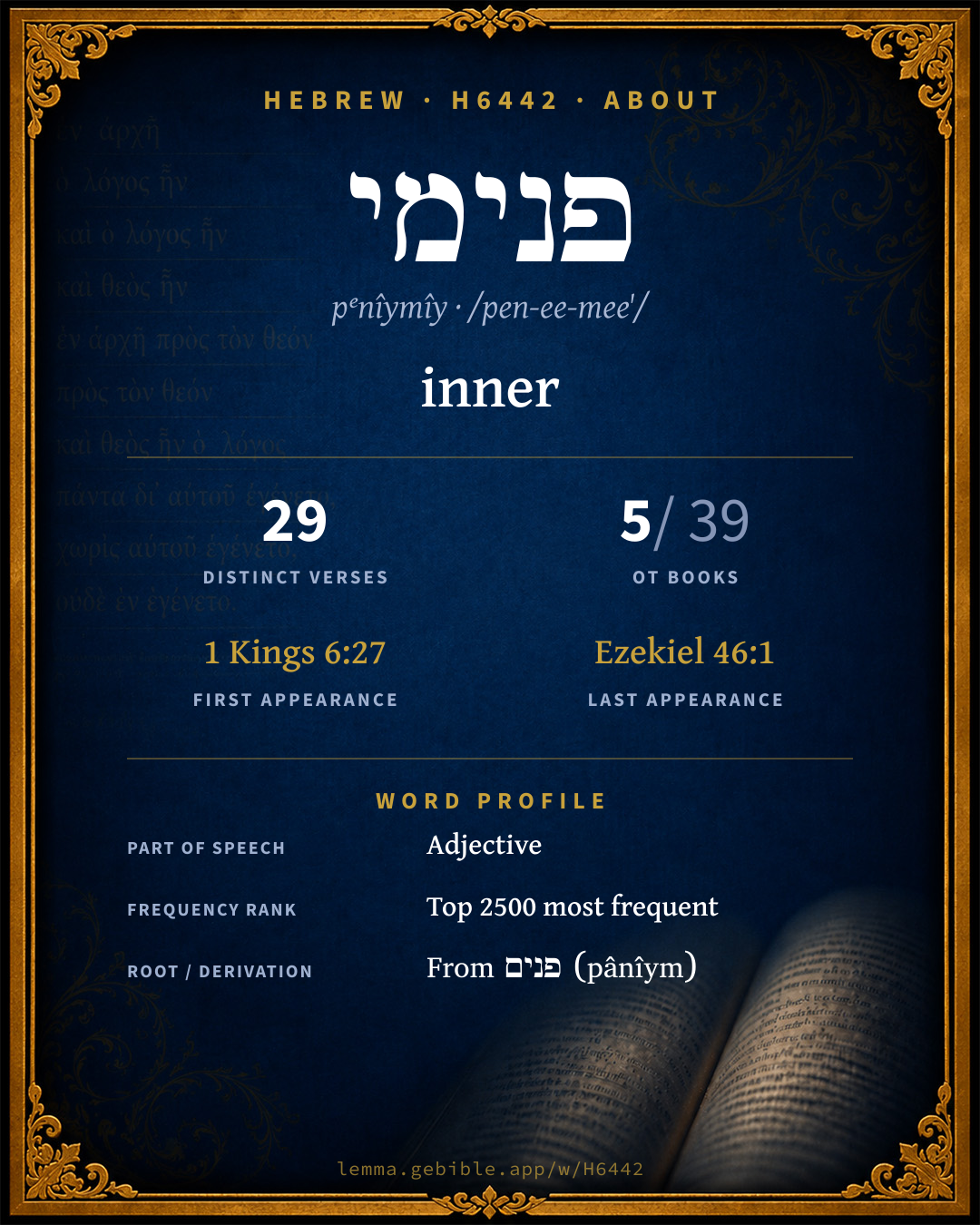
פְּנִימִי
inner
Full lexicon entry — Brown-Driver-Briggs (BDB)
From Brown-Driver-Briggs (BDB)
Where this word appears
Grammar key — what these labels mean
State
- Absolute
- The independent form of a noun, not bound to a following word.
Gender
- Masculine
- Grammatically masculine.
- Feminine
- Grammatically feminine.
Number
- Singular
- One.
- Plural
- More than one (in Hebrew, generally three or more).
Grammatical forms
- Adjective, Adjective, Masculine, Singular, Absolute 16 times (50%)
- Adjective, Adjective, Feminine, Singular, Absolute 14 times (44%)
- Adjective, Adjective, Feminine, Plural, Absolute 1 time (3%)
- Adjective, Adjective, Masculine, Plural, Absolute 1 time (3%)
Parsed forms decoded from the imported morphology (morphhb / Westminster Leningrad Codex — WLC text public domain, morphhb tagging CC BY 4.0), counted across 32 parsed occurrences — not distinct verses.
Every verse where H6442 appears — 29 distinct verses across 5 books. Click any verse to open its interlinear word-by-word view. Verse text shown in the World English Bible for context — . Each verse’s Hebrew form is shown with its reference; the English is not keyword-highlighted, since the data carries no word-level English alignment. Use “Compare translations” on any verse to read it across multiple English versions. This concordance covers the Hebrew Bible; Septuagint (Greek Old Testament) occurrences are not indexed here.
1 Kings 4 verses
- 1 Kings 6:27 הַ/פְּנִימִ֗י ptcl def.art + Adjective Adjective ms He set the cherubim within the inner house; and the wings of the cherubim were stretched forth, so that the wing of the one touched the one wall, and the wing of the other cherub touched the other wall; and their wings touched one another in the midst of the house.
- 1 Kings 6:36 הַ/פְּנִימִ֔ית ptcl def.art + Adjective Adjective fs He built the inner court with three courses of hewn stone, and a course of cedar beams.
- 1 Kings 7:12 הַ/פְּנִימִ֖ית ptcl def.art + Adjective Adjective fs The great court round about had three courses of hewn stone, and a course of cedar beams; like as the inner court of the house of Yahweh, and the porch of the house.
- 1 Kings 7:50 הַ/פְּנִימִ֜י ptcl def.art + Adjective Adjective ms and the cups, and the snuffers, and the basins, and the spoons, and the fire pans, of pure gold; and the hinges, both for the doors of the inner house, the most holy place, and for the doors of the house, [to wit], of the temple, of gold.
1 Chronicles 1 verse
2 Chronicles 1 verse
Esther 2 verses
- Esther 4:11 הַ/פְּנִימִ֜ית ptcl def.art + Adjective Adjective fs All the king's servants, and the people of the king's provinces, do know, that whoever, whether man or woman, shall come to the king into the inner court, who is not called, there is one law for him, that he be put to death, except those to whom the king shall hold out the golden scepter, that he may live: but I have not been called to come in to the king these thirty days.
- Esther 5:1 הַ/פְּנִימִ֔ית ptcl def.art + Adjective Adjective fs Now it happened on the third day, that Esther put on her royal clothing, and stood in the inner court of the king's house, over against the king's house: and the king sat on his royal throne in the royal house, over against the entrance of the house.
Ezekiel 21 verses
- Ezekiel 8:3 הַ/פְּנִימִית֙ ptcl def.art + Adjective Adjective fs He put forth the form of a hand, and took me by a lock of my head; and the Spirit lifted me up between earth and the sky, and brought me in the visions of God to Jerusalem, to the door of the gate of the inner [court] that looks toward the north; where was the seat of the image of jealousy, which provokes to jealousy.
- Ezekiel 8:16 הַ/פְּנִימִית֒ ptcl def.art + Adjective Adjective fs He brought me into the inner court of Yahweh's house; and see, at the door of the temple of Yahweh, between the porch and the altar, were about twenty-five men, with their backs toward the temple of Yahweh, and their faces toward the east; and they were worshipping the sun toward the east.
- Ezekiel 10:3 הַ/פְּנִימִֽית ptcl def.art + Adjective Adjective fs Now the cherubim stood on the right side of the house, when the man went in; and the cloud filled the inner court.
- Ezekiel 40:15 הַ/פְּנִימִ֑י ptcl def.art + Adjective Adjective ms [From] the forefront of the gate at the entrance to the forefront of the inner porch of the gate were fifty cubits.
- Ezekiel 40:19 הַ/פְּנִימִ֛י ptcl def.art + Adjective Adjective ms Then he measured the breadth from the forefront of the lower gate to the forefront of the inner court outside, one hundred cubits, [both] on the east and on the north.
- Ezekiel 40:23 הַ/פְּנִימִ֔י ptcl def.art + Adjective Adjective ms There was a gate to the inner court over against the [other] gate, [both] on the north and on the east; and he measured from gate to gate one hundred cubits.
- Ezekiel 40:27 הַ/פְּנִימִ֖י ptcl def.art + Adjective Adjective ms There was a gate to the inner court toward the south: and he measured from gate to gate toward the south a hundred cubits.
- Ezekiel 40:28 הַ/פְּנִימִ֖י ptcl def.art + Adjective Adjective ms Then he brought me to the inner court by the south gate: and he measured the south gate according to these measures;
- Ezekiel 40:32 הַ/פְּנִימִ֖י ptcl def.art + Adjective Adjective ms He brought me into the inner court toward the east: and he measured the gate according to these measures;
- Ezekiel 40:44 הַ/פְּנִימִ֜י הַ/פְּנִימִי֙ ptcl def.art + Adjective Adjective ms ptcl def.art + Adjective Adjective ms Outside of the inner gate were chambers for the singers in the inner court, which was at the side of the north gate; and their prospect was toward the south; one at the side of the east gate having the prospect toward the north.
- Ezekiel 41:15 הַ/פְּנִימִ֔י ptcl def.art + Adjective Adjective ms He measured the length of the building before the separate place which was at the back of it, and the galleries of it on the one side and on the other side, one hundred cubits; and the inner temple, and the porches of the court;
- Ezekiel 41:17 הַ/פְּנִימִ֨י בַּ/פְּנִימִ֥י ptcl def.art + Adjective Adjective ms prep det + Adjective Adjective ms to [the space] above the door, even to the inner house, and outside, and by all the wall round about inside and outside, by measure.
- Ezekiel 42:3 הַ/פְּנִימִ֔י ptcl def.art + Adjective Adjective ms Over against the twenty [cubits] which belonged to the inner court, and over against the pavement which belonged to the outer court, was gallery against gallery in the third story.
- Ezekiel 42:4 הַ/פְּנִימִ֔ית ptcl def.art + Adjective Adjective fs Before the chambers was a walk of ten cubits' breadth inward, a way of one cubit; and their doors were toward the north.
- Ezekiel 42:15 הַ/פְּנִימִ֔י ptcl def.art + Adjective Adjective ms Now when he had made an end of measuring the inner house, he brought me forth by the way of the gate whose prospect is toward the east, and measured it round about.
- Ezekiel 43:5 הַ/פְּנִימִ֑י ptcl def.art + Adjective Adjective ms The Spirit took me up, and brought me into the inner court; and, behold, the glory of Yahweh filled the house.
- Ezekiel 44:17 הַ/פְּנִימִ֔ית הַ/פְּנִימִ֖ית ptcl def.art + Adjective Adjective fs ptcl def.art + Adjective Adjective fs It shall be that, when they enter in at the gates of the inner court, they shall be clothed with linen garments; and no wool shall come on them, while they minister in the gates of the inner court, and within.
- Ezekiel 44:21 הַ/פְּנִימִֽית ptcl def.art + Adjective Adjective fs Neither shall any of the priests drink wine, when they enter into the inner court.
- Ezekiel 44:27 הַ/פְּנִימִית֙ ptcl def.art + Adjective Adjective fs In the day that he goes into the sanctuary, into the inner court, to minister in the sanctuary, he shall offer his sin-offering, says the Lord Yahweh.
- Ezekiel 45:19 הַ/פְּנִימִֽית ptcl def.art + Adjective Adjective fs The priest shall take of the blood of the sin-offering, and put it on the door-posts of the house, and on the four corners of the ledge of the altar, and on the posts of the gate of the inner court.
- Ezekiel 46:1 הַ/פְּנִימִית֙ ptcl def.art + Adjective Adjective fs Thus says the Lord Yahweh: The gate of the inner court that looks toward the east shall be shut the six working days; but on the Sabbath day it shall be opened, and on the day of the new moon it shall be opened.
About this entry
At a glance — auto-summarized from this page’s data, not written by a person. Every figure links to its source below. This summary describes the numbers; it doesn’t interpret them.
At its core, פנימי (pᵉnîymîy) means “inner.” The word gravitates to Ezekiel (72%), then 1 Kings and Esther. It turns up in 29 verses across 5 books, a moderately common footprint. Scripture first uses it in 1 Kings 6:27. It shares a root with פנים, לפני and פנימה. Each statement above links to its evidence; the full detail follows below.
Gloss history
Strong's 1890 vs modern scholarship
About this word
Strong's H6442 catalogs a Hebrew word from the Hebrew Old Testament.
These counts are not copied from any lexicon or concordance. They are computed here, from the morphology-tagged Hebrew Old Testament. What Lemma adds →
- 29
- distinct verses
- The word appears in 29 distinct verses.
- 5 / 39
- OT books
- The word appears in 5 of 39 Old Testament books.
- #1,086
- by frequency
- Top 2500 most frequent Hebrew words (rank 1,086 of 8,640 Hebrew words by occurrence).
View all 29 occurrences in the concordance →
By section of the Old Testament
By traditional corpus
Conventional, traditional groupings — biblical authorship is debated, so this is a traditional corpus grouping, not an authorship claim. Each share is this word’s portion of its verses in that division of the Hebrew canon. Each figure is a share of the word’s 29 distinct verses.
- Prophets (Nevi'im) 25 verses · 86%
- Writings (Ketuvim) 4 verses · 14%
How translations render this word
Counts come from each version’s own published word-to-Strong’s tagging or interlinear alignment — an approximate guide to how each version renders this word, not a word-level alignment the data otherwise carries. Because each total is that version’s own tagged count, the per-version totals vary from one another and need not match the appearance or distinct-verse counts above. These counts may also differ from a printed concordance because Lemma counts each distinctly tagged rendering and does not collapse phrase taggings into a single head-word total. This is a fixed set of word-tagged versions (KJV, ASV, BSB, ULT) and does not change with the reading translation you choose elsewhere. Each version’s license is shown beside its name below (and on Sources).
- King James Version: Inner 27×
- American Standard Version: Inner 26×
- Berean Standard Bible: Inner 23×
- unfoldingWord Literal Text: Inner 27×
King James Version Public Domain
Renders H6442 across 32 tagged occurrences — most commonly:
Plus 5 renderings that appear only once — usually multi-word phrases or single function words the recovered tagging swept in, not distinct renderings.
American Standard Version Public Domain
Renders H6442 across 32 tagged occurrences — most commonly:
Plus 6 renderings that appear only once — usually multi-word phrases or single function words the recovered tagging swept in, not distinct renderings.
Berean Standard Bible Public Domain
Renders H6442 across 31 tagged occurrences — most commonly:
Plus 8 renderings that appear only once — usually multi-word phrases or single function words the recovered tagging swept in, not distinct renderings. Not rendered by a distinct English word in 1 further occurrence.
unfoldingWord Literal Text CC BY-SA 4.0
Renders H6442 across 32 tagged occurrences — most commonly:
Plus 5 renderings that appear only once — usually multi-word phrases or single function words the recovered tagging swept in, not distinct renderings.
Senses in BDB
The 1 sense BDB distinguishes for this word, in lexicon order (not ranked by frequency or importance). The full entry — with sub-senses — is in the Lexicon Entry tab.
- inner
Word origin
Derived from פנים (pânîym) (H6440) — face.
Jastrow Dictionary
A second Hebrew/Aramaic lexicon for comparison, covering Aramaic and post-biblical (Talmudic, Targumic, Midrashic) usage that the biblical-Hebrew BDB does not. Matched by lemma rather than by Strong’s number, so a lemma may carry more than one Jastrow headword (shown separately below), and the entries cover usage well beyond the Bible.
פְּנִימִי
- inner, interior, innermost, central. Erub. 65ᵇ ישראל ונכרי בפ׳ וכ׳ if an Israelite and a gentile live in the inner court, and an Israelite in the outer court. Ib. פ׳ במקומו מהו dare the resident of the inner court move things within its precincts? Tanḥ. Naso 5 פתח את הפ׳ וכ׳ he opened the central door and went to the outer room. Zeb. 51ᵃ, a. fr. מזבה הפ׳ the inner altar (in the Holy); a. v. fr.—Gen. R. s. 21 (ref. to פלמוני, Dan. VIII, 13) תרגם עקילס לפ׳ … לפנים ממלאכי וכ׳ Aquila translated it ‘to him who was inside’, which means Adam whose partitioned seat was in front of the ministering angels (v. פְּנִים); Yalk. Dan. 1066.—Pl. פְּנִימִיִּים; f. פְּנִימִיּוֹת. Zeb. 52ᵇ דמים הפ׳ blood to be sprinkled in the Holy; שיריים הפ׳ the remnants of blood sprinkled in the Holy. Tam. I, 4; Y. Yoma II, 39ᶜ, v. אָכַל; a. fr. e.g. Daniel 8:13
A Dictionary of the Targumim, the Talmud Babli and Yerushalmi, and the Midrashic Literature (Marcus Jastrow; London, Luzac, 1903) — Public Domain. Digitized via Sefaria. Digitized via Sefaria. Full attribution on Sources.
Forms in the corpus
The 17 distinct written forms H6442 takes in the Hebrew Bible, most frequent first — each parse links to that state’s occurrences in the concordance. Hebrew forms include their vowel points and cantillation, so a single lemma takes many written forms.
| Form | Parsing | Example | Uses |
|---|---|---|---|
| הַ/פְּנִימִ֔י | Adjective, Adjective, Masculine, Singular, Absolute | Ezekiel 40:23 | 4 |
| הַ/פְּנִימִ֔ית | Adjective, Adjective, Feminine, Singular, Absolute | Esther 5:1 | 4 |
| הַ/פְּנִימִ֖י | Adjective, Adjective, Masculine, Singular, Absolute | Ezekiel 40:27 | 3 |
| הַ/פְּנִימִֽית | Adjective, Adjective, Feminine, Singular, Absolute | Ezekiel 10:3 | 3 |
| הַ/פְּנִימִית֙ | Adjective, Adjective, Feminine, Singular, Absolute | Ezekiel 8:3 | 3 |
| הַ/פְּנִימִ֑י | Adjective, Adjective, Masculine, Singular, Absolute | Ezekiel 40:15 | 2 |
| הַ/פְּנִימִ֖ית | Adjective, Adjective, Feminine, Singular, Absolute | Ezekiel 44:17 | 2 |
| הַ/פְּנִימִ֜י | Adjective, Adjective, Masculine, Singular, Absolute | Ezekiel 40:44 | 2 |
| בַּ/פְּנִימִ֥י | Adjective, Adjective, Masculine, Singular, Absolute | Ezekiel 41:17 | 1 |
| הַ/פְּנִימִ֖ים | Adjective, Adjective, Masculine, Plural, Absolute | 1 Chronicles 28:11 | 1 |
| הַ/פְּנִימִ֗י | Adjective, Adjective, Masculine, Singular, Absolute | 1 Kings 6:27 | 1 |
| הַ/פְּנִימִ֛י | Adjective, Adjective, Masculine, Singular, Absolute | Ezekiel 40:19 | 1 |
| הַ/פְּנִימִ֜ית | Adjective, Adjective, Feminine, Singular, Absolute | Esther 4:11 | 1 |
| הַ/פְּנִימִ֨י | Adjective, Adjective, Masculine, Singular, Absolute | Ezekiel 41:17 | 1 |
| הַ/פְּנִימִי֙ | Adjective, Adjective, Masculine, Singular, Absolute | Ezekiel 40:44 | 1 |
| הַ/פְּנִימִיּ֜וֹת | Adjective, Adjective, Feminine, Plural, Absolute | 2 Chronicles 4:22 | 1 |
| הַ/פְּנִימִית֒ | Adjective, Adjective, Feminine, Singular, Absolute | Ezekiel 8:16 | 1 |
Same root — word family
Other BDB entries built from the same root as H6442, grouped by Strong’s listed origin. These share a root / origin per the lexicon — not necessarily a shared meaning. Each links to that word’s own entry.
Derives from
Shares the same root
Compare all same-root words → They share a root, not necessarily a meaning.
Septuagint verse parallels
This word appears in 29 verses that also exist in the Greek Old Testament (Septuagint), out of the 29 Hebrew verses it occurs in. You can read those verses in Greek by switching the Old Testament edition to the Septuagint.
Read these verses in the Septuagint
This is a verse-level parallel only — the same verses exist in both the Hebrew and Greek Old Testaments. No word-level Hebrew↔Greek correspondence is claimed: the data carries no such alignment, so no Greek word is shown as this Hebrew word’s translation. Coverage is not total — the Septuagint omits the deuterocanon and renumbers the Psalms, so some Hebrew verses have no direct Greek parallel.