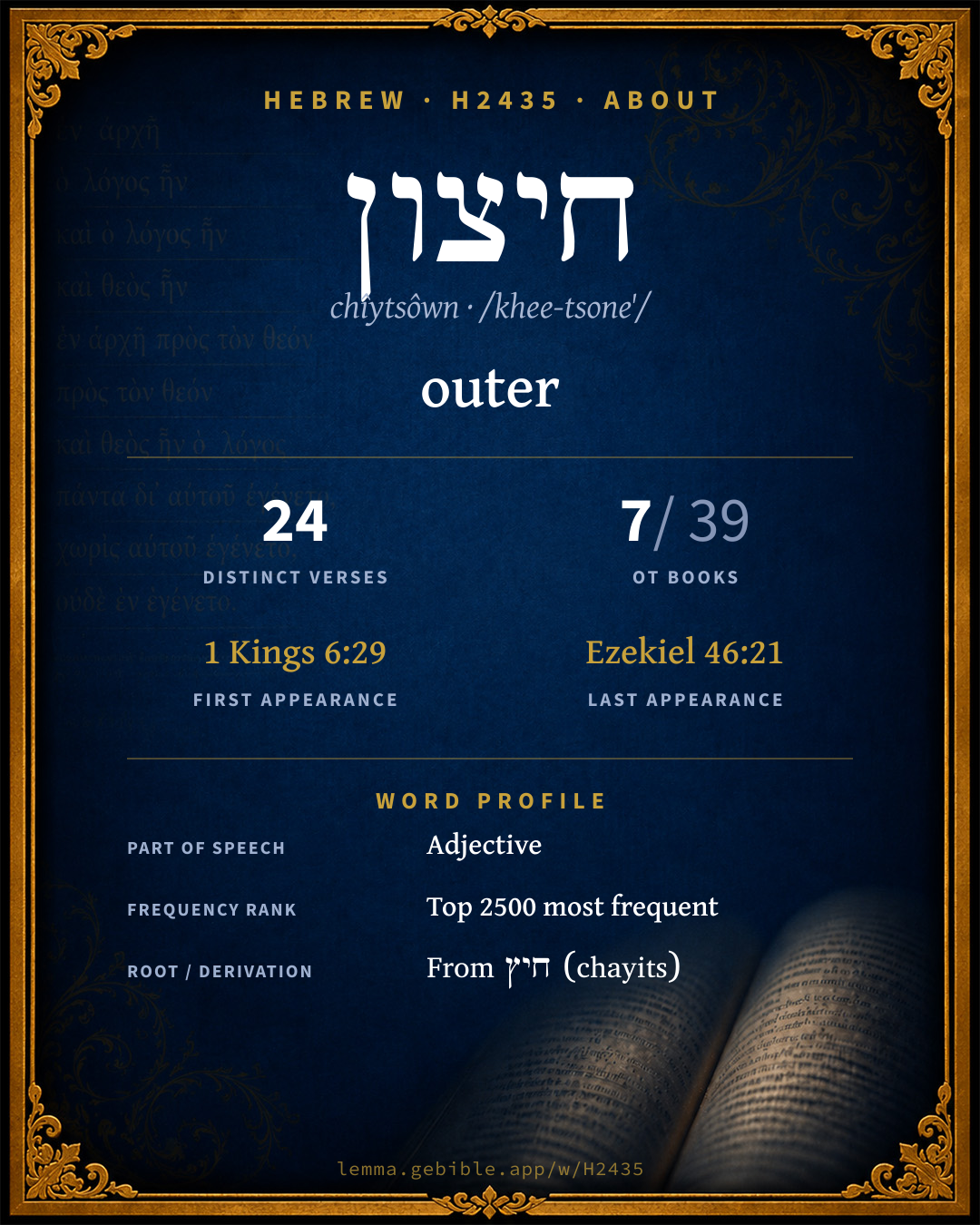
חִיצוֹן
outer
Full lexicon entry — Brown-Driver-Briggs (BDB)
From Brown-Driver-Briggs (BDB)
Where this word appears
Grammar key — what these labels mean
Part of speech
- Adjective
- A word that describes or qualifies a noun.
State
- Absolute
- The independent form of a noun, not bound to a following word.
Gender
- Feminine
- Grammatically feminine.
- Masculine
- Grammatically masculine.
Number
- Singular
- One.
Grammatical forms
- Adjective, Adjective, Feminine, Singular, Absolute 20 times (80%)
- Adjective, Adjective, Masculine, Singular, Absolute 5 times (20%)
Parsed forms decoded from the imported morphology (morphhb / Westminster Leningrad Codex — WLC text public domain, morphhb tagging CC BY 4.0), counted across 25 parsed occurrences — not distinct verses.
Every verse where H2435 appears — 24 distinct verses across 7 books. Click any verse to open its interlinear word-by-word view. Verse text shown in the World English Bible for context — . Each verse’s Hebrew form is shown with its reference; the English is not keyword-highlighted, since the data carries no word-level English alignment. Use “Compare translations” on any verse to read it across multiple English versions. This concordance covers the Hebrew Bible; Septuagint (Greek Old Testament) occurrences are not indexed here.
1 Kings 2 verses
- 1 Kings 6:29 וְ/לַ/חִיצֽוֹן conj + prep det + Adjective Adjective ms He carved all the walls of the house round about with carved figures of cherubim and palm trees and open flowers, inside and outside.
- 1 Kings 6:30 וְ/לַ/חִיצֽוֹן conj + prep det + Adjective Adjective ms The floor of the house he overlaid with gold, inside and outside.
2 Kings 1 verse
1 Chronicles 1 verse
2 Chronicles 1 verse
Nehemiah 1 verse
Esther 1 verse
Ezekiel 17 verses
- Ezekiel 10:5 הַ/חִיצֹנָ֑ה ptcl def.art + Adjective Adjective fs The sound of the wings of the cherubim was heard even to the outer court, as the voice of God Almighty when he speaks.
- Ezekiel 40:17 הַ/חִ֣יצוֹנָ֔ה ptcl def.art + Adjective Adjective fs Then brought he me into the outer court; and, behold, there were chambers and a pavement, made for the court round about: thirty chambers were on the pavement.
- Ezekiel 40:20 הַ/חִֽיצוֹנָ֑ה ptcl def.art + Adjective Adjective fs The gate of the outer court whose prospect is toward the north, he measured the length of it and the breadth of it.
- Ezekiel 40:31 הַ/חִ֣צוֹנָ֔ה ptcl def.art + Adjective Adjective fs The arches of it were toward the outer court; and palm trees were on the posts of it: and the ascent to it had eight steps.
- Ezekiel 40:34 הַ/חִ֣יצוֹנָ֔ה ptcl def.art + Adjective Adjective fs The arches of it were toward the outer court; and palm trees were on the posts of it, on this side, and on that side: and the ascent to it had eight steps.
- Ezekiel 40:37 הַ/חִ֣יצוֹנָ֔ה ptcl def.art + Adjective Adjective fs The posts of it were toward the outer court; and palm trees were on the posts of it, on this side, and on that side: and the ascent to it had eight steps.
- Ezekiel 41:17 וּ/בַ/חִיצ֖וֹן conj + prep det + Adjective Adjective ms to [the space] above the door, even to the inner house, and outside, and by all the wall round about inside and outside, by measure.
- Ezekiel 42:1 הַ/חִ֣יצוֹנָ֔ה ptcl def.art + Adjective Adjective fs Then he brought me forth into the outer court, the way toward the north: and he brought me into the chamber that was over against the separate place, and which was over against the building toward the north.
- Ezekiel 42:3 הַ/חִֽיצוֹנָ֑ה ptcl def.art + Adjective Adjective fs Over against the twenty [cubits] which belonged to the inner court, and over against the pavement which belonged to the outer court, was gallery against gallery in the third story.
- Ezekiel 42:7 הַ/חִֽצוֹנָ֖ה ptcl def.art + Adjective Adjective fs The wall that was outside by the side of the chambers, toward the outer court before the chambers, the length of it was fifty cubits.
- Ezekiel 42:8 הַ/חִֽצוֹנָ֖ה ptcl def.art + Adjective Adjective fs For the length of the chambers that were in the outer court was fifty cubits: and, behold, before the temple were one hundred cubits.
- Ezekiel 42:9 הַ/חִצֹנָֽה ptcl def.art + Adjective Adjective fs From under these chambers was the entry on the east side, as one goes into them from the outer court.
- Ezekiel 42:14 הַ/חִיצוֹנָ֔ה ptcl def.art + Adjective Adjective fs When the priests enter in, then shall they not go out of the holy place into the outer court, but there they shall lay their garments in which they minister; for they are holy: and they shall put on other garments, and shall approach to that which pertains to the people.
- Ezekiel 44:1 הַֽ/חִיצ֔וֹן ptcl def.art + Adjective Adjective ms Then he brought me back by the way of the outer gate of the sanctuary, which looks toward the east; and it was shut.
- Ezekiel 44:19 הַ/חִיצוֹנָ֜ה הַ/חִיצוֹנָה֮ ptcl def.art + Adjective Adjective fs ptcl def.art + Adjective Adjective fs When they go forth into the outer court, even into the outer court to the people, they shall put off their garments in which they minister, and lay them in the holy chambers; and they shall put on other garments, that they not sanctify the people with their garments.
- Ezekiel 46:20 הַ/חִֽיצוֹנָ֖ה ptcl def.art + Adjective Adjective fs He said to me, This is the place where the priests shall boil the trespass-offering and the sin-offering, [and] where they shall bake the meal-offering; that they not bring them forth into the outer court, to sanctify the people.
- Ezekiel 46:21 הַ/חִ֣יצֹנָ֔ה ptcl def.art + Adjective Adjective fs Then he brought me forth into the outer court, and caused me to pass by the four corners of the court; and, behold, in every corner of the court there was a court.
About this entry
At a glance — auto-summarized from this page’s data, not written by a person. Every figure links to its source below. This summary describes the numbers; it doesn’t interpret them.
At its core, חיצון (chîytsôwn) means “outer.” Its uses cluster heavily in Ezekiel (71% of all occurrences). Spanning 24 verses in 7 books, it ranks among the uncommon words of the Hebrew Bible. Scripture first uses it in 1 Kings 6:29. The King James Version usually renders it “utter,” while modern versions prefer “outer” (Berean Standard Bible) — see the renderings breakdown. Each statement above links to its evidence; the full detail follows below.
Gloss history
Strong's 1890 vs modern scholarship
About this word
Strong's H2435 catalogs a Hebrew word from the Hebrew Old Testament.
These counts are not copied from any lexicon or concordance. They are computed here, from the morphology-tagged Hebrew Old Testament. What Lemma adds →
- 24
- distinct verses
- The word appears in 24 distinct verses.
- 7 / 39
- OT books
- The word appears in 7 of 39 Old Testament books.
- #1,282
- by frequency
- Top 2500 most frequent Hebrew words (rank 1,282 of 8,640 Hebrew words by occurrence).
View all 24 occurrences in the concordance →
By section of the Old Testament
By traditional corpus
Conventional, traditional groupings — biblical authorship is debated, so this is a traditional corpus grouping, not an authorship claim. Each share is this word’s portion of its verses in that division of the Hebrew canon. Each figure is a share of the word’s 24 distinct verses.
- Prophets (Nevi'im) 20 verses · 83%
- Writings (Ketuvim) 4 verses · 17%
How translations render this word
Counts come from each version’s own published word-to-Strong’s tagging or interlinear alignment — an approximate guide to how each version renders this word, not a word-level alignment the data otherwise carries. Because each total is that version’s own tagged count, the per-version totals vary from one another and need not match the appearance or distinct-verse counts above. These counts may also differ from a printed concordance because Lemma counts each distinctly tagged rendering and does not collapse phrase taggings into a single head-word total. This is a fixed set of word-tagged versions (KJV, ASV, BSB, ULT) and does not change with the reading translation you choose elsewhere. Each version’s license is shown beside its name below (and on Sources).
- King James Version: Utter 7×, Without 5×, Outward 3×
- American Standard Version: Outer 9×, Without 4×, Thereof were toward the outer 3×
- Berean Standard Bible: Outer 14×, Faced the outer 2×, Outer sanctuaries 2×
- unfoldingWord Literal Text: Outer 17×, Outside 4×, Faced the outer 2×
King James Version Public Domain
Renders H2435 across 25 tagged occurrences — most commonly:
Plus 8 renderings that appear only once — usually multi-word phrases or single function words the recovered tagging swept in, not distinct renderings.
American Standard Version Public Domain
Renders H2435 across 24 tagged occurrences — most commonly:
Plus 8 renderings that appear only once — usually multi-word phrases or single function words the recovered tagging swept in, not distinct renderings.
Berean Standard Bible Public Domain
Renders H2435 across 24 tagged occurrences — most commonly:
Plus 4 renderings that appear only once — usually multi-word phrases or single function words the recovered tagging swept in, not distinct renderings. Not rendered by a distinct English word in 1 further occurrence.
unfoldingWord Literal Text CC BY-SA 4.0
Renders H2435 across 25 tagged occurrences — most commonly:
Plus 2 renderings that appear only once — usually multi-word phrases or single function words the recovered tagging swept in, not distinct renderings.
Senses in BDB
The 1 sense BDB distinguishes for this word, in lexicon order (not ranked by frequency or importance). The full entry — with sub-senses — is in the Lexicon Entry tab.
- outer, external, outward
Word origin
v. sub I. II. חוץ.
— Brown-Driver-Briggs (Oxford 1906, public domain), digitized via Sefaria, supplemented by the OpenScriptures HebrewLexicon (CC BY 4.0). See Sources.
Derived from חיץ (chayits) (H2434) — wall.
Jastrow Dictionary
A second Hebrew/Aramaic lexicon for comparison, covering Aramaic and post-biblical (Talmudic, Targumic, Midrashic) usage that the biblical-Hebrew BDB does not. Matched by lemma rather than by Strong’s number, so a lemma may carry more than one Jastrow headword (shown separately below), and the entries cover usage well beyond the Bible.
חִיצוֹן
- outer, external. Zeb. V, 1 מזבת הח׳ the outer altar (in the Temple court); a. fr.—Nidd. V, 1 בית הח׳ vagina.—Fem. חִיצוֹנָה. Y. Yeb. I, 3ᵃ, v. חוּצָה II.—Num. R. s. 18 משנה הח׳ = בָּרַיְיתָא.—Pl. חִיצוֹנוֹת. Sabb. 31ᵇ מפתחות הח׳ the outside keys (of the treasury); Yalk. Deut. 855; Yalk. Is. 302; En Yakob Sabb. l. c. (מפתחות) החִיצוֹנִית the keys to the outer room.
A Dictionary of the Targumim, the Talmud Babli and Yerushalmi, and the Midrashic Literature (Marcus Jastrow; London, Luzac, 1903) — Public Domain. Digitized via Sefaria. Digitized via Sefaria. Full attribution on Sources.
Forms in the corpus
The 18 distinct written forms H2435 takes in the Hebrew Bible, most frequent first — each parse links to that state’s occurrences in the concordance. Hebrew forms include their vowel points and cantillation, so a single lemma takes many written forms.
| Form | Parsing | Example | Uses |
|---|---|---|---|
| הַ/חִ֣יצוֹנָ֔ה | Adjective, Adjective, Feminine, Singular, Absolute | Esther 6:4 | 5 |
| הַ/חִֽיצוֹנָ֑ה | Adjective, Adjective, Feminine, Singular, Absolute | Ezekiel 40:20 | 2 |
| הַ/חִֽצוֹנָ֖ה | Adjective, Adjective, Feminine, Singular, Absolute | Ezekiel 42:7 | 2 |
| וְ/לַ/חִיצֽוֹן | Adjective, Adjective, Masculine, Singular, Absolute | 1 Kings 6:29 | 2 |
| הַ/חִ֣יצֹנָ֔ה | Adjective, Adjective, Feminine, Singular, Absolute | Ezekiel 46:21 | 1 |
| הַ/חִ֣צוֹנָ֔ה | Adjective, Adjective, Feminine, Singular, Absolute | Ezekiel 40:31 | 1 |
| הַ/חִֽיצֹנָה֙ | Adjective, Adjective, Feminine, Singular, Absolute | Nehemiah 11:16 | 1 |
| הַ/חִֽיצוֹנָ֖ה | Adjective, Adjective, Feminine, Singular, Absolute | Ezekiel 46:20 | 1 |
| הַ/חִֽיצוֹנָה֙ | Adjective, Adjective, Feminine, Singular, Absolute | 1 Chronicles 26:29 | 1 |
| הַ/חִיצֹנָ֑ה | Adjective, Adjective, Feminine, Singular, Absolute | Ezekiel 10:5 | 1 |
| הַ/חִיצוֹנָ֔ה | Adjective, Adjective, Feminine, Singular, Absolute | Ezekiel 42:14 | 1 |
| הַ/חִיצוֹנָ֜ה | Adjective, Adjective, Feminine, Singular, Absolute | Ezekiel 44:19 | 1 |
| הַ/חִיצוֹנָה֮ | Adjective, Adjective, Feminine, Singular, Absolute | Ezekiel 44:19 | 1 |
| הַ/חִצֹנָֽה | Adjective, Adjective, Feminine, Singular, Absolute | Ezekiel 42:9 | 1 |
| הַֽ/חִיצ֔וֹן | Adjective, Adjective, Masculine, Singular, Absolute | Ezekiel 44:1 | 1 |
| הַֽ/חִיצ֔וֹנָ/ה | Adjective, Adjective, Masculine, Singular, Absolute | 2 Kings 16:18 | 1 |
| וּ/בַ/חִיצ֖וֹן | Adjective, Adjective, Masculine, Singular, Absolute | Ezekiel 41:17 | 1 |
| חִֽיצוֹנָ֣ה | Adjective, Adjective, Feminine, Singular, Absolute | 2 Chronicles 33:14 | 1 |
Septuagint verse parallels
This word appears in 23 verses that also exist in the Greek Old Testament (Septuagint), out of the 24 Hebrew verses it occurs in. You can read those verses in Greek by switching the Old Testament edition to the Septuagint.
Read these verses in the Septuagint
This is a verse-level parallel only — the same verses exist in both the Hebrew and Greek Old Testaments. No word-level Hebrew↔Greek correspondence is claimed: the data carries no such alignment, so no Greek word is shown as this Hebrew word’s translation. Coverage is not total — the Septuagint omits the deuterocanon and renumbers the Psalms, so some Hebrew verses have no direct Greek parallel.