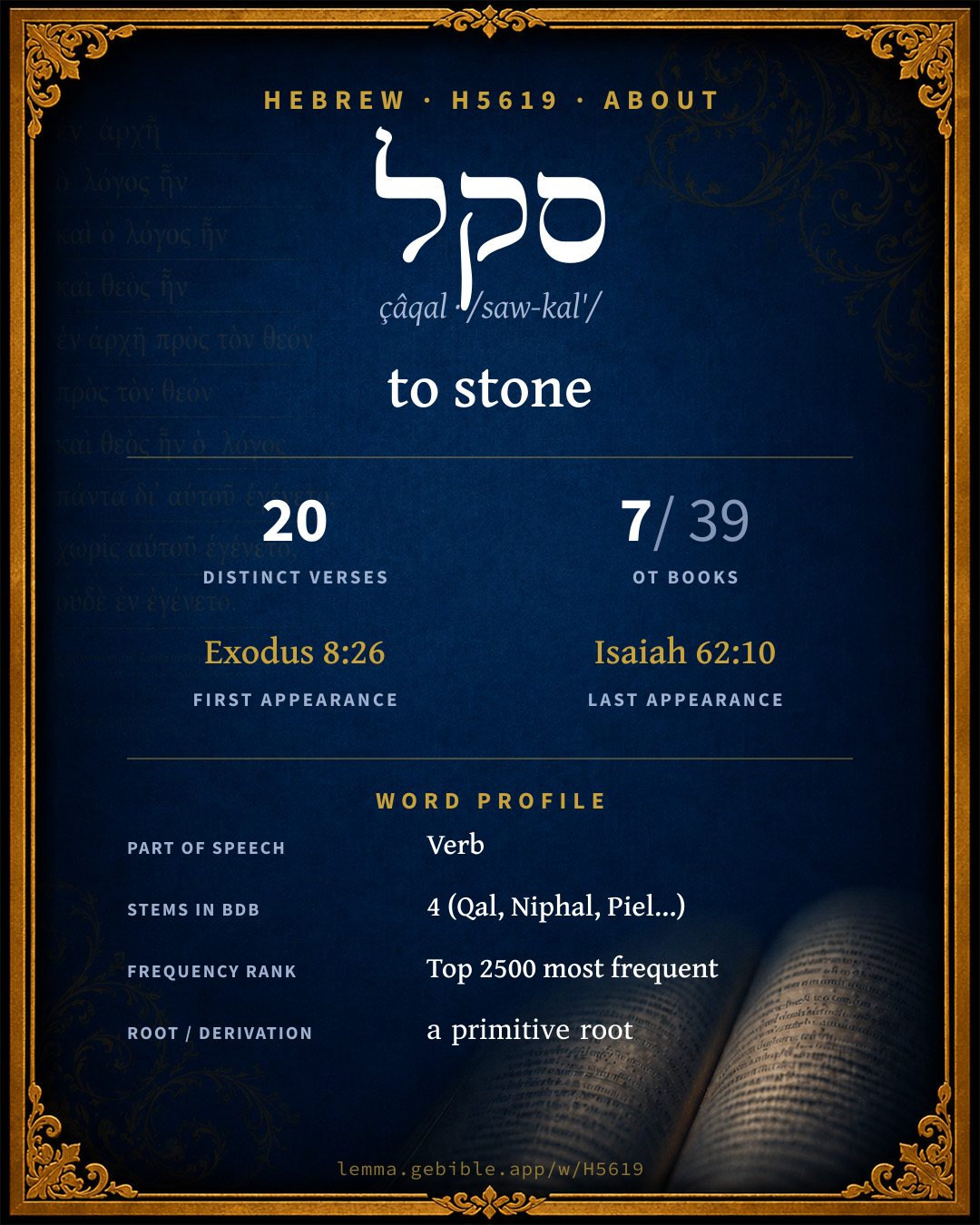
סָקַל
to stone
‘to stone’ is one of 4 main senses fuller range ↓
Full lexicon entry — Brown-Driver-Briggs (BDB)
From Brown-Driver-Briggs (BDB)
Where this word appears
See every Qal verb in the Hebrew Bible →
Grammar key — what these labels mean
Part of speech
- Verb
- An action or state-of-being word.
Stem
- Niphal
- Usually the simple passive or reflexive of the Qal (“he was written”).
- Piel
- An intensive or resultative active stem. Here: ‘stone’
- Pual
- The passive counterpart of the Piel.
- Qal
- The basic, simple active stem — the plain form of the verb (“he wrote”).
Form
- Imperfect
- An incomplete, ongoing, or future action (“he will / would write”).
- Sequential Imperfect
- An imperfect with prefixed waw — the standard past-narrative form (waw-consecutive imperfect).
- Perfect
- A completed action or state — Hebrew marks aspect (completeness) more than strict tense (“he wrote”).
- Infinitive Absolute
- An unbound verbal noun, often intensifying or standing in for a finite verb.
- Sequential Perfect
- A perfect with prefixed waw continuing a preceding imperfect or command (waw-consecutive perfect).
- Imperative
- A direct command (“write!”).
- Infinitive Construct
- A bound verbal noun, frequently with prepositions (“to write / in writing”).
Person
- 3rd Person
- The one spoken about (“he / she / it / they”).
- 2nd Person
- The one addressed (“you”).
Gender
- Masculine
- Grammatically masculine.
- Common
- Either gender — not distinguished for this form.
Number
- Singular
- One.
- Plural
- More than one (in Hebrew, generally three or more).
Grammatical forms 12 distinct
- Verb, Niphal, Imperfect, 3rd Person, Masculine, Singular 4 times (18%)
- Verb, Piel, Sequential Imperfect, 3rd Person, Masculine, Singular 3 times (14%)
- Verb, Pual, Perfect, 3rd Person, Masculine, Singular 2 times (9%)
- Verb, Qal, Infinitive Absolute 2 times (9%)
- Verb, Qal, Sequential Perfect, 2nd Person, Masculine, Singular 2 times (9%)
- Verb, Qal, Sequential Perfect, 3rd Person, Common, Plural 2 times (9%)
- Verb, Qal, Sequential Imperfect, 3rd Person, Masculine, Plural 2 times (9%)
- Verb, Qal, Sequential Perfect, 2nd Person, Masculine, Plural 1 time (5%)
+4 more forms (4 occurrences)
Parsed forms decoded from the imported morphology (morphhb / Westminster Leningrad Codex — WLC text public domain, morphhb tagging CC BY 4.0), counted across 22 parsed occurrences — not distinct verses.
Every verse where H5619 appears — 20 distinct verses across 7 books. Click any verse to open its interlinear word-by-word view. Verse text shown in the World English Bible for context — . Each verse’s Hebrew form is shown with its reference; the English is not keyword-highlighted, since the data carries no word-level English alignment. Use “Compare translations” on any verse to read it across multiple English versions. This concordance covers the Hebrew Bible; Septuagint (Greek Old Testament) occurrences are not indexed here.
Exodus 6 verses
- Exodus 8:26 יִסְקְלֻֽ/נוּ Qal impf 3mp + sfx pers 1cp Moses said, "It isn't appropriate to do so; for we shall sacrifice the abomination of the Egyptians to Yahweh our God. Behold, shall we sacrifice the abomination of the Egyptians before their eyes, and won't they stone us?
- Exodus 17:4 וּ/סְקָלֻֽ/נִי conj + Qal wpf 3cp + sfx pers 1cs Moses cried to Yahweh, saying, "What shall I do with these people? They are almost ready to stone me."
- Exodus 19:13 סָק֤וֹל יִסָּקֵל֙ Qal inf.abs Niphal impf 3ms No hand shall touch him, but he shall surely be stoned or shot through; whether it is animal or man, he shall not live.' When the trumpet sounds long, they shall come up to the mountain."
- Exodus 21:28 סָק֨וֹל יִסָּקֵ֜ל Qal inf.abs Niphal impf 3ms "If a bull gores a man or a woman to death, the bull shall surely be stoned, and its flesh shall not be eaten; but the owner of the bull shall not be held responsible.
- Exodus 21:29 יִסָּקֵ֔ל Niphal impf 3ms But if the bull had a habit of goring in the past, and it has been testified to its owner, and he has not kept it in, but it has killed a man or a woman, the bull shall be stoned, and its owner shall also be put to death.
- Exodus 21:32 יִסָּקֵֽל Niphal impf 3ms If the bull gores a man-servant or a maid-servant, thirty shekels of silver shall be given to their master, and the ox shall be stoned.
Deuteronomy 4 verses
- Deuteronomy 13:10 וּ/סְקַלְתּ֥/וֹ conj + Qal wpf 2ms + sfx pers 3ms You shall stone him to death with stones, because he has sought to draw you away from Yahweh your God, who brought you out of the land of Egypt, out of the house of bondage.
- Deuteronomy 17:5 וּ/סְקַלְתָּ֥/ם conj + Qal wpf 2ms + sfx pers 3mp then shall you bring forth that man or that woman, who has done this evil thing, to your gates, even the man or the woman; and you shall stone them to death with stones.
- Deuteronomy 22:21 וּ/סְקָלוּ/הָ֩ conj + Qal wpf 3cp + sfx pers 3fs then they shall bring out the young lady to the door of her father's house, and the men of her city shall stone her to death with stones, because she has done folly in Israel, to play the prostitute in her father's house: so shall you put away the evil from the midst of you.
- Deuteronomy 22:24 וּ/סְקַלְתֶּ֨ם conj + Qal wpf 2mp then you shall bring them both out to the gate of that city, and you shall stone them to death with stones; the lady, because she didn't cry, being in the city; and the man, because he has humbled his neighbor's wife: so you shall put away the evil from the midst of you.
Joshua 1 verse
1 Samuel 1 verse
2 Samuel 2 verses
- 2 Samuel 16:6 וַ/יְסַקֵּ֤ל conj + Piel wimpf 3ms He cast stones at David, and at all the servants of king David: and all the people and all the mighty men were on his right hand and on his left.
- 2 Samuel 16:13 וַ/יְסַקֵּ֤ל conj + Piel wimpf 3ms So David and his men went by the way; and Shimei went along on the hill-side over against him, and cursed as he went, and threw stones at him, and cast dust.
1 Kings 4 verses
- 1 Kings 21:10 וְ/סִקְלֻ֖/הוּ conj + Qal impv 2mp + sfx pers 3ms and set two men, base fellows, before him, and let them testify against him, saying, You did curse God and the king. Then carry him out, and stone him to death.
- 1 Kings 21:13 וַ/יִּסְקְלֻ֥/הוּ conj + Qal wimpf 3mp + sfx pers 3ms The two men, the base fellows, came in and sat before him: and the base fellows bore witness against him, even against Naboth, in the presence of the people, saying, Naboth did curse God and the king. Then they carried him forth out of the city, and stoned him to death with stones.
- 1 Kings 21:14 סֻקַּ֥ל Pual pf 3ms Then they sent to Jezebel, saying, Naboth is stoned, and is dead.
- 1 Kings 21:15 סֻקַּ֥ל Pual pf 3ms It happened, when Jezebel heard that Naboth was stoned, and was dead, that Jezebel said to Ahab, Arise, take possession of the vineyard of Naboth the Jezreelite, which he refused to give you for money; for Naboth is not alive, but dead.
Isaiah 2 verses
- Isaiah 5:2 וַֽ/יְסַקְּלֵ֗/הוּ conj + Piel wimpf 3ms + sfx pers 3ms He dug it up, Gathered out its stones, Planted it with the choicest vine, Built a tower in its midst, And also cut out a winepress therein. He looked for it to yield grapes, But it yielded wild grapes.
- Isaiah 62:10 סַקְּל֣וּ Piel impv 2mp Go through, go through the gates; prepare you the way of the people; cast up, cast up the highway; gather out the stones; lift up an ensign for the peoples.
About this entry
At a glance — auto-summarized from this page’s data, not written by a person. Every figure links to its source below. This summary describes the numbers; it doesn’t interpret them.
סקל — transliterated çâqal — is a Hebrew verb carrying the sense “to stone.” As a verb its force shifts by stem, across 4 stems (Qal, Niphal, and more). The Hebrew Bible uses it across 20 verses — uncommon. More than a quarter of its appearances fall in Exodus. Debuting at Exodus 8:26, it then recurs through the corpus. See the sense tree, 20-verse concordance, and the renderings breakdown below.
Gloss history
Strong's 1890 vs modern scholarship
About this word
Strong's H5619 catalogs a Hebrew word from the Hebrew Old Testament.
These counts are not copied from any lexicon or concordance. They are computed here, from the morphology-tagged Hebrew Old Testament. What Lemma adds →
- 20
- distinct verses
- The word appears in 20 distinct verses.
- 7 / 39
- OT books
- The word appears in 7 of 39 Old Testament books.
- #1,412
- by frequency
- Top 2500 most frequent Hebrew words (rank 1,412 of 8,640 Hebrew words by occurrence).
View all 20 occurrences in the concordance →
Most concentrated in
- Exodus 6 verses 30%
- Deuteronomy 4 verses 20%
- 1 Kings 4 verses 20%
By section of the Old Testament
By traditional corpus
Conventional, traditional groupings — biblical authorship is debated, so this is a traditional corpus grouping, not an authorship claim. Each share is this word’s portion of its verses in that division of the Hebrew canon. Each figure is a share of the word’s 20 distinct verses.
- Torah (Pentateuch) 10 verses · 50%
- Prophets (Nevi'im) 10 verses · 50%
How translations render this word
Counts come from each version’s own published word-to-Strong’s tagging or interlinear alignment — an approximate guide to how each version renders this word, not a word-level alignment the data otherwise carries. Because each total is that version’s own tagged count, the per-version totals vary from one another and need not match the appearance or distinct-verse counts above. These counts may also differ from a printed concordance because Lemma counts each distinctly tagged rendering and does not collapse phrase taggings into a single head-word total. This is a fixed set of word-tagged versions (KJV, ASV, BSB, ULT) and does not change with the reading translation you choose elsewhere. Each version’s license is shown beside its name below (and on Sources).
- King James Version: Shall be stoned 2×, Stoned 2×
- American Standard Version: Stoned 3×, Shall be stoned 2×
- Berean Standard Bible: Must be stoned 2×, Stone him 2×
- unfoldingWord Literal Text: He shall be stoned 2×, He stoned 2×, Shall be stoned 2×
King James Version Public Domain
Renders H5619 across 22 tagged occurrences — most commonly:
Plus 18 renderings that appear only once — usually multi-word phrases or single function words the recovered tagging swept in, not distinct renderings.
American Standard Version Public Domain
Renders H5619 across 23 tagged occurrences — most commonly:
Plus 18 renderings that appear only once — usually multi-word phrases or single function words the recovered tagging swept in, not distinct renderings.
Berean Standard Bible Public Domain
Renders H5619 across 20 tagged occurrences — most commonly:
Plus 16 renderings that appear only once — usually multi-word phrases or single function words the recovered tagging swept in, not distinct renderings. Not rendered by a distinct English word in 2 further occurrences.
unfoldingWord Literal Text CC BY-SA 4.0
Renders H5619 across 26 tagged occurrences — most commonly:
Plus 18 renderings that appear only once — usually multi-word phrases or single function words the recovered tagging swept in, not distinct renderings.
Senses in the full BDB
Hebrew verbs can shift meaning by stem (binyan): Qal is the basic action, Niphal is often passive or reflexive, Piel often intensifies or makes it factitive, and Hiphil is typically causative. The senses below are grouped under the stem BDB assigns to each. This entry also uses Pual (the passive of Piel).
What do BDB’s symbols mean?
BDB uses these scholarly abbreviations:
| Symbol | Meaning |
|---|---|
| 𝔊 | the Septuagint (the ancient Greek translation, LXX) |
| 𝔙 | the Vulgate (the Latin translation) |
| 𝔖 | the Syriac version (the Peshitta) |
| 𝔗 | the Targum (the Aramaic translation) |
| ψ | the Psalms |
| √ | root (the underlying root or stem) |
| ‖ | parallel passage (a synonymous or contrasted parallel) |
| † | the dagger: every passage where the word occurs is cited |
The 6 senses and sub-senses the full Brown-Driver-Briggs lexicon distinguishes for this word, in lexicon order (not ranked by frequency), with BDB’s own verbatim wording and sub-sense lettering. Shown in Hebrew script with BDB’s own scholarly abbreviations. The condensed entry is in the Lexicon Entry tab. See also the Forms in the corpus table below.
Qal
- Pf. 2 ms. sf. וּסְקַלְתּוֹ consec. Dt 13:11; 3 mpl. sf. וּסְקָלֻנִי consec. Ex 17:4; 2 mpl. וּסְקַלְתֶּם consec. Dt 22:24, etc.; Impf. 3 mpl. יִסְקְלוּ Jos 7:25, sf. יִסְקְלֻהוּ 1 K 21:13, etc.; Imv. mpl. sf. סִקְלֻהוּ 1 K 21:10; Inf. abs. סָקוֹל Ex 19:13; 21:28; cstr. sf. סָקְלוֹ 1 S 30:6;—pelt with stones, stone to death, (as penalty) c. acc. pers. vel animal., Ex 8:22; 17:4 (both JE) 1 S 30:6; 1 K 21:10, abs. Ex 19:13; 21:28 (JE); c. acc. pers. + בְּ instr. בָּאֲבָנִים Dt 13:11; 17:5; 22:21, 24; Jos 7:25; 1 K 21:13. e.g. Deuteronomy 13:11
Niphal
- Impf. 3 ms. יִסָּקֵל be stoned to death Ex 19:13; 21:28, 29, 32 (JE). e.g. Exodus 19:13
Piel
- Impf. 3 ms. יְסַקֵּל 2 S 16:6, 13, sf. יְסַקְּלֵהוּ Is 5:2; Imv. mpl. סַקְּלוּ Is 62:10;— e.g. 2 Samuel 16:6
- 1. stone, pelt with stones, c. acc. pers. + בָּאֲבָנִים 2 S 16:6, acc. om. v 13 (‖ עִפַּר בֶּעָפָר). e.g. 2 Samuel 16:6
- 2. free vineyard (acc.) from stones (Ges§ 52 h) Is 5:2; so also 2 S 4:6, reading pt. f. מְסַקְּלָה חִטִּים lo, the portress was cleansing wheat from stones (for MT לֹקְחֵי ח׳), so We Dr Bu Kit Löhr HPS after 𝔊; (> reading however mostly סֹלְקָה, Qal Pt.); סַקְּלוּ מֵאֶבֶן Is 62:10 free (highway) from stones. e.g. Isaiah 5:2
Pual
- Pf. סֻקַּל be stoned to death 1 K 21:14, 15.—Not in HP; these and other writings (except above) use syn. רגם, cf. BrHex. 73 e.g. 1 Kings 21:14
Senses from the full Brown-Driver-Briggs lexicon (Brown, Driver, Briggs; Oxford 1906 — public domain), digitized via Sefaria, supplemented by the OpenScriptures HebrewLexicon (CC BY 4.0). Full attribution on Sources.
Word origin
vb. stone, put to death by stoning, also (Pi.) free from stones (appears like denom., but noun unknown; NH סְקִילָא execution by stoning);—
— Brown-Driver-Briggs (Oxford 1906, public domain), digitized via Sefaria, supplemented by the OpenScriptures HebrewLexicon (CC BY 4.0). See Sources.
Origin: a primitive root
Jastrow Dictionary
A second Hebrew/Aramaic lexicon for comparison, covering Aramaic and post-biblical (Talmudic, Targumic, Midrashic) usage that the biblical-Hebrew BDB does not. Matched by lemma rather than by Strong’s number, so a lemma may carry more than one Jastrow headword (shown separately below), and the entries cover usage well beyond the Bible.
סָקַל
- (b. h.) to stone, put to death by stoning. Snh. VI, 1 (42ᵇ); מוציאין אותו לסוֹקְלוֹ (Mish. ed. לסָקְלוֹ) they take him out (from the court) to execute him. Ib. 46ᵃ וסְקָלוּהוּ and they condemned him to be stoned; a. fr.—Tosef. Sabb. VI (VII), 5 האומר סִקְלוּ תרנגול זה וכ׳ (not תרנגולת) ed. Zuck. (Var. שחטו) if one says, stone this cock, for he crowed at evening,—that is a superstitious practice (v. אֱמוֹרִי).
- to be stoned, be condemned to death by stoning. Snh. 43ᵃ אבן שנ׳ בה the stone with which the culprit is to be put to death. Ib. VI, 1 יוצא לִיסָּקֵל is taken out to be stoned. Ib. 3 האיש נ׳ ערום ואין האשה נִסְקֶלֶת וכ׳ the male convict is put to death undressed, but not so the woman. Ib. 4 כל הנִסְקָלִין נתלין all those executed by stoning are afterwards hanged; a. fr.—שור הנִסְקָל the ox that is to be, or has been put to death by stoning, having killed a human being (Ex. XXI, 28). Ib. I, 4 שור הנ׳ וכ׳ the case of an ox to be stoned is argued before a court of twenty-three. Mekh. Misp., Nziḳin, s. 10; a. fr. e.g. Exodus 21:28
- to clear of stones. Shebi. II, 3 מְסַקְּלִין עד וכ׳ you may clear fields of stones (in the sixth year) up to the beginning of the Sabbatical year. Tosef. B. Kam. II, 12 כדרך … לא יְסַקֵּל ואם סי׳ וכ׳ as one has no right to put dung on the public road, so one must not clear his field and deposit the stones on the road, and if he does clear it, he must carry the stones to &c. Ib. 13 (to one who deposited stones on the road) מפני מה אתה מְסַקֵּל מתוך וכ׳ why dost thou remove the stones from a place which is not thine to a place which is thine?; a. fr.
סְקַל I
- B. Kam. 41ᵃ היכא דסַקְלֵיה מִסְקַל after one has stoned him (the ox).
סְקַל II
- m., v. סִקּוּל
A Dictionary of the Targumim, the Talmud Babli and Yerushalmi, and the Midrashic Literature (Marcus Jastrow; London, Luzac, 1903) — Public Domain. Digitized via Sefaria. Digitized via Sefaria. Full attribution on Sources.
Forms in the corpus
The 20 distinct written forms H5619 takes in the Hebrew Bible, most frequent first — each parse links to that stem’s occurrences in the concordance. Hebrew forms include their vowel points and cantillation, so a single lemma takes many written forms.
Septuagint verse parallels
This word appears in 20 verses that also exist in the Greek Old Testament (Septuagint), out of the 20 Hebrew verses it occurs in. You can read those verses in Greek by switching the Old Testament edition to the Septuagint.
Read these verses in the Septuagint
This is a verse-level parallel only — the same verses exist in both the Hebrew and Greek Old Testaments. No word-level Hebrew↔Greek correspondence is claimed: the data carries no such alignment, so no Greek word is shown as this Hebrew word’s translation. Coverage is not total — the Septuagint omits the deuterocanon and renumbers the Psalms, so some Hebrew verses have no direct Greek parallel.