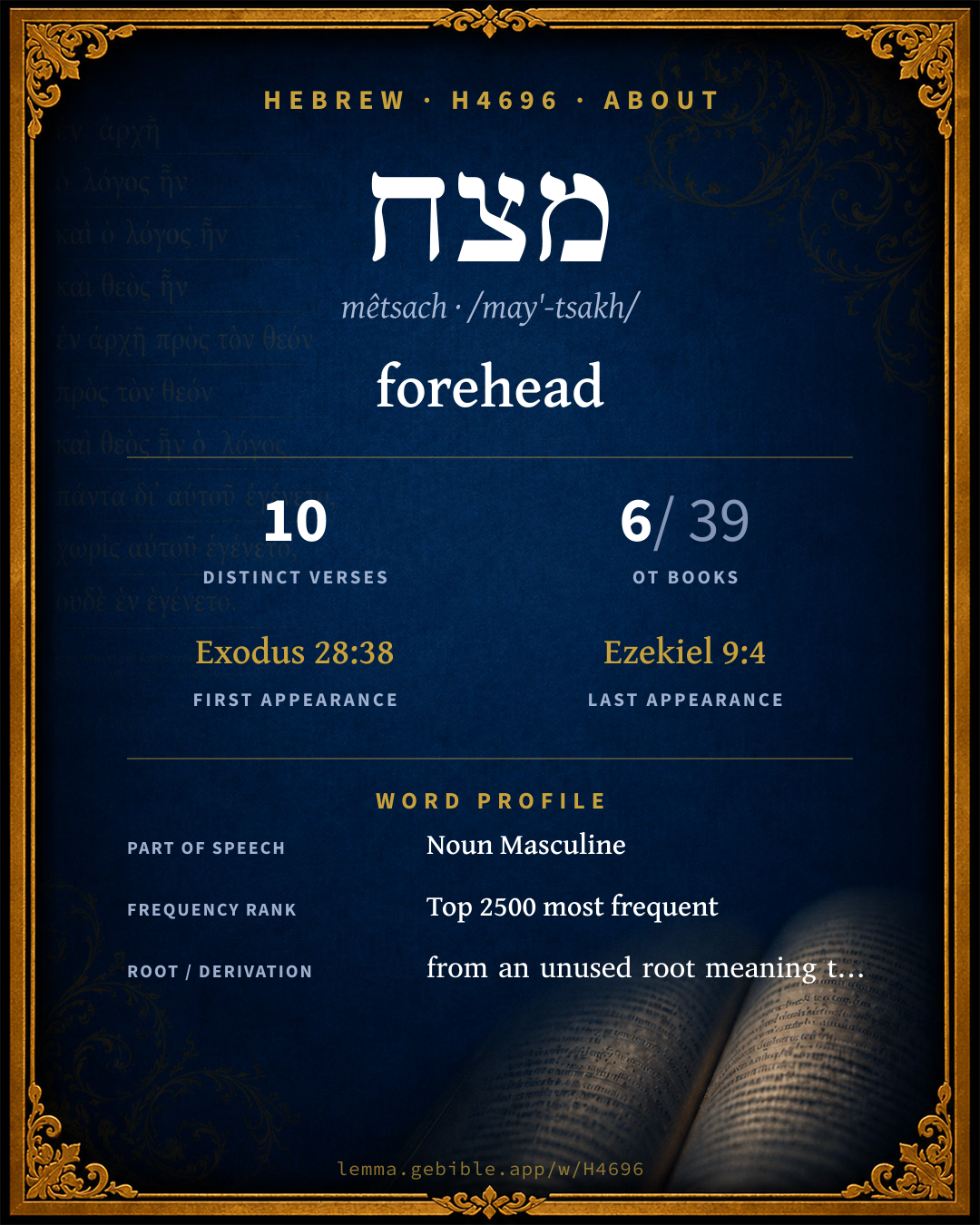
מֵ֫צַח
forehead
Full lexicon entry — Brown-Driver-Briggs (BDB)
From Brown-Driver-Briggs (BDB)
Where this word appears
See every Construct-state word in the Hebrew Bible →
Grammar key — what these labels mean
Part of speech
- Noun
- A naming word — a person, place, thing, or idea.
Noun type
- Common
- A common noun — a general class of person, place, or thing (“king,” “city,” “water”), not a specific name.
State
- Construct
- A noun bound to a following noun in a possessive / “of” relationship (the construct chain).
- Absolute
- The independent form of a noun, not bound to a following word.
Gender
- Masculine
- Grammatically masculine.
Number
- Singular
- One.
- Plural
- More than one (in Hebrew, generally three or more).
Grammatical forms
- Noun, Common, Masculine, Singular, Construct 11 times (85%)
- Noun, Common, Masculine, Plural, Construct 1 time (8%)
- Noun, Common, Masculine, Singular, Absolute 1 time (8%)
Parsed forms decoded from the imported morphology (morphhb / Westminster Leningrad Codex — WLC text public domain, morphhb tagging CC BY 4.0), counted across 13 parsed occurrences — not distinct verses.
Every verse where H4696 appears — 10 distinct verses across 6 books. Click any verse to open its interlinear word-by-word view. Verse text shown in the World English Bible for context — . Each verse’s Hebrew form is shown with its reference; the English is not keyword-highlighted, since the data carries no word-level English alignment. Use “Compare translations” on any verse to read it across multiple English versions. This concordance covers the Hebrew Bible; Septuagint (Greek Old Testament) occurrences are not indexed here.
Exodus 1 verse
1 Samuel 1 verse
2 Chronicles 2 verses
- 2 Chronicles 26:19 בְ/מִצְח֜/וֹ prep + n c ms cs + sfx pers 3ms Then Uzziah was angry; and he had a censer in his hand to burn incense; and while he was angry with the priests, the leprosy broke forth in his forehead before the priests in the house of Yahweh, beside the altar of incense.
- 2 Chronicles 26:20 בְּ/מִצְח֔/וֹ prep + n c ms cs + sfx pers 3ms Azariah the chief priest, and all the priests, looked on him, and, behold, he was leprous in his forehead, and they thrust him out quickly from there; yes, himself hurried also to go out, because Yahweh had struck him.
Isaiah 1 verse
Jeremiah 1 verse
Ezekiel 4 verses
- Ezekiel 3:7 מֵ֥צַח n c ms But the house of Israel will not listen to you; for they will not listen to me: for all the house of Israel are of hard forehead and of a stiff heart.
- Ezekiel 3:8 מִצְחֲ/ךָ֥ מִצְחָֽ/ם n c ms cs + sfx pers 2ms n c ms cs + sfx pers 3mp Behold, I have made your face hard against their faces, and your forehead hard against their foreheads.
- Ezekiel 3:9 מִצְחֶ֑/ךָ n c ms cs + sfx pers 2ms As an adamant harder than flint have I made your forehead: don't be afraid of them, neither be dismayed at their looks, though they are a rebellious house.
- Ezekiel 9:4 מִצְח֣וֹת n c mp cs Yahweh said to him, Go through the midst of the city, through the midst of Jerusalem, and set a mark on the foreheads of the men that sigh and that cry over all the abominations that are done in the midst of it.
About this entry
At a glance — auto-summarized from this page’s data, not written by a person. Every figure links to its source below. This summary describes the numbers; it doesn’t interpret them.
מצח (mêtsach) is a Hebrew noun most often rendered “forehead.” It first appears in Exodus 28:38. Spanning 10 verses in 6 books, it ranks among the uncommon words of the Hebrew Bible. Ezekiel dominates its distribution — 4 of 10 verses. Related forms include מצחה. For the data behind this summary, explore the sense tree and the renderings breakdown below.
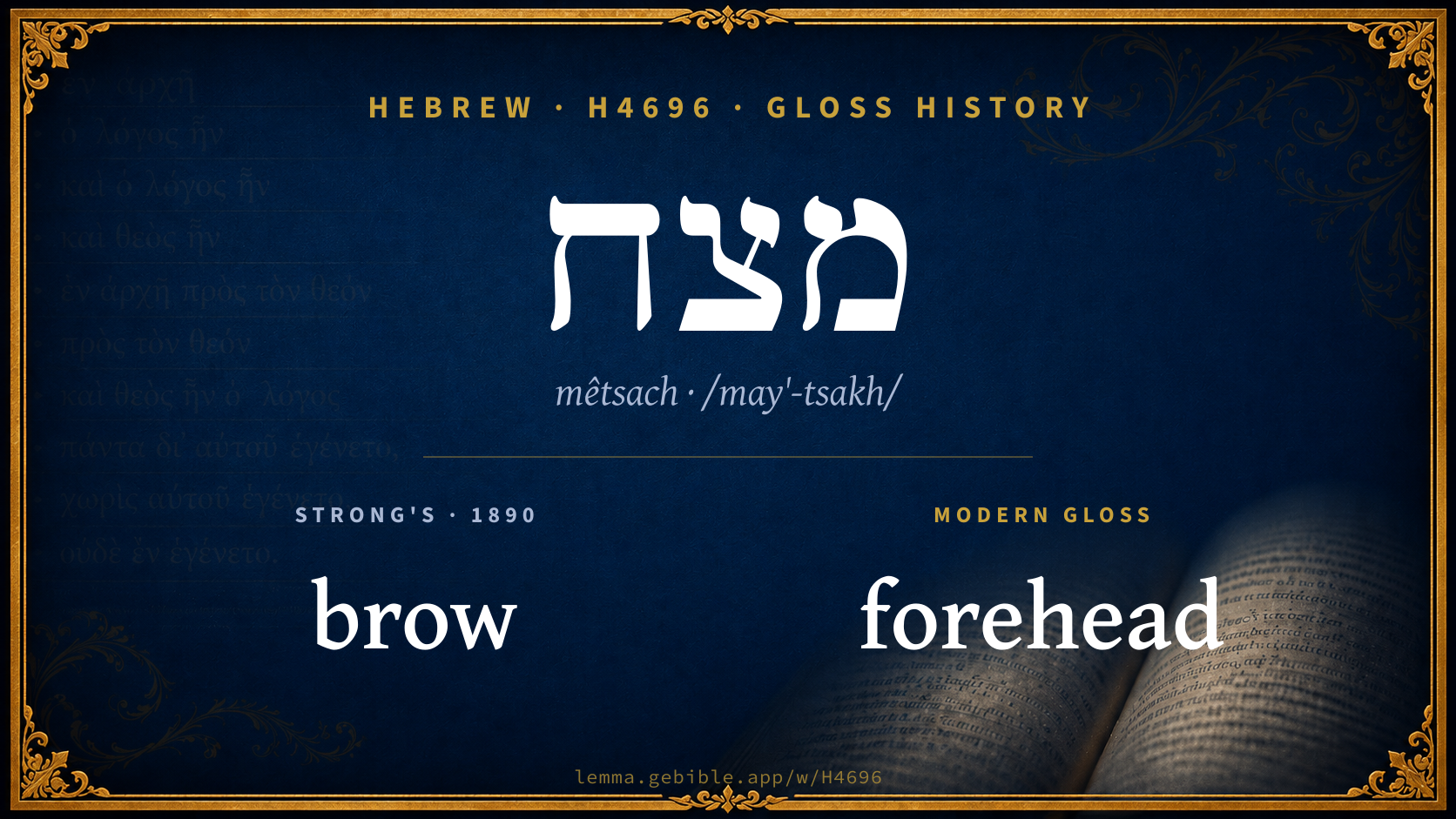
Gloss history
Strong's 1890 vs modern scholarship
About this word
Strong's H4696 catalogs a Hebrew word from the Hebrew Old Testament.
These counts are not copied from any lexicon or concordance. They are computed here, from the morphology-tagged Hebrew Old Testament. What Lemma adds →
- 10
- distinct verses
- The word appears in 10 distinct verses.
- 6 / 39
- OT books
- The word appears in 6 of 39 Old Testament books.
- #2,001
- by frequency
- Top 2500 most frequent Hebrew words (rank 2,001 of 8,640 Hebrew words by occurrence).
View all 10 occurrences in the concordance →
Most concentrated in
- Ezekiel 4 verses 40%
- 2 Chronicles 2 verses 20%
- Exodus 1 verse 10%
By section of the Old Testament
By traditional corpus
Conventional, traditional groupings — biblical authorship is debated, so this is a traditional corpus grouping, not an authorship claim. Each share is this word’s portion of its verses in that division of the Hebrew canon. Each figure is a share of the word’s 10 distinct verses.
- Prophets (Nevi'im) 7 verses · 70%
- Writings (Ketuvim) 2 verses · 20%
- Torah (Pentateuch) 1 verse · 10%
How translations render this word
Counts come from each version’s own published word-to-Strong’s tagging or interlinear alignment — an approximate guide to how each version renders this word, not a word-level alignment the data otherwise carries. Because each total is that version’s own tagged count, the per-version totals vary from one another and need not match the appearance or distinct-verse counts above. These counts may also differ from a printed concordance because Lemma counts each distinctly tagged rendering and does not collapse phrase taggings into a single head-word total. This is a fixed set of word-tagged versions (KJV, ASV, BSB, ULT) and does not change with the reading translation you choose elsewhere. Each version’s license is shown beside its name below (and on Sources).
- King James Version: Forehead 9×, Foreheads 2×
- American Standard Version: Forehead 6×, 's forehead 2×, Foreheads 2×
- Berean Standard Bible: Forehead 9×, Foreheads 2×
- unfoldingWord Literal Text: Forehead 6×, Brow 2×, Forehead of 2×
King James Version Public Domain
Renders H4696 across 12 tagged occurrences — most commonly:
Plus 1 rendering that appears only once — usually multi-word phrases or single function words the recovered tagging swept in, not distinct renderings. Not rendered by a distinct English word in 1 further occurrence.
American Standard Version Public Domain
Renders H4696 across 12 tagged occurrences — most commonly:
Plus 2 renderings that appear only once — usually multi-word phrases or single function words the recovered tagging swept in, not distinct renderings.
Berean Standard Bible Public Domain
Renders H4696 across 12 tagged occurrences — most commonly:
Plus 1 rendering that appears only once — usually multi-word phrases or single function words the recovered tagging swept in, not distinct renderings. Not rendered by a distinct English word in 1 further occurrence.
unfoldingWord Literal Text CC BY-SA 4.0
Renders H4696 across 14 tagged occurrences — most commonly:
Plus 4 renderings that appear only once — usually multi-word phrases or single function words the recovered tagging swept in, not distinct renderings.
Senses in BDB
The 1 sense BDB distinguishes for this word, in lexicon order (not ranked by frequency or importance). The full entry — with sub-senses — is in the Lexicon Entry tab.
- brow, forehead
Word origin
n.m. Ez 3:8 brow, forehead;—מ׳ abs. Ez 3:7, cstr. Ex 28:38 Je 3:3; sf. מִצְחֲךָ Ez 3:8 Is 48:4, מִצְחֶ֑ךָ Ez 3:9; מִצְחוֹ Ex 28:38 + 4 times; מִצְחָם Ez 3:8; pl. cstr. מִצְחוֹת Ez 9:4;—brow, forehead, struck by stone from David’s sling 1 S 17:49(×2); Aaron’s forehead Ex 28:38(×2); place where leprosy appears 2 Ch 26:19, 20; place for a distinguishing mark or cross Ez 9:4; חִזְקֵי־מ׳ 3:7 the house of Isr. are stout of forehead (i. e. obstinate; ‖ קְשֵׁי־לֵב), cf. v 8; so מִצְחֲךָ נְחוּשָׁה Is 48:4 thy brow (is) brass (‖ גִּיד בַּרְזֶל עָרְפֶּ֑ךָ); also of boldness, firmness of prophet v 8, and v 9 (but del. 𝔊 Co); מ׳ אִשָּׁה זוֹנָה הָיָה לָךְ Je 3:3, i. e. thou wast shameless (‖ מֵאַנְתְּ הִכָּלֵם).
— Brown-Driver-Briggs (Oxford 1906, public domain), digitized via Sefaria, supplemented by the OpenScriptures HebrewLexicon (CC BY 4.0). See Sources.
Origin: from an unused root meaning to be clear, i.e. conspicuous
Jastrow Dictionary
A second Hebrew/Aramaic lexicon for comparison, covering Aramaic and post-biblical (Talmudic, Targumic, Midrashic) usage that the biblical-Hebrew BDB does not. Matched by lemma rather than by Strong’s number, so a lemma may carry more than one Jastrow headword (shown separately below), and the entries cover usage well beyond the Bible.
מֵצַח
- צחח to glisten) forehead. Koh. R. to XII, 2 והירח זה המ׳ ‘and the moon’ (ib.) means the forehead; Lev. R. s. 18 והאור זה המ׳ (Sabb. 151ᵇ זו פדחת). Yoma 7ᵇ, a. e. עודהו על מִצְחוֹ as long as it (the plate) is on the high priest’s forehead; a. e.—Trnsf. effrontery. Tanḥ. T’rum. 11 לכפר על מ׳ הנחשת to atone for the brazen front. Kidd. 70ᵇ עזות מ׳, v. עַזּוּת; a. e.
A Dictionary of the Targumim, the Talmud Babli and Yerushalmi, and the Midrashic Literature (Marcus Jastrow; London, Luzac, 1903) — Public Domain. Digitized via Sefaria. Digitized via Sefaria. Full attribution on Sources.
Forms in the corpus
The 12 distinct written forms H4696 takes in the Hebrew Bible, most frequent first — each parse links to that state’s occurrences in the concordance. Hebrew forms include their vowel points and cantillation, so a single lemma takes many written forms.
| Form | Parsing | Example | Uses |
|---|---|---|---|
| בְּ/מִצְח֔/וֹ | Noun, Common, Masculine, Singular, Construct | 1 Samuel 17:49 | 2 |
| בְ/מִצְח֜/וֹ | Noun, Common, Masculine, Singular, Construct | 2 Chronicles 26:19 | 1 |
| וּ/מִצְחֲ/ךָ֖ | Noun, Common, Masculine, Singular, Construct | Isaiah 48:4 | 1 |
| וּ/מֵ֨צַח | Noun, Common, Masculine, Singular, Construct | Jeremiah 3:3 | 1 |
| מִצְח/וֹ֙ | Noun, Common, Masculine, Singular, Construct | Exodus 28:38 | 1 |
| מִצְח֑/וֹ | Noun, Common, Masculine, Singular, Construct | 1 Samuel 17:49 | 1 |
| מִצְח֣וֹת | Noun, Common, Masculine, Plural, Construct | Ezekiel 9:4 | 1 |
| מִצְחֲ/ךָ֥ | Noun, Common, Masculine, Singular, Construct | Ezekiel 3:8 | 1 |
| מִצְחֶ֑/ךָ | Noun, Common, Masculine, Singular, Construct | Ezekiel 3:9 | 1 |
| מִצְחָֽ/ם | Noun, Common, Masculine, Singular, Construct | Ezekiel 3:8 | 1 |
| מֵ֣צַח | Noun, Common, Masculine, Singular, Construct | Exodus 28:38 | 1 |
| מֵ֥צַח | Noun, Common, Masculine, Singular, Absolute | Ezekiel 3:7 | 1 |
Same root — word family
Other BDB entries built from the same root as H4696, grouped by Strong’s listed origin. These share a root / origin per the lexicon — not necessarily a shared meaning. Each links to that word’s own entry.
Derived from this word
Compare all same-root words → They share a root, not necessarily a meaning.
Septuagint verse parallels
This word appears in 9 verses that also exist in the Greek Old Testament (Septuagint), out of the 10 Hebrew verses it occurs in. You can read those verses in Greek by switching the Old Testament edition to the Septuagint.
Read these verses in the Septuagint
This is a verse-level parallel only — the same verses exist in both the Hebrew and Greek Old Testaments. No word-level Hebrew↔Greek correspondence is claimed: the data carries no such alignment, so no Greek word is shown as this Hebrew word’s translation. Coverage is not total — the Septuagint omits the deuterocanon and renumbers the Psalms, so some Hebrew verses have no direct Greek parallel.