
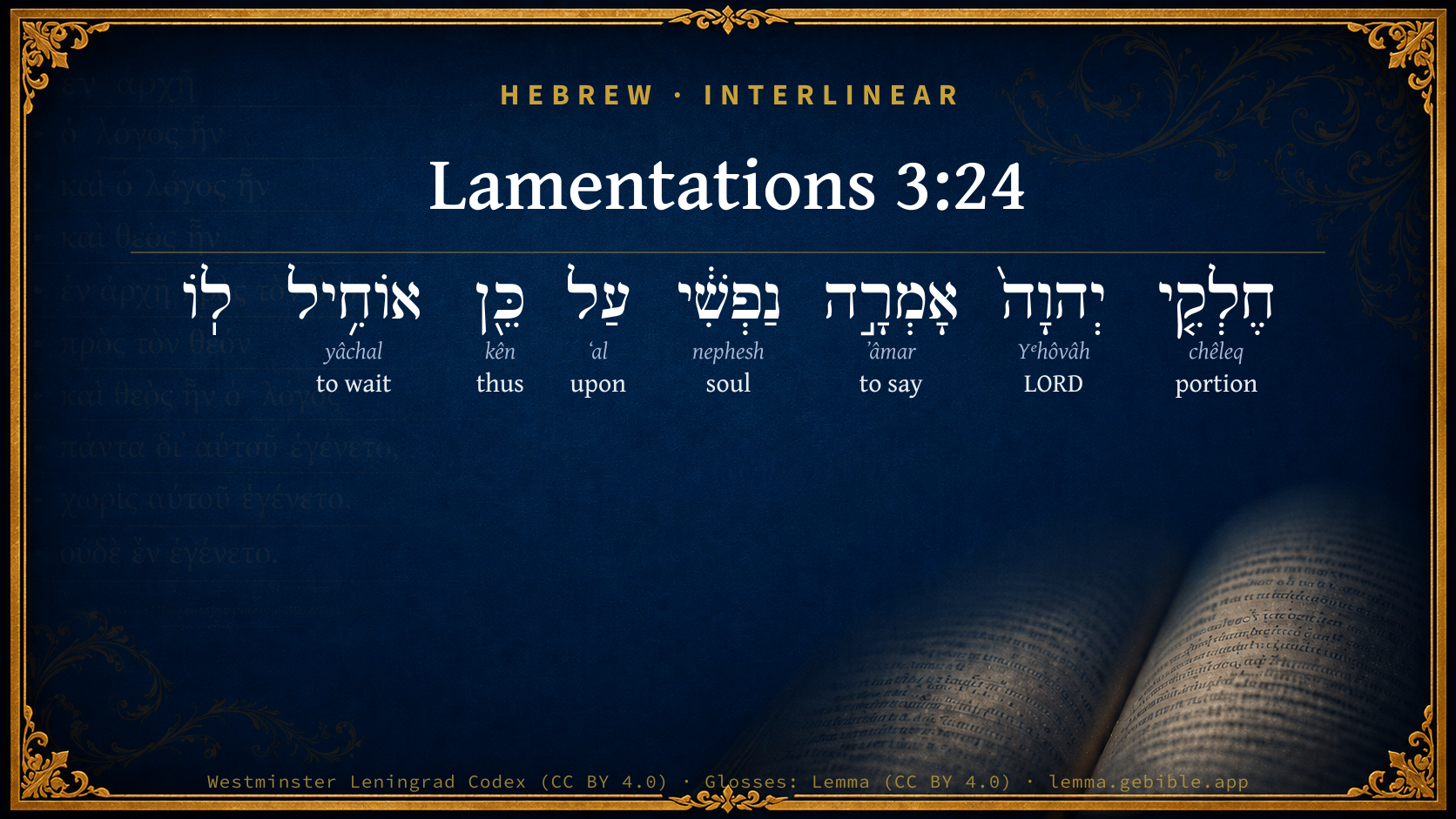
Lamentations 3:24

Hebrew (Westminster Leningrad Codex) Lamentations 3:24 appears in the Hebrew Old Testament. The text above is from the Westminster Leningrad Codex. Each word links to its Strong’s number, a concise gloss, and parsing drawn from the Open Scriptures Hebrew Bible morphology. Click any word for its full Brown-Driver-Briggs (BDB) entry.
Download image
Cite this verse

Lamentations 3:24 (World English Bible). Public Domain. Lemma interlinear Bible study tool, https://lemma.gebible.app/v/lamentations/3/24.

Show BibTeX & RIS
BibTeX
RIS
English Translation
Yahweh is my portion, says my soul; therefore will I hope in him.
World English Bible · Public Domain
Download a study sheet

One document with this verse’s original text, its word-by-word gloss line, the meaning frame, cross-references with their text, attributed commentary, and full source and license credits — printable, and it pastes into notes with its structure intact.

This verse Autodidact and up

Study sheet (.html) Plain text (.txt)

A passage Seminary Student

Up to 50 verses in one chapter. A passage sheet keeps up to 6 commentary sources and 12 cross-references per verse, in the order this page ranks them, and says so on the sheet whenever that leaves anything out. Ask for a single verse and you get the Autodidact verse sheet above.

Everything on this page stays free to read, with no account — the sheet is a download of what is already on screen, not access to it.

Want to remove ads? Support Godless Engineer
Compare translations 3

The same verse in 3 English versions, stacked beneath the original-language interlinear above. Click any original word for its lexicon entry.

Each is an independent rendering of the whole verse — the interlinear is not word-aligned to these translations.

Highlighted words mark where these versions differ — a whole-verse word diff, not a word-by-word alignment.

  • World English Bible Public Domain
    Yahweh is my portion, says my soul; therefore will I hope in him.
  • King James Version Public Domain
    The LORD is my portion, saith my soul; therefore will I hope in him.
  • unfoldingWord Literal Text CC BY-SA 4.0
    “Yahweh my portion,” my soul said; therefore I will hope in him. TETH

unfoldingWord Literal Text — © unfoldingWord, licensed CC BY-SA 4.0. Word-aligned USFM3 via Door43 (git.door43.org/unfoldingWord/en_ult).

Versions to compare (up to 4)

3 of 4 selected

Show all 18 translations

Every available English version of this verse, each an independent rendering of the whole verse.

  • World English Bible Public Domain
    Yahweh is my portion, says my soul; therefore will I hope in him.
  • Berean Standard Bible Public Domain
    “The LORD is my portion,” says my soul, “therefore I will hope in Him.”
  • Majority Standard Bible Public Domain
    “The LORD is my portion,” says my soul, “therefore I will hope in Him.”
  • King James Version Public Domain
    The LORD is my portion, saith my soul; therefore will I hope in him.
  • American Standard Version (1901) Public Domain
    Jehovah is my portion, saith my soul; therefore will I hope in him.
  • Revised Version (1885) Public Domain
    The LORD is my portion, saith my soul; therefore will I hope in him.
  • Geneva Bible (1599) Public Domain
    The Lord is my portion, sayth my soule: therefore wil I hope in him.
  • Douay-Rheims (1899) Public Domain
    Heth. The Lord is my portion, said my soul: therefore will I wait for him.
  • Young's Literal Translation Public Domain
    My portion `is' Jehovah, hath my soul said, Therefore I hope for Him.
  • Literal Standard Version CC BY-SA 4.0
    My portion [is] YHWH, my soul has said, || Therefore I hope for Him.
  • Unlocked Literal Bible CC BY-SA 4.0
    “Yahweh is my inheritance,” I said, therefore I will hope in him.
  • unfoldingWord Literal Text CC BY-SA 4.0
    “Yahweh my portion,” my soul said; therefore I will hope in him. TETH
  • Darby Bible Public Domain
    Jehovah is my portion, saith my soul; therefore will I hope in him.
  • World Messianic Bible Public Domain
    “The LORD is my portion,” says my soul. “Therefore I will hope in him.”
  • Webster's Bible Public Domain
    The LORD is my portion, saith my soul; therefore will I hope in him.
  • Free Bible Version CC BY-SA 4.0
    “The Lord is all I need,” I tell myself, “so I will put my hope in him.”
  • Bible in Basic English Public Domain
    I said to myself, The Lord is my heritage; and because of this I will have hope in him.
  • JPS Tanakh (1917) Public Domain
    'The LORD is my portion', saith my soul; 'Therefore will I hope in Him.'

Literal Standard Version (2020), Covenant Press — licensed CC BY-SA 4.0. Text via the HelloAO Bible API (eBible.org). Unlocked Literal Bible (unfoldingWord) — licensed CC BY-SA 4.0. Text via the HelloAO Bible API (eBible.org). unfoldingWord Literal Text — © unfoldingWord, licensed CC BY-SA 4.0. Word-aligned USFM3 via Door43 (git.door43.org/unfoldingWord/en_ult). Free Bible Version, Dr. Jonathan Gallagher — licensed CC BY-SA 4.0. Text via the HelloAO Bible API (eBible.org).

Word by word

More ways to search: Search by grammar → Find every occurrence → Compare this word →

Practice this passage: Drill this verse → Learn its vocabulary →

About this verse

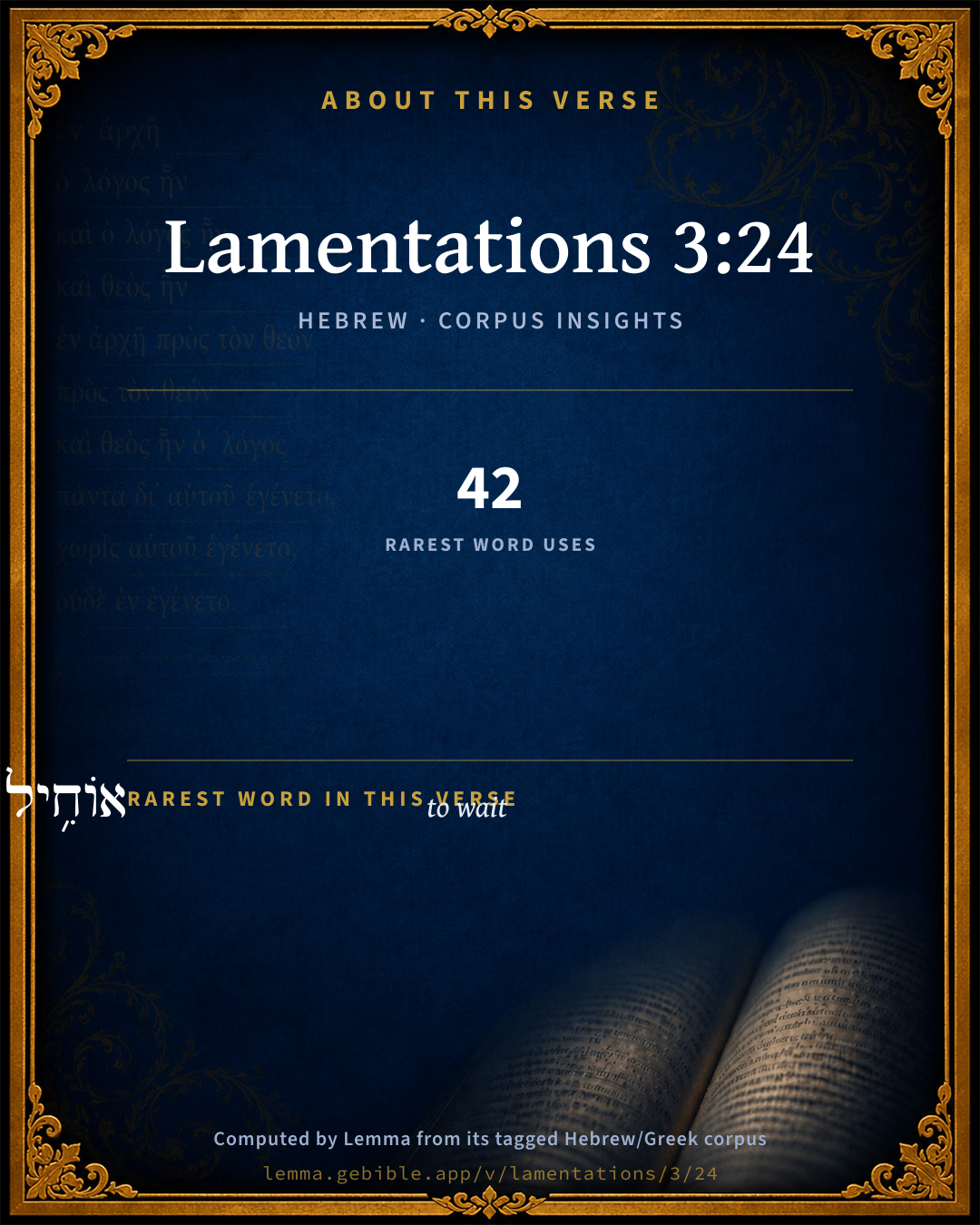
These counts appear in no published source. They are computed here, from the morphology-tagged text and Lemma’s own curated glosses. What Lemma adds →

8
words
7
distinct lemmas
Prophets
section

Shared distinctive vocabulary

אוֹחִ֥יל to wait H3176 occurs in 41 verses of the Hebrew Bible. Also found in:

Grammatical profile

  • 2 verbs
  • 3 nouns
  • 2 prepositions
  • 1 particle

Verb forms

  • אָמְרָ֣ה Qal · Perfect
  • אוֹחִ֥יל Hiphil · Imperfect

Hebrew & Septuagint length

In English translation the verse runs 13 words from the Hebrew and 14 from the Septuagint (LXX English) — closely comparable.

A rough comparison of the two English renderings, which tokenize alike — not a word-level alignment.

Word counts can differ between the Hebrew and the Greek without any difference in meaning — e.g. the Hebrew direct-object marker אֵת has no separate Greek word, and Greek often adds the article ὁ.

Cross-references

19

Topical passages linked to Lamentations 3:24 in the Treasury of Scripture Knowledge — connected by theme and wording, ordered by reader-vote popularity; previews shown in the World English Bible.

  • Psalms 73:26 My flesh and my heart fails, But God is the strength of my heart and my portion forever.
  • Psalms 16:5 Yahweh assigned my portion and my cup. You made my lot secure.
  • Psalms 142:5 I cried to you, Yahweh. I said, "You are my refuge, My portion in the land of the living."
  • Lamentations 3:21 This I recall to my mind; therefore have I hope.
  • Psalms 33:18 Behold, Yahweh's eye is on those who fear him, On those who hope in his loving kindness;
  • Job 13:15 Behold, he will kill me; I have no hope. Nevertheless, I will maintain my ways before him.
  • Psalms 31:24 Be strong, and let your heart take courage, All you who hope in Yahweh.
  • Psalms 62:8 Trust in him at all times, you people. Pour out your heart before him. God is a refuge for us. Selah.
  • Jeremiah 51:19 The portion of Jacob is not like these; for he is the former of all things; and [Israel] is the tribe of his inheritance: Yahweh of Hosts is his name.
  • 1 Samuel 30:6 David was greatly distressed; for the people spoke of stoning him, because the soul of all the people was grieved, every man for his sons and for his daughters: but David strengthened himself in Yahweh his God.
  • 1 Chronicles 5:20 They were helped against them, and the Hagrites were delivered into their hand, and all who were with them; for they cried to God in the battle, and he was entreated of them, because they put their trust in him.
  • Psalms 42:11 Why are you in despair, my soul? Why are you disturbed within me? Hope in God! For I shall still praise him, The saving help of my countenance, and my God.
  • Psalms 43:5 Why are you in despair, my soul? Why are you disturbed within me? Hope in God! For I shall still praise him: My Savior, my helper, and my God.
  • Psalms 84:12 Yahweh of Hosts, Blessed is the man who trusts in you.
  • Psalms 130:7 Israel, hope in Yahweh, For with Yahweh there is loving kindness. With him is abundant redemption.
  • Jeremiah 10:16 The portion of Jacob is not like these; for he is the former of all things; and Israel is the tribe of his inheritance: Yahweh of Hosts is his name.
  • Romans 15:12 Again, Isaiah says, "There will be the root of Jesse, He who arises to rule over the Gentiles; On him will the Gentiles hope."
  • 1 Peter 1:21 who through him are believers in God, who raised him from the dead, and gave him glory; so that your faith and hope might be in God.
  • Psalms 119:57 Yahweh is my portion. I promised to obey your words.

Cross-references courtesy of OpenBible.info (CC BY 4.0).

Hebrew and Greek witnesses Masoretic Hebrew ↔ Greek Septuagint

The same verse in the two great witnesses to the Old Testament, shown verse-for-verse.

These are two independent witnesses, not word-aligned to each other, and the Septuagint is shown in lemma (dictionary) form.

Hebrew Lamentations 3:24 Masoretic · Westminster Leningrad Codex

חֶלְקִ֤י יְהוָה֙ אָמְרָ֣ה נַפְשִׁ֔י עַל כֵּ֖ן אוֹחִ֥יל לֽוֹ

Yahweh is my portion, says my soul; therefore will I hope in him.

World English Bible · Public Domain

Greek LXX Lamentations 3:24 Septuagint · lemma form
The Lord is my portion, says my soul; therefore will I wait for him.

LXX2012 (modern English Septuagint) · Public Domain

Hebrew: Westminster Leningrad Codex (CC BY 4.0). Greek: Septuagint (public domain); English from LXX2012 (modern English Septuagint) (Public Domain). How the Septuagint differs from the Hebrew →

Commentary

Notes on Lamentations 3:24 from classic Christian and Jewish commentators (each source and its license shown beneath its notes). The classic Christian expositions comment on the surrounding passage and are grouped to its opening verse, so a note may address several verses; the Jewish commentaries on the Tanakh (Rashi and others) are per-verse, so they appear only where the commentator wrote on this verse.

Lemma curates 59 commentaries, every one of them public domain or Creative Commons licensed, each selected and text-cleaned for this edition rather than reprinted as found. About our sources →

Trapp's Complete Commentary

John Trapp

Lam 3:24 The LORD [is] my portion, saith my soul; therefore will I hope in him.

Ver. 24. The Lord is my portion.] And that is enough for me, should I never have more. {See Trapp on "Psa 16:5"} That which giveth content in any portion is (1.) The favour and presence of God; (2.) That it is from the hand of a Father; (3.) That it comes to us in the covenant of grace; (4.) That it is the purchase of Christ’s blood; (5.) That it is an answer of prayers, and a blessing from above on honest endeavours, &c. Vide autem, pie Lector, saith an expositor: See here, good reader, how this prophetic lamentation beginneth to be a guide to godliness. For it doth not, after the manner of silly women, throw out empty words without wisdom; but teacheth all along, either overtly or covertly, that all things here below, how highly soever esteemed, are vanity and soon lost; but the grace of God is solid and stable; {a} Christum tollere nemo potest. Christ is a portion unlosable, as one {b} once answered to those that asked him why he was still merry and cheerful.

Said my soul.] {c} Not my mouth only; but I speak it from my very heart, which rejoiceth in God my portion more than the many do in the increase of their grain and wine. {Psa 4:7}

Therefore will I hope in him.] Expectabo ut teneam per speciem, quem teneo per spem.

{a} Pet. a Figueir.

{b} Deicola Abbas.

{c} Emphatice loquitur.

John Trapp, A Commentary or Exposition upon All the Books of the Old and New Testament (1647–1656) — public domain. Text from a community e-Sword module.

Joseph Benson's Commentary

Lam 3:24-26. The Lord is my portion, saith my soul — An interest in the favour and love of God, and his presence with me, my heart tells me, is the best inheritance. And, possessing these, I have that which is sufficient to balance all my troubles, and make up all my losses. For, while portions on earth are empty and perishing things, God is an all-sufficient and durable portion, a portion for ever. Therefore will I hope in him — I will stay myself upon him, and encourage myself in him, when all other supports and encouragements fail me. Observe, reader, it is our duty and interest to make God the portion of our souls, and then to enjoy and take comfort in him as such, in the midst of afflictions and lamentations. The Lord is good unto them that wait for him — To them that patiently wait his time; when he shall judge it a proper season to afford them comfort and deliverance; and who, in the mean while, apply themselves to him by prayer and humiliation. It is good — It is our duty, and will be our unspeakable comfort and satisfaction; that a man should hope and quietly wait, &c. — To hope that it will come, though the difficulties that lie in the way of it seem insuperable; to wait till it does come, though it be long delayed; and while we wait to be quiet and silent, not quarrelling with God, or making ourselves uneasy, but acquiescing in the divine disposal.

Joseph Benson's Commentary on the Old and New Testaments (1811–1818) — public domain. Text from a community e-Sword module.

Tyndale Open Study Notes

Tyndale Open Resources

3:24 The Lord is my inheritance: The land of Canaan had been regarded as Israel’s inheritance since the time of Moses (Exod 15:17; Josh 21:19; 1 Chr 28:8; Ps 47:4), but the true inheritance of God’s people is really God himself (see Ps 16:5-6; Eph 1:11; Heb 9:15; 1 Pet 1:3-4).

Tyndale Open Study Notes — © Tyndale Open Resources, licensed CC BY-SA 4.0. Text via the HelloAO Bible API.

Geneva Bible (1599)

Geneva Bible translators

The godly put their whole confidence in God, and therefore look for none other inheritance, as Ps. 16:5.

Geneva Bible (1599) marginal notes — public domain. Text via Bolls.life.

Jamieson, Fausset & Brown

Robert Jamieson, A. R. Fausset & David Brown

(Num 18:20; Psa 16:5; Psa 73:26; Psa 119:57; Jer 10:16). To have God for our portion is the one only foundation of hope.

Jamieson, Fausset & Brown — Commentary Critical and Explanatory on the Whole Bible (1871) — public domain (CC PDM 1.0). Text via the HelloAO Bible API.

Adam Clarke's Commentary

Verse 24. The Lord is my portion] See Clarke on Ps 119:57.

Adam Clarke's Commentary on the Bible (1810–1826) — public domain. Text from a community e-Sword/MySword module.

John Calvin's Commentaries

The Prophet intimates in this verse that we cannot stand firm in adversities, except we be content with God alone and his favor; for as soon as we depart from him, any adversity that may happen to us will cause our faith to fail. It is then the only true foundation of patience and hope to trust in God alone; and this is the case when we are persuaded that his favor is sufficient for our perfect safety. In this sense it is that David calls God his portion. (Psalm 16:5.) But there is in the words an implied contrast, for most men seek their happiness apart from God. All desire to be happy, but as the thoughts of men wander here and there, there is nothing more difficult than so to fix all our hopes in God so as to disregard all other things.

This then is the doctrine which the Prophet now handles, when he says, that those alone could hope, that is, persevere in hope and patience, who have so received God as their portion as to be satisfied with him alone, and to seek nothing else besides him. But he speaks emphatically, that his soul had thus said. Even the unbelieving are ashamed to deny what we have stated, that the whole of our salvation and happiness is found in God alone. Then the unbelieving also confess that God is the fountain of all blessings, and that they ought to acquiesce in him; but with the mouth only they confess this, while they believe nothing less. This then is the reason why the Prophet ascribes what he says to his soul, as though he had said, that lie did not boast, like hypocrites, that God was his portion, but that of this lie had a thorough conviction. My soul has said, that is, I am fully convinced that God is my portion; therefore will I hope in him. We now understand the meaning of this passage.

It remains for us to make an application of this doctrine. That we may not then fail in adversities, let us bear in mind this truth, that all our thoughts will ever wander and go astray, until we are fully persuaded that God alone is sufficient for us, so that lie may become alone our heritage. For all who are not satisfied with God alone, are immediately seized with impatience, whenever famine oppresses them, or sword threatens them, or any other grievous calamity. And for this reason Paul also says,

“If God be for us, who can be against us? I am persuaded that neither famine, nor nakedness, nor sword, nor death, nor life, can separate me from the love of God, which is in Christ.” (Romans 8:31, 35-39.)

Then Paul lays hold of the paternal favor of God as a ground of solid confidence; for the words in Christ sufficiently show that those are mistaken interpreters who take this love passively, as though he had said, that the faithful would never cease to love God, though he exercised them with many afflictions. But Paul meant that the faithful ought so to fix their minds on God alone, that whatever might happen, they would not yet cease to glory in him. Why? because God is their life in death, their light in darkness, their rest in war and tumult, their abundance in penury and want. It is in the same sense our Prophet now says, when lie intimates that none hope in God but those who build on his paternal favor alone, so that they seek nothing else but to have him propitious to them. It afterwards follows, —

John Calvin's Commentaries (1540-1563) — public domain. Text from the Calvin Translation Society English edition (1840s-50s) via the Christian Classics Ethereal Library (ccel.org). Calvin's coverage is partial (roughly two-thirds of the Bible); uncommented books and verses are honest gaps, never fabricated. The 19th-century editor's footnotes and remarks are omitted so the notes are faithfully Calvin's own voice.

Ellicott's Commentary for English Readers

(24) The Lord.—An inversion of the sentence gives a closer and more emphatic rendering: My portion is Jehovah. The phrase is a reminiscence from Psa_16:5; Psa_73:26; Psa_142:5; Psa_119:57, the thought resting primarily on Num_18:20.

A Bible Commentary for English Readers, edited by Charles John Ellicott (1878–1897) — public domain. Text from a community e-Sword module.

The Cambridge Bible for Schools and Colleges

gen. ed. J. J. S. Perowne

24. The Lord is my portion] a frequent expression in the Psalms (Psa_16:5, Psa_73:26, Psa_119:57, Psa_142:5).

The Cambridge Bible for Schools and Colleges (gen. ed. J. J. S. Perowne; Cambridge University Press, 1878–1918) — public domain. Text from a community e-Sword module.

John Gill's Exposition

The Lord is my portion, saith my soul,.... The prophet, or the church, whom he represents, rises and increases in the exercise of faith; from considering the mercies, compassions, and faithfulness of God, concludes a sure and firm interest in him, as a portion and inheritance. The Lord is the portion of his people in life and in death, in time and to eternity; all he is, and has, is theirs; they are heirs of him, and shall enjoy him for ever, and therefore shall not be consumed; he is a portion large and full, inexpressibly rich and great, a soul satisfying one, and will last for ever. And happy are those, who from their hearts, and with their souls, under a testimony of the Spirit of God to their spirits, and through a gracious experience of him, can say he is their portion and exceeding great reward, as the church here did; and these may say with her, as follows:

therefore will I hope in him: for deliverance from all evils and enemies; for present supplies of grace; and for the enjoyment of future glory and happiness.

John Gill's Exposition of the Whole Bible (1746–1763) — public domain (CC PDM 1.0). Text via the HelloAO Bible API.

Albert Barnes' Notes on the Bible

The Lord is my portion - “My portion is Yahweh,” see Num 18:20; Psa 16:5 ff.

Therefore will I hope in him - A more full expression of the confidence present in the prophet’s mind in Lam 3:21, but based now upon God’s faithfulness in showing mercy.

Albert Barnes' Notes on the Bible (1834–1885) — public domain. Text from a community e-Sword/MySword module.

Matthew Poole's English Annotations

God is the portion of his people, and they have chosen him as their portion; he hath declared himself to them as such, and they have accepted him as such. This gives them ground both for patience under his providences, and also of expectation of good from him in their lowest and meanest state.

Matthew Poole's English Annotations on the Holy Bible (1683–1685) — public domain. Text from a community e-Sword/MySword module.

Whedon's Commentary on the Bible

Daniel D. Whedon

24. The Lord is my portion — An almost verbatim quotation from

Psa_119:57, which is also substantially identical with several other passages.

Daniel D. Whedon (gen. ed.), Commentary on the Old and New Testaments (1874–1909) — public domain. Text from a community e-Sword module.

The Pulpit Commentary

The Lord is my Portion. A reminiscence of Psa_16:5. (Psa_73:26 Psa_119:57 Psa_142:5)

The secret of hope.

The reader of the psalms is familiar with the utterance, "The Lord is my Portion." The characteristic peculiarity of the adoption of this confession of faith by the sufferer of the Lamentations is his taking it as a ground of hope. The present is so dark that he can have little joy even in God. Earthly things are so unpropitious that he can hope little from them. But with God for his Portion he can look forward from the troubles of the present and the threatenings of earthly calamities to an unearthly joy in the future. Let us endeavour to see how to haw God for our Portion is the secret of hope.

I GOD IS THE BEST OBJECT OF SORE.

1. Consider how God can be an Object of hope. We hope in God when we hope to enjoy, his presence, to bask in the sunshine of his love, to enter into the life of communion with him. To know God is satisfaction to the intellect. To have fellowship with God through love is to have rest and joy in the heart. To be reconciled to God is to have the trouble of conscience allayed. All the deepest longings of the soul find their end and satisfaction in God.

2. Consider how God is the one perfect Object of hope. The greatest disappointment of an earthly home is when the thing anticipated is given to us and yet the joy expected from it is not forthcoming. We clasp our treasure and find it to be dross, or we see it to be gold and we find that it will not stay the hunger of our souls. We are larger than the biggest. earthly hope. Our aspirations soar able the highest of them. But God is higher and deeper and greater than the largest desire of any soul. He is just what we all need for rest and gladness. He cannot disappoint us. If money is our portion it may be lost, or it may not buy ease of heart. If power, pleasure, success, or any other common end be our portion, we may be most wearied when we have gained most, God is the Portion to satisfy hope, and he only.

II GOD IS THE BEST GROUND OF HOPE. We have most assurance that our hope will not fail us when we trust in him. Why?

1. Because he is good. Malignant beings take pleasure in frustrating hope; cruel people do it with indifference; and selfish and thoughtless men unwittingly. But God, who is love itself and who ever regards the needs of his children with merciful consideration, is too gracious to disappoint the hope we have in him.

2. Because he is faithful. He has invited our confidence and promised his inheritance to his obedient and trustful children. Thus he has pledged his word. His honour is involved. He will never prove false to his promise.

3. Because he is almighty. With the best intentions a man may be compelled to disappoint the confidence reposed upon him through simple inability to meet it. The bankrupt cannot pay his debts, however honest he may be. But as there is no limit to the power of God, so there will be no failure of hope in him.

4. Because hope in God is lawful and right. We need not fear that the strictest judgment will condemn it. It is a holy hope, and it is therefore likely more and more to be satisfied, as the judgment of God condemns and destroys unworthy objects of ambition.

The Portion of the godly.

When the land of promise was divided among the tribes of Israel, no inheritance was assigned to one of the number, viz. the tribe of Levi. It appeared good to Divine wisdom that the consecrated and sacerdotal tribe should be distributed among the population, and that a regular provision should be made for their maintenance. To reconcile the Levites to their lot, it was declared to them by Jehovah himself that he was their Portion. The language here appropriated by the prophet, as his faith and hope revive, is language which every true servant of God may take to himself.

I THE LORD IS AN INCOMPARABLE AND UNRIVALLED PORTION. Without the Divine favour, the greatest, the wealthiest, the most prosperous, are poor; with this favour, the lowliest and the penniless are rich. For that which pertains to the soul exceeds in value that which is external; circumstances are not unimportant, but to the just and reflective mind they are inferior to what is spiritual.

II THE LORD IS A SUFFICIENT AND SATISFYING PORTION. With what jubilant, triumphant exultation did the psalmist exclaim, "The Lord is the Portion of mine inheritance, and my cup"! He who made and redeemed the soul can alone fully satisfy and supply it. Well might the apostle assure his Christian readers, "All things are yours;" and well might he reason for their encouragement, "Shall not God with Christ also freely give you all things?

III THE LORD IS AN ETERNAL PORTION. Whilst "riches take to themselves wings and fly away," whilst "the bubble reputation" bursts, whilst death levels the kings of the earth with the beggars, the spiritual possessions of the pious remain undiminished in preciousness. In fact, the true value of the Portion of the godly can only be known in eternity. Here the estate is in reversion; there it is fully possessed and everlastingly enjoyed. T.

Those who have Jehovah for their Portion.

I EVERY MAN HAS HIS PORTION. That which is his capital, which constitutes his resources, and out of which he has to build up the results of his life. It was only natural that an Israelite should make a great deal of portions. Israel had a portion, divinely secured and wonderfully packed with the raw materials of wealth. Each tribe had its portion, given by lot, so that there was no ground of complaint, and so to each household in due time there came a portion. In Israel, as in every other nation, there were the rich and the poor those with great possessions and those with none at all. Thus there are inequalities, and not the least of them are those which inhere in the constitution of the individual. Our portion depends, not on what we legally possess, but on what we have the energy and the skill to use. The greatest of a man"s natural resources are in himself. Otherwise he may sit among large possessions which are of no more use to him than are his hoards to a miser.

II EVERY MAN HAS IT IN HIS OWN POWER TO REMOVE THE INEQUALITIES OF HIS PORTION. Jeremiah shows us how. Whatever his natural portion may have been, it had well nigh vanished through the hatred of his people and even of his own acquaintance. Nor must we forget that he was speaking in the midst of a desolate land. Many portions had gone and left their owners not knowing which way to turn. But now Jeremiah both assures us of his own resources and advises us where to seek ourselves, by saying, "Jehovah is my Portion." Thus he turns away the mind from mere external property. It is the dreadful character of all mere external wealth that there is only so much of it, and therefore, just in proportion as some grow rich, others must become poor. Besides which there is to be considered that moment when riches will take to themselves wings and flee away, and that still more serious moment when flesh and heart will fail. Thus we see that the complaint about the inequalities of life has more plausibility than force. All purely natural portions are reduced to the same vanity at last, and the man who trusts in them has but wasted his time and procured for himself the deepest disappointments. Whatever we may lack, we need not lack that portion which consists in the promises of God made to them who truly trust in him.

III THE CONSEQUENCE OF HAVING GOD FOR A PORTION. The life is filled with hope. A man can only hope according to his portion. If his portion is in this world, his hope will hate a corresponding character; whereas if his portion is really in God, his hope will partake of the necessary elevation and fulness of his portion. God takes care that those who are really his should have a feeling in their hearts which makes them look forward to a future always better than the present. We are saved by hope. The process is yet far from complete, hut it is our right to rejoice that we are in the hands of One who will make salvation complete in his own time. Y.

The Pulpit Commentary (1880–1919), ed. H.D.M. Spence-Jones & Joseph S. Exell — public domain. Text from a community e-Sword module.

Rashi

Rabbi Shlomo Yitzchaki (Rashi)

“The Lord is my portion,” says my soul The Lord is my portion; it is therefore proper that I should hope in Him.

Rashi on the Tanakh — English translations: “The Judaica Press complete Tanach with Rashi, translated by A. J. Rosenberg” (CC BY 4.0); “Pentateuch with Rashi's commentary by M. Rosenbaum and A.M. Silbermann, 1929-1934” (public domain); “The Metsudah Tanach series, Lakewood, N.J” (CC BY 4.0); and “The Book of Joshua, Metsudah Publications, 1997” (CC BY 4.0). Text via Sefaria.

Lesson kit

Teaching starters — assembled from the data on this page, not authored interpretation. Every prompt links to the verse data it draws on. Edit before teaching.

Lamentations, in the Prophets, opens this verse with 8 words (7 distinct Hebrew lemmas). Its most distinctive word is yâchal (“to wait”). A historical commentator’s framing appears above. Read the whole chapter for the surrounding context.

Discussion questions

  1. The word yâchal carries the sense “to wait.” How does it shape the verse?
  2. Genesis 8:12 shares the word «to wait» with this verse. How do the two illuminate each other?
  3. These translations render this verse differently; the difference is in the English rendering, not the original. What questions does that raise?
  4. The verb «אָמְרָ֣ה» is Qal Perfect. How does its form color the action?
  5. Reading how Trapp's Complete Commentary and Joseph Benson's Commentary read this verse, where do the two commentators agree and where do they part?

Things to notice

Reading settings

Reading text

Shown beneath each verse's original-language words.

Old Testament
Old Testament edition

Read the OT as the Masoretic Hebrew (MT) or the Greek Septuagint (LXX).

English shown for the Greek Septuagint (in the Hebrew ↔ Greek comparison).

Comparing translations? Open the Compare panel on any verse page to stack up to four side by side.