
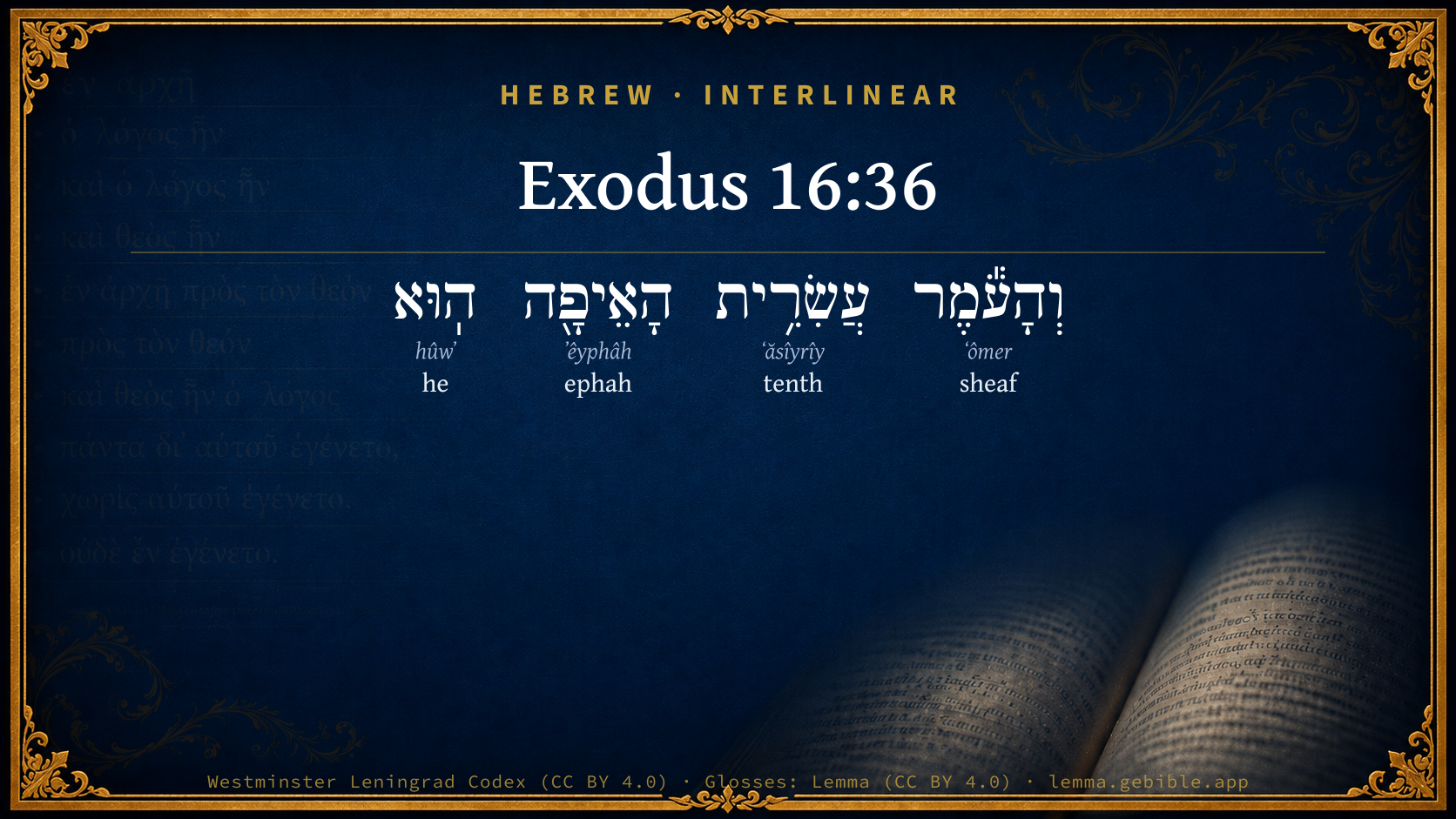
Exodus 16:36

Hebrew (Westminster Leningrad Codex) Exodus 16:36 appears in the Hebrew Old Testament. The text above is from the Westminster Leningrad Codex. Each word links to its Strong’s number, a concise gloss, and parsing drawn from the Open Scriptures Hebrew Bible morphology. Click any word for its full Brown-Driver-Briggs (BDB) entry.
Download image
Cite this verse

Exodus 16:36 (World English Bible). Public Domain. Lemma interlinear Bible study tool, https://lemma.gebible.app/v/exodus/16/36.

Show BibTeX & RIS
BibTeX
RIS
English Translation
Now an omer is the tenth part of an ephah.
World English Bible · Public Domain
Highlights
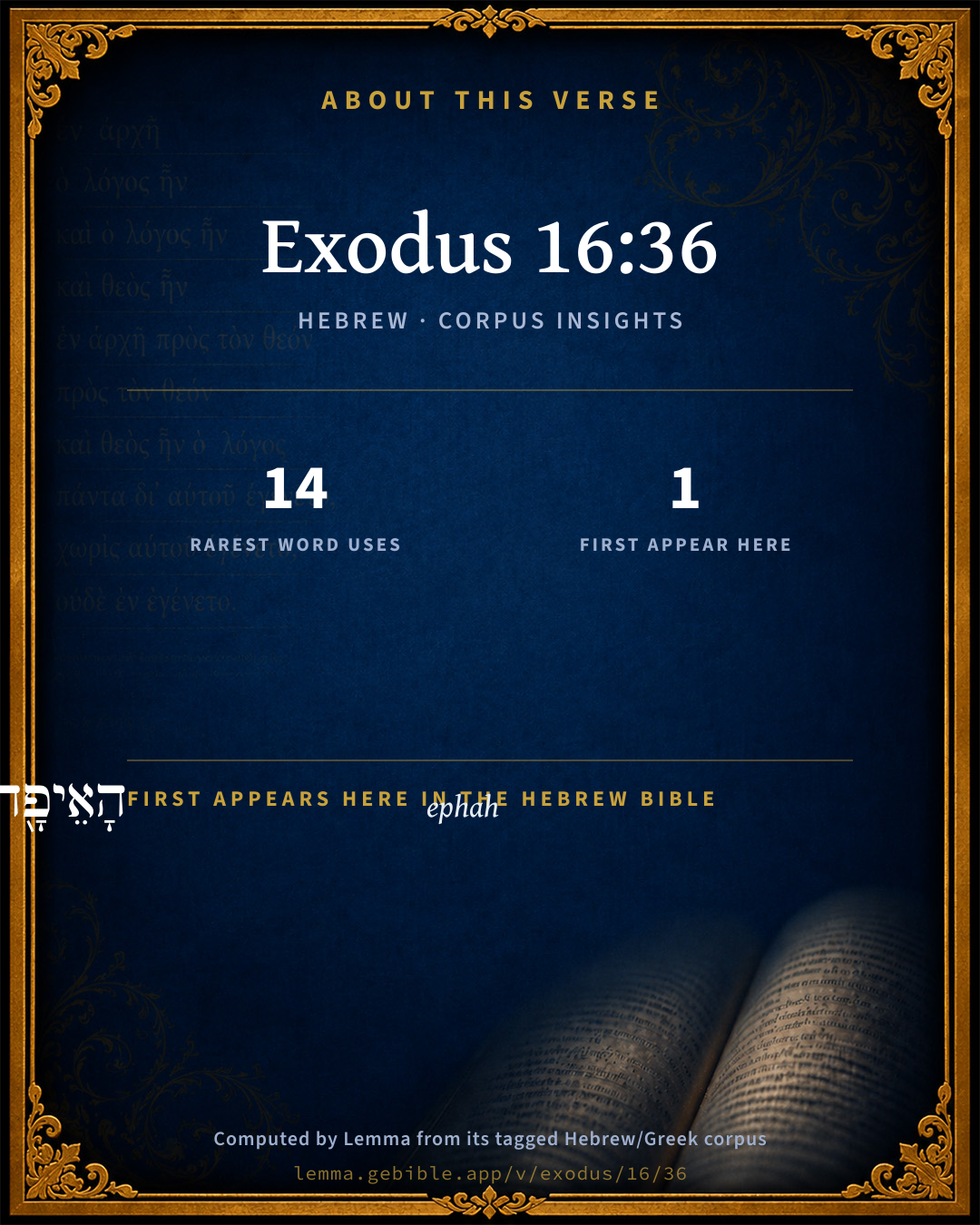
  • 1 first appearance in the Hebrew Bible
Full analysis ↓
Download a study sheet

One document with this verse’s original text, its word-by-word gloss line, the meaning frame, cross-references with their text, attributed commentary, and full source and license credits — printable, and it pastes into notes with its structure intact.

This verse Autodidact and up

Study sheet (.html) Plain text (.txt)

A passage Seminary Student

Up to 50 verses in one chapter. A passage sheet keeps up to 6 commentary sources and 12 cross-references per verse, in the order this page ranks them, and says so on the sheet whenever that leaves anything out. Ask for a single verse and you get the Autodidact verse sheet above.

Everything on this page stays free to read, with no account — the sheet is a download of what is already on screen, not access to it.

Want to remove ads? Support Godless Engineer
Compare translations 3

The same verse in 3 English versions, stacked beneath the original-language interlinear above. Click any original word for its lexicon entry.

Each is an independent rendering of the whole verse — the interlinear is not word-aligned to these translations.

Highlighted words mark where these versions differ — a whole-verse word diff, not a word-by-word alignment.

  • World English Bible Public Domain
    Now an omer is the tenth part of an ephah.
  • King James Version Public Domain
    Now an omer is the tenth part of an ephah.
  • unfoldingWord Literal Text CC BY-SA 4.0
    (And an omer, it is a tenth of an ephah.)

unfoldingWord Literal Text — © unfoldingWord, licensed CC BY-SA 4.0. Word-aligned USFM3 via Door43 (git.door43.org/unfoldingWord/en_ult).

Versions to compare (up to 4)

3 of 4 selected

Show all 18 translations

Every available English version of this verse, each an independent rendering of the whole verse.

  • World English Bible Public Domain
    Now an omer is the tenth part of an ephah.
  • Berean Standard Bible Public Domain
    (Now an omer is a tenth of an ephah.)
  • Majority Standard Bible Public Domain
    (Now an omer is a tenth of an ephah.)
  • King James Version Public Domain
    Now an omer is the tenth part of an ephah.
  • American Standard Version (1901) Public Domain
    Now an omer is the tenth part of an ephah.
  • Revised Version (1885) Public Domain
    Now an omer is the tenth part of an ephah.
  • Geneva Bible (1599) Public Domain
    The Omer is the tenth part of the Ephah.
  • Douay-Rheims (1899) Public Domain
    Now a gomor is the tenth part of an ephi.
  • Young's Literal Translation Public Domain
    and the omer is a tenth of the ephah.
  • Literal Standard Version CC BY-SA 4.0
    And the omer is a tenth of the ephah.
  • Unlocked Literal Bible CC BY-SA 4.0
    Now an omer is a tenth of an ephah.
  • unfoldingWord Literal Text CC BY-SA 4.0
    (And an omer, it is a tenth of an ephah.)
  • Darby Bible Public Domain
    Now an omer is the tenth [part] of an ephah.
  • World Messianic Bible Public Domain
    Now an omer is one tenth of an efah.
  • Webster's Bible Public Domain
    Now an omer is the tenth part of an ephah.
  • Free Bible Version CC BY-SA 4.0
    (An omer is a tenth of an ephah.)
  • Bible in Basic English Public Domain
    Now an omer is the tenth part of an ephah.
  • JPS Tanakh (1917) Public Domain
    Now an omer is the tenth part of an ephah.

Literal Standard Version (2020), Covenant Press — licensed CC BY-SA 4.0. Text via the HelloAO Bible API (eBible.org). Unlocked Literal Bible (unfoldingWord) — licensed CC BY-SA 4.0. Text via the HelloAO Bible API (eBible.org). unfoldingWord Literal Text — © unfoldingWord, licensed CC BY-SA 4.0. Word-aligned USFM3 via Door43 (git.door43.org/unfoldingWord/en_ult). Free Bible Version, Dr. Jonathan Gallagher — licensed CC BY-SA 4.0. Text via the HelloAO Bible API (eBible.org).

Word by word

More ways to search: Search by grammar → Find every occurrence → Compare this word →

Practice this passage: Drill this verse → Learn its vocabulary →

About this verse

These counts appear in no published source. They are computed here, from the morphology-tagged text and Lemma’s own curated glosses. What Lemma adds →

4
words
4
distinct lemmas
Pentateuch
section

Notable vocabulary

The rarest word here is וְהָעֹ֕מֶר sheaf H6016 — appearing just 14 times in the whole Hebrew Bible.

First appearance in Scripture

This word makes its first canonical appearance in the Hebrew Bible here:

  • הָאֵיפָ֖ה ephah H374

Shared distinctive vocabulary

וְהָעֹ֕מֶר sheaf H6016 occurs in 14 verses of the Hebrew Bible. Also found in:

Grammatical profile

  • 2 nouns
  • 1 adjective
  • 1 pronoun

Hebrew & Septuagint length

In English translation the verse runs 10 words from the Hebrew and 10 from the Septuagint (LXX English) — the same length.

A rough comparison of the two English renderings, which tokenize alike — not a word-level alignment.

Word counts can differ between the Hebrew and the Greek without any difference in meaning — e.g. the Hebrew direct-object marker אֵת has no separate Greek word, and Greek often adds the article ὁ.

Cross-references

2

Topical passages linked to Exodus 16:36 in the Treasury of Scripture Knowledge — connected by theme and wording, ordered by reader-vote popularity; previews shown in the World English Bible.

  • Exodus 16:16 This is the thing which Yahweh has commanded: "Gather of it everyone according to his eating; an omer a head, according to the number of your persons, shall you take it, every man for those who are in his tent."
  • Exodus 16:32–33 Moses said, "This is the thing which Yahweh has commanded, 'Let an omer-full of it be kept throughout your generations, that they may see the bread with which I fed you in the wilderness, when I brought you forth from the land of Egypt."

Cross-references courtesy of OpenBible.info (CC BY 4.0).

Hebrew and Greek witnesses Masoretic Hebrew ↔ Greek Septuagint

The same verse in the two great witnesses to the Old Testament, shown verse-for-verse.

These are two independent witnesses, not word-aligned to each other, and the Septuagint is shown in lemma (dictionary) form.

Hebrew Exodus 16:36 Masoretic · Westminster Leningrad Codex

וְהָעֹ֕מֶר עֲשִׂרִ֥ית הָאֵיפָ֖ה הֽוּא

Now an omer is the tenth part of an ephah.

World English Bible · Public Domain

Greek LXX Exodus 16:36 Septuagint · lemma form

ὁ δέ γομορ ὁ δέκατος ὁ τρεῖς μέτρον εἰμί

Now the homer was the tenth part of three measures.

LXX2012 (modern English Septuagint) · Public Domain

Hebrew: Westminster Leningrad Codex (CC BY 4.0). Greek: Septuagint (public domain); English from LXX2012 (modern English Septuagint) (Public Domain). How the Septuagint differs from the Hebrew →

Targum (Aramaic paraphrase)

2

The Targum is the ancient Jewish Aramaic paraphrase of the Hebrew Scriptures — an interpretive translation, not the Hebrew text itself. Onkelos (literal) and Pseudo-Jonathan (expansive) render the Torah, and Jonathan the Prophets. Coverage is partial: where no permissively-licensed English translation exists for a verse, only the Aramaic is shown. This is verse-level text, not a word-by-word alignment to the Hebrew.

  1. Targum Onkelos Torah (Genesis–Deuteronomy)
    וְעֻמְרָא חַד מִן עַסְרָא בִּתְלָת סְאִין הוּא:

    (no public-domain English translation for this verse)

    Targum Onkelos — Aramaic: “Onkelos Genesis” (public domain); “Onkelos Exodus” (public domain); “Onkelos Leviticus” (public domain); “Onkelos Numbers” (public domain); “Onkelos Deuteronomy” (public domain). English: “Sefaria Community Translation” (CC0 1.0 (public-domain dedication)); “J.W. Etheridge. The Targums of Onkelos and Jonathan Ben Uzziel on the Pentateuch. London: Longmans, Green, 1862” (public domain). Text via Sefaria.

  2. Targum Pseudo-Jonathan Torah (Genesis–Deuteronomy)
    וְעִמְרָא חָד מִן עַשְרָא לִתְלַת סְאִין הוּא

    And a homera is one tenth of three seahs.

    Targum Pseudo-Jonathan — Aramaic: “Targum Jonathan on Genesis” (public domain); “Targum Jonathan on Exodus” (public domain); “Targum Jonathan on Leviticus” (public domain); “Targum Jonathan on Numbers” (public domain); “Targum Jonathan on Deuteronomy” (public domain). English: “The Targum of Jonathan ben Uzziel, trans. J. W. Etheridge, London, 1862” (public domain). Text via Sefaria.

Commentary

Notes on Exodus 16:36 from classic Christian and Jewish commentators (each source and its license shown beneath its notes). The classic Christian expositions comment on the surrounding passage and are grouped to its opening verse, so a note may address several verses; the Jewish commentaries on the Tanakh (Rashi and others) are per-verse, so they appear only where the commentator wrote on this verse.

Lemma curates 59 commentaries, every one of them public domain or Creative Commons licensed, each selected and text-cleaned for this edition rather than reprinted as found. About our sources →

Trapp's Complete Commentary

John Trapp

Exo 16:36 Now an omer [is] the tenth [part] of an ephah.

Ver. 36. Of an ephah.] Or, Of a bushel: a plentiful allowance. {See Trapp on "Joh 2:7"}

John Trapp, A Commentary or Exposition upon All the Books of the Old and New Testament (1647–1656) — public domain. Text from a community e-Sword module.

Geneva Bible (1599)

Geneva Bible translators

Which measure contained about ten pottels.

Geneva Bible (1599) marginal notes — public domain. Text via Bolls.life.

Adam Clarke's Commentary

Verse 36. Now an omer is the tenth part of an ephah.] About six pints, English. See Clarke on Ex 16:16. The true place of this verse seems to be immediately after Ex 16:18, for here it has no connection.

1. ON the miracle of the manna, which is the chief subject in this chapter, a good deal has already been said in the preceding notes. The sacred historian has given us the most circumstantial proofs that it was a supernatural and miraculous supply; that nothing of the kind had ever been seen before, and probably nothing like it had ever afterwards appeared. That it was a type of our blessed Redeemer, and of the salvation which he has provided for man, there can be no doubt, for in this way it is applied by Christ himself; and from it we may gather this general conclusion, that salvation is of the Lord. The Israelites must have perished in the wilderness, had not God fed them with bread from heaven; and every human soul must have perished, had not Jesus Christ come down from heaven, and given himself for the life of the world.

2. God would have the Israelites continually dependent on himself for all their supplies; but he would make them, in a certain way, workers with him. He provided the manna; they gathered and ate it. The first was God's work; the latter, their own. They could not produce the manna, and God would not gather it for them. Thus the providence of God appears in such a way as to secure the co-operation of man. Though man should plant and water, yet it is God who giveth the increase. But if man neither plant nor water, God will give no increase. We cannot do God's work, and he will not do ours. Let us, therefore, both in things spiritual and temporal, be workers together with HIM.

3. This daily supply of the manna probably gave rise to that petition, Give us to-day our daily bread. It is worthy of remark, 1. That what was left over night contrary to the command of God bred worms and stank; 2. That a double portion was gathered on the day preceding the Sabbath; 3. That this alone continued wholesome on the following day; and, 4. That none fell on the Sabbath! Hence we find that the Sabbath was considered a Divine institution previously to the giving of the Mosaic law; and that God continued to honour that day by permitting no manna to fall during its course. Whatever is earned on the Sabbath is a curse in a man's property. They who WILL be rich, fall into temptation and into a snare, c. for, using illicit means to acquire lawful things, they bring God's curse upon themselves, and are drowned in destruction and perdition. Reader, dost thou work on the Sabbath to increase thy property? See thou do it not! Property acquired in this way will be a curse both to thee and to thy posterity.

4. To show their children and children's children what God had done for their fathers, a pot of manna was laid up before the testimony. We should remember our providential and gracious deliverances in such a way as to give God the praise of his own grace. An ungrateful heart is always associated with an unbelieving mind and an unholy life. Like Israel, we should consider with what bread God has fed our fathers, and see that we have the same; the same Christ - the bread of life, the same doctrines, the same ordinances, and the same religious experience. How little are we benefited by being Protestants, if we be not partakers of the Protestant faith! And how useless will even that faith be to us, if we hold the truth in unrighteousness. Our fathers had religion enough to enable them to burn gloriously for the truth of God! Reader, hast thou so much of the life of God in thy soul, that thou couldst burn to ashes at the stake rather than lose it? In a word, couldst thou be a martyr? Or hast thou so little grace to lose, that thy life would be more than an equivalent for thy loss? Where is the manna on which thy fathers fed?

Adam Clarke's Commentary on the Bible (1810–1826) — public domain. Text from a community e-Sword/MySword module.

Ellicott's Commentary for English Readers

(36) Now an omer.—The “omer” and the “ephah” were both of them Egyptian measures. One—the latter—continued in use among the Hebrews, at any rate, until the captivity (Ezekiel 45, 46); the other—the omer—fell out of use very early. Hence this parenthetic verse, which is exegetical of the word “omer,” and may have been added by the completer of Deuteronomy, or by some later editor—perhaps Ezra.

A Bible Commentary for English Readers, edited by Charles John Ellicott (1878–1897) — public domain. Text from a community e-Sword module.

The Cambridge Bible for Schools and Colleges

gen. ed. J. J. S. Perowne

36. An explanatory note: cf. on v. 16.

The manna of the Peninsula of Sinai is the sweet juice of the Ṭarfa, a species of Tamarisk. It exudes in summer by night from the trunk and branches, and forms small round white grains, which (as observed by Seetzen in 1809) partly adhere to the twigs of the trees, and partly drop to the ground: in the early morning it is of the consistency of wax, but the sun’s rays soon melt it (cf. v. 21, above), and later in the day it disappears, being absorbed in the earth. A fresh supply appears each night during its season (June and July). The Arabs gather it in the early morning, boil it down, strain it through coarse stuff, and keep it in leather skins: they ‘pour it like honey over their unleavened bread; its taste is agreeable, somewhat aromatic, and as sweet as honey’ (Burckh., p. 600). In a cool place it keeps for long: the monks of the Sinai monastery store samples of it, which they sell or give to travellers and pilgrims (Rob. i. 115; Ebers, p. 225), as their predecessors did, 13 centuries ago, to Antoninus (Itin. § 39). According to Ehrenberg (Rob. i. 590) it is produced by the puncture of an insect (now called Gossyparia mannifera). It softens in the heat of the hand, and consists almost entirely of sugar; so it cannot be ‘ground,’ or made into ‘cakes’ (Num_11:8). It is not found in all parts of the Peninsula; W. Gharandel, W. Ṭaiyibeh, W. Feiran, W. Sheikh (leading round on the N. from J. Serbâl to J. Mûsâ: see on Exo_19:1), and W. Naṣb (8–10 miles SE. of J. Mûsâ), are named as parts in which it is abundant. It is found only after a rainy spring, and hence frequently fails altogether. The quantity yielded by the Peninsula in modern times is small—according to Burckhardt (in 1816), 500–600 pounds annually1[156].

[156] See further Knob. ap. Di., and McLean in EB., from whom the above particulars are mostly taken; also Ebers, p. 224 ff. The note in the Speaker’s Comm. p. 321a is translated almost verbally from Knob, without acknowledgement.

The manna described in the Pentateuch thus resembles the manna produced naturally in the Peninsula, in, approximately, the place (El Markhâ, between Wâdy Ṭaiyibeh and Wâdy Feiran,—if this was really the ‘wilderness of Sin’) of at least its first appearance; in colour, appearance, and taste (vv. 14, 31, Num_11:8); in being found and gathered in the early morning; in melting in the sun; and in being called by the same name which is still used in Arabic: it differs from it in being represented as found not under the tamarisk trees, but on the surface of the wilderness generally, after the disappearance of the dew; as falling in sufficient quantity to feed daily an immense multitude of people; as adjusting itself automatically to the household needs of each person who gathered it; as not falling on the sabbath, the needs of that day being supplied by a double amount being provided on the previous day; as being not confined to wet years, or to the districts on the W. of the Peninsula, but as lasting, apparently continuously, for forty years, throughout the whole journeyings of the Israelites to the border of Canaan; as being capable of being ‘ground’ and made into ‘cakes,’ like meal; and as putrefying if kept (except on the 6th day of the week) till the next morning. It is evident that the Biblical manna, while on the one hand (like the Plagues) it has definite points of contact with a natural phaenomenon or product of the country, differs from the natural manna in the many praeternatural or miraculous features attributed to it. According to Dillmann, ‘the intention of the story (Sage) followed by the writer was to explain how the Hebrews, during their long journey through the wilderness, where there is no corn, obtained their most important means of life. The question was solved by the supposition that God, in His infinite power, had sent them bread from heaven, in the shape of manna, which was of such a nature that it could be used as earthly corn.’

The narrative is to be taken as a signal and beautiful symbolical illustration of the great truth of God’s ever-sustaining providence: He supplies His people with food, He cares for them in their needs, and He makes the food which He gives them the vehicle of spiritual lessons. The writer of Deuteronomy (Exo_8:3; Exo_8:16 f.) points to the manna as illustrating the discipline of the wilderness; Israel was ‘humbled’ by being suffered to feel a want, and then by its being taught how, for its relief, and for its own very existence, it was dependent upon the (creative) word of God; it was further ‘proved,’ by the opportunity thus afforded it of shewing whether or not it would accommodate itself, trustfully and contentedly (contrast Num_11:6; Num_21:5), to this state of continued dependence upon an ordinance of God. In St John (Joh_6:31 ff.), our Lord, after the reference made by the Jews to the manna eaten by the fathers in the wilderness, uses imagery suggested by the manna to denote Himself as the ‘bread of life,’ which ‘cometh down from heaven, and giveth life unto the world.’ For other later allusions, see Wis_16:20 (with the last words here, ‘agreeing to every taste,’ of. the Rabb. legend that the manna adapted itself to the taste of every individual, tasting like what he himself desired it to be: set Jewish Encycl. s.v.), Exo_19:21; 1Co_10:3 (πνευματικὸν βρῶμα); and Taylor, Sayings of the Jewish Fathers, ed. 2, p. 178 f. In Apoc. Bar. xxix. 8, Sib. Orac. vii. 149 (cf. Rev_2:17) it is to be the food of the elect in the future Messianic kingdom.

The Cambridge Bible for Schools and Colleges (gen. ed. J. J. S. Perowne; Cambridge University Press, 1878–1918) — public domain. Text from a community e-Sword module.

Whedon's Commentary on the Bible

Daniel D. Whedon

36. An omer — The reason for here specially mentioning the capacity of the omer seems to be that given by Michaelis and Hengstenberg. Literally, the word omer signifies a sheaf of wheat, but in this chapter it denotes a measure, and it is never used with this meaning afterwards. When subsequently the same measure is spoken of it is called the tenth part of an ephah, as in Num_5:15; Num_28:15. According to these commentators the word here really means the little earthen vessel or cup which the Israelites used for drinking purposes in the desert, and the author here means to say that this cup usually held a tenth of an ephah, the ephah being then a well known measure. In arranging the book into regular form for the use of coming generations it was proper and appropriate thus to describe the capacity of the vessel in which the Israelites measured the daily allowance of manna. Afterwards the name of the vessel came naturally to be used to designate the measure of the vessel — as our word “cup” has both meanings, the vessel and the measure. Omer is to be distinguished from homer, which was ten ephahs, or a hundred omers.

Daniel D. Whedon (gen. ed.), Commentary on the Old and New Testaments (1874–1909) — public domain. Text from a community e-Sword module.

The Pulpit Commentary

An omer. The "omer" must be distinguished from the "homer" of later times. It was an Egyptian measure, as also was the" ephah." It is not improbable that the verse is an addition by a later writer, as Joshua, or Ezra.

The Pulpit Commentary (1880–1919), ed. H.D.M. Spence-Jones & Joseph S. Exell — public domain. Text from a community e-Sword module.

Keil & Delitzsch

C. F. Keil & F. Delitzsch

In conclusion, the quantity of the manna collected for the daily supply of each individual, which was preserved in the sanctuary, is given according to the ordinary measurement, viz., the ephah. The common opinion, that עמר was the name for a measure of capacity, which was evidently shared by the Seventy, who have rendered the word γομόρ, has no foundation so far as the Scriptures are concerned. Not only is it a fact, that the word omer is never used as a measure except in this chapter, but the tenth of an ephah is constantly indicated, even in the Pentateuch, by "the tenth part of an ephah" (Lev 5:11; Lev 6:13; Num 5:15; Num 28:5), or "a tenth deal" (Exo 29:40; Lev 14:10, etc.; in all 30 times). The omer was a small vessel, cup, or bowl, which formed part of the furniture of every house, and being always of the same size, could be used as a measure in case of need.

(Note: Omer proprie nomen poculi fuit, quale secum gestare solent Orientales, per deserta iter facientes, ad hauriendam si quam rivus vel fons offerret aquam.... Hoc in poculo, alia vasa non habentes, et mannam collegerunt Israelitae (Michaelis, Supplem. ad Lex. hebr., p. 1929). Cf. Hengstenberg, Dissertations on the Pentateuch, vol. ii. p. 172.)

The ephah is given by Bertheau as consisting of 198577 Parisian cubic inches, and holding 739,800 Parisian grains of water; Thenius, however, gives only 101439 Parisian, or 112467 Rhenish inches. (See my Archologie, ii. 141-2.)

Keil & Delitzsch — Biblical Commentary on the Old Testament (1861–1891) — public domain (CC PDM 1.0). Text via the HelloAO Bible API. (Old Testament only.)

Rashi

Rabbi Shlomo Yitzchaki (Rashi)

עשירית האפה [THE OMER] IS THE TENTH PART OF AN EPHAH — The Ephah is three Seahs, and the Seah is six Kabs, and the Kab is four Logs and the Log has the capacity of six eggs: it follows, therefore, that the tenth of an Ephah has the capacity of forty-three and a fifth eggs — and this is the minimum quantity of dough for the Challa (the minimum quantity to which applies the injunction to separate a portion of the dough; cf. Numbers 15:20), and the measure for the meal offering (cf. Rashi on Eruvin 83b).

Rashi on the Tanakh — English translations: “The Judaica Press complete Tanach with Rashi, translated by A. J. Rosenberg” (CC BY 4.0); “Pentateuch with Rashi's commentary by M. Rosenbaum and A.M. Silbermann, 1929-1934” (public domain); “The Metsudah Tanach series, Lakewood, N.J” (CC BY 4.0); and “The Book of Joshua, Metsudah Publications, 1997” (CC BY 4.0). Text via Sefaria.

Lesson kit

Teaching starters — assembled from the data on this page, not authored interpretation. Every prompt links to the verse data it draws on. Edit before teaching.

Exodus, in the Pentateuch, opens this verse with 4 words (4 distinct Hebrew lemmas). Its most distinctive word is ʻômer (“sheaf”). A historical commentator’s framing appears above. Read the whole chapter for the surrounding context.

Discussion questions

  1. How does “sheaf” (ʻômer) shape what this verse is saying?
  2. The word “ephah” first appears here in Scripture. What is being introduced at this debut?
  3. Exodus 16:16 shares the word «sheaf» with this verse. How do the two illuminate each other?
  4. These translations render this verse differently. What is at stake in choosing one wording over another?
  5. Reading how Trapp's Complete Commentary and Geneva Bible (1599) read this verse, where do the two commentators agree and where do they part?

Things to notice

  • 1 word makes its first canonical appearance in Scripture here.
  • These translations choose different wording for 2 words in this verse.
  • 4 distinct Hebrew lemmas span 4 words in this verse.

Reading settings

Reading text

Shown beneath each verse's original-language words.

Old Testament
Old Testament edition

Read the OT as the Masoretic Hebrew (MT) or the Greek Septuagint (LXX).

English shown for the Greek Septuagint (in the Hebrew ↔ Greek comparison).

Comparing translations? Open the Compare panel on any verse page to stack up to four side by side.