
Proverbs 26:4

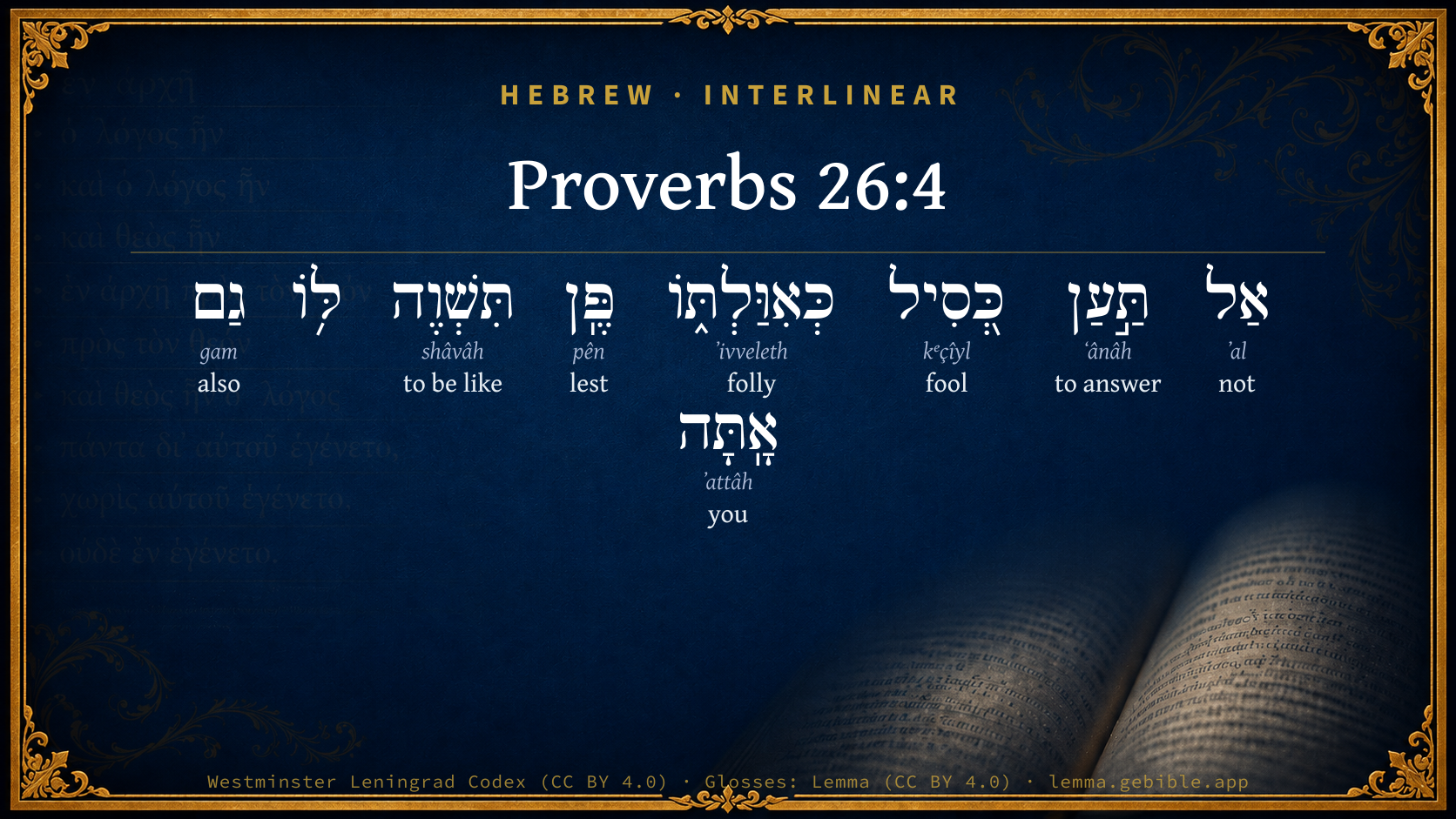
Hebrew (Westminster Leningrad Codex) Proverbs 26:4 appears in the Hebrew Old Testament. The text above is from the Westminster Leningrad Codex. Each word links to its Strong’s number, a concise gloss, and parsing drawn from the Open Scriptures Hebrew Bible morphology. Click any word for its full Brown-Driver-Briggs (BDB) entry.
Download image
Cite this verse

Proverbs 26:4 (World English Bible). Public Domain. Lemma interlinear Bible study tool, https://lemma.gebible.app/v/proverbs/26/4.

Show BibTeX & RIS
BibTeX
RIS
English Translation
Don't answer a fool according to his folly, Lest you also be like him.
World English Bible · Public Domain
Download a study sheet

One document with this verse’s original text, its word-by-word gloss line, the meaning frame, cross-references with their text, attributed commentary, and full source and license credits — printable, and it pastes into notes with its structure intact.

This verse Autodidact and up

Study sheet (.html) Plain text (.txt)

A passage Seminary Student

Up to 50 verses in one chapter. A passage sheet keeps up to 6 commentary sources and 12 cross-references per verse, in the order this page ranks them, and says so on the sheet whenever that leaves anything out. Ask for a single verse and you get the Autodidact verse sheet above.

Everything on this page stays free to read, with no account — the sheet is a download of what is already on screen, not access to it.

Want to remove ads? Support Godless Engineer
Compare translations 3

The same verse in 3 English versions, stacked beneath the original-language interlinear above. Click any original word for its lexicon entry.

Each is an independent rendering of the whole verse — the interlinear is not word-aligned to these translations.

Highlighted words mark where these versions differ — a whole-verse word diff, not a word-by-word alignment.

  • World English Bible Public Domain
    Don't answer a fool according to his folly, Lest you also be like him.
  • King James Version Public Domain
    Answer not a fool according to his folly, lest thou also be like unto him.
  • unfoldingWord Literal Text CC BY-SA 4.0
    Do not answer a stupid one according to his folly, lest you yourself also become like him.

unfoldingWord Literal Text — © unfoldingWord, licensed CC BY-SA 4.0. Word-aligned USFM3 via Door43 (git.door43.org/unfoldingWord/en_ult).

Versions to compare (up to 4)

3 of 4 selected

Show all 18 translations

Every available English version of this verse, each an independent rendering of the whole verse.

  • World English Bible Public Domain
    Don't answer a fool according to his folly, Lest you also be like him.
  • Berean Standard Bible Public Domain
    Do not answer a fool according to his folly, or you yourself will be like him.
  • Majority Standard Bible Public Domain
    Do not answer a fool according to his folly, or you yourself will be like him.
  • King James Version Public Domain
    Answer not a fool according to his folly, lest thou also be like unto him.
  • American Standard Version (1901) Public Domain
    Answer not a fool according to his folly, Lest thou also be like unto him.
  • Revised Version (1885) Public Domain
    Answer not a fool according to his folly, lest thou also be like unto him.
  • Geneva Bible (1599) Public Domain
    Answer not a foole according to his foolishnes, least thou also be like him.
  • Douay-Rheims (1899) Public Domain
    Answer not a fool according to his folly, lest thou be made like him.
  • Young's Literal Translation Public Domain
    Answer not a fool according to his folly, Lest thou be like to him -- even thou.
  • Literal Standard Version CC BY-SA 4.0
    Do not answer a fool according to his folly, || Lest you are like to him—even you.
  • Unlocked Literal Bible CC BY-SA 4.0
    Do not answer a fool according to his folly, or you will become like him.
  • unfoldingWord Literal Text CC BY-SA 4.0
    Do not answer a stupid one according to his folly, lest you yourself also become like him.
  • Darby Bible Public Domain
    Answer not a fool according to his folly, lest thou also be like unto him.
  • World Messianic Bible Public Domain
    Don’t answer a fool according to his folly, lest you also be like him.
  • Webster's Bible Public Domain
    Answer not a fool according to his folly, lest thou also be like him.
  • Free Bible Version CC BY-SA 4.0
    Don't answer stupid people following their stupidity, or you'll become as bad as them.
  • Bible in Basic English Public Domain
    Do not give to the foolish man a foolish answer, or you will be like him.
  • JPS Tanakh (1917) Public Domain
    Answer not a fool according to his folly, lest thou also be like unto him.

Literal Standard Version (2020), Covenant Press — licensed CC BY-SA 4.0. Text via the HelloAO Bible API (eBible.org). Unlocked Literal Bible (unfoldingWord) — licensed CC BY-SA 4.0. Text via the HelloAO Bible API (eBible.org). unfoldingWord Literal Text — © unfoldingWord, licensed CC BY-SA 4.0. Word-aligned USFM3 via Door43 (git.door43.org/unfoldingWord/en_ult). Free Bible Version, Dr. Jonathan Gallagher — licensed CC BY-SA 4.0. Text via the HelloAO Bible API (eBible.org).

Word by word

More ways to search: Search by grammar → Find every occurrence → Compare this word →

Practice this passage: Drill this verse → Learn its vocabulary →

תִּשְׁוֶה
shâvâh
H7737
“to be like”
Verb, Qal, Imperfect, 2nd Person, Masculine, Singular
Part of Speech
Verb
Stem
Qal
Form
Imperfect
Person
2nd Person
Gender
Masculine
Number
Singular
Full BDB Definition

Origin: a primitive root

TWOT: 2342 , 2343

to agree with, be or become like, level, resemble - (Qal) - to be like - equivalent (participle) - to set, place - setting (participle) - (Piel) to level, smooth, still - (Hiphil) to make like - (Nithpael) to be alike - (Piel) to set, place
  1. אַל ʼal H408 “not” Particle, Negative
  2. תַּ֣עַן ʻânâh H6030 “to answer” Verb, Qal, Jussive, 2nd Person, Masculine, Singular
  3. כְּ֭סִיל kᵉçîyl H3684 “fool” Adjective, Adjective, Masculine, Singular, Absolute
  4. כְּאִוַּלְתּ֑וֹ ʼivveleth H200 “like/as · folly · his” Preposition + Noun, Common, Feminine, Singular, Construct + Suffix, Personal, 3rd Person, Masculine, Singular
  5. פֶּֽן pên H6435 “lest” Conjunction
  6. גַם gam H1571 “also” Adverb
  7. אָֽתָּה ʼattâh H859 “you” Pronoun, Personal, 2nd Person, Masculine, Singular

About this verse

These counts appear in no published source. They are computed here, from the morphology-tagged text and Lemma’s own curated glosses. What Lemma adds →

9
words
8
distinct lemmas
Wisdom
section

Notable vocabulary

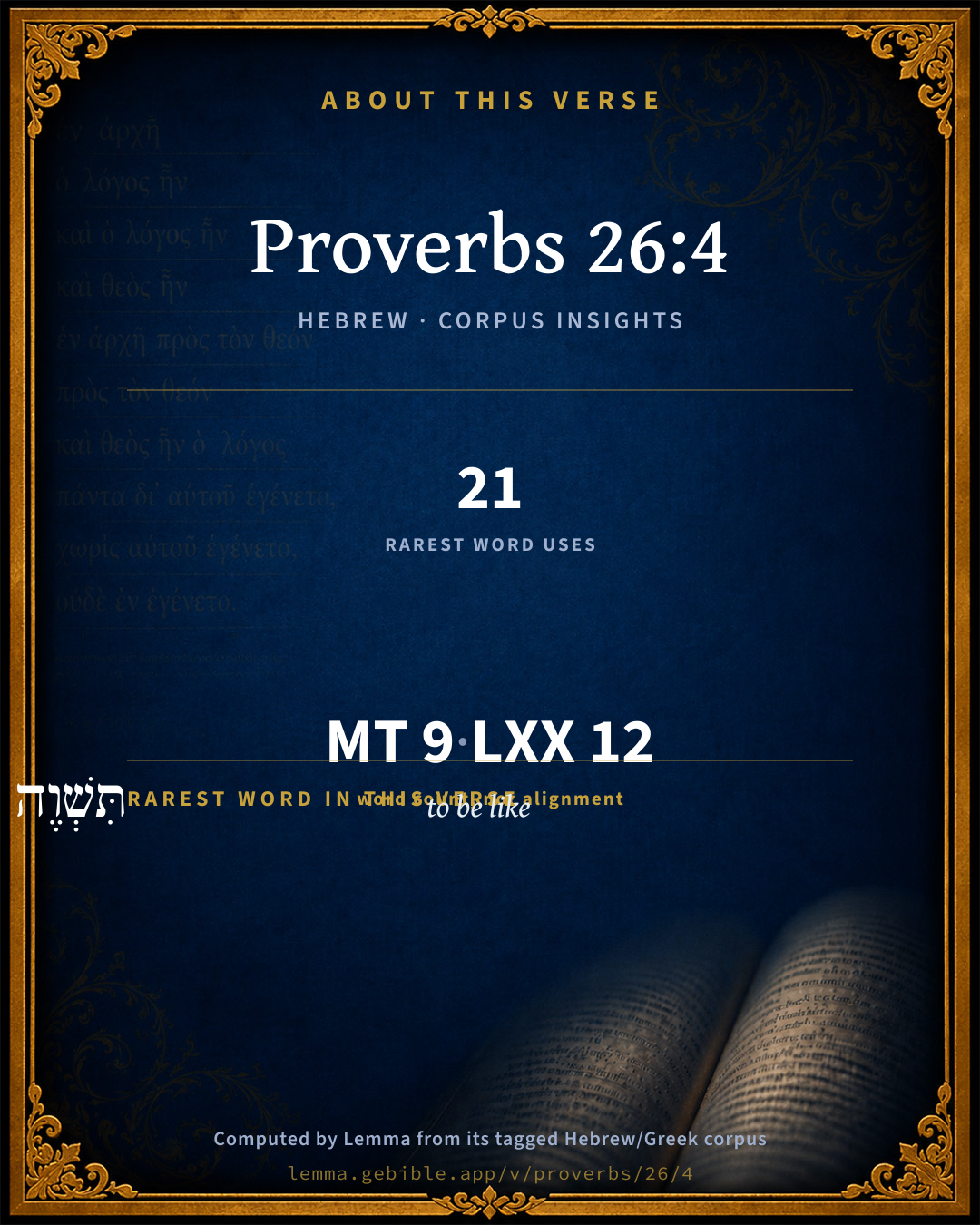
The rarest word here is תִּשְׁוֶה to be like H7737 — appearing just 21 times in the whole Hebrew Bible.

Shared distinctive vocabulary

תִּשְׁוֶה to be like H7737 occurs in 21 verses of the Hebrew Bible. Also found in:

Grammatical profile

  • 2 verbs
  • 1 noun
  • 1 adjective
  • 1 pronoun
  • 1 preposition
  • 1 conjunction
  • 1 adverb
  • 1 particle

Verb forms

  • תַּ֣עַן Qal · Jussive
  • תִּשְׁוֶה Qal · Imperfect

Hebrew & Septuagint length

In English translation the verse runs 14 words from the Hebrew and 13 from the Septuagint (LXX English) — closely comparable.

A rough comparison of the two English renderings, which tokenize alike — not a word-level alignment.

Word counts can differ between the Hebrew and the Greek without any difference in meaning — e.g. the Hebrew direct-object marker אֵת has no separate Greek word, and Greek often adds the article ὁ.

In the original languages it is 9 Hebrew tokens and 12 Greek tokens — but the two are counted differently (Hebrew bundles its prefixes and suffixes into one token; the Greek is in lemma form), so that isn’t a like-for-like length.

Cross-references

11

Topical passages linked to Proverbs 26:4 in the Treasury of Scripture Knowledge — connected by theme and wording, ordered by reader-vote popularity; previews shown in the World English Bible.

  • Proverbs 26:5 Answer a fool according to his folly, Lest he be wise in his own eyes.
  • 1 Peter 3:9 not rendering evil for evil, or reviling for reviling; but instead blessing; knowing that to this were you called, that you may inherit a blessing.
  • Jude 1:9 But Michael, the archangel, when contending with the devil and arguing about the body of Moses, dared not bring against him an abusive condemnation, but said, "May the Lord rebuke you!"
  • 1 Kings 12:14 and spoke to them after the counsel of the young men, saying, My father made your yoke heavy, but I will add to your yoke: my father chastised you with whips, but I will chastise you with scorpions.
  • Proverbs 17:14 The beginning of strife is like breaching a dam, Therefore stop contention before quarreling breaks out.
  • Judges 12:1–6 The men of Ephraim were gathered together, and passed northward; and they said to Jephthah, Why did you pass over to fight against the children of Ammon, and didn't call us to go with you? we will burn your house on you with fire.
  • 2 Samuel 19:41–43 Behold, all the men of Israel came to the king, and said to the king, Why have our brothers the men of Judah stolen you away, and brought the king, and his household, over the Jordan, and all David's men with him?
  • 1 Kings 12:16 When all Israel saw that the king didn't listen to them, the people answered the king, saying, What portion have we in David? neither have we inheritance in the son of Jesse: to your tents, Israel: now see to your own house, David. So Israel departed to their tents.
  • 2 Kings 14:8–10 Then Amaziah sent messengers to Jehoash, the son of Jehoahaz son of Jehu, king of Israel, saying, Come, let us look one another in the face.
  • Isaiah 36:21 But they held their peace, and answered him not a word; for the king's commandment was, saying, Don't answer him.
  • 1 Peter 2:21–23 For to this you were called, because Christ also suffered for us, leaving you an example, that you should follow his steps,

Cross-references courtesy of OpenBible.info (CC BY 4.0).

Hebrew and Greek witnesses Masoretic Hebrew ↔ Greek Septuagint

The same verse in the two great witnesses to the Old Testament, shown verse-for-verse.

These are two independent witnesses, not word-aligned to each other, and the Septuagint is shown in lemma (dictionary) form.

Hebrew Proverbs 26:4 Masoretic · Westminster Leningrad Codex

אַל תַּ֣עַן כְּ֭סִיל כְּאִוַּלְתּ֑וֹ פֶּֽן תִּשְׁוֶה לּ֥וֹ גַם אָֽתָּה

Don't answer a fool according to his folly, Lest you also be like him.

World English Bible · Public Domain

Greek LXX Proverbs 26:4 Septuagint · lemma form

μή ἀποκρίνω ἄφρων πρός ὁ ἐκεῖνος ἀφροσύνη ἵνα μή ὅμοιος γίγνομαι αὐτός

Answer not a fool according to his folly, lest you become like him.

LXX2012 (modern English Septuagint) · Public Domain

Hebrew: Westminster Leningrad Codex (CC BY 4.0). Greek: Septuagint (public domain); English from LXX2012 (modern English Septuagint) (Public Domain). How the Septuagint differs from the Hebrew →

Commentary

Notes on Proverbs 26:4 from classic Christian and Jewish commentators (each source and its license shown beneath its notes). The classic Christian expositions comment on the surrounding passage and are grouped to its opening verse, so a note may address several verses; the Jewish commentaries on the Tanakh (Rashi and others) are per-verse, so they appear only where the commentator wrote on this verse.

Lemma curates 59 commentaries, every one of them public domain or Creative Commons licensed, each selected and text-cleaned for this edition rather than reprinted as found. About our sources →

Trapp's Complete Commentary

John Trapp

Pro 26:4 Answer not a fool according to his folly, lest thou also be like unto him.

Ver. 4. Answer not a fool according to his folly.] When either he curseth thee, {as Pro 26:2} or cryeth out upon thee for giving him due correction {Pro 26:3} - for every public person had need to carry a spare handkerchief, to wipe off the dirt of disgrace and obloquy cast upon him for doing his duty, - pass such a one by in silence, as not worthy the answering. Sile, et funestam dedisti plagam, say nothing, and you play him to purpose. {a} Hezekiah would not answer Rabshakeh, nor Jeremiah Hananiah; {Jer 28:11} nor our Saviour his adversaries. {Mat 26:62 Joh 19:9} He reviled not his revilers, he threatened not his open opposites. {1Pe 2:23}

Lest thou also be like unto him.] As hot and as headlong as he; for a little thing kindles us, and we are apt to think that we have reason to be mad, if evil entreated; to talk as fast for ourselves as he doth against us, and to give him as good as he brings; so that at length there will be never a wiser of the two, and people will say so.

{a} Chrysost.

John Trapp, A Commentary or Exposition upon All the Books of the Old and New Testament (1647–1656) — public domain. Text from a community e-Sword module.

Albert Barnes' Notes on the Bible

Two sides of a truth. To “answer a fool according to his folly” is in Pro 26:4 to bandy words with him, to descend to his level of coarse anger and vile abuse; in Pro 26:5 it is to say the right word at the right time, to expose his unwisdom and untruth to others and to himself, not by a teaching beyond his reach, but by words that he is just able to apprehend. The apparent contradiction between the two verses led some of the rabbis to question the canonical authority of this book. The Pythagoreans had maxims expressing a truth in precepts seemingly contradictory.

Albert Barnes' Notes on the Bible (1834–1885) — public domain. Text from a community e-Sword/MySword module.

The Biblical Illustrator

Joseph S. Exell

Pro_26:4-5

Answer not a fool according to his folly, lest thou also be like unto him

Answering a fool according to his folly

The ambiguity in these verses lies in the connecting words according to, which are here used in two different senses.

Answer not a fool according to, i.e.,, not in a manner agreeing with his folly, lest thou become as foolish and perverse as he. Answer him according to, i.e.,, according to the nature and desert of his folly; so as best to meet and refute it. (E. Pond, D. D.)

The treatment of a fool

There are many cases in which a fool is to be heard, and not answered at all. When a scorner reviles us, it is needless to reprove him for it. Our Lord often kept silence when impertinent questions were asked Him. But silence cannot be the rule in every ease. In many cases it is proper that a fools words should be answered, only you must take care in answering not to imitate him. If he speaks unreasonable, profane, peevish, or passionate words, you must not answer him in his own style. You are angry at him for his folly, and reprove him for the extravagance of his behaviour, and therefore you cannot but confess that yourselves are worthy of a very sharp reproof, if you behave like him at the very time that you are testifying your displeasure at his conduct. It becomes not the followers of Jesus to return railing for railing, or one angry reflection for another, but in whatever manner others talk, our tongues ought still to be governed by the law of meekness and charity. (George Lawson, D. D.)

The scorner answered

A certain preacher had wrought his best to benefit his audience; but one of them came to him, and somewhat rudely remarked, Your preaching is of no use to me. I do not believe that I have a soul; I dont want to be talked to about an imaginary hereafter. I shall die like a dog. The minister calmly replied, Sir, I have evidently failed through misapprehension. I did my best for the good of all my hearers; but I prepared the entertainment under the notion that I was catering for men with souls. Had I known there were creatures present who had no souls, and would die like dogs, I would have provided a good supply of bones for them. (C. H. Spurgeon.)

Reply to scoffers

It is stated by one of the biographers of John Wesley that while he was staying at an hotel at Oxford for a few hours, some wild young men, who were aware of the fact, took occasion to play a joke upon him. Coming suddenly into the room where he was sitting, they exclaimed, Oh, Mr. Wesley, the devils dead! The aged saint arose, and placing his hands upon the heads of two of the young men, he said, with a voice full of pity, My poor fatherless children, what will you do?

The Biblical Illustrator, edited by Joseph S. Exell (c. 1880s–1900s) — public domain. Text from a community e-Sword module.

Joseph Benson's Commentary

Pro 26:4-5. Answer not a fool, &c. — Answer a fool, &c. — These contrary directions are easily reconciled, by considering the difference of persons, times, places, and other circumstances, and of the manner of answering. And such seemingly contradictory precepts are not only used by, but are esteemed elegant in other authors. Answer him not, when he is incorrigible, or when he is inflamed with wine, or with passion, &c., or when it is not necessary nor likely to do him good. Answer him, when he is capable of receiving good by it, or when it is necessary for the glory of God, for the discharge of a man’s duty, or for the good of others. Answer not, &c., according to his folly — So as to imitate his folly, in such passionate, or reproachful, or foolish speeches as he uses to thee; lest thou be like unto him — Show thyself to be as great a fool as he is. Answer a fool according to his folly — So as his folly needs and requires, convincing him strongly, reproving him sharply, and exposing him to just shame; lest he be wise in his own conceit — Lest thy silence make him arrogant and presumptuous, as if his words were unanswerable.

Joseph Benson's Commentary on the Old and New Testaments (1811–1818) — public domain. Text from a community e-Sword module.

Whedon's Commentary on the Bible

Daniel D. Whedon

4, 5. Answer not a fool… answer a fool — The point in these two proverbs, which are the complement of each other, is found in the play upon a single letter, the כ, (kaph,) used as a sign of comparison or similarity in Hebrew, and which we render according to. In Pro_26:4, “according to” means, in the manner of his folly, with folly like his, whether it be silliness, scurrility, or wickedness. In Pro_26:5, “according to” means, as he deserves, or as is fitting, so as to expose his folly and rebuke him. “The Pythagoreans had maxims like in form, in which a truth was expressed in precepts seemingly contradictory, as, ‘walk,’ and ‘walk not,’ in the broad road.” — Speaker’s Commentary.

Daniel D. Whedon (gen. ed.), Commentary on the Old and New Testaments (1874–1909) — public domain. Text from a community e-Sword module.

Tyndale Open Study Notes

Tyndale Open Resources

26:4-5 Proverbs are often context sensitive. Whether or not to answer the foolish arguments of fools depends on what kind of fool and what kind of situation.

Tyndale Open Study Notes — © Tyndale Open Resources, licensed CC BY-SA 4.0. Text via the HelloAO Bible API.

Geneva Bible (1599)

Geneva Bible translators

Consent not unto him in his doings.

Geneva Bible (1599) marginal notes — public domain. Text via Bolls.life.

Matthew Henry's Commentary

See here the noble security of the scripture-style, which seems to contradict itself, but really does not. Wise men have need to be directed how to deal with fools; and they have never more need of wisdom than in dealing with such, to know when to keep silence and when to speak, for there may be a time for both. 1. In some cases a wise man will not set his wit to that of a fool so far as to answer him according to his folly "If he boast of himself, do not answer him by boasting of thyself. If he rail and talk passionately, do not thou rail and talk passionately too. If he tell one great lie, do not thou tell another to match it. If he calumniate thy friends, do not thou calumniate his. If he banter, do not answer him in his own language, lest thou be like him, even thou, who knowest better things, who hast more sense, and hast been better taught." 2. Yet, in other cases, a wise man will use his wisdom for the conviction of a fool, when, by taking notice of what he says, there may be hopes of doing good, or at least preventing further, mischief, either to himself or others. "If thou have reason to think that thy silence will be deemed an evidence of the weakness of thy cause, or of thy own weakness, in such a case answer him, and let it be an answer ad hominem - to the man, beat him at his own weapons, and that will be an answer ad rem - to the point, or as good as one. If he offer any thing that looks like an argument, an answer that, and suit thy answer to his case. If he think, because thou dost not answer him, that what he says is unanswerable, then give him an answer, lest he be wise in his own conceit and boast of a victory." For (Luk 7:35) Wisdom's children must justify her.

Matthew Henry's Commentary on the Whole Bible (1708–1710) — public domain (CC PDM 1.0). Text via the HelloAO Bible API.

Jamieson, Fausset & Brown

Robert Jamieson, A. R. Fausset & David Brown

Answer not--that is, approvingly by like folly.

Jamieson, Fausset & Brown — Commentary Critical and Explanatory on the Whole Bible (1871) — public domain (CC PDM 1.0). Text via the HelloAO Bible API.

Adam Clarke's Commentary

Verse 4. Answer not a fool] On this and the following verse Bishop Warburton, who has written well on many things, and very indifferently on the doctrine of grace, has written with force and perspicuity: "Had this advice been given simply, and without circumstance, to answer the fool, and not to answer him, one who had reverence for the text would satisfy himself in supposing that the different directions referred to the doing a thing in and out of season;

1. The reasons given why a fool should not be answered according to his folly, is, "lest he (the answerer) should be like unto him."

2. The reason given why the fool should be answered according to his folly, is, "lest he (the fool) should be wise in his own conceit."

"1. The cause assigned for forbidding to answer, therefore, plainly insinuates that the defender of religion should not imitate the insulter of it in his modes of disputation, which may be comprised in sophistry, buffoonery, and scurrility.

"2. The cause assigned for directing to answer, as plainly intimates that the sage should address himself to confute the fool upon his own false principles, by showing that they lead to conclusions very wide from, very opposite to, those impieties he would deduce from them. If any thing can allay the fool's vanity, and prevent his being wise in his own conceit, it must be the dishonour of having his own principles turned against himself, and shown to be destructive of his own conclusions."-Treatise on Grace. Preface.

Adam Clarke's Commentary on the Bible (1810–1826) — public domain. Text from a community e-Sword/MySword module.

Ellicott's Commentary for English Readers

(4) Answer not a fool.—Comp. Pro_1:22.

According to his folly.—Do not lower yourself by disputing or arguing with him; he will not take in your meaning, and will think he has got the better of you, perhaps will insult you. It is noticeable that our Lord never answered a question which should not have been asked Him, but always put it by (e.g., Mat_21:23, sqq.; Luk_13:23-24; Luk_23:9; Joh_21:21-22; Act_1:6, sqq.).

A Bible Commentary for English Readers, edited by Charles John Ellicott (1878–1897) — public domain. Text from a community e-Sword module.

The Cambridge Bible for Schools and Colleges

gen. ed. J. J. S. Perowne

4, 5. according to] Let not your answer be according to his folly in foolishness; but let it be according to it in appositeness.

The Cambridge Bible for Schools and Colleges (gen. ed. J. J. S. Perowne; Cambridge University Press, 1878–1918) — public domain. Text from a community e-Sword module.

John Gill's Exposition

Answer not a fool according to his folly,.... Sometimes a fool, or wicked man, is not to be answered at all; as the ministers of Hezekiah answered not a word to Rabshakeh; nor Jeremiah the prophet to Hananiah; nor Christ to the Scribes and Pharisees; and when an answer is returned, it should not be in his foolish way and manner, rendering evil for evil, and railing for railing, in the same virulent, lying, calumniating, and reproachful language;

lest thou also be like unto him; lest thou also, who art a man of understanding and sense, and hast passed for one among men, come under the same imputation, and be reckoned a fool like him.

John Gill's Exposition of the Whole Bible (1746–1763) — public domain (CC PDM 1.0). Text via the HelloAO Bible API.

Haydock's Catholic Bible Commentary

Answer not a fool, &c. Viz., so as to imitate him; but only so as to reprove his folly. (Challoner) --- If thou answer at all, (ver. 5.) do it to the purpose, and to prevent others from taking scandal, (Calmet) as well as to humble the wicked, for his good. (Haydock)

George Leo Haydock (1774–1849), Haydock's Catholic Family Bible and Commentary, 1859 edition — public domain. Excludes Psalms (Douay-Rheims chapter numbering differs from Protestant) and Deuterocanonical books (Catholic canon only).

Matthew Poole's English Annotations

How can these contrary rules be reconciled, answer him not, and answer him?

Answ. Easily, by considering the difference of persons, and times, and places, and other circumstances, and of the manner of answering. And such seemingly contradictory precepts are not only used by, but are esteemed elegant in, other authors.

Answer him not, when he is incorrigible, or when he is inflamed with passion or wine, &c., or when it is not necessary, nor likely to do him good.

Answer him, when he is capable of receiving good by it, or when it is necessary for the glory of God, or for the discharge of a man’s duty, or for the good of others.

According to his folly; so as to imitate his folly, by such passionate, or reproachful, or foolish speeches as he useth to thee.

Be like unto him; show thyself to be as great a fool as he.

Matthew Poole's English Annotations on the Holy Bible (1683–1685) — public domain. Text from a community e-Sword/MySword module.

The Pulpit Commentary

Answer not a fool according to his folly. Do not lower yourself to the fool"s level by answering his silly questions or arguing with him as if he were a sensible man. Lest thou also be like unto him; lest you be led to utter folly yourself or to side with him in his opinions and practices. Our blessed Saviour never responded to foolish and captious questions in the way that the questioner hoped and desired, he put them by or gave an unexpected turn to them which silenced the adversary. Instances may be seen in Mat_21:23, etc.; Mat_22:21, 22 Luk_13:23, etc.; Joh_21:21, etc.

Vers. 4, 5. The wise treatment of folly.

These two verses need not be taken as mutually contradictory. They balance one another.

I IT IS DIFFICULT TO ANSWER FOLLY. Whichever way we take it, we are in danger of blundering. If we meet it on its own ground we may share its shame. If we treat it soberly we may only incur ridicule. Both courses are beset with difficulties. This is especially true of folly in the biblical sense of the word, according to which it is not so much stupidity as wilful perverseness, light-hearted but depraved. It is not easy to find any point of attachment through which to influence this condition of soul. We need great grace in endeavoring to recover the thoughtless, foolish evil-livers. The sad may be approached through their troubles, but the frivolous elude our grasp.

II IT IS A FATAL MISTAKE TO IMITATE THE FOLLY OF THE FOOLISH. St. Paul would become all things to all men in the hope that he might by any means save some. But he would never descend to frivolity; that would have been lowering to his true dignity as a servant of Christ. It is not necessary to be always grave. We may arouse and interest thoughtless people by using methods that would not be desirable or acceptable in the case of earnest men and women. Assuredly there is no virtue in pretence, pomposity, pride, a stilted style, etc. But it can never be right nor wise to say or do anything that would lower the majesty of truth and righteousness or degrade the ideal of Christian conduct. It may be possible to "draw" crowds by such more than questionable methods, but it is certainly impossible to "raise" them by such means, and what is the use of massing people together under pretence of religious work when our course of action is not likely to inspire the reverance which is the root of religion? It would be a far more successful method, as well as a more Worthy one, to have much humbler aims in regard to numbers, but much higher ones in regard to the spiritual character of our work.

III IT IS NECESSARY TO TREAT THE FOOLISH IN REGARD TO THEIR FOLLY. We are not to give back foolish answers to foolish questions, nor to attempt to attract the frivolous by frivolous methods. But, on the other hand, it is not wise, nor is it right, to treat foolish people as though they were serious and thoughtful. Thus, if questions are raised in mockery, it is our duty to treat them accordingly, and therefore to refuse to answer them. If it is evident that an inquirer is not in earnest it is not for his good nor for the honour of truth to meet him with the language which would be suitable for an honest truth seeker. To do so would be to cast pearls before swine. It may be well to meet folly with gravity and to rebuke frivolity. This is answering a fool according to his folly, in the right way; for it is taking note of his folly and directing attention to it. Mockery should not go unchastised. Insincerity ought to be exposed. Pompous folly is sometimes best met by ridicule. Thus Erasmus castigated hypocritical pretences to piety with the keen rapier of his wit. It is wise to prick a windbag.

Vers. 4-12. Discussion of folly and its treatment.

I How we ANSWER THE FOOL. (Vers. 4, 5)

1. Not according to his folly; i.e. so chiming in with his nonsense that yon become as he is. Do not descend into the arena with a fool. Preserve self-respect, and observe the conduct of the Saviour when to folly he "answered not again.

2. According to his folly; that is, with the sharp and cutting reply his folly invites and deserves. We have also examples of this in the conduct of our Lord; e.g. in reference to the inquiry of the Jews concerning the purging of the temple, which he answered by a reference to John"s baptism. (Mat_21:25, etc.) The twofold treatment of the fool reminds that the spirit and motive must determine the act, and that opposite methods may be equally good at different times.

II THE FOOL IS NOT TO BE TRUSTED. (Vers. 6, 7)

1. With messages and commissions. (Ver. 6) He who does so is like one who amputates his own limbs, deprives himself of the means of gaining his object, or who voluntarily drinks of an evil brewage.

2. His words are not to be trusted. (Ver. 7) Sayings in the mouth of the fool are purposeless and pointless, when they even do no harm. Fools will not be prudent, says Luther, and yet would ever play the part of wise men. "A wise saying doth as ill become a fool as dancing does a cripple." The wise and weighty saying becomes in his mouth a jest. He who would instruct others in Divine wisdom must first have embraced it himself. Solemnity may be a cover for a sot; and the greatest folly is to impose on one"s self.

III THE FOOL IS NOT TO BE HONOURED. (Ver. 8) To lift him out of his place by compliments or honours is as inapt as to lay a jewel upon a common heap of stones. The sling makes the stone bound in it an implement of death; and to flatter the undeserving brings disgrace upon one"s self. It is like putting sword or pistol into a madman"s hand. But the other interpretation is better. Ver. 9 shows how mischievous are even good things in the lips and hands of those who only abuse them. Luther quaintly says, "If a drunkard sports with a briar, he scratches more with it than he allows to smell the roses on it; so does a fool often work more mischief with the Scripture than good." (The meaning of ver. 10 is so obscure, it must be left to exegetes; it appears to coincide with the foregoing the fool is not to be trusted)

IV THE FOOL IS INCORRIGIBLE. (Vers. 11, 12; see 2Pe_2:22) He returns to his exploded nonsense, his often-repeated fallacies; and to his exposed errors of conduct. (Mat_12:45 Joh_5:14 Heb_6:4-8) Relapses into sin, as into sickness, are dangerous and deadly. "A raw sin is like a blow to a broken leg, a burden to a crushed arm." The cause of these relapses and this incorrigibility is pointed out deep-rooted self-conceit. This is the fruitful mother of follies. Let none deem himself perfect, but let every one cultivate humility as his dearest possession. God giveth grace to the lowly, but resisteth the proud and them that are wise in their own conceits. J.

Vers. 4, 5. The two ways of meeting folly.

They are these

I THE CAREFUL AVOIDANCE OF REPEATING IT. (Ver. 4) Only too often men allow the foolish to draw them into a repetition of their folly, so that one fool makes another. Folly is contagious, and we are all in some danger of catching it. This is the case with us when:

1. We let the word of anger provoke us to a responsive bitterness; then we are "overcome of evil" instead of "overcoming evil with good". (Rom_12:21)

2. We allow one exaggeration to lead us into another. When two men are in conversation, one is often tempted to lead the other into statements that exceed the truth; and exaggeration is only another name for falsehood.

3. We accept a foolish challenge. The young, more particularly, are fond of exciting one another to deeds of folly, and it often requires courage, steadfastness, even nobility of spirit, to refuse to follow the leading of unwisdom.

4. We indulge in idle gossip; letting the first statement about our neighbour, which is unfounded and slanderous, conduct us to idle and mischievous talk in the same foolish strain.

5. We permit ourselves to follow the lead of the man whose thoughts and words are in the direction of a doubtful, or a dishonourable, or a defiling region. In all these cases it behoves us "not to answer a fool according to his folly," to be silent altogether; or else to break away into another and worthier strain; or even to "take up our parable" against that which has been said in our hearing. But here we reach the other method, viz.

II THE WISE CONDEMNATION OF IT. Folly is sometimes to be rebuked (ver. 5). Silence on our part would be mistaken and abused; it would be regarded as acquiescence or as incapacity to meet what has been said, and folly would go on its way, its empty head held higher than before. We must use discretion here; must understand "when only silence suiteth best," and also when silence would be a mistake and even a sin. The times to answer a fool according to his folly, i.e. in the way which is demanded by his folly, are surely these:

1. When ignorance needs to be exposed.

2. When pretentiousness and presumptuousness want to be put down.

3. When irreverence or actual profanity requires to be rebuked and silenced.

4. When vice or cruelty deserves to be smitten and abashed. Then let the true and brave man speak; let the name and the honour of his holy Saviour, let the cause of truth and righteousness, let the interests of the young and the poor and the weak unloose his tongue, and let him pour forth his indignation. In so doing he will be following in the footsteps of the Lord of truth and love, and of the noblest and worthiest of his followers. C.

The Pulpit Commentary (1880–1919), ed. H.D.M. Spence-Jones & Joseph S. Exell — public domain. Text from a community e-Sword module.

John Wesley's Explanatory Notes

According - So as to imitate his folly, by passionate or reproachful speeches.

John Wesley, Explanatory Notes Upon the Whole Bible (1754–1765) — public domain. Text via the GEBible commentary corpus.

Keil & Delitzsch

C. F. Keil & F. Delitzsch

4 Answer not the fool according to his folly,

Lest thou thyself also become like unto him.

After, or according to his folly, is here equivalent to recognising the foolish supposition and the foolish object of his question, and thereupon considering it, as if, e.g., he asked why the ignorant man was happier than the man who had much knowledge, or how one may acquire the art of making gold; for "a fool can ask more than ten wise men can answer." He who recognises such questions as justifiable, and thus sanctions them, places himself on an equality with the fool, and easily himself becomes one. The proverb that follows affirms apparently the direct contrary:

Keil & Delitzsch — Biblical Commentary on the Old Testament (1861–1891) — public domain (CC PDM 1.0). Text via the HelloAO Bible API. (Old Testament only.)

Bridges on Proverbs

Charles Bridges

We are forbidden, and yet commanded, to answer a fool. One rule decides — Answer him not — the other — Answer him. The reason however attached to each rule explains the apparent contradiction.†1 Both together are a wise directory for the treatment of the fool, according to the difference of character, time, or circumstances. Suppose a free-thinker or scoffer at religion, shewing the desperate "folly of his heart by making a mock at sin" (Pro 14:9 ), by witty and profane jestings, or specious arguments against the word or ways of God. Generally speaking, it would be better to follow Hezekiah’s command concerning Rabshakeh’s blasphemy — "Answer him not."†2 Jeremiah thus turned away in silence from the folly of the false prophets. (Jer 28:11 .) If however we are constrained to reply — Answer him not according to his folly; not in his own foolish manner; "not rendering railing for railing." (1Pe 3:9 .) Moses offended here. He answered the rebels according to their folly — passion for passion, and thus he became like unto them.†3 David’s answer to Nabal was in the same humiliating spirit.†4 The answerer in this case is like the fool. He appears at the time to be cast in the same mold.

But what may be at one time our duty to restrain, at another time, and under different circumstances, it may be no less our duty to do. Silence may sometimes be mistaken for defeat. Unanswered words may be deemed unanswerable, and the fool become arrogant, more and more wise in his own conceit.†5 An answer therefore may be called for; yet not in folly, but to folly; ’not in his foolish manner, but in the manner which his foolishness required;’†6 not according to his folly, but according to thine own wisdom. Yet here, our words would be sharp as rods. The fool’s back needs them. Such was Job’s answer to his wife; grave, convincing, silencing — "Thou speakest as one of the foolish women speaketh. What! shall we receive good at the hand of God, and shall we not receive evil?" (Job 2:9-10 .)

Oh! for wisdom to govern the tongue; to discover "the time to keep silence, and the time to speak" (Ecc 3:7 ); most of all to suggest the "word fitly spoken" (Pro 15:23 ; Pro 25:11 ) for effective reproof! How instructive is the pattern of our great Master! His silence and his answers were equally worthy of Himself. The former always conveyed a dignified rebuke.†7 The latter issued in the confusion of his captious enemies.†8 Will not a prayerful meditative study communicate to us a large measure of his Divine wisdom?

Footnotes:

†1 Yet the learned Dr. Kennicott was so strangely stumbled by this verbal contradiction, as to propose a rash emendation of the text from the Syriac and Targum, which wholly misses the point of the text. Dissert. ii. on Heb. Text of Old Testament, p. 369.

†2 2Ki 18:36 . Jud 1:9 .

†3 Num 20:2-10. Psa 106:33 .

†4 1Sa 25:21-22 .

†5 Pro 26:12. Job 11:2 .

†6 Fuller’s Harmony of Scripture.

†7 Mat 16:1-4; Mat 21:23-27 .

†8 Mat 22:46. Luk 13:17 .

Charles Bridges, An Exposition of the Book of Proverbs (1846) — public domain. Text from a community e-Sword module.

Rashi

Rabbi Shlomo Yitzchaki (Rashi)

Do not answer a fool with words of quarrel and contention lest you become like him.

Rashi on the Tanakh — English translations: “The Judaica Press complete Tanach with Rashi, translated by A. J. Rosenberg” (CC BY 4.0); “Pentateuch with Rashi's commentary by M. Rosenbaum and A.M. Silbermann, 1929-1934” (public domain); “The Metsudah Tanach series, Lakewood, N.J” (CC BY 4.0); and “The Book of Joshua, Metsudah Publications, 1997” (CC BY 4.0). Text via Sefaria.

Lesson kit

Teaching starters — assembled from the data on this page, not authored interpretation. Every prompt links to the verse data it draws on. Edit before teaching.

Proverbs, in the Wisdom, opens this verse with 9 words (8 distinct Hebrew lemmas). Its most distinctive word is shâvâh (“to be like”). A historical commentator’s framing appears above. Read the whole chapter for the surrounding context.

Discussion questions

  1. The word shâvâh carries the sense “to be like.” How does it shape the verse?
  2. How does 2 Samuel 22:34, which shares the word «to be like», read alongside this verse?
  3. These translations render this verse differently. What is at stake in choosing one wording over another?
  4. «תַּ֣עַן» is a Qal Jussive verb. How does that grammatical form shape the action described?
  5. Compare how Trapp's Complete Commentary and Albert Barnes' Notes on the Bible read this verse. Where do they agree or differ?

Things to notice

Reading settings

Reading text

Shown beneath each verse's original-language words.

Old Testament
Old Testament edition

Read the OT as the Masoretic Hebrew (MT) or the Greek Septuagint (LXX).

English shown for the Greek Septuagint (in the Hebrew ↔ Greek comparison).

Comparing translations? Open the Compare panel on any verse page to stack up to four side by side.