
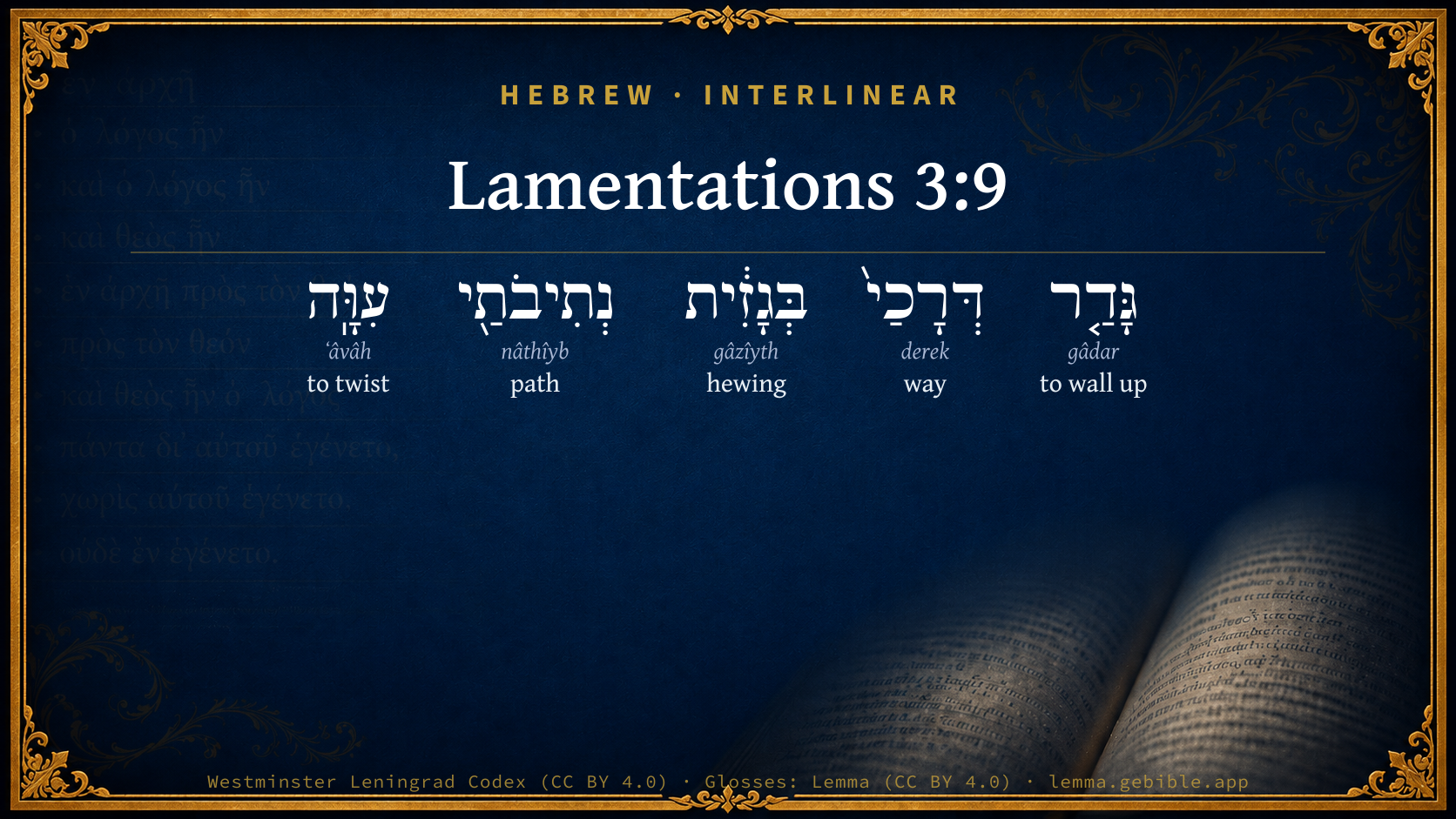
Lamentations 3:9

Hebrew (Westminster Leningrad Codex) Lamentations 3:9 appears in the Hebrew Old Testament. The text above is from the Westminster Leningrad Codex. Each word links to its Strong’s number, a concise gloss, and parsing drawn from the Open Scriptures Hebrew Bible morphology. Click any word for its full Brown-Driver-Briggs (BDB) entry.
Download image
Cite this verse

Lamentations 3:9 (World English Bible). Public Domain. Lemma interlinear Bible study tool, https://lemma.gebible.app/v/lamentations/3/9.

Show BibTeX & RIS
BibTeX
RIS
English Translation
He has walled up my ways with hewn stone; he has made my paths crooked.
World English Bible · Public Domain
Download a study sheet

One document with this verse’s original text, its word-by-word gloss line, the meaning frame, cross-references with their text, attributed commentary, and full source and license credits — printable, and it pastes into notes with its structure intact.

This verse Autodidact and up

Study sheet (.html) Plain text (.txt)

A passage Seminary Student

Up to 50 verses in one chapter. A passage sheet keeps up to 6 commentary sources and 12 cross-references per verse, in the order this page ranks them, and says so on the sheet whenever that leaves anything out. Ask for a single verse and you get the Autodidact verse sheet above.

Everything on this page stays free to read, with no account — the sheet is a download of what is already on screen, not access to it.

Want to remove ads? Support Godless Engineer
Compare translations 3

The same verse in 3 English versions, stacked beneath the original-language interlinear above. Click any original word for its lexicon entry.

Each is an independent rendering of the whole verse — the interlinear is not word-aligned to these translations.

Highlighted words mark where these versions differ — a whole-verse word diff, not a word-by-word alignment.

  • World English Bible Public Domain
    He has walled up my ways with hewn stone; he has made my paths crooked.
  • King James Version Public Domain
    He hath inclosed my ways with hewn stone, he hath made my paths crooked.
  • unfoldingWord Literal Text CC BY-SA 4.0
    He walled up my ways with hewn stone; my paths he has made crooked. DALETH

unfoldingWord Literal Text — © unfoldingWord, licensed CC BY-SA 4.0. Word-aligned USFM3 via Door43 (git.door43.org/unfoldingWord/en_ult).

Versions to compare (up to 4)

3 of 4 selected

Show all 18 translations

Every available English version of this verse, each an independent rendering of the whole verse.

  • World English Bible Public Domain
    He has walled up my ways with hewn stone; he has made my paths crooked.
  • Berean Standard Bible Public Domain
    He has barred my ways with cut stones; He has made my paths crooked.
  • Majority Standard Bible Public Domain
    He has barred my ways with cut stones; He has made my paths crooked.
  • King James Version Public Domain
    He hath inclosed my ways with hewn stone, he hath made my paths crooked.
  • American Standard Version (1901) Public Domain
    He hath walled up my ways with hewn stone; he hath made my paths crooked.
  • Revised Version (1885) Public Domain
    He hath fenced up my ways with hewn stone, he hath made my paths crooked.
  • Geneva Bible (1599) Public Domain
    He hath stopped vp my wayes with hewen stone, and turned away my paths.
  • Douay-Rheims (1899) Public Domain
    Ghimel. He hath shut up my ways with square stones, he hath turned my paths upside down.
  • Young's Literal Translation Public Domain
    He hath hedged my ways with hewn work, My paths He hath made crooked.
  • Literal Standard Version CC BY-SA 4.0
    He has hedged my ways with hewn work, || My paths He has made crooked.
  • Unlocked Literal Bible CC BY-SA 4.0
    He blocked my path with a wall of hewn stone; he made my paths crooked.
  • unfoldingWord Literal Text CC BY-SA 4.0
    He walled up my ways with hewn stone; my paths he has made crooked. DALETH
  • Darby Bible Public Domain
    He hath inclosed my ways with hewn stone, he hath made my paths crooked.
  • World Messianic Bible Public Domain
    He has walled up my ways with cut stone. He has made my paths crooked.
  • Webster's Bible Public Domain
    He hath inclosed my ways with hewn stone, he hath made my paths crooked.
  • Free Bible Version CC BY-SA 4.0
    He has put stone blocks in my way and sends me down crooked paths.
  • Bible in Basic English Public Domain
    He has put up a wall of cut stones about my ways, he has made my roads twisted.
  • JPS Tanakh (1917) Public Domain
    He hath enclosed my ways with hewn stone, He hath made my paths crooked.

Literal Standard Version (2020), Covenant Press — licensed CC BY-SA 4.0. Text via the HelloAO Bible API (eBible.org). Unlocked Literal Bible (unfoldingWord) — licensed CC BY-SA 4.0. Text via the HelloAO Bible API (eBible.org). unfoldingWord Literal Text — © unfoldingWord, licensed CC BY-SA 4.0. Word-aligned USFM3 via Door43 (git.door43.org/unfoldingWord/en_ult). Free Bible Version, Dr. Jonathan Gallagher — licensed CC BY-SA 4.0. Text via the HelloAO Bible API (eBible.org).

Word by word

More ways to search: Search by grammar → Find every occurrence → Compare this word →

Practice this passage: Drill this verse → Learn its vocabulary →

About this verse

These counts appear in no published source. They are computed here, from the morphology-tagged text and Lemma’s own curated glosses. What Lemma adds →

5
words
5
distinct lemmas
Prophets
section

Notable vocabulary

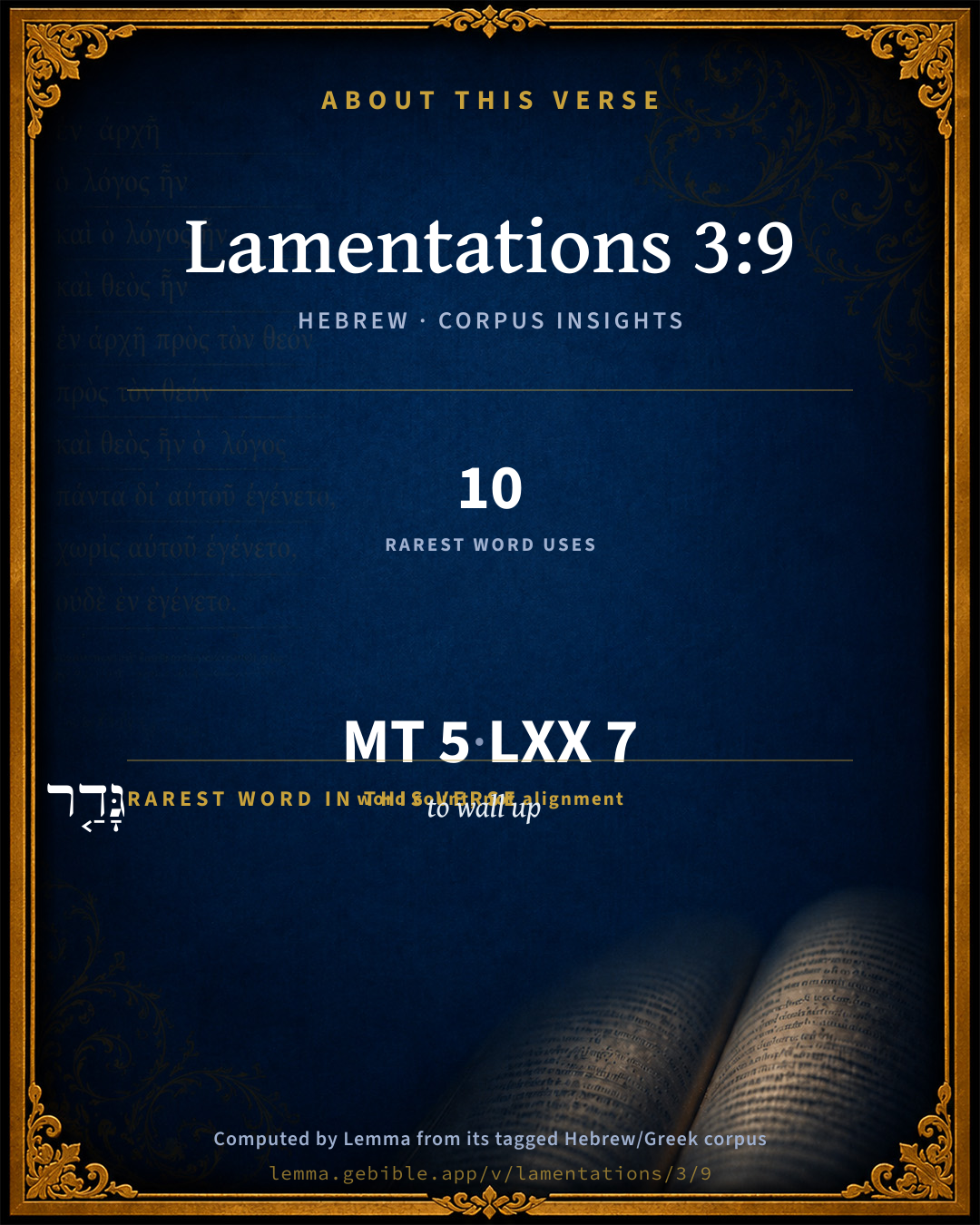
The rarest word here is גָּדַ֤ר to wall up H1443 — appearing just 10 times in the whole Hebrew Bible.

Shared distinctive vocabulary

גָּדַ֤ר to wall up H1443 occurs in 10 verses of the Hebrew Bible. Also found in:

Grammatical profile

  • 2 verbs
  • 3 nouns

Verb forms

  • גָּדַ֤ר Qal · Perfect
  • עִוָּֽה Piel · Perfect

Hebrew & Septuagint length

In English translation the verse runs 15 words from the Hebrew and 12 from the Septuagint (LXX English) — closely comparable.

A rough comparison of the two English renderings, which tokenize alike — not a word-level alignment.

Word counts can differ between the Hebrew and the Greek without any difference in meaning — e.g. the Hebrew direct-object marker אֵת has no separate Greek word, and Greek often adds the article ὁ.

In the original languages it is 5 Hebrew tokens and 7 Greek tokens — but the two are counted differently (Hebrew bundles its prefixes and suffixes into one token; the Greek is in lemma form), so that isn’t a like-for-like length.

Cross-references

4

Topical passages linked to Lamentations 3:9 in the Treasury of Scripture Knowledge — connected by theme and wording, ordered by reader-vote popularity; previews shown in the World English Bible.

  • Isaiah 63:17 O Yahweh, why do you make us to err from your ways, and harden our heart from your fear? Return for your servants' sake, the tribes of your inheritance.
  • Isaiah 30:28 and his breath is as an overflowing stream, that reaches even to the neck, to sift the nations with the sieve of destruction: and a bridle that causes to err [shall be] in the jaws of the peoples.
  • Lamentations 3:11 He has turned aside my ways, and pulled me in pieces; he has made me desolate.
  • Hosea 2:6 Therefore, behold, I will hedge up your way with thorns, And I will build a wall against her, That she can't find her way.

Cross-references courtesy of OpenBible.info (CC BY 4.0).

Hebrew and Greek witnesses Masoretic Hebrew ↔ Greek Septuagint

The same verse in the two great witnesses to the Old Testament, shown verse-for-verse.

These are two independent witnesses, not word-aligned to each other, and the Septuagint is shown in lemma (dictionary) form.

Hebrew Lamentations 3:9 Masoretic · Westminster Leningrad Codex

גָּדַ֤ר דְּרָכַי֙ בְּגָזִ֔ית נְתִיבֹתַ֖י עִוָּֽה

He has walled up my ways with hewn stone; he has made my paths crooked.

World English Bible · Public Domain

Greek LXX Lamentations 3:9 Septuagint · lemma form

ἀναοἰκοδομέω ὁδός ἐγώ ἐνφράσσω τρίβος ἐγώ ταράσσω

DALETH. He has built up my ways, he has hedged my paths;

LXX2012 (modern English Septuagint) · Public Domain

Hebrew: Westminster Leningrad Codex (CC BY 4.0). Greek: Septuagint (public domain); English from LXX2012 (modern English Septuagint) (Public Domain). How the Septuagint differs from the Hebrew →

Commentary

Notes on Lamentations 3:9 from classic Christian and Jewish commentators (each source and its license shown beneath its notes). The classic Christian expositions comment on the surrounding passage and are grouped to its opening verse, so a note may address several verses; the Jewish commentaries on the Tanakh (Rashi and others) are per-verse, so they appear only where the commentator wrote on this verse.

Lemma curates 59 commentaries, every one of them public domain or Creative Commons licensed, each selected and text-cleaned for this edition rather than reprinted as found. About our sources →

Trapp's Complete Commentary

John Trapp

Lam 3:9 He hath inclosed my ways with hewn stone, he hath made my paths crooked.

Ver. 9. He hath enclosed my ways with hewn stone,] i.e., Most strongly and closely, so that none can come at me.

He hath made all my paths crooked.] So that all things go cross with me; and although they were never so well devised, yet still they sort out unto the worst.

John Trapp, A Commentary or Exposition upon All the Books of the Old and New Testament (1647–1656) — public domain. Text from a community e-Sword module.

Joseph Benson's Commentary

Lam 3:9-13. He hath enclosed my way with hewn stone — He hath not only hedged it up with thorns, Hos 2:6, but stopped it up with a stone wall which cannot be broken through; so that my paths are made crooked — That is, I traverse to and fro, to the right hand and to the left, to try to get forward, but I am still turned back. Observe, reader, if we walk in the crooked ways of sin, crossing or swerving from God’s laws, it is just with God to make us walk in the crooked paths of affliction, crossing our designs and breaking our measures. He was unto me as a bear lying in wait — Surprising me with his judgments; and as a lion in secret places — So that which way soever I went, I was in continual fear of being attacked, and could never think myself safe. He hath turned aside my ways — Hath blasted all my counsels and ruined my projects; (see above on Lam 3:9;) and pulled me in pieces — Hath torn and gone away, Hos 5:14. He hath made me desolate — Deprived me of all society, and of all comfort in my soul. He hath bent his bow — That bow, which was ordained against the church’s persecutors, is bent against her sons. He hath set me as a mark for his arrows — Which he aims at, and is sure to hit: so that the arrows of his quiver enter into my reins — And give me an inward and mortal wound.

Joseph Benson's Commentary on the Old and New Testaments (1811–1818) — public domain. Text from a community e-Sword module.

Tyndale Open Study Notes

Tyndale Open Resources

3:9 blocked my way . . . made my road crooked: Sin causes confusion and cuts a person or a community off from a happy future. Innocent people know the future as a straight path that is easy to follow (Prov 21:8). Isaiah imagined God’s activities as a procession on a straight road that his worshipers would prepare (Isa 40:3).

Tyndale Open Study Notes — © Tyndale Open Resources, licensed CC BY-SA 4.0. Text via the HelloAO Bible API.

Geneva Bible (1599)

Geneva Bible translators

And keepeth me in hold as a prisoner.

Geneva Bible (1599) marginal notes — public domain. Text via Bolls.life.

Jamieson, Fausset & Brown

Robert Jamieson, A. R. Fausset & David Brown

hewn stone--which coheres so closely as not to admit of being broken through.

paths crooked--thwarted our plans and efforts so that none went right.

Jamieson, Fausset & Brown — Commentary Critical and Explanatory on the Whole Bible (1871) — public domain (CC PDM 1.0). Text via the HelloAO Bible API.

Adam Clarke's Commentary

Verse 9. He hath inclosed my ways with hewn stone] He has put insuperable obstacles in my way; and confounded all my projects of deliverance and all my expectations of prosperity.

Adam Clarke's Commentary on the Bible (1810–1826) — public domain. Text from a community e-Sword/MySword module.

John Calvin's Commentaries

Other metaphors are used. Some think that the Prophet refers to the siege of Jerusalem, but such a view is not suitable. The metaphors correspond with one another, though they are somewhat different. He had said before, that he was enclosed by God, or surrounded as with a mound; and now he transfers this idea to his ways. When the life of man is spoken of, it is, we know, compared to a way. Then the Prophet includes under this word all the doings of his life, as though he had said, that all his plans were brought into straits, as though his way was shut up, so that he could not proceed: “Were I to proceed ill any direction, an obstacle is set before me; I am compelled to remain as it were fixed.” So the Prophet now says, his ways were enclosed, because God allowed none of His counsels or His purposes to be carried into effect.

And to the same purpose he adds, that. God had perverted his ways, that is, that he had confounded all his doings, and all his counsels.

But these words are added, with a squared stone The verb גזז gizaz, means to cut; hence the word גזית, gizit, signifies a polished stone, or one trimmed by the hammer. And we know that such stones are more durable and firmer than other stones. For when unpolished stones are used, the building is not so strong as when the stones are squared, as they fit together better. Then the Prophet intimates that the enclosures were such that he could by no means break through them, as they could not be broken. He, in short, means that he was so oppressed by God’s hand, that whatever he purposed God immediately reversed it. We now, then, perceive what he means by saying, that all his ways were subverted or overturned by God. This is not to be understood generally, for it is God who directs our ways. But he is said to pervert our ways, when he disconcerts our counsels, when all our purposes and efforts are rendered void; in a word, when God as it were meets us as an adversary, and impedes our course; it is then that he is said to pervert our ways. But this ought not to be understood as though God blinded men unjustly, or as though he led them astray. The Prophet only means that he could find no success in all his counsels, in all his efforts and doings, because he had God opposed to him. here I stop.

John Calvin's Commentaries (1540-1563) — public domain. Text from the Calvin Translation Society English edition (1840s-50s) via the Christian Classics Ethereal Library (ccel.org). Calvin's coverage is partial (roughly two-thirds of the Bible); uncommented books and verses are honest gaps, never fabricated. The 19th-century editor's footnotes and remarks are omitted so the notes are faithfully Calvin's own voice.

Ellicott's Commentary for English Readers

(9) He hath inclosed.—Yet another figure of resourceless misery follows. A massive wall of stone runs across the mourner’s way. When he turns aside into by-paths, they are turned and twisted in labyrinthine confusion, and lead nowhither.

A Bible Commentary for English Readers, edited by Charles John Ellicott (1878–1897) — public domain. Text from a community e-Sword module.

The Cambridge Bible for Schools and Colleges

gen. ed. J. J. S. Perowne

9. hath made my paths crooked] The writer, seeing that the direct way was as it were blocked, tried side paths, but found that they also failed to lead him in the desired direction. The figure expresses perplexity and dismay.

The Cambridge Bible for Schools and Colleges (gen. ed. J. J. S. Perowne; Cambridge University Press, 1878–1918) — public domain. Text from a community e-Sword module.

John Gill's Exposition

He hath enclosed my ways with hewn stone,.... Not with a hedge of thorns, or mud walls, but with a fence of stones; and these not rough, and laid loosely together, but hewn and put in order, and well cemented. The Targum is, with marble hewn stones, which are harder than common stones, and not so easily demolished; this may respect the case of the prophet in prison, and in the dungeon, and in Jerusalem, when besieged; or in general his afflictive state, from whence he had no prospect of deliverance; or the state of the Jews in captivity, from which there was no likelihood of a release;

he hath made my paths crooked; or, "perverted my ways" (h); so that he could not find his way out, when he attempted it; he got into a way which led him wrong; everything went cross and against him, and all his measures were disconcerted, and his designs defeated; no one step he took prospered.

(h) "semitas meas pervertit", Pagninus, Montanus, Vatablus, Calvin; "contorsit", Michealis.

John Gill's Exposition of the Whole Bible (1746–1763) — public domain (CC PDM 1.0). Text via the HelloAO Bible API.

Albert Barnes' Notes on the Bible

Inclosed - Or, hedged Lam 3:7.

Hath, made crooked - Or, “hath” turned aside. A solid wall being built across the main road, Jeremiah turns aside into by-ways, but finds them turned aside, so that they lead him back after long wandering to the place from where he started.

Albert Barnes' Notes on the Bible (1834–1885) — public domain. Text from a community e-Sword/MySword module.

Haydock's Catholic Bible Commentary

Stones. There is no passage, Job xix. 8.

George Leo Haydock (1774–1849), Haydock's Catholic Family Bible and Commentary, 1859 edition — public domain. Excludes Psalms (Douay-Rheims chapter numbering differs from Protestant) and Deuterocanonical books (Catholic canon only).

Matthew Poole's English Annotations

Ways in Scripture ordinarily signifies men’s courses, and methods of counsels, and actions; if the term be taken in that sense here, it signifieth God’s defeating all their methods and counsels taken for their own security, in the pursuit of which they met not with ordinary, but with insuperable difficulties, like walls of hewn stone. Nay, God had not only defeated their counsels, but had made them prove more fatal and pernicious to themselves, which seemeth to be intended, by making their ways crooked, which should have led right on to the end intended.

Matthew Poole's English Annotations on the Holy Bible (1683–1685) — public domain. Text from a community e-Sword/MySword module.

Whedon's Commentary on the Bible

Daniel D. Whedon

9. Hewn stones would be of considerable size, and employed to make a strong wall. The term enclosed is the same as “hedged” in Lam_3:7.

Made my paths crooked — Rather, he hath turned aside my paths, so that I cannot go forward.

Daniel D. Whedon (gen. ed.), Commentary on the Old and New Testaments (1874–1909) — public domain. Text from a community e-Sword module.

The Pulpit Commentary

Inclosed; or, walled up; the participle of this verb is rendered "masons" in the Authorized Version of 2Ki_12:12. Made my paths crooked; i.e. hath compelled me to walk in byways. (comp. margin of the Authorized Version, Jud_1:5:6) But this hardly seems appropriate to the context. The semitas meas subvertit of the Vulgate is preferable. Render, therefore, turned my path upside down. (comp. Isa_24:1) An analogous expression m Job_30:13 is rendered in the Authorized Version, "they mar my path." Thenius thinks that the destruction of a raised causeway is the figure intended; but the word is quite correctly rendered "paths;" see the note of Delitzsch on Isa_59:8.

The Pulpit Commentary (1880–1919), ed. H.D.M. Spence-Jones & Joseph S. Exell — public domain. Text from a community e-Sword module.

John Wesley's Explanatory Notes

Enclosed - He has defeated all my methods and counsels for security, by insuperable difficulties like walls of hewn stone. Crooked - Nay, God not only defeated their counsels, but made them fatal and pernicious to them.

John Wesley, Explanatory Notes Upon the Whole Bible (1754–1765) — public domain. Text via the GEBible commentary corpus.

unfoldingWord translationNotes

Door43 World Missions Community

He blocked my path

The author speaks of God causing him to continue to suffer as if God was preventing him from escaping the suffering by blocking his path. AT: "It is as though he blocked my path" (See: Metaphor)

a wall of hewn stone

"a wall of cut stones." People would cut stones into regular shapes that could fit together well in order to build a strong wall.

he made my paths crooked

Crooked paths do not lead people to where they want to go. Here they represent unsuccessful ways of escaping suffering. AT: "it is as though he has made my paths crooked" or "I have tried to make the suffering stop, but God has prevented me, like one who prevents another from escaping by making his paths crooked" (See: Metaphor)

He is like a bear waiting to ambush me, a lion in hiding

The author speaks of God being ready to cause him to suffer more, as if God were a wild animal waiting to attack him. (See: Simile)

he turned aside my paths

Possible meanings are 1) "he dragged me off the path" or 2) "he caused my path to turn in the wrong direction"

he has made me desolate

"he has made me hopeless" or "he has not allowed me to have any help"

translationWords

lions

desolate

unfoldingWord translationNotes — © Distant Shores Media and the Door43 World Missions Community, licensed CC BY-SA 4.0. Source: git.door43.org/Door43/en_tn.

Rashi

Rabbi Shlomo Yitzchaki (Rashi)

He has made my paths crooked If I wish to go out, I do not go out on roads paved in a straight way, because of the enemies, but I go out on a crooked road.

Rashi on the Tanakh — English translations: “The Judaica Press complete Tanach with Rashi, translated by A. J. Rosenberg” (CC BY 4.0); “Pentateuch with Rashi's commentary by M. Rosenbaum and A.M. Silbermann, 1929-1934” (public domain); “The Metsudah Tanach series, Lakewood, N.J” (CC BY 4.0); and “The Book of Joshua, Metsudah Publications, 1997” (CC BY 4.0). Text via Sefaria.

Lesson kit

Teaching starters — assembled from the data on this page, not authored interpretation. Every prompt links to the verse data it draws on. Edit before teaching.

Lamentations, in the Prophets, opens this verse with 5 words (5 distinct Hebrew lemmas). Its most distinctive word is gâdar (“to wall up”). A historical commentator’s framing appears above. Read the whole chapter for the surrounding context.

Discussion questions

  1. How does “to wall up” (gâdar) shape what this verse is saying?
  2. How does 2 Kings 12:12, which shares the word «to wall up», read alongside this verse?
  3. These translations render this verse differently; the difference is in the English rendering, not the original. What questions does that raise?
  4. «גָּדַ֤ר» is a Qal Perfect verb. How does that grammatical form shape the action described?
  5. Compare how Trapp's Complete Commentary and Joseph Benson's Commentary read this verse. Where do they agree or differ?

Things to notice

Reading settings

Reading text

Shown beneath each verse's original-language words.

Old Testament
Old Testament edition

Read the OT as the Masoretic Hebrew (MT) or the Greek Septuagint (LXX).

English shown for the Greek Septuagint (in the Hebrew ↔ Greek comparison).

Comparing translations? Open the Compare panel on any verse page to stack up to four side by side.