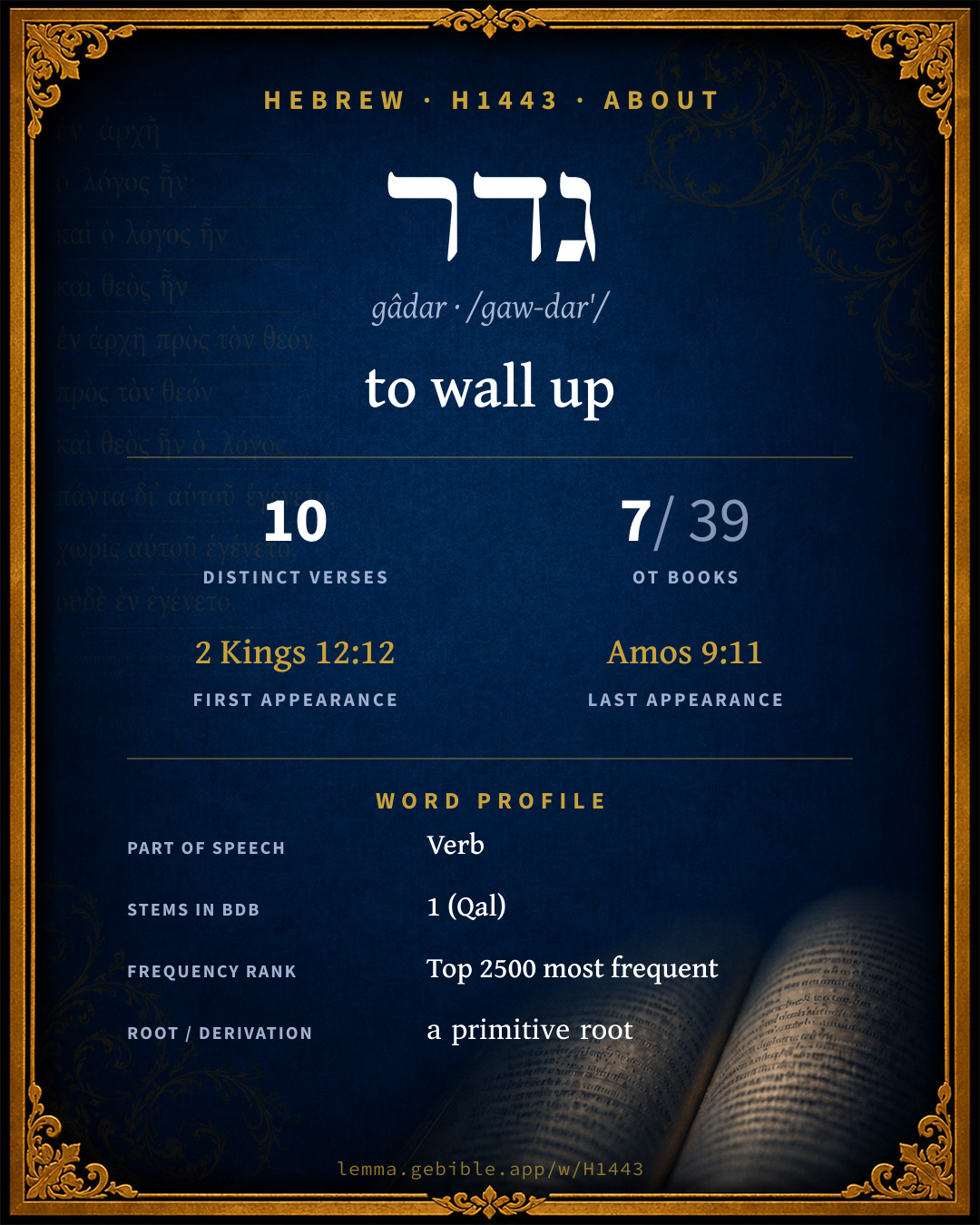
גָּדַר
to wall up
also: wall off, close off, build a wall fuller range ↓
Full lexicon entry — Brown-Driver-Briggs (BDB)
From Brown-Driver-Briggs (BDB)
Where this word appears
Grammar key — what these labels mean
Part of speech
- Verb
- An action or state-of-being word.
Stem
- Qal
- The basic, simple active stem — the plain form of the verb (“he wrote”).
Form
- Perfect
- A completed action or state — Hebrew marks aspect (completeness) more than strict tense (“he wrote”).
- Participle Active
- A verbal adjective expressing ongoing or characteristic action (“writing / one who writes”).
- Sequential Perfect
- A perfect with prefixed waw continuing a preceding imperfect or command (waw-consecutive perfect).
- Sequential Imperfect
- An imperfect with prefixed waw — the standard past-narrative form (waw-consecutive imperfect).
State
- Absolute
- The independent form of a noun, not bound to a following word.
Person
- 3rd Person
- The one spoken about (“he / she / it / they”).
- 1st Person
- The speaker (“I / we”).
- 2nd Person
- The one addressed (“you”).
Gender
- Masculine
- Grammatically masculine.
- Common
- Either gender — not distinguished for this form.
Number
- Singular
- One.
- Plural
- More than one (in Hebrew, generally three or more).
Grammatical forms
- Verb, Qal, Perfect, 3rd Person, Masculine, Singular 3 times (30%)
- Verb, Qal, Participle Active, Masculine, Plural, Absolute 2 times (20%)
- Verb, Qal, Sequential Perfect, 1st Person, Common, Singular 2 times (20%)
- Verb, Qal, Participle Active, Masculine, Singular, Absolute 2 times (20%)
- Verb, Qal, Sequential Imperfect, 2nd Person, Masculine, Plural 1 time (10%)
Parsed forms decoded from the imported morphology (morphhb / Westminster Leningrad Codex — WLC text public domain, morphhb tagging CC BY 4.0), counted across 10 parsed occurrences — not distinct verses.
Every verse where H1443 appears — 10 distinct verses across 7 books. Click any verse to open its interlinear word-by-word view. Verse text shown in the World English Bible for context — . Each verse’s Hebrew form is shown with its reference; the English is not keyword-highlighted, since the data carries no word-level English alignment. Use “Compare translations” on any verse to read it across multiple English versions. This concordance covers the Hebrew Bible; Septuagint (Greek Old Testament) occurrences are not indexed here.
2 Kings 2 verses
- 2 Kings 12:12 וְ/לַ/גֹּֽדְרִים֙ conj + prep det + Qal ptcp.act mp and to the masons and the stone cutters, and for buying timber and hewn stone to repair the breaches of the house of Yahweh, and for all that was laid out for the house to repair it.
- 2 Kings 22:6 וְ/לַ/גֹּֽדְרִ֑ים conj + prep det + Qal ptcp.act mp to the carpenters, and to the builders, and to the masons, and for buying timber and hewn stone to repair the house.
Job 1 verse
Isaiah 1 verse
Lamentations 2 verses
Ezekiel 2 verses
- Ezekiel 13:5 וַ/תִּגְדְּר֥וּ conj + Qal wimpf 2mp You have not gone up into the gaps, neither built up the wall for the house of Israel, to stand in the battle in the day of Yahweh.
- Ezekiel 22:30 גֹּֽדֵר Qal ptcp.act ms I sought for a man among them, who should build up the wall, and stand in the gap before me for the land, that I should not destroy it; but I found none.
Hosea 1 verse
Amos 1 verse
About this entry
At a glance — auto-summarized from this page’s data, not written by a person. Every figure links to its source below. This summary describes the numbers; it doesn’t interpret them.
The Hebrew verb גדר centers on the idea of “to wall up.” Its earliest occurrence is 2 Kings 12:12. The Hebrew Bible uses it across 10 verses — uncommon. Alongside “to wall up” the lexicon also lists “wall off”, “close off”, and “build a wall” — part of its full sense range. Sharing its root, it stands alongside גדר, גדר and גדר. Dig into 10-verse concordance and the renderings breakdown below.
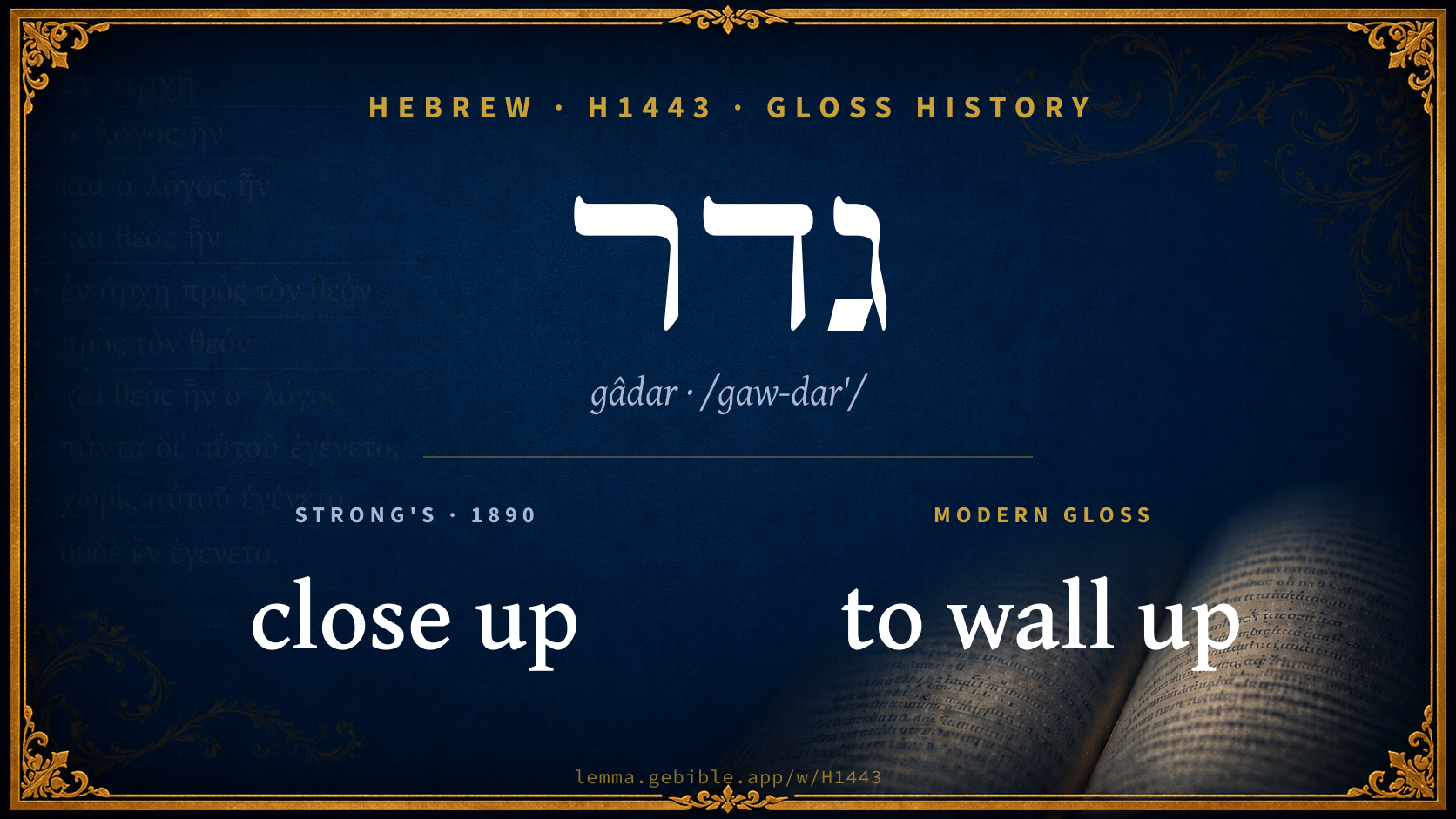
Gloss history
Strong's 1890 vs modern scholarship
About this word
Strong's H1443 catalogs a Hebrew word from the Hebrew Old Testament.
These counts are not copied from any lexicon or concordance. They are computed here, from the morphology-tagged Hebrew Old Testament. What Lemma adds →
- 10
- distinct verses
- The word appears in 10 distinct verses.
- 7 / 39
- OT books
- The word appears in 7 of 39 Old Testament books.
- #2,342
- by frequency
- Top 2500 most frequent Hebrew words (rank 2,342 of 8,640 Hebrew words by occurrence).
View all 10 occurrences in the concordance →
Most concentrated in
- 2 Kings 2 verses 20%
- Lamentations 2 verses 20%
- Ezekiel 2 verses 20%
By section of the Old Testament
By traditional corpus
Conventional, traditional groupings — biblical authorship is debated, so this is a traditional corpus grouping, not an authorship claim. Each share is this word’s portion of its verses in that division of the Hebrew canon. Each figure is a share of the word’s 10 distinct verses.
- Prophets (Nevi'im) 7 verses · 70%
- Writings (Ketuvim) 3 verses · 30%
How translations render this word
Counts come from each version’s own published word-to-Strong’s tagging or interlinear alignment — an approximate guide to how each version renders this word, not a word-level alignment the data otherwise carries. Because each total is that version’s own tagged count, the per-version totals vary from one another and need not match the appearance or distinct-verse counts above. These counts may also differ from a printed concordance because Lemma counts each distinctly tagged rendering and does not collapse phrase taggings into a single head-word total. This is a fixed set of word-tagged versions (KJV, ASV, BSB, ULT) and does not change with the reading translation you choose elsewhere. Each version’s license is shown beside its name below (and on Sources).
- King James Version: Masons 2×
- American Standard Version: He hath walled 2×, Masons 2×
- Berean Standard Bible: Masons 2×
- unfoldingWord Literal Text: Masons 2×
King James Version Public Domain
Renders H1443 across 10 tagged occurrences — most commonly:
Plus 8 renderings that appear only once — usually multi-word phrases or single function words the recovered tagging swept in, not distinct renderings.
American Standard Version Public Domain
Renders H1443 across 10 tagged occurrences — most commonly:
Plus 6 renderings that appear only once — usually multi-word phrases or single function words the recovered tagging swept in, not distinct renderings.
Berean Standard Bible Public Domain
Renders H1443 across 10 tagged occurrences — most commonly:
Plus 8 renderings that appear only once — usually multi-word phrases or single function words the recovered tagging swept in, not distinct renderings.
unfoldingWord Literal Text CC BY-SA 4.0
Renders H1443 across 10 tagged occurrences — most commonly:
Plus 8 renderings that appear only once — usually multi-word phrases or single function words the recovered tagging swept in, not distinct renderings.
Senses in the full BDB
What do BDB’s symbols mean?
BDB uses these scholarly abbreviations:
| Symbol | Meaning |
|---|---|
| 𝔊 | the Septuagint (the ancient Greek translation, LXX) |
| 𝔙 | the Vulgate (the Latin translation) |
| 𝔖 | the Syriac version (the Peshitta) |
| 𝔗 | the Targum (the Aramaic translation) |
| ψ | the Psalms |
| √ | root (the underlying root or stem) |
| ‖ | parallel passage (a synonymous or contrasted parallel) |
| † | the dagger: every passage where the word occurs is cited |
The 1 sense the full Brown-Driver-Briggs lexicon distinguishes for this word, in lexicon order (not ranked by frequency), with BDB’s own verbatim wording and sub-sense lettering. Shown in Hebrew script with BDB’s own scholarly abbreviations. The condensed entry is in the Lexicon Entry tab. See also the Forms in the corpus table below.
Qal
- Pf. גָּדַר Jb 19:8 + 2 times, וְגָדַרְתִּ֫י Ho 2:8 Am 9:11; Impf. 2 mpl. וַתִּגְדְּרוּ Ez 13:5; Pt. גֹּדֵר Is 58:12 Ez 22:30; pl. גֹּדְרִים 2 K 12:13; 22:6;—wall up, shut off, lit. only Pt., abs. = masons (wall-builders) 2 K 12:13; 22:6; also Is 58:12 (obj. פֶּרֶץ); fig. of Yahweh’s dealings with men, obj. אֹרַח Jb 19:8, דֶּרֶך La 3:9; cf. Ho 2:8 (acc. cogn. גָּדֵר), in all = obstructing path of life, cf. also La 3:7 (c. בַּעֲדִי); of restoring fallen booth of David Am 9:11 (obj. פרצים); of repairing fortunes of Israel, a work neglected by prophets Ez 13:5, and by all in power 22:30 (both c. acc. cogn.) e.g. Job 19:8
Senses from the full Brown-Driver-Briggs lexicon (Brown, Driver, Briggs; Oxford 1906 — public domain), digitized via Sefaria, supplemented by the OpenScriptures HebrewLexicon (CC BY 4.0). Full attribution on Sources.
Word origin
vb. wall up or off, build a wall (denom.? NH id. Arabic جَدَرَ and v. גָּדֵר infr.)—
— Brown-Driver-Briggs (Oxford 1906, public domain), digitized via Sefaria, supplemented by the OpenScriptures HebrewLexicon (CC BY 4.0). See Sources.
Origin: a primitive root
Jastrow Dictionary
A second Hebrew/Aramaic lexicon for comparison, covering Aramaic and post-biblical (Talmudic, Targumic, Midrashic) usage that the biblical-Hebrew BDB does not. Matched by lemma rather than by Strong’s number, so a lemma may carry more than one Jastrow headword (shown separately below), and the entries cover usage well beyond the Bible.
גַּדַּר
- to roll, v. גַּנְדַּר I.
גָּדַר
- v. גדד I)
- 1. to cut, esp. to harvest dates. B. Mets. 89ᵇ (Ar. גדד, v. Rabb. D. S. a. l. note 300). B. Bath. 36ᵇ עד שיגדור ג׳ גדירות until he has reaped three date harvests.—Y. Sabb. VII, 9ᶜ top; Bab. Sabb. 73ᵇ (terms equivalent to קוצר); Y. ib. 10ᵃ ed. Krot. הגורד (corr. acc.).—Sabb. 50ᵃ; 125ᵇ חריות … שגְּדָרָן לעצים twigs of a date tree which one cut with the intention of using them for fuel; v. גָּדַע.—Tosef. Ber. IV, 21; a. fr.—*Part. pass. גָּדוּר cut down. Tosef. Shebi. IV, 13 כרם ג׳ בציפורי (Var. גדול; R. S. to Shebi. VI, 4 גריד) a ruined vineyard in Zepphoris.
- 2. to surround with a גֶּדֶר, fence in; to limit, control, ward off. B. Kam. 23ᵃ שהיה לו לגוֹדְרָהּ ולא גְדָרָהּ he ought to have fenced it in and did not do so. Tosef. M. Kat. I, 7 חומת … גֹּודְרִין אותה if a city wall is broken into, we may fence it in (repair it, during the festive week).—Gen. R. s. 49 (play on haaf, Gen. XVIII, 23) אתה גוֹדֵר את האף והאף לא יִגְדָּרְךָ Thou controllest the anger, but the anger does not control Thee.—Y. Ber. IX, end, 14ᶜ וגוֹדְרָהּ, v. זָקֵן I.—Mikv. V, 6 גודר כלים one may form a dam with garments (Tosef. ib. IV, 10 גרר, corr. acc.). Y. Ber. III, 6ᶜ דבר שהוא גוֹדֵר את ישראל מן וכ׳ a custom which guards Israel from sin. Lev. R. s. 24 מי שהוא גודר עצמו וכ׳ (Y. Yeb. II, 3ᵈ top פורש) he who guards himself against sin (restraining himself from anything unchaste) is called holy. Gen. R. s. 70 גָּדְרוּ עצמן וכ׳ trained themselves to chastity; a. fr.—Part. pass. גָּדוּר abstinent, chaste. Lev. R. s. 22 ומעצמו הוא ג׳ and he will become abstinent of his own accord. Gen. R. l. c. אנשי מזרח גְּדוּרִים וכ׳ the people of the East are chaste; a. fr.—ג׳ פרצה (or sub. פרצה) to fence in a breach, to remedy calamities, also to check lawlessness by preventive measures (v. גְּזֵרָה). Ber. 19ᵃ שתִּגְדֹּור וכ׳ that Thou repair our breaches (relieve us); B. Bath. 91ᵇ.—Lev. R. s. 1 (play on Abigdor I Chr. IV, e.g. Genesis 18:23
- 4. הרבה גוֹדְרִין וכ׳ Israel had many fencemakers (guardians against sin). Ruth. R. s. 2, a. fr.—Erub. 6ᵃ, a. e. ג׳ בה גדר, v. בִּקְעָה.—[Y. Erub. X, 26ᵇ bot. דלת גודרת וכ׳; Tosef. ib. XI (VII), 18 גוררת ed. Zuck., Var. גוד׳, v. גָּרַר.]—[Y. Sabb. XV, 15ᵇ top וגדרתא, read וּגְדָרַתָּהּ.]
- to be guarded; to guard one’s self. Y. Sabb. XVII, beg. 16ᵃ כיון שנִגְדְּרוּ (ib. III, 6ᵃ top שנִתְגַּדְּרוּ) when they had been trained (to guard against desecrating the Sabbath). Lev. R. s. 32 נ׳ כל הנשים וכ׳ all women were made chaste through her meritorious example; a. e.
- to cut into. Gitt. 56ᵇ; Lev. R. s. 20; 22; Num. R. s. 18 וגִידּ׳ את הפרוכת and cut into the curtain (Koh. R. to V, 8; Tanḥ. Ḥuck. 1 וגָד׳). [Tosef. Shebi. III, 20 מְגַדֵּר בחורשין Var. (ed. Zuck. מברך) to cut into, to clear thickets, v. בהה.]
- 1. [ [to cut one’sself off from others,] to distinguish one’s self, to excel; to raise one’s self above others, to arrogate power, be presumptuous. Ber. 17ᵃ כשם שהוא אינו מִתְגַּדֵּר וכ׳ as he cannot excel in my work (study), so can I not in his (field labor). Ḥull. 7ᵃ my predecessors have left room for me להִתְגַּדֵּר בו to distinguish myself; Yoma 78ᵃ; (Y. Dem. II, 22ᶜ bot. עטרה להתעטר, Ar. להתגדר).—Ned. 81ᵃ כדי שלא יִתְגַּדְּרוּ על וכ׳ in order that they may not be presumptuous towards the people; v. גָּבַר Hithpa. [Mekh. B’shall., Vayassa 1 כבן שמתגדר וכ׳, v. גָּרַר II.]
- 2. to be trained, v. supra Nif.
גְּדַר
- 1. to fence in; to check. B. Kam. 23ᵇ, v. גְּדֵירָא. Yeb. 90ᵇ מִיגְדַּר מילתא שאני a measure to check something (an extraordinary measure for checking lawlessnes) is something different, allows of no analogies.—
- *2. to cut off, deduct. Esth. R. to I, 4 גַּדְרָאנֵיה מן פורני I will deduct it from my dowry. [Ib. to I, 9 אנא מגדיר, v. גְּרַר.]
גֶּדֶר I
- (v. גָּדֵיר) fence, partition. Peah II, 3. Y. ib. 16ᵈ ג׳ מחובר a hedge, v. חָבַר. B. Kam. 23ᵃ [read:] ונפל הג׳ (v. Rabb. D. S. a. l.) and the partition wall fell in; a. v. fr.—Trnsf. guard against trespassing the law, restraint, preventive measure (v. גְּזֵרָה). Tosef. Shebi. III, 13 לא גזרו אלא ג׳ שיכול לעמוד they (the scholars) erect only such a fence as can stand, i.e. enact only practicable measures (v. גָּזַר). Snh. 21ᵃ ג׳ גדול גָּדְרָה וכ׳ Tamar erected a great guard at the time (became a warning to girls). Lev. R. s. 26 the serpent פרץ גִּדְרוֹ של עולם made a breach in the fence of the world (opened the way to lawlessness). Lev. R. s. 24, a. fr. ג׳ ערוה guard against immorality, chastity, v. גָּדַר; a. fr.—Y. Pes. I, 27ᶜ bot. ויש ג׳ לג׳ can a preventive rabbinical law (גְּזֵרָה) be enacted as a guard for another preventive law?—Pl. גְּדֵרוֹת. Lev. R. s. 24; a. e., v. גָּדֵיר.
גֶּדֶר II
- Geder (Gadara), capital of Peraea, v. גְּדוֹר. Pesik. R. s. 21 (p. 107ᵃ ed. Fr.) מן הגודר (read גדור or גדר), v. גַּיּוּס; ib. (p. 108ᵃ) מן הג׳.—R. Hash. 23ᵇ, v. גְּדוֹר. Esth. R. to I, 3, v. אַרְכִיּוֹן.—Y. Kidd. III, 64ᵈ top חמתא דג׳ Ḥamtha (Hot Springs) near G.—Sabb. 109ᵃ מי ג׳ springs of G.—Erub. 61ᵃ; Tosef. ib. VI (V), 13 שיהו בני ג׳ יומין וכ׳ that the inhabitants of G. were permitted to go down to Ḥamtha (on the Sabbath), but &c., v. טַטְּרֵג.
A Dictionary of the Targumim, the Talmud Babli and Yerushalmi, and the Midrashic Literature (Marcus Jastrow; London, Luzac, 1903) — Public Domain. Digitized via Sefaria. Digitized via Sefaria. Full attribution on Sources.
Forms in the corpus
The 10 distinct written forms H1443 takes in the Hebrew Bible, most frequent first — each parse links to that stem’s occurrences in the concordance. Hebrew forms include their vowel points and cantillation, so a single lemma takes many written forms.
| Form | Parsing | Example | Uses |
|---|---|---|---|
| גָ֭דַר | Verb, Qal, Perfect, 3rd Person, Masculine, Singular | Job 19:8 | 1 |
| גָּדַ֤ר | Verb, Qal, Perfect, 3rd Person, Masculine, Singular | Lamentations 3:9 | 1 |
| גָּדַ֧ר | Verb, Qal, Perfect, 3rd Person, Masculine, Singular | Lamentations 3:7 | 1 |
| גֹּֽדֵר | Verb, Qal, Participle Active, Masculine, Singular, Absolute | Ezekiel 22:30 | 1 |
| גֹּדֵ֣ר | Verb, Qal, Participle Active, Masculine, Singular, Absolute | Isaiah 58:12 | 1 |
| וְ/גָֽדַרְתִּי֙ | Verb, Qal, Sequential Perfect, 1st Person, Common, Singular | Hosea 2:6 | 1 |
| וְ/גָדַרְתִּ֣י | Verb, Qal, Sequential Perfect, 1st Person, Common, Singular | Amos 9:11 | 1 |
| וְ/לַ/גֹּֽדְרִ֑ים | Verb, Qal, Participle Active, Masculine, Plural, Absolute | 2 Kings 22:6 | 1 |
| וְ/לַ/גֹּֽדְרִים֙ | Verb, Qal, Participle Active, Masculine, Plural, Absolute | 2 Kings 12:12 | 1 |
| וַ/תִּגְדְּר֥וּ | Verb, Qal, Sequential Imperfect, 2nd Person, Masculine, Plural | Ezekiel 13:5 | 1 |
Same root — word family
Other BDB entries built from the same root as H1443, grouped by Strong’s listed origin. These share a root / origin per the lexicon — not necessarily a shared meaning. Each links to that word’s own entry.
Derived from this word
Proper names from this root
People and places named from this root — a name, not an additional meaning of the word.
Compare all same-root words → 1 of the same-root words is a proper name (a person or place). They share a root, not necessarily a meaning.
Septuagint verse parallels
This word appears in 10 verses that also exist in the Greek Old Testament (Septuagint), out of the 10 Hebrew verses it occurs in. You can read those verses in Greek by switching the Old Testament edition to the Septuagint.
Read these verses in the Septuagint
This is a verse-level parallel only — the same verses exist in both the Hebrew and Greek Old Testaments. No word-level Hebrew↔Greek correspondence is claimed: the data carries no such alignment, so no Greek word is shown as this Hebrew word’s translation. Coverage is not total — the Septuagint omits the deuterocanon and renumbers the Psalms, so some Hebrew verses have no direct Greek parallel.