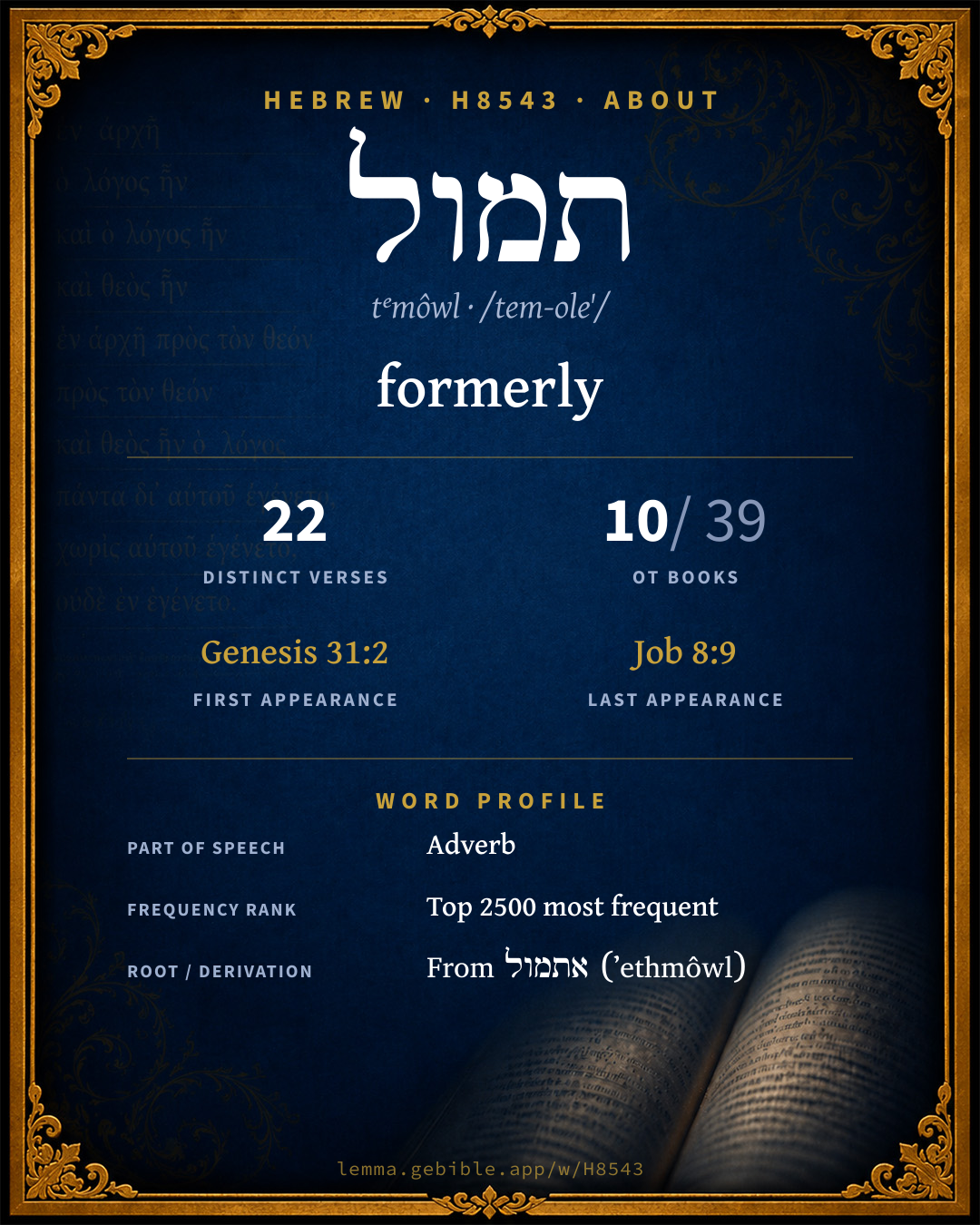
תְּמוֹל
formerly
‘formerly’ is one of 4 main senses fuller range ↓
Full lexicon entry — Brown-Driver-Briggs (BDB)
From Brown-Driver-Briggs (BDB)
Where this word appears
Grammar key — what these labels mean
Part of speech
- Adverb
- A word that modifies a verb, adjective, or other adverb.
Every verse where H8543 appears — 22 distinct verses across 10 books. Click any verse to open its interlinear word-by-word view. Verse text shown in the World English Bible for context — . Each verse’s Hebrew form is shown with its reference; the English is not keyword-highlighted, since the data carries no word-level English alignment. Use “Compare translations” on any verse to read it across multiple English versions. This concordance covers the Hebrew Bible; Septuagint (Greek Old Testament) occurrences are not indexed here.
Genesis 2 verses
- Genesis 31:2 כִּ/תְמ֥וֹל prep + adv Jacob saw the expression on Laban's face, and, behold, it was not toward him as before.
- Genesis 31:5 כִּ/תְמֹ֣ל prep + adv and said to them, "I see the expression on your father's face, that it is not toward me as before; but the God of my father has been with me.
Exodus 6 verses
- Exodus 4:10 מִ/תְּמוֹל֙ prep + adv Moses said to Yahweh, "Oh, Lord, I am not eloquent, neither before now, nor since you have spoken to your servant; for I am slow of speech, and of a slow tongue."
- Exodus 5:7 כִּ/תְמ֣וֹל prep + adv "You shall no longer give the people straw to make brick, as before. Let them go and gather straw for themselves.
- Exodus 5:8 תְּמ֤וֹל adv The number of the bricks, which they made before, you require from them. You shall not diminish anything of it, for they are idle; therefore they cry, saying, 'Let us go and sacrifice to our God.'
- Exodus 5:14 כִּ/תְמ֣וֹל תְּמ֖וֹל prep + adv adv The officers of the children of Israel, whom Pharaoh's taskmasters had set over them, were beaten, and demanded, "Why haven't you fulfilled your quota both yesterday and today, in making brick as before?"
- Exodus 21:29 מִ/תְּמֹ֣ל prep + adv But if the bull had a habit of goring in the past, and it has been testified to its owner, and he has not kept it in, but it has killed a man or a woman, the bull shall be stoned, and its owner shall also be put to death.
- Exodus 21:36 מִ/תְּמ֣וֹל prep + adv Or if it is known that the bull was in the habit of goring in the past, and its owner has not kept it in, he shall surely pay bull for bull, and the dead animal shall be his own.
Deuteronomy 3 verses
- Deuteronomy 4:42 מִ/תְּמ֣וֹל prep + adv that the manslayer might flee there, who kills his neighbor unawares, and didn't hate him in time past; and that fleeing to one of these cities he might live:
- Deuteronomy 19:4 מִ/תְּמֹ֥ל prep + adv This is the case of the manslayer, that shall flee there and live: whoever kills his neighbor unawares, and didn't hate him in time past;
- Deuteronomy 19:6 מִ/תְּמ֥וֹל prep + adv lest the avenger of blood pursue the manslayer, while his heart is hot, and overtake him, because the way is long, and strike him mortally; whereas he was not worthy of death, inasmuch as he didn't hate him in time past.
Joshua 3 verses
- Joshua 3:4 מִ/תְּמ֥וֹל prep + adv Yet there shall be a space between you and it, about two thousand cubits by measure: don't come near to it, that you may know the way by which you must go; for you have not passed this way heretofore.
- Joshua 4:18 כִ/תְמוֹל prep + adv It happened, when the priests who bore the ark of the covenant of Yahweh were come up out of the midst of the Jordan, and the soles of the priests' feet were lifted up to the dry ground, that the waters of the Jordan returned to their place, and went over all its banks, as before.
- Joshua 20:5 מִ/תְּמ֥וֹל prep + adv If the avenger of blood pursue after him, then they shall not deliver up the manslayer into his hand; because he struck his neighbor unawares, and didn't hate him before.
Ruth 1 verse
1 Samuel 2 verses
- 1 Samuel 20:27 תְּמ֥וֹל adv It happened on the next day after the new moon, [which was] the second [day], that David's place was empty: and Saul said to Jonathan his son, Why doesn't the son of Jesse come to meat, neither yesterday, nor today?
- 1 Samuel 21:5 כִּ/תְמ֣וֹל prep + adv David answered the priest, and said to him, Of a truth women have been kept from us about these three days; when I came out, the vessels of the young men were holy, though it was but a common journey; how much more then today shall their vessels be holy?
2 Samuel 2 verses
- 2 Samuel 3:17 תְּמוֹל֙ adv Abner had communication with the elders of Israel, saying, In times past you sought for David to be king over you:
- 2 Samuel 15:20 תְּמ֣וֹל adv Whereas you came but yesterday, should I this day make you go up and down with us, seeing I go where I may? return you, and take back your brothers; mercy and truth be with you.
2 Kings 1 verse
1 Chronicles 1 verse
Job 1 verse
About this entry
At a glance — auto-summarized from this page’s data, not written by a person. Every figure links to its source below. This summary describes the numbers; it doesn’t interpret them.
“formerly” is the headline sense of the Hebrew verb תמול (tᵉmôwl). Carrying more than one sense, it rewards its full sense range. With 22 verses in 10 books, it is an uncommon word in the Hebrew Bible. It concentrates in Exodus, which alone accounts for 27% of its uses. Scripture first uses it in Genesis 31:2. The sections below give every sense, occurrence, and version rendering.
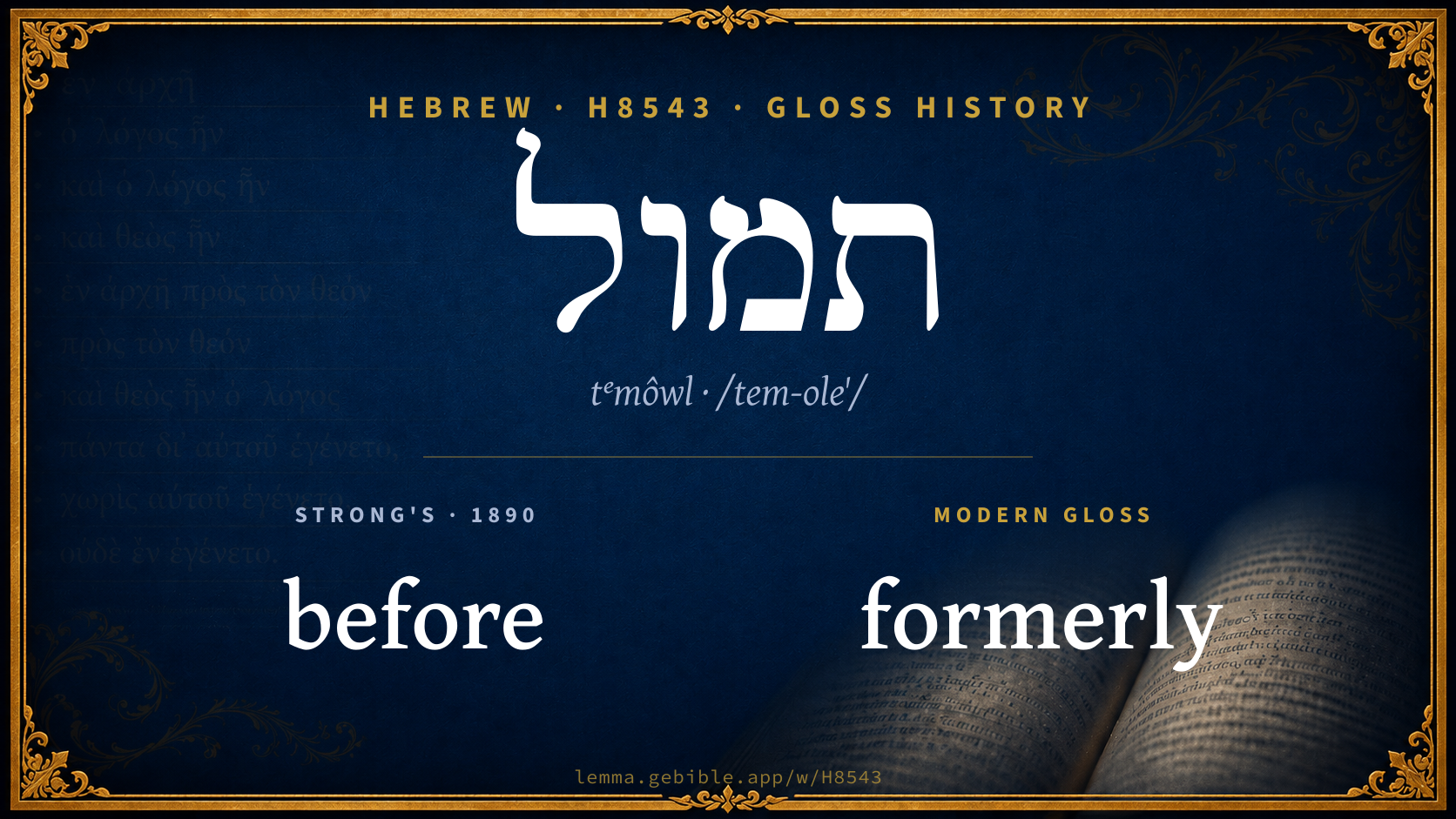
Gloss history
Strong's 1890 vs modern scholarship
About this word
Strong's H8543 catalogs a Hebrew word from the Hebrew Old Testament.
These counts are not copied from any lexicon or concordance. They are computed here, from the morphology-tagged Hebrew Old Testament. What Lemma adds →
- 22
- distinct verses
- The word appears in 22 distinct verses.
- 10 / 39
- OT books
- The word appears in 10 of 39 Old Testament books.
- #1,368
- by frequency
- Top 2500 most frequent Hebrew words (rank 1,368 of 8,640 Hebrew words by occurrence).
View all 22 occurrences in the concordance →
Most concentrated in
- Exodus 6 verses 27%
- Deuteronomy 3 verses 14%
- Joshua 3 verses 14%
By section of the Old Testament
By traditional corpus
Conventional, traditional groupings — biblical authorship is debated, so this is a traditional corpus grouping, not an authorship claim. Each share is this word’s portion of its verses in that division of the Hebrew canon. Each figure is a share of the word’s 22 distinct verses.
- Torah (Pentateuch) 11 verses · 50%
- Prophets (Nevi'im) 8 verses · 36%
- Writings (Ketuvim) 3 verses · 14%
How translations render this word
Counts come from each version’s own published word-to-Strong’s tagging or interlinear alignment — an approximate guide to how each version renders this word, not a word-level alignment the data otherwise carries. Because each total is that version’s own tagged count, the per-version totals vary from one another and need not match the appearance or distinct-verse counts above. These counts may also differ from a printed concordance because Lemma counts each distinctly tagged rendering and does not collapse phrase taggings into a single head-word total. This is a fixed set of word-tagged versions (KJV, ASV, BSB, ULT) and does not change with the reading translation you choose elsewhere. Each version’s license is shown beside its name below (and on Sources).
- King James Version: Heretofore 2×, Time 2×, Time past 2×
- American Standard Version: Time 3×, Heretofore 2×, Time past 2×
- Berean Standard Bible: Before 4×, Yesterday 4×, Past 2×
- unfoldingWord Literal Text: Yesterday 16×, Past 2×, Previous 2×
King James Version Public Domain
Renders H8543 across 18 tagged occurrences — most commonly:
Plus 8 renderings that appear only once — usually multi-word phrases or single function words the recovered tagging swept in, not distinct renderings. Not rendered by a distinct English word in 5 further occurrences.
American Standard Version Public Domain
Renders H8543 across 18 tagged occurrences — most commonly:
Plus 7 renderings that appear only once — usually multi-word phrases or single function words the recovered tagging swept in, not distinct renderings.
Berean Standard Bible Public Domain
Renders H8543 across 16 tagged occurrences — most commonly:
Plus 6 renderings that appear only once — usually multi-word phrases or single function words the recovered tagging swept in, not distinct renderings. Not rendered by a distinct English word in 6 further occurrences.
unfoldingWord Literal Text CC BY-SA 4.0
Renders H8543 across 23 tagged occurrences — most commonly:
Plus 3 renderings that appear only once — usually multi-word phrases or single function words the recovered tagging swept in, not distinct renderings.
Senses in the full BDB
What do BDB’s symbols mean?
BDB uses these scholarly abbreviations:
| Symbol | Meaning |
|---|---|
| 𝔊 | the Septuagint (the ancient Greek translation, LXX) |
| 𝔙 | the Vulgate (the Latin translation) |
| 𝔖 | the Syriac version (the Peshitta) |
| 𝔗 | the Targum (the Aramaic translation) |
| ψ | the Psalms |
| √ | root (the underlying root or stem) |
| ‖ | parallel passage (a synonymous or contrasted parallel) |
| † | the dagger: every passage where the word occurs is cited |
The 6 senses and sub-senses the full Brown-Driver-Briggs lexicon distinguishes for this word, in lexicon order (not ranked by frequency), with BDB’s own verbatim wording and sub-sense lettering. Shown in Hebrew script with BDB’s own scholarly abbreviations. The condensed entry is in the Lexicon Entry tab. See also the Forms in the corpus table below.
- 1. 2 S 15:20 תְּמוֹל בּוֹאֲךָ yesterday (= only lately) was thy coming, Jb 8:9 תמול אנחנו (of) yesterday (Ges§141d) are we, ψ 90:4 (genit.) כְּיוֹם אֶתְמוֹל. e.g. 2 Samuel 15:20
- 2. usually in combin. with שִׁלְשֹׁם yesterday (and) the third day, to express the idea of formerly: thus
- a. as adv. acc. (a) גַּם תְּמוֹל גַּם הַיּוֹם 1 S 20:27 (lit.), cf. Ex 5:14 (sub b); (b) תְּמוֹל שִׁלְשֹׁם Ex 5:8; Ru 2:11, so אֶתְמ׳ שׁ׳ 1 S 4:7; (c) גַּם ת׳ גַּם שׁ׳ 2 S 3:17; 1 Ch 11:2 (‖ 2 S 5:2 with אֶתְמ׳). e.g. 1 Samuel 20:27
- b. כִּתְמוֹל שִׁלְשֹׁם as formerly Gn 31:2, 5; Ex 5:7; Jos 4:18; 1 S 21:6 (but Bu מִתְּ׳, as c), 2 K 13:5; כְּאֶתְמ׳ שׁ׳ 1 S 14:21; 19:7; Ex 5:14 כִּת׳ שׁ׳ גַּם תְּמוֹל גַּם הַיּוֹם as yesterday (and) the third day (= as formerly), both yesterday and to-day (= so more recently). e.g. Genesis 31:2
- c. מִתְּמוֹל שׁ׳ = (from) aforetime, Ex 21:29, 36; Jos 3:4, וְהוּא לֹא שׂנֵא לוֹ מִתְּ׳ שׁ׳ Dt 4:42; 19:4, 6; Jos 20:5; so מֵאִתְּמוֹל שׁ׳ 1 S 10:11; גַּם מִתְּ׳ גַּם מִשּׁ׳ Ex 4:10. e.g. Exodus 21:29
- 3. מֵאֶתְמוּל (alone) Is 30:33 from yesterday = already; וְאֶתְמוּל עַמִּי Mi 2:8 corrupt, read וְאַתֶּם לְעַמִּי (WRS, with יָקוּם; עַל עַמִּי We Now, with תָּקוּמוּ), and v. שַׂלְמָה. e.g. Isaiah 30:33
Senses from the full Brown-Driver-Briggs lexicon (Brown, Driver, Briggs; Oxford 1906 — public domain), digitized via Sefaria, supplemented by the OpenScriptures HebrewLexicon (CC BY 4.0). Full attribution on Sources.
Word origin
(תְּמֹל)23, אֶתְמוֹל5, אִתְּמוֹל † 1 S 10:11, אֶתְמוּל †Is 30:33; Mi 2:8 (v. inf.), subst., used sometimes as adv.acc., yesterday, fig. recently, formerly (Aramaic אִתְּמָלֵי, תְּמָלֵי, sometimes אִתְּמוֹל, ܬܡܳܠ, ܐܶܬܡܳܠ, ܐܶܬܡܳܠܝ; Mand. עתמאל NöM 202; Ethiopic ትማልም Assyrian timâli, itimâli, ina timâli (Dl158, 721); der. dub.; according to MeGr Syriac 118 Köii 264 f. from Arabic مَلَا ii. prolongavit, iv. longam vitam concessit, مَلًا tempus, المَلَوَانِ the two times, i.e. night and day, in form an inf. of vi. تَمَالٍ; hence proposes long time, (past) time, specialized to yesterday);—yesterday, but usually fig. = recently or formerly:
— Brown-Driver-Briggs (Oxford 1906, public domain), digitized via Sefaria, supplemented by the OpenScriptures HebrewLexicon (CC BY 4.0). See Sources.
Derived from אתמול (ʼethmôwl) (H865) — yesterday.
Forms in the corpus
The 15 distinct written forms H8543 takes in the Hebrew Bible, most frequent first — each parse links to that state’s occurrences in the concordance. Hebrew forms include their vowel points and cantillation, so a single lemma takes many written forms.
| Form | Parsing | Example | Uses |
|---|---|---|---|
| כִּ/תְמ֣וֹל | Adverb | Exodus 5:7 | 3 |
| מִ/תְּמ֥וֹל | Adverb | Deuteronomy 19:6 | 3 |
| כִּ/תְמ֥וֹל | Adverb | Genesis 31:2 | 2 |
| מִ/תְּמ֣וֹל | Adverb | Deuteronomy 4:42 | 2 |
| תְּמ֣וֹל | Adverb | 1 Chronicles 11:2 | 2 |
| תְּמ֥וֹל | Adverb | 1 Samuel 20:27 | 2 |
| כִ/תְמוֹל | Adverb | Joshua 4:18 | 1 |
| כִּ/תְמֹ֣ל | Adverb | Genesis 31:5 | 1 |
| מִ/תְּמֹ֣ל | Adverb | Exodus 21:29 | 1 |
| מִ/תְּמֹ֥ל | Adverb | Deuteronomy 19:4 | 1 |
| מִ/תְּמוֹל֙ | Adverb | Exodus 4:10 | 1 |
| תְמ֣וֹל | Adverb | Job 8:9 | 1 |
| תְּמ֖וֹל | Adverb | Exodus 5:14 | 1 |
| תְּמ֤וֹל | Adverb | Exodus 5:8 | 1 |
| תְּמוֹל֙ | Adverb | 2 Samuel 3:17 | 1 |
Septuagint verse parallels
This word appears in 22 verses that also exist in the Greek Old Testament (Septuagint), out of the 22 Hebrew verses it occurs in. You can read those verses in Greek by switching the Old Testament edition to the Septuagint.
Read these verses in the Septuagint
- Genesis 31:2
- Exodus 4:10
- Deuteronomy 4:42
- Joshua 3:4
- Ruth 2:11
- 1 Samuel 20:27
- 2 Samuel 3:17
- 2 Kings 13:5
- 1 Chronicles 11:2
- Job 8:9
This is a verse-level parallel only — the same verses exist in both the Hebrew and Greek Old Testaments. No word-level Hebrew↔Greek correspondence is claimed: the data carries no such alignment, so no Greek word is shown as this Hebrew word’s translation. Coverage is not total — the Septuagint omits the deuterocanon and renumbers the Psalms, so some Hebrew verses have no direct Greek parallel.