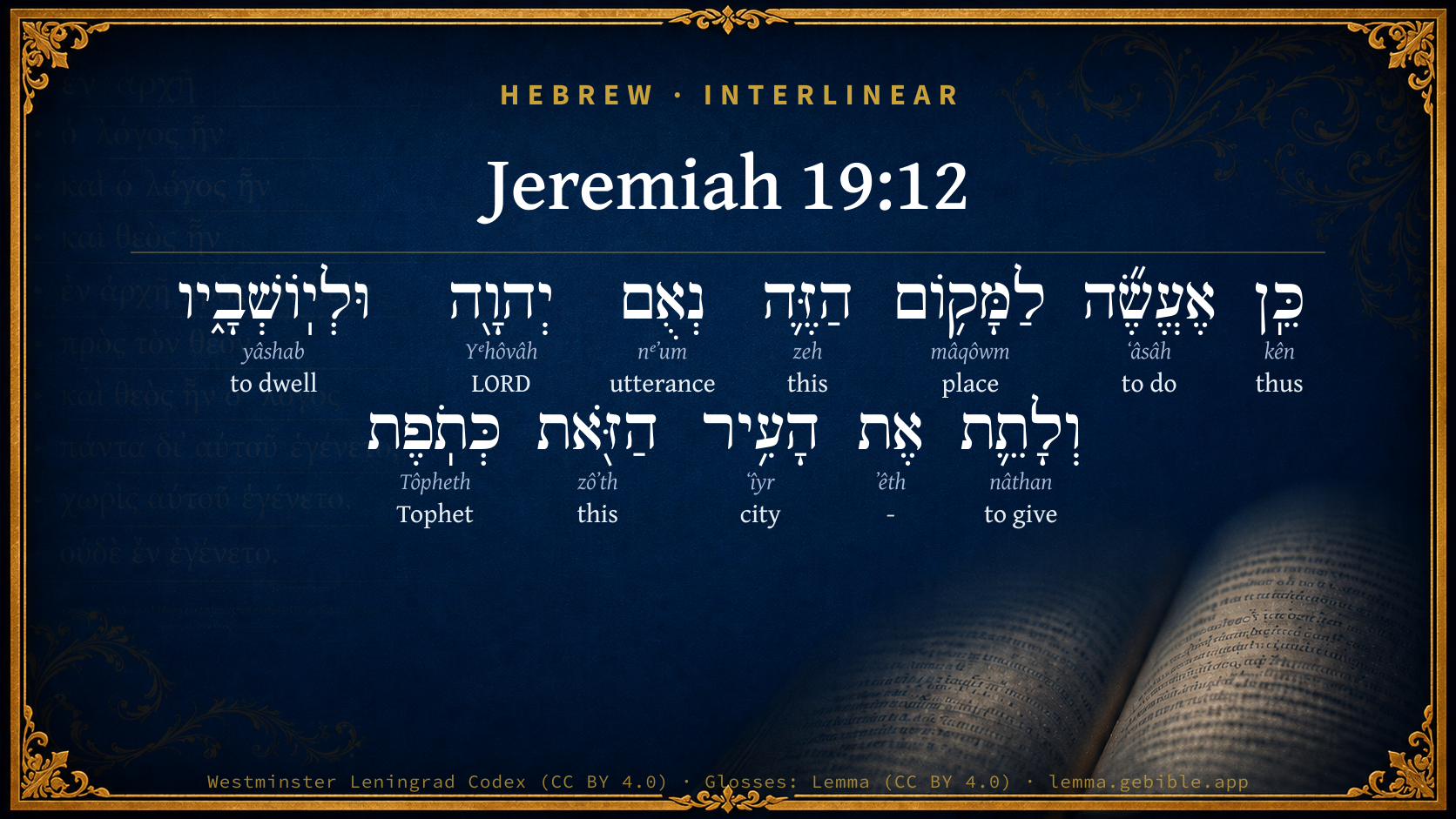
Jeremiah 19:12

Hebrew (Westminster Leningrad Codex) Jeremiah 19:12 appears in the Hebrew Old Testament. The text above is from the Westminster Leningrad Codex. Each word links to its Strong’s number, a concise gloss, and parsing drawn from the Open Scriptures Hebrew Bible morphology. Click any word for its full Brown-Driver-Briggs (BDB) entry.
Download image
Cite this verse

Jeremiah 19:12 (World English Bible). Public Domain. Lemma interlinear Bible study tool, https://lemma.gebible.app/v/jeremiah/19/12.

Show BibTeX & RIS
BibTeX
RIS
English Translation
Thus will I do to this place, says Yahweh, and to the inhabitants of it, even making this city as Topheth:
World English Bible · Public Domain
Download a study sheet

One document with this verse’s original text, its word-by-word gloss line, the meaning frame, cross-references with their text, attributed commentary, and full source and license credits — printable, and it pastes into notes with its structure intact.

This verse Autodidact and up

Study sheet (.html) Plain text (.txt)

A passage Seminary Student

Up to 50 verses in one chapter. A passage sheet keeps up to 6 commentary sources and 12 cross-references per verse, in the order this page ranks them, and says so on the sheet whenever that leaves anything out. Ask for a single verse and you get the Autodidact verse sheet above.

Everything on this page stays free to read, with no account — the sheet is a download of what is already on screen, not access to it.

Want to remove ads? Support Godless Engineer
Compare translations 3

The same verse in 3 English versions, stacked beneath the original-language interlinear above. Click any original word for its lexicon entry.

Each is an independent rendering of the whole verse — the interlinear is not word-aligned to these translations.

Highlighted words mark where these versions differ — a whole-verse word diff, not a word-by-word alignment.

  • World English Bible Public Domain
    Thus will I do to this place, says Yahweh, and to the inhabitants of it, even making this city as Topheth:
  • King James Version Public Domain
    Thus will I do unto this place, saith the LORD, and to the inhabitants thereof, and even make this city as Tophet:
  • unfoldingWord Literal Text CC BY-SA 4.0
    Thus I will do to this place’ —the declaration of Yahweh—‘and to its dwellers, and to make this city like Topheth.

unfoldingWord Literal Text — © unfoldingWord, licensed CC BY-SA 4.0. Word-aligned USFM3 via Door43 (git.door43.org/unfoldingWord/en_ult).

Versions to compare (up to 4)

3 of 4 selected

Show all 18 translations

Every available English version of this verse, each an independent rendering of the whole verse.

  • World English Bible Public Domain
    Thus will I do to this place, says Yahweh, and to the inhabitants of it, even making this city as Topheth:
  • Berean Standard Bible Public Domain
    This is what I will do to this place and to its residents, declares the LORD. I will make this city like Topheth.
  • Majority Standard Bible Public Domain
    This is what I will do to this place and to its residents, declares the LORD. I will make this city like Topheth.
  • King James Version Public Domain
    Thus will I do unto this place, saith the LORD, and to the inhabitants thereof, and even make this city as Tophet:
  • American Standard Version (1901) Public Domain
    Thus will I do unto this place, saith Jehovah, and to the inhabitants thereof, even making this city as Topheth:
  • Revised Version (1885) Public Domain
    Thus will I do unto this place, saith the LORD, and to the inhabitants thereof, even making this city as Topheth:
  • Geneva Bible (1599) Public Domain
    Thus will I doe vnto this place, sayth the Lord, and to the inhabitantes thereof, and I will make this citie like Topheth.
  • Douay-Rheims (1899) Public Domain
    Thus will I do to this place, saith the Lord, and to the inhabitants thereof: and I will make this city as Topheth.
  • Young's Literal Translation Public Domain
    so I do to this place -- an affirmation of Jehovah -- and to its inhabitants, so as to make this city as Tophet;
  • Literal Standard Version CC BY-SA 4.0
    so I do to this place—a declaration of YHWH—and to its inhabitants, so as to make this city as Tophet;
  • Unlocked Literal Bible CC BY-SA 4.0
    This is what I will do to this place and its inhabitants when I make this city like Topheth—this is Yahweh's declaration—
  • unfoldingWord Literal Text CC BY-SA 4.0
    Thus I will do to this place’ —the declaration of Yahweh—‘and to its dwellers, and to make this city like Topheth.
  • Darby Bible Public Domain
    Thus will I do unto this place, saith Jehovah, and to the inhabitants thereof, and make this city as Topheth.
  • World Messianic Bible Public Domain
    This is what I will do to this place,” says the LORD, “and to its inhabitants, even making this city as Topheth.
  • Webster's Bible Public Domain
    Thus will I do to this place, saith the LORD, and to its inhabitants, and even make this city as Tophet:
  • Free Bible Version CC BY-SA 4.0
    This is what I'm going to do to this place and to the people who live here, declares the Lord. I will turn this city into Topheth.
  • Bible in Basic English Public Domain
    This is what I will do to this place, says the Lord, and to its people, making this town like Topheth:
  • JPS Tanakh (1917) Public Domain
    Thus will I do unto this place, saith the LORD, and to the inhabitants thereof, even making this city as Topheth;

Literal Standard Version (2020), Covenant Press — licensed CC BY-SA 4.0. Text via the HelloAO Bible API (eBible.org). Unlocked Literal Bible (unfoldingWord) — licensed CC BY-SA 4.0. Text via the HelloAO Bible API (eBible.org). unfoldingWord Literal Text — © unfoldingWord, licensed CC BY-SA 4.0. Word-aligned USFM3 via Door43 (git.door43.org/unfoldingWord/en_ult). Free Bible Version, Dr. Jonathan Gallagher — licensed CC BY-SA 4.0. Text via the HelloAO Bible API (eBible.org).

Word by word

More ways to search: Search by grammar → Find every occurrence → Compare this word →

Practice this passage: Drill this verse → Learn its vocabulary →

כְּתֹֽפֶת
Tôpheth
H8612
“like/as · Tophet”
Preposition + Noun, Proper
Part of Speech
Preposition + Noun
Type
Proper
Full BDB Definition

Origin: the same as H8611

TWOT: 2539

Tophet or Topheth = "place of fire"
  1. כֵּֽן kên H3651 “thus” Particle, Demonstrative
  2. אֶעֱשֶׂ֞ה ʻâsâh H6213 “to do” Verb, Qal, Imperfect, 1st Person, Common, Singular
  3. לַמָּק֥וֹם mâqôwm H4725 “to/for the · place” Preposition, Determined + Noun, Common, Masculine, Singular, Absolute
  4. הַזֶּ֛ה zeh H2088 “the · this” Particle, Definite Article + Pronoun, Demonstrative, Masculine, Singular
  5. נְאֻם nᵉʼum H5002 “utterance of” Noun, Common, Masculine, Singular, Construct
  6. יְהוָ֖ה Yᵉhôvâh H3068 “LORD” Noun, Proper
  7. וּלְיֽוֹשְׁבָ֑יו yâshab H3427 “and · to/for · dwelling · him” Conjunction + Preposition + Verb, Qal, Participle Active, Masculine, Plural, Construct + Suffix, Personal, 3rd Person, Masculine, Singular
  8. וְלָתֵ֛ת nâthan H5414 “and · to give” Conjunction + Preposition + Verb, Qal, Infinitive Construct
  9. אֶת ʼêth H853 “-” Particle, Direct Object
  10. הָעִ֥יר ʻîyr H5892 “the · city” Particle, Definite Article + Noun, Common, Feminine, Singular, Absolute
  11. הַזֹּ֖את zôʼth H2063 “the · this” Particle, Definite Article + Pronoun, Demonstrative, Feminine, Singular

About this verse

These counts appear in no published source. They are computed here, from the morphology-tagged text and Lemma’s own curated glosses. What Lemma adds →

12
words
12
distinct lemmas
Prophets
section

Notable vocabulary

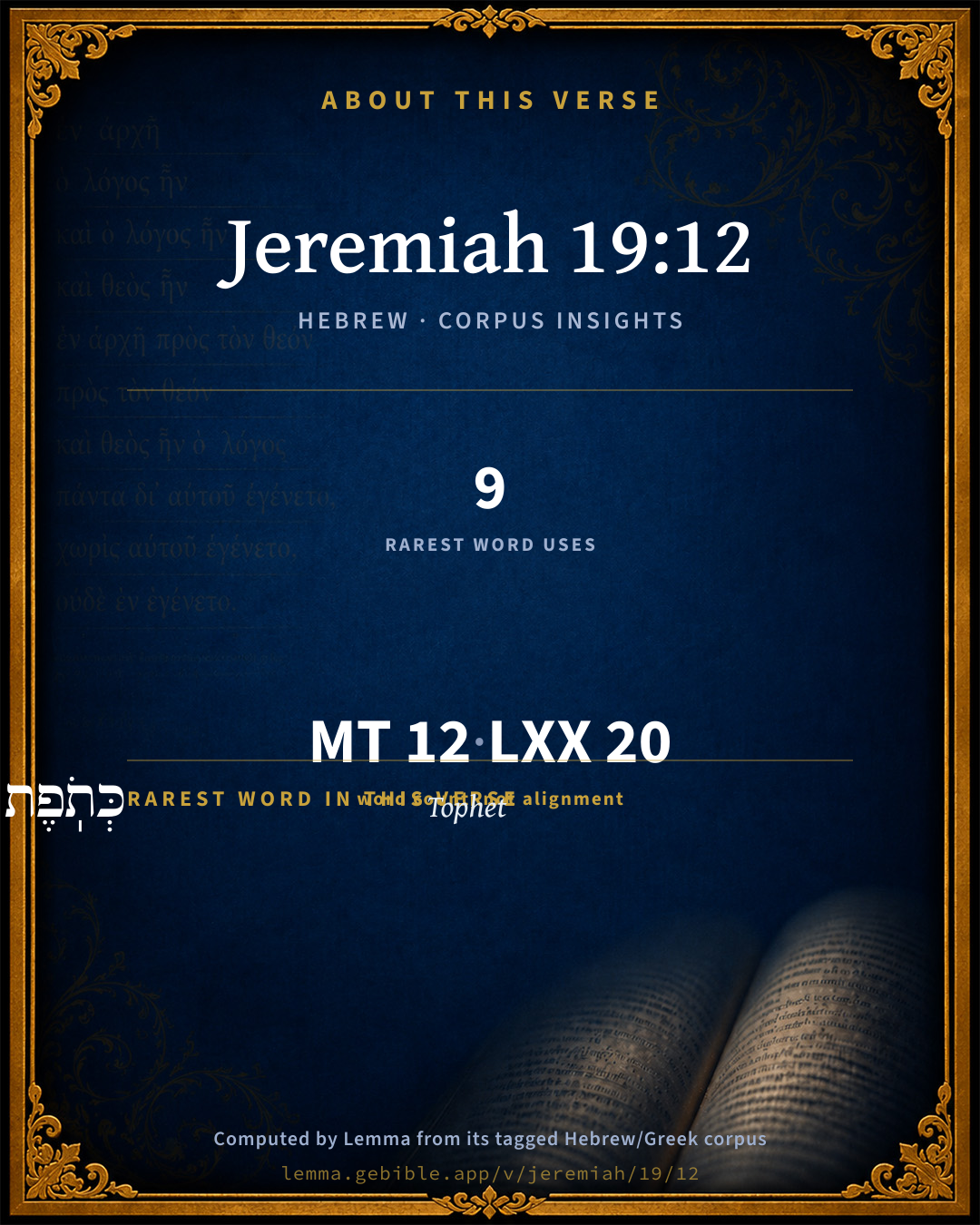
The rarest word here is כְּתֹֽפֶת Tophet H8612 — appearing just 9 times in the whole Hebrew Bible.

Shared distinctive vocabulary

כְּתֹֽפֶת Tophet H8612 occurs in 8 verses of the Hebrew Bible. Also found in:

Grammatical profile

  • 3 verbs
  • 5 nouns
  • 2 pronouns
  • 2 particles

Verb forms

  • אֶעֱשֶׂ֞ה Qal · Imperfect
  • וּלְיֽוֹשְׁבָ֑יו Qal · Participle Active
  • וְלָתֵ֛ת Qal · Infinitive Construct

Hebrew & Septuagint length

In the original languages it is 12 Hebrew tokens and 20 Greek tokens — but the two are counted differently (Hebrew bundles its prefixes and suffixes into one token; the Greek is in lemma form), so that isn’t a like-for-like length.

Cross-references

2

Topical passages linked to Jeremiah 19:12 in the Treasury of Scripture Knowledge — connected by theme and wording, ordered by reader-vote popularity; previews shown in the World English Bible.

  • Jeremiah 10:13 when he utters his voice, there is a tumult of waters in the heavens, and he causes the vapors to ascend from the ends of the earth; he makes lightnings for the rain, and brings forth the wind out of his treasuries.
  • Jeremiah 11:5 that I may establish the oath which I swore to your fathers, to give them a land flowing with milk and honey, as at this day. Then answered I, and said, Amen, Yahweh.

Cross-references courtesy of OpenBible.info (CC BY 4.0).

Hebrew and Greek witnesses Masoretic Hebrew ↔ Greek Septuagint

The same verse in the two great witnesses to the Old Testament, shown verse-for-verse.

These are two independent witnesses, not word-aligned to each other, and the Septuagint is shown in lemma (dictionary) form.

Hebrew Jeremiah 19:12 Masoretic · Westminster Leningrad Codex

כֵּֽן אֶעֱשֶׂ֞ה לַמָּק֥וֹם הַזֶּ֛ה נְאֻם יְהוָ֖ה וּלְיֽוֹשְׁבָ֑יו וְלָתֵ֛ת אֶת הָעִ֥יר הַזֹּ֖את כְּתֹֽפֶת

Thus will I do to this place, says Yahweh, and to the inhabitants of it, even making this city as Topheth:

World English Bible · Public Domain

Greek LXX Structure differs

In the Septuagint, Jeremiah is about an eighth shorter than the Hebrew and arranges its material differently — the Oracles Against the Nations (Hebrew chapters 46–51) appear in the middle of the Greek book, after 25:13. Because the chapter and verse boundaries do not line up, a verse-for-verse comparison with the Hebrew is not shown.

A verse-for-verse comparison isn’t shown here because the chapters and verses don’t line up. Switch to the LXX edition with the MT / LXX toggle above to read the Greek directly.

Hebrew: Westminster Leningrad Codex (CC BY 4.0). Greek: Septuagint (public domain); English from a public-domain English Septuagint. How the Septuagint differs from the Hebrew →

Targum (Aramaic paraphrase)

1

The Targum is the ancient Jewish Aramaic paraphrase of the Hebrew Scriptures — an interpretive translation, not the Hebrew text itself. Onkelos (literal) and Pseudo-Jonathan (expansive) render the Torah, and Jonathan the Prophets. Coverage is partial: where no permissively-licensed English translation exists for a verse, only the Aramaic is shown. This is verse-level text, not a word-by-word alignment to the Hebrew.

  1. Targum Jonathan Prophets (Joshua–Malachi)
    כֵּן אַעְבֵיד לְאַתְרָא הָדֵין אֲמַר יְיָ וּלְיַתְבוֹהִי וּלְמִתַּן יַת קַרְתָּא הָדָא בְּתוֹפֶת:

    (no public-domain English translation for this verse)

    Targum Jonathan — Aramaic: “Mikraot Gedolot” (public domain). English: “Sefaria Community Translation” (CC0 1.0 (public-domain dedication)); “London "Chaldee Paraphrase," 1871” (public domain). Text via Sefaria.

Commentary

Notes on Jeremiah 19:12 from classic Christian and Jewish commentators (each source and its license shown beneath its notes). The classic Christian expositions comment on the surrounding passage and are grouped to its opening verse, so a note may address several verses; the Jewish commentaries on the Tanakh (Rashi and others) are per-verse, so they appear only where the commentator wrote on this verse.

Lemma curates 59 commentaries, every one of them public domain or Creative Commons licensed, each selected and text-cleaned for this edition rather than reprinted as found. About our sources →

Trapp's Complete Commentary

John Trapp

Jer 19:12 Thus will I do unto this place, saith the LORD, and to the inhabitants thereof, and [even] make this city as Tophet:

Ver. 12. And even make their city as Tophet.] Every whit as abominable and horrid; a very hell above ground.

John Trapp, A Commentary or Exposition upon All the Books of the Old and New Testament (1647–1656) — public domain. Text from a community e-Sword module.

Jamieson, Fausset & Brown

Robert Jamieson, A. R. Fausset & David Brown

make this city as Tophet--that is, as defiled with dead bodies as Tophet.

Jamieson, Fausset & Brown — Commentary Critical and Explanatory on the Whole Bible (1871) — public domain (CC PDM 1.0). Text via the HelloAO Bible API.

Adam Clarke's Commentary

Verse 12. And even make this city as Tophet] A place of slaughter and destruction.

Adam Clarke's Commentary on the Bible (1810–1826) — public domain. Text from a community e-Sword/MySword module.

John Calvin's Commentaries

As he had said before that the valley would be the place of slaughter, that thence it might take its name, so now he declares the same as to the city; “As then Tophet shall be the valley of slaughter, so shall Jerusalem be.” They were no doubt kindled into rage (as we shall see in the next chapter) on hearing this prophecy; but yet God purposed, however irreclaimable and refractory they were, to let them know what was approaching, and though they did not believe the words of the Prophet, God touched and even deeply wounded their consciences, so that before the event came they were miserable. For the same purpose he adds —

John Calvin's Commentaries (1540-1563) — public domain. Text from the Calvin Translation Society English edition (1840s-50s) via the Christian Classics Ethereal Library (ccel.org). Calvin's coverage is partial (roughly two-thirds of the Bible); uncommented books and verses are honest gaps, never fabricated. The 19th-century editor's footnotes and remarks are omitted so the notes are faithfully Calvin's own voice.

Ellicott's Commentary for English Readers

(12) And even make this city as Tophet.—This is an allusive reference partly to the state of the valley of Hinnom as a heap of ruins and rubbish, partly to the meaning of the name Tophet, as a place spat upon and scorned. (See Note on Jer_7:31.)

A Bible Commentary for English Readers, edited by Charles John Ellicott (1878–1897) — public domain. Text from a community e-Sword module.

The Cambridge Bible for Schools and Colleges

gen. ed. J. J. S. Perowne

12. As Topheth had been made unclean (2Ki_23:10) by Josiah, so shall the houses of Jerusalem be.

The Cambridge Bible for Schools and Colleges (gen. ed. J. J. S. Perowne; Cambridge University Press, 1878–1918) — public domain. Text from a community e-Sword module.

John Gill's Exposition

And the houses of Jerusalem,.... Where the common people dwelt:

and the houses of the kings of Judah; the palaces of the king, princes, and nobles of Judah, one as well as another:

shall be defiled os Tophet; as that was defiled with the bodies and bones of the slain, and with the faith of the city brought unto it; so the houses of great and small, high and low, should be defiled with the carcasses of the slain that should lie unburied there; their houses should be their graves, and they buried in the ruins of them: or, "the houses of Jerusalem, and the houses of the kings of Judah, which are defiled" (s), with the idolatries after mentioned, shall be as Tophet, places of slaughter:

because of all the houses upon whose roofs they have burnt incense to all the host of heaven; the roofs of houses with the Jews were built flat; and, as they sometimes used them for prayer to the God of heaven, as Peter did, Act 10:9; idolaters used them to burn incense on to the sun, moon, and stars; to which they were nearer, and of which they could have a clearer view upon the house tops, and therefore chose them for this purpose; and so common was this sort of idolatry, that it was practised upon most, if not all, the houses in Jerusalem; see Zep 1:5;

and have poured out drink offerings unto other gods; besides the God of Israel; to Baal, and other Heathen deities.

(s) "quae pollutae sunt", Gataker.

John Gill's Exposition of the Whole Bible (1746–1763) — public domain (CC PDM 1.0). Text via the HelloAO Bible API.

Matthew Poole's English Annotations

That is, a place of slaughter and burials, or a base, ignominious place, or where the noise of drums, and trumpets, and cryings, and yellings shall be heard, as used to be in Tophet

Matthew Poole's English Annotations on the Holy Bible (1683–1685) — public domain. Text from a community e-Sword/MySword module.

Whedon's Commentary on the Bible

Daniel D. Whedon

12. As Tophet — See 2Ki_23:10; Jer_7:31.

Daniel D. Whedon (gen. ed.), Commentary on the Old and New Testaments (1874–1909) — public domain. Text from a community e-Sword module.

The Pulpit Commentary

As Tophet; i.e. an unclean spot, avoided by mankind.

The Pulpit Commentary (1880–1919), ed. H.D.M. Spence-Jones & Joseph S. Exell — public domain. Text from a community e-Sword module.

John Wesley's Explanatory Notes

As Tophet - That is, a place of slaughter and burials.

John Wesley, Explanatory Notes Upon the Whole Bible (1754–1765) — public domain. Text via the GEBible commentary corpus.

unfoldingWord translationNotes

Door43 World Missions Community

this is Yahweh's declaration

Yahweh speaks of himself by name to express the certainty of what he is declaring. See how you translated this in Jeremiah 1:8. AT: "this is what Yahweh has declared" or "this is what I, Yahweh, have declared" (See: First, Second, or Third Person)

of the kings of Judah

The words "the houses" may be supplied here. AT: "the houses of the kings of Judah" (See: Ellipsis)

the unclean people

People who are not acceptable for God's purposes are spoken of as if they were physically unclean. (See: Metaphor)

translationWords

Jerusalem

king

kingdom of Judah

clean

worship

heaven

drink offering

false god

unfoldingWord translationNotes — © Distant Shores Media and the Door43 World Missions Community, licensed CC BY-SA 4.0. Source: git.door43.org/Door43/en_tn.

Rashi

Rabbi Shlomo Yitzchaki (Rashi)

this city like the Topheth All of it will be full of the slain just as the Topheth, where they slay the children for Molech.

Rashi on the Tanakh — English translations: “The Judaica Press complete Tanach with Rashi, translated by A. J. Rosenberg” (CC BY 4.0); “Pentateuch with Rashi's commentary by M. Rosenbaum and A.M. Silbermann, 1929-1934” (public domain); “The Metsudah Tanach series, Lakewood, N.J” (CC BY 4.0); and “The Book of Joshua, Metsudah Publications, 1997” (CC BY 4.0). Text via Sefaria.

Lesson kit

Teaching starters — assembled from the data on this page, not authored interpretation. Every prompt links to the verse data it draws on. Edit before teaching.

Jeremiah, in the Prophets, opens this verse with 12 words (12 distinct Hebrew lemmas). Its most distinctive word is Tôpheth (“Tophet”). A historical commentator’s framing appears above. Read the whole chapter for the surrounding context.

Discussion questions

  1. The word Tôpheth carries the sense “Tophet.” How does it shape the verse?
  2. 2 Kings 23:10 shares the word «Tophet» with this verse. How do the two illuminate each other?
  3. The translations on this page render this verse differently — a whole-verse word diff, not a word-by-word alignment. What might account for the different wordings?
  4. The verb «אֶעֱשֶׂ֞ה» is Qal Imperfect. How does its form color the action?
  5. Reading how Trapp's Complete Commentary and Jamieson, Fausset & Brown read this verse, where do the two commentators agree and where do they part?

Things to notice

Reading settings

Reading text

Shown beneath each verse's original-language words.

Old Testament
Old Testament edition

Read the OT as the Masoretic Hebrew (MT) or the Greek Septuagint (LXX).

English shown for the Greek Septuagint (in the Hebrew ↔ Greek comparison).

Comparing translations? Open the Compare panel on any verse page to stack up to four side by side.