
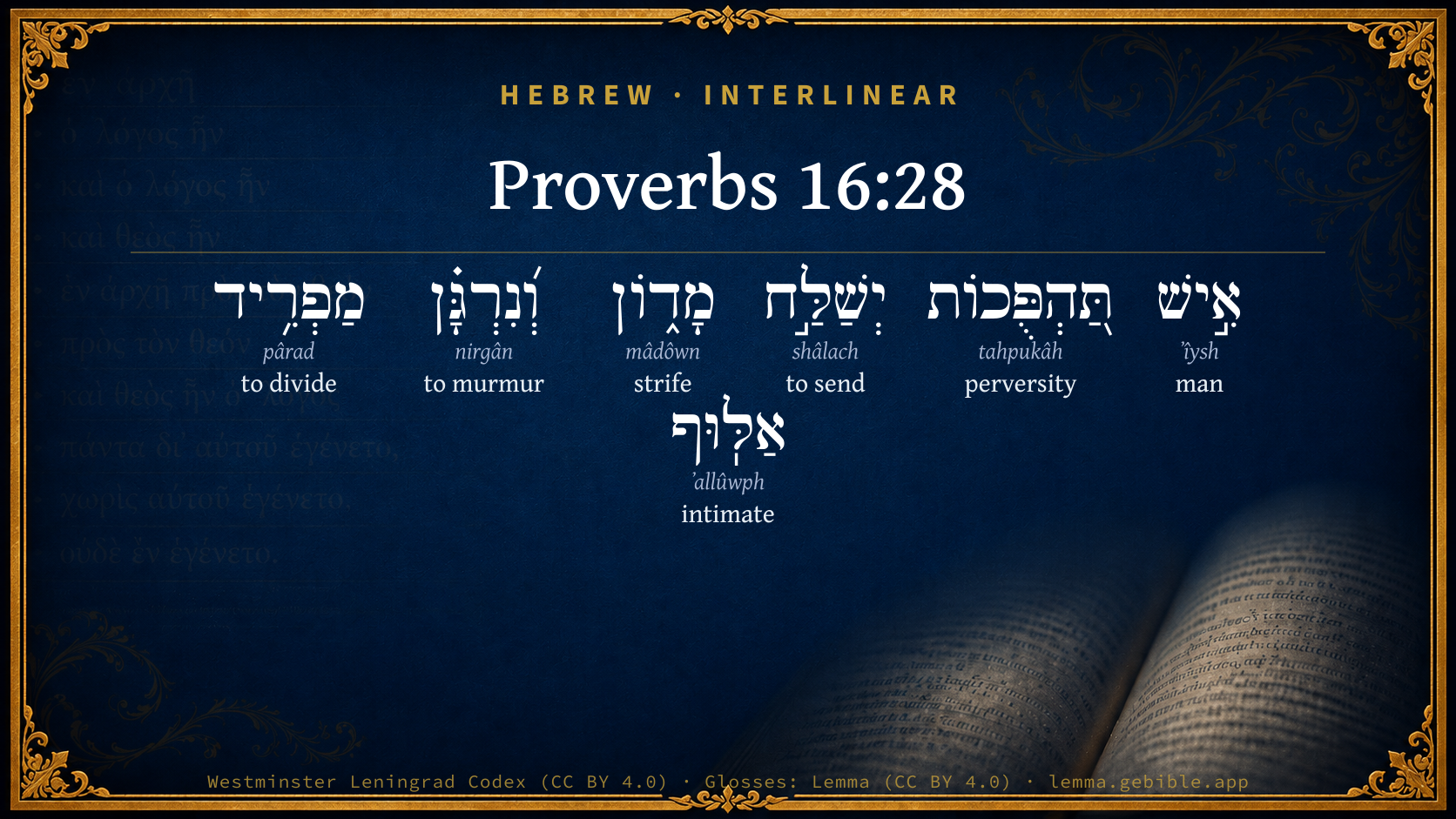
Proverbs 16:28

Hebrew (Westminster Leningrad Codex) Proverbs 16:28 appears in the Hebrew Old Testament. The text above is from the Westminster Leningrad Codex. Each word links to its Strong’s number, a concise gloss, and parsing drawn from the Open Scriptures Hebrew Bible morphology. Click any word for its full Brown-Driver-Briggs (BDB) entry.
Download image
Cite this verse

Proverbs 16:28 (World English Bible). Public Domain. Lemma interlinear Bible study tool, https://lemma.gebible.app/v/proverbs/16/28.

Show BibTeX & RIS
BibTeX
RIS
English Translation
A perverse man stirs up strife. A whisperer separates close friends.
World English Bible · Public Domain
Highlights Full analysis ↓
Download a study sheet

One document with this verse’s original text, its word-by-word gloss line, the meaning frame, cross-references with their text, attributed commentary, and full source and license credits — printable, and it pastes into notes with its structure intact.

This verse Autodidact and up

Study sheet (.html) Plain text (.txt)

A passage Seminary Student

Up to 50 verses in one chapter. A passage sheet keeps up to 6 commentary sources and 12 cross-references per verse, in the order this page ranks them, and says so on the sheet whenever that leaves anything out. Ask for a single verse and you get the Autodidact verse sheet above.

Everything on this page stays free to read, with no account — the sheet is a download of what is already on screen, not access to it.

Want to remove ads? Support Godless Engineer
Compare translations 3

The same verse in 3 English versions, stacked beneath the original-language interlinear above. Click any original word for its lexicon entry.

Each is an independent rendering of the whole verse — the interlinear is not word-aligned to these translations.

Highlighted words mark where these versions differ — a whole-verse word diff, not a word-by-word alignment.

  • World English Bible Public Domain
    A perverse man stirs up strife. A whisperer separates close friends.
  • King James Version Public Domain
    A froward man soweth strife: and a whisperer separateth chief friends.
  • unfoldingWord Literal Text CC BY-SA 4.0
    A man of perverse things lets loose strife, and a murmurer separates the friendly.

unfoldingWord Literal Text — © unfoldingWord, licensed CC BY-SA 4.0. Word-aligned USFM3 via Door43 (git.door43.org/unfoldingWord/en_ult).

Versions to compare (up to 4)

3 of 4 selected

Show all 18 translations

Every available English version of this verse, each an independent rendering of the whole verse.

  • World English Bible Public Domain
    A perverse man stirs up strife. A whisperer separates close friends.
  • Berean Standard Bible Public Domain
    A perverse man spreads dissension, and a gossip divides close friends.
  • Majority Standard Bible Public Domain
    A perverse man spreads dissension, and a gossip divides close friends.
  • King James Version Public Domain
    A froward man soweth strife: and a whisperer separateth chief friends.
  • American Standard Version (1901) Public Domain
    A perverse man scattereth abroad strife; And a whisperer separateth chief friends.
  • Revised Version (1885) Public Domain
    A froward man scattereth abroad strife: and a whisperer separateth chief friends.
  • Geneva Bible (1599) Public Domain
    A frowarde person soweth strife: and a tale teller maketh diuision among princes.
  • Douay-Rheims (1899) Public Domain
    A perverse man stirreth up quarrels: and one full of words separateth princes.
  • Young's Literal Translation Public Domain
    A froward man sendeth forth contention, A tale-bearer is separating a familiar friend.
  • Literal Standard Version CC BY-SA 4.0
    A contrary man sends forth contention, || A tale-bearer is separating a familiar friend.
  • Unlocked Literal Bible CC BY-SA 4.0
    A perverse person stirs up conflict and a gossip separates close friends.
  • unfoldingWord Literal Text CC BY-SA 4.0
    A man of perverse things lets loose strife, and a murmurer separates the friendly.
  • Darby Bible Public Domain
    A false man soweth contention; and a talebearer separateth very friends.
  • World Messianic Bible Public Domain
    A perverse man stirs up strife. A whisperer separates close friends.
  • Webster's Bible Public Domain
    A froward man soweth strife: and a whisperer separateth chief friends.
  • Free Bible Version CC BY-SA 4.0
    Quarrelsome people cause conflict, and a gossip comes between the closest friends.
  • Bible in Basic English Public Domain
    A man of twisted purposes is a cause of fighting everywhere: and he who says evil secretly makes trouble between friends.
  • JPS Tanakh (1917) Public Domain
    A froward man soweth strife; and a whisperer separateth familiar friends.

Literal Standard Version (2020), Covenant Press — licensed CC BY-SA 4.0. Text via the HelloAO Bible API (eBible.org). Unlocked Literal Bible (unfoldingWord) — licensed CC BY-SA 4.0. Text via the HelloAO Bible API (eBible.org). unfoldingWord Literal Text — © unfoldingWord, licensed CC BY-SA 4.0. Word-aligned USFM3 via Door43 (git.door43.org/unfoldingWord/en_ult). Free Bible Version, Dr. Jonathan Gallagher — licensed CC BY-SA 4.0. Text via the HelloAO Bible API (eBible.org).

Word by word

More ways to search: Search by grammar → Find every occurrence → Compare this word →

Practice this passage: Drill this verse → Learn its vocabulary →

About this verse

These counts appear in no published source. They are computed here, from the morphology-tagged text and Lemma’s own curated glosses. What Lemma adds →

7
words
7
distinct lemmas
Wisdom
section

Notable vocabulary

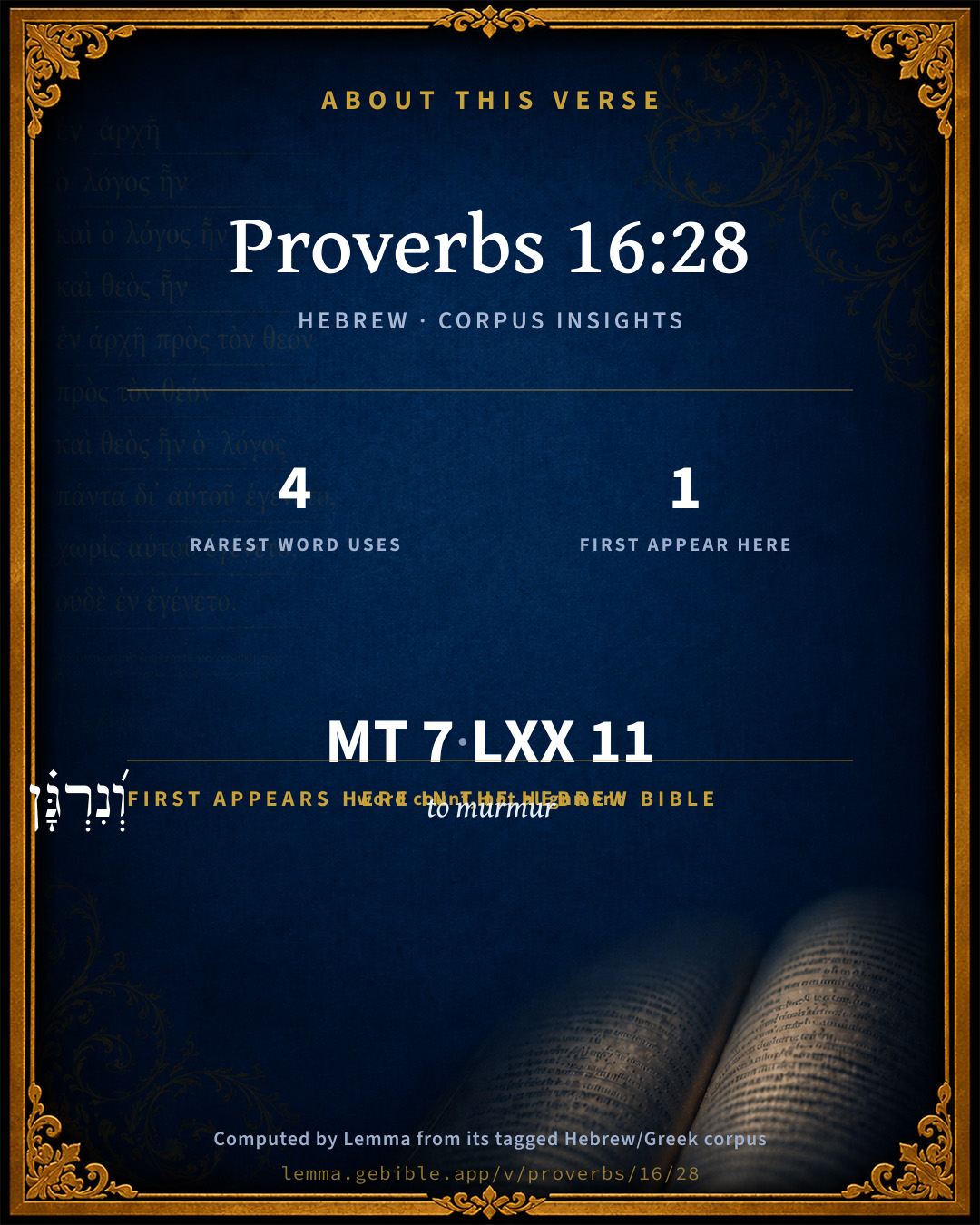
The rarest word here is וְ֝נִרְגָּ֗ן to murmur H5372 — appearing just 4 times in the whole Hebrew Bible.

First appearance in Scripture

This word makes its first canonical appearance in the Hebrew Bible here:

  • וְ֝נִרְגָּ֗ן to murmur H5372

Shared distinctive vocabulary

וְ֝נִרְגָּ֗ן to murmur H5372 occurs in 4 verses of the Hebrew Bible. Also found in:

Grammatical profile

  • 3 verbs
  • 3 nouns
  • 1 adjective

Verb forms

  • יְשַׁלַּ֣ח Piel · Imperfect
  • וְ֝נִרְגָּ֗ן Niphal · Participle Active
  • מַפְרִ֥יד Hiphil · Participle Active

Hebrew & Septuagint length

In English translation the verse runs 11 words from the Hebrew and 18 from the Septuagint (LXX English) — the Septuagint runs noticeably longer here. See the side-by-side →

A rough comparison of the two English renderings, which tokenize alike — not a word-level alignment.

Word counts can differ between the Hebrew and the Greek without any difference in meaning — e.g. the Hebrew direct-object marker אֵת has no separate Greek word, and Greek often adds the article ὁ.

In the original languages it is 7 Hebrew tokens and 11 Greek tokens — but the two are counted differently (Hebrew bundles its prefixes and suffixes into one token; the Greek is in lemma form), so that isn’t a like-for-like length.

Cross-references

14

Topical passages linked to Proverbs 16:28 in the Treasury of Scripture Knowledge — connected by theme and wording, ordered by reader-vote popularity; previews shown in the World English Bible.

  • Proverbs 17:9 He who covers an offense promotes love; But he who repeats a matter separates best friends.
  • Proverbs 15:18 A wrathful man stirs up contention, But one who is slow to anger appeases strife.
  • Proverbs 18:8 The words of a gossip are like dainty morsels: They go down into a person's innermost parts.
  • Romans 1:29 being filled with all unrighteousness, sexual immorality, wickedness, covetousness, maliciousness; full of envy, murder, strife, deceit, evil habits, secret slanderers,
  • James 3:14–16 But if you have bitter jealousy and selfish ambition in your heart, don't boast and don't lie against the truth.
  • Proverbs 6:14 In whose heart is perverseness, Who devises evil continually, Who always sows discord.
  • Genesis 3:1–13 Now the serpent was more subtle than any animal of the field which Yahweh God had made. He said to the woman, "Yes, has God said, 'You shall not eat of any tree of the garden?'"
  • Proverbs 6:19 A false witness who utters lies, And he who sows discord among brothers.
  • 1 Timothy 6:3–5 If anyone teaches a different doctrine, and doesn't consent to sound words, the words of our Lord Jesus Christ, and to the doctrine which is according to godliness,
  • 1 Samuel 24:9 David said to Saul, Why listen you to men's words, saying, Behold, David seeks your hurt?
  • Proverbs 26:20–22 For lack of wood a fire goes out; Without gossip, a quarrel dies down.
  • Proverbs 30:33 For as the churning of milk brings forth butter, And the wringing of the nose brings forth blood; So the forcing of wrath brings forth strife."
  • 2 Corinthians 12:20 For I am afraid that by any means, when I come, I might find you not the way I want to, and that I might be found by you as you don't desire; that by any means there would be strife, jealousy, outbursts of anger, factions, slander, whisperings, proud thoughts, riots;
  • Proverbs 29:22 An angry man stirs up strife, And a wrathful man abounds in sin.

Cross-references courtesy of OpenBible.info (CC BY 4.0).

Hebrew and Greek witnesses Masoretic Hebrew ↔ Greek Septuagint

The same verse in the two great witnesses to the Old Testament, shown verse-for-verse.

Here the Septuagint runs noticeably longer than the Hebrew — LXX2012 (modern English Septuagint) 18 words vs World English Bible 11. A rough length comparison of the two English translations, not a word-level alignment — read both below.

These are two independent witnesses, not word-aligned to each other, and the Septuagint is shown in lemma (dictionary) form.

Hebrew Proverbs 16:28 Masoretic · Westminster Leningrad Codex

אִ֣ישׁ תַּ֭הְפֻּכוֹת יְשַׁלַּ֣ח מָד֑וֹן וְ֝נִרְגָּ֗ן מַפְרִ֥יד אַלּֽוּף

A perverse man stirs up strife. A whisperer separates close friends.

World English Bible · Public Domain

Greek LXX Proverbs 16:28 Septuagint · lemma form

κρείσσων ἀνήρ μακρόθυμος ἰσχυρός ὁ δέ κρατέω ὀργή κρείσσων καταλαμβάνω πόλις

A perverse man spreads mischief, and will kindle a torch of deceit with mischiefs; and he separates friends.

LXX2012 (modern English Septuagint) · Public Domain

On this verse, The Cambridge Bible for Schools and Colleges discusses the Septuagint’s reading. Read the note in Commentary ↓

Hebrew: Westminster Leningrad Codex (CC BY 4.0). Greek: Septuagint (public domain); English from LXX2012 (modern English Septuagint) (Public Domain). How the Septuagint differs from the Hebrew →

Commentary

Notes on Proverbs 16:28 from classic Christian and Jewish commentators (each source and its license shown beneath its notes). The classic Christian expositions comment on the surrounding passage and are grouped to its opening verse, so a note may address several verses; the Jewish commentaries on the Tanakh (Rashi and others) are per-verse, so they appear only where the commentator wrote on this verse.

Lemma curates 59 commentaries, every one of them public domain or Creative Commons licensed, each selected and text-cleaned for this edition rather than reprinted as found. About our sources →

Trapp's Complete Commentary

John Trapp

Pro 16:28 A froward man soweth strife: and a whisperer separateth chief friends.

Ver. 28. A froward man soweth strife.] The Belialist before mentioned, {Pro 16:27} as he digs, so he sows; but as ill seed as may be, that which comes not up but with a curse, as cud-weed, {a} and devil’s bit. He is a sedulous seedsman of sedition; this bad seed he sows in every furrow where he can find footing.

And a whisperer separateth even very friends.] A pestilent tale bearer that carries tales, and so sows strife. Such were Doeg and other abjects that tare David’s name, "and ceased not," {Psa 35:15} tossing it with their carrion mouths as dogs, buzzing into Saul’s ears ever and anon that which might set him agog against him. Such also were those malicious make baits the Pharisees, who, when they thought the disciples had offended, spake not to them, but to their Master, "Why do thy disciples that which is not lawful?" As when they thought Christ offended, they spake not to him, but to his disciples. Thus these whisperers went about to "separate very friends," to make a breach in the family of Christ, by setting off the one from the other. "The words of such whisperers are as wounds, and they go down into the innermost parts of the belly." {Pro 18:8} They are like the wind that creeps in by the chinks and crevices in a wall, or the cracks in a window, that commonly prove more dangerous than a storm that meets a man in the face upon the champion [the plain].

{a} The common name for the genus Gnaphalium of composite plants, having chaffy scales surrounding the flower heads; originally proper to G. sylvaticum; extended to other plants, of allied genera, or similar appearance.

John Trapp, A Commentary or Exposition upon All the Books of the Old and New Testament (1647–1656) — public domain. Text from a community e-Sword module.

Jamieson, Fausset & Brown

Robert Jamieson, A. R. Fausset & David Brown

(Compare Pro 6:14; Pro 10:31).

whisperer--prater, talebearer (Pro 18:8; Pro 26:20).

Jamieson, Fausset & Brown — Commentary Critical and Explanatory on the Whole Bible (1871) — public domain (CC PDM 1.0). Text via the HelloAO Bible API.

Ellicott's Commentary for English Readers

(28) A froward man.—Who distorts the truth.

A Bible Commentary for English Readers, edited by Charles John Ellicott (1878–1897) — public domain. Text from a community e-Sword module.

The Cambridge Bible for Schools and Colleges

gen. ed. J. J. S. Perowne

28. soweth] Rather, scattereth abroad, R.V. διαπέμπεται κακὰ, LXX. Comp. Pro_6:14.

separateth chief friends] “Or, alienateih his friend,” R.V. marg. See Pro_19:7.

The Cambridge Bible for Schools and Colleges (gen. ed. J. J. S. Perowne; Cambridge University Press, 1878–1918) — public domain. Text from a community e-Sword module.

John Gill's Exposition

A violent man enticeth his neighbour,.... As false teachers do, who are grievous wolves, not sparing the flock, and who by good words and fair speeches deceive the heart of the simple; and as the man of sin, that has shed the blood of the saints, and been drunk with the same, deceives with his miracles and sorceries them that dwell on the earth;

and leadeth him into the way that is not good; yea, into one that is very bad; so far are false teachers from leading their neighbours into the good old way of truth and righteousness, that they lead them into pernicious ways, by whom the way; of truth is spoken evil of; they lead them into a ditch, and into destruction hereafter; as does the man of sin and violence his followers.

John Gill's Exposition of the Whole Bible (1746–1763) — public domain (CC PDM 1.0). Text via the HelloAO Bible API.

Haydock's Catholic Bible Commentary

Words. Protestants, "a whisperer separateth chief friends."

George Leo Haydock (1774–1849), Haydock's Catholic Family Bible and Commentary, 1859 edition — public domain. Excludes Psalms (Douay-Rheims chapter numbering differs from Protestant) and Deuterocanonical books (Catholic canon only).

Matthew Poole's English Annotations

A froward man; or, perverse man, who perverteth his words and ways; who pleaseth not God, and is contrary to men, as was said of the Jews, 1Th 2:15.

Soweth strife, by whispering such things as may provoke one against another.

A whisperer, who secretly carries tales from one to another, publishing those evil words and actions which they should conceal, and detracting from their good actions, and perverting such as are innocent with their false constructions.

Chief friends, Heb. a chief friend; the singular number put for the plural, as is frequent in the Hebrew text.

Matthew Poole's English Annotations on the Holy Bible (1683–1685) — public domain. Text from a community e-Sword/MySword module.

Whedon's Commentary on the Bible

Daniel D. Whedon

28. A froward man — A perverter.

A whisperer — Murmurer; a man who is always complaining. It also means a garrulous man, a great talker, tattler, or talebearer. Comp. Pro_6:14; Pro_6:19; Pro_15:18; Pro_17:9; Pro_18:8; Pro_26:20-22; Pro_29:22.

Daniel D. Whedon (gen. ed.), Commentary on the Old and New Testaments (1874–1909) — public domain. Text from a community e-Sword module.

The Pulpit Commentary

A froward man soweth strife. (Pro_6:14, Pro_6:19) The verb means, literally, "sends forth," which may signify "scatters as seed" or "hurls as a missile weapon." The character intended is the perverse man, who distorts the truth, gives a wrong impression, attributes evil motives; such a one occasions quarrels and heartburnings. And a whisperer separateth chief friends. (Pro_17:9) Nirgan is either "a chatterer," or "a whisperer," "calumniator." In Pro_18:8 and Pro_26:20:22 it is translated "tale bearer." "Be not called a whisperer (qiyurov )," says the Son of Sirach (Ecc_5:14), speaking of secret slander. "Slanderers," says an old apothegm, "are Satan"s bellows to blow up contension." Septuagint, "A perverse man sendeth abroad evils, and kindleth a torch of deceit for the wicked, and separateth friends." The alternative rendering of the second clause, "estrangeth a leader," i.e. alienates one leader from another, or from his army, is not confirmed by the authority of the versions or the best commentators.

See homily on Pro_17:9 C.

The Pulpit Commentary (1880–1919), ed. H.D.M. Spence-Jones & Joseph S. Exell — public domain. Text from a community e-Sword module.

Keil & Delitzsch

C. F. Keil & F. Delitzsch

28 A man of falsehood scattereth strife,

And a backbiter separateth confidential friends.

Regarding תּהפּכות (מדבר) אישׁ, vid., Pro 2:12, and מדון ישׁלּח, Pro 6:14; the thought of 28b is found at Pro 6:19. נרגּן (with ן minusculum, which occurs thrice with the terminal Nun) is a Niphal formation from רגן, to murmur (cf. נזיד, from זיד), and denotes the whisperer, viz., the backbiter, ψίθυρος, Sir. 5:14, ψιθυριστής, susurro; the Arab. nyrj is abbreviated from it, a verbal stem of נרג (cf. Aram. norgo, an axe, Arab. naurag, a threshing-sledge = מורג) cannot be proved. Aquila is right in translating by τονθρυστής, and Theodotion by γόγγυσος, from רגן, Hiph. נרגּן, γογγύζειν. Regarding אלּוּף, confidential friend, vid., p. 82; the sing., as Pro 18:9, is used in view of the mutual relationship, and מפריד proceeds on the separation of the one, and, at the same time, of the other from it. Luther, in translating by "a slanderer makes princes disagree," is in error, for אלּוּף, φύλαρχος, is not a generic word for prince.

Keil & Delitzsch — Biblical Commentary on the Old Testament (1861–1891) — public domain (CC PDM 1.0). Text via the HelloAO Bible API. (Old Testament only.)

Kretzmann's Popular Commentary

Paul E. Kretzmann

v. 28. A froward man, one who makes use of malice, soweth strife, for his conduct is bound to create enmity; and a whisperer, a backbiter, separateth chief friends, causing close friends to be divided, for such is the effect of slander skillfully disseminated.

Paul E. Kretzmann, Popular Commentary of the Bible (1921–1924) — public domain. Text from a community e-Sword module.

Rashi

Rabbi Shlomo Yitzchaki (Rashi)

and a grumbler alienates the Lord And through his grumbling, he alienates the Lord of the world from himself.

Rashi on the Tanakh — English translations: “The Judaica Press complete Tanach with Rashi, translated by A. J. Rosenberg” (CC BY 4.0); “Pentateuch with Rashi's commentary by M. Rosenbaum and A.M. Silbermann, 1929-1934” (public domain); “The Metsudah Tanach series, Lakewood, N.J” (CC BY 4.0); and “The Book of Joshua, Metsudah Publications, 1997” (CC BY 4.0). Text via Sefaria.

Lesson kit

Teaching starters — assembled from the data on this page, not authored interpretation. Every prompt links to the verse data it draws on. Edit before teaching.

Proverbs, in the Wisdom, opens this verse with 7 words (7 distinct Hebrew lemmas). Its most distinctive word is nirgân (“to murmur”). The Greek Septuagint runs longer here. A historical commentator’s framing appears above. Read the whole chapter for the surrounding context.

Discussion questions

  1. What does “to murmur” (nirgân) contribute to the verse as a whole?
  2. The word “to murmur” first appears here in Scripture. What is being introduced at this debut?
  3. Proverbs 18:8 shares the word «to murmur» with this verse. How do the two illuminate each other?
  4. Compared with the Hebrew, the Septuagint runs longer here. What questions does that raise?
  5. These translations render this verse differently; the difference is in the English rendering, not the original. What questions does that raise?
  6. The verb «יְשַׁלַּ֣ח» is Piel Imperfect. How does its form color the action?
  7. Reading how Trapp's Complete Commentary and Jamieson, Fausset & Brown read this verse, where do the two commentators agree and where do they part?

Things to notice

Reading settings

Reading text

Shown beneath each verse's original-language words.

Old Testament
Old Testament edition

Read the OT as the Masoretic Hebrew (MT) or the Greek Septuagint (LXX).

English shown for the Greek Septuagint (in the Hebrew ↔ Greek comparison).

Comparing translations? Open the Compare panel on any verse page to stack up to four side by side.