
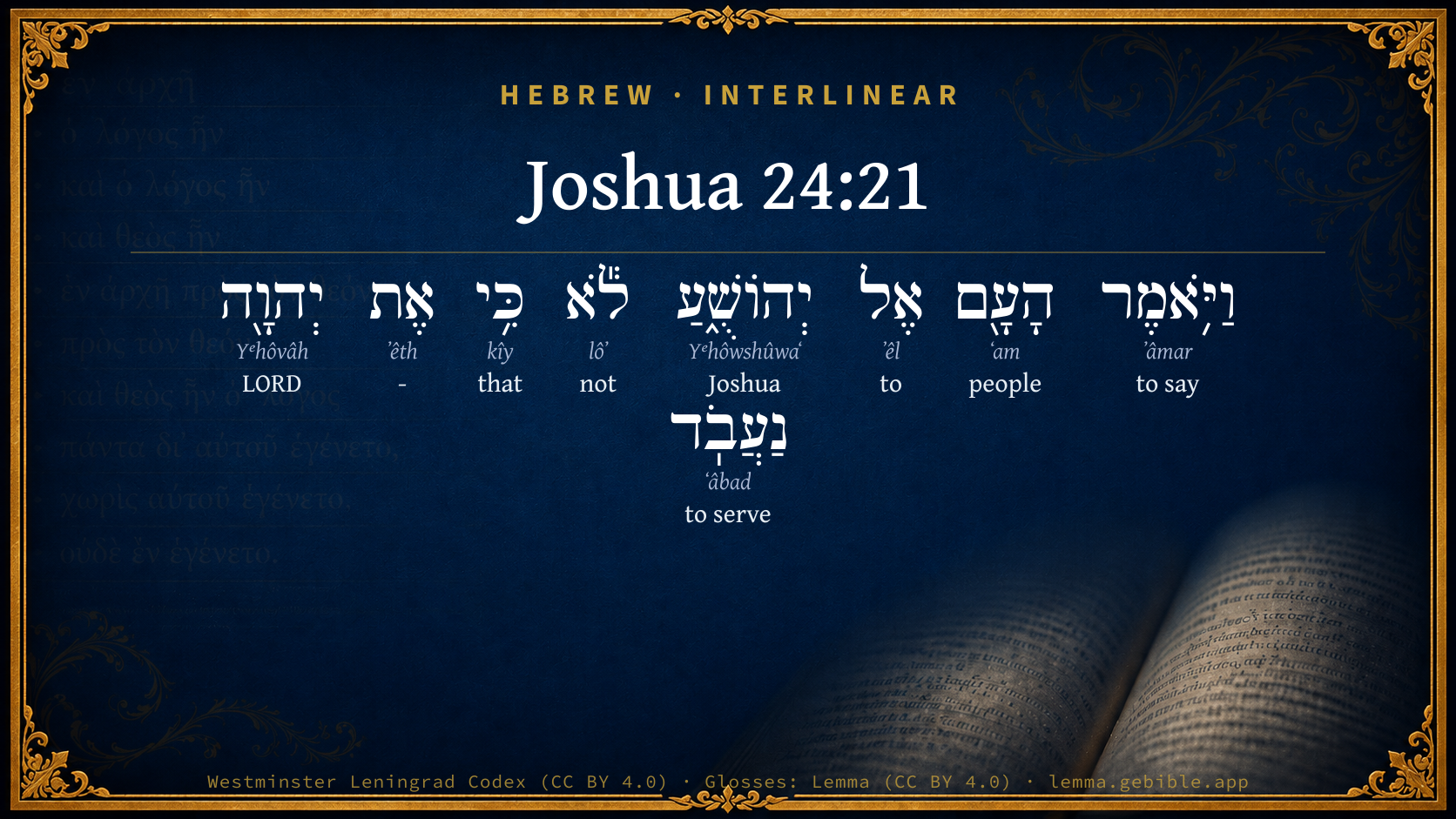
Joshua 24:21

Hebrew (Westminster Leningrad Codex) Joshua 24:21 appears in the Hebrew Old Testament. The text above is from the Westminster Leningrad Codex. Each word links to its Strong’s number, a concise gloss, and parsing drawn from the Open Scriptures Hebrew Bible morphology. Click any word for its full Brown-Driver-Briggs (BDB) entry.
Download image
Cite this verse

Joshua 24:21 (World English Bible). Public Domain. Lemma interlinear Bible study tool, https://lemma.gebible.app/v/joshua/24/21.

Show BibTeX & RIS
BibTeX
RIS
English Translation
The people said to Joshua, No; but we will serve Yahweh.
World English Bible · Public Domain
Download a study sheet

One document with this verse’s original text, its word-by-word gloss line, the meaning frame, cross-references with their text, attributed commentary, and full source and license credits — printable, and it pastes into notes with its structure intact.

This verse Autodidact and up

Study sheet (.html) Plain text (.txt)

A passage Seminary Student

Up to 50 verses in one chapter. A passage sheet keeps up to 6 commentary sources and 12 cross-references per verse, in the order this page ranks them, and says so on the sheet whenever that leaves anything out. Ask for a single verse and you get the Autodidact verse sheet above.

Everything on this page stays free to read, with no account — the sheet is a download of what is already on screen, not access to it.

Want to remove ads? Support Godless Engineer
Compare translations 3

The same verse in 3 English versions, stacked beneath the original-language interlinear above. Click any original word for its lexicon entry.

Each is an independent rendering of the whole verse — the interlinear is not word-aligned to these translations.

Highlighted words mark where these versions differ — a whole-verse word diff, not a word-by-word alignment.

  • World English Bible Public Domain
    The people said to Joshua, No; but we will serve Yahweh.
  • King James Version Public Domain
    And the people said unto Joshua, Nay; but we will serve the LORD.
  • unfoldingWord Literal Text CC BY-SA 4.0
    And the people said to Joshua, “No, but we will serve Yahweh.”

unfoldingWord Literal Text — © unfoldingWord, licensed CC BY-SA 4.0. Word-aligned USFM3 via Door43 (git.door43.org/unfoldingWord/en_ult).

Versions to compare (up to 4)

3 of 4 selected

Show all 18 translations

Every available English version of this verse, each an independent rendering of the whole verse.

  • World English Bible Public Domain
    The people said to Joshua, No; but we will serve Yahweh.
  • Berean Standard Bible Public Domain
    “No!” replied the people. “We will serve the LORD!”
  • Majority Standard Bible Public Domain
    “No!” replied the people. “We will serve the LORD!”
  • King James Version Public Domain
    And the people said unto Joshua, Nay; but we will serve the LORD.
  • American Standard Version (1901) Public Domain
    And the people said unto Joshua, Nay; but we will serve Jehovah.
  • Revised Version (1885) Public Domain
    And the people said unto Joshua, Nay; but we will serve the LORD.
  • Geneva Bible (1599) Public Domain
    And the people saide vnto Ioshua, Nay, but we will serue the Lord.
  • Douay-Rheims (1899) Public Domain
    And the people said to Josue: No, it shall not be so as thou sayest, but we will serve the Lord.
  • Young's Literal Translation Public Domain
    And the people saith unto Joshua, `No, but Jehovah we do serve.'
  • Literal Standard Version CC BY-SA 4.0
    And the people say to Joshua, “No, but we serve YHWH!”
  • Unlocked Literal Bible CC BY-SA 4.0
    But the people said to Joshua, “No, we will worship Yahweh.”
  • unfoldingWord Literal Text CC BY-SA 4.0
    And the people said to Joshua, “No, but we will serve Yahweh.”
  • Darby Bible Public Domain
    And the people said to Joshua, No; but we will serve Jehovah.
  • World Messianic Bible Public Domain
    The people said to Joshua, “No, but we will serve the LORD.”
  • Webster's Bible Public Domain
    And the people said to Joshua, No; but we will serve the LORD.
  • Free Bible Version CC BY-SA 4.0
    “Don't say that!” the people replied. “We will worship the Lord!”
  • Bible in Basic English Public Domain
    And the people said to Joshua, No! But we will be the servants of the Lord.
  • JPS Tanakh (1917) Public Domain
    And the people said unto Joshua: 'Nay; but we will serve the LORD.'

Literal Standard Version (2020), Covenant Press — licensed CC BY-SA 4.0. Text via the HelloAO Bible API (eBible.org). Unlocked Literal Bible (unfoldingWord) — licensed CC BY-SA 4.0. Text via the HelloAO Bible API (eBible.org). unfoldingWord Literal Text — © unfoldingWord, licensed CC BY-SA 4.0. Word-aligned USFM3 via Door43 (git.door43.org/unfoldingWord/en_ult). Free Bible Version, Dr. Jonathan Gallagher — licensed CC BY-SA 4.0. Text via the HelloAO Bible API (eBible.org).

Word by word

More ways to search: Search by grammar → Find every occurrence → Compare this word →

Practice this passage: Drill this verse → Learn its vocabulary →

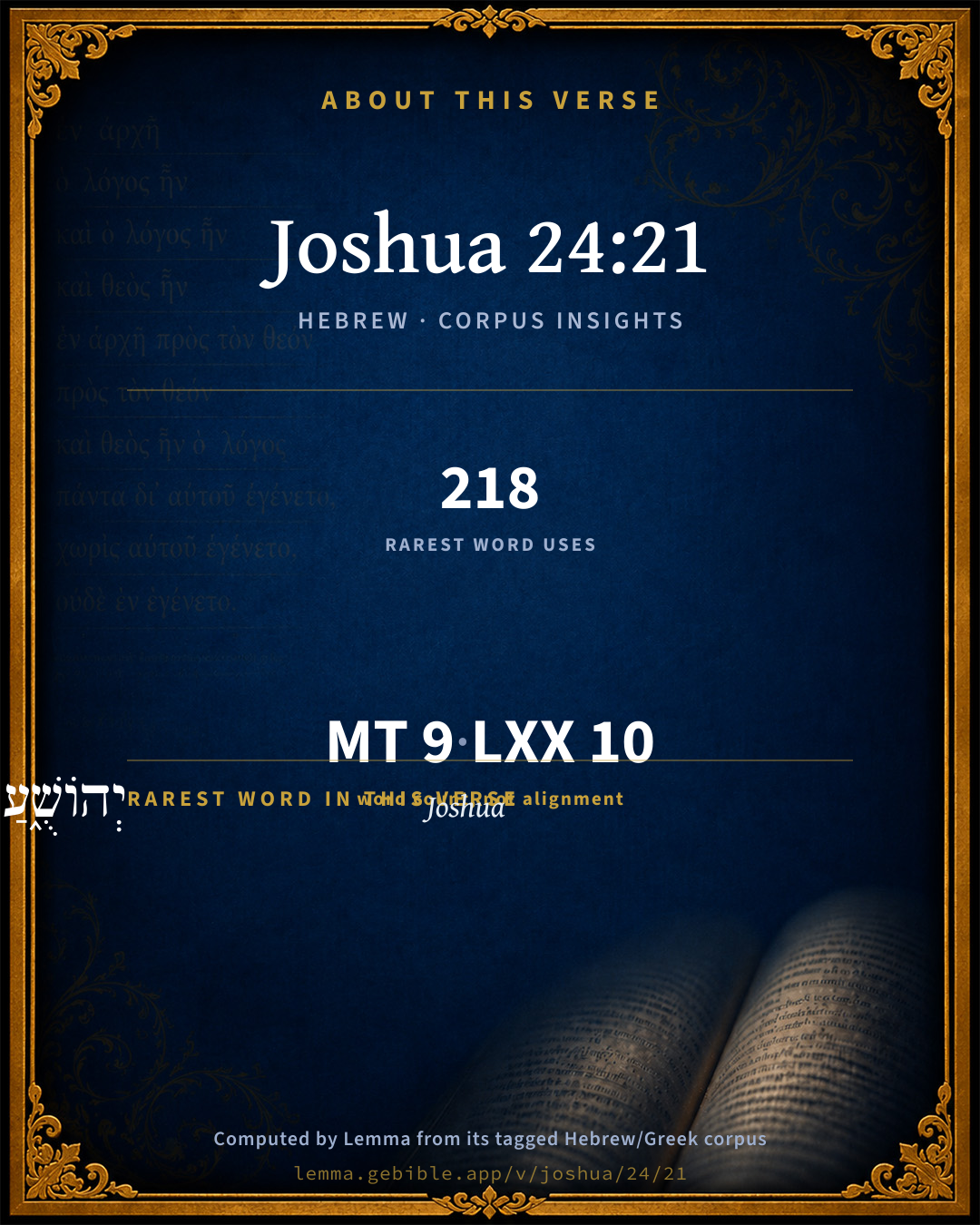
About this verse

These counts appear in no published source. They are computed here, from the morphology-tagged text and Lemma’s own curated glosses. What Lemma adds →

9
words
9
distinct lemmas
Historical
section

Grammatical profile

  • 2 verbs
  • 3 nouns
  • 1 preposition
  • 1 conjunction
  • 2 particles

Verb forms

  • וַיֹּ֥אמֶר Qal · Sequential Imperfect
  • נַעֲבֹֽד Qal · Imperfect

Hebrew & Septuagint length

In English translation the verse runs 11 words from the Hebrew and 13 from the Septuagint (LXX English) — closely comparable.

A rough comparison of the two English renderings, which tokenize alike — not a word-level alignment.

Word counts can differ between the Hebrew and the Greek without any difference in meaning — e.g. the Hebrew direct-object marker אֵת has no separate Greek word, and Greek often adds the article ὁ.

In the original languages it is 9 Hebrew tokens and 10 Greek tokens — but the two are counted differently (Hebrew bundles its prefixes and suffixes into one token; the Greek is in lemma form), so that isn’t a like-for-like length.

Cross-references

6

Topical passages linked to Joshua 24:21 in the Treasury of Scripture Knowledge — connected by theme and wording, ordered by reader-vote popularity; previews shown in the World English Bible.

  • Exodus 19:8 All the people answered together, and said, "All that Yahweh has spoken we will do." Moses reported the words of the people to Yahweh.
  • Exodus 20:19 They said to Moses, "Speak with us yourself, and we will listen; but don't let God speak with us, lest we die."
  • Deuteronomy 5:27–28 Go you near, and hear all that Yahweh our God shall say: and speak you to us all that Yahweh our God shall speak to you; and we will hear it, and do it.
  • Isaiah 44:5 One shall say, I am Yahweh's; and another shall call [himself] by the name of Jacob; and another shall subscribe with his hand to Yahweh, and surname [himself] by the name of Israel.
  • Exodus 24:3 Moses came and told the people all the words of Yahweh, and all the ordinances; and all the people answered with one voice, and said, "All the words which Yahweh has spoken will we do."
  • Exodus 24:7 He took the book of the covenant and read it in the hearing of the people, and they said, "All that Yahweh has spoken will we do, and be obedient."

Cross-references courtesy of OpenBible.info (CC BY 4.0).

Hebrew and Greek witnesses Masoretic Hebrew ↔ Greek Septuagint

The same verse in the two great witnesses to the Old Testament, shown verse-for-verse.

These are two independent witnesses, not word-aligned to each other, and the Septuagint is shown in lemma (dictionary) form.

Hebrew Joshua 24:21 Masoretic · Westminster Leningrad Codex

וַיֹּ֥אמֶר הָעָ֖ם אֶל יְהוֹשֻׁ֑עַ לֹ֕א כִּ֥י אֶת יְהוָ֖ה נַעֲבֹֽד

The people said to Joshua, No; but we will serve Yahweh.

World English Bible · Public Domain

Greek LXX Joshua 24:21 Septuagint · lemma form

καί εἶπον ὁ λαός πρός ἰησοῦς οὐ ἀλλά κύριος λατρεύω

And the people said to Joshua, Nay, but we will serve the Lord.

LXX2012 (modern English Septuagint) · Public Domain

Hebrew: Westminster Leningrad Codex (CC BY 4.0). Greek: Septuagint (public domain); English from LXX2012 (modern English Septuagint) (Public Domain). How the Septuagint differs from the Hebrew →

Targum (Aramaic paraphrase)

1

The Targum is the ancient Jewish Aramaic paraphrase of the Hebrew Scriptures — an interpretive translation, not the Hebrew text itself. Onkelos (literal) and Pseudo-Jonathan (expansive) render the Torah, and Jonathan the Prophets. Coverage is partial: where no permissively-licensed English translation exists for a verse, only the Aramaic is shown. This is verse-level text, not a word-by-word alignment to the Hebrew.

  1. Targum Jonathan Prophets (Joshua–Malachi)
    וַאֲמַר עַמָא לִיהוֹשֻׁעַ לָא אֱלָהֵן קֳדָם יְיָ נִפְלָח:

    (no public-domain English translation for this verse)

    Targum Jonathan — Aramaic: “Mikraot Gedolot” (public domain). English: “Sefaria Community Translation” (CC0 1.0 (public-domain dedication)); “London "Chaldee Paraphrase," 1871” (public domain). Text via Sefaria.

Commentary

Notes on Joshua 24:21 from classic Christian and Jewish commentators (each source and its license shown beneath its notes). The classic Christian expositions comment on the surrounding passage and are grouped to its opening verse, so a note may address several verses; the Jewish commentaries on the Tanakh (Rashi and others) are per-verse, so they appear only where the commentator wrote on this verse.

Lemma curates 59 commentaries, every one of them public domain or Creative Commons licensed, each selected and text-cleaned for this edition rather than reprinted as found. About our sources →

Trapp's Complete Commentary

John Trapp

Jos 24:21 And the people said unto Joshua, Nay; but we will serve the LORD.

Ver. 21. Nay; but we will serve the Lord.] Only and wholly, for subject and object. This was well resolved, if as well practised. These here were ready to enter into covenant, and so to bind their deceitful hearts to a good abearance, which else would be ready to slip collar.

John Trapp, A Commentary or Exposition upon All the Books of the Old and New Testament (1647–1656) — public domain. Text from a community e-Sword module.

Joseph Benson's Commentary

Jos 24:21-22. Nay, but we will serve the Lord — Namely, him only, and not strange gods. Ye are witnesses against yourselves — This solemn profession will be a swift witness against you, if hereafter ye apostatize from God. They said, We are witnesses — Here they renew their choice of Jehovah for their God and king, which their forefathers made when they came out of Egypt, Exo 19:7; Exo 24:7; and acknowledge they should be self-condemned if they did not make it good.

Joseph Benson's Commentary on the Old and New Testaments (1811–1818) — public domain. Text from a community e-Sword module.

Adam Clarke's Commentary

Verse 21. And the people said - Nay; but we will serve, &c.] So they understood the words of Joshua to imply no moral impossibility on their side: and had they earnestly sought the gracious assistance of God, they would have continued steady in his covenant.

Adam Clarke's Commentary on the Bible (1810–1826) — public domain. Text from a community e-Sword/MySword module.

Ellicott's Commentary for English Readers

(21) Nay; but we will serve the Lord.—Being brought to the point, no other answer was possible. If they must give up Jehovah or the idols, the idols must go first.

(22,23) Ye are witnesses . . . that ye have chosen you the Lord . . . Now therefore put away . . . the strange gods.—This was the practical conclusion to which Joshua desired that they should come. But we do not read that they did anything in obedience to these words. We read of no images being buried or burned, as in the days of Jacob by David (Gen_35:4; 2Sa_5:21). There is only a verbal promise: “The Lord our God will we serve, and His voice will we obey.”

A Bible Commentary for English Readers, edited by Charles John Ellicott (1878–1897) — public domain. Text from a community e-Sword module.

The Cambridge Bible for Schools and Colleges

gen. ed. J. J. S. Perowne

21. Nay; but we will] The people repeat their protestations of fidelity to Jehovah, and vow to serve Him with sincerity.

The Cambridge Bible for Schools and Colleges (gen. ed. J. J. S. Perowne; Cambridge University Press, 1878–1918) — public domain. Text from a community e-Sword module.

John Gill's Exposition

And the people said unto Joshua, nay,.... We will not serve strange gods:

but we will serve the Lord; according to his revealed will, and him only.

John Gill's Exposition of the Whole Bible (1746–1763) — public domain (CC PDM 1.0). Text via the HelloAO Bible API.

Haydock's Catholic Bible Commentary

Lord. We shall not experience the chastisements with which thou hast threatened us, because we will adhere inviolably to the Lord. (Calmet)

George Leo Haydock (1774–1849), Haydock's Catholic Family Bible and Commentary, 1859 edition — public domain. Excludes Psalms (Douay-Rheims chapter numbering differs from Protestant) and Deuterocanonical books (Catholic canon only).

Matthew Poole's English Annotations

To wit, him only, and not strange gods, as was supposed by Joshua, Jos 24:20.

Matthew Poole's English Annotations on the Holy Bible (1683–1685) — public domain. Text from a community e-Sword/MySword module.

The Pulpit Commentary

Vers. 21-25. The covenant.

I THE TERMS OF THE COVENANT. It was to bind the people to their promise to renounce the old life of sin and idolatry, and to enter upon and remain in the true service of God. Nations are proud of protecting treaties, constitutional pledges, charters of liberty, etc. No nation ever took a more important covenant than this. The chief question for all of us is whether we will live for the world or for God. The gospel brings to us a new covenant. The promises are greater, the terms are more light. Yet we must choose and resolve and yield ourselves in submission to it if we would enjoy the advantages its offers. This covenant has two sides. God pledges His blessings, but we must pledge our devotion. His is the infinitely greater part. Yet if we fail in ours God"s promises of blessing no longer apply.

II THE OBJECTS OF THE COVENANT,

(1) It was to preserve the memory of the pledge. Men make resolutions in moments of exaltation which they are apt to forget when the feelings which gave rise to them have subsided. Yet it is just then that they are most necessary. They are not needed when they are freely made, because the impulse to resolve would carry out the action without the resolution. Their real value is for those seasons of trial and service when the lack of a strong spontaneous impulse makes it necessary to fall back on some fixed principle.

(2) It was to secure the execution of the pledge. It is easy to promise. The difficulty lies in the performance. God is only mocked with the devotion of the sanctuary which is not followed by the service of the daily life. Hence we need to preserve and carry the high impulses of worship into the work of the world. Many men live two lives, and the life of the Sunday has no bearing on that of the week day. We should use all means to bring religion into life.

III THE FORM OF THE COVENANT.

(1) There was an appeal to memory. The people were to be witnesses against themselves. We should treasure in the memory and often call to mind the thoughts of our seasons of spiritual elevation.

(2) There was a written record. Writing remains unchanged with the varying moods of men. It may he well to write our higher thoughts and deeper resolves for our own subsequent private meditation. The New Testament is a written covenant.

(3) There was a memorial stone. This would be always visible. So the covenant would be often called to mind. We often need to have our memories refreshed and our thoughts called back to the great practical truths of Christianity. Hence the utility of preaching not only new ideas, but truths that all of us know, and yet that all need to be reminded of, and to have often brought before us for practical application. The stone would not lose its value as it became old and familiar. Truth does not grow feeble with age, nor is it the less important because it is the more familiar. W.F.A.

The Pulpit Commentary (1880–1919), ed. H.D.M. Spence-Jones & Joseph S. Exell — public domain. Text from a community e-Sword module.

John Wesley's Explanatory Notes

The Lord - Namely, him only, and not strange gods.

John Wesley, Explanatory Notes Upon the Whole Bible (1754–1765) — public domain. Text via the GEBible commentary corpus.

Keil & Delitzsch

C. F. Keil & F. Delitzsch

The people adhered to their resolution. לא, minime, as in Jos 5:14, i.e., we will not serve other gods, but Jehovah.

Keil & Delitzsch — Biblical Commentary on the Old Testament (1861–1891) — public domain (CC PDM 1.0). Text via the HelloAO Bible API. (Old Testament only.)

unfoldingWord translationNotes

Door43 World Missions Community

people

This refers to the Israelites.

turn your heart to Yahweh

Deciding to obey Yahweh only is spoken of as turning their heart towards him. Here "heart" represents the whole person. In this case, "heart" is plural because it refers to all the Israelites as a single group. However, it may be best to translate it in the plural since "your" is plural. AT: "turn yourselves to Yahweh" or "decide to obey Yahweh" (See: Metaphor and Synecdoche and Forms of You)

translationWords

Joshua

worship

Yahweh

testimony

false god

heart

God

Israel

unfoldingWord translationNotes — © Distant Shores Media and the Door43 World Missions Community, licensed CC BY-SA 4.0. Source: git.door43.org/Door43/en_tn.

Lesson kit

Teaching starters — assembled from the data on this page, not authored interpretation. Every prompt links to the verse data it draws on. Edit before teaching.

Joshua, in the Historical, opens this verse with 9 words (9 distinct Hebrew lemmas). Its most distinctive word is Yᵉhôwshûwaʻ (“Joshua”). A historical commentator’s framing appears above. Read the whole chapter for the surrounding context.

Discussion questions

  1. The word Yᵉhôwshûwaʻ carries the sense “Joshua.” How does it shape the verse?
  2. How does Exodus 19:8, which shares this passage’s theme, read alongside this verse?
  3. These translations render this verse differently. What is at stake in choosing one wording over another?
  4. «וַיֹּ֥אמֶר» is a Qal Sequential Imperfect verb. How does that grammatical form shape the action described?
  5. Compare how Trapp's Complete Commentary and Joseph Benson's Commentary read this verse. Where do they agree or differ?

Things to notice

Reading settings

Reading text

Shown beneath each verse's original-language words.

Old Testament
Old Testament edition

Read the OT as the Masoretic Hebrew (MT) or the Greek Septuagint (LXX).

English shown for the Greek Septuagint (in the Hebrew ↔ Greek comparison).

Comparing translations? Open the Compare panel on any verse page to stack up to four side by side.