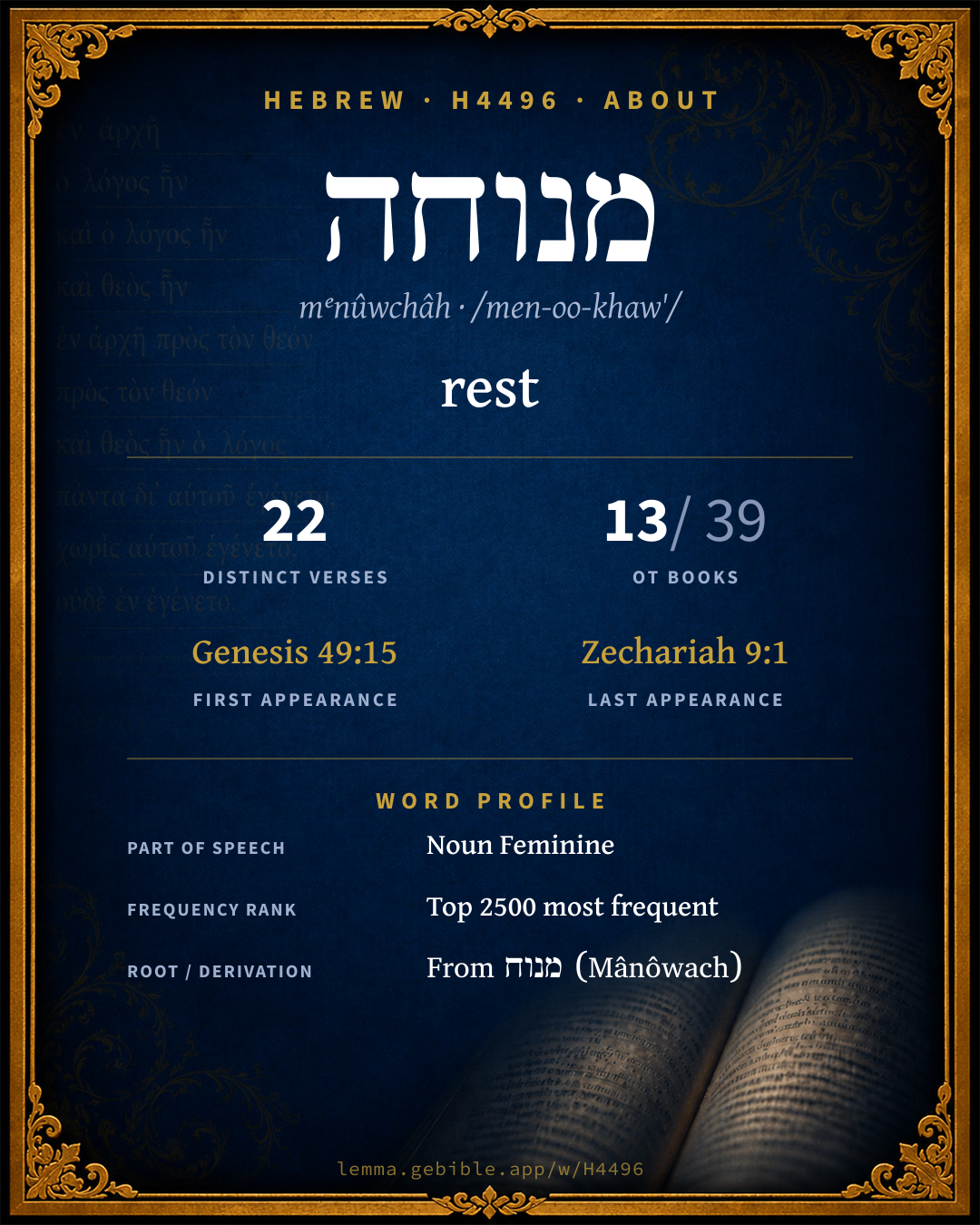
מְנוּחָה
rest
‘rest’ is one of 3 main senses fuller range ↓
Full lexicon entry — Brown-Driver-Briggs (BDB)
From Brown-Driver-Briggs (BDB)
Where this word appears
See every Absolute-state word in the Hebrew Bible →
Grammar key — what these labels mean
Part of speech
- Noun
- A naming word — a person, place, thing, or idea.
Noun type
- Common
- A common noun — a general class of person, place, or thing (“king,” “city,” “water”), not a specific name.
State
- Absolute
- The independent form of a noun, not bound to a following word.
- Construct
- A noun bound to a following noun in a possessive / “of” relationship (the construct chain).
Gender
- Both
- Attested as both masculine and feminine.
Number
- Singular
- One.
- Plural
- More than one (in Hebrew, generally three or more).
Grammatical forms
- Noun, Common, Both, Singular, Absolute 13 times (59%)
- Noun, Common, Both, Singular, Construct 6 times (27%)
- Noun, Common, Both, Plural, Construct 2 times (9%)
- Noun, Common, Both, Plural, Absolute 1 time (5%)
Parsed forms decoded from the imported morphology (morphhb / Westminster Leningrad Codex — WLC text public domain, morphhb tagging CC BY 4.0), counted across 22 parsed occurrences — not distinct verses.
Every verse where H4496 appears — 22 distinct verses across 13 books. Click any verse to open its interlinear word-by-word view. Verse text shown in the World English Bible for context — . Each verse’s Hebrew form is shown with its reference; the English is not keyword-highlighted, since the data carries no word-level English alignment. Use “Compare translations” on any verse to read it across multiple English versions. This concordance covers the Hebrew Bible; Septuagint (Greek Old Testament) occurrences are not indexed here.
Genesis 1 verse
Numbers 1 verse
Deuteronomy 1 verse
Judges 1 verse
Ruth 1 verse
2 Samuel 1 verse
1 Kings 1 verse
1 Chronicles 2 verses
- 1 Chronicles 22:9 מְנוּחָ֔ה n c bs Behold, a son shall be born to you, who shall be a man of rest; and I will give him rest from all his enemies round about; for his name shall be Solomon, and I will give peace and quietness to Israel in his days:
- 1 Chronicles 28:2 מְנוּחָ֜ה n c bs Then David the king stood up on his feet, and said, Hear me, my brothers, and my people: as for me, it was in my heart to build a house of rest for the ark of the covenant of Yahweh, and for the footstool of our God; and I had made ready for the building.
Psalms 5 verses
- Psalms 23:2 מְנֻח֣וֹת n c bp He makes me lie down in green pastures. He leads me beside still waters.
- Psalms 95:11 מְנוּחָתִֽ/י n c bs cs + sfx pers 1cs Therefore I swore in my wrath, "They won't enter into my rest."
- Psalms 116:7 לִ/מְנוּחָ֑יְ/כִי prep + n c bp cs + sfx pers 2fs Return to your rest, my soul, For Yahweh has dealt bountifully with you.
- Psalms 132:8 לִ/מְנוּחָתֶ֑/ךָ prep + n c bs cs + sfx pers 2ms Arise, Yahweh, into your resting place; You, and the ark of your strength.
- Psalms 132:14 מְנוּחָתִ֥/י n c bs cs + sfx pers 1cs "This is my resting place forever. Here I will live, for I have desired it.
Isaiah 4 verses
- Isaiah 11:10 מְנֻחָת֖/וֹ n c bs cs + sfx pers 3ms It shall happen in that day, that the root of Jesse, who stands for an ensign of the peoples, to him shall the nations seek; and his resting-place shall be glorious.
- Isaiah 28:12 הַ/מְּנוּחָה֙ ptcl def.art + n c bs to whom he said, This is the rest, give you rest to him who is weary; and this is the refreshing: yet they would not hear.
- Isaiah 32:18 וּ/בִ/מְנוּחֹ֖ת conj + prep + n c bp cs My people shall abide in a peaceable habitation, and in safe dwellings, and in quiet resting-places.
- Isaiah 66:1 מְנוּחָתִֽ/י n c bs cs + sfx pers 1cs Thus says Yahweh, heaven is my throne, and the earth is my footstool: what manner of house will you build to me? and what place shall be my rest?
Jeremiah 2 verses
- Jeremiah 45:3 וּ/מְנוּחָ֖ה conj + n c bs You did say, Woe is me now! for Yahweh has added sorrow to my pain; I am weary with my groaning, and I find no rest.
- Jeremiah 51:59 מְנוּחָֽה n c bs The word which Jeremiah the prophet commanded Seraiah the son of Neriah, the son of Mahseiah, when he went with Zedekiah the king of Judah to Babylon in the fourth year of his reign. Now Seraiah was chief chamberlain.
Micah 1 verse
Zechariah 1 verse
About this entry
At a glance — auto-summarized from this page’s data, not written by a person. Every figure links to its source below. This summary describes the numbers; it doesn’t interpret them.
At its core, מנוחה (mᵉnûwchâh) means “rest.” Where the King James Version says “rest,” newer translations reach for “resting place” (Berean Standard Bible); the renderings breakdown has the detail. It appears 22 verses across 13 books of the Hebrew Bible, among its uncommon vocabulary. First canonically at Genesis 49:15, it enters the text early. Carrying more than one sense, it rewards its full sense range. Each statement above links to its evidence; the full detail follows below.
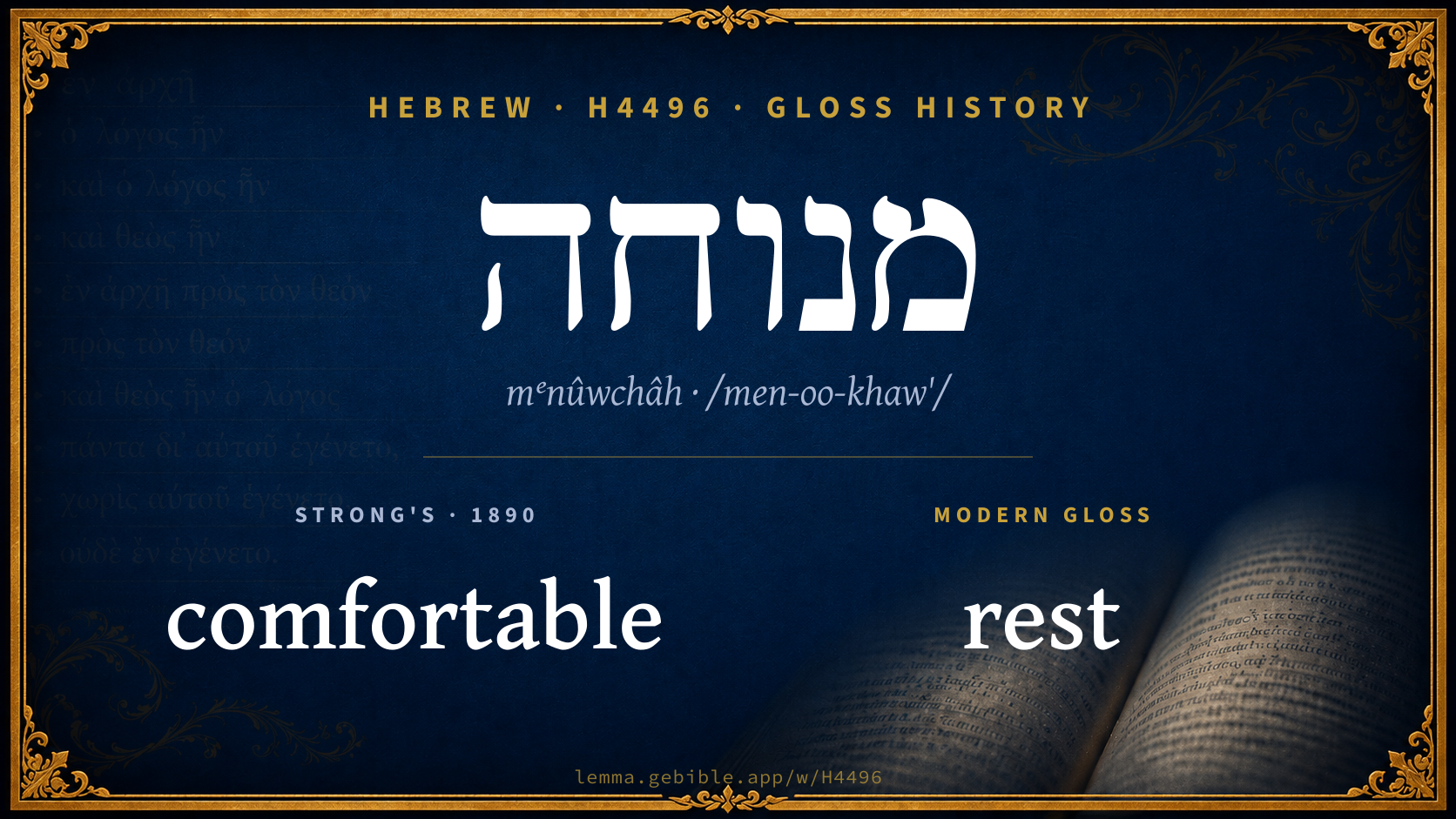
Gloss history
Strong's 1890 vs modern scholarship
About this word
Strong's H4496 catalogs a Hebrew word from the Hebrew Old Testament.
These counts are not copied from any lexicon or concordance. They are computed here, from the morphology-tagged Hebrew Old Testament. What Lemma adds →
- 22
- distinct verses
- The word appears in 22 distinct verses.
- 13 / 39
- OT books
- The word appears in 13 of 39 Old Testament books.
- #1,412
- by frequency
- Top 2500 most frequent Hebrew words (rank 1,412 of 8,640 Hebrew words by occurrence).
View all 22 occurrences in the concordance →
Most concentrated in
- Psalms 5 verses 23%
- Isaiah 4 verses 18%
- 1 Chronicles 2 verses 9%
By section of the Old Testament
By traditional corpus
Conventional, traditional groupings — biblical authorship is debated, so this is a traditional corpus grouping, not an authorship claim. Each share is this word’s portion of its verses in that division of the Hebrew canon. Each figure is a share of the word’s 22 distinct verses.
- Prophets (Nevi'im) 11 verses · 50%
- Writings (Ketuvim) 8 verses · 36%
- Torah (Pentateuch) 3 verses · 14%
How translations render this word
Counts come from each version’s own published word-to-Strong’s tagging or interlinear alignment — an approximate guide to how each version renders this word, not a word-level alignment the data otherwise carries. Because each total is that version’s own tagged count, the per-version totals vary from one another and need not match the appearance or distinct-verse counts above. These counts may also differ from a printed concordance because Lemma counts each distinctly tagged rendering and does not collapse phrase taggings into a single head-word total. This is a fixed set of word-tagged versions (KJV, ASV, BSB, ULT) and does not change with the reading translation you choose elsewhere. Each version’s license is shown beside its name below (and on Sources).
BDB lists this Strong’s number as 2 distinct words (homographs). Each count above pools all of them and is not split by sense — see the Senses section below. A low-frequency rendering may belong to a different one of those words, not the primary meaning.
- King James Version†: Rest 11×
- American Standard Version†: Rest 6×, Resting-place 4×
- Berean Standard Bible†: Resting place 6×, Rest 5×, Place of rest 2×
- unfoldingWord Literal Text†: Rest 11×, Resting place 4×
King James Version Public Domain
Renders H4496 across 21† tagged occurrences — most commonly:
Plus 10 renderings that appear only once — usually multi-word phrases or single function words the recovered tagging swept in, not distinct renderings.
American Standard Version Public Domain
Renders H4496 across 21† tagged occurrences — most commonly:
Plus 11 renderings that appear only once — usually multi-word phrases or single function words the recovered tagging swept in, not distinct renderings.
Berean Standard Bible Public Domain
Renders H4496 across 21† tagged occurrences — most commonly:
Plus 8 renderings that appear only once — usually multi-word phrases or single function words the recovered tagging swept in, not distinct renderings. Not rendered by a distinct English word in 1 further occurrence.
unfoldingWord Literal Text CC BY-SA 4.0
Renders H4496 across 24† tagged occurrences — most commonly:
Plus 9 renderings that appear only once — usually multi-word phrases or single function words the recovered tagging swept in, not distinct renderings.
Senses in the full BDB
What do BDB’s symbols mean?
BDB uses these scholarly abbreviations:
| Symbol | Meaning |
|---|---|
| 𝔊 | the Septuagint (the ancient Greek translation, LXX) |
| 𝔙 | the Vulgate (the Latin translation) |
| 𝔖 | the Syriac version (the Peshitta) |
| 𝔗 | the Targum (the Aramaic translation) |
| ψ | the Psalms |
| √ | root (the underlying root or stem) |
| ‖ | parallel passage (a synonymous or contrasted parallel) |
| † | the dagger: every passage where the word occurs is cited |
The 2 senses and sub-senses the full Brown-Driver-Briggs lexicon distinguishes for this word, in lexicon order (not ranked by frequency), with BDB’s own verbatim wording and sub-sense lettering. Shown in Hebrew script with BDB’s own scholarly abbreviations. The condensed entry is in the Lexicon Entry tab. See also the Forms in the corpus table below.
- 1. resting-place Mi 2:10 Nu 10:33 (JE), Dt 12:9 (+ הַנַּחֲלָה) so ψ 95:11 (י׳’s resting-pl.), cf. 132:8 = 2 Ch 6:41 (v. supr.), ψ 132:14 Is 66:1 (‖ בַּיִת אֲשֶׁר תִּבְנוּ לִי), cf. בֵּית מ׳ לַאֲרוֹן וגו׳ 1 Ch 28:2; also Is 11:10; prob. also Gn 49:15 (‖ הָאָרֶץ; טוֹב here is appar. subst., Sam. reads adj. טוֹבָה; but read perhaps מְנֻחֹה, his resting-place, from מָנוֹחַ, BallHpt Holz after 𝔖); מְנוּחֹת שַׁאֲנַנּוֹת Is 32:18 (+ נְוֵה שָׁלוֹם, מִשְׁכְּנוֹת מִבְטַחִים); of י׳’s word Zc 9:1; resting- place on journey, in שַׂר מ׳ Je 51:59 (Ew Gf Gie al.); fig. for security, assurance 2 S 14:17 (taken from resting, equilibrium, of scale according to Klo). e.g. Micah 2:10
- 2. rest, quietness, pl. מֵי מְנֻחוֹת ψ 23:2; = refreshment Is 28:12 (‖ מַרְגֵּעָה); rest (from enemies) = peace 1 K 8:56 (cf. 5:18), אִישׁ מ׳ 1 Ch 22:9 a man of peace (cf. הֵנִיחַ v b); = relief from sorrow Je 45:3; condition of rest and security attained by marriage Ru 1:9 (= מָנוֹחַ 3:1).—מ׳ Ju 20:43 is perhaps n.pr., cf. GFM. e.g. Psalms 23:2
Senses from the full Brown-Driver-Briggs lexicon (Brown, Driver, Briggs; Oxford 1906 — public domain), digitized via Sefaria, supplemented by the OpenScriptures HebrewLexicon (CC BY 4.0). Full attribution on Sources.
Word origin
n.f. resting-place, rest;—abs. מ׳ Mi 2:10 +, מְנֻחָה Gn 49:15 (but v. infr.), 2 S 14:17; sf. מְנוּחָתִי ψ 95:11 + 2 times, מְנוּחָתֶ֑ךָ ψ 132:8 = 2 Ch 6:41 (where read as in ψ, for anom. לְנוּחֶ֑ךָ MT), מְנֻחָתוֹ Is 11:10 Zc 9:1; pl. מְנוּחֹת Is 32:18, מְנֻחוֹת ψ 23:2;—
— Brown-Driver-Briggs (Oxford 1906, public domain), digitized via Sefaria, supplemented by the OpenScriptures HebrewLexicon (CC BY 4.0). See Sources.
Derived from מנוח (Mânôwach) (H4495) — Manoah.
Jastrow Dictionary
A second Hebrew/Aramaic lexicon for comparison, covering Aramaic and post-biblical (Talmudic, Targumic, Midrashic) usage that the biblical-Hebrew BDB does not. Matched by lemma rather than by Strong’s number, so a lemma may carry more than one Jastrow headword (shown separately below), and the entries cover usage well beyond the Bible.
מְנוּחָה
- (b. h.); same. Num. R. s. 10 הנבואה נקראת מ׳ inspiration is called resting (ref. to Jer. LI, 59, a. Is. XI, 2). Ber. 64ᵃ ת"ח אין להם מ׳ scholars are never at rest (constantly progressing). Ex. R. s. 1 ראה שאין להם מ׳ he saw that they had no recreation from labor; a. fr.—Esp. the seat of the central sanctuary (with ref. to Deut. XII, 9). Tosef. Zeb. XIII, 20; Zeb. 119ᵃ, sq. e.g. Jeremiah 51:59
A Dictionary of the Targumim, the Talmud Babli and Yerushalmi, and the Midrashic Literature (Marcus Jastrow; London, Luzac, 1903) — Public Domain. Digitized via Sefaria. Digitized via Sefaria. Full attribution on Sources.
Forms in the corpus
The 18 distinct written forms H4496 takes in the Hebrew Bible, most frequent first — each parse links to that state’s occurrences in the concordance. Hebrew forms include their vowel points and cantillation, so a single lemma takes many written forms.
Septuagint verse parallels
This word appears in 18 verses that also exist in the Greek Old Testament (Septuagint), out of the 22 Hebrew verses it occurs in. You can read those verses in Greek by switching the Old Testament edition to the Septuagint.
Read these verses in the Septuagint
- Genesis 49:15
- Numbers 10:33
- Deuteronomy 12:9
- Judges 20:43
- Ruth 1:9
- 2 Samuel 14:17
- 1 Kings 8:56
- 1 Chronicles 22:9
- Psalms 23:2
- Isaiah 11:10
- Jeremiah 45:3
- Micah 2:10
This is a verse-level parallel only — the same verses exist in both the Hebrew and Greek Old Testaments. No word-level Hebrew↔Greek correspondence is claimed: the data carries no such alignment, so no Greek word is shown as this Hebrew word’s translation. Coverage is not total — the Septuagint omits the deuterocanon and renumbers the Psalms, so some Hebrew verses have no direct Greek parallel.