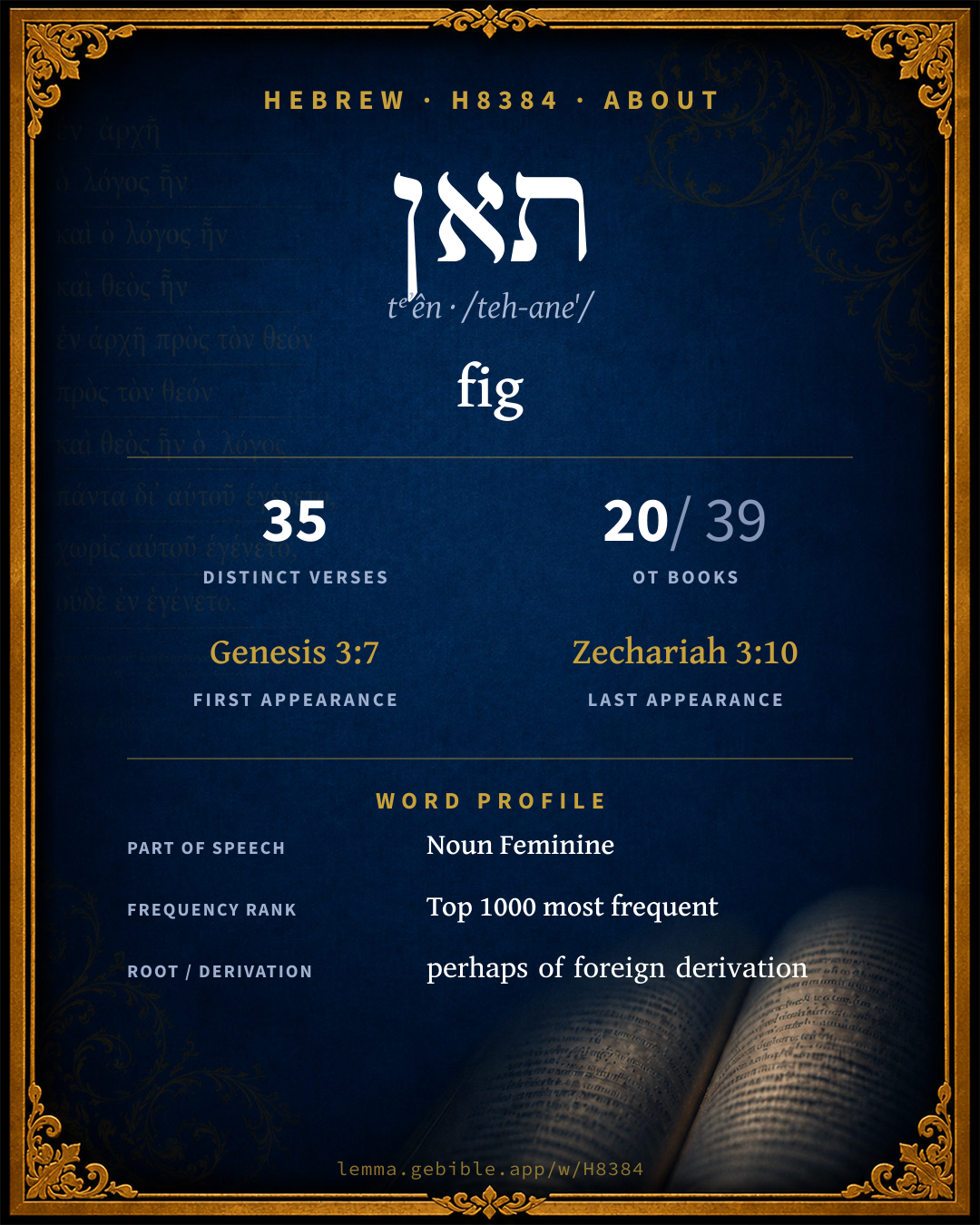
תְּאֵנָה
fig
Full lexicon entry — Brown-Driver-Briggs (BDB)
From Brown-Driver-Briggs (BDB)
Where this word appears
See every Absolute-state word in the Hebrew Bible →
Grammar key — what these labels mean
Part of speech
- Noun
- A naming word — a person, place, thing, or idea.
Noun type
- Common
- A common noun — a general class of person, place, or thing (“king,” “city,” “water”), not a specific name.
State
- Absolute
- The independent form of a noun, not bound to a following word.
- Construct
- A noun bound to a following noun in a possessive / “of” relationship (the construct chain).
Gender
- Feminine
- Grammatically feminine.
Number
- Plural
- More than one (in Hebrew, generally three or more).
- Singular
- One.
Grammatical forms
- Noun, Common, Feminine, Singular, Absolute 15 times (38%)
- Noun, Common, Feminine, Plural, Absolute 14 times (36%)
- Noun, Common, Feminine, Singular, Construct 8 times (21%)
- Noun, Common, Feminine, Plural, Construct 2 times (5%)
Parsed forms decoded from the imported morphology (morphhb / Westminster Leningrad Codex — WLC text public domain, morphhb tagging CC BY 4.0), counted across 39 parsed occurrences — not distinct verses.
Every verse where H8384 appears — 35 distinct verses across 20 books. Click any verse to open its interlinear word-by-word view. Verse text shown in the World English Bible for context — . Each verse’s Hebrew form is shown with its reference; the English is not keyword-highlighted, since the data carries no word-level English alignment. Use “Compare translations” on any verse to read it across multiple English versions. This concordance covers the Hebrew Bible; Septuagint (Greek Old Testament) occurrences are not indexed here.
Genesis 1 verse
Numbers 2 verses
- Numbers 13:23 הַ/תְּאֵנִֽים ptcl def.art + n c fp They came to the valley of Eshcol, and cut down from there a branch with one cluster of grapes, and they bore it on a staff between two; [they brought] also of the pomegranates, and of the figs.
- Numbers 20:5 וּ/תְאֵנָ֤ה conj + n c fs Why have you made us to come up out of Egypt, to bring us in to this evil place? it is no place of seed, or of figs, or of vines, or of pomegranates; neither is there any water to drink.
Deuteronomy 1 verse
Judges 2 verses
1 Kings 1 verse
2 Kings 2 verses
- 2 Kings 18:31 תְּאֵֽנָת֔/וֹ n c fs cs + sfx pers 3ms Don't listen to Hezekiah: for thus says the king of Assyria, Make your peace with me, and come out to me; and eat you everyone of his vine, and everyone of his fig tree, and everyone drink the waters of his own cistern;
- 2 Kings 20:7 תְּאֵנִ֑ים n c fp Isaiah said, Take a cake of figs. They took and laid it on the boil, and he recovered.
Nehemiah 1 verse
Psalms 1 verse
Proverbs 1 verse
Song of Solomon 1 verse
Isaiah 3 verses
- Isaiah 34:4 מִ/תְּאֵנָֽה prep + n c fs All the host of the sky shall be dissolved, and the heavens shall be rolled together as a scroll; and all their host shall fade away, as the leaf fades from off the vine, and as a fading [leaf] from the fig tree.
- Isaiah 36:16 תְּאֵנָת֔/וֹ n c fs cs + sfx pers 3ms Don't listen to Hezekiah: for thus says the king of Assyria, Make your peace with me, and come out to me; and eat you everyone of his vine, and everyone of his fig tree, and drink you everyone the waters of his own cistern;
- Isaiah 38:21 תְּאֵנִ֑ים n c fp Now Isaiah had said, Let them take a cake of figs, and lay it for a plaster on the boil, and he shall recover.
Jeremiah 8 verses
- Jeremiah 5:17 וּ/תְאֵנָתֶ֑/ךָ conj + n c fs cs + sfx pers 2ms They shall eat up your harvest, and your bread, [which] your sons and your daughters should eat; they shall eat up your flocks and your herds; they shall eat up your vines and your fig trees; they shall beat down your fortified cities, in which you trust, with the sword.
- Jeremiah 8:13 תְּאֵנִ֣ים בַּ/תְּאֵנָ֗ה n c fp prep det + n c fs I will utterly consume them, says Yahweh: there shall be no grapes on the vine, nor figs on the fig tree, and the leaf shall fade; and [the things that] I have given them shall pass away from them.
- Jeremiah 24:1 תְאֵנִ֔ים n c fp Yahweh shown me, and, behold, two baskets of figs set before the temple of Yahweh, after that Nebuchadrezzar king of Babylon had carried away captive Jeconiah the son of Jehoiakim, king of Judah, and the princes of Judah, with the craftsmen and smiths, from Jerusalem, and had brought them to Babylon.
- Jeremiah 24:2 תְּאֵנִים֙ כִּ/תְאֵנֵ֖י תְּאֵנִים֙ n c fp prep + n c fp cs n c fp One basket had very good figs, like the figs that are first-ripe; and the other basket had very bad figs, which could not be eaten, they were so bad.
- Jeremiah 24:3 תְּאֵנִ֑ים הַ/תְּאֵנִ֤ים n c fp ptcl def.art + n c fp Then said Yahweh to me, What see you, Jeremiah? I said, Figs; the good figs, very good; and the bad, very bad, that can't be eaten, they are so bad.
- Jeremiah 24:5 כַּ/תְּאֵנִ֥ים prep det + n c fp Thus says Yahweh, the God of Israel: Like these good figs, so will I regard the captives of Judah, whom I have sent out of this place into the land of the Chaldeans, for good.
- Jeremiah 24:8 וְ/כַ/תְּאֵנִים֙ conj + prep det + n c fp As the bad figs, which can't be eaten, they are so bad, surely thus says Yahweh, So will I give up Zedekiah the king of Judah, and his princes, and the residue of Jerusalem, who remain in this land, and those who dwell in the land of Egypt,
- Jeremiah 29:17 כַּ/תְּאֵנִים֙ prep det + n c fp thus says Yahweh of Hosts; Behold, I will send on them the sword, the famine, and the pestilence, and will make them like vile figs, that can't be eaten, they are so bad.
Hosea 2 verses
- Hosea 2:12 וּ/תְאֵ֣נָתָ֔/הּ conj + n c fs cs + sfx pers 3fs I will lay waste her vines and her fig trees, About which she has said, 'These are my wages that my lovers have given me; And I will make them a forest,' And the animals of the field shall eat them.
- Hosea 9:10 בִ/תְאֵנָה֙ prep + n c fs I found Israel like grapes in the wilderness. I saw your fathers as the first ripe in the fig tree at its first season; But they came to Baal Peor, and consecrated themselves to the shameful thing, And became abominable like that which they loved.
Joel 3 verses
- Joel 1:7 וּ/תְאֵנָתִ֖/י conj + n c fs cs + sfx pers 1cs He has laid my vine waste, And stripped my fig tree. He has stripped its bark, and thrown it away. Its branches are made white.
- Joel 1:12 וְ/הַ/תְּאֵנָ֖ה conj + ptcl def.art + n c fs The vine has dried up, and the fig tree withered; the pomegranate tree, the palm tree also, and the apple tree, Even all of the trees of the field are withered; For joy has withered away from the sons of men.
- Joel 2:22 תְּאֵנָ֥ה n c fs Don't be afraid, you animals of the field; For the pastures of the wilderness spring up, For the tree bears its fruit. The fig tree and the vine yield their strength.
Amos 1 verse
Micah 1 verse
Nahum 1 verse
Habakkuk 1 verse
Haggai 1 verse
Zechariah 1 verse
About this entry
At a glance — auto-summarized from this page’s data, not written by a person. Every figure links to its source below. This summary describes the numbers; it doesn’t interpret them.
תאן — transliterated tᵉʼên — is a Hebrew noun carrying the sense “fig.” Debuting at Genesis 3:7, it then recurs through the corpus. The Hebrew Bible uses it across 35 verses — moderately common. Each statement above links to its evidence; the full detail follows below.
Gloss history
Strong's 1890 vs modern scholarship
About this word
Strong's H8384 catalogs a Hebrew word from the Hebrew Old Testament.
These counts are not copied from any lexicon or concordance. They are computed here, from the morphology-tagged Hebrew Old Testament. What Lemma adds →
- 35
- distinct verses
- The word appears in 35 distinct verses.
- 20 / 39
- OT books
- The word appears in 20 of 39 Old Testament books.
- #922
- by frequency
- Top 1000 most frequent Hebrew words (rank 922 of 8,640 Hebrew words by occurrence).
View all 35 occurrences in the concordance →
By section of the Old Testament
By traditional corpus
Conventional, traditional groupings — biblical authorship is debated, so this is a traditional corpus grouping, not an authorship claim. Each share is this word’s portion of its verses in that division of the Hebrew canon. Each figure is a share of the word’s 35 distinct verses.
- Prophets (Nevi'im) 27 verses · 77%
- Torah (Pentateuch) 4 verses · 11%
- Writings (Ketuvim) 4 verses · 11%
How translations render this word
Counts come from each version’s own published word-to-Strong’s tagging or interlinear alignment — an approximate guide to how each version renders this word, not a word-level alignment the data otherwise carries. Because each total is that version’s own tagged count, the per-version totals vary from one another and need not match the appearance or distinct-verse counts above. These counts may also differ from a printed concordance because Lemma counts each distinctly tagged rendering and does not collapse phrase taggings into a single head-word total. This is a fixed set of word-tagged versions (KJV, ASV, BSB, ULT) and does not change with the reading translation you choose elsewhere. Each version’s license is shown beside its name below (and on Sources).
- King James Version: Figs 13×, Fig tree 12×, Fig trees 5×
- American Standard Version: Figs 13×, Fig-tree 11×, Fig-trees 4×
- Berean Standard Bible: Figs 13×, Fig tree 11×, Fig trees 4×
- unfoldingWord Literal Text: Fig tree 18×, Figs 14×, Fig 3×
King James Version Public Domain
Renders H8384 across 39 tagged occurrences — most commonly:
Plus 7 renderings that appear only once — usually multi-word phrases or single function words the recovered tagging swept in, not distinct renderings.
American Standard Version Public Domain
Renders H8384 across 40 tagged occurrences — most commonly:
Plus 10 renderings that appear only once — usually multi-word phrases or single function words the recovered tagging swept in, not distinct renderings.
Berean Standard Bible Public Domain
Renders H8384 across 39 tagged occurrences — most commonly:
Plus 4 renderings that appear only once — usually multi-word phrases or single function words the recovered tagging swept in, not distinct renderings.
unfoldingWord Literal Text CC BY-SA 4.0
Renders H8384 across 46 tagged occurrences — most commonly:
Plus 3 renderings that appear only once — usually multi-word phrases or single function words the recovered tagging swept in, not distinct renderings.
Senses in the full BDB
What do BDB’s symbols mean?
BDB uses these scholarly abbreviations:
| Symbol | Meaning |
|---|---|
| 𝔊 | the Septuagint (the ancient Greek translation, LXX) |
| 𝔙 | the Vulgate (the Latin translation) |
| 𝔖 | the Syriac version (the Peshitta) |
| 𝔗 | the Targum (the Aramaic translation) |
| ψ | the Psalms |
| √ | root (the underlying root or stem) |
| ‖ | parallel passage (a synonymous or contrasted parallel) |
| † | the dagger: every passage where the word occurs is cited |
The 2 senses and sub-senses the full Brown-Driver-Briggs lexicon distinguishes for this word, in lexicon order (not ranked by frequency), with BDB’s own verbatim wording and sub-sense lettering. Shown in Hebrew script with BDB’s own scholarly abbreviations. The condensed entry is in the Lexicon Entry tab. See also the Forms in the corpus table below.
- 1. fig-tree (ficus carica PostFlora 730; Hast. DB, s. v. TrNHB 350 M’Lean-Th-Dyer Ency. Bib., s. v.; cf. Löw§ 335; often + גֶּפֶן): Ju 9:10, 11 (in allegory), Am 4:9; Ho 9:10; Na 3:12; 1 K 5:5 2 K 18:31 = Is 36:16; Mi 4:4; Is 34:4; Pr 27:18; עֲלֵה ת׳ Gn 3:7 (J) fig-leaves, הַתּ׳ חָֽנְטָה פַגֶּיהָ Ct 2:13; coll. Nu 20:5 (JE), Ho 2:14; Je 5:17; 8:13; Dt 8:8; Hb 3:17; Hg 2:19; Zc 3:10; Jo 1:7, 12; 2:22 ψ 105:33. e.g. Judges 9:10
- 2. fig, always pl.: Nu 13:23 (JE), Je 24:1, 2(×2), 3(×2), 5, 8; 29:17 (all symbolic of Judæans), Je 8:13 (אֵין תּ׳ בַּתְּאֵנָה), Ne 13:15; as medicament, דְּבֶלֶת ת׳ 2 K 20:7 = Is 38:21; תְּאֵנֵי הַבַּכֻּרוֹת Je 24:2 the figs of early ripeness (cf. Du). e.g. Numbers 13:23
Senses from the full Brown-Driver-Briggs lexicon (Brown, Driver, Briggs; Oxford 1906 — public domain), digitized via Sefaria, supplemented by the OpenScriptures HebrewLexicon (CC BY 4.0). Full attribution on Sources.
Word origin
n.f. fig-tree, (then) fig (√ dub.; Arabic تِينٌ,, Aramaic תִּינְתָא, ܬܻܐܬܳܐ; perhaps Pun. תין (v. Lzb385; i.e. תְּיֵן Eut, v. DHMVOJ i. 26), Assyrian tittu, a tree; LagM i. 58ff. combines ת׳ (precariously) with √ (III) אנה meet opportunely, with ref. to fructifying of fig by another tree, cf. HomAufsätze u. Abh. i (1892), 100);—abs. ת׳ Ju 9:10 +; sf. תְּאֵנָתוֹ 1 K 5:5 +, etc.; pl. תְּאֵנִים Nu 13:23 +; cstr. תְּאֵנֵי Je 24:2; sf. תְּאֵנֵיכֶם Am 4:9;—
— Brown-Driver-Briggs (Oxford 1906, public domain), digitized via Sefaria, supplemented by the OpenScriptures HebrewLexicon (CC BY 4.0). See Sources.
Origin: perhaps of foreign derivation
Forms in the corpus
The 35 distinct written forms H8384 takes in the Hebrew Bible, most frequent first — each parse links to that state’s occurrences in the concordance. Hebrew forms include their vowel points and cantillation, so a single lemma takes many written forms.
Septuagint verse parallels
This word appears in 32 verses that also exist in the Greek Old Testament (Septuagint), out of the 35 Hebrew verses it occurs in. You can read those verses in Greek by switching the Old Testament edition to the Septuagint.
Read these verses in the Septuagint
- Genesis 3:7
- Numbers 13:23
- Deuteronomy 8:8
- Judges 9:10
- 2 Kings 18:31
- Psalms 105:33
- Proverbs 27:18
- Song of Solomon 2:13
- Isaiah 34:4
- Jeremiah 5:17
- Hosea 2:12
- Joel 1:7
This is a verse-level parallel only — the same verses exist in both the Hebrew and Greek Old Testaments. No word-level Hebrew↔Greek correspondence is claimed: the data carries no such alignment, so no Greek word is shown as this Hebrew word’s translation. Coverage is not total — the Septuagint omits the deuterocanon and renumbers the Psalms, so some Hebrew verses have no direct Greek parallel.