
Job 28:15

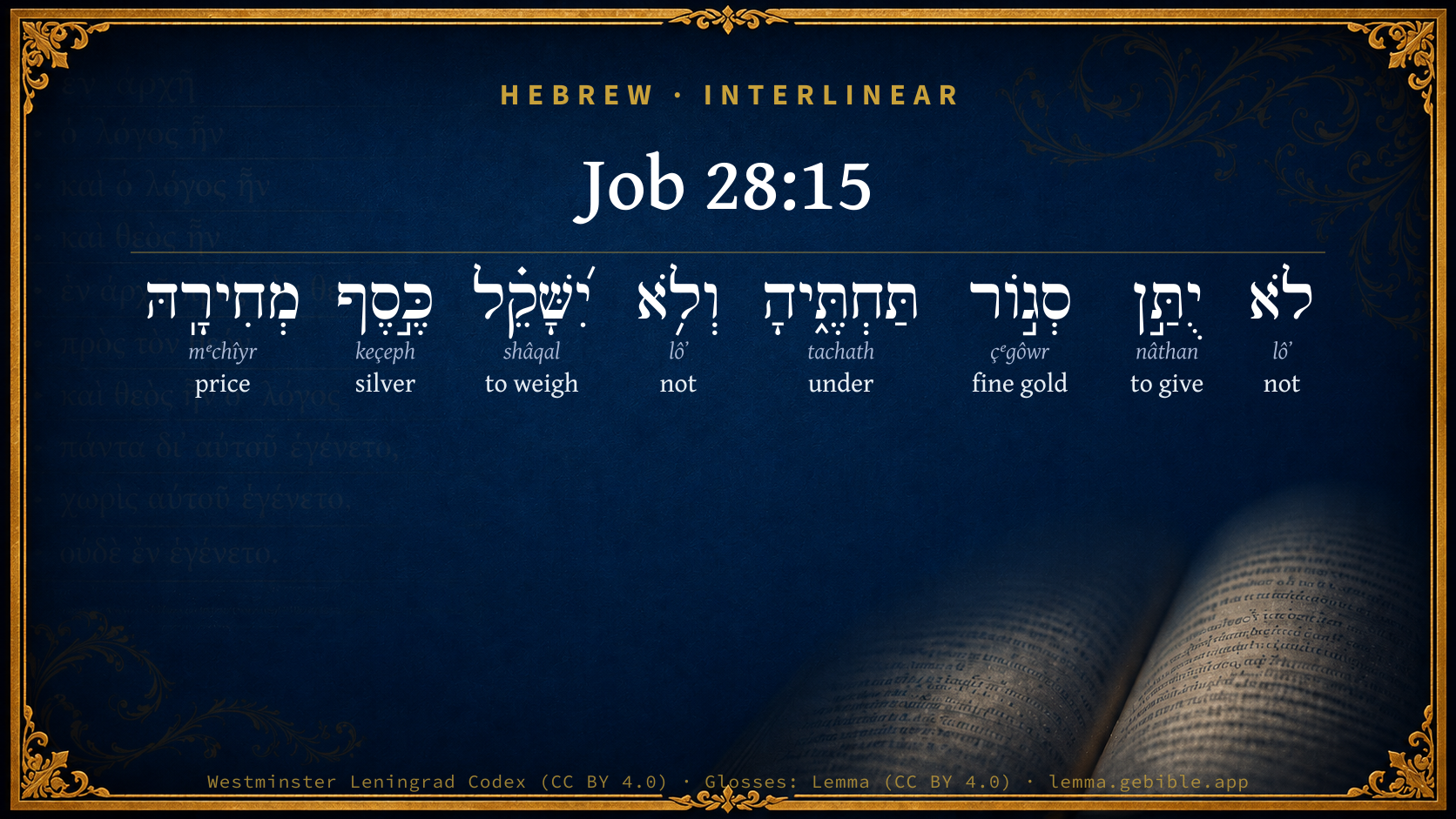
Hebrew (Westminster Leningrad Codex) Job 28:15 appears in the Hebrew Old Testament. The text above is from the Westminster Leningrad Codex. Each word links to its Strong’s number, a concise gloss, and parsing drawn from the Open Scriptures Hebrew Bible morphology. Click any word for its full Brown-Driver-Briggs (BDB) entry.
Download image
Cite this verse

Job 28:15 (World English Bible). Public Domain. Lemma interlinear Bible study tool, https://lemma.gebible.app/v/job/28/15.

Show BibTeX & RIS
BibTeX
RIS
English Translation
It can't be gotten for gold, Neither shall silver be weighed for its price.
World English Bible · Public Domain
Highlights
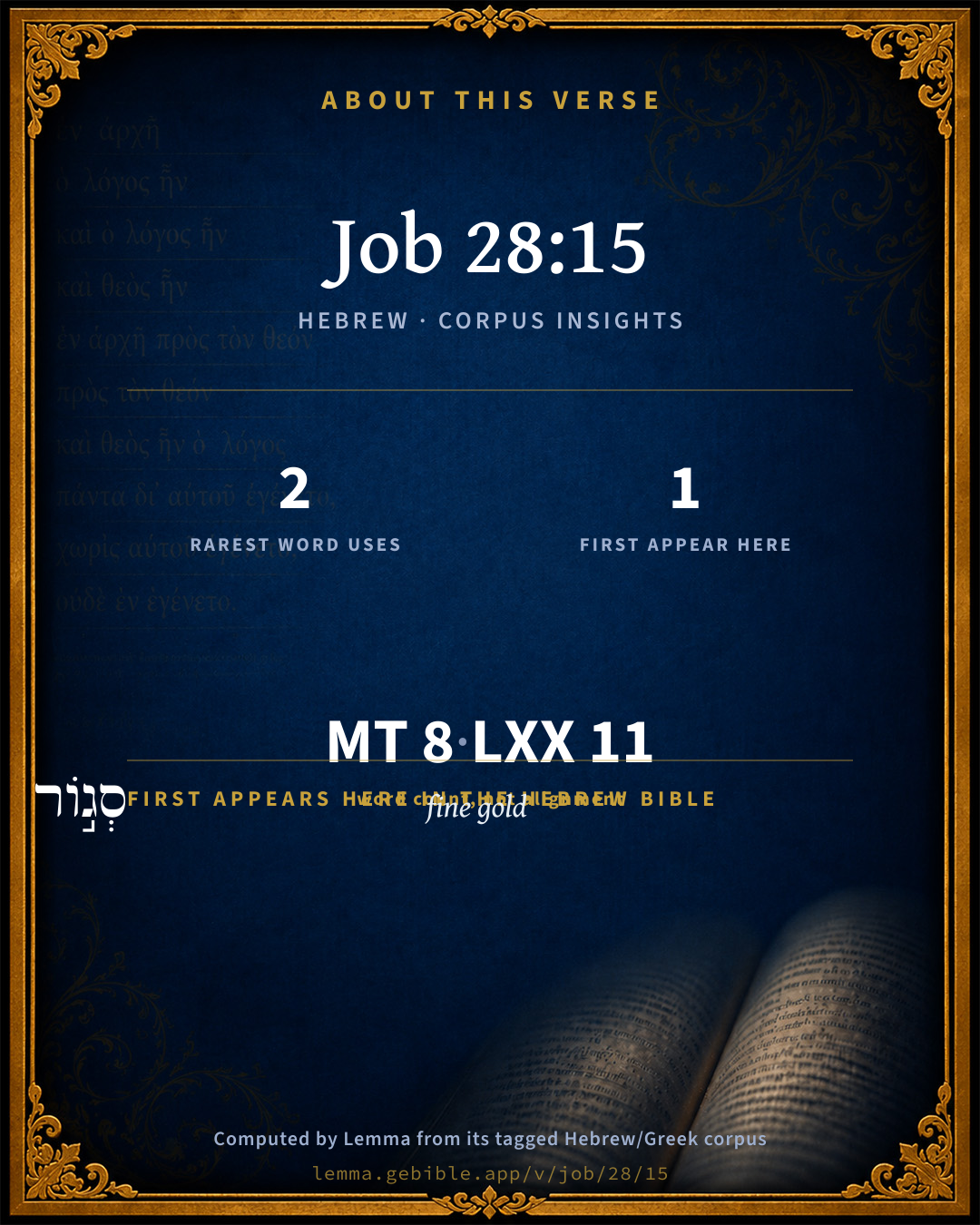
  • 1 first appearance in the Hebrew Bible
Full analysis ↓
Download a study sheet

One document with this verse’s original text, its word-by-word gloss line, the meaning frame, cross-references with their text, attributed commentary, and full source and license credits — printable, and it pastes into notes with its structure intact.

This verse Autodidact and up

Study sheet (.html) Plain text (.txt)

A passage Seminary Student

Up to 50 verses in one chapter. A passage sheet keeps up to 6 commentary sources and 12 cross-references per verse, in the order this page ranks them, and says so on the sheet whenever that leaves anything out. Ask for a single verse and you get the Autodidact verse sheet above.

Everything on this page stays free to read, with no account — the sheet is a download of what is already on screen, not access to it.

Want to remove ads? Support Godless Engineer
Compare translations 3

The same verse in 3 English versions, stacked beneath the original-language interlinear above. Click any original word for its lexicon entry.

Each is an independent rendering of the whole verse — the interlinear is not word-aligned to these translations.

Highlighted words mark where these versions differ — a whole-verse word diff, not a word-by-word alignment.

  • World English Bible Public Domain
    It can't be gotten for gold, Neither shall silver be weighed for its price.
  • King James Version Public Domain
    It cannot be gotten for gold, neither shall silver be weighed for the price thereof.
  • unfoldingWord Literal Text CC BY-SA 4.0
    Gold is not given for it, nor is silver weighed its price.

unfoldingWord Literal Text — © unfoldingWord, licensed CC BY-SA 4.0. Word-aligned USFM3 via Door43 (git.door43.org/unfoldingWord/en_ult).

Versions to compare (up to 4)

3 of 4 selected

Show all 18 translations

Every available English version of this verse, each an independent rendering of the whole verse.

  • World English Bible Public Domain
    It can't be gotten for gold, Neither shall silver be weighed for its price.
  • Berean Standard Bible Public Domain
    It cannot be bought with gold, nor can its price be weighed out in silver.
  • Majority Standard Bible Public Domain
    It cannot be bought with gold, nor can its price be weighed out in silver.
  • King James Version Public Domain
    It cannot be gotten for gold, neither shall silver be weighed for the price thereof.
  • American Standard Version (1901) Public Domain
    It cannot be gotten for gold, Neither shall silver be weighed for the price thereof.
  • Revised Version (1885) Public Domain
    It cannot be gotten for gold, neither shall silver be weighed for the price thereof.
  • Geneva Bible (1599) Public Domain
    Golde shall not be giuen for it, neyther shall siluer be weighed for the price thereof.
  • Douay-Rheims (1899) Public Domain
    The finest gold shall not purchase it, neither shall silver be weighed in exchange for it
  • Young's Literal Translation Public Domain
    Gold is not given for it, Nor is silver weighed -- its price.
  • Literal Standard Version CC BY-SA 4.0
    Gold is not given for it, || Nor is silver weighed—its price.
  • Unlocked Literal Bible CC BY-SA 4.0
    It cannot be gotten for gold; neither can silver be weighed as its price.
  • unfoldingWord Literal Text CC BY-SA 4.0
    Gold is not given for it, nor is silver weighed its price.
  • Darby Bible Public Domain
    Choice gold cannot be given for it, nor silver be weighed for its price.
  • World Messianic Bible Public Domain
    It can’t be gotten for gold, neither will silver be weighed for its price.
  • Webster's Bible Public Domain
    It cannot be obtained for gold, neither shall silver be weighed for the price of it.
  • Free Bible Version CC BY-SA 4.0
    It cannot be bought with gold; nor can it be purchased with silver.
  • Bible in Basic English Public Domain
    Gold may not be given for it, or a weight of silver in payment for it.
  • JPS Tanakh (1917) Public Domain
    It cannot be gotten for gold, neither shall silver be weighed for the price thereof.

Literal Standard Version (2020), Covenant Press — licensed CC BY-SA 4.0. Text via the HelloAO Bible API (eBible.org). Unlocked Literal Bible (unfoldingWord) — licensed CC BY-SA 4.0. Text via the HelloAO Bible API (eBible.org). unfoldingWord Literal Text — © unfoldingWord, licensed CC BY-SA 4.0. Word-aligned USFM3 via Door43 (git.door43.org/unfoldingWord/en_ult). Free Bible Version, Dr. Jonathan Gallagher — licensed CC BY-SA 4.0. Text via the HelloAO Bible API (eBible.org).

Word by word

More ways to search: Search by grammar → Find every occurrence → Compare this word →

Practice this passage: Drill this verse → Learn its vocabulary →

About this verse

These counts appear in no published source. They are computed here, from the morphology-tagged text and Lemma’s own curated glosses. What Lemma adds →

8
words
7
distinct lemmas
Wisdom
section

Notable vocabulary

The rarest word here is סְג֣וֹר fine gold H5458 — appearing just 2 times in the whole Hebrew Bible.

First appearance in Scripture

This word makes its first canonical appearance in the Hebrew Bible here:

  • סְג֣וֹר fine gold H5458

Shared distinctive vocabulary

סְג֣וֹר fine gold H5458 occurs in 2 verses of the Hebrew Bible. Also found in:

Grammatical profile

  • 2 verbs
  • 3 nouns
  • 1 preposition
  • 2 particles

Verb forms

  • יֻתַּ֣ן Hophal · Imperfect
  • יִ֝שָּׁקֵ֗ל Niphal · Imperfect

Repetition

A word recurs within this verse — often emphatic in Hebrew:

Hebrew & Septuagint length

In English translation the verse runs 14 words from the Hebrew and 18 from the Septuagint (LXX English) — closely comparable.

A rough comparison of the two English renderings, which tokenize alike — not a word-level alignment.

Word counts can differ between the Hebrew and the Greek without any difference in meaning — e.g. the Hebrew direct-object marker אֵת has no separate Greek word, and Greek often adds the article ὁ.

In the original languages it is 8 Hebrew tokens and 11 Greek tokens — but the two are counted differently (Hebrew bundles its prefixes and suffixes into one token; the Greek is in lemma form), so that isn’t a like-for-like length.

Cross-references

6

Topical passages linked to Job 28:15 in the Treasury of Scripture Knowledge — connected by theme and wording, ordered by reader-vote popularity; previews shown in the World English Bible.

  • Proverbs 16:16 How much better it is to get wisdom than gold! Yes, to get understanding is to be chosen rather than silver.
  • Proverbs 3:13–15 Happy is the man who finds wisdom, The man who gets understanding.
  • Proverbs 8:10–11 Receive my instruction rather than silver; Knowledge rather than choice gold.
  • Proverbs 8:19 My fruit is better than gold, yes, than fine gold; My yield than choice silver.
  • Job 28:18 No mention shall be made of coral or of crystal: Yes, the price of wisdom is above rubies.
  • Proverbs 8:17 I love those who love me. Those who seek me diligently will find me.

Cross-references courtesy of OpenBible.info (CC BY 4.0).

Hebrew and Greek witnesses Masoretic Hebrew ↔ Greek Septuagint

The same verse in the two great witnesses to the Old Testament, shown verse-for-verse.

These are two independent witnesses, not word-aligned to each other, and the Septuagint is shown in lemma (dictionary) form.

Hebrew Job 28:15 Masoretic · Westminster Leningrad Codex

לֹא יֻתַּ֣ן סְג֣וֹר תַּחְתֶּ֑יהָ וְלֹ֥א יִ֝שָּׁקֵ֗ל כֶּ֣סֶף מְחִירָֽהּ

It can't be gotten for gold, Neither shall silver be weighed for its price.

World English Bible · Public Domain

Greek LXX Job 28:15 Septuagint · lemma form

οὐ δίδωμι συγκλεισμός ἀντί αὐτός καί οὐ ἵστημι ἀργύριον ἀντάλλαγμα αὐτός

One shall not give fine gold instead of it, neither shall silver be weighed in exchange for it.

LXX2012 (modern English Septuagint) · Public Domain

On this verse, Haydock's Catholic Bible Commentary discusses the Septuagint’s reading. Read the note in Commentary ↓

Hebrew: Westminster Leningrad Codex (CC BY 4.0). Greek: Septuagint (public domain); English from LXX2012 (modern English Septuagint) (Public Domain). How the Septuagint differs from the Hebrew →

Commentary

Notes on Job 28:15 from classic Christian and Jewish commentators (each source and its license shown beneath its notes). The classic Christian expositions comment on the surrounding passage and are grouped to its opening verse, so a note may address several verses; the Jewish commentaries on the Tanakh (Rashi and others) are per-verse, so they appear only where the commentator wrote on this verse.

Lemma curates 59 commentaries, every one of them public domain or Creative Commons licensed, each selected and text-cleaned for this edition rather than reprinted as found. About our sources →

Trapp's Complete Commentary

John Trapp

Job 28:15 It cannot be gotten for gold, neither shall silver be weighed [for] the price thereof.

Ver. 15. It cannot be gotten for gold] Non emitur, nec aestimatur, it is not purchased or procured with money, as other learning may ( en precium et praestantiam sapientiae). "With a great sum obtained I this freedom," said that colonel, Act 22:28. So may many say of their learning, they have sufficiently paid for it. Cleanthes parted with all he had for learning; Plato gave thirty thousand florins for three books; Reuchlin gave the Jew that taught him Hebrew a crown for every hour’s pains; Jerome got his skill in that language with the hazard of his life, and held it a good bargain. But here is no such trading. See Act 8:18-20. Fie (quoth that rich and wretched cardinal, when he saw he must die), will money do nothing? will not death be hired? may not heaven be purchased? No, no, God is no money merchant; his kingdom is not partum, wealthy, but paratum, the prepared, Mat 25:34, his grace is gratuitous; Mat 13:11, To you it is given (and what more free than gift?) to know the mysteries of the kingdom of God. And to you it is given, freely given, on behalf of Christ, not only to believe on him, &c., Php 1:29. That proud merit monger that said, Gratis non accipiam, I will not have grace or glory of free cost, could not but go without both (Vega).

John Trapp, A Commentary or Exposition upon All the Books of the Old and New Testament (1647–1656) — public domain. Text from a community e-Sword module.

Joseph Benson's Commentary

Job 28:15-17. It cannot be gotten for gold — The choicest gold laid up in treasures, as the word סגר, segor, signifies: neither shall silver be weighed for the price thereof — Namely, in the balance; for in those times money was paid by weight. It cannot be valued with gold of Ophir — Though the gold that comes from thence be the purest of all, neither that, nor the most precious stones, can purchase this wisdom. The gold and the crystal — Hebrew, זכוכית, zecucith, gemma nitidissima, a very bright gem, says Buxtorf: lapis pretiosus, nitidus, a bright precious stone, Ab. Ezra. The word is not elsewhere used, but being derived from זכךְ, zachach, purus, vel mundus esse, it has in it the signification of purity, clearness, and brightness. The exchange of it shall not be for jewels — Or, vessels, as כלי, chelei, rather means; of fine gold, פז, paz, of solid gold, in which vessels the curiosity of art is added to the excellence of the matter of which they are formed.

Joseph Benson's Commentary on the Old and New Testaments (1811–1818) — public domain. Text from a community e-Sword module.

Whedon's Commentary on the Bible

Daniel D. Whedon

15. Gold — Hebrew, segor. Four different words are used for gold in this chapter. Gold, “most honoured prize of wealth,” (Pindar,) first and last (Job_28:15; Job_28:19) in this brilliant array of nature’s treasures, filled then, as now, its world-wide place of supremacy. See note, however, on Job_28:1.

Daniel D. Whedon (gen. ed.), Commentary on the Old and New Testaments (1874–1909) — public domain. Text from a community e-Sword module.

Geneva Bible (1599)

Geneva Bible translators

It can neither be bought for gold nor precious stones, but is only the gift of God.

Geneva Bible (1599) marginal notes — public domain. Text via Bolls.life.

Jamieson, Fausset & Brown

Robert Jamieson, A. R. Fausset & David Brown

Not the usual word for "gold"; from a Hebrew root, "to shut up" with care; that is, purest gold (Kg1 6:20, Margin).

weighed--The precious metals were weighed out before coining was known (Gen 23:16).

Jamieson, Fausset & Brown — Commentary Critical and Explanatory on the Whole Bible (1871) — public domain (CC PDM 1.0). Text via the HelloAO Bible API.

Adam Clarke's Commentary

Verse 15. It cannot be gotten for gold] Genuine religion and true happiness are not to be acquired by earthly property. Solomon made gold and silver as plentiful as the stones in Jerusalem, and had all the delights of the sons of men, and yet he was not happy; yea, he had wisdom, was the wisest of men, but he had not the wisdom of which Job speaks here, and therefore, to him, all was vanity and vexation of spirit. If Solomon, as some suppose, was the author of this book, the sentiments expressed here are such as we might expect from this deeply experienced and wise man.

Adam Clarke's Commentary on the Bible (1810–1826) — public domain. Text from a community e-Sword/MySword module.

The Cambridge Bible for Schools and Colleges

gen. ed. J. J. S. Perowne

15. for gold] Probably, as margin, fine gold, i. e. purified gold; comp. 1Ki_6:20, where a word somewhat similar occurs.

be weighed] In ancient times money was weighed, not counted, Gen_23:16.

15–19. As the preceding verses (1–14) expressed the idea that there was no “place” of Wisdom where men could find it and from which they could bring it forth, these verses express the idea that it can be acquired by no price which men can offer for it. It is altogether unattainable. The passage may contain the additional idea of the preciousness or desirableness of Wisdom (see Job_28:18), but the purpose of these verses is not to set forth wisdom as a good or as the chief good, for which one might willingly give all that he holds most precious; the thought of the passage is that though one should offer gold and precious stones for Wisdom it cannot be procured, being nowhere to be found. That the Writer’s purpose is to express this conception mainly is evident from the refrain which closes the passage, as a similar one closed the preceding passage: But Wisdom whence cometh it? and where is the place of understanding? (Job_28:20).

The Cambridge Bible for Schools and Colleges (gen. ed. J. J. S. Perowne; Cambridge University Press, 1878–1918) — public domain. Text from a community e-Sword module.

John Gill's Exposition

It cannot be gotten for gold,.... Having in general said that there is nothing in the whole compass of the terraqueous globe, nothing that is upon the surface of the earth, or in the bowels of it, or in the vast ocean, that is an equivalent price for wisdom, Job descends to particulars, and instances first in gold, that being the most valuable of metals; the word here used for it signifies "shut up" (w), because it is first shut up in the earth, out of which it is dug, and when taken from thence, and refined, and made into coins or vessels, it is shut up among the treasures of men; the words may be more literally rendered, "gold shall not be given instead of it" (x); as a sufficient price, or valuable consideration for it:

neither shall silver be weighed for the price thereof; in former times this metal used to be delivered, in buying and selling, not by the number and value of pieces, but by weight, in rude masses and lumps, and even when coined into shekels; see Gen 23:16.

(w) Sept. "conclusum", Tigurine version; "clausum", Bolducius. (x) "non dabitur pro ea", V. L. Montanus, Schultens.

John Gill's Exposition of the Whole Bible (1746–1763) — public domain (CC PDM 1.0). Text via the HelloAO Bible API.

Albert Barnes' Notes on the Bible

It cannot be gotten for gold - Margin, “fine gold shall not be given for it.” The word which is here rendered “gold.” and in the margin “fine gold” (סגור segôr), is not the common word used to denote this metal. It is derived from סגר sâgar, to “shut,” to “close,” and means properly that which is “shut up” or “enclosed;” and hence, Gesenius supposes it means pure gold, or the most precious gold, as that which is shut up or enclosed with care. Dr. Good renders it “solid gold,” supposing it means that which is condensed, or beaten. The phrase occurs in nearly the same form סגור זהב zâhâb sâgûr, “gold shut up,” Margin,) in 1Ki 6:20-21; 1Ki 7:49-50; 1Ki 10:21; 2Ch 4:21-22; 2Ch 9:20, and undoubtedly denotes there the most precious kind of gold. Its relation to the sense of the verb “to shut up” is not certain. Prof. Lee supposes that the idea is derived from the use of the word, and of similar words in Arabic, where the idea of heating, fusing, giving another color, changing the shape, and thence of fixing, retaining, etc., is found; and that the idea here is that of fused or purified gold. Michaelis supposes that it refers to “native” gold that is pure and unadulterated, or the form of gold called “dendroides,” from its shooting out in the form of a tree - “baumartig gewachsenes Gold” (from the Arabic, “a tree”). It is not known, however, that the Hebrew word סגר was always used to denote a tree. There can be no doubt that the word denotes “gold” of a pure kind, and it may have been given to it because gold of that kind was carefully “shut up” in places of safe keeping; but it would seem more probable to me that it was given to it for some reason now unknown. Of many of the names now given by us to objects which are significant, and which are easily understood by us, it would be impossible to trace the reason or propriety, after the lapse of four thousand years.

Neither shall silver be weighed - That is, it would be impossible to weigh out so much silver as to equal its value. Before the art of coining was known, it was common to weigh the precious metals that were used as a medium of trade; compare Gen 23:16.

Albert Barnes' Notes on the Bible (1834–1885) — public domain. Text from a community e-Sword/MySword module.

Haydock's Catholic Bible Commentary

Finest, obrizum, which has the colour of fire. (Pliny, [Natural History?] xxiii. 3.) The old Vulgate and Septuagint read "locked-up gold," aurum conclusum, (Calmet) and the Hebrew Segor, (Haydock) "that which is shut up," like things of value: gold is sometimes specified, 3 Kings vi. 20.

George Leo Haydock (1774–1849), Haydock's Catholic Family Bible and Commentary, 1859 edition — public domain. Excludes Psalms (Douay-Rheims chapter numbering differs from Protestant) and Deuterocanonical books (Catholic canon only).

Matthew Poole's English Annotations

For gold; the choicest gold laid up in treasures, as the word signifies. Weighed, to wit, in the balance; for in those times money was paid by weight, not by tale. See Gen 23:16; Jer 23:9,10.

Matthew Poole's English Annotations on the Holy Bible (1683–1685) — public domain. Text from a community e-Sword/MySword module.

The Pulpit Commentary

It cannot be gotten for gold. No amount of gold can purchase it; no, not of the purest and most refined quality, (1Ki_6:20, 1Ki_6:21) for it is not a thing that can be bought or sold God must grant it, and find a way of imparting it; which he certainly will not do for a sum of money. Neither shall silver be weighed for the price thereof; If gold cannot purchase it, much less can silver the less valuable medium of exchange. (On the weighing of silver, in sales, see Gen_23:16 Jer_32:9 Ezr_8:26)

The Pulpit Commentary (1880–1919), ed. H.D.M. Spence-Jones & Joseph S. Exell — public domain. Text from a community e-Sword module.

unfoldingWord translationNotes

Door43 World Missions Community

It cannot be gotten for gold

This can be stated in active form. This implies that wisdom is worth much more than gold. AT: "People cannot pay for wisdom with gold" (See: Assumed Knowledge and Implicit Information)

neither can silver be weighed as its price

This implies that wisdom is worth much more than silver. It can be stated in active form. AT: "and people cannot weigh out enough silver to pay for wisdom" (See: Assumed Knowledge and Implicit Information)

It cannot be valued with ... sapphire

This implies that wisdom is much more valuable than the gold of Ophir, precious onyx and sapphire. (See: Assumed Knowledge and Implicit Information)

Ophir

This is the name of a land where there was fine gold. (See: How to Translate Names)

onyx

a valuable black gemstone

sapphire

a valuable blue gemstone

Gold and crystal cannot equal it in worth

This implies that wisdom is much more valuable than gold and crystal.

crystal

a valuable gemstone that is clear or lightly colored

neither can it be exchanged for jewels of fine gold

"and it cannot be exchanged for jewels of fine gold." This implies that wisdom is much more valuable than jewels of fine gold.

exchanged

"traded"

translationWords

gold

silver

unfoldingWord translationNotes — © Distant Shores Media and the Door43 World Missions Community, licensed CC BY-SA 4.0. Source: git.door43.org/Door43/en_tn.

Rashi

Rabbi Shlomo Yitzchaki (Rashi)

Fine gold cannot be given Heb. סְגוּר. This is synonymous with זהב סגוּר, lit. closed gold. This is fine gold, for when it is open, all gold establishments close.

Rashi on the Tanakh — English translations: “The Judaica Press complete Tanach with Rashi, translated by A. J. Rosenberg” (CC BY 4.0); “Pentateuch with Rashi's commentary by M. Rosenbaum and A.M. Silbermann, 1929-1934” (public domain); “The Metsudah Tanach series, Lakewood, N.J” (CC BY 4.0); and “The Book of Joshua, Metsudah Publications, 1997” (CC BY 4.0). Text via Sefaria.

Lesson kit

Teaching starters — assembled from the data on this page, not authored interpretation. Every prompt links to the verse data it draws on. Edit before teaching.

Job, in the Wisdom, opens this verse with 8 words (7 distinct Hebrew lemmas). Its most distinctive word is çᵉgôwr (“fine gold”). A historical commentator’s framing appears above. Read the whole chapter for the surrounding context.

Discussion questions

  1. What does “fine gold” (çᵉgôwr) contribute to the verse as a whole?
  2. This is the first place “fine gold” appears in Scripture (first appears here). What does its debut here establish?
  3. How does Hosea 13:8, which shares the word «fine gold», read alongside this verse?
  4. What does the repetition of “not” (2× in this one verse) do in this verse?
  5. These translations render this verse differently. What is at stake in choosing one wording over another?
  6. «יֻתַּ֣ן» is a Hophal Imperfect verb. How does that grammatical form shape the action described?
  7. Compare how Trapp's Complete Commentary and Joseph Benson's Commentary read this verse. Where do they agree or differ?

Things to notice

Reading settings

Reading text

Shown beneath each verse's original-language words.

Old Testament
Old Testament edition

Read the OT as the Masoretic Hebrew (MT) or the Greek Septuagint (LXX).

English shown for the Greek Septuagint (in the Hebrew ↔ Greek comparison).

Comparing translations? Open the Compare panel on any verse page to stack up to four side by side.