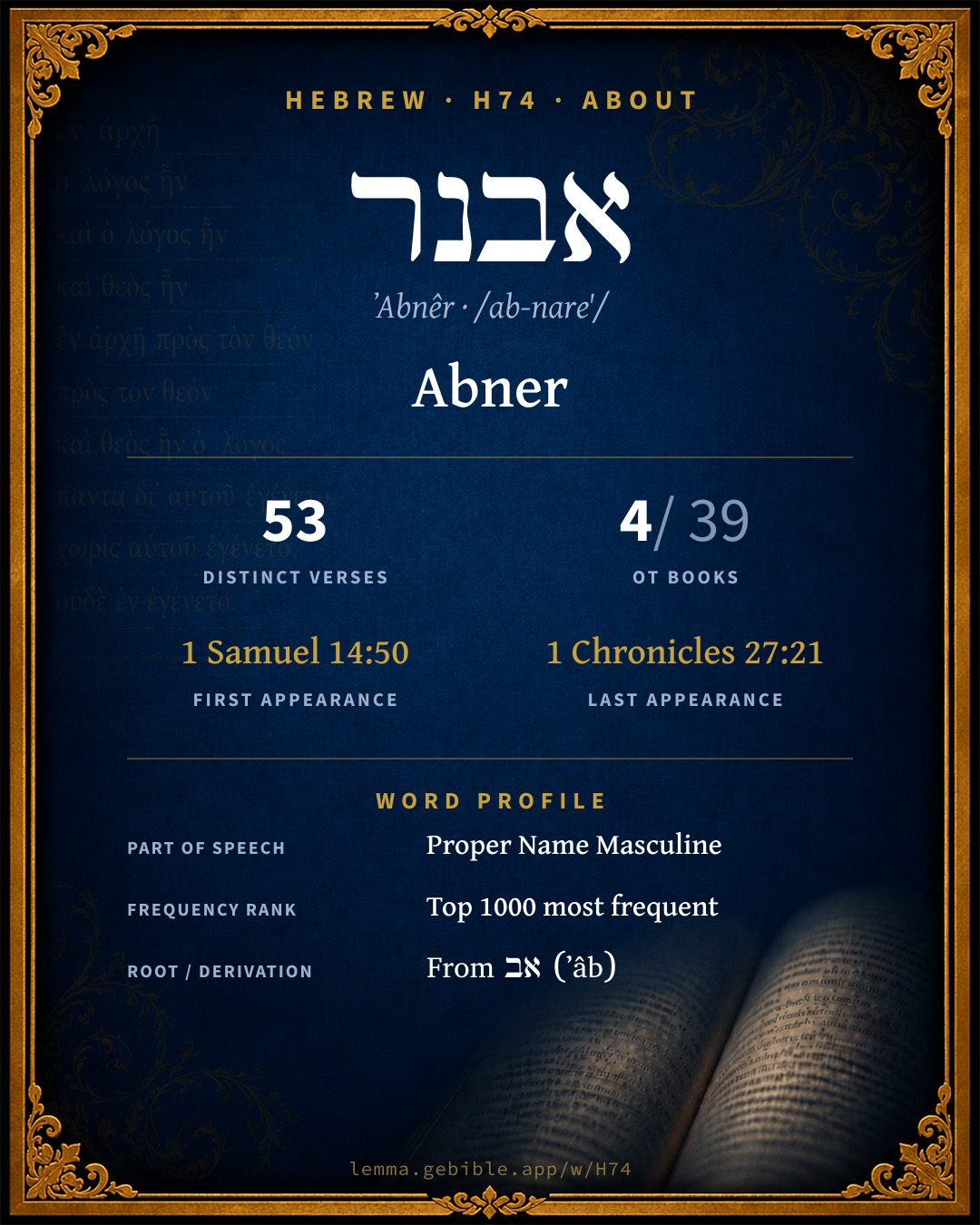
אֲבִינֵר
Abner
BDB lists 2 entries for ‘Abner’ fuller range ↓
Full lexicon entry — Brown-Driver-Briggs (BDB)
From Brown-Driver-Briggs (BDB)
Where this word appears
Grammar key — what these labels mean
Part of speech
- Noun
- A naming word — a person, place, thing, or idea.
Noun type
- Proper
- A name of a specific person, place, or people (e.g. Abraham, Zion, Israel).
Every verse where H74 appears in the Book of 1 Samuel — 9 distinct verses. Click any verse to open its interlinear word-by-word view. Verse text shown in the World English Bible for context — . Each verse’s Hebrew form is shown with its reference; the English is not keyword-highlighted, since the data carries no word-level English alignment. Use “Compare translations” on any verse to read it across multiple English versions. This concordance covers the Hebrew Bible; Septuagint (Greek Old Testament) occurrences are not indexed here.
1 Samuel
- 1 Samuel 14:50 אֲבִינֵ֔ר n Proper and the name of Saul's wife was Ahinoam the daughter of Ahimaaz. The name of the captain of his host was Abner the son of Ner, Saul's uncle.
- 1 Samuel 14:51 אַבְנֵ֖ר n Proper Kish was the father of Saul; and Ner the father of Abner was the son of Abiel.
- 1 Samuel 17:55 אַבְנֵר֙ אַבְנֵ֑ר אַבְנֵ֔ר n Proper n Proper n Proper When Saul saw David go forth against the Philistine, he said to Abner, the captain of the host, Abner, whose son is this youth? Abner said, As your soul lives, O king, I can't tell.
- 1 Samuel 17:57 אַבְנֵ֔ר n Proper As David returned from the slaughter of the Philistine, Abner took him, and brought him before Saul with the head of the Philistine in his hand.
- 1 Samuel 20:25 אַבְנֵ֖ר n Proper The king sat on his seat, as at other times, even on the seat by the wall; and Jonathan stood up, and Abner sat by Saul's side: but David's place was empty.
- 1 Samuel 26:5 וְ/אַבְנֵ֥ר conj + n Proper David arose, and came to the place where Saul had encamped; and David saw the place where Saul lay, and Abner the son of Ner, the captain of his host: and Saul lay within the place of the wagons, and the people were encamped round about him.
- 1 Samuel 26:7 וְ/אַבְנֵ֣ר conj + n Proper So David and Abishai came to the people by night: and, behold, Saul lay sleeping within the place of the wagons, with his spear stuck in the ground at his head; and Abner and the people lay round about him.
- 1 Samuel 26:14 אַבְנֵ֤ר אַבְנֵ֑ר אַבְנֵר֙ n Proper n Proper n Proper and David cried to the people, and to Abner the son of Ner, saying, Don't you answer, Abner? Then Abner answered, Who are you who cries to the king?
- 1 Samuel 26:15 אַבְנֵ֜ר n Proper David said to Abner, Aren't you a [valiant] man? and who is like you in Israel? why then have you not kept watch over your lord, the king? for there came one of the people in to destroy the king your lord.
About this entry
At a glance — auto-summarized from this page’s data, not written by a person. Every figure links to its source below. This summary describes the numbers; it doesn’t interpret them.
אבנר — transliterated ʼAbnêr — is a Hebrew name carrying the sense “Abner.” Its uses cluster heavily in 2 Samuel (75% of all occurrences). With 53 verses in 4 books, it is a moderately common word in the Hebrew Bible. It first appears in 1 Samuel 14:50. Each statement above links to its evidence; the full detail follows below.
Gloss history
Strong's 1890 vs modern scholarship
About this word
Strong's H74 catalogs a Hebrew word from the Hebrew Old Testament.
These counts are not copied from any lexicon or concordance. They are computed here, from the morphology-tagged Hebrew Old Testament. What Lemma adds →
- 53
- distinct verses
- The word appears in 53 distinct verses.
- 4 / 39
- OT books
- The word appears in 4 of 39 Old Testament books.
- #611
- by frequency
- Top 1000 most frequent Hebrew words (rank 611 of 8,640 Hebrew words by occurrence).
View all 53 occurrences in the concordance →
By section of the Old Testament
By traditional corpus
Conventional, traditional groupings — biblical authorship is debated, so this is a traditional corpus grouping, not an authorship claim. Each share is this word’s portion of its verses in that division of the Hebrew canon. Each figure is a share of the word’s 53 distinct verses.
- Prophets (Nevi'im) 51 verses · 96%
- Writings (Ketuvim) 2 verses · 4%
How translations render this word
Counts come from each version’s own published word-to-Strong’s tagging or interlinear alignment — an approximate guide to how each version renders this word, not a word-level alignment the data otherwise carries. Because each total is that version’s own tagged count, the per-version totals vary from one another and need not match the appearance or distinct-verse counts above. These counts may also differ from a printed concordance because Lemma counts each distinctly tagged rendering and does not collapse phrase taggings into a single head-word total. This is a fixed set of word-tagged versions (KJV, ASV, BSB, ULT) and does not change with the reading translation you choose elsewhere. Each version’s license is shown beside its name below (and on Sources).
BDB lists this Strong’s number as 2 distinct words (homographs). Each count above pools all of them and is not split by sense — see the Senses section below. A low-frequency rendering may belong to a different one of those words, not the primary meaning.
- King James Version†: Abner 55×, Was abner 2×
- American Standard Version†: Abner 52×, Was abner 2×
- Berean Standard Bible†: Abner 51×, Abner’s 3×
- unfoldingWord Literal Text†: Abner 62×
King James Version Public Domain
Renders H74 across 63† tagged occurrences — most commonly:
Plus 6 renderings that appear only once — usually multi-word phrases or single function words the recovered tagging swept in, not distinct renderings.
American Standard Version Public Domain
Renders H74 across 63† tagged occurrences — most commonly:
Plus 9 renderings that appear only once — usually multi-word phrases or single function words the recovered tagging swept in, not distinct renderings.
Berean Standard Bible Public Domain
Renders H74 across 62† tagged occurrences — most commonly:
Plus 8 renderings that appear only once — usually multi-word phrases or single function words the recovered tagging swept in, not distinct renderings. Not rendered by a distinct English word in 1 further occurrence.
unfoldingWord Literal Text CC BY-SA 4.0
Renders H74 across 63† tagged occurrences — most commonly:
Plus 1 rendering that appears only once — usually multi-word phrases or single function words the recovered tagging swept in, not distinct renderings.
Senses in BDB
The 2 senses BDB distinguishes for this word, in lexicon order (not ranked by frequency or importance). The full entry — with sub-senses — is in the Lexicon Entry tab.
- Abner = "my father is a lamp"
- Saul's cousin and army captain, treacherously slain by Joab
Word origin
I. n.pr.m. (my father is Nêr, or is a lamp cf. 2 S 21:17; according to LagBN 75 = אֲבֶן (= בֶּן) + נֵר = son of Ner; cf. 𝔊 Ἀβεννηρ)—so only 1 S 14:50, elsewhere אַבְנֵר—cousin of Saul, and captain of his host 1 S 14:50, 51; 17:55(×3) + 52 times 1 & 2 S + 1 K 2:5, 32 1 Ch 26:28; 27:21.
I. v. אֲבִינֵר sub II. אָבָה.
— Brown-Driver-Briggs (Oxford 1906, public domain), digitized via Sefaria, supplemented by the OpenScriptures HebrewLexicon (CC BY 4.0). See Sources.
Derived from אב (ʼâb) (H1) — father.
Forms in the corpus
The 22 distinct written forms H74 takes in the Hebrew Bible, most frequent first — each parse links to that state’s occurrences in the concordance. Hebrew forms include their vowel points and cantillation, so a single lemma takes many written forms.
| Form | Parsing | Example | Uses |
|---|---|---|---|
| אַבְנֵ֖ר | Noun, Proper | 1 Samuel 14:51 | 8 |
| אַבְנֵר֙ | Noun, Proper | 1 Samuel 17:55 | 8 |
| אַבְנֵ֔ר | Noun, Proper | 1 Samuel 17:55 | 7 |
| אַבְנֵ֑ר | Noun, Proper | 1 Samuel 17:55 | 6 |
| אַבְנֵ֣ר | Noun, Proper | 2 Samuel 2:12 | 4 |
| אַבְנֵ֤ר | Noun, Proper | 1 Kings 2:32 | 4 |
| וְ/אַבְנֵ֣ר | Noun, Proper | 1 Chronicles 26:28 | 4 |
| אַבְנֵ֗ר | Noun, Proper | 2 Samuel 2:21 | 3 |
| אַבְנֵֽר | Noun, Proper | 1 Chronicles 27:21 | 3 |
| אַבְנֵ֜ר | Noun, Proper | 1 Samuel 26:15 | 2 |
| אַבְנֵ֥ר | Noun, Proper | 2 Samuel 3:28 | 2 |
| לְ/אַבְנֵ֨ר | Noun, Proper | 1 Kings 2:5 | 2 |
| אֲבִינֵ֔ר | Noun, Proper | 1 Samuel 14:50 | 1 |
| אַבְנֵ֛ר | Noun, Proper | 2 Samuel 3:16 | 1 |
| אַבְנֵ֨ר | Noun, Proper | 2 Samuel 3:12 | 1 |
| אַבְנֵר֩ | Noun, Proper | 2 Samuel 2:23 | 1 |
| וְ/אַבְנֵ֗ר | Noun, Proper | 2 Samuel 3:22 | 1 |
| וְ/אַבְנֵ֛ר | Noun, Proper | 2 Samuel 3:6 | 1 |
| וְ/אַבְנֵ֥ר | Noun, Proper | 1 Samuel 26:5 | 1 |
| לְ/אַבְנֵ֑ר | Noun, Proper | 2 Samuel 3:30 | 1 |
| לְ/אַבְנֵ֔ר | Noun, Proper | 2 Samuel 3:9 | 1 |
| לְ/אַבְנֵ֛ר | Noun, Proper | 2 Samuel 3:20 | 1 |
Same root — word family
Other BDB entries built from the same root as H74, grouped by Strong’s listed origin. These share a root / origin per the lexicon — not necessarily a shared meaning. Each links to that word’s own entry.
Derives from
Shares the same root
Proper names from this root
People and places named from this root — a name, not an additional meaning of the word.
- אבי ʼĂbîy H21 Abi
- אביאל ʼĂbîyʼêl H22 Abiel
- אביאסף ʼĂbîyʼâçâph H23 Abiasaph
- אבי גבעון ʼĂbîy Gibʻôwn H25 father of Gibeon
- אביגיל ʼĂbîygayil H26 Abigail
- אבידן ʼĂbîydân H27 Abidan
- אבידע ʼĂbîydâʻ H28 Abida
- אביה ʼĂbîyâh H29 Abijah
- אביהוא ʼĂbîyhûwʼ H30 Abihu
- אביהוד ʼĂbîyhûwd H31 Ahihud
- אביהיל ʼĂbîyhayil H32 Abihail
- אביטוב ʼĂbîyṭûwb H36 Abitub
- אביטל ʼĂbîyṭâl H37 Abital
- אבים ʼĂbîyâm H38 Abijam
- אבימאל ʼĂbîymâʼêl H39 Abimael
- אבימלך ʼĂbîymelek H40 Abimelech
- אבינדב ʼĂbîynâdâb H41 Abinadab
- אבינעם ʼĂbîynôʻam H42 Abinoam
- אביעזר ʼĂbîyʻezer H44 Abiezer
- אביעלבון ʼĂbîy-ʻalbôwn H45 Abialbon
- אבירם ʼĂbîyrâm H48 Abiram
- אבישג ʼĂbîyshag H49 Abishag
- אבישוע ʼĂbîyshûwaʻ H50 Abishua
- אבישור ʼĂbîyshûwr H51 Abishur
+6 more proper names from this root (not shown).
Compare all same-root words → Showing 4 of 34 — not the complete family. 30 of the same-root words are proper names (people or places). They share a root, not necessarily a meaning.
Bible dictionary
Public-domain dictionary articles matched to this entry by name (Abner). A biblical name can be shared by more than one person or place, so an article may treat several.
Easton's Bible Dictionary · M. G. Easton, 1897
Father of light; i.e., "enlightening", the son of Ner and uncle of Saul. He was commander-in-chief of Saul's army (1 Sam. 14:50; 17:55; 20:25). He first introduced David to the court of Saul after the victory over Goliath (1 Sam. 17:57). After the death of Saul, David was made king over Judah, and reigned in Hebron. Among the other tribes there was a feeling of hostility to Judah; and Abner, at the head of Ephraim, fostered this hostility in the interest of the house of Saul, whose son Ish-bosheth he caused to be proclaimed king (2 Sam. 2:8). A state of war existed between these two kings. A battle fatal to Abner, who was the leader of Ish-boseth's army, was fought with David's army under Joab at Gibeon (2 Sam. 2:12). Abner, escaping from the field, was overtaken by Asahel, who was "light of foot as a wild roe," the brother of Joab and Abishai, whom he thrust through with a back stroke of his spear (2 Sam. 2: 18-32).
Being rebuked by Ish-bosheth for the impropriety of taking to wife Rizpah, who had been a concubine of King Saul, he found an excuse for going over to the side of David, whom he now professed to regard as anointed by the Lord to reign over all Israel. David received him favourably, and promised that he would have command of the armies. At this time Joab was absent from Hebron, but on his return he found what had happened. Abner had just left the city; but Joab by a stratagem recalled him, and meeting him at the gate of the city on his return, thrust him through with his sword (2 Sam. 3:27, 31-39; 4:12. Comp. 1 Kings 2:5, 32). David lamented in pathetic words the death of Abner, "Know ye not that there is a prince and a great man fallen this day in Israel?" (2 Sam. 3:33-38.)
Smith's Bible Dictionary · William Smith, 1863
(father of light).
+ Son of Ner, who was the brother of Kish, (1 Chronicles 9:36) the father of Saul. (B.C. 1063.) Abner, therefore, was Saul's first cousin, and was made by him commander-in-chief of his army. (1 Samuel 14:51; 17:57; 26:5-14) After the death of Saul David was proclaimed king of Judah; and some time subsequently Abner proclaimed Ish-bosheth, Saul's son, king of Israel. War soon broke out between the two rival kings, and a "very sore battle" was fought at Gibeon between the men of Israel under Abner and the men of Judah under Joab. (1 Chronicles 2:16) Abner had married Rizpah, Saul's concubine, and this, according to the views of Oriental courts, might be so interpreted as to imply a design upon the throne. Rightly or wrongly, Ish-bosheth so understood it, and he even ventured to reproach Abner with it. Abner, incensed at his ingratitude, opened negotiations with David, by whom he was most favorably received at Hebron. He then undertook to procure his recognition throughout Israel; but after leaving his presence for the purpose was enticed back by Joab, and treacherously murdered by him and his brother Abishai, at the gate of the city, partly, no doubt, from fear lest so distinguished a convert to their cause should gain too high a place in David's favor, but ostensibly in retaliation for the death of Asahel. David in sorrow and indignation, poured forth a simple dirge over the slain hero. (2 Samuel 3:33,34) + The father of Jaasiel, chief of the Benjamites in David's reign, (1 Chronicles 27:21) probably the same as the preceding.
Hitchcock's Bible Names Dictionary · Roswell D. Hitchcock, 1869
father of light
Classic public-domain reference works; full attribution on Sources.
Septuagint verse parallels
This word appears in 51 verses that also exist in the Greek Old Testament (Septuagint), out of the 53 Hebrew verses it occurs in. You can read those verses in Greek by switching the Old Testament edition to the Septuagint.
Read these verses in the Septuagint
This is a verse-level parallel only — the same verses exist in both the Hebrew and Greek Old Testaments. No word-level Hebrew↔Greek correspondence is claimed: the data carries no such alignment, so no Greek word is shown as this Hebrew word’s translation. Coverage is not total — the Septuagint omits the deuterocanon and renumbers the Psalms, so some Hebrew verses have no direct Greek parallel.