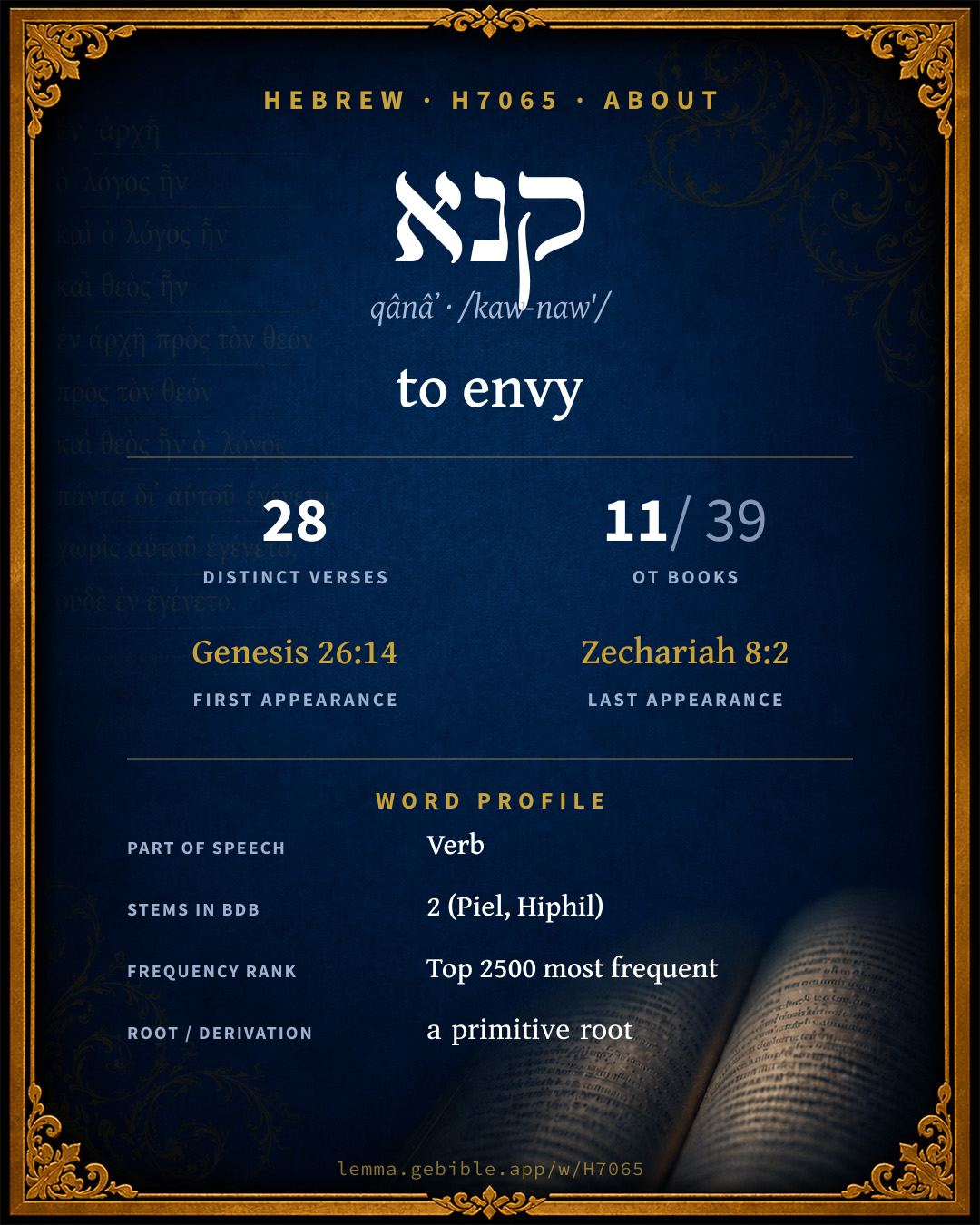
קָנָא
to envy
also: be jealous, be envious, be zealous fuller range ↓
Full lexicon entry — Brown-Driver-Briggs (BDB)
From Brown-Driver-Briggs (BDB)
Where this word appears
Grammar key — what these labels mean
Part of speech
- Verb
- An action or state-of-being word.
Stem
- Piel
- An intensive or resultative active stem. Here: ‘be jealous’
- Hiphil
- The causative active stem (“he caused / brought about”). Here: ‘provoke to jealous anger’
Form
- Perfect
- A completed action or state — Hebrew marks aspect (completeness) more than strict tense (“he wrote”).
- Sequential Imperfect
- An imperfect with prefixed waw — the standard past-narrative form (waw-consecutive imperfect).
- Jussive
- A third- or second-person volitional form expressing wish or command (“let him write”).
- Infinitive Construct
- A bound verbal noun, frequently with prepositions (“to write / in writing”).
- Imperfect
- An incomplete, ongoing, or future action (“he will / would write”).
- Infinitive Absolute
- An unbound verbal noun, often intensifying or standing in for a finite verb.
- Sequential Perfect
- A perfect with prefixed waw continuing a preceding imperfect or command (waw-consecutive perfect).
- Participle Active
- A verbal adjective expressing ongoing or characteristic action (“writing / one who writes”).
State
- Absolute
- The independent form of a noun, not bound to a following word.
Person
- 1st Person
- The speaker (“I / we”).
- 3rd Person
- The one spoken about (“he / she / it / they”).
- 2nd Person
- The one addressed (“you”).
Gender
- Common
- Either gender — not distinguished for this form.
- Masculine
- Grammatically masculine.
- Feminine
- Grammatically feminine.
Number
- Singular
- One.
- Plural
- More than one (in Hebrew, generally three or more).
Every verse where H7065 appears in the Book of Genesis — 3 distinct verses. Click any verse to open its interlinear word-by-word view. Verse text shown in the World English Bible for context — . Each verse’s Hebrew form is shown with its reference; the English is not keyword-highlighted, since the data carries no word-level English alignment. Use “Compare translations” on any verse to read it across multiple English versions. This concordance covers the Hebrew Bible; Septuagint (Greek Old Testament) occurrences are not indexed here.
Genesis
- Genesis 26:14 וַ/יְקַנְא֥וּ conj + Piel wimpf 3mp He had possessions of flocks, possessions of herds, and a great household. The Philistines envied him.
- Genesis 30:1 וַ/תְּקַנֵּ֥א conj + Piel wimpf 3fs When Rachel saw that she bore Jacob no children, Rachel envied her sister. She said to Jacob, "Give me children, or else I will die."
- Genesis 37:11 וַ/יְקַנְאוּ conj + Piel wimpf 3mp His brothers envied him; but his father kept this saying in mind.
About this entry
At a glance — auto-summarized from this page’s data, not written by a person. Every figure links to its source below. This summary describes the numbers; it doesn’t interpret them.
“to envy” is the headline sense of the Hebrew verb קנא (qânâʼ). Scripture first uses it in Genesis 26:14. With 28 verses in 11 books, it is a moderately common word in the Hebrew Bible. The verb spans 2 stems, from Piel to Hiphil. From the same root come קנא and קנאה. The sections below give every sense, occurrence, and version rendering.
Gloss history
Strong's 1890 vs modern scholarship
About this word
Strong's H7065 catalogs a Hebrew word from the Hebrew Old Testament.
These counts are not copied from any lexicon or concordance. They are computed here, from the morphology-tagged Hebrew Old Testament. What Lemma adds →
- 28
- distinct verses
- The word appears in 28 distinct verses.
- 11 / 39
- OT books
- The word appears in 11 of 39 Old Testament books.
- #1,064
- by frequency
- Top 2500 most frequent Hebrew words (rank 1,064 of 8,640 Hebrew words by occurrence).
View all 28 occurrences in the concordance →
By section of the Old Testament
By traditional corpus
Conventional, traditional groupings — biblical authorship is debated, so this is a traditional corpus grouping, not an authorship claim. Each share is this word’s portion of its verses in that division of the Hebrew canon. Each figure is a share of the word’s 28 distinct verses.
- Torah (Pentateuch) 10 verses · 36%
- Prophets (Nevi'im) 10 verses · 36%
- Writings (Ketuvim) 8 verses · 29%
How translations render this word
Counts come from each version’s own published word-to-Strong’s tagging or interlinear alignment — an approximate guide to how each version renders this word, not a word-level alignment the data otherwise carries. Because each total is that version’s own tagged count, the per-version totals vary from one another and need not match the appearance or distinct-verse counts above. These counts may also differ from a printed concordance because Lemma counts each distinctly tagged rendering and does not collapse phrase taggings into a single head-word total. This is a fixed set of word-tagged versions (KJV, ASV, BSB, ULT) and does not change with the reading translation you choose elsewhere. Each version’s license is shown beside its name below (and on Sources).
- King James Version: Envied 4×, He be jealous 3×, Envy 2×
- American Standard Version: Him 3×, I am jealous 3×, Jealous 3×
- Berean Standard Bible: Envy 6×, He suspects 3×, He was zealous 2×
- unfoldingWord Literal Text: Do 5×, Be envious 4×, Being jealous 3×
King James Version Public Domain
Renders H7065 across 33 tagged occurrences — most commonly:
Plus 14 renderings that appear only once — usually multi-word phrases or single function words the recovered tagging swept in, not distinct renderings.
American Standard Version Public Domain
Renders H7065 across 33 tagged occurrences — most commonly:
Plus 16 renderings that appear only once — usually multi-word phrases or single function words the recovered tagging swept in, not distinct renderings.
Berean Standard Bible Public Domain
Renders H7065 across 32 tagged occurrences — most commonly:
Plus 15 renderings that appear only once — usually multi-word phrases or single function words the recovered tagging swept in, not distinct renderings. Not rendered by a distinct English word in 2 further occurrences.
unfoldingWord Literal Text CC BY-SA 4.0
Renders H7065 across 50 tagged occurrences — most commonly:
Plus 23 renderings that appear only once — usually multi-word phrases or single function words the recovered tagging swept in, not distinct renderings.
8 senses and sub-senses in the full BDB
Hebrew verbs can shift meaning by stem (binyan): Qal is the basic action, Niphal is often passive or reflexive, Piel often intensifies or makes it factitive, and Hiphil is typically causative. The senses below are grouped under the stem BDB assigns to each.
What do BDB’s symbols mean?
BDB uses these scholarly abbreviations:
| Symbol | Meaning |
|---|---|
| 𝔊 | the Septuagint (the ancient Greek translation, LXX) |
| 𝔙 | the Vulgate (the Latin translation) |
| 𝔖 | the Syriac version (the Peshitta) |
| 𝔗 | the Targum (the Aramaic translation) |
| ψ | the Psalms |
| √ | root (the underlying root or stem) |
| ‖ | parallel passage (a synonymous or contrasted parallel) |
| † | the dagger: every passage where the word occurs is cited |
The 8 senses and sub-senses the full Brown-Driver-Briggs lexicon distinguishes for this word, in lexicon order (not ranked by frequency), with BDB’s own verbatim wording and sub-sense lettering. Shown in Hebrew script with BDB’s own scholarly abbreviations. The condensed entry is in the Lexicon Entry tab. See also the Forms in the corpus table below.
Piel
- be jealous, zealous (Gerber131);—Pf. 3 ms. קִנֵּא Nu 25:13 +; 1 s. קִנֵּאתִי Zc 1:14 + etc.; Impf. יְקַנֵּא Is 11:13; Pr 23:17, etc.; Inf. abs. קַנֹּא 1 K 19:10, 14; cstr. sf. קַנְאוֹ Nu 25:11; קַנֹאתוֹ 2 S 21:2; Pt. מְקַנֵּא Nu 11:29;— e.g. Numbers 25:13
- 1. be jealous of, c. acc. אֶת־אִשְׁתּוֹ Nu 5:14(×2), 30 (P); in rivalry Is 11:13. e.g. Numbers 5:14
- 2. be envious of, c. ב pers., Gn 30:1 (E), 37:11 (J) ψ 37:1; 73:3; Pr 3:31; 23:17; 24:1, 19; c. acc. pers. Gn 26:14 (J); Ez 31:9; c. ל pers. ψ 106:16. e.g. Genesis 30:1
- 3. be zealous for:
- a. of man, c. ל pers. Nu 11:29 (J); 2 S 21:2; for God Nu 25:13 (P), 1 K 19:10, 14; ק׳ קנאה Nu 25:11 (P). e.g. Numbers 11:29
- b. of God, לְשֵׁם קָדְשִׁי Ez 39:25; לְאַרְצוֹ Jo 2:18; לִירוּשׁ׳ Zc 1:14; לְצִיּוֹן Zc 8:2(×2) e.g. Ezekiel 39:25
- 4. excite to jealous anger, c. בִּ instr. Dt 32:21 a (dub.; probably הַקְנִאוּנִי; cf. v 16, 21 b), 1 K 14:22. e.g. Deuteronomy 32:21
Hiphil
- provoke to jealous anger: Impf. 3 mpl. sf. יַקְנִאֻהוּ Dt 32:16; יַקְנִיאוּהוּ ψ 78:58 (‖ וַיַּכְעִיסוּהוּ); 1 s. אַקְנִיאֵם Dt 32:21 b; Pt. metapl. מַקְנֶה Ez 8:3 (Ges§ 75 q, del. Co). e.g. Deuteronomy 32:16
Senses from the full Brown-Driver-Briggs lexicon (Brown, Driver, Briggs; Oxford 1906 — public domain), digitized via Sefaria, supplemented by the OpenScriptures HebrewLexicon (CC BY 4.0). Full attribution on Sources.
Word origin
Origin: a primitive root
Jastrow Dictionary
A second Hebrew/Aramaic lexicon for comparison, covering Aramaic and post-biblical (Talmudic, Targumic, Midrashic) usage that the biblical-Hebrew BDB does not. Matched by lemma rather than by Strong’s number, so a lemma may carry more than one Jastrow headword (shown separately below), and the entries cover usage well beyond the Bible.
קָנָא
- , Pi. קִנֵּא, v. קני I.
קְנָא
- , Pa. קַנֵּי, v. קְנֵי I.
קְנֵא
- to buy, v. קְנֵי II.
קַנָּא
- , v. קַנַּאי
קני
- (cmp. Arab. ḳana) to be hot.
- (b. h.)
- 1. to be jealous; to envy. Lam. R. introd. (R. Joḥ. 1) לא קִנֵּאתִי בה I was not jealous of her; מפני מה קִנֵּאתָ לע"ז וכ׳ why art thou jealous of an idol in which there is no reality?; a. e.—Esp. ק׳ לאשתו to suspect one’s wife of unbecoming conduct; to accuse of faithlessness; to warn one’s wife. Sot. I, 1 המְקַנֵּא … מקנא לה על פי שנים he who suspects his wife … must bring charges against her based on a warning given in the presence of two witnesses. Ib. 2 כיצד מקנא לה אומר לה בפני שנים אל תדברי וכ׳ how must he warn her? If he says before two witnesses, do not speak (associate) with that man, and she does so, she is still permitted to him for marital life &c. Tosef. ib. I, 1 [read:] המקנא לאשתו מקנא על פי עד אחד וכ׳ (ed. Zuck. המְקַנֶּה, Var. מקנה) he who wants to proceed against his wife, must bring charges based on a statement of warning by one witness or on his own statement; Sot. 2ᵇ. Ib. 2ᵃ אסור לקַנְּאוֹת it is forbidden to warn one’s wife (in the presence of witnesses). Ib. 3ᵃ מותר לק׳ it is permitted &c. M. Kat. 18ᵇ (ref. to Ps. CVI, 16) שכל … קי׳ לאשתו ממשה every one of them warned his wife in jealousy of Moses. Num. R. s. 9 ע"י איש הוא מקנה אותה וכ׳ he may bring charges on the ground of suspicious conduct towards a man (human being) but not &c. Ib. בית רין מְקַנְּאִין להם וכ׳ (some ed. מְקַנִּין) the court takes proceedings in their (the husbands’) behalf &c.; a. fr. e.g. Psalms 106:16
- 2. to arouse jealousy; to provoke. Meg. 15ᵇ קִנְּאַתּוּ במלך וכ׳ she (by inviting Haman) aroused against him the jealousy of the king and the jealousy of the (other) princes. Num. R. l. c. שהיא מְקַנְּאָה להקב"ה וכ׳ for she provokes the Lord and her husband; a. e.
- to be jealous; to be incensed. Men. 109ᵇ נ׳ בו … בשמעי אחיו Onias was jealous of his brother Shimei. Snh. 105ᵇ בכל אדם מִתְקַנֵּא וכ׳ a man is envious of all except his son and his pupil. Meg. 13ᵃ מִתְקַנְּאָה, v. יָרֵךְ. Ab. Zar. 54ᵇ מפני מה מתקנא בעובדיה וכ׳ why is he jealous of (incensed against) those who worship it (the idol), and is not jealous of (takes no revenge on) itself? Meg. 19ᵃ מה … שנ׳ בכל וכ׳ what reason had Haman to take revenge on all the Jews?; a. fr.
קְנֵי
- ch., v. infra.
- 1. to be zealous for; to be jealous; to suspect of unfaithfulness. Targ. Num. XI, 29. Ib. XXV, 11. Targ. Gen. XXX, 1. Targ. Num. V, 14; a. fr.
- 2. to make jealous. Targ. II Esth. II, 19 קַנְּאָהּ וכ׳ (ed. קָנְאָה, ed. Vien. קָנְאָתָּהּ) make her jealous by marrying other wives.
- 3. to warn one’s wife. Sot. 2ᵇ זמנין דלא ק׳ ואמר קַנָּאִי it may happen that he did not warn her and yet he may declare, I did warn her. Ib. וכ"ע ידעי דק׳ לה and all will know that he did warn her; a. fr.
- to make jealous; to provoke. Targ. Ps. LXXVIII, 58. Targ. I Sam. I, 6, v. אַקְנָיוּתָא. Targ. Deut. XXXII, 16 (Y. I קְנוֹן, read: קַנּוֹן). Ib. 21; a. e.
- to be jealous, incensed. Meg. 16ᵃ אי׳ בה … א׳ בי וכ׳ he (Haman) had a grudge against Vashti and put her to death, and now he has a grudge against me &c. Ib. 13ᵃ דמִיקְּנֵי ביה המן against whom Haman was enraged. Ib. 19ᵃ מה … דאי׳ וכ׳ what reason had Mordecai to be hostile to Haman?; a. e.
קְנֵי ²
- Targ. Gen. XXXI, 18. Targ. Y. ib. XLVII, 23; a. fr.—Keth. 82ᵇ דקְנָאִי ודקָנִינָא which I have acquired (own), and which I may acquire in the future. B. Bath. 44ᵇ דאִיקְנֵי קנה וכ׳ if the document reads ‘that which I may obtain’ (shall be seizable for my debt), and be bought and sold again …, it cannot be seized; ib. 157ᵃ. Ib. 168ᵃ אסמכתא קַנְיָא, v. אַסְמַכְתָּא. B. Mets. 66ᵇ וא"ל קְנִי קְנֵי and he said to him, take possession (of the collateral, I shall not redeem it), he has obtained it. Ib. כל דְּאִי לא קָנֵי an obligation with an ‘if’ (conditional forfeiture) gives no title; a. v. fr.—Ḥull. 77ᵃ דקני, דקנא, דקנה, v. רִירָא.
- 1. to make one a bondman. Targ. Zech. XIII, 5.
- 2. to give possession, sell. Targ. II Chr. XXI, 3.—B. Bath. 44ᵇ אי א׳ … אגב וכ׳ if he gave him possession of movable chattel by dint of immovables jointly sold (v. אַגַּב) &c. B. Mets. 72ᵃ אַקְנְיֵיה לבנו וכ׳ he signed it over to his minor son. Kidd. 7ᵃ מַקְנְיָא נפשה she may give possession of herself (become his wife); a. fr.
- to be obtained, acquired. B. Bath. 77ᵃ מִיקְּנִין (Rashb. מִיקְּנוּ), v. מִילָּא II.
A Dictionary of the Targumim, the Talmud Babli and Yerushalmi, and the Midrashic Literature (Marcus Jastrow; London, Luzac, 1903) — Public Domain. Digitized via Sefaria. Digitized via Sefaria. Full attribution on Sources.
Forms in the corpus
The 25 distinct written forms H7065 takes in the Hebrew Bible, most frequent first — each parse links to that stem’s occurrences in the concordance. Hebrew forms include their vowel points and cantillation, so a single lemma takes many written forms.
Same root — word family
Other BDB entries built from the same root as H7065, grouped by Strong’s listed origin. These share a root / origin per the lexicon — not necessarily a shared meaning. Each links to that word’s own entry.
Derived from this word
Compare all same-root words → They share a root, not necessarily a meaning.
Septuagint verse parallels
This word appears in 26 verses that also exist in the Greek Old Testament (Septuagint), out of the 28 Hebrew verses it occurs in. You can read those verses in Greek by switching the Old Testament edition to the Septuagint.
Read these verses in the Septuagint
- Genesis 26:14
- Numbers 5:14
- Deuteronomy 32:16
- 2 Samuel 21:2
- 1 Kings 19:10
- Psalms 37:1
- Proverbs 3:31
- Isaiah 11:13
- Ezekiel 31:9
- Joel 2:18
- Zechariah 1:14
This is a verse-level parallel only — the same verses exist in both the Hebrew and Greek Old Testaments. No word-level Hebrew↔Greek correspondence is claimed: the data carries no such alignment, so no Greek word is shown as this Hebrew word’s translation. Coverage is not total — the Septuagint omits the deuterocanon and renumbers the Psalms, so some Hebrew verses have no direct Greek parallel.