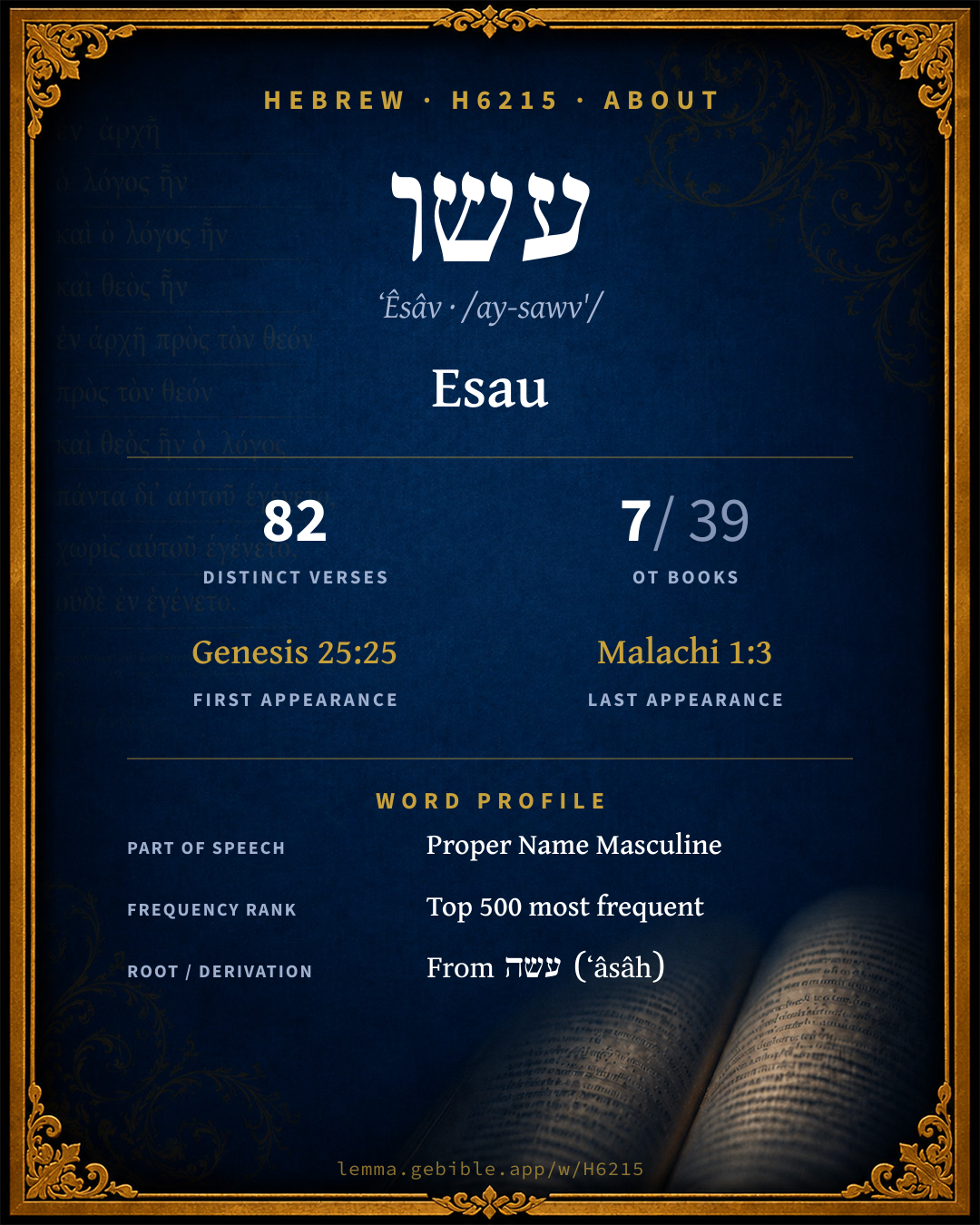
עֵשָׂו
Esau
BDB lists 2 entries for ‘Esau’ fuller range ↓
Full lexicon entry — Brown-Driver-Briggs (BDB)
From Brown-Driver-Briggs (BDB)
Where this word appears
Grammar key — what these labels mean
Part of speech
- Noun
- A naming word — a person, place, thing, or idea.
Noun type
- Proper
- A name of a specific person, place, or people (e.g. Abraham, Zion, Israel).
Every verse where H6215 appears in the Book of Deuteronomy — 6 distinct verses. Click any verse to open its interlinear word-by-word view. Verse text shown in the World English Bible for context — . Each verse’s Hebrew form is shown with its reference; the English is not keyword-highlighted, since the data carries no word-level English alignment. Use “Compare translations” on any verse to read it across multiple English versions. This concordance covers the Hebrew Bible; Septuagint (Greek Old Testament) occurrences are not indexed here.
Deuteronomy
- Deuteronomy 2:4 עֵשָׂ֔ו n Proper Command you the people, saying, You are to pass through the border of your brothers the children of Esau, who dwell in Seir; and they will be afraid of you: take good heed to yourselves therefore;
- Deuteronomy 2:5 לְ/עֵשָׂ֔ו prep + n Proper don't contend with them; for I will not give you of their land, no, not so much as for the sole of the foot to tread on; because I have given Mount Seir to Esau for a possession.
- Deuteronomy 2:8 עֵשָׂ֗ו n Proper So we passed by from our brothers the children of Esau, who dwell in Seir, from the way of the Arabah from Elath and from Ezion Geber. We turned and passed by the way of the wilderness of Moab.
- Deuteronomy 2:12 עֵשָׂ֣ו n Proper The Horites also lived in Seir before, but the children of Esau succeeded them; and they destroyed them from before them, and lived in their place; as Israel did to the land of his possession, which Yahweh gave to them.)
- Deuteronomy 2:22 עֵשָׂ֔ו n Proper as he did for the children of Esau, who dwell in Seir, when he destroyed the Horites from before them; and they succeeded them, and lived in their place even to this day:
- Deuteronomy 2:29 עֵשָׂ֗ו n Proper as the children of Esau who dwell in Seir, and the Moabites who dwell in Ar, did to me; until I shall pass over the Jordan into the land which Yahweh our God gives us.
About this entry
At a glance — auto-summarized from this page’s data, not written by a person. Every figure links to its source below. This summary describes the numbers; it doesn’t interpret them.
At its core, עשו (ʻÊsâv) means “Esau.” Its uses cluster heavily in Genesis (77% of all occurrences). Spanning 82 verses in 7 books, it ranks among the moderately common words of the Hebrew Bible. Scripture first uses it in Genesis 25:25. Each statement above links to its evidence; the full detail follows below.
Gloss history
Strong's 1890 vs modern scholarship
About this word
Strong's H6215 catalogs a Hebrew word from the Hebrew Old Testament.
These counts are not copied from any lexicon or concordance. They are computed here, from the morphology-tagged Hebrew Old Testament. What Lemma adds →
- 82
- distinct verses
- The word appears in 82 distinct verses.
- 7 / 39
- OT books
- The word appears in 7 of 39 Old Testament books.
- #432
- by frequency
- Top 500 most frequent Hebrew words (rank 432 of 8,640 Hebrew words by occurrence).
View all 82 occurrences in the concordance →
Most concentrated in
- Genesis 63 verses 77%
- Deuteronomy 6 verses 7%
- Obadiah 6 verses 7%
By section of the Old Testament
By traditional corpus
Conventional, traditional groupings — biblical authorship is debated, so this is a traditional corpus grouping, not an authorship claim. Each share is this word’s portion of its verses in that division of the Hebrew canon. Each figure is a share of the word’s 82 distinct verses.
- Torah (Pentateuch) 69 verses · 84%
- Prophets (Nevi'im) 11 verses · 13%
- Writings (Ketuvim) 2 verses · 2%
How translations render this word
Counts come from each version’s own published word-to-Strong’s tagging or interlinear alignment — an approximate guide to how each version renders this word, not a word-level alignment the data otherwise carries. Because each total is that version’s own tagged count, the per-version totals vary from one another and need not match the appearance or distinct-verse counts above. These counts may also differ from a printed concordance because Lemma counts each distinctly tagged rendering and does not collapse phrase taggings into a single head-word total. This is a fixed set of word-tagged versions (KJV, ASV, BSB, ULT) and does not change with the reading translation you choose elsewhere. Each version’s license is shown beside its name below (and on Sources).
- King James Version: Esau 76×, Esau's 12×, Behold esau 2×
- American Standard Version: Esau 84×
- Berean Standard Bible: Esau 75×, Esau’s 12×, Am esau 2×
- unfoldingWord Literal Text: Esau 94×
King James Version Public Domain
Renders H6215 across 97 tagged occurrences — most commonly:
Plus 7 renderings that appear only once — usually multi-word phrases or single function words the recovered tagging swept in, not distinct renderings.
American Standard Version Public Domain
Renders H6215 across 97 tagged occurrences — most commonly:
Plus 13 renderings that appear only once — usually multi-word phrases or single function words the recovered tagging swept in, not distinct renderings.
Berean Standard Bible Public Domain
Renders H6215 across 96 tagged occurrences — most commonly:
Plus 7 renderings that appear only once — usually multi-word phrases or single function words the recovered tagging swept in, not distinct renderings. Not rendered by a distinct English word in 1 further occurrence.
unfoldingWord Literal Text CC BY-SA 4.0
Renders H6215 across 95 tagged occurrences — most commonly:
Plus 1 rendering that appears only once — usually multi-word phrases or single function words the recovered tagging swept in, not distinct renderings.
Senses in BDB
The 2 senses BDB distinguishes for this word, in lexicon order (not ranked by frequency or importance). The full entry — with sub-senses — is in the Lexicon Entry tab.
- Esau = "hairy"
- eldest son of Isaac and Rebecca and twin brother of Jacob…
Word origin
n.pr.m. Esau, Ησαυ;—Esau, elder son of Isaac Gn 25:25, 26 + 7 times 25, 26:34; 27:1 + 24 times 27, 28; 32:4 + 15 times 32, 33, 35; Jos 24:4(×2) Mal 1:2, 3; 1 Ch 1:34; identif. with אֱדוֹם Gn 36:1, 8, 19, ancestor of Edomites v 9, 43, cf. 1 Ch 1:35; dwelling in Mt. Seir Gn 36:8 (25 times in all, Gn 36) Dt 2:5; Jos 24:4; בְּנֵי עֵשָׂו = Edomites Dt 2:4, 8, 12, 22, 29; עֵשָׂו = Edom Je 49:8; Ob 6, בֵּית עֵשָׂו v 18(×2), הַר עֵשָׂו v 8, 9, 19, 21.
— Brown-Driver-Briggs (Oxford 1906, public domain), digitized via Sefaria, supplemented by the OpenScriptures HebrewLexicon (CC BY 4.0). See Sources.
Derived from עשה (ʻâsâh) (H6213) — to do.
Jastrow Dictionary
A second Hebrew/Aramaic lexicon for comparison, covering Aramaic and post-biblical (Talmudic, Targumic, Midrashic) usage that the biblical-Hebrew BDB does not. Matched by lemma rather than by Strong’s number, so a lemma may carry more than one Jastrow headword (shown separately below), and the entries cover usage well beyond the Bible.
עֵשָׂו
- (b. h.) pr. n. m. Esau, son of Isaac; (gent. noun) Esau (Edom), frequ. a disguise for Rome. Yoma 38ᵇ רשע דר … זה ע׳ a wicked man that dwelt between two righteous men without adopting their doings, that is Esau. Gitt. 57ᵇ (ref. to Gen. XXVII, 22) אין לך … מזרעו של ע׳ there is no successful war in which descendants of Esau have no part. Gen. R. s. 2 ויהי ערב ערבו של ע׳ ‘and it was evening’ (Gen. I, 5), the evening (decline) of Esau (Rome). Koh. R. to V, 7 אם ראית ע׳ בכרך הגדול של רומי עושק וכ׳ when thou seest Esau in the large city of Rome oppressing the poor and robbing the indigent &c.; a. fr. e.g. Genesis 27:22
A Dictionary of the Targumim, the Talmud Babli and Yerushalmi, and the Midrashic Literature (Marcus Jastrow; London, Luzac, 1903) — Public Domain. Digitized via Sefaria. Digitized via Sefaria. Full attribution on Sources.
Forms in the corpus
The 20 distinct written forms H6215 takes in the Hebrew Bible, most frequent first — each parse links to that state’s occurrences in the concordance. Hebrew forms include their vowel points and cantillation, so a single lemma takes many written forms.
| Form | Parsing | Example | Uses |
|---|---|---|---|
| עֵשָׂ֔ו | Noun, Proper | Deuteronomy 2:4 | 16 |
| עֵשָׂ֖ו | Noun, Proper | Genesis 25:28 | 15 |
| עֵשָֽׂו | Noun, Proper | Genesis 25:25 | 9 |
| עֵשָׂ֑ו | Noun, Proper | Genesis 27:24 | 8 |
| עֵשָׂ֛ו | Noun, Proper | Genesis 25:29 | 7 |
| עֵשָׂו֙ | Noun, Proper | Genesis 26:34 | 7 |
| עֵשָׂ֗ו | Noun, Proper | Deuteronomy 2:8 | 6 |
| עֵשָׂ֣ו | Noun, Proper | Deuteronomy 2:12 | 6 |
| עֵשָׂ֜ו | Noun, Proper | Genesis 25:30 | 4 |
| עֵשָׂ֥ו | Noun, Proper | Genesis 27:6 | 4 |
| עֵשָׂ֤ו | Noun, Proper | Genesis 27:11 | 3 |
| לְ/עֵשָׂ֑ו | Noun, Proper | Genesis 32:4 | 2 |
| לְ/עֵשָׂ֔ו | Noun, Proper | Deuteronomy 2:5 | 2 |
| לְ/עֵשָׂ֗ו | Noun, Proper | Genesis 25:34 | 2 |
| וְ/עֵשָׂ֣ו | Noun, Proper | Genesis 27:30 | 1 |
| וְ/עֵשָֽׂו | Noun, Proper | Genesis 28:5 | 1 |
| לְ/עֵשָׂ֖ו | Noun, Proper | Genesis 36:4 | 1 |
| לְ/עֵשָׂ֜ו | Noun, Proper | Joshua 24:4 | 1 |
| לְ/עֵשָׂ֥ו | Noun, Proper | Genesis 32:13 | 1 |
| עֵשָׂ֡ו | Noun, Proper | Genesis 36:6 | 1 |
Same root — word family
Other BDB entries built from the same root as H6215, grouped by Strong’s listed origin. These share a root / origin per the lexicon — not necessarily a shared meaning. Each links to that word’s own entry.
Derives from
Shares the same root
Proper names from this root
People and places named from this root — a name, not an additional meaning of the word.
- בעשיה Baʻăsêyâh H1202 Baaseiah
- יעשו Yaʻăsûw H3299 Jaasau
- יעשיאל Yaʻăsîyʼêl H3300 Jasiel
- מעשי Maʻăsay H4640 Maasiai
- עשהאל ʻĂsâhʼêl H6214 Asahel
- עשיאל ʻĂsîyʼêl H6221 Asiel
- עשיה ʻĂsâyâh H6222 Asaiah
- Ησαυ Ēsaû G2269 Esau
Compare all same-root words → Showing 4 of 11 — not the complete family. 8 of the same-root words are proper names (people or places). They share a root, not necessarily a meaning.
Bible dictionary
Public-domain dictionary articles matched to this entry by name (Esau). A biblical name can be shared by more than one person or place, so an article may treat several.
Easton's Bible Dictionary · M. G. Easton, 1897
Hairy, Rebekah's first-born twin son (Gen. 25:25). The name of Edom, "red", was also given to him from his conduct in connection with the red lentil "pottage" for which he sold his birthright (30, 31). The circumstances connected with his birth foreshadowed the enmity which afterwards subsisted between the twin brothers and the nations they founded (25:22, 23, 26). In process of time Jacob, following his natural bent, became a shepherd; while Esau, a "son of the desert," devoted himself to the perilous and toilsome life of a huntsman. On a certain occasion, on returning from the chase, urged by the cravings of hunger, Esau sold his birthright to his brother, Jacob, who thereby obtained the covenant blessing (Gen. 27:28, 29, 36; Heb. 12:16, 17). He afterwards tried to regain what he had so recklessly parted with, but was defeated in his attempts through the stealth of his brother (Gen. 27:4, 34, 38).
At the age of forty years, to the great grief of his parents, he married (Gen. 26:34, 35) two Canaanitish maidens, Judith, the daughter of Beeri, and Bashemath, the daughter of Elon. When Jacob was sent away to Padan-aram, Esau tried to conciliate his parents (Gen. 28:8, 9) by marrying his cousin Mahalath, the daughter of Ishmael. This led him to cast in his lot with the Ishmaelite tribes; and driving the Horites out of Mount Seir, he settled in that region. After some thirty years' sojourn in Padan-aram Jacob returned to Canaan, and was reconciled to Esau, who went forth to meet him (33:4). Twenty years after this, Isaac their father died, when the two brothers met, probably for the last time, beside his grave (35:29). Esau now permanently left Canaan, and established himself as a powerful and wealthy chief in the land of Edom (q.v.).
Long after this, when the descendants of Jacob came out of Egypt, the Edomites remembered the old quarrel between the brothers, and with fierce hatred they warred against Israel.
Smith's Bible Dictionary · William Smith, 1863
(hairy), the eldest son of Isaac, and twin-brother of Jacob. The singular appearance of the child at his birth originated the name. (Genesis 25:25) Esau's robust frame and "rough" aspect were the types of a wild and daring nature. He was a thorough Bedouin, a "son of the desert." He was much loved by his father, and was of course his heir, but was induced to sell his birthright to Jacob. Mention of his unhappy marriages may be found in (Genesis 26:34) The next episode in the life of Esau is the loss of his father's covenant blessing, which Jacob secured through the craft of his mother, and the anger of Esau, who vows vengeance. (Genesis 27:1) ... Later he marries a daughter of Ishmael, (Genesis 28:8,9) and soon after establishes himself in Mount Seir, where he was living when Jacob returned from Padan-aram rich and powerful, and the two brothers were reconciled. (Genesis 33:4) Twenty years thereafter they united in burying Isaac's body in the cave of Machpelah. Of Esau's subsequent history nothing is known; for that of his descendants see Edom, Idumaea Or Idumea.
Hitchcock's Bible Names Dictionary · Roswell D. Hitchcock, 1869
he that acts or finishes
Classic public-domain reference works; full attribution on Sources.
Septuagint verse parallels
This word appears in 82 verses that also exist in the Greek Old Testament (Septuagint), out of the 82 Hebrew verses it occurs in. You can read those verses in Greek by switching the Old Testament edition to the Septuagint.
Read these verses in the Septuagint
This is a verse-level parallel only — the same verses exist in both the Hebrew and Greek Old Testaments. No word-level Hebrew↔Greek correspondence is claimed: the data carries no such alignment, so no Greek word is shown as this Hebrew word’s translation. Coverage is not total — the Septuagint omits the deuterocanon and renumbers the Psalms, so some Hebrew verses have no direct Greek parallel.