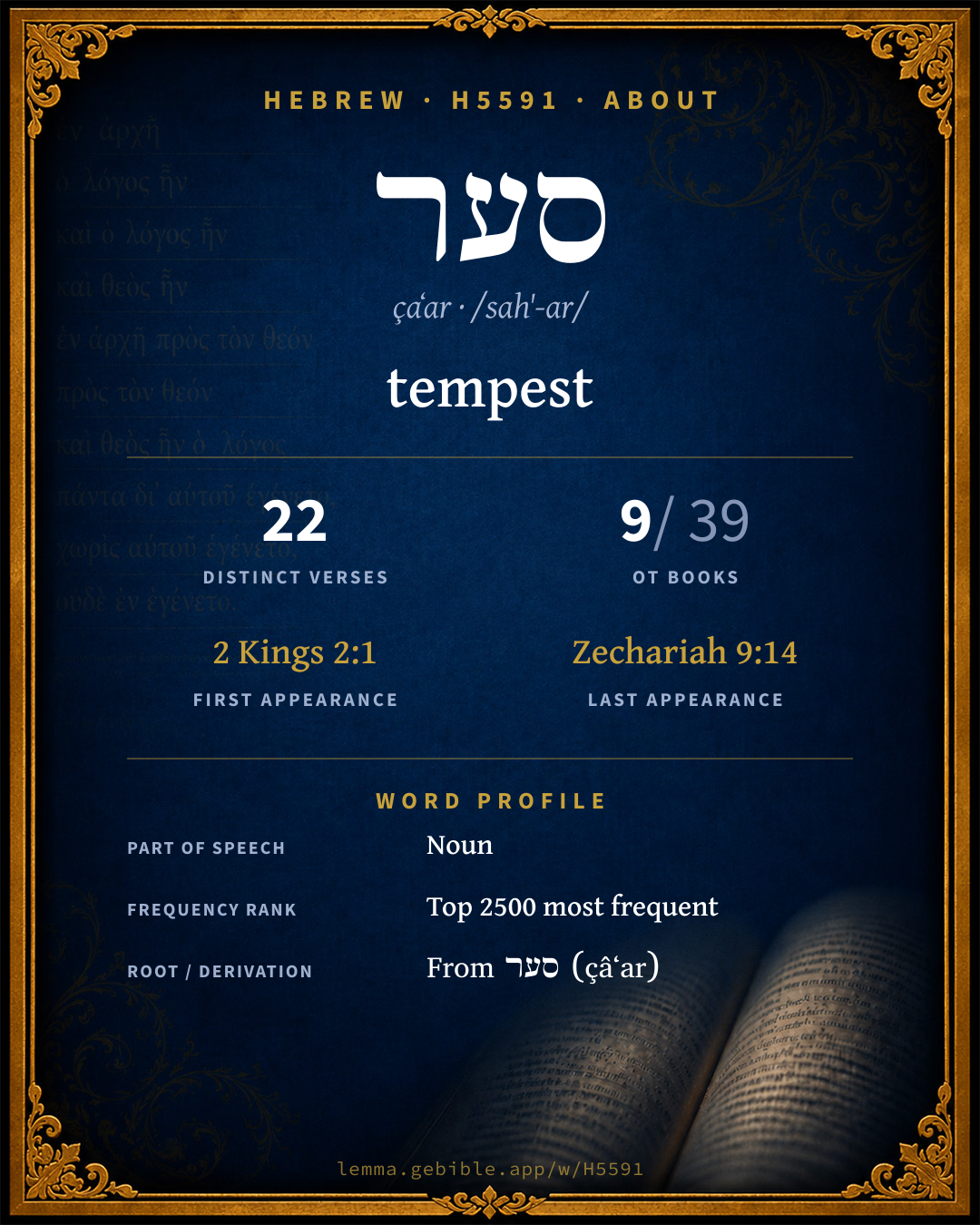
סַ֫עַר
tempest
also: storm, whirlwind fuller range ↓
Full lexicon entry — Brown-Driver-Briggs (BDB)
From Brown-Driver-Briggs (BDB)
Where this word appears
See every Absolute-state word in the Hebrew Bible →
Grammar key — what these labels mean
Part of speech
- Noun
- A naming word — a person, place, thing, or idea.
Noun type
- Common
- A common noun — a general class of person, place, or thing (“king,” “city,” “water”), not a specific name.
State
- Absolute
- The independent form of a noun, not bound to a following word.
- Construct
- A noun bound to a following noun in a possessive / “of” relationship (the construct chain).
Gender
- Feminine
- Grammatically feminine.
- Masculine
- Grammatically masculine.
Number
- Singular
- One.
- Plural
- More than one (in Hebrew, generally three or more).
Every verse where H5591 appears in the Book of Psalms — 5 distinct verses. Click any verse to open its interlinear word-by-word view. Verse text shown in the World English Bible for context — . Each verse’s Hebrew form is shown with its reference; the English is not keyword-highlighted, since the data carries no word-level English alignment. Use “Compare translations” on any verse to read it across multiple English versions. This concordance covers the Hebrew Bible; Septuagint (Greek Old Testament) occurrences are not indexed here.
Psalms
- Psalms 55:8 מִ/סָּֽעַר prep + n c ms "I would hurry to a shelter from the stormy wind and tempest."
- Psalms 83:15 בְּ/סַעֲרֶ֑/ךָ prep + n c ms cs + sfx pers 2ms So pursue them with your tempest, And terrify them with your storm.
- Psalms 107:25 סְעָרָ֑ה n c fs For he commands, and raises the stormy wind, Which lifts up its waves.
- Psalms 107:29 סְ֭עָרָה n c fs He makes the storm a calm, So that its waves are still.
- Psalms 148:8 סְ֝עָרָ֗ה n c fs Lightning and hail, snow and clouds; Stormy wind, fulfilling his word;
About this entry
At a glance — auto-summarized from this page’s data, not written by a person. Every figure links to its source below. This summary describes the numbers; it doesn’t interpret them.
סער — transliterated çaʻar — is a Hebrew noun carrying the sense “tempest.” The King James Version usually renders it “whirlwind,” while modern versions prefer “storm” (Berean Standard Bible) — see the renderings breakdown. Spanning 22 verses in 9 books, it ranks among the uncommon words of the Hebrew Bible. Debuting at 2 Kings 2:1, it then recurs through the corpus. It also covers “storm” and “whirlwind”, alongside “tempest” — see its full sense range. See the sense tree, 22-verse concordance, and the renderings breakdown below.
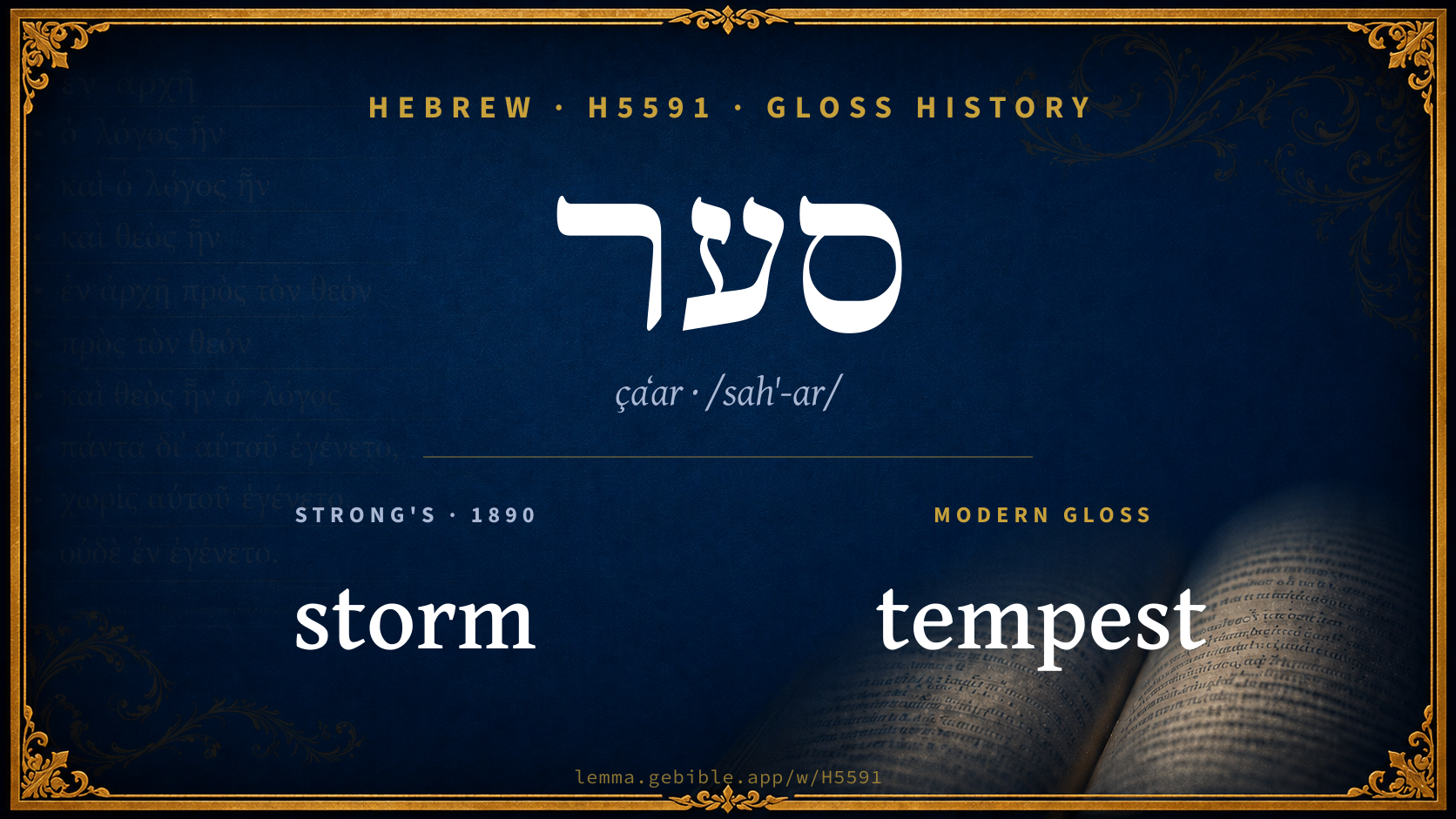
Gloss history
Strong's 1890 vs modern scholarship
About this word
Strong's H5591 catalogs a Hebrew word from the Hebrew Old Testament.
These counts are not copied from any lexicon or concordance. They are computed here, from the morphology-tagged Hebrew Old Testament. What Lemma adds →
- 22
- distinct verses
- The word appears in 22 distinct verses.
- 9 / 39
- OT books
- The word appears in 9 of 39 Old Testament books.
- #1,251
- by frequency
- Top 2500 most frequent Hebrew words (rank 1,251 of 8,640 Hebrew words by occurrence).
View all 22 occurrences in the concordance →
By section of the Old Testament
By traditional corpus
Conventional, traditional groupings — biblical authorship is debated, so this is a traditional corpus grouping, not an authorship claim. Each share is this word’s portion of its verses in that division of the Hebrew canon. Each figure is a share of the word’s 22 distinct verses.
- Prophets (Nevi'im) 15 verses · 68%
- Writings (Ketuvim) 7 verses · 32%
How translations render this word
Counts come from each version’s own published word-to-Strong’s tagging or interlinear alignment — an approximate guide to how each version renders this word, not a word-level alignment the data otherwise carries. Because each total is that version’s own tagged count, the per-version totals vary from one another and need not match the appearance or distinct-verse counts above. These counts may also differ from a printed concordance because Lemma counts each distinctly tagged rendering and does not collapse phrase taggings into a single head-word total. This is a fixed set of word-tagged versions (KJV, ASV, BSB, ULT) and does not change with the reading translation you choose elsewhere. Each version’s license is shown beside its name below (and on Sources).
BDB lists this Strong’s number as 4 distinct words (homographs). Each count above pools all of them and is not split by sense — see the Senses section below. A low-frequency rendering may belong to a different one of those words, not the primary meaning.
- King James Version†: Whirlwind 9×, Tempest 6×, Stormy 4×
- American Standard Version†: Tempest 7×, Stormy 4×, Whirlwind 4×
- Berean Standard Bible†: Storm 6×, Whirlwind 6×, Tempest 4×
- unfoldingWord Literal Text†: Storm 6×, Tempest 5×, Whirlwind 4×
King James Version Public Domain
Renders H5591 across 23† tagged occurrences — most commonly:
Plus 4 renderings that appear only once — usually multi-word phrases or single function words the recovered tagging swept in, not distinct renderings. Not rendered by a distinct English word in 1 further occurrence.
American Standard Version Public Domain
Renders H5591 across 22† tagged occurrences — most commonly:
Plus 5 renderings that appear only once — usually multi-word phrases or single function words the recovered tagging swept in, not distinct renderings.
Berean Standard Bible Public Domain
Renders H5591 across 20† tagged occurrences — most commonly:
Plus 4 renderings that appear only once — usually multi-word phrases or single function words the recovered tagging swept in, not distinct renderings. Not rendered by a distinct English word in 4 further occurrences.
unfoldingWord Literal Text CC BY-SA 4.0
Renders H5591 across 24† tagged occurrences — most commonly:
Plus 5 renderings that appear only once — usually multi-word phrases or single function words the recovered tagging swept in, not distinct renderings.
8 senses and sub-senses in the full BDB
Hebrew verbs can shift meaning by stem (binyan): Qal is the basic action, Niphal is often passive or reflexive, Piel often intensifies or makes it factitive, and Hiphil is typically causative. The senses below are grouped under the stem BDB assigns to each. This entry also uses one or more reduplicated stems (the Pōlēl/Pilpēl type), which for hollow or geminate roots behave much like Piel — often intensive or iterative.
What do BDB’s symbols mean?
BDB uses these scholarly abbreviations:
| Symbol | Meaning |
|---|---|
| 𝔊 | the Septuagint (the ancient Greek translation, LXX) |
| 𝔙 | the Vulgate (the Latin translation) |
| 𝔖 | the Syriac version (the Peshitta) |
| 𝔗 | the Targum (the Aramaic translation) |
| ψ | the Psalms |
| √ | root (the underlying root or stem) |
| ‖ | parallel passage (a synonymous or contrasted parallel) |
| † | the dagger: every passage where the word occurs is cited |
The 8 senses and sub-senses the full Brown-Driver-Briggs lexicon distinguishes for this word, in lexicon order (not ranked by frequency), with BDB’s own verbatim wording and sub-sense lettering. Shown in Hebrew script with BDB’s own scholarly abbreviations. The condensed entry is in the Lexicon Entry tab. See also the Forms in the corpus table below.
סער I support, sustain, stay (NH id., especially take a meal
Qal
- Pf. 3 ms. וְסָעַד consec. Pr 20:28; Impf. 3 ms. יִסְעָ֑ד 3 fs. sf. תִּסְעָדֵ֫נִי ψ 18:36, read also in ‖ 2 S 22:36, etc.; Imv. ms. סְעָד Ju 19:5 (on—ָ prob. ŏ, by error, v. Köi 261 f. GFMad loc.), סְעָד־נָא v 8 (cf. id.), וּסֳעָ֑דָה 1 K 13:7; sf. סְעָדֵנִי ψ 119:117; Inf. cstr. sf. וּלְסַעֲדָהּ Is 9:6;—support, sustain, always fig.: e.g. Proverbs 20:28
- 1. sustain, stay, the heart (cf. לֵבָב 8, לֵב 8), with food Gn 18:5 (J), Ju 19:5 (c. 2 acc.), v 8, ψ 104:15; obj. om. 1 K 13:7. e.g. Genesis 18:5
- 2.
- a. support throne (subj. kg.) Pr 20:28, coming ruler Is 9:6. e.g. Proverbs 20:28
- b. support, uphold c. acc. pers. (subj. י׳, his hand etc.) ψ 18:36 + ‖ 2 S 22:36 (v supr.), ψ 20:3; 41:4; 94:18; 119:117. e.g. Psalms 18:36
סער II storm, rage (Ecclus. סער Hiph. 47
Qal
- Impf. 3 mpl. fig., יִסְעֲרוּ Hb 3:14 they [my foes] storm along to scatter me; Pt. act. סֹעֵר Jon 1:11 the sea was growing more and more stormy, so v 13 (+ עֲלֵיהֶם); f. סֹעֲרָה Is 54:11 storm-tossed (fig. of Jerusalem). e.g. Habakkuk 3:14
Niphal
- Impf. 3 ms. וַיִּסָּעֵר 2 K 6:11 and the heart of the king … was enraged because of (עַל־) this thing. e.g. 2 Kings 6:11
Piel
- Impf. 1 s. sf. וְאֵסָֽעֲרֵם עַל־ Zc 7:14 (on form v. Ges§§ 23 h, 52 n) and storm them away (hurl them by a storm-wind) upon the nations. e.g. Zechariah 7:14
Po
- Impf. 3 ms. כְּמֹץ יְסֹעֵר Ho 13:3 shall be like chaff (which) is storm-driven from a threshing-floor. e.g. Hosea 13:3
סער III tempest, storm-wind
Senses from the full Brown-Driver-Briggs lexicon (Brown, Driver, Briggs; Oxford 1906 — public domain), digitized via Sefaria, supplemented by the OpenScriptures HebrewLexicon (CC BY 4.0). Full attribution on Sources.
Word origin
I. vb. support, sustain, stay (NH id., especially take a meal; Aramaic סְעַד support, stay; Zinj. סעד strengthen Lzb 330, support, perhaps feed Cook85; ChrPalAramaic n. ܣܥܕܘܢܐ aid, SchwallyIdiot. 64; Arabic سَعِدَ, سُعِدَ iii, iv. aid, assist, Lane 1360, سَاعِدٌ forearm Id 1362; Sab. סעד DHM Südar. Alt. p. 16);—
I. vb. storm, rage (Ecclus. סער Hiph. 47:17 move tempestuously; סְעָרָה storm-wind 43:17; 48:9; NH Pi. stir up, blow, סְעָרָה storm-wind; = II. שָׂעַר, but relation obscure; Assyrian šâru, wind, favours originality of שׂ׳, but this only late in Heb., and for ס׳ Frä 189 cp. Arabic سَعَرَ kindle fire, excite, inflame, be vehemently hungry and thirsty, be mad, insane, etc. Lane 1363);—
I. n.m. Je 23:19 tempest;—abs. ס׳ Am 1:14 + 5 times; סָ֑עַר ψ 55:9; pl. sf. סַעֲרֶיךָ 83:16;—tempest, especially fig.: of passionate acts of men, מֵרוּחַ סֹעָה מִסָּ֑עַר ψ 55:9 (מִסּ׳ here awkward, without ו); of י׳’s wrath Je 23:19 (ס׳ מִתְחוֹלֵל), cf. 25:32; 30:23; tempest as instr. of י׳’s wrath, ψ 83:16 (‖ סוּפָה); v. also בְּסַעַר בְּיוֹם סוּפָה Am 1:14 and Jon 1:4, 12.
I. n.f. tempest, storm-wind;—abs. סְעָרָה Is 29:6 + (so also 2 K 2:1, 11 Ginsb; Baer בַּסֳּעָרָה); cstr. סַעֲרַת Je 23:19; 30:23; pl. סְעָרוֹת Ez 13:11, 13; cstr. סַעֲרוֹת Zc 9:14;—4, as instr. of י׳’s wrath, Is 29:6 (+ סוּפָה), cf.40:24; 41:16, also רוּחַ סְעָרוֹת Ez 13:11, 13 (against nation under fig. of wall); storm-wind of Elijah’s translation 2 K 2:1, 11; of theophany Ez 1:4 (רִוּחַ סְעָרָה), Jb 38:1; 40:6, and סַעֲרוֹת תֵּימָן Zc 9:14; סַעֲרַת י׳ as fig. of י׳’s wrath Je 23:19; 30:23; of ordinary tempests only in late ψψ: רוּחַ סְעָרָה 107:25; 148:8, ס׳ opp. דְּמָמָה 107:29.
— Brown-Driver-Briggs (Oxford 1906, public domain), digitized via Sefaria, supplemented by the OpenScriptures HebrewLexicon (CC BY 4.0). See Sources.
Derived from סער (çâʻar) (H5590) — to storm.
Jastrow Dictionary
A second Hebrew/Aramaic lexicon for comparison, covering Aramaic and post-biblical (Talmudic, Targumic, Midrashic) usage that the biblical-Hebrew BDB does not. Matched by lemma rather than by Strong’s number, so a lemma may carry more than one Jastrow headword (shown separately below), and the entries cover usage well beyond the Bible.
*סָעַר I
- (cmp. סוּר) to go around; to visit. Sabb. 12ᵇ מנין שהקב"ה סוֹעֵר את החולה Ms. M. (Ar. סר; ed. שהשכינה סועד) whence is it proven that the Lord visits the sick?—Answ. ref. to יסעדנו (Ps. XLI, 4), [to which is added in Ar.: קרי ביה יִסְעָרֶנּוּ read it yisʿarennu ‘shall visit him]. e.g. Psalms 41:4
סְעַר
- , (corresp. to h. פקד) to visit, examine. Targ. I Kings IX, 12 (ed. Lag. למחזי). Targ. I Sam. XIV, 17.—Esp. ס׳ (ל)שלם to inquire after a person’s health. Ib. XVII, 18 (ed. Wil. תַּסְ׳ Af.). Targ. II Kings X, 13 (ed. Wil. למסעד, corr. acc.; v. Koh. Ar. Compl. s. v. סער).
- 1. same, v. supra.
- 2. (with על of person) to visit upon. Targ. Job XXXIV, 29. Ib. XXXVI, 23 אַסְעַר Ms. (ed. יִסְעַר, read יַסְ׳). Targ. O. Lev. XXVI, 16; a. fr.
- to be visited; to be inflicted upon. Targ. O. Num. XVI, 29 (some ed. יִסְתְּ׳, Ithpe.).
סָעַר II
- to be rough; to be in commotion.
- to stir up, to blow. Kil. V, 7 וסִיעַרְתֹּו הרוח לאחריו and the wind drove the seed backward; Tosef. ib. III, 12 סייתו, סייעתו, הסעורתו ed. Zuck. (corr. acc., v. infra). B. Bath. 25ᵃ (ref. to שעירם, Deut. XXXII, 2) זו … שמְסָעֶרֶת וכ׳ that is the east wind which stirs up the whole world like a saʿir (demon); [Sifré Deut. 306 שמשחיד וכ׳; Yalk. ib. 942 שמשחרת which makes the sky black like goats. e.g. Deuteronomy 32:2
- same. Tosef. l. c. והסעורתו, read: יהִסְעִירָתוֹ, v. supra. Num. R. s. 9 (play on שְׂעֹרִים, Num. V, 15) והִסְעִירָם הב"ה וכ׳ (not והסעידה) and the Lord scattered them among the nations (with ref. to Zech. VII, 14). e.g. Numbers 5:15
סְעַר ²
- ; Ithpa. אִסְתַּעַר to be excited, troubled. Targ. II Kings VI, 11.
סֵעָר
- hair, v. שֵׂעָר.
סְעָר
- (preced. art.; cmp. זוּף II a. זַיִף) hair. Targ. O. Gen. XXV, 25 ed. Berl.; a. fr. [Mostly with שׂ, v. שַׂעֲרָא.]—Y. Naz. IX, end, 58ᵃ סַעֲרָה, v. שַׂעֲרָא.—Pl. סַעֲרָן f. Targ. Ps. LXIX, 5 (Ms. סַעֲרִין).
A Dictionary of the Targumim, the Talmud Babli and Yerushalmi, and the Midrashic Literature (Marcus Jastrow; London, Luzac, 1903) — Public Domain. Digitized via Sefaria. Digitized via Sefaria. Full attribution on Sources.
Forms in the corpus
The 22 distinct written forms H5591 takes in the Hebrew Bible, most frequent first — each parse links to that state’s occurrences in the concordance. Hebrew forms include their vowel points and cantillation, so a single lemma takes many written forms.
Septuagint verse parallels
This word appears in 18 verses that also exist in the Greek Old Testament (Septuagint), out of the 22 Hebrew verses it occurs in. You can read those verses in Greek by switching the Old Testament edition to the Septuagint.
Read these verses in the Septuagint
- 2 Kings 2:1
- Job 38:1
- Psalms 55:8
- Isaiah 29:6
- Jeremiah 23:19
- Ezekiel 1:4
- Amos 1:14
- Jonah 1:4
- Zechariah 9:14
This is a verse-level parallel only — the same verses exist in both the Hebrew and Greek Old Testaments. No word-level Hebrew↔Greek correspondence is claimed: the data carries no such alignment, so no Greek word is shown as this Hebrew word’s translation. Coverage is not total — the Septuagint omits the deuterocanon and renumbers the Psalms, so some Hebrew verses have no direct Greek parallel.