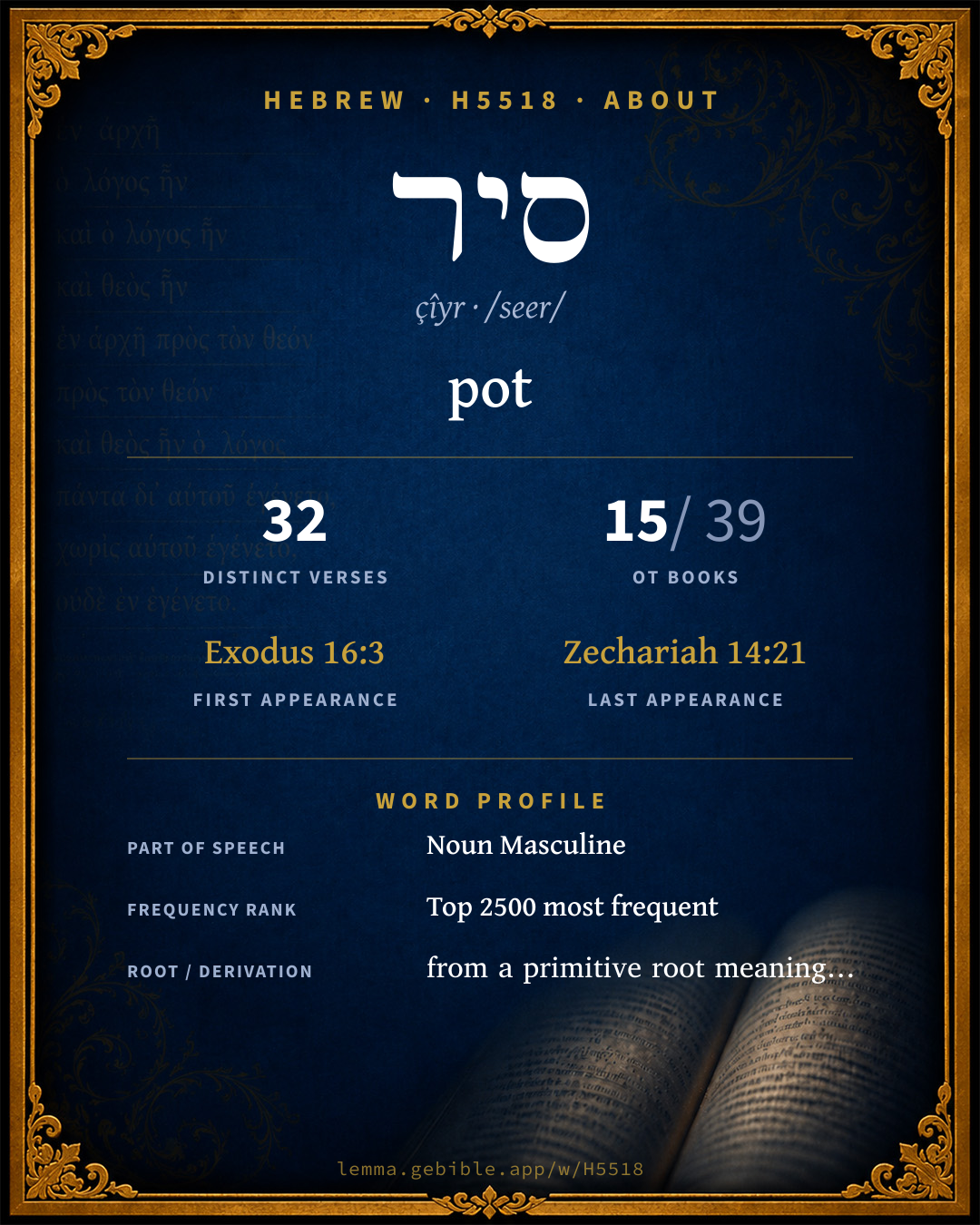
סִיר
pot
‘pot’ is one of 2 main senses fuller range ↓
Full lexicon entry — Brown-Driver-Briggs (BDB)
From Brown-Driver-Briggs (BDB)
Where this word appears
See every Absolute-state word in the Hebrew Bible →
Grammar key — what these labels mean
Part of speech
- Noun
- A naming word — a person, place, thing, or idea.
Noun type
- Common
- A common noun — a general class of person, place, or thing (“king,” “city,” “water”), not a specific name.
State
- Absolute
- The independent form of a noun, not bound to a following word.
- Construct
- A noun bound to a following noun in a possessive / “of” relationship (the construct chain).
Gender
- Both
- Attested as both masculine and feminine.
- Feminine
- Grammatically feminine.
Number
- Plural
- More than one (in Hebrew, generally three or more).
- Singular
- One.
Grammatical forms
- Noun, Common, Both, Singular, Absolute 14 times (41%)
- Noun, Common, Both, Plural, Absolute 9 times (26%)
- Noun, Common, Both, Singular, Construct 4 times (12%)
- Noun, Common, Feminine, Plural, Absolute 3 times (9%)
- Noun, Common, Both, Plural, Construct 2 times (6%)
- Noun, Common, Feminine, Plural, Construct 1 time (3%)
- Noun, Common, Feminine, Singular, Absolute 1 time (3%)
Parsed forms decoded from the imported morphology (morphhb / Westminster Leningrad Codex — WLC text public domain, morphhb tagging CC BY 4.0), counted across 34 parsed occurrences — not distinct verses.
Every verse where H5518 appears — 32 distinct verses across 15 books. Click any verse to open its interlinear word-by-word view. Verse text shown in the World English Bible for context — . Each verse’s Hebrew form is shown with its reference; the English is not keyword-highlighted, since the data carries no word-level English alignment. Use “Compare translations” on any verse to read it across multiple English versions. This concordance covers the Hebrew Bible; Septuagint (Greek Old Testament) occurrences are not indexed here.
Exodus 3 verses
- Exodus 16:3 סִ֣יר n c bs cs and the children of Israel said to them, "We wish that we had died by the hand of Yahweh in the land of Egypt, when we sat by the flesh-pots, when we ate our fill of bread, for you have brought us out into this wilderness, to kill this whole assembly with hunger."
- Exodus 27:3 סִּֽירֹתָי/ו֙ n c bp cs + sfx pers 3ms You shall make its pots to take away its ashes, its shovels, its basins, its flesh hooks, and its fire pans: all its vessels you shall make of brass.
- Exodus 38:3 הַ/סִּירֹ֤ת ptcl def.art + n c bp He made all the vessels of the altar, the pots, the shovels, the basins, the flesh-hooks, and the fire pans. He made all its vessels of brass.
1 Kings 1 verse
2 Kings 5 verses
- 2 Kings 4:38 הַ/סִּ֣יר ptcl def.art + n c bs Elisha came again to Gilgal. There was a dearth in the land; and the sons of the prophets were sitting before him; and he said to his servant, Set on the great pot, and boil stew for the sons of the prophets.
- 2 Kings 4:39 סִ֥יר n c bs cs One went out into the field to gather herbs, and found a wild vine, and gathered of it wild gourds his lap full, and came and shred them into the pot of stew; for they didn't recognize them.
- 2 Kings 4:40 בַּ/סִּיר֙ prep det + n c bs So they poured out for the men to eat. It happened, as they were eating of the stew, that they cried out, and said, man of God, there is death in the pot. They could not eat of it.
- 2 Kings 4:41 הַ/סִּ֑יר בַּ/סִּֽיר ptcl def.art + n c bs prep det + n c bs But he said, Then bring meal. He cast it into the pot; and he said, Pour out for the people, that they may eat. There was no harm in the pot.
- 2 Kings 25:14 הַ/סִּירֹ֨ת ptcl def.art + n c bp The pots, and the shovels, and the snuffers, and the spoons, and all the vessels of brass with which they ministered, took they away.
2 Chronicles 3 verses
- 2 Chronicles 4:11 הַ֨/סִּיר֔וֹת ptcl def.art + n c bp Huram made the pots, and the shovels, and the basins. So Huram made an end of doing the work that he did for king Solomon in the house of God:
- 2 Chronicles 4:16 הַ֠/סִּירוֹת ptcl def.art + n c bp The pots also, and the shovels, and the flesh-hooks, and all the vessels of it, did Huram his father make for king Solomon for the house of Yahweh of bright brass.
- 2 Chronicles 35:13 בַּ/סִּיר֤וֹת prep det + n c bp They roasted the Passover with fire according to the ordinance: and the holy offerings boiled they in pots, and in caldrons, and in pans, and carried them quickly to all the children of the people.
Job 1 verse
Psalms 3 verses
- Psalms 58:9 סִּֽירֹתֵי/כֶ֣ם n c bp cs + sfx pers 2mp Before your pots can feel the heat of the thorns, He will sweep away the green and the burning alike.
- Psalms 60:8 סִ֬יר n c bs cs Moab is my wash basin. I will throw my shoe on Edom. I shout in triumph over Philistia."
- Psalms 108:9 סִ֬יר n c bs cs Moab is my wash pot. I will toss my sandal on Edom. I will shout over Philistia."
Ecclesiastes 1 verse
Isaiah 1 verse
Jeremiah 3 verses
- Jeremiah 1:13 סִ֤יר n c bs The word of Yahweh came to me the second time, saying, What see you? I said, I see a boiling caldron; and the face of it is from the north.
- Jeremiah 52:18 הַ֠/סִּרוֹת ptcl def.art + n c bp The pots also, and the shovels, and the snuffers, and the basins, and the spoons, and all the vessels of brass with which they ministered, took they away.
- Jeremiah 52:19 הַ/סִּיר֣וֹת ptcl def.art + n c bp The cups, and the fire pans, and the basins, and the pots, and the lampstands, and the spoons, and the bowls-that which was of gold, in gold, and that which was of silver, in silver,-the captain of the guard took away.
Ezekiel 5 verses
- Ezekiel 11:3 הַ/סִּ֔יר ptcl def.art + n c bs who say, [The time] is not near to build houses: this [city] is the caldron, and we are the flesh.
- Ezekiel 11:7 הַ/סִּ֑יר ptcl def.art + n c bs Therefore thus says the Lord Yahweh: Your slain whom you have laid in the midst of it, they are the flesh, and this [city] is the caldron; but you shall be brought forth out of the midst of it.
- Ezekiel 11:11 לְ/סִ֔יר prep + n c bs This [city] shall not be your caldron, neither shall you be the flesh in the midst of it; I will judge you in the border of Israel;
- Ezekiel 24:3 הַ/סִּיר֙ ptcl def.art + n c bs Utter a parable to the rebellious house, and tell them, Thus says the Lord Yahweh, Set on the caldron, set it on, and also pour water into it:
- Ezekiel 24:6 סִ֚יר n c bs Therefore thus says the Lord Yahweh: Woe to the bloody city, to the caldron whose rust is therein, and whose rust is not gone out of it! take out of it piece after piece; No lot is fallen on it.
Hosea 1 verse
Amos 1 verse
Micah 1 verse
Nahum 1 verse
Zechariah 2 verses
- Zechariah 14:20 הַ/סִּירוֹת֙ ptcl def.art + n c bp In that day there will be on the bells of the horses, "HOLY TO YAHWEH;" and the pots in Yahweh's house will be like the bowls before the altar.
- Zechariah 14:21 סִ֨יר n c bs Yes, every pot in Jerusalem and in Judah will be holy to Yahweh of Hosts; and all those who sacrifice will come and take of them, and cook in them. In that day there will no longer be a Canaanite in the house of Yahweh of Hosts.
About this entry
At a glance — auto-summarized from this page’s data, not written by a person. Every figure links to its source below. This summary describes the numbers; it doesn’t interpret them.
At its core, סיר (çîyr) means “pot.” Scripture first uses it in Exodus 16:3. It appears 32 verses across 15 books of the Hebrew Bible, among its moderately common vocabulary. Not a single-sense word: explore its full sense range. Each statement above links to its evidence; the full detail follows below.
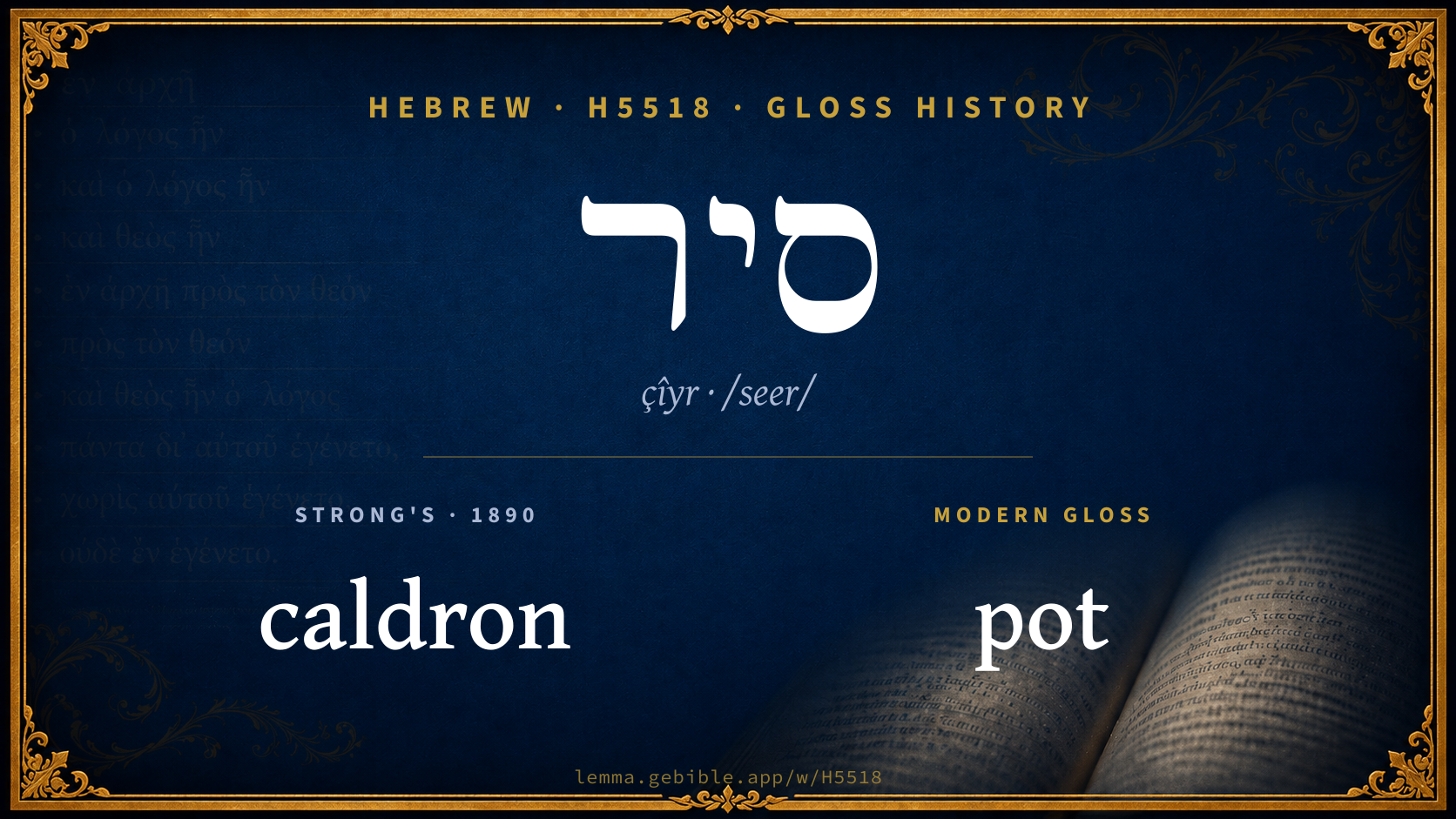
Gloss history
Strong's 1890 vs modern scholarship
About this word
Strong's H5518 catalogs a Hebrew word from the Hebrew Old Testament.
These counts are not copied from any lexicon or concordance. They are computed here, from the morphology-tagged Hebrew Old Testament. What Lemma adds →
- 32
- distinct verses
- The word appears in 32 distinct verses.
- 15 / 39
- OT books
- The word appears in 15 of 39 Old Testament books.
- #1,041
- by frequency
- Top 2500 most frequent Hebrew words (rank 1,041 of 8,640 Hebrew words by occurrence).
View all 32 occurrences in the concordance →
By section of the Old Testament
By traditional corpus
Conventional, traditional groupings — biblical authorship is debated, so this is a traditional corpus grouping, not an authorship claim. Each share is this word’s portion of its verses in that division of the Hebrew canon. Each figure is a share of the word’s 32 distinct verses.
- Prophets (Nevi'im) 21 verses · 66%
- Writings (Ketuvim) 8 verses · 25%
- Torah (Pentateuch) 3 verses · 9%
How translations render this word
Counts come from each version’s own published word-to-Strong’s tagging or interlinear alignment — an approximate guide to how each version renders this word, not a word-level alignment the data otherwise carries. Because each total is that version’s own tagged count, the per-version totals vary from one another and need not match the appearance or distinct-verse counts above. These counts may also differ from a printed concordance because Lemma counts each distinctly tagged rendering and does not collapse phrase taggings into a single head-word total. This is a fixed set of word-tagged versions (KJV, ASV, BSB, ULT) and does not change with the reading translation you choose elsewhere. Each version’s license is shown beside its name below (and on Sources).
BDB lists this Strong’s number as 2 distinct words (homographs). Each count above pools all of them and is not split by sense — see the Senses section below. A low-frequency rendering may belong to a different one of those words, not the primary meaning.
- King James Version†: Pot 9×, Pots 7×, Thorns 4×
- American Standard Version†: Pots 9×, Pot 6×, Caldron 3×
- Berean Standard Bible†: Pot 11×, Pots 11×, Thorns 4×
- unfoldingWord Literal Text†: Pot 8×, Pots 6×, Cooking pot 4×
King James Version Public Domain
Renders H5518 across 32† tagged occurrences — most commonly:
Plus 8 renderings that appear only once — usually multi-word phrases or single function words the recovered tagging swept in, not distinct renderings. Not rendered by a distinct English word in 2 further occurrences.
American Standard Version Public Domain
Renders H5518 across 32† tagged occurrences — most commonly:
Plus 11 renderings that appear only once — usually multi-word phrases or single function words the recovered tagging swept in, not distinct renderings.
Berean Standard Bible Public Domain
Renders H5518 across 34† tagged occurrences — most commonly:
Plus 6 renderings that appear only once — usually multi-word phrases or single function words the recovered tagging swept in, not distinct renderings.
unfoldingWord Literal Text CC BY-SA 4.0
Renders H5518 across 35† tagged occurrences — most commonly:
Plus 10 renderings that appear only once — usually multi-word phrases or single function words the recovered tagging swept in, not distinct renderings.
Senses in the full BDB
What do BDB’s symbols mean?
BDB uses these scholarly abbreviations:
| Symbol | Meaning |
|---|---|
| 𝔊 | the Septuagint (the ancient Greek translation, LXX) |
| 𝔙 | the Vulgate (the Latin translation) |
| 𝔖 | the Syriac version (the Peshitta) |
| 𝔗 | the Targum (the Aramaic translation) |
| ψ | the Psalms |
| √ | root (the underlying root or stem) |
| ‖ | parallel passage (a synonymous or contrasted parallel) |
| † | the dagger: every passage where the word occurs is cited |
The 5 senses and sub-senses the full Brown-Driver-Briggs lexicon distinguishes for this word, in lexicon order (not ranked by frequency), with BDB’s own verbatim wording and sub-sense lettering. Shown in Hebrew script with BDB’s own scholarly abbreviations. The condensed entry is in the Lexicon Entry tab. See also the Forms in the corpus table below.
סיר I
- 1.
- a. household utensil for boiling 2 K 4:38, 39, 40, 41(×2), ס׳ הַבָּשָׂר Ex 16:3 (P), Zc 14:21; ס׳ נָפוּחָ Je 1:13 (cf. נפח; in vision), symbol. of Jerus. Ez 11:3, 7, 11; 24:3, 6; fig. also ψ 58:10 (cf. Che); in sim. Mi 3:3 Jb 41:23 Ec 7:6. e.g. 2 Kings 4:38
- b. ס׳ רַחְצִי ψ 60:10 my washing-pot, 108:10. e.g. Psalms 60:10
- 2. pots used in sanctuary, Ex 27:3; 38:3 (both P), 1 K 7:40 (read סִירוֹת for MT כִּיֹּרוֹת, so Codd. of ℌ 𝔊 𝔙 Th Ke Klo Kmp Benz), v 45 = 2 Ch 4:11, 16, 2 K 25:14 = Je 52:18, also Je 52:19 2 Ch 35:13 Zc 14:20.—Here belongs prob. סִרָה in בּוֹר הַסִּרָה, v. p. 92 b. e.g. Exodus 27:3
סיר II [m.] thorn, hook (𝔗 id.
- 1. pl. סִירִיס, thorns, sign of desolation Is 34:13, a barrier Ho 2:8, on Na 1:10 v. [סָבַךְ]; כְּקוֹל הַסּ׳ תַּחַת הַסִּיר Ec 7:6 as the sound of thorns (crackling as they burn) under the pot. e.g. Isaiah 34:13
- 2. pl. סִירוֹת hooks Am 4:2 (cf. בּוּגָה sub דגה; ‖ צִנּוֹת; on realtion of meanings v. חוֹחַ, צֵן). e.g. Amos 4:2
Senses from the full Brown-Driver-Briggs lexicon (Brown, Driver, Briggs; Oxford 1906 — public domain), digitized via Sefaria, supplemented by the OpenScriptures HebrewLexicon (CC BY 4.0). Full attribution on Sources.
Word origin
I. n.m. Je 1:13 et f. 2 K 4:38 pot (probably foreign wd. (Egyptian?), Arabic زِيرٌ a large water-jar Lane1276 is perhaps loan-wd.; on Gk. deriv. σιρός, σίρινος, v. LewyFremdw. 107);—ס׳ abs. 2 K 4:38 +, cstr. Ex 16:3 +; pl. סִירֹת 38:3, סִירוֹת 1 K 7:45 +; sf. סִירֹתָיו Ex 27:3, סִירֹתֵיכֶם ψ 58:10;—pot:
II. n.[m.] thorn, hook (𝔗 id.; cf. סירם in Sab. n.pr. HomZMG xivi (1892), 532);—
— Brown-Driver-Briggs (Oxford 1906, public domain), digitized via Sefaria, supplemented by the OpenScriptures HebrewLexicon (CC BY 4.0). See Sources.
Origin: from a primitive root meaning to boil up
Jastrow Dictionary
A second Hebrew/Aramaic lexicon for comparison, covering Aramaic and post-biblical (Talmudic, Targumic, Midrashic) usage that the biblical-Hebrew BDB does not. Matched by lemma rather than by Strong’s number, so a lemma may carry more than one Jastrow headword (shown separately below), and the entries cover usage well beyond the Bible.
סִיר
- pot. Num. R. s. 14 (ref. to Ps. LX, 10) מה הבשר מתעכל בס׳ וכ׳ as the flesh is consumed in the pot, so were they (David’s parents and kindred) consumed there (in Moab).—[סִיר thorn, v. סִירָה I.] e.g. Psalms 60:10
A Dictionary of the Targumim, the Talmud Babli and Yerushalmi, and the Midrashic Literature (Marcus Jastrow; London, Luzac, 1903) — Public Domain. Digitized via Sefaria. Digitized via Sefaria. Full attribution on Sources.
Forms in the corpus
The 31 distinct written forms H5518 takes in the Hebrew Bible, most frequent first — each parse links to that state’s occurrences in the concordance. Hebrew forms include their vowel points and cantillation, so a single lemma takes many written forms.
Septuagint verse parallels
This word appears in 31 verses that also exist in the Greek Old Testament (Septuagint), out of the 32 Hebrew verses it occurs in. You can read those verses in Greek by switching the Old Testament edition to the Septuagint.
Read these verses in the Septuagint
- Exodus 16:3
- 1 Kings 7:45
- 2 Kings 4:38
- 2 Chronicles 4:11
- Psalms 58:9
- Ecclesiastes 7:6
- Isaiah 34:13
- Jeremiah 1:13
- Ezekiel 11:3
- Hosea 2:6
- Amos 4:2
- Micah 3:3
This is a verse-level parallel only — the same verses exist in both the Hebrew and Greek Old Testaments. No word-level Hebrew↔Greek correspondence is claimed: the data carries no such alignment, so no Greek word is shown as this Hebrew word’s translation. Coverage is not total — the Septuagint omits the deuterocanon and renumbers the Psalms, so some Hebrew verses have no direct Greek parallel.