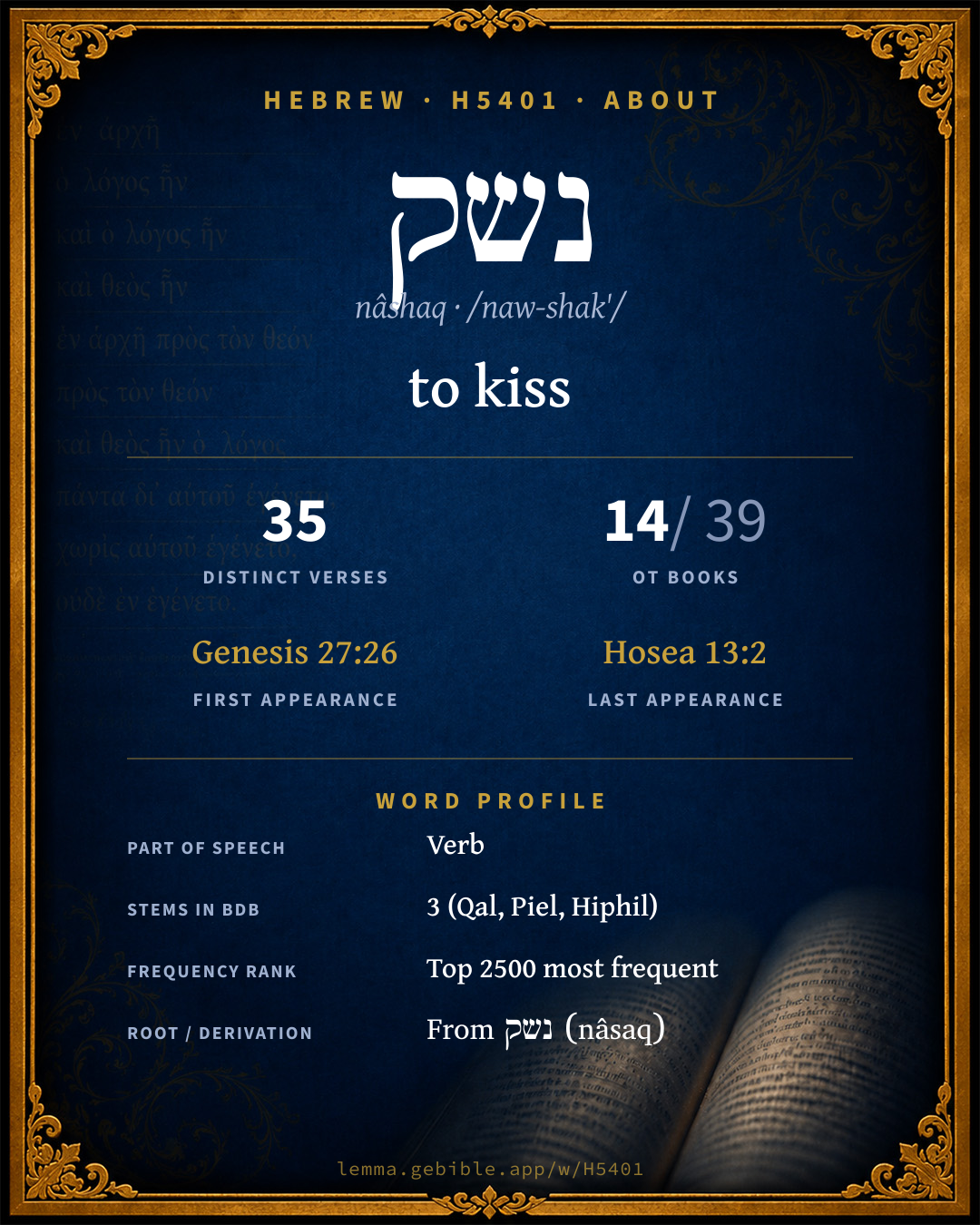
נָשַׁק
to kiss
‘to kiss’ is one of 2 main senses fuller range ↓
Full lexicon entry — Brown-Driver-Briggs (BDB)
From Brown-Driver-Briggs (BDB)
Where this word appears
Grammar key — what these labels mean
Part of speech
- Verb
- An action or state-of-being word.
Stem
- Qal
- The basic, simple active stem — the plain form of the verb (“he wrote”). Here: ‘pl. cstr.’
- Piel
- An intensive or resultative active stem.
- Hiphil
- The causative active stem (“he caused / brought about”).
Form
- Sequential Imperfect
- An imperfect with prefixed waw — the standard past-narrative form (waw-consecutive imperfect).
- Participle Active
- A verbal adjective expressing ongoing or characteristic action (“writing / one who writes”).
- Imperfect
- An incomplete, ongoing, or future action (“he will / would write”).
- Perfect
- A completed action or state — Hebrew marks aspect (completeness) more than strict tense (“he wrote”).
- Sequential Perfect
- A perfect with prefixed waw continuing a preceding imperfect or command (waw-consecutive perfect).
- Imperative
- A direct command (“write!”).
- Infinitive Construct
- A bound verbal noun, frequently with prepositions (“to write / in writing”).
- Cohortative
- A first-person volitional form expressing wish or resolve (“let me / let us write”).
State
- Construct
- A noun bound to a following noun in a possessive / “of” relationship (the construct chain).
- Absolute
- The independent form of a noun, not bound to a following word.
Person
- 3rd Person
- The one spoken about (“he / she / it / they”).
- 2nd Person
- The one addressed (“you”).
- 1st Person
- The speaker (“I / we”).
Gender
- Masculine
- Grammatically masculine.
- Feminine
- Grammatically feminine.
- Common
- Either gender — not distinguished for this form.
Number
- Singular
- One.
- Plural
- More than one (in Hebrew, generally three or more).
Every verse where H5401 appears in the Book of Song of Solomon — 2 distinct verses. Click any verse to open its interlinear word-by-word view. Verse text shown in the World English Bible for context — . Each verse’s Hebrew form is shown with its reference; the English is not keyword-highlighted, since the data carries no word-level English alignment. Use “Compare translations” on any verse to read it across multiple English versions. This concordance covers the Hebrew Bible; Septuagint (Greek Old Testament) occurrences are not indexed here.
Song of Solomon
- Song of Solomon 1:2 יִשָּׁקֵ֨/נִי֙ Qal impf 3ms + sfx pers 1cs Let him kiss me with the kisses of his mouth; For your love is better than wine.
- Song of Solomon 8:1 אֶשָׁ֣קְ/ךָ֔ Qal impf 1cs + sfx pers 2ms Oh that you were like my brother, Who sucked the breasts of my mother! If I found you outside, I would kiss you; Yes, and no one would despise me.
About this entry
At a glance — auto-summarized from this page’s data, not written by a person. Every figure links to its source below. This summary describes the numbers; it doesn’t interpret them.
The Hebrew verb נשק centers on the idea of “to kiss.” Its earliest occurrence is Genesis 27:26. It turns up in 35 verses across 14 books, a moderately common footprint. The word gravitates to Genesis (31%), then 2 Samuel and Psalms. Read the stem: it spans 3 stems, including Qal and Piel. Dig into 35-verse concordance and the renderings breakdown below.
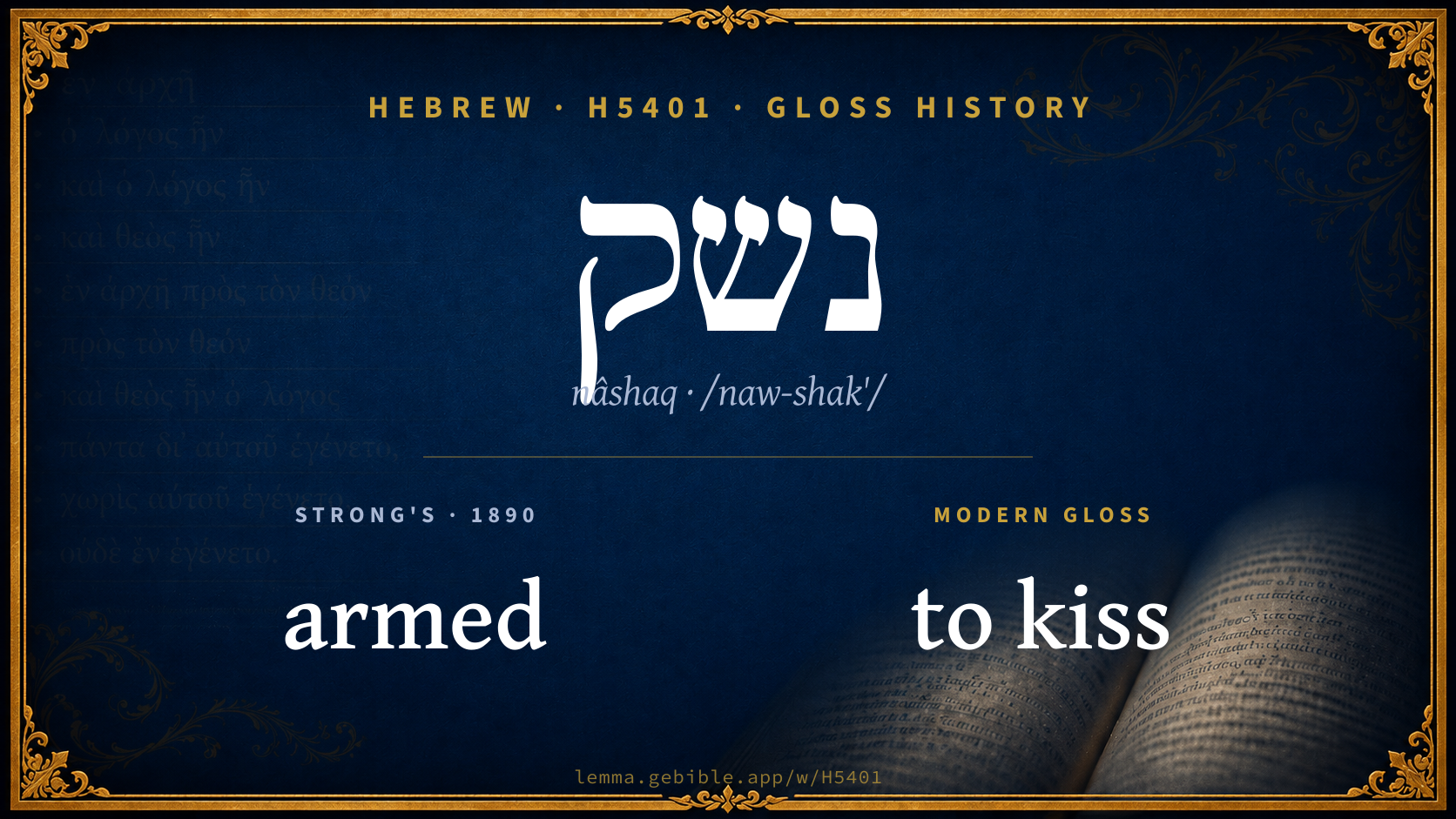
Gloss history
Strong's 1890 vs modern scholarship
About this word
Strong's H5401 catalogs a Hebrew word from the Hebrew Old Testament.
These counts are not copied from any lexicon or concordance. They are computed here, from the morphology-tagged Hebrew Old Testament. What Lemma adds →
- 35
- distinct verses
- The word appears in 35 distinct verses.
- 14 / 39
- OT books
- The word appears in 14 of 39 Old Testament books.
- #1,023
- by frequency
- Top 2500 most frequent Hebrew words (rank 1,023 of 8,640 Hebrew words by occurrence).
View all 35 occurrences in the concordance →
By section of the Old Testament
By traditional corpus
Conventional, traditional groupings — biblical authorship is debated, so this is a traditional corpus grouping, not an authorship claim. Each share is this word’s portion of its verses in that division of the Hebrew canon. Each figure is a share of the word’s 35 distinct verses.
- Torah (Pentateuch) 13 verses · 37%
- Writings (Ketuvim) 12 verses · 34%
- Prophets (Nevi'im) 10 verses · 29%
How translations render this word
Counts come from each version’s own published word-to-Strong’s tagging or interlinear alignment — an approximate guide to how each version renders this word, not a word-level alignment the data otherwise carries. Because each total is that version’s own tagged count, the per-version totals vary from one another and need not match the appearance or distinct-verse counts above. These counts may also differ from a printed concordance because Lemma counts each distinctly tagged rendering and does not collapse phrase taggings into a single head-word total. This is a fixed set of word-tagged versions (KJV, ASV, BSB, ULT) and does not change with the reading translation you choose elsewhere. Each version’s license is shown beside its name below (and on Sources).
BDB lists this Strong’s number as 2 distinct words (homographs). Each count above pools all of them and is not split by sense — see the Senses section below. A low-frequency rendering may belong to a different one of those words, not the primary meaning.
- King James Version†: Kissed 13×, Kiss 4×
- American Standard Version†: Kissed 8×, Him 3×, Kiss 3×
- Berean Standard Bible†: Kissed 12×, Kiss 6×, Kissed him 2×
- unfoldingWord Literal Text†: Kissed 11×, Kiss 5×, He kissed 3×
King James Version Public Domain
Renders H5401 across 35† tagged occurrences — most commonly:
Plus 18 renderings that appear only once — usually multi-word phrases or single function words the recovered tagging swept in, not distinct renderings.
American Standard Version Public Domain
Renders H5401 across 35† tagged occurrences — most commonly:
Plus 19 renderings that appear only once — usually multi-word phrases or single function words the recovered tagging swept in, not distinct renderings.
Berean Standard Bible Public Domain
Renders H5401 across 35† tagged occurrences — most commonly:
Plus 15 renderings that appear only once — usually multi-word phrases or single function words the recovered tagging swept in, not distinct renderings.
unfoldingWord Literal Text CC BY-SA 4.0
Renders H5401 across 40† tagged occurrences — most commonly:
Plus 15 renderings that appear only once — usually multi-word phrases or single function words the recovered tagging swept in, not distinct renderings.
Senses in the full BDB
Hebrew verbs can shift meaning by stem (binyan): Qal is the basic action, Niphal is often passive or reflexive, Piel often intensifies or makes it factitive, and Hiphil is typically causative. The senses below are grouped under the stem BDB assigns to each.
What do BDB’s symbols mean?
BDB uses these scholarly abbreviations:
| Symbol | Meaning |
|---|---|
| 𝔊 | the Septuagint (the ancient Greek translation, LXX) |
| 𝔙 | the Vulgate (the Latin translation) |
| 𝔖 | the Syriac version (the Peshitta) |
| 𝔗 | the Targum (the Aramaic translation) |
| ψ | the Psalms |
| √ | root (the underlying root or stem) |
| ‖ | parallel passage (a synonymous or contrasted parallel) |
| † | the dagger: every passage where the word occurs is cited |
The 4 senses and sub-senses the full Brown-Driver-Briggs lexicon distinguishes for this word, in lexicon order (not ranked by frequency), with BDB’s own verbatim wording and sub-sense lettering. Shown in Hebrew script with BDB’s own scholarly abbreviations. The condensed entry is in the Lexicon Entry tab. See also the Forms in the corpus table below.
נשק I kiss (NH id., Assyrian našâku, 𝔗 נְשֵׁיק, נְשַׁק, Syriac ܢܫܰܩ, kiss (orig. smell [نَشِقَ] according to LagNov. Psalt. Spec. 24 f.)
Qal
- Pf. 3 ms. נ׳ 1 K 19:18 2 S 15:5; 3 fs. נָֽשְׁקָה Pr 7:13; 3 pl. נָשָׁ֑קוּ ψ 85:11; Impf. יִשַּׁק Gn 41:40, וַיִּשַּׁק 27:27 +; sf. יִשָּׁקֵ֫נִי Ct 1:2; 1 s. cohort. אֶשֳּׁקָה־ 1 K 19:20; 3 mpl. יִשָּׁק֑וּן Ho 13:2, etc.; Imv. וּשֲׁקָה Gn 27:26; Inf. cstr. נְשָׁק־ 2 S 20:9;—kiss, usually c. לְ pers.: Gn 27:26, 27; 29:11; 50:1 Ex 4:27 (all J), Gn 48:10 Ex 18:7 (both E), 2 S 15:5; 14:33; 19:40; 20:9 1 K 19:20 Pr 7:13 Ru 1:9, 14; so of idol-worship 1 K 19:18 (cf. WeSkizzen iii. 105; Heid. 109), cf. וַתִּשַּׁק יָדִי לְפִי Jb 31:27 and my hand hath kissed my mouth; rarely c. acc. pers. 1 S 20:41 (אִישׁ אֶת־רֵעֵהוּ), sf. pers. 1 S 10:1 Ct 1:2 (+ מִנְּשִׁיקוֹת), 8:1, also Gn 33:4 וַיִּשָּׁקֵהוּ (J; Holz E; wd. suspicious, Di rejects); עֲגָלִים יִשּׁ׳ Ho 13:2 calves do they kiss; שְׂפָתַיִם יִשָּׁ֑ק Pr 24:26 lips he kisses; abs. ψ 85:11 (fig., recipr.).—עַל־פִּיךָ יִשַּׁק Gn 41:40 is dub., Di ‘to thy mouth all my people shall yield’ (fit, adapt themselves, cf. Arabic √), so Kau BuhlLex, but this meaning uncertain, and text perhaps corrupt, v. Di Holz). e.g. 1 Kings 19:18
Piel
- Impf. 3 ms. וַיְנַשֵּׁק Gn 32:1; 45:15, וַיְנַשֶּׁק־ 29:13; Imv. mpl. נַשְּׁקוּ־ ψ 2:12; Inf. cstr. נַשֵּׁק Gn 31:28;—kiss = Qal: c. לְ pers. Gn 29:13 (J), 31:28; 32:1; 45:15 (all E); נַשְּׁקוּ־בַר ψ 2:12 is dub., cf. i. בַּר p. 135 a supr. e.g. Genesis 32:1
Hiphil
- Pt. מַשִּׁיקוֹת Ez 3:13 of wings of cherubim, gently touching each other (c. אֶל־). e.g. Ezekiel 3:13
נשק II exact meaning uncertain
Qal
- Pt. pl. cstr. נֹשְׁקֵי:—נ׳ קֶשֶׁת 1 Ch 12:2 equipped with the bow, so 2 Ch 17:17 (+ מָגֵן); נ׳ רוֹמֵי קֶשֶׁת ψ 78:9 is difficult, ר׳ appos. of נ׳ according to Hup-Now Bae al. (Ges§ 130 e); del. רוֹמֵי as explan. gloss Hup Hi Che Kau; del. ver. as gloss Hup Kau Bae. e.g. 1 Chronicles 12:2
Senses from the full Brown-Driver-Briggs lexicon (Brown, Driver, Briggs; Oxford 1906 — public domain), digitized via Sefaria, supplemented by the OpenScriptures HebrewLexicon (CC BY 4.0). Full attribution on Sources.
Word origin
I. vb. kiss (NH id., Assyrian našâku, 𝔗 נְשֵׁיק, נְשַׁק, Syriac ܢܫܰܩ, kiss (orig. smell [نَشِقَ] according to LagNov. Psalt. Spec. 24 f.): Arabic نَسَقَ is fasten together, arrange in order, Ethiopic ንሱቅ pt. ordine dispositus, apte sertus Di 641, poss. akin to II. נשׁק);—
II. vb. exact meaning uncertain; prob. either handle, or be equipped with (cf. perhaps Arabic نَسَقَ, etc., sub I. נשׁק);—only
— Brown-Driver-Briggs (Oxford 1906, public domain), digitized via Sefaria, supplemented by the OpenScriptures HebrewLexicon (CC BY 4.0). See Sources.
Derived from נשק (nâsaq) (H5400) — to kindle.
Jastrow Dictionary
A second Hebrew/Aramaic lexicon for comparison, covering Aramaic and post-biblical (Talmudic, Targumic, Midrashic) usage that the biblical-Hebrew BDB does not. Matched by lemma rather than by Strong’s number, so a lemma may carry more than one Jastrow headword (shown separately below), and the entries cover usage well beyond the Bible.
נָשַׁק
- 1. to touch closely; to kiss. Y. Yeb. XV, 14ᵈ (ref. to נשק, Ps. CXL, 8) ביום שהקיץ נוֹשֵׁק וכ׳ when the summer kisses the autumn (at the change of seasons, when disease is rife). Ib. ששני עולמות נוֹשְׁקִין וכ׳ when the two worlds touch eath other (the moment of death). Gen. R. s. 90, beg. (ref. to Gen. XLI, 40) שלא יהא אדם נוֹשְׁקֵינִי וכ׳ none shall kiss me (the kiss of homage) but thou. Ber. 8ᵇ, a. e. כשנוֹשְׁקִין אין נושקין אלא וכ׳ when they (the Medians) kiss, they do so only on the hand. Yalk. Gen. 159 בדבר שהוא נוֹשְׁקוֹ על ערפו וכ׳ with a thing which one puts close to one’s neck, that is the bow; a. fr.—Part. pass. נָשׁוּק (cmp. אָחוּז fr. אָחַז) kissing. Sot. 42ᵇ (ref. to Ruth I, 14) יבאו בני הנְשׁוּקָה … הדבוקה let the children of her that kissed (and parted) come and fall into the hands of the children of her who clung (to Naomi); Yalk. Sam. 156 הנְשֵׁיקָה … הדְּבֵקָה. e.g. Psalms 140:8
- 2. (denom. of נֶשֶׁק) to arm, equip. Cant. R. to I, 2 (expl. ישקני, ib.) יזיינני יטהרני ידביקני may he arm me (ref. to I Chr. XII, 2), may he purify me (v. infra), may he attach me (ref. to Ezek. III, 13). e.g. 1 Chronicles 12:2
- 1. to kiss. Snh. VII, 6 המְנַשֵּׁק he who kisses (an idol); a. fr.
- 2. to arm, equip. Part. pass. מְנוּשָּׁק; f. מְנוּשֶּׁקֶת, pl. מְנוּשָּׁקוֹת. Cant. R. l. c. אם עסקת … ששפתיך מנ׳ וכ׳ if thou studiest the words of the Law so that thy lips be equipped (ready for contest), all shall kiss thee &c.
- 1. to bring in close contact, to close (lips). Y. Ab. Zar. II, 41ᵈ top יש דברים שמַשִּׁיקִין וכ׳ there are things on which you must seal your mouth (v. חָשַׁק).
- 2. (Levitical law) to restore a liquid to cleanness by contact or levelling with a clean well. Mikv. VI, 8 מביא … ומושכו ומַשִּׁיקוֹ he takes a pipe … and draws (the water from the clean pond) and makes it touch the surface of the unclean pond; Tosef. ib. V, 5. Cant. R. l. c. (expl. ישקני, may He cleanse me, v. supra) כאדם שהוא מַשִּׁיק וכ׳ as one brings in contact or levels &c., v. גֶּבֶא. Bets. II, 3 ושוין שמַשִּׁיקִין וכ׳ and they agree that you may (on the Holy Day) dip a vessel with an unclean liquid into a well so that the two surfaces are on a level, v. הַשָּׁקָה. Ḥull. 26ᵃ sq. עד שלא החמיץ מַשִּׁיקוֹ וכ׳ before it is sour, you may cleanse it by levelling &c.; a. e.
נְשַׁק
- Targ. Gen. XXIX, 11; 13 (O. ed. Vien. נַשֵּׁיק Pa.). Targ. Prov. XXIV, 26 נִנְשְׁקוּ וכ׳ let them close the lips of &c. Targ. Job XXXI, 27; a. fr.—M. Kat. 25ᵇ נָשׁוּק, v. כֵּיפָא I. B. Bath. 74ᵃ היכא דנַשְׁקָא ארעא וכ׳ where earth and heaven meet. Y. Maas. Sh. IV, 55ᵇ bot. חמית … נשקה וכ׳ I saw in my dream one of my eyes touch the other. Gitt. 57ᵇ bot. ואֵינַשְׁקֵיה פורתא that I may kiss him a little (before he is put to death); a. fr.
- same. Targ. O. Gen. XXXI, 28; a. e.
נֶשֶׁק
- preced.) [hostile meeting, cmp. זָוַג, מִלְחָמָה &c.,] going to war; כלי נ׳ (or sub. כלי) weapon, armor. Y. Yeb. XV, 14ᵈ (ref. to Ps. CXL, 8) נִשְׁקוֹ של גוג the day of war against Gog (v. זִיּוּן); Yalk. Ps. 888. e.g. Psalms 140:8
A Dictionary of the Targumim, the Talmud Babli and Yerushalmi, and the Midrashic Literature (Marcus Jastrow; London, Luzac, 1903) — Public Domain. Digitized via Sefaria. Digitized via Sefaria. Full attribution on Sources.
Forms in the corpus
The 30 distinct written forms H5401 takes in the Hebrew Bible, most frequent first — each parse links to that stem’s occurrences in the concordance. Hebrew forms include their vowel points and cantillation, so a single lemma takes many written forms.
Same root — word family
Other BDB entries built from the same root as H5401, grouped by Strong’s listed origin. These share a root / origin per the lexicon — not necessarily a shared meaning. Each links to that word’s own entry.
Derives from
Derived from this word
Compare all same-root words → They share a root, not necessarily a meaning.
Septuagint verse parallels
This word appears in 34 verses that also exist in the Greek Old Testament (Septuagint), out of the 35 Hebrew verses it occurs in. You can read those verses in Greek by switching the Old Testament edition to the Septuagint.
Read these verses in the Septuagint
- Genesis 27:26
- Exodus 4:27
- Ruth 1:9
- 1 Samuel 10:1
- 2 Samuel 14:33
- 1 Kings 19:18
- 1 Chronicles 12:2
- 2 Chronicles 17:17
- Job 31:27
- Psalms 2:12
- Proverbs 7:13
- Song of Solomon 1:2
This is a verse-level parallel only — the same verses exist in both the Hebrew and Greek Old Testaments. No word-level Hebrew↔Greek correspondence is claimed: the data carries no such alignment, so no Greek word is shown as this Hebrew word’s translation. Coverage is not total — the Septuagint omits the deuterocanon and renumbers the Psalms, so some Hebrew verses have no direct Greek parallel.