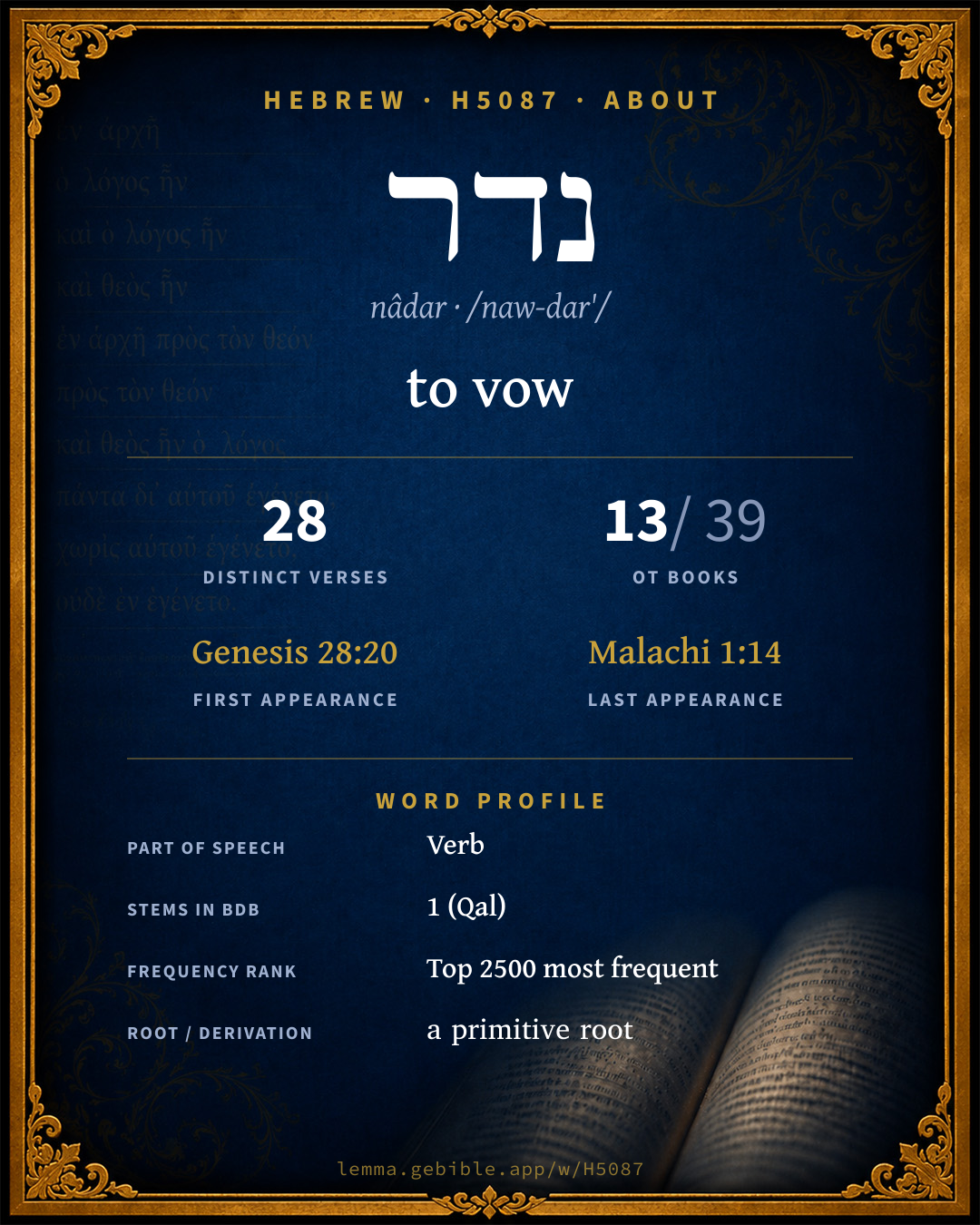
נָדַר
to vow
‘to vow’ is one of 2 main senses fuller range ↓
Full lexicon entry — Brown-Driver-Briggs (BDB)
From Brown-Driver-Briggs (BDB)
Where this word appears
Grammar key — what these labels mean
Part of speech
- Verb
- An action or state-of-being word.
Stem
- Qal
- The basic, simple active stem — the plain form of the verb (“he wrote”).
Form
- Imperfect
- An incomplete, ongoing, or future action (“he will / would write”).
- Sequential Imperfect
- An imperfect with prefixed waw — the standard past-narrative form (waw-consecutive imperfect).
- Perfect
- A completed action or state — Hebrew marks aspect (completeness) more than strict tense (“he wrote”).
- Infinitive Construct
- A bound verbal noun, frequently with prepositions (“to write / in writing”).
- Sequential Perfect
- A perfect with prefixed waw continuing a preceding imperfect or command (waw-consecutive perfect).
- Participle Active
- A verbal adjective expressing ongoing or characteristic action (“writing / one who writes”).
- Imperative
- A direct command (“write!”).
State
- Absolute
- The independent form of a noun, not bound to a following word.
Person
- 2nd Person
- The one addressed (“you”).
- 3rd Person
- The one spoken about (“he / she / it / they”).
- 1st Person
- The speaker (“I / we”).
Gender
- Masculine
- Grammatically masculine.
- Common
- Either gender — not distinguished for this form.
- Feminine
- Grammatically feminine.
Number
- Singular
- One.
- Plural
- More than one (in Hebrew, generally three or more).
Every verse where H5087 appears in the Book of Ecclesiastes — 2 distinct verses. Click any verse to open its interlinear word-by-word view. Verse text shown in the World English Bible for context — . Each verse’s Hebrew form is shown with its reference; the English is not keyword-highlighted, since the data carries no word-level English alignment. Use “Compare translations” on any verse to read it across multiple English versions. This concordance covers the Hebrew Bible; Septuagint (Greek Old Testament) occurrences are not indexed here.
Ecclesiastes
- Ecclesiastes 5:4 תִּדֹּ֨ר תִּדֹּ֖ר Qal impf 2ms Qal impf 2ms When you vow a vow to God, don't defer to pay it; for he has no pleasure in fools. Pay that which you vow.
- Ecclesiastes 5:5 תִדֹּ֑ר מִ/שֶׁ/תִּדּ֖וֹר Qal impf 2ms prep + ptcl rel + Qal impf 2ms It is better that you should not vow, than that you should vow and not pay.
About this entry
At a glance — auto-summarized from this page’s data, not written by a person. Every figure links to its source below. This summary describes the numbers; it doesn’t interpret them.
“to vow” is the headline sense of the Hebrew verb נדר (nâdar). Where the King James Version says “vowed,” newer translations reach for “made” (Berean Standard Bible); the renderings breakdown has the detail. It appears 28 verses across 13 books of the Hebrew Bible, among its moderately common vocabulary. First canonically at Genesis 28:20, it enters the text early. Its meaning spans more than one sense — see its full sense range. See the sense tree, 28-verse concordance, and the renderings breakdown below.
Gloss history
Strong's 1890 vs modern scholarship
About this word
Strong's H5087 catalogs a Hebrew word from the Hebrew Old Testament.
These counts are not copied from any lexicon or concordance. They are computed here, from the morphology-tagged Hebrew Old Testament. What Lemma adds →
- 28
- distinct verses
- The word appears in 28 distinct verses.
- 13 / 39
- OT books
- The word appears in 13 of 39 Old Testament books.
- #1,120
- by frequency
- Top 2500 most frequent Hebrew words (rank 1,120 of 8,640 Hebrew words by occurrence).
View all 28 occurrences in the concordance →
Most concentrated in
- Numbers 6 verses 21%
- Deuteronomy 5 verses 18%
- Genesis 2 verses 7%
By section of the Old Testament
By traditional corpus
Conventional, traditional groupings — biblical authorship is debated, so this is a traditional corpus grouping, not an authorship claim. Each share is this word’s portion of its verses in that division of the Hebrew canon. Each figure is a share of the word’s 28 distinct verses.
- Torah (Pentateuch) 14 verses · 50%
- Prophets (Nevi'im) 10 verses · 36%
- Writings (Ketuvim) 4 verses · 14%
How translations render this word
Counts come from each version’s own published word-to-Strong’s tagging or interlinear alignment — an approximate guide to how each version renders this word, not a word-level alignment the data otherwise carries. Because each total is that version’s own tagged count, the per-version totals vary from one another and need not match the appearance or distinct-verse counts above. These counts may also differ from a printed concordance because Lemma counts each distinctly tagged rendering and does not collapse phrase taggings into a single head-word total. This is a fixed set of word-tagged versions (KJV, ASV, BSB, ULT) and does not change with the reading translation you choose elsewhere. Each version’s license is shown beside its name below (and on Sources).
- King James Version: Vowed 6×, Vow 4×, I have vowed 2×
- American Standard Version: Vowed 6×, Voweth 4×, Thou vowest 3×
- Berean Standard Bible: Made 6×, Vow 3×, Makes 2×
- unfoldingWord Literal Text: Vowed 5×, Vow 4×, You vow 4×
King James Version Public Domain
Renders H5087 across 31 tagged occurrences — most commonly:
Plus 15 renderings that appear only once — usually multi-word phrases or single function words the recovered tagging swept in, not distinct renderings.
American Standard Version Public Domain
Renders H5087 across 31 tagged occurrences — most commonly:
Plus 12 renderings that appear only once — usually multi-word phrases or single function words the recovered tagging swept in, not distinct renderings.
Berean Standard Bible Public Domain
Renders H5087 across 31 tagged occurrences — most commonly:
Plus 16 renderings that appear only once — usually multi-word phrases or single function words the recovered tagging swept in, not distinct renderings.
unfoldingWord Literal Text CC BY-SA 4.0
Renders H5087 across 35 tagged occurrences — most commonly:
Plus 15 renderings that appear only once — usually multi-word phrases or single function words the recovered tagging swept in, not distinct renderings.
Senses in the full BDB
What do BDB’s symbols mean?
BDB uses these scholarly abbreviations:
| Symbol | Meaning |
|---|---|
| 𝔊 | the Septuagint (the ancient Greek translation, LXX) |
| 𝔙 | the Vulgate (the Latin translation) |
| 𝔖 | the Syriac version (the Peshitta) |
| 𝔗 | the Targum (the Aramaic translation) |
| ψ | the Psalms |
| √ | root (the underlying root or stem) |
| ‖ | parallel passage (a synonymous or contrasted parallel) |
| † | the dagger: every passage where the word occurs is cited |
The 1 sense the full Brown-Driver-Briggs lexicon distinguishes for this word, in lexicon order (not ranked by frequency), with BDB’s own verbatim wording and sub-sense lettering. Shown in Hebrew script with BDB’s own scholarly abbreviations. The condensed entry is in the Lexicon Entry tab. See also the Forms in the corpus table below.
Qal
- Pf. 3 ms. נ׳ ψ 132:2 2 S 15:8; נָדָ֑ר Ju 11:39; 3 fs. נָדָ֑רָה Nu 30:11; 2 ms. נָדַרְתָּ Gn 31:13 + 5 times Pf.; Impf. 3 ms. יִדֹּר Nu 6:21 + 5 times יִדַּר Ju 11:30; 2 ms. תִּדֹּר Dt 12:17 + 4 times, תִּדּוֹר Ec 5:4 + 4 times; Imv. pl. נִדְרוּ ψ 76:12; Inf. לִנְדֹּר Nu 6:2 Dt 23:23; Pt. נֹדֵר Lv 27:8; Mal 1:14;—vow a vow נָדַר נֶדֶר Gn 28:20; 31:13 (both E), Nu 21:2; (J), Nu 6:2; 30:3, 4 (P), Ju 11:30; 1 S 1:11; 2 S 15:8, 7; Is 19:21; נֶדֶר om. Lv 27:8 Nu 30:11 (P); Dt 23:23; ψ 76:12 Ec 5:4(×2); c. לְ to whom Nu 6:21 Dt 23:24; Mal 1:14; ψ 132:2; Ec 5:3; נֶדֶר אֲשֶׁר נָדַר vow which he vowed Dt 12:11, 17; 23:22(×2) Ju 11:39; Je 44:25; Jon 1:16; cf. אֲשֶׁר נ׳ אֲשַׁלֵּ֑מָה Jon 2:10, אֵת אֲשֶׁר תִּדֹּר שַׁלֵּם Ec 5:3. e.g. Psalms 132:2
Senses from the full Brown-Driver-Briggs lexicon (Brown, Driver, Briggs; Oxford 1906 — public domain), digitized via Sefaria, supplemented by the OpenScriptures HebrewLexicon (CC BY 4.0). Full attribution on Sources.
Word origin
vb. vow (NH id.; Ph. נדר; ‖ form of נָזַר, q.v.);—
— Brown-Driver-Briggs (Oxford 1906, public domain), digitized via Sefaria, supplemented by the OpenScriptures HebrewLexicon (CC BY 4.0). See Sources.
Origin: a primitive root
Jastrow Dictionary
A second Hebrew/Aramaic lexicon for comparison, covering Aramaic and post-biblical (Talmudic, Targumic, Midrashic) usage that the biblical-Hebrew BDB does not. Matched by lemma rather than by Strong’s number, so a lemma may carry more than one Jastrow headword (shown separately below), and the entries cover usage well beyond the Bible.
נָדַר
- [to keep off,] to vow (abstinence). Ned. V, 1 שנָדְרוּ זה מזה who vowed not to receive benefits from one another. Ib. III, 6 הנוֹדֵר מיורדי הים he who vows to forbid himself benefits from seafarers. Ib. VI, 1 הנודר מן המבושל who vows to abstain from whatever is cooked. Ib. 77ᵇ כל הנודר אע"פ וכ׳ whoever vows, even if he fulfills his vow, is called a sinner. Ib. I, 1 נ׳ בנזיר … ובקרבן his is a valid vow implying nazariteship and sacrifice. Naz. IV, 4 שנָדְרָה בנזיר who vowed to be a Nazarite; a. fr.—Imperative: דּוֹר. Snh. III, 2 דּוֹר לי בחיי ראשך vow (swear) to me by anything concerning thy person (and I will accept it as a legal oath). Kidd. 41ᵃ דור הנאה ממנו renounce all benefit from him.—Ned. III, 4 נוֹדְרִין להרגין וכ׳ (Tosef. ib. II, 2 תולין) you are not bound by a vow made to escape robbery by highway-men &c. Arakh. I, 1, a. e. נודרים may vow to dedicate the value of a certain person to the sanctuary, contrad. to עָרַךְ q. v.—Part. pass. נָדוּר being under the obligation of a vow; being the legitimate subject of a vow. Shebu. 20ᵃ והוא שנ׳ ובא מאותו היום provided he was bound by a vow to fast on that day; Ned. 12ᵃ והוא שנ׳ באותו היום (v. Rashi a. l.). Ib. שנ׳ ובא מאותו היום ואילך that he has vowed to fast regularly on that day (every week). Ib. 13ᵃ דבר הנ׳ a thing which can be made forbidden by a vow (not otherwise forbidden by law). Ib. 46ᵃ תני ונ׳ הנאה וכ׳ interpret מודר as meaning, and he through his own vow is forbidden any benefit &c. Naz. 9ᵇ נ׳ ונזיר he is under the influence of a vow (of abstention from dried figs) and is also a Nazarite; a. e.
- 1. to be made the subject of a vow; to have one’s personal value dedicated to the sanctuary. Arakh. I, 1 נודרים ונִידָּרִים are entitled to dedicate (v. supra) and to be dedicated. Ib. 3 לא נ׳ cannot be dedicated (has no value); a. fr.
- 2. to be vowed for a sacrifice. Meg. I, 10 כל שהוא נִידָּר, v. נָדַב; a. e.
- to put a person under the influence of a vow; to prohibit, forbid. Keth. VII, 1 המַדִּיר את אשתו מליהנות לו if one vows that his wife shall derive no benefit from him. Ib. המדיר … שלא תטעום וכ׳ if a man (by confirming her vow) subjects his wife to a restriction from tasting &c. Y. ib. 31ᵇ ויש אדם שמדיר את אשתו מחיים (not חבירו) can a man forbid his wife that which belongs to the necessaries of life? Ib. bot. הִדִּירָהּ שלא להשאיל וכ׳ if he, by means of a vow, forbade her to lend to her neighbors a winnow or a sieve. Ned. III, 3 הִדִּירוֹ חבירו וכ׳ if his friend urged him under a vow to dine with him. Naz. IV, 6 מַדִּיר את בנו בנזיר has power to make his (minor) son a Nazarite; a. fr.—Trnsf. to make inaccessible. B. Bath. 22ᵃ במַדִּיר את כותלו, v. מָדַר.
- to be forbidden by a vow; to be subjected to the influence of a vow. Gitt. 35ᵇ נדר שה׳ ברבים a votary prohibition imposed on a person in public; ib. 36ᵃ; a. e. Ned. IV, 1 המוּדָּר הנאה מחבירו he who is forbidden, by his neighbor’s vow, to derive any benefit &c. Ib. 46ᵃ היה אחד מהם מודר וכ׳ if one was forbidden &c., expl. ‘forbidden through his own vow’, v. supra. Ib. V, 4 המודר אסור he against whom the vow was directed is forbidden (all benefits). Ib. I, 1 מוּדְּרַנִי ממך I will be (as if) subjected to a vow of thine forbidding me any benefit at thy hands. Ib. 5ᵃ מודר אני ממך לא משתעינא וכ׳ ‘I will be muddar (kept distant) from thee’ may mean, I will not talk to thee; a. fr.
נְדַר I
- Targ. Num. XXX, 3; a. fr.—Ned. 22ᵃ אילו הוה ידעת … מי נַדְרַת if thou hadst known …, wouldst thou have vowed? Ib. 22ᵇ נדרת אדעת דהכי wouldst thou have made the vow, if thou hadst known this. Ib. לא נַדְרִי I should not have vowed. Ib. 9ᵃ לא נְדרְנָא I will not vow; a. v. fr.
- as preced. Hif. Ib. 21ᵇ דאַדַּרְתָּהּ לברתה who forbade her daughter all benefits from her. Ib. 24ᵃ אַדְּרֵיה מזמנא וכ׳ the host urged the guest with a vow; אדריה זמינא וכ׳ the guest caused the host to invite him with a vow. Ib. 22ᵃ מי אדרתה wouldst thou have forbidden her? Gitt. 36ᵃ דאַדְּרֵיה ר׳ אחא whom R. A. forbade to teach. Keth. 70ᵇ אַדַּרְתָּן thou hast put me under restrictions; a fr.
נְדַר II
- (transpos. of נרד, cmp. מָדר) to run down (v. Peshit. Mic. I, 4). e.g. Micah 1:4
- to roll down. Targ. O. Gen. XXIX, 3; a. e., v. גַּנְדַּר I.
- same. Targ. I Kings XIV, 10 Var. ed. Lag., v. גַּנְדַּר I.—V. מַדְרוֹן, מִדְרָא.
נֶדֶר
- vow. Kinn. I, 1, v. נְדָבָה. Ned. II, 3 יש נ׳ בתוך נ׳ there is a vow within a vow, i.e. if one repeats the vow to be a Nazarite, it is a double vow. Ib. 8ᵃ נ׳ גדול נָדַר וכ׳ (by saying so) he has made a great vow to the God of Israel; a. v. fr.—Y. Sabb. II, 5ᵇ bot. הותר הנ׳ the vow is annulled, i.e. the ban is rescinded.—Pl. נְדָרִים, constr. נִדְרֵי. Ned. I, 1, v. כִּינּוּי. Ib. III, 1 ארבע נ׳ וכ׳ four sorts of vows have the scholars declared not to be binding; נדרי זרוזין וכ׳, v. זֵירוּז, הֲבַאי &c. Ib. XI, 1, a. fr. נדרי עינוי נפש vows referring to privation of the necessaries of life; a. fr.—N’darim, name of a treatise, of the Order of Nashim, of Mishnah, Tosefta, Talmud Babli a. Y’rushalmi.
נְדַר III
- Targ. Jud. XI, 36. Targ. Num. XXX, 3; a. fr.—Ned. 8ᵇ, v. וָאלִי. Ib. רבינא הוה לה נ׳ וכ׳ the wife of R. had made a vow. Snh. 109ᵇ נ׳ נַדְרִי I have vowed; a. fr.—Pl. נִדְרִין, נִי׳. Targ. Ps. LXXVI, 12. Targ. Num. XXX, 12; a. fr.
A Dictionary of the Targumim, the Talmud Babli and Yerushalmi, and the Midrashic Literature (Marcus Jastrow; London, Luzac, 1903) — Public Domain. Digitized via Sefaria. Digitized via Sefaria. Full attribution on Sources.
Forms in the corpus
The 29 distinct written forms H5087 takes in the Hebrew Bible, most frequent first — each parse links to that stem’s occurrences in the concordance. Hebrew forms include their vowel points and cantillation, so a single lemma takes many written forms.
| Form | Parsing | Example | Uses |
|---|---|---|---|
| תִדֹּ֥ר | Verb, Qal, Imperfect, 2nd Person, Masculine, Singular | Deuteronomy 23:21 | 2 |
| וַ/יִּדַּ֨ר | Verb, Qal, Sequential Imperfect, 3rd Person, Masculine, Singular | Judges 11:30 | 2 |
| הַ/נֹּדֵ֔ר | Verb, Qal, Participle Active, Masculine, Singular, Absolute | Leviticus 27:8 | 1 |
| וְ/נָדְרוּ | Verb, Qal, Sequential Perfect, 3rd Person, Common, Plural | Isaiah 19:21 | 1 |
| וְ/נֹדֵ֛ר | Verb, Qal, Participle Active, Masculine, Singular, Absolute | Malachi 1:14 | 1 |
| וַ/יִּדַּ֥ר | Verb, Qal, Sequential Imperfect, 3rd Person, Masculine, Singular | Genesis 28:20 | 1 |
| וַ/תִּדֹּ֨ר | Verb, Qal, Sequential Imperfect, 3rd Person, Feminine, Singular | 1 Samuel 1:11 | 1 |
| וַֽ/יִּדְּר֖וּ | Verb, Qal, Sequential Imperfect, 3rd Person, Masculine, Plural | Jonah 1:16 | 1 |
| יִדֹּ֔ר | Verb, Qal, Imperfect, 3rd Person, Masculine, Singular | Numbers 6:21 | 1 |
| יִדֹּ֨ר | Verb, Qal, Imperfect, 3rd Person, Masculine, Singular | Numbers 30:2 | 1 |
| יִדֹּר֒ | Verb, Qal, Imperfect, 3rd Person, Masculine, Singular | Numbers 6:21 | 1 |
| לִ/נְדֹּ֑ר | Verb, Qal, Infinitive Construct | Deuteronomy 23:22 | 1 |
| לִ/נְדֹּר֙ | Verb, Qal, Infinitive Construct | Numbers 6:2 | 1 |
| מִ/שֶׁ/תִּדּ֖וֹר | Verb, Qal, Imperfect, 2nd Person, Masculine, Singular | Ecclesiastes 5:5 | 1 |
| נִֽדֲר֣וּ | Verb, Qal, Imperative, 2nd Person, Masculine, Plural | Psalms 76:11 | 1 |
| נָ֝דַ֗ר | Verb, Qal, Perfect, 3rd Person, Masculine, Singular | Psalms 132:2 | 1 |
| נָדַ֖רְתִּי | Verb, Qal, Perfect, 1st Person, Common, Singular | Jonah 2:9 | 1 |
| נָדַ֜רְתָּ | Verb, Qal, Perfect, 2nd Person, Masculine, Singular | Deuteronomy 23:23 | 1 |
| נָדַ֣ר | Verb, Qal, Perfect, 3rd Person, Masculine, Singular | 2 Samuel 15:8 | 1 |
| נָדַ֥רְתִּי | Verb, Qal, Perfect, 1st Person, Common, Singular | 2 Samuel 15:7 | 1 |
| נָדַ֥רְתָּ | Verb, Qal, Perfect, 2nd Person, Masculine, Singular | Genesis 31:13 | 1 |
| נָדַ֨רְנוּ֙ | Verb, Qal, Perfect, 1st Person, Common, Plural | Jeremiah 44:25 | 1 |
| נָדָ֑ר | Verb, Qal, Perfect, 3rd Person, Masculine, Singular | Judges 11:39 | 1 |
| נָדָ֑רָה | Verb, Qal, Perfect, 3rd Person, Feminine, Singular | Numbers 30:10 | 1 |
| תִדֹּ֑ר | Verb, Qal, Imperfect, 2nd Person, Masculine, Singular | Ecclesiastes 5:5 | 1 |
| תִּדְּר֖וּ | Verb, Qal, Imperfect, 2nd Person, Masculine, Plural | Deuteronomy 12:11 | 1 |
| תִּדֹּ֔ר | Verb, Qal, Imperfect, 2nd Person, Masculine, Singular | Deuteronomy 12:17 | 1 |
| תִּדֹּ֖ר | Verb, Qal, Imperfect, 2nd Person, Masculine, Singular | Ecclesiastes 5:4 | 1 |
| תִּדֹּ֨ר | Verb, Qal, Imperfect, 2nd Person, Masculine, Singular | Ecclesiastes 5:4 | 1 |
Same root — word family
Other BDB entries built from the same root as H5087, grouped by Strong’s listed origin. These share a root / origin per the lexicon — not necessarily a shared meaning. Each links to that word’s own entry.
Derived from this word
Compare all same-root words → They share a root, not necessarily a meaning.
Septuagint verse parallels
This word appears in 27 verses that also exist in the Greek Old Testament (Septuagint), out of the 28 Hebrew verses it occurs in. You can read those verses in Greek by switching the Old Testament edition to the Septuagint.
Read these verses in the Septuagint
- Genesis 28:20
- Leviticus 27:8
- Numbers 6:2
- Deuteronomy 12:11
- Judges 11:30
- 1 Samuel 1:11
- 2 Samuel 15:7
- Psalms 76:11
- Ecclesiastes 5:4
- Isaiah 19:21
- Jonah 1:16
- Malachi 1:14
This is a verse-level parallel only — the same verses exist in both the Hebrew and Greek Old Testaments. No word-level Hebrew↔Greek correspondence is claimed: the data carries no such alignment, so no Greek word is shown as this Hebrew word’s translation. Coverage is not total — the Septuagint omits the deuterocanon and renumbers the Psalms, so some Hebrew verses have no direct Greek parallel.