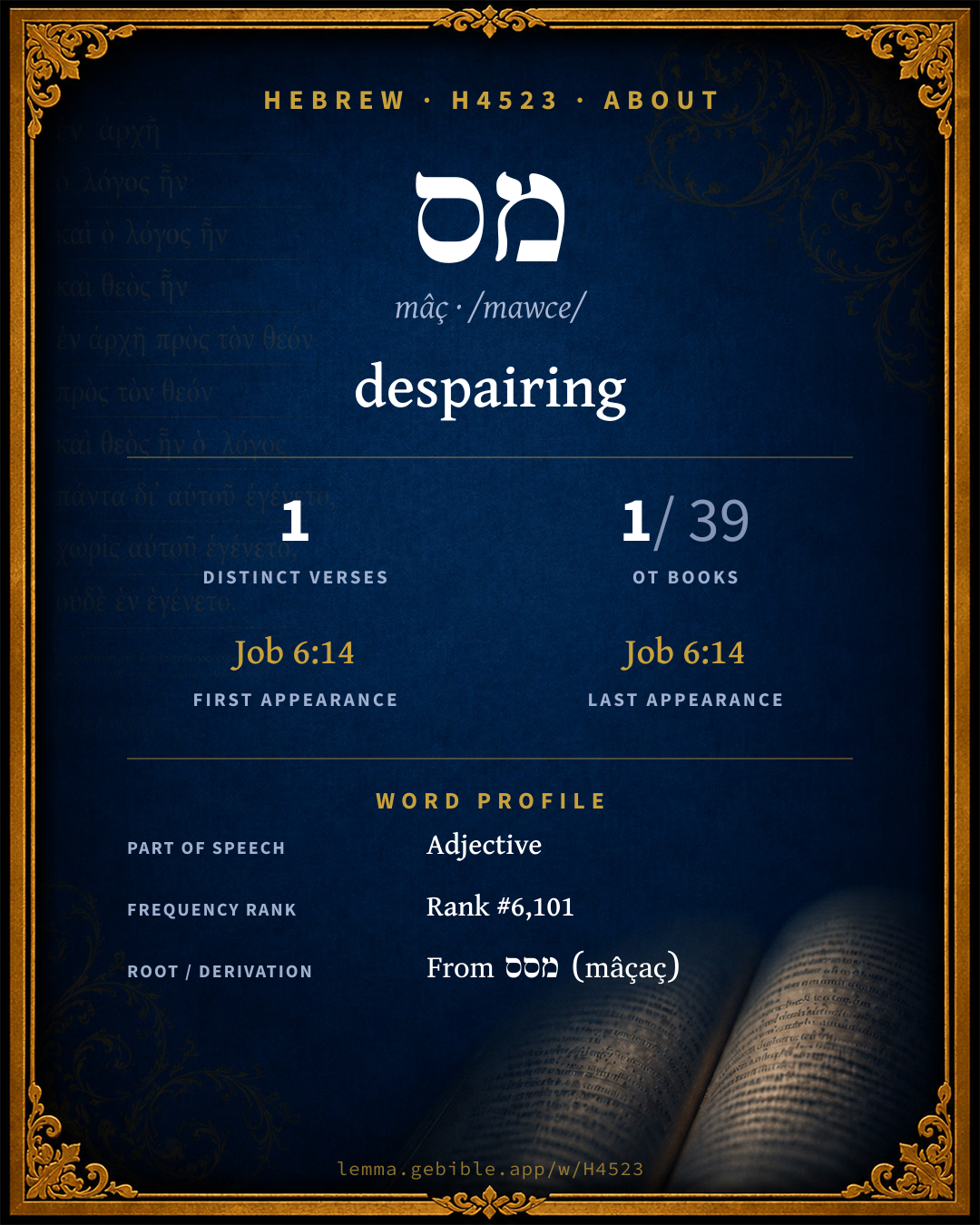
מָס
despairing
Full lexicon entry — Brown-Driver-Briggs (BDB)
From Brown-Driver-Briggs (BDB)
Where this word appears
Grammar key — what these labels mean
State
- Absolute
- The independent form of a noun, not bound to a following word.
Gender
- Masculine
- Grammatically masculine.
Number
- Singular
- One.
Every verse where H4523 appears — 1 distinct verse across 1 book. Click any verse to open its interlinear word-by-word view. Verse text shown in the World English Bible for context — . Each verse’s Hebrew form is shown with its reference; the English is not keyword-highlighted, since the data carries no word-level English alignment. Use “Compare translations” on any verse to read it across multiple English versions. This concordance covers the Hebrew Bible; Septuagint (Greek Old Testament) occurrences are not indexed here.
Job 1 verse
About this entry
At a glance — auto-summarized from this page’s data, not written by a person. Every figure links to its source below. This summary describes the numbers; it doesn’t interpret them.
מס (mâç) is a Hebrew adjective most often rendered “despairing.” It occurs a mere 1 verse across Scripture. It clusters heavily in Job, which alone accounts for 100% of its uses. Scripture uses it exactly once, at Job 6:14. It clusters with מסס, מס and מסה under a shared root. For the data behind this summary, explore the sense tree and the renderings breakdown below.
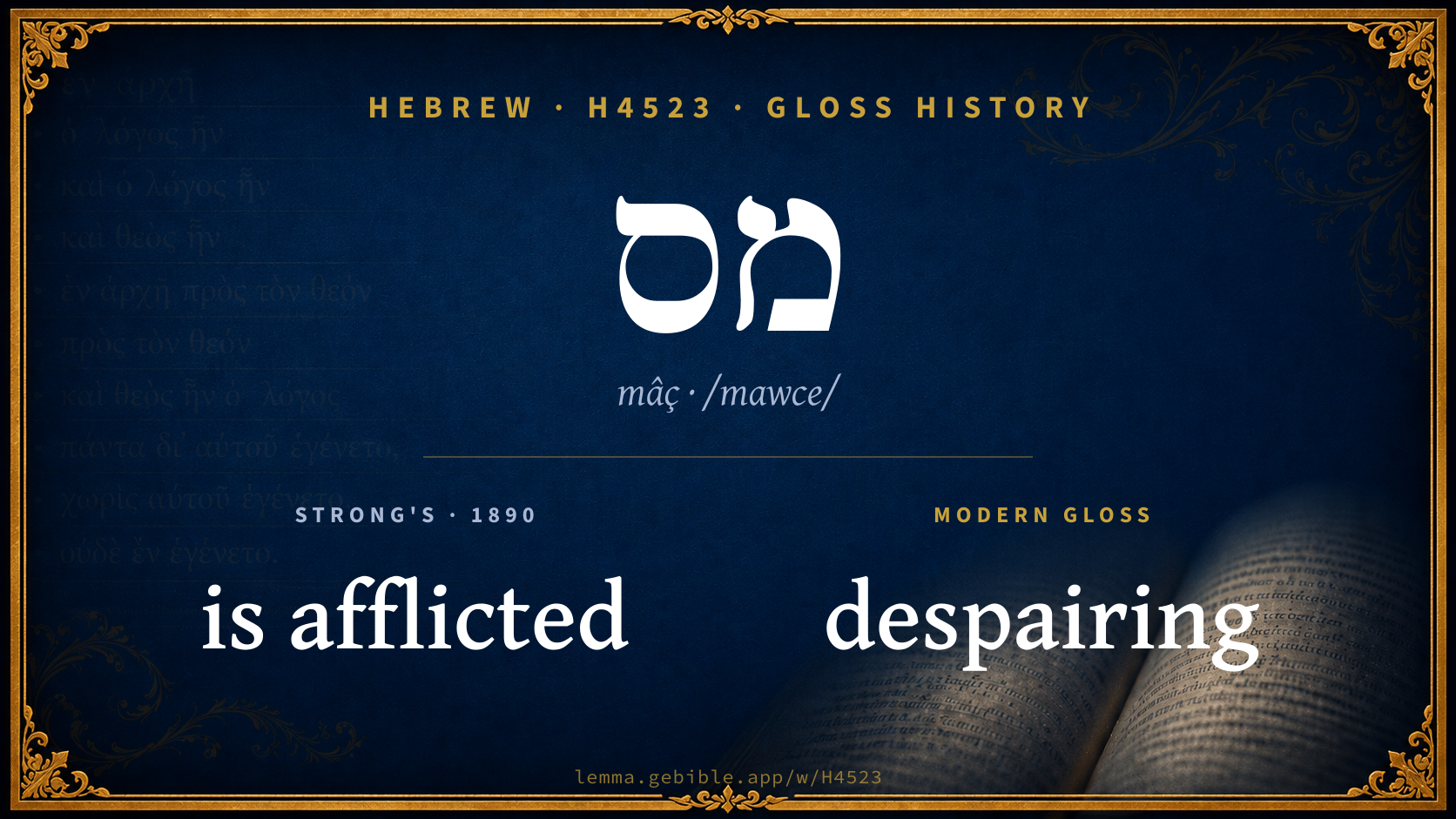
Gloss history
Strong's 1890 vs modern scholarship
About this word
Strong's H4523 catalogs a Hebrew word from the Hebrew Old Testament.
These counts are not copied from any lexicon or concordance. They are computed here, from the morphology-tagged Hebrew Old Testament. What Lemma adds →
- 1
- distinct verses
- The word appears in 1 distinct verse.
- 1 / 39
- OT books
- The word appears in 1 of 39 Old Testament books.
- #6,101
- by frequency
- Rank #6,101 (rank 6,101 of 8,640 Hebrew words by occurrence).
View all 1 occurrence in the concordance →
Most concentrated in
- Job 1 verse 100%
By section of the Old Testament
By traditional corpus
Conventional, traditional groupings — biblical authorship is debated, so this is a traditional corpus grouping, not an authorship claim. Each share is this word’s portion of its verses in that division of the Hebrew canon. Each figure is a share of the word’s 1 distinct verse.
- Writings (Ketuvim) 1 verse · 100%
How translations render this word
Counts come from each version’s own published word-to-Strong’s tagging or interlinear alignment — an approximate guide to how each version renders this word, not a word-level alignment the data otherwise carries. Because each total is that version’s own tagged count, the per-version totals vary from one another and need not match the appearance or distinct-verse counts above. These counts may also differ from a printed concordance because Lemma counts each distinctly tagged rendering and does not collapse phrase taggings into a single head-word total. This is a fixed set of word-tagged versions (KJV, ASV, BSB, ULT) and does not change with the reading translation you choose elsewhere. Each version’s license is shown beside its name below (and on Sources).
BDB lists this Strong’s number as 2 distinct words (homographs). Each count above pools all of them and is not split by sense — see the Senses section below. A low-frequency rendering may belong to a different one of those words, not the primary meaning.
- King James Version†: Is afflicted 1×
- American Standard Version†: Is ready 1×
- Berean Standard Bible†: Despairing man 1×
- unfoldingWord Literal Text†: Despairing 1×
King James Version Public Domain
Renders H4523 across 1† tagged occurrence — most commonly:
American Standard Version Public Domain
Renders H4523 across 1† tagged occurrence — most commonly:
Berean Standard Bible Public Domain
Renders H4523 across 1† tagged occurrence — most commonly:
unfoldingWord Literal Text CC BY-SA 4.0
Renders H4523 across 1† tagged occurrence — most commonly:
Senses in the full BDB
What do BDB’s symbols mean?
BDB uses these scholarly abbreviations:
| Symbol | Meaning |
|---|---|
| 𝔊 | the Septuagint (the ancient Greek translation, LXX) |
| 𝔙 | the Vulgate (the Latin translation) |
| 𝔖 | the Syriac version (the Peshitta) |
| 𝔗 | the Targum (the Aramaic translation) |
| ψ | the Psalms |
| √ | root (the underlying root or stem) |
| ‖ | parallel passage (a synonymous or contrasted parallel) |
| † | the dagger: every passage where the word occurs is cited |
The 5 senses and sub-senses the full Brown-Driver-Briggs lexicon distinguishes for this word, in lexicon order (not ranked by frequency), with BDB’s own verbatim wording and sub-sense lettering. Shown in Hebrew script with BDB’s own scholarly abbreviations. The condensed entry is in the Lexicon Entry tab.
מס I
- 1. labour-band, labour-gang, body of task-workers for public service, formed by levy upon the people by Sol. וַיַּ֫עַל הַמֶּלֶךְ שׁלֹמֹה מַס מִכָּל־יִשְׂרָאֵל 1 K 5:27, amounting to 30,000 men v 27; הַמּ׳ אֲשֶׁר הֶעֱלָה 9:15; וַיַּעֲלֵם שׁ׳ לְמַס עֹבֵד v 21 and Sol. levied them for a toiling labour-band (cf. Gn 49:15 Jos 16:10)=וַיַּעֲלֵם שׁ׳ לְמַס 2 Ch 8:8; appar. instituted, earlier, by David, cf. וַאֲדֹרָם עַל־הַמַּ֑ס 2 S 20:24, i.e. had charge of the body of labourers, so 1 K 4:6; 5:28; 12:18=2 Ch 10:18. e.g. 1 Kings 5:27
- 2.
- a. of labour-bands, slave-gangs of Isr. in Egypt, only שָׁרֵי מִסִּים Ex 1:11 (J) gang-overseers. e.g. Exodus 1:11
- b. of conquered populations, subject to forced labour: יִהְיוּ לְךָ לָמַס וַעֲבָדוּךָ Dt 20:11 cf. Ju 1:30, 33, 35 (v. GFM), Is 31:8 La 1:1; so ויהי לְמַס עֹבֵד Jos 16:10 (cf. Gn 49:15 1 K 9:21); וַיִּתְּנוּ אֶת־הַכְּנַעֲנִי לָמַ֑ס Jos 17:13, cf. (וַיָּ֫שֶׁם וגו׳) Ju 1:28. e.g. Deuteronomy 20:11
- 3. in gen.: וַיְהִי לְמַס־עֹבֵד Gn 49:15 and he (Issachar) became a slaving labour-band (poem in J; cf. Jos 16:10 1 K 9:21); cf. רְמִיָּה תִּהְיֶה לָמַ֑ס Pr 12:24 (here appar. of individ.) e.g. Genesis 49:15
- 4. forced service, serfdom (or poss. (in late passage) tribute=enforced payment, cf. NH, 𝔗, v. supr.), only of Ahasuerus: וַיָּשֶׂם הַמֶּלָךְ מַס עַל־הָאָרֶץ וגו׳ Est 10:1. e.g. Esther 10:1
מס II despairing (lit. melting, i.e. failing, collapsing)
Senses from the full Brown-Driver-Briggs lexicon (Brown, Driver, Briggs; Oxford 1906 — public domain), digitized via Sefaria, supplemented by the OpenScriptures HebrewLexicon (CC BY 4.0). Full attribution on Sources.
Word origin
I. n.m. 1 K 5:27 usually coll. body of forced labourers, task-workers, labour-band or gang, also (late) forced service, task-work, serfdom (𝔗 מִסָּא, especially in phr. מַסְּקֵי מִיסִּין (implying late and [for BH] false sense ‘tribute,’ so NH מַעֲלֵי מִסִּים; √ unknown, prob. loan-wd.; follows anal. of ע׳׳ע);—abs. מ׳ 1 K 5:27 +; לָמַ֑ס Jos 17:13 +, הַמַּ֑ס 2 S 20:24 +; pl. מִסִּים Ex 1:11;—
III. adj. despairing (lit. melting, i.e. failing, collapsing);—לַמָּס Jb 6:14 to him who despaireth belongeth kindness, etc.
— Brown-Driver-Briggs (Oxford 1906, public domain), digitized via Sefaria, supplemented by the OpenScriptures HebrewLexicon (CC BY 4.0). See Sources.
Derived from מסס (mâçaç) (H4549) — to melt.
Jastrow Dictionary
A second Hebrew/Aramaic lexicon for comparison, covering Aramaic and post-biblical (Talmudic, Targumic, Midrashic) usage that the biblical-Hebrew BDB does not. Matched by lemma rather than by Strong’s number, so a lemma may carry more than one Jastrow headword (shown separately below), and the entries cover usage well beyond the Bible.
מַס I
- (מָסַס)
- 1. (cmp. מִסְמֵס II) juice. Num. R. s. 14 (play on כמ̇שמ̇ר̇ו̇ת̇, Koh. XII, 11) כמ̇ס̇ מ̇ר̇ו̇ת̇ (bitter) as the juice of bitter things, v. מִסְמֵס II. e.g. Ecclesiastes 12:11
- 2. melting, fainting. Lam. R. to I, 1 שרתי, v. לָמַס.
מַס II
- (b. h.; = מנס; נסה = נשא) impost, tribute, tax. Lam. R. to I, 1 שרתי, v. לָמַס a. מַסָּא I.—Pl. מִסִּים, מִסִּין. Y. Dem. II, 22ᵈ top מעלי מ׳ כמי שנתכבשו the places which were made tributary (under Joshua) are considered as conquered (belonging to the Holy Land); Y. Shebi. VI, 36ᶜ bot. בעלי סיסין (corr. acc.); Gen. R. s. 98. Lev. R. s. 33, end לא למסגד אלא למפלח במ׳ וכ׳ (this ועבדתם, Deut. IV, 28) does not mean ‘to worship’ but ‘to serve’ by paying imposts, annonae &c. Ib.; Cant. R. to II, 14 אם למ׳ … את מלך עלינו וכ׳ (some ed. לפסים) if it be a question of taxes … thou art king over us … (we recognize thy sovereignty) …, but &c. e.g. Deuteronomy 4:28
A Dictionary of the Targumim, the Talmud Babli and Yerushalmi, and the Midrashic Literature (Marcus Jastrow; London, Luzac, 1903) — Public Domain. Digitized via Sefaria. Digitized via Sefaria. Full attribution on Sources.
Same root — word family
Other BDB entries built from the same root as H4523, grouped by Strong’s listed origin. These share a root / origin per the lexicon — not necessarily a shared meaning. Each links to that word’s own entry.
Derives from
Shares the same root
Compare all same-root words → They share a root, not necessarily a meaning.
Septuagint verse parallels
This word appears in 1 verse that also exists in the Greek Old Testament (Septuagint), out of the 1 Hebrew verse it occurs in. You can read those verses in Greek by switching the Old Testament edition to the Septuagint.
Read these verses in the Septuagint
This is a verse-level parallel only — the same verses exist in both the Hebrew and Greek Old Testaments. No word-level Hebrew↔Greek correspondence is claimed: the data carries no such alignment, so no Greek word is shown as this Hebrew word’s translation. Coverage is not total — the Septuagint omits the deuterocanon and renumbers the Psalms, so some Hebrew verses have no direct Greek parallel.