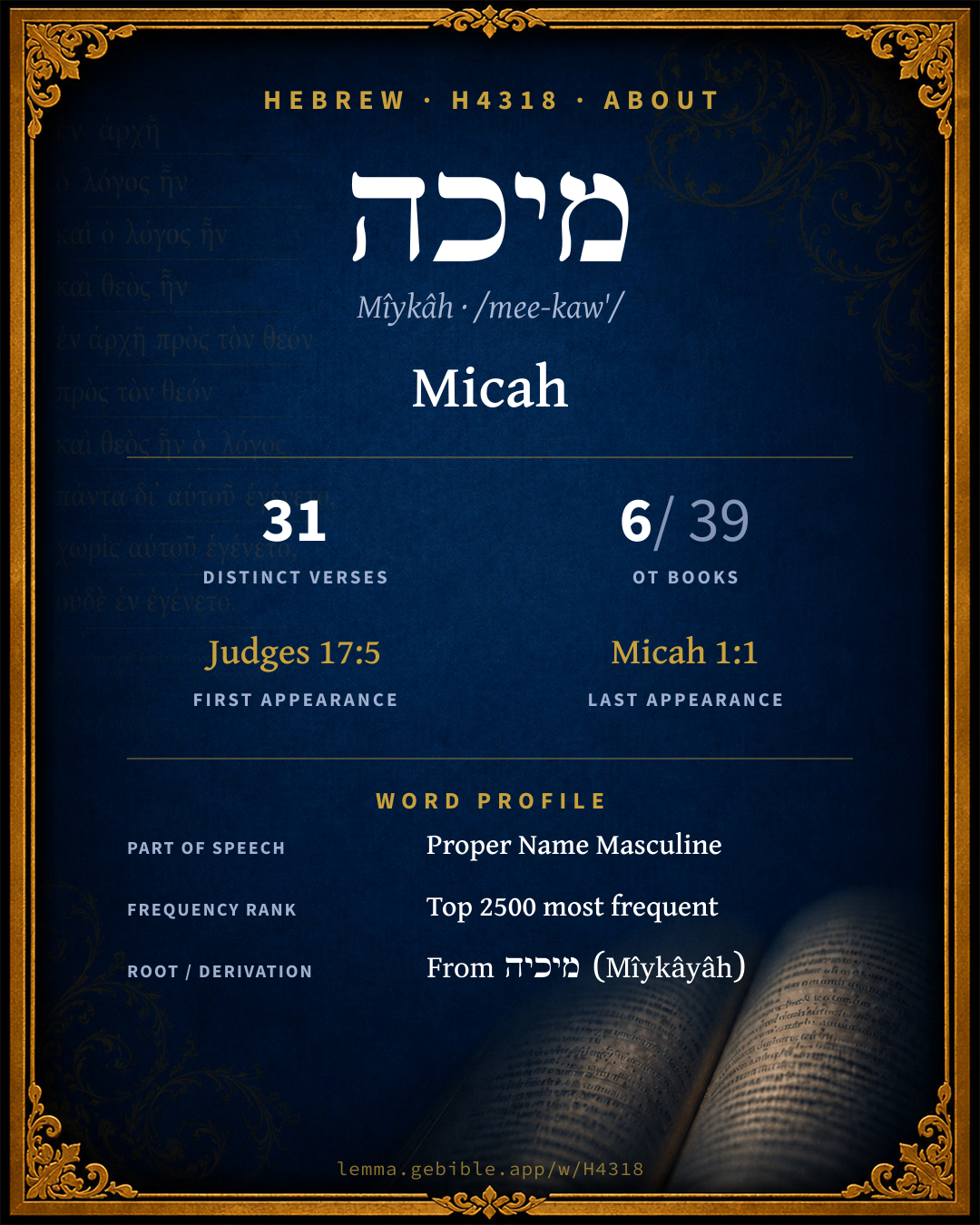
מִיכָה
Micah
BDB lists 8 entries for ‘Micah’ fuller range ↓
Full lexicon entry — Brown-Driver-Briggs (BDB)
From Brown-Driver-Briggs (BDB)
Where this word appears
Grammar key — what these labels mean
Part of speech
- Noun
- A naming word — a person, place, thing, or idea.
Noun type
- Proper
- A name of a specific person, place, or people (e.g. Abraham, Zion, Israel).
Every verse where H4318 appears in the Book of Judges — 17 distinct verses. Click any verse to open its interlinear word-by-word view. Verse text shown in the World English Bible for context — . Each verse’s Hebrew form is shown with its reference; the English is not keyword-highlighted, since the data carries no word-level English alignment. Use “Compare translations” on any verse to read it across multiple English versions. This concordance covers the Hebrew Bible; Septuagint (Greek Old Testament) occurrences are not indexed here.
Judges
- Judges 17:5 מִיכָ֔ה n Proper The man Micah had a house of gods, and he made an ephod, and teraphim, and consecrated one of his sons, who became his priest.
- Judges 17:8 מִיכָ֖ה n Proper The man departed out of the city, out of Bethlehem Judah, to sojourn where he could find [a place], and he came to the hill-country of Ephraim to the house of Micah, as he traveled.
- Judges 17:9 מִיכָ֖ה n Proper Micah said to him, Whence come you? He said to him, I am a Levite of Bethlehem Judah, and I go to sojourn where I may find [a place].
- Judges 17:10 מִיכָ֜ה n Proper Micah said to him, Dwell with me, and be to me a father and a priest, and I will give you ten [pieces] of silver by the year, and a suit of clothing, and your food. So the Levite went in.
- Judges 17:12 מִיכָה֙ מִיכָֽה n Proper n Proper Micah consecrated the Levite, and the young man became his priest, and was in the house of Micah.
- Judges 17:13 מִיכָ֔ה n Proper Then said Micah, Now know I that Yahweh will do me good, seeing I have a Levite to my priest.
- Judges 18:2 מִיכָ֔ה n Proper The children of Dan sent of their family five men from their whole number, men of valor, from Zorah, and from Eshtaol, to spy out the land, and to search it; and they said to them, Go, search the land. They came to the hill-country of Ephraim, to the house of Micah, and lodged there.
- Judges 18:3 מִיכָ֔ה n Proper When they were by the house of Micah, they knew the voice of the young man the Levite; and they turned aside there, and said to him, Who brought you here? and what do you in this place? and what have you here?
- Judges 18:4 מִיכָ֑ה n Proper He said to them, Thus and thus has Micah dealt with me, and he has hired me, and I am become his priest.
- Judges 18:13 מִיכָֽה n Proper They passed there to the hill-country of Ephraim, and came to the house of Micah.
- Judges 18:15 מִיכָ֑ה n Proper They turned aside there, and came to the house of the young man the Levite, even to the house of Micah, and asked him of his welfare.
- Judges 18:18 מִיכָ֔ה n Proper When these went into Micah's house, and fetched the engraved image, the ephod, and the teraphim, and the molten image, the priest said to them, What do you?
- Judges 18:22 מִיכָ֑ה מִיכָ֔ה n Proper n Proper When they were a good way from the house of Micah, the men who were in the houses near to Micah's house were gathered together, and overtook the children of Dan.
- Judges 18:23 לְ/מִיכָ֔ה prep + n Proper They cried to the children of Dan. They turned their faces, and said to Micah, What ails you, that you come with such a company?
- Judges 18:26 מִיכָ֗ה n Proper The children of Dan went their way: and when Micah saw that they were too strong for him, he turned and went back to his house.
- Judges 18:27 מִיכָ֗ה n Proper They took that which Micah had made, and the priest whom he had, and came to Laish, to a people quiet and secure, and struck them with the edge of the sword; and they burnt the city with fire.
- Judges 18:31 מִיכָ֖ה n Proper So they set them up Micah's engraved image which he made, all the time that the house of God was in Shiloh.
About this entry
At a glance — auto-summarized from this page’s data, not written by a person. Every figure links to its source below. This summary describes the numbers; it doesn’t interpret them.
The Hebrew name מיכה centers on the idea of “Micah.” Judges dominates its distribution — 17 of 31 verses. The Hebrew Bible uses it across 31 verses — moderately common. First canonically at Judges 17:5, it enters the text early. Dig into 31-verse concordance and the renderings breakdown below.
Gloss history
Strong's 1890 vs modern scholarship
About this word
Strong's H4318 catalogs a Hebrew word from the Hebrew Old Testament.
These counts are not copied from any lexicon or concordance. They are computed here, from the morphology-tagged Hebrew Old Testament. What Lemma adds →
- 31
- distinct verses
- The word appears in 31 distinct verses.
- 6 / 39
- OT books
- The word appears in 6 of 39 Old Testament books.
- #1,041
- by frequency
- Top 2500 most frequent Hebrew words (rank 1,041 of 8,640 Hebrew words by occurrence).
View all 31 occurrences in the concordance →
Most concentrated in
- Judges 17 verses 55%
- 1 Chronicles 8 verses 26%
- 2 Chronicles 3 verses 10%
By section of the Old Testament
By traditional corpus
Conventional, traditional groupings — biblical authorship is debated, so this is a traditional corpus grouping, not an authorship claim. Each share is this word’s portion of its verses in that division of the Hebrew canon. Each figure is a share of the word’s 31 distinct verses.
- Prophets (Nevi'im) 19 verses · 61%
- Writings (Ketuvim) 12 verses · 39%
How translations render this word
Counts come from each version’s own published word-to-Strong’s tagging or interlinear alignment — an approximate guide to how each version renders this word, not a word-level alignment the data otherwise carries. Because each total is that version’s own tagged count, the per-version totals vary from one another and need not match the appearance or distinct-verse counts above. These counts may also differ from a printed concordance because Lemma counts each distinctly tagged rendering and does not collapse phrase taggings into a single head-word total. This is a fixed set of word-tagged versions (KJV, ASV, BSB, ULT) and does not change with the reading translation you choose elsewhere. Each version’s license is shown beside its name below (and on Sources).
- King James Version: Micah 21×, Michah 4×, Micah's 2×
- American Standard Version: Micah 26×
- Berean Standard Bible: Micah 20×, Micah’s 8×
- unfoldingWord Literal Text: Micah 30×
King James Version Public Domain
Renders H4318 across 31 tagged occurrences — most commonly:
Plus 4 renderings that appear only once — usually multi-word phrases or single function words the recovered tagging swept in, not distinct renderings.
American Standard Version Public Domain
Renders H4318 across 30 tagged occurrences — most commonly:
Plus 4 renderings that appear only once — usually multi-word phrases or single function words the recovered tagging swept in, not distinct renderings. Not rendered by a distinct English word in 1 further occurrence.
Berean Standard Bible Public Domain
Renders H4318 across 32 tagged occurrences — most commonly:
Plus 4 renderings that appear only once — usually multi-word phrases or single function words the recovered tagging swept in, not distinct renderings.
unfoldingWord Literal Text CC BY-SA 4.0
Renders H4318 across 32 tagged occurrences — most commonly:
Plus 2 renderings that appear only once — usually multi-word phrases or single function words the recovered tagging swept in, not distinct renderings.
7 senses and sub-senses in the full BDB
What do BDB’s symbols mean?
BDB uses these scholarly abbreviations:
| Symbol | Meaning |
|---|---|
| 𝔊 | the Septuagint (the ancient Greek translation, LXX) |
| 𝔙 | the Vulgate (the Latin translation) |
| 𝔖 | the Syriac version (the Peshitta) |
| 𝔗 | the Targum (the Aramaic translation) |
| ψ | the Psalms |
| √ | root (the underlying root or stem) |
| ‖ | parallel passage (a synonymous or contrasted parallel) |
| † | the dagger: every passage where the word occurs is cited |
The 7 senses and sub-senses the full Brown-Driver-Briggs lexicon distinguishes for this word, in lexicon order (not ranked by frequency), with BDB’s own verbatim wording and sub-sense lettering. Shown in Hebrew script with BDB’s own scholarly abbreviations. The condensed entry is in the Lexicon Entry tab. See also the Forms in the corpus table below.
- 1. Micha, the Ephraimite (𝔊 Μειχαίας), Ju 17:5, 8, 9, 10, 12(×2), 13; 18:2 ff. (12 times), called מִיכָֽיְהוּ 17:1 4. e.g. Judges 17:5
- 2. the prophet Micah (𝔊 Μειχαίας), Mi 1:1 (Je 26:18 Kt מִיכָיָה). e.g. Micah 1:1
- 3. 1 Ch 5:5. e.g. 1 Chronicles 5:5
- 4. son of Meribbaal (Mephibosheth) 8:34 f. (𝔊 Μιχια), 9:40 f. (𝔊 Μειχα), called מִיכָא 2 S 9:12. e.g. 1 Chronicles 8:34
- 5. 23:20 (𝔊 Μειχας), 24:24, 25 (𝔊 Μειχα). e.g. 1 Chronicles 23:20
- 6. 2 Ch 18:14 (= מִיכָֽיְהוּ 2). e.g. 2 Chronicles 18:14
- 7. 34:20 (‖ 2 K 22:12 מִיכָיָה). e.g. 2 Chronicles 34:20
Senses from the full Brown-Driver-Briggs lexicon (Brown, Driver, Briggs; Oxford 1906 — public domain), digitized via Sefaria, supplemented by the OpenScriptures HebrewLexicon (CC BY 4.0). Full attribution on Sources.
Word origin
Derived from מיכיה (Mîykâyâh) (H4320) — Micah.
Jastrow Dictionary
A second Hebrew/Aramaic lexicon for comparison, covering Aramaic and post-biblical (Talmudic, Targumic, Midrashic) usage that the biblical-Hebrew BDB does not. Matched by lemma rather than by Strong’s number, so a lemma may carry more than one Jastrow headword (shown separately below), and the entries cover usage well beyond the Bible.
מִיכָה I
- (b. h.) pr. n. m. Micah,
- 1. M., the owner of an idolatrous temple (Jud. XVII). Esth. R. to III, 7 צלם מ׳; Snh. 103ᵇ פסלו של מ׳ the image put up by M.; ib. עשן פסל מ׳ the smoke rising from the sacrifices to the image &c.—Ib. 101ᵇ, v. מִכְמֵךְ. Shebu. 35ᵇ כל שמות … במ׳ תול all divine names mentioned in connection with M. (Jud. l. c.) are profane (not names of the Lord). Pes. 117ᵃ פיסלו של מ׳ עומד בבכי וכ׳ with Micah’s image at Bekhi, the Israelites should have sung the Hallel?—Ex. R. s. 41; a. fr. e.g. Judges 17:12
- 2. M., the prophet. Lev. R. s. 10 שלחתי את מ׳ וכ׳ I sent M. and they smote him. Macc. 24ᵃ בא מ׳ והעמירן וכ׳ M. came and based all the laws of the Torah on three principles; a. e.
מִיכָה II
- (מוּךְ) decline, reduction to poverty. B. Mets. 114ᵃ מי גמר מ׳ מ׳ מערכין can an analogy between assessments of vowed values and assessments in cases of indebtedness be based on the use of the root מוּךְ (Lev. XXVII, 8 a. XXV, 35)? e.g. Leviticus 27:8
A Dictionary of the Targumim, the Talmud Babli and Yerushalmi, and the Midrashic Literature (Marcus Jastrow; London, Luzac, 1903) — Public Domain. Digitized via Sefaria. Digitized via Sefaria. Full attribution on Sources.
Forms in the corpus
The 12 distinct written forms H4318 takes in the Hebrew Bible, most frequent first — each parse links to that state’s occurrences in the concordance. Hebrew forms include their vowel points and cantillation, so a single lemma takes many written forms.
| Form | Parsing | Example | Uses |
|---|---|---|---|
| מִיכָ֔ה | Noun, Proper | 1 Chronicles 24:24 | 7 |
| מִיכָ֑ה | Noun, Proper | 1 Chronicles 8:35 | 5 |
| מִיכָה֙ | Noun, Proper | 1 Chronicles 24:25 | 5 |
| מִיכָ֖ה | Noun, Proper | 1 Chronicles 24:24 | 4 |
| מִיכָֽה | Noun, Proper | 1 Chronicles 8:34 | 4 |
| מִיכָ֗ה | Noun, Proper | Judges 18:26 | 2 |
| מִיכָ֜ה | Noun, Proper | 2 Chronicles 34:20 | 2 |
| לְ/מִיכָ֔ה | Noun, Proper | Judges 18:23 | 1 |
| מִ֠יכָה | Noun, Proper | Nehemiah 11:17 | 1 |
| מִיכָ֣ה | Noun, Proper | 1 Chronicles 23:20 | 1 |
| מִיכָ֥ה | Noun, Proper | 1 Chronicles 5:5 | 1 |
| מיכהו | Noun, Proper | 2 Chronicles 18:8 | 1 |
Same root — word family
Other BDB entries built from the same root as H4318, grouped by Strong’s listed origin. These share a root / origin per the lexicon — not necessarily a shared meaning. Each links to that word’s own entry.
Derives from
Proper names from this root
People and places named from this root — a name, not an additional meaning of the word.
Compare all same-root words → 3 of the same-root words are proper names (people or places). They share a root, not necessarily a meaning.
Bible dictionary
Public-domain dictionary articles matched to this entry by name (Micah). A biblical name can be shared by more than one person or place, so an article may treat several.
Easton's Bible Dictionary · M. G. Easton, 1897
A shortened form of Micaiah, who is like Jehovah? (1.) A man of Mount Ephraim, whose history so far is introduced in Judg. 17, apparently for the purpose of leading to an account of the settlement of the tribe of Dan in Northern Palestine, and for the purpose also of illustrating the lawlessness of the times in which he lived (Judg. 18; 19:1-29; 21:25).
(2.) The son of Merib-baal (Mephibosheth), 1 Chr. 8:34, 35.
(3.) The first in rank of the priests of the family of Kohathites (1 Chr. 23:20).
(4.) A descendant of Joel the Reubenite (1 Chr. 5:5).
(5.) "The Morasthite," so called to distinguish him from Micaiah, the son of Imlah (1 Kings 22:8). He was a prophet of Judah, a contemporary of Isaiah (Micah 1:1), a native of Moresheth of Gath (1:14, 15). Very little is known of the circumstances of his life (comp. Jer. 26:18, 19).
Smith's Bible Dictionary · William Smith, 1863
(who is like God?), the same name as Micaiah. [Micaiah]
+ An Israelite whose familiar story is preserved in the 17th and 18th chapters of Judges. Micah is evidently a devout believers in Jehovah, and yet so completely ignorant is he of the law of Jehovah that the mode which he adopts of honoring him is to make a molten and graven image, teraphim or images of domestic gods, and to set up an unauthorized priesthood, first in his own family, (Judges 17:5) and then in the person of a Levite not of the priestly line. ver. (Judges 17:12) A body of 600 Danites break in upon and steal his idols from him. + The sixth in order of the minor prophets. He is called the Morasthite, that is, a native of Moresheth, a small village near Eleutheropolis to the east, where formerly the prophet's tomb was shown, though in the days of Jerome it had been succeeded by a church. Micah exercised the prophetical office during the reigns of Jotham, Ahaz and Hezekiah, kings of Judah, giving thus a maximum limit of 59 years, B.C. 756-697, from the accession of Jotham to the death of Hezekiah, and a minimum limit of 16 years, B.C. 742-726, from the death of Jotham to the accession of Hezekiah. He was contemporary with Hosea and Amos during the part of their ministry in Israel, and with Isaiah in Judah. + A descendant of Joel the Reubenite. (1 Chronicles 5:5) + The son of Meribbaal or Mephibosheth, the son of Jonathan. (1 Chronicles 8:34,35; 9:40,41) + A Kohathite levite, the eldest son of Uzziel the brother of Amram. (1 Chronicles 23:30) + The father of Abdon, a man of high station in the reign of Josiah. (2 Chronicles 34:20)
Hitchcock's Bible Names Dictionary · Roswell D. Hitchcock, 1869
poor; humble
Classic public-domain reference works; full attribution on Sources.
Septuagint verse parallels
This word appears in 30 verses that also exist in the Greek Old Testament (Septuagint), out of the 31 Hebrew verses it occurs in. You can read those verses in Greek by switching the Old Testament edition to the Septuagint.
Read these verses in the Septuagint
This is a verse-level parallel only — the same verses exist in both the Hebrew and Greek Old Testaments. No word-level Hebrew↔Greek correspondence is claimed: the data carries no such alignment, so no Greek word is shown as this Hebrew word’s translation. Coverage is not total — the Septuagint omits the deuterocanon and renumbers the Psalms, so some Hebrew verses have no direct Greek parallel.