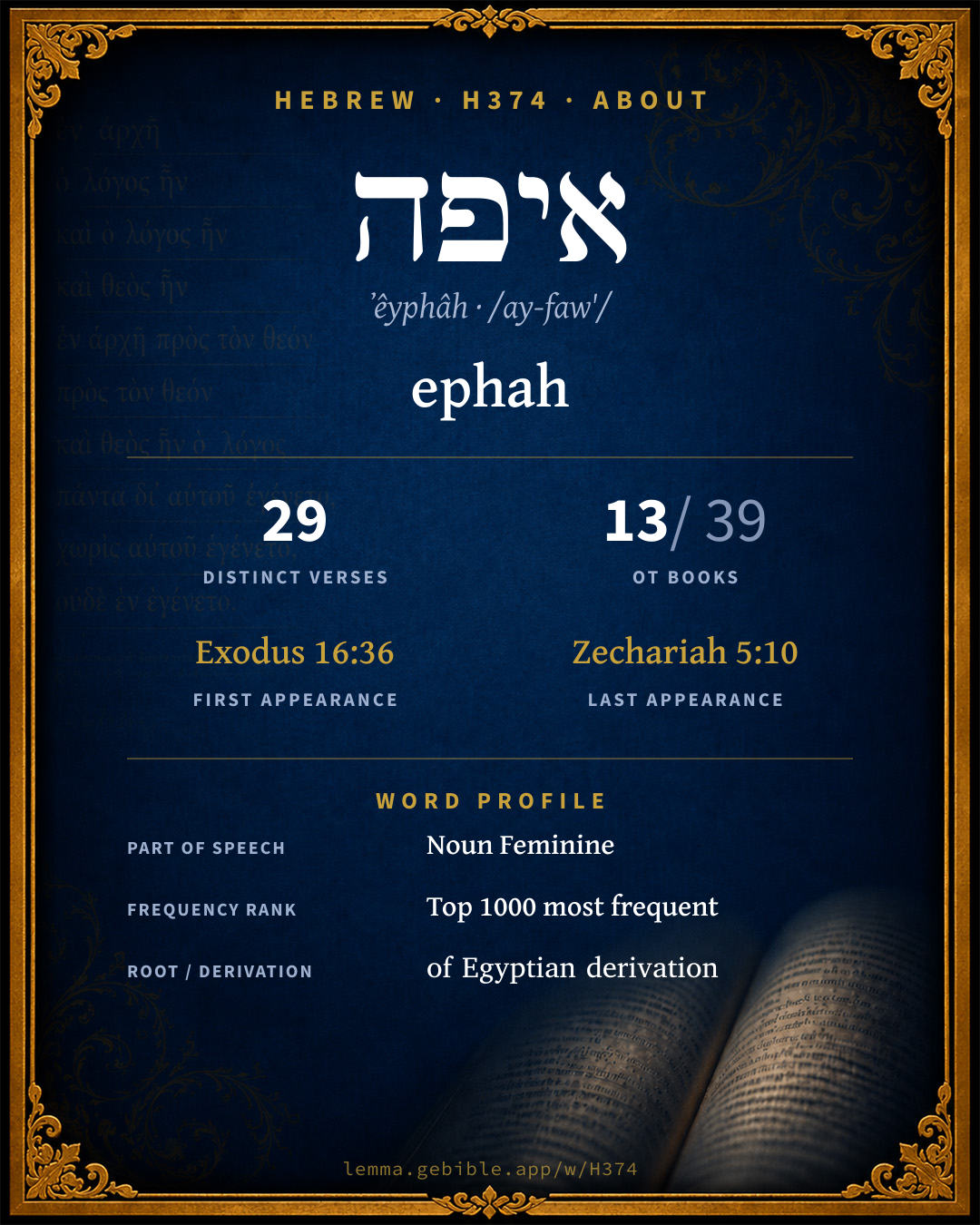
אֵיפָה
ephah
‘ephah’ is one of 3 main senses fuller range ↓
Full lexicon entry — Brown-Driver-Briggs (BDB)
From Brown-Driver-Briggs (BDB)
Where this word appears
See every Absolute-state word in the Hebrew Bible →
Grammar key — what these labels mean
Part of speech
- Noun
- A naming word — a person, place, thing, or idea.
Noun type
- Common
- A common noun — a general class of person, place, or thing (“king,” “city,” “water”), not a specific name.
State
- Absolute
- The independent form of a noun, not bound to a following word.
- Construct
- A noun bound to a following noun in a possessive / “of” relationship (the construct chain).
Gender
- Feminine
- Grammatically feminine.
Number
- Singular
- One.
Every verse where H374 appears in the Book of Ezekiel — 8 distinct verses. Click any verse to open its interlinear word-by-word view. Verse text shown in the World English Bible for context — . Each verse’s Hebrew form is shown with its reference; the English is not keyword-highlighted, since the data carries no word-level English alignment. Use “Compare translations” on any verse to read it across multiple English versions. This concordance covers the Hebrew Bible; Septuagint (Greek Old Testament) occurrences are not indexed here.
Ezekiel
- Ezekiel 45:10 וְ/אֵֽיפַת conj + n c fs cs You shall have just balances, and a just ephah, and a just bath.
- Ezekiel 45:11 הָ/אֵיפָ֣ה הָֽ/אֵיפָ֔ה ptcl def.art + n c fs ptcl def.art + n c fs The ephah and the bath shall be of one measure, that the bath may contain the tenth part of a homer, and the ephah the tenth part of a homer: the measure of it shall be after the homer.
- Ezekiel 45:13 הָֽ/אֵיפָה֙ הָֽ/אֵיפָ֔ה ptcl def.art + n c fs ptcl def.art + n c fs This is the offering that you shall offer: the sixth part of an ephah from a homer of wheat; and you shall give the sixth part of an ephah from a homer of barley;
- Ezekiel 45:24 אֵיפָ֥ה וְ/אֵיפָ֥ה לָ/אֵיפָֽה n c fs conj + n c fs prep det + n c fs He shall prepare a meal-offering, an ephah for a bull, and an ephah for a ram, and a hin of oil to an ephah.
- Ezekiel 46:5 אֵיפָ֣ה לָ/אֵיפָֽה n c fs prep det + n c fs and the meal-offering shall be an ephah for the ram, and the meal-offering for the lambs as he is able to give, and a hin of oil to an ephah.
- Ezekiel 46:7 וְ/אֵיפָ֨ה וְ/אֵיפָ֤ה לָ/אֵיפָֽה conj + n c fs conj + n c fs prep det + n c fs and he shall prepare a meal-offering, an ephah for the bull, and an ephah for the ram, and for the lambs according as he is able, and a hin of oil to an ephah.
- Ezekiel 46:11 אֵיפָ֤ה וְ/אֵיפָ֣ה לָ/אֵיפָֽה n c fs conj + n c fs prep det + n c fs In the feasts and in the solemnities the meal-offering shall be an ephah for a bull, and an ephah for a ram, and for the lambs as he is able to give, and a hin of oil to an ephah.
- Ezekiel 46:14 הָֽ/אֵיפָ֔ה ptcl def.art + n c fs You shall prepare a meal-offering with it morning by morning, the sixth part of an ephah, and the third part of a hin of oil, to moisten the fine flour; a meal-offering to Yahweh continually by a perpetual ordinance.
About this entry
At a glance — auto-summarized from this page’s data, not written by a person. Every figure links to its source below. This summary describes the numbers; it doesn’t interpret them.
איפה — transliterated ʼêyphâh — is a Hebrew noun carrying the sense “ephah.” Its earliest occurrence is Exodus 16:36. Spanning 29 verses in 13 books, it ranks among the moderately common words of the Hebrew Bible. Its uses concentrate in Ezekiel (28% of all occurrences). The lexicon spreads it across several senses; see its full sense range. See the sense tree, 29-verse concordance, and the renderings breakdown below.
Gloss history
Strong's 1890 vs modern scholarship
About this word
Strong's H374 catalogs a Hebrew word from the Hebrew Old Testament.
These counts are not copied from any lexicon or concordance. They are computed here, from the morphology-tagged Hebrew Old Testament. What Lemma adds →
- 29
- distinct verses
- The word appears in 29 distinct verses.
- 13 / 39
- OT books
- The word appears in 13 of 39 Old Testament books.
- #909
- by frequency
- Top 1000 most frequent Hebrew words (rank 909 of 8,640 Hebrew words by occurrence).
View all 29 occurrences in the concordance →
By section of the Old Testament
By traditional corpus
Conventional, traditional groupings — biblical authorship is debated, so this is a traditional corpus grouping, not an authorship claim. Each share is this word’s portion of its verses in that division of the Hebrew canon. Each figure is a share of the word’s 29 distinct verses.
- Prophets (Nevi'im) 19 verses · 66%
- Torah (Pentateuch) 8 verses · 28%
- Writings (Ketuvim) 2 verses · 7%
How translations render this word
Counts come from each version’s own published word-to-Strong’s tagging or interlinear alignment — an approximate guide to how each version renders this word, not a word-level alignment the data otherwise carries. Because each total is that version’s own tagged count, the per-version totals vary from one another and need not match the appearance or distinct-verse counts above. These counts may also differ from a printed concordance because Lemma counts each distinctly tagged rendering and does not collapse phrase taggings into a single head-word total. This is a fixed set of word-tagged versions (KJV, ASV, BSB, ULT) and does not change with the reading translation you choose elsewhere. Each version’s license is shown beside its name below (and on Sources).
- King James Version: Ephah 25×, Part of an ephah 4×, Divers measures 2×
- American Standard Version: Ephah 24×, Part of an ephah 3×, Diverse measures 2×
- Berean Standard Bible: Ephah 25×, Basket 4×, Per ephah 3×
- unfoldingWord Literal Text: Ephah 24×, Ephah of 6×, And 2×
King James Version Public Domain
Renders H374 across 38 tagged occurrences — most commonly:
Plus 3 renderings that appear only once — usually multi-word phrases or single function words the recovered tagging swept in, not distinct renderings. Not rendered by a distinct English word in 2 further occurrences.
American Standard Version Public Domain
Renders H374 across 38 tagged occurrences — most commonly:
Plus 5 renderings that appear only once — usually multi-word phrases or single function words the recovered tagging swept in, not distinct renderings.
Berean Standard Bible Public Domain
Renders H374 across 38 tagged occurrences — most commonly:
Plus 6 renderings that appear only once — usually multi-word phrases or single function words the recovered tagging swept in, not distinct renderings. Not rendered by a distinct English word in 2 further occurrences.
unfoldingWord Literal Text CC BY-SA 4.0
Renders H374 across 44 tagged occurrences — most commonly:
Plus 12 renderings that appear only once — usually multi-word phrases or single function words the recovered tagging swept in, not distinct renderings.
Senses in the full BDB
What do BDB’s symbols mean?
BDB uses these scholarly abbreviations:
| Symbol | Meaning |
|---|---|
| 𝔊 | the Septuagint (the ancient Greek translation, LXX) |
| 𝔙 | the Vulgate (the Latin translation) |
| 𝔖 | the Syriac version (the Peshitta) |
| 𝔗 | the Targum (the Aramaic translation) |
| ψ | the Psalms |
| √ | root (the underlying root or stem) |
| ‖ | parallel passage (a synonymous or contrasted parallel) |
| † | the dagger: every passage where the word occurs is cited |
The 2 senses and sub-senses the full Brown-Driver-Briggs lexicon distinguishes for this word, in lexicon order (not ranked by frequency), with BDB’s own verbatim wording and sub-sense lettering. Shown in Hebrew script with BDB’s own scholarly abbreviations. The condensed entry is in the Lexicon Entry tab. See also the Forms in the corpus table below.
- 1. a certain quantity of wheat, barley, etc. = ten omers (עֹמֶר) Ex 16:36 (cf. in measure of offerings Lv 5:11; 6:13 Nu 5:15; 28:5, all עֲשִׂירִית הָא׳; = 1/10 chomer (חֹמֶר) Ez 45:11 (= bath, בַּת, liqu. meas. q.v.) cf. Is 5:10; chiefly of offerings, v. supr. & 1 S 1:24 Ez 45:13(×2), 24(×3); 46:5(×2), 7(×3), 11(×3), 14; cf. Ju 6:19, but also of food 1 S 17:17 cf. Ru 2:17 & Is 5:10 supr. e.g. Exodus 16:36
- 2. receptacle or measure, holding an ephah, in proph. vision Zc 5:6, 7, 8, 9, 10; just measure אֵיפַת־צֶדֶק Lv 19:36 (‖ מֹאזְנֵי־צ׳, אַבְנֵי־צ׳, הִין צ׳) cf. Ez 45:10, 11; אֵיפָה שְׁלֵמָה וָצ׳ Dt 25:15 (‖ אֶבֶן שׁ׳ וָצ׳); of unjust measure אֵיפָה וְאֵיפָה Dt 25:14 Pr 20:10; הַקְטִין א׳ Am 8:5; אֵיפַת רָזוֹן Mi 6:10. (On the actual size of ephah, cf. בַּת). e.g. Zechariah 5:6
Senses from the full Brown-Driver-Briggs lexicon (Brown, Driver, Briggs; Oxford 1906 — public domain), digitized via Sefaria, supplemented by the OpenScriptures HebrewLexicon (CC BY 4.0). Full attribution on Sources.
Word origin
n.f. ephah (etym. dub., 𝔊 οιφι etc., cf. Copt. ôipi, Thes LagOr. ii. 2 & cit.)—א׳ Nu 5:15 +; אֵפָה Ex 16:36 +; cstr. אֵיפַת Lv 19:36 +;—ephah, a grain-measure.
— Brown-Driver-Briggs (Oxford 1906, public domain), digitized via Sefaria, supplemented by the OpenScriptures HebrewLexicon (CC BY 4.0). See Sources.
Origin: of Egyptian derivation
Jastrow Dictionary
A second Hebrew/Aramaic lexicon for comparison, covering Aramaic and post-biblical (Talmudic, Targumic, Midrashic) usage that the biblical-Hebrew BDB does not. Matched by lemma rather than by Strong’s number, so a lemma may carry more than one Jastrow headword (shown separately below), and the entries cover usage well beyond the Bible.
אֵיפָה I
- Sifra Sh’mini ch. VII, Par. 6, v. חֵיפָה II
*אֵיפָה II
- (cmp. אוֹפִי) character, disposition, temper. Ex. R. s. 40 (play on אֵיפֹה Job XXXVIII, 4) הא׳ שלך וכ׳ where was thy predestined temper suspended? (on which limb of Adam’s head, hair &c.?, v. preceding passage ibid.). Ib. אֵיפָתְךָ. e.g. Job 38:4
אֵיפָה III
- [batch], Ephah, a dry measure. Sifré Deut. 294, both a small as well as a large Ephah קרויה א׳ is named Ephah.—Men. 45ᵇ top אֵיפָתָן the Ephah belonging to the sacrifices; a. fr.—Pl. אֵיפוֹת. Ibid.
A Dictionary of the Targumim, the Talmud Babli and Yerushalmi, and the Midrashic Literature (Marcus Jastrow; London, Luzac, 1903) — Public Domain. Digitized via Sefaria. Digitized via Sefaria. Full attribution on Sources.
Forms in the corpus
The 28 distinct written forms H374 takes in the Hebrew Bible, most frequent first — each parse links to that state’s occurrences in the concordance. Hebrew forms include their vowel points and cantillation, so a single lemma takes many written forms.
Septuagint verse parallels
This word appears in 29 verses that also exist in the Greek Old Testament (Septuagint), out of the 29 Hebrew verses it occurs in. You can read those verses in Greek by switching the Old Testament edition to the Septuagint.
Read these verses in the Septuagint
- Exodus 16:36
- Leviticus 5:11
- Numbers 5:15
- Deuteronomy 25:14
- Judges 6:19
- Ruth 2:17
- 1 Samuel 1:24
- Proverbs 20:10
- Isaiah 5:10
- Ezekiel 45:10
- Amos 8:5
- Micah 6:10
This is a verse-level parallel only — the same verses exist in both the Hebrew and Greek Old Testaments. No word-level Hebrew↔Greek correspondence is claimed: the data carries no such alignment, so no Greek word is shown as this Hebrew word’s translation. Coverage is not total — the Septuagint omits the deuterocanon and renumbers the Psalms, so some Hebrew verses have no direct Greek parallel.