
Zechariah 5:9

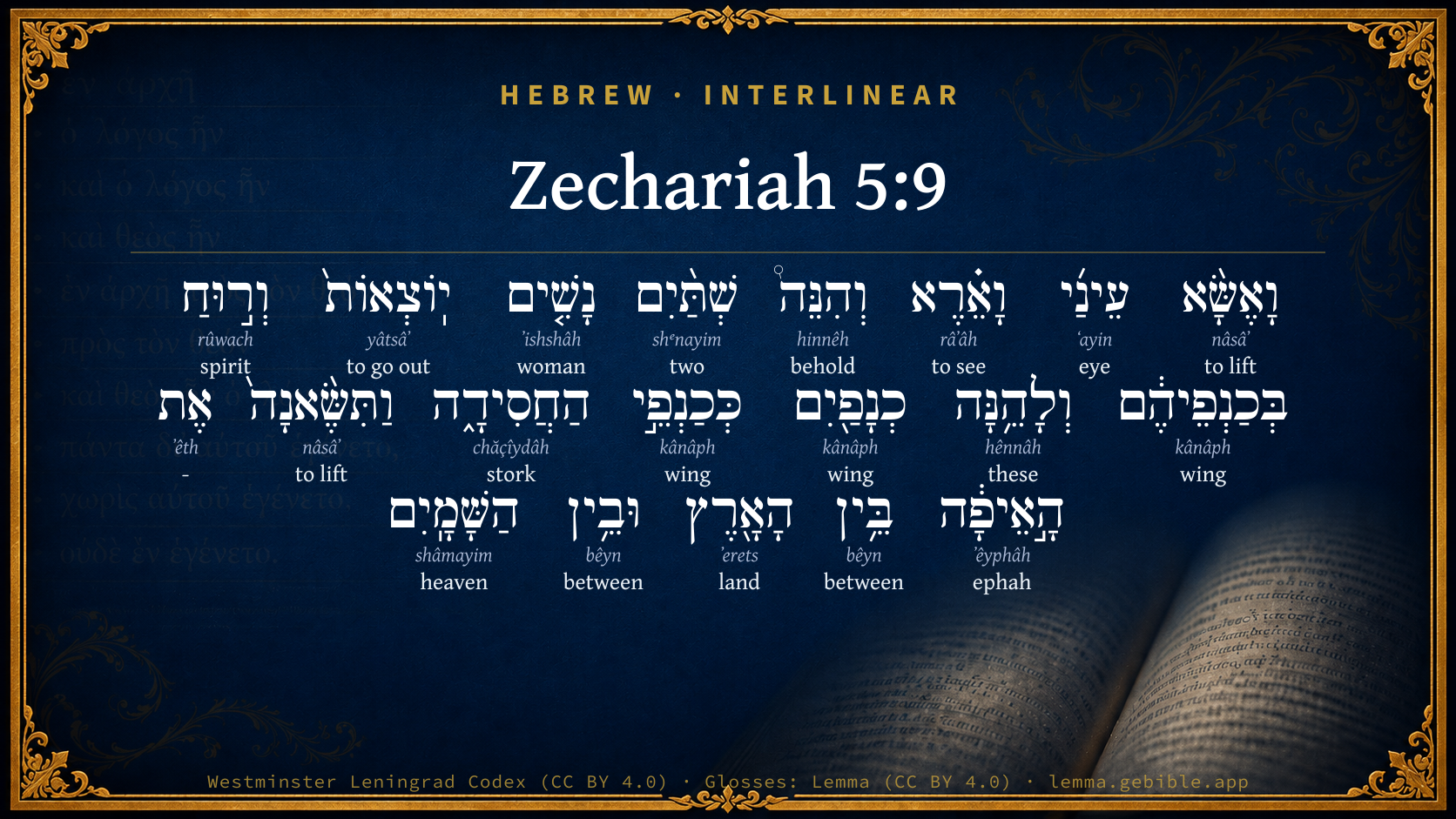
Hebrew (Westminster Leningrad Codex) Zechariah 5:9 appears in the Hebrew Old Testament. The text above is from the Westminster Leningrad Codex. Each word links to its Strong’s number, a concise gloss, and parsing drawn from the Open Scriptures Hebrew Bible morphology. Click any word for its full Brown-Driver-Briggs (BDB) entry.
Download image
Cite this verse

Zechariah 5:9 (World English Bible). Public Domain. Lemma interlinear Bible study tool, https://lemma.gebible.app/v/zechariah/5/9.

Show BibTeX & RIS
BibTeX
RIS
English Translation
Then lifted I up my eyes, and saw, and, behold, there were two women, and the wind was in their wings. Now they had wings like the wings of a stork, and they lifted up the ephah basket between earth and the sky.
World English Bible · Public Domain
Download a study sheet

One document with this verse’s original text, its word-by-word gloss line, the meaning frame, cross-references with their text, attributed commentary, and full source and license credits — printable, and it pastes into notes with its structure intact.

This verse Autodidact and up

Study sheet (.html) Plain text (.txt)

A passage Seminary Student

Up to 50 verses in one chapter. A passage sheet keeps up to 6 commentary sources and 12 cross-references per verse, in the order this page ranks them, and says so on the sheet whenever that leaves anything out. Ask for a single verse and you get the Autodidact verse sheet above.

Everything on this page stays free to read, with no account — the sheet is a download of what is already on screen, not access to it.

Want to remove ads? Support Godless Engineer
Compare translations 3

The same verse in 3 English versions, stacked beneath the original-language interlinear above. Click any original word for its lexicon entry.

Each is an independent rendering of the whole verse — the interlinear is not word-aligned to these translations.

Highlighted words mark where these versions differ — a whole-verse word diff, not a word-by-word alignment.

  • World English Bible Public Domain
    Then lifted I up my eyes, and saw, and, behold, there were two women, and the wind was in their wings. Now they had wings like the wings of a stork, and they lifted up the ephah basket between earth and the sky.
  • King James Version Public Domain
    Then lifted I up mine eyes, and looked, and, behold, there came out two women, and the wind was in their wings; for they had wings like the wings of a stork: and they lifted up the ephah between the earth and the heaven.
  • unfoldingWord Literal Text CC BY-SA 4.0
    And I lifted up my eyes and I saw, and behold, two women were going out, and wind in their wings. And they had wings like the wings of the stork. And they lifted up the ephah between the earth and between the heavens.

unfoldingWord Literal Text — © unfoldingWord, licensed CC BY-SA 4.0. Word-aligned USFM3 via Door43 (git.door43.org/unfoldingWord/en_ult).

Versions to compare (up to 4)

3 of 4 selected

Show all 18 translations

Every available English version of this verse, each an independent rendering of the whole verse.

  • World English Bible Public Domain
    Then lifted I up my eyes, and saw, and, behold, there were two women, and the wind was in their wings. Now they had wings like the wings of a stork, and they lifted up the ephah basket between earth and the sky.
  • Berean Standard Bible Public Domain
    Then I lifted up my eyes and saw two women approaching, with the wind in their wings. Their wings were like those of a stork, and they lifted up the basket between heaven and earth.
  • Majority Standard Bible Public Domain
    Then I lifted up my eyes and saw two women approaching, with the wind in their wings. Their wings were like those of a stork, and they lifted up the basket between heaven and earth.
  • King James Version Public Domain
    Then lifted I up mine eyes, and looked, and, behold, there came out two women, and the wind was in their wings; for they had wings like the wings of a stork: and they lifted up the ephah between the earth and the heaven.
  • American Standard Version (1901) Public Domain
    Then lifted I up mine eyes, and saw, and, behold, there came forth two women, and the wind was in their wings; now they had wings like the wings of a stork; and they lifted up the ephah between earth and heaven.
  • Revised Version (1885) Public Domain
    Then lifted I up mine eyes, and saw, and behold, there came forth two women, and the wind was in their wings; now they had wings like the wings of a stork: and they lifted up the ephah between the earth and the heaven.
  • Geneva Bible (1599) Public Domain
    Then lift I vp mine eyes, and looked: and beholde, there came out two women, and the winde was in their wings (for they had wings like the wings of a storke) and they lift vp the Ephah betweene the earth and the heauen.
  • Douay-Rheims (1899) Public Domain
    And I lifted up my eyes and looked: and behold there came out two women, and wind was in their wings, and they had wings like the wings of a kite: and they lifted up the vessel between the earth and the heaven.
  • Young's Literal Translation Public Domain
    And I lift up mine eyes, and see, and lo, two women are coming forth, and wind in their wings; and they have wings like wings of the stork, and they lift up the ephah between the earth and the heavens.
  • Literal Standard Version CC BY-SA 4.0
    And I lift up my eyes, and see, and behold, two women are coming forth, and wind [is] in their wings; and they have wings like wings of the stork, and they lift up the ephah between the earth and the heavens.
  • Unlocked Literal Bible CC BY-SA 4.0
    I lifted my eyes and saw two women coming toward me, and wind was in their wings—for they had wings like a stork's wings. They lifted up the basket between earth and heaven.
  • unfoldingWord Literal Text CC BY-SA 4.0
    And I lifted up my eyes and I saw, and behold, two women were going out, and wind in their wings. And they had wings like the wings of the stork. And they lifted up the ephah between the earth and between the heavens.
  • Darby Bible Public Domain
    And I lifted up mine eyes, and saw, and behold, there came out two women, and the wind was in their wings; and they had wings like the wings of a stork; and they lifted up the ephah between the earth and the heavens.
  • World Messianic Bible Public Domain
    Then I lifted up my eyes and saw, and behold, there were two women; and the wind was in their wings. Now they had wings like the wings of a stork, and they lifted up the efah basket between earth and the sky.
  • Webster's Bible Public Domain
    Then I lifted up my eyes, and looked and behold, there came out two women, and the wind was in their wings; for they had wings like the wings of a stork: and they lifted up the ephah between the earth and the heaven.
  • Free Bible Version CC BY-SA 4.0
    I looked once more and saw two women flying towards me. Their wings looked like those of a stork. They picked up the barrel and flew away, high into the sky.
  • Bible in Basic English Public Domain
    And lifting up my eyes I saw two women coming out, and the wind was in their wings; and they had wings like the wings of a stork: and they took the ephah, lifting it up between earth and heaven.
  • JPS Tanakh (1917) Public Domain
    Then lifted I up mine eyes, and saw, and, behold, there came forth two women, and the wind was in their wings; for they had wings like the wings of a stork; and they lifted up the measure between the earth and the heaven.

Literal Standard Version (2020), Covenant Press — licensed CC BY-SA 4.0. Text via the HelloAO Bible API (eBible.org). Unlocked Literal Bible (unfoldingWord) — licensed CC BY-SA 4.0. Text via the HelloAO Bible API (eBible.org). unfoldingWord Literal Text — © unfoldingWord, licensed CC BY-SA 4.0. Word-aligned USFM3 via Door43 (git.door43.org/unfoldingWord/en_ult). Free Bible Version, Dr. Jonathan Gallagher — licensed CC BY-SA 4.0. Text via the HelloAO Bible API (eBible.org).

Word by word

More ways to search: Search by grammar → Find every occurrence → Compare this word →

Practice this passage: Drill this verse → Learn its vocabulary →

הַחֲסִידָ֑ה
chăçîydâh
H2624
“the · stork”
Particle, Definite Article + Noun, Common, Feminine, Singular, Absolute
Part of Speech
Particle + Noun
Type
Common
Gender
Feminine
Number
Singular
State
Absolute
Full BDB Definition

Origin: from H2623

TWOT: 698c

stork
  1. וָאֶשָּׂ֨א nâsâʼ H5375 “and · to lift” Conjunction + Verb, Qal, Sequential Imperfect, 1st Person, Common, Singular
  2. עֵינַ֜י ʻayin H5869 “eyes · my” Noun, Common, Both, Dual, Construct + Suffix, Personal, 1st Person, Common, Singular
  3. וָאֵ֗רֶא râʼâh H7200 “and · to see” Conjunction + Verb, Qal, Sequential Imperfect, 1st Person, Common, Singular
  4. וְהִנֵּה֩ hinnêh H2009 “and · behold” Conjunction + Particle, Demonstrative
  5. שְׁתַּ֨יִם shᵉnayim H8147 “two” Adjective, Cardinal number, Feminine, Dual, Absolute
  6. נָשִׁ֤ים ʼishshâh H802 “women” Noun, Common, Feminine, Plural, Absolute
  7. יֽוֹצְאוֹת֙ yâtsâʼ H3318 “going out” Verb, Qal, Participle Active, Feminine, Plural, Absolute
  8. וְר֣וּחַ rûwach H7307 “and · spirit” Conjunction + Noun, Common, Both, Singular, Absolute
  9. בְּכַנְפֵיהֶ֔ם kânâph H3671 “in/at · wings · their” Preposition + Noun, Common, Feminine, Dual, Construct + Suffix, Personal, 3rd Person, Masculine, Plural
  10. וְלָהֵ֥נָּה hênnâh H2007 “and · to/for · them” Conjunction + Preposition + Suffix, Personal, 3rd Person, Feminine, Plural
  11. כְנָפַ֖יִם kânâph H3671 “wings” Noun, Common, Feminine, Dual, Absolute
  12. כְּכַנְפֵ֣י kânâph H3671 “like/as · wings of” Preposition + Noun, Common, Feminine, Dual, Construct
  13. וַתִּשֶּׂ֨אנָה֙ nâsâʼ H5375 “and · to lift” Conjunction + Verb, Qal, Sequential Imperfect, 3rd Person, Feminine, Plural
  14. אֶת ʼêth H853 “-” Particle, Direct Object
  15. הָ֣אֵיפָ֔ה ʼêyphâh H374 “the · ephah” Particle, Definite Article + Noun, Common, Feminine, Singular, Absolute
  16. בֵּ֥ין bêyn H996 “between” Preposition
  17. הָאָ֖רֶץ ʼerets H776 “the · land” Particle, Definite Article + Noun, Common, Both, Singular, Absolute
  18. וּבֵ֥ין bêyn H996 “and · between” Conjunction + Preposition
  19. הַשָּׁמָֽיִם shâmayim H8064 “the · heaven(s)” Particle, Definite Article + Noun, Common, Masculine, Plural, Absolute

About this verse

These counts appear in no published source. They are computed here, from the morphology-tagged text and Lemma’s own curated glosses. What Lemma adds →

20
words
16
distinct lemmas
Prophets
section

Notable vocabulary

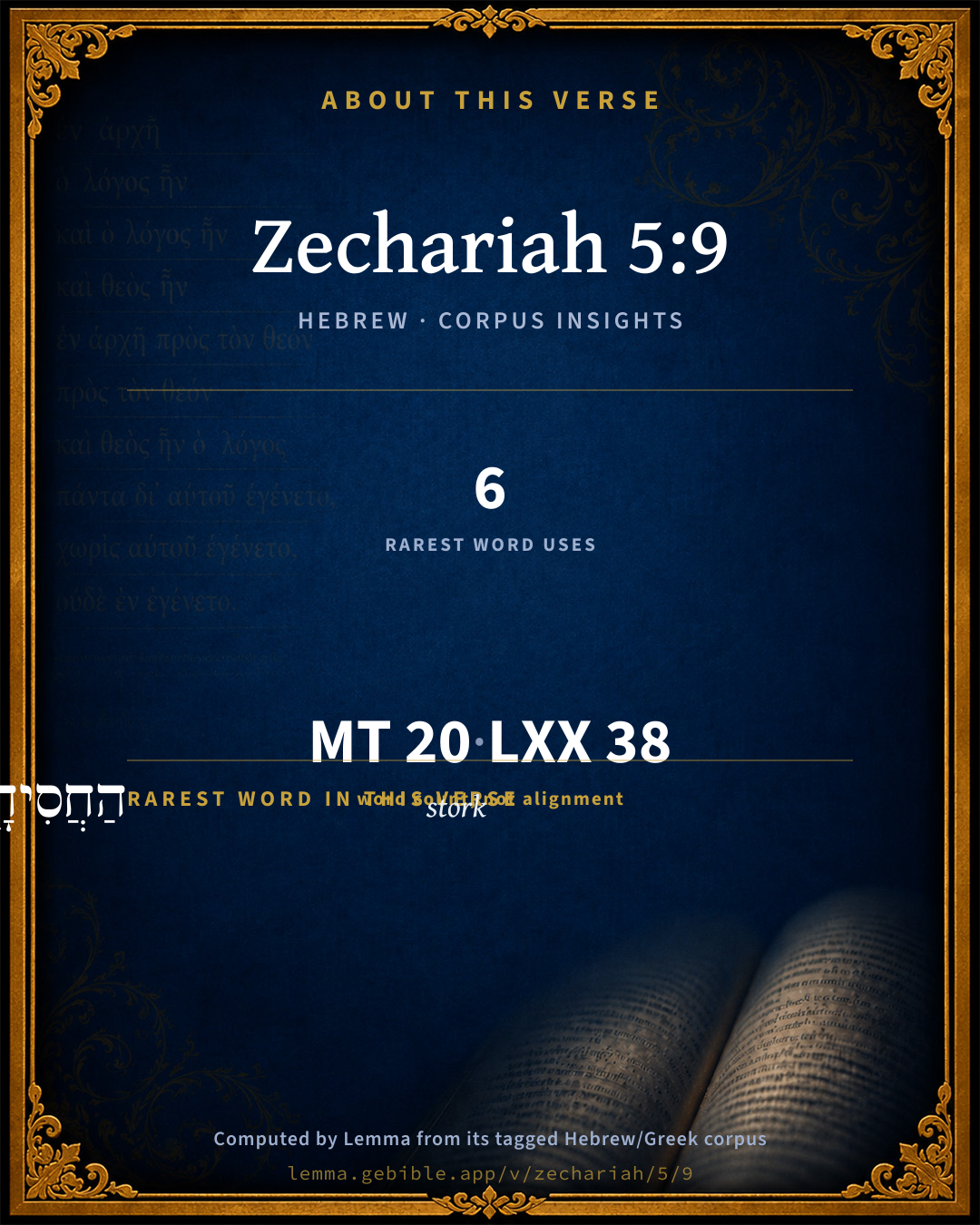
The rarest word here is הַחֲסִידָ֑ה stork H2624 — appearing just 6 times in the whole Hebrew Bible.

Shared distinctive vocabulary

הַחֲסִידָ֑ה stork H2624 occurs in 6 verses of the Hebrew Bible. Also found in:

Grammatical profile

  • 4 verbs
  • 10 nouns
  • 1 adjective
  • 3 prepositions
  • 2 particles

Verb forms

  • וָאֶשָּׂ֨א Qal · Sequential Imperfect
  • וָאֵ֗רֶא Qal · Sequential Imperfect
  • יֽוֹצְאוֹת֙ Qal · Participle Active
  • וַתִּשֶּׂ֨אנָה֙ Qal · Sequential Imperfect

Repetition

Words recur within this verse — often emphatic in Hebrew:

  • בְּכַנְפֵיהֶ֔ם wing H3671 ×3
  • וָאֶשָּׂ֨א to lift H5375 ×2
  • בֵּ֥ין between H996 ×2

Hebrew & Septuagint length

In English translation the verse runs 43 words from the Hebrew and 38 from the Septuagint (LXX English) — closely comparable.

A rough comparison of the two English renderings, which tokenize alike — not a word-level alignment.

Word counts can differ between the Hebrew and the Greek without any difference in meaning — e.g. the Hebrew direct-object marker אֵת has no separate Greek word, and Greek often adds the article ὁ.

In the original languages it is 20 Hebrew tokens and 38 Greek tokens — but the two are counted differently (Hebrew bundles its prefixes and suffixes into one token; the Greek is in lemma form), so that isn’t a like-for-like length.

Cross-references

5

Topical passages linked to Zechariah 5:9 in the Treasury of Scripture Knowledge — connected by theme and wording, ordered by reader-vote popularity; previews shown in the World English Bible.

  • Deuteronomy 28:49 Yahweh will bring a nation against you from far, from the end of the earth, as the eagle flies; a nation whose language you shall not understand;
  • Daniel 9:26–27 After the sixty-two weeks the Anointed One shall be cut off, and shall have nothing: and the people of the prince who shall come shall destroy the city and the sanctuary; and the end of it shall be with a flood, and even to the end shall be war; desolations are determined.
  • Hosea 8:1 "Put the trumpet to your lips! Something like an eagle is over Yahweh's house, Because they have broken my covenant, And rebelled against my law.
  • Leviticus 11:19 the stork, any kind of heron, the hoopoe, and the bat.
  • Matthew 24:28 For wherever the carcass is, there will the vultures be gathered together.

Cross-references courtesy of OpenBible.info (CC BY 4.0).

Hebrew and Greek witnesses Masoretic Hebrew ↔ Greek Septuagint

The same verse in the two great witnesses to the Old Testament, shown verse-for-verse.

These are two independent witnesses, not word-aligned to each other, and the Septuagint is shown in lemma (dictionary) form.

Hebrew Zechariah 5:9 Masoretic · Westminster Leningrad Codex

וָאֶשָּׂ֨א עֵינַ֜י וָאֵ֗רֶא וְהִנֵּה֩ שְׁתַּ֨יִם נָשִׁ֤ים יֽוֹצְאוֹת֙ וְר֣וּחַ בְּכַנְפֵיהֶ֔ם וְלָהֵ֥נָּה כְנָפַ֖יִם כְּכַנְפֵ֣י הַחֲסִידָ֑ה וַתִּשֶּׂ֨אנָה֙ אֶת הָ֣אֵיפָ֔ה בֵּ֥ין הָאָ֖רֶץ וּבֵ֥ין הַשָּׁמָֽיִם

Then lifted I up my eyes, and saw, and, behold, there were two women, and the wind was in their wings. Now they had wings like the wings of a stork, and they lifted up the ephah basket between earth and the sky.

World English Bible · Public Domain

Greek LXX Zechariah 5:9 Septuagint · lemma form

καί αἴρω ὁ ὀφθαλμός ἐγώ καί ὁράω καί ἰδού δύο γυνή ἐκπορεύομαι καί πνεῦμα ἐν ὁ πτέρυξ αὐτός καί οὗτος ἔχω πτέρυξ ὡς πτέρυξ ἔποψ καί ἀναλαμβάνω ὁ μέτρον ἀνά μέσος ὁ γῆ καί ἀνά μέσος ὁ οὐρανός

And I lifted up my eyes, and saw, and, behold, two women coming forth, and the wind was in their wings; and they had stork's wings: and they lifted up the measure between the earth and the sky.

LXX2012 (modern English Septuagint) · Public Domain

On this verse, Jamieson, Fausset & Brown discusses the Septuagint’s reading. Read the note in Commentary ↓

Hebrew: Westminster Leningrad Codex (CC BY 4.0). Greek: Septuagint (public domain); English from LXX2012 (modern English Septuagint) (Public Domain). How the Septuagint differs from the Hebrew →

Targum (Aramaic paraphrase)

1

The Targum is the ancient Jewish Aramaic paraphrase of the Hebrew Scriptures — an interpretive translation, not the Hebrew text itself. Onkelos (literal) and Pseudo-Jonathan (expansive) render the Torah, and Jonathan the Prophets. Coverage is partial: where no permissively-licensed English translation exists for a verse, only the Aramaic is shown. This is verse-level text, not a word-by-word alignment to the Hebrew.

  1. Targum Jonathan Prophets (Joshua–Malachi)
    וּזְקָפֵית עֵינַי וַחֲזֵית וְהָא תַרְתֵּין מְדִינָן גַלְיָן לְבֵינֵי מַלְכְּוַת עַמְמֵי אַרְעָא וְעַמְמִין קַלִילִין מִגְלַן יַתְהוֹן בְקַלִילוּ כְּמָא דְמִשְׁתְּדֵי נִשְׁרָא וְאַגְלִיאוּ יַת עַמָא דַהֲווֹ נַסְבִין וְיָהֲבִין בִּמְכִילְתָּא דְשִׁקְרָא לְבֵינֵי מַלְכְּוַת עַמְמַיָא דְאַרְעָא דִתְחוֹת כָּל שְׁמַיָא:

    (no public-domain English translation for this verse)

    Targum Jonathan — Aramaic: “Mikraot Gedolot” (public domain). English: “Sefaria Community Translation” (CC0 1.0 (public-domain dedication)); “London "Chaldee Paraphrase," 1871” (public domain). Text via Sefaria.

Commentary

Notes on Zechariah 5:9 from classic Christian and Jewish commentators (each source and its license shown beneath its notes). The classic Christian expositions comment on the surrounding passage and are grouped to its opening verse, so a note may address several verses; the Jewish commentaries on the Tanakh (Rashi and others) are per-verse, so they appear only where the commentator wrote on this verse.

Lemma curates 59 commentaries, every one of them public domain or Creative Commons licensed, each selected and text-cleaned for this edition rather than reprinted as found. About our sources →

Trapp's Complete Commentary

John Trapp

Zec 5:9 Then lifted I up mine eyes, and looked, and, behold, there came out two women, and the wind [was] in their wings; for they had wings like the wings of a stork: and they lifted up the ephah between the earth and the heaven.

Ver. 9. Behold, there came out two women] Winged women, and carried through the air with a pleasant wind, to note their ready and speedy obedience, prompt and present. Women they are said to be, to keep proportion with the present vision; lest the meeting and mixing together of men and women in the same matter might minister occasion to some impure surmisings. But that they were men, and not women, that are here meant is agreed upon by all. These were Ezra and Nehemiah (saith Willet on Lev 11:1-47., after Junius and Piscator on the text), those great reformers of the Jewish Church. But this stands not with the last verse. I rather subscribe to those that expound the text of the Romans, who with great celerity and violence destroyed the Jews’ state; and so, that which they feared befell them, Joh 11:48. The Romans, said they, shall come to take away both our place and our nation; and within a few years it proved accordingly; as if God had taken them at their word, as he did those murmuring miscreants, Num 14:28 "As truly as I live, saith the Lord, as ye have spoken in mine ears, so will I do unto you." Hereunto the Chaldee paraphrast consenteth, when by these two women thus described he understandeth, populos leves et expeditos, such agents and instruments as God would employ in the speedy execution of his wrath upon the Jewish nation; such as were Titus, Vespasian, and Aelius Adrian. Diodati maketh these two women a figure of God, two properties, namely, mercy towards his elect, and justice towards his enemies, wherewith he transports upon these last the judgments by which he had punished his own people; which is done with admirable celerity. Thus he. Danaeus makes those two women to be the anger and justice of God, which do always follow and wait upon one another, and take vengeance on men’s wickedness. Iudicium sit penes lectorem.

And the wind was in their wings] A masculine affix referred to a feminine noun: to intimate that these women were indeed types of men, saith Mr Pemble. The Romans were men every inch of them, as the proverb is; and therefore of cowards they were wont to say that they had nothing Roman in them; and of Brutus, that he was the last of the Romans.

And they lift up the ephah between the earth and the heaven] This betokeneth a deportation and dissection of the Jewish nation; being tossed as a tennis ball into all nations, and scattered into the four winds, as Jer 49:36. Rupertus hence concludeth them rejected of both earth and heaven. Out of the earth they are as it were banished, by a common consent of nations; and heaven admitteth them not, as those that please not God, and are contrary to all men, 1Th 2:15. And as their guide Judas, when they took Jesus, was hanged between heaven and earth, being coelo terraeque perosus; so fares it with that wretched people, and will do till God shall call them a people which were not a people, and her beloved which was not beloved, Rom 9:25.

John Trapp, A Commentary or Exposition upon All the Books of the Old and New Testament (1647–1656) — public domain. Text from a community e-Sword module.

Joseph Benson's Commentary

Zec 5:9-11. Then lifted I up mine eyes, &c. — Great difficulties attend the interpretation of this part of the vision, and commentators are much divided upon it. According to Calmet, the woman enclosed in the ephah denoted the iniquity of Babylon; the mass of lead which fell down upon her was the vengeance of the Lord; and the two women who lifted her up into the air were the Medes and Persians, who destroyed the empire of Babylon. Houbigant, however, observes, “that nobody has yet found out, nor ever will find out, why these women should carry the ephah into the land of Shinar, or of the Chaldees, if Shinar be understood literally, and not metaphorically. The Jews were not again carried captive into the land of the Chaldeans, after the rebuilding of the temple by Zerubbabel; nor can the Chaldeans be understood by the ephah which is carried into the land of Shinar with the woman, who abused it to fraudulent purposes; for the ephah is a Hebrew measure; and this woman, who is kept shut up in the ephah, is carried into a land not her own. Shinar will be more properly understood, as spoken metaphorically of the last captivity, under which the Jews now live; being, in the several kingdoms of the world, in the same state of servitude as they lived in under, the kings of the Chaldeans; having their dwelling everywhere, with the deceitful ephah, to denote their usury and fraud. There is no necessity to be anxious about explaining why the ephah was to be carried by two women, and not by one only, or more, for the empire of the Greeks and Romans is not denoted hereby, but two women pertain only to the parable; as it might have seemed too much for one to have carried into a distant country an ephah burdened with lead, and with a woman shut up in it.” Archbishop Newcome understands the words in this sense: considering the two women as “mere agents in the symbolical vision;” the meaning of which, he says, seems to be, “that the Babylonish captivity had happened on account of the wickedness committed by the Jews; and that a like dispersion would befall them, if they relapsed into like crimes. Thus the whole chapter would be an awful admonition that multiplied curses, and particularly that dispersion and captivity, would be the punishment of national guilt.” Blayney interprets the vision in a similar way. “These, [namely, two women,] and the other circumstances mentioned Zec 5:9, seem to indicate nothing more particular, than that Providence would make use of quick and forcible means to effect its purpose.” Hence these women are said to have had wings like the wings of a stork; the stork, like other birds of passage, being provided with strong wings. Though the land of Shinar signifies, as he observes, the land of Babylon, (see Gen 11:2,) yet “this does not necessarily imply that Babylon would be the scene of the next captivity; but only that the people, in case of fresh transgression, might expect another severe captivity, like that in Babylon, but of still longer duration. In this manner Egypt is used proverbially for any grievous calamity, inflicted by the judgment of God: see Deu 28:68; Hos 8:13; Hos 9:3.”

Joseph Benson's Commentary on the Old and New Testaments (1811–1818) — public domain. Text from a community e-Sword module.

Keil & Delitzsch

C. F. Keil & F. Delitzsch

Zac 5:9. "And I lifted up my eyes, and saw, and behold there came forth two women, and wind in their wings, and they had wings like a stork's wings; and they carried the ephah between earth and heaven. Zac 5:10. And I said to the angel that talked with me, Whither are these taking the ephah? Zac 5:11. And he said to me, To build it a dwelling in the land of Shinar: and it will be placed and set up there upon its stand." The meaning of this new scene may easily be discovered. The ephah with the woman in it is carried away between earth and heaven, i.e., through the air. Women carry it because there is a woman inside; and two women, because two persons are required to carry so large and heavy a measure, that they may lay hold of it on both sides (תּשּׂנה with the א dropped; cf. Ges. 74, Anm. 4). These women have wings, because it passes through the air; and a stork's wings, because these birds have broad pinions, and not because the stork is a bird of passage or an unclean bird. The wings are filled with wind, that they may be able to carry their burden with greater velocity through the air. The women denote the instruments or powers employed by God to carry away the sinners out of His congregation, without any special allusion to this or the other historical nation. This is all that we have to seek for in these features, which only serve to give distinctness to the picture. But the statement in Zac 5:11 is significant: "to build it a house in the land of Shinar." The pronoun לה with the suffix softened instead of לּהּ, as in Exo 9:18; Lev 13:4 (cf. Ewald, 247, d), refers grammatically to האיפה; but so far as the sense is concerned, it refers to the woman sitting in the ephah, since a house is not built for a measure, but only for men to dwell in. This also applies to the feminine form הנּתחה, and to the suffix in מכנתהּ. The building of a house indicates that the woman is to dwell there permanently, as is still more clearly expressed in the second hemistich. הוּכן refers to בּית , and is not to be taken hypothetically, in the sense of "as soon as the house shall be restored," but is a perfect with Vav consec.; and hūkhan, the hophal of kūn, is not to be taken in the sense of restoring, but, in correspondence with mekhunâh, in the sense of establishing or building on firm foundations. Mekhunâh: the firmly established house. In this the woman of sin is brought to rest. The land in which the woman of sin carried away out of the holy land is permanently to dwell, is the land of Shinar. This name is not to be identified with Babel, so as to support the conclusion that it refers to a fresh removal of the people of Israel into exile; but according to Gen 10:10 and Gen 11:2, Shinar is the land in which Nimrod founded the first empire, and where the human race built the tower of Babel which was to reach to the sky. The name is not to be taken geographically here as an epithet applied to Mesopotamia, but is a notional or real definition, which affirms that the ungodliness carried away out of the sphere of the people of God will have its permanent settlement in the sphere of the imperial power that is hostile to God. The double vision of this chapter, therefore, shows the separation of the wicked from the congregation of the Lord, and their banishment into and concentration within the ungodly kingdom of the world. This distinction and separation commenced with the coming of the Messiah, and runs through all the ages of the spread and development of the Christian church, until at the time of the end they will come more and more into outward manifestation; and the evil, having been sifted out by the judicial power of God and His Spirit, will form itself into a Babel of the last days, as Ezekiel 38 and 39 clearly show, and attempt a last struggle with the kingdom of God, in which it will be overcome and destroyed by the last judgment.

Keil & Delitzsch — Biblical Commentary on the Old Testament (1861–1891) — public domain (CC PDM 1.0). Text via the HelloAO Bible API. (Old Testament only.)

Tyndale Open Study Notes

Tyndale Open Resources

5:9 The depiction of divine or angelic winged creatures as women is unusual in the Old Testament. If the two women are the Lord’s servants, they are unique angels. If they are the attendants of Wickedness (a foreign goddess), their submission to God’s command demonstrates his power over false gods.

Tyndale Open Study Notes — © Tyndale Open Resources, licensed CC BY-SA 4.0. Text via the HelloAO Bible API.

Geneva Bible (1599)

Geneva Bible translators

Which declared that God would execute his judgment by the means of the weak and infirm means.

Geneva Bible (1599) marginal notes — public domain. Text via Bolls.life.

Jamieson, Fausset & Brown

Robert Jamieson, A. R. Fausset & David Brown

The agents to carry away the "woman," are, consistently with the image, "women." God makes the wicked themselves the agents of punishing and removing wickedness. "Two" are employed, as one is not enough to carry such a load [MAURER]. Or, the Assyrians and Babylonians, who carried away idolatry in the persons, respectively, of Israel and Judah [HENDERSON]. As two "anointed ones" (Zac 4:14) stand by the Lord as His ministers, so two winged women execute His purpose here in removing the embodiment of "wickedness": answering to the "mystery of iniquity" (the Septuagint here in Zechariah uses the same words as Paul and "the man of sin," whom the Lord shall destroy with the spirit of His mouth and the brightness of His coming, Th2 2:3, Th2 2:7-8). Their "wings" express velocity. The "stork" has long and wide wings, for which reason it is specified; also it is a migratory bird. The "wind" helps the rapid motion of the wings. The being "lifted up between heaven and earth" implies open execution of the judgment before the eyes of all. As the "woman" here is removed to Babylon as her own dwelling, so the woman in the Apocalypse of St. John is Babylon (Rev 17:3-5).

Jamieson, Fausset & Brown — Commentary Critical and Explanatory on the Whole Bible (1871) — public domain (CC PDM 1.0). Text via the HelloAO Bible API.

Adam Clarke's Commentary

Verse 9. There came out two women] As the one woman represented the impiety of the Jewish nation; so these two women who were to carry the ephah, in which the woman INIQUITY was shut up, under the weight of a talent of lead, may mean the desperate UNBELIEF of the Jews in rejecting the Messiah; and that IMPIETY, or universal corruption of manners, which was the consequence of their unbelief, and brought down the wrath of God upon them. The strong wings, like those of a stork, may point out the power and swiftness with which Judea was carried on to fill up the measure of her iniquity, and to meet the punishment which she deserved.

Between the earth and the heaven.] Sins against GOD and MAN, sins which heaven and earth contemplated with horror.

Or the Babylonians and Romans may be intended by the two women who carried the Jewish ephah to its final punishment. The Chaldeans ruined Judea before the advent of our Lord; the Romans, shortly after.

Adam Clarke's Commentary on the Bible (1810–1826) — public domain. Text from a community e-Sword/MySword module.

John Calvin's Commentaries

The Prophet says here that such would be the change of things, that God would in turn afflict the Chaldeans, who had so cruelly treated the chosen people. And this is the reason why I think that iniquity is to be taken for the violent injustice and plunder which heathen enemies had exercised towards the Jews. For when he says that a house would be for iniquity in the land of Shinar, it is as though he had said, “as Judea has been for a long time plundered by enemies, and has been exposed to their outrages, so the Chaldeans in their turn shall be punished, not once, nor for a short time, but perpetually; for God will fix a habitation for wickedness in their land.” We hence see the design of the vision, that is, that when God had mercy on his Church its enemies would have to render an account, and that they would not escape God’s hand, though he had employed them to chastise his people.

He says then, that wickedness was taken away, that a house might be made for it, that is, that it might have a fixed and permanent dwelling in the land of Shinar, which means among the Chaldeans, who had been inveterate enemies to the Jews; and as Babylon was the metropolis of that empire, he includes under it all the ungodly who opposed or persecuted the children of God. Why God represents the measure as carried away by women rather than by men does not appear to me, except it was that the Jews might know that there was no need of any warlike preparations, but that their strongest enemies could be laid prostrate by weak and feeble instruments; and thus under the form of weakness his own power would be made evident. The Prophet saw women with wings, because sudden would be the change, so that in one day, as we shall presently see, wickedness was taken away. By the wings of a stork either celerity or strength is indicated. This is the sum of the whole.

John Calvin's Commentaries (1540-1563) — public domain. Text from the Calvin Translation Society English edition (1840s-50s) via the Christian Classics Ethereal Library (ccel.org). Calvin's coverage is partial (roughly two-thirds of the Bible); uncommented books and verses are honest gaps, never fabricated. The 19th-century editor's footnotes and remarks are omitted so the notes are faithfully Calvin's own voice.

Ellicott's Commentary for English Readers

(9) Behold . . .—Here commences the third scene of the vision. We need not enter into the minute details of the verse, as they are, probably, introduced merely to give greater distinctness to the picture. (Comp. Note on Zec_1:8.) The wings of the woman seem, however, to be represented as filled with the wind to enable them to carry their burden with greater ease and velocity through the air. The prophet, perhaps, borrowed his imagery from some of the grotesque figures he had seen in Babylon.

A Bible Commentary for English Readers, edited by Charles John Ellicott (1878–1897) — public domain. Text from a community e-Sword module.

The Cambridge Bible for Schools and Colleges

gen. ed. J. J. S. Perowne

9. looked] Rather, saw.

came out] or came forth (as in Zec_5:5-6), from the surrounding darkness upon the stage or scene of the vision.

No meaning need be sought for the details of this verse. They merely convey the fact, clothed in imagery in keeping with the vision, that wickedness was borne swiftly from the land. “Pertinent haec ad colorem imaginis.” Maurer.

The Cambridge Bible for Schools and Colleges (gen. ed. J. J. S. Perowne; Cambridge University Press, 1878–1918) — public domain. Text from a community e-Sword module.

John Gill's Exposition

Then lifted I up mine eyes, and looked,.... This is not a new vision, but a continuation of the former, as appears from the "ephah" seen in it:

and, behold, there came out two women; out of the same place the "ephah" did. The Targum explains these "two women" by two provinces; and Kimchi interprets them of the two tribes of Judah and Benjamin, who had been carried captive into Babylon; and others of the two kings, Jehoiakim and Zedekiah, who were the cause of the captivity; but Jarchi understands by them the Babylonians and Chaldeans, two nations as one, joined in Nebuchadnezzar's armies, which carried them captive: others think the two reformers, Ezra and Nehemiah, are meant, who were instruments of purging the Jews, returned from captivity, though but weak ones, and therefore are compared to "women"; yet what they did they did swiftly, and therefore are said to have "wings", and under the influence of the Spirit of God; hence the "wind", or "spirit" (f), is said to be in their wings; and they acted from a tender regard to the glory of God and the good of their country; and therefore their wings were like the "wings of a stork"; a bird of passage, as appears from Jer 8:7 and so a fit emblem to be used in the transportation of the "ephah"; of whom Pliny (g) says, from whence they come, and whither they betake themselves, is yet unknown; and adds, there is no doubt that they come from afar; as it is plain they must, if that relation be true, which seems to have good authority, that one of these creatures, upon its return to Germany, brought a green root of ginger with it; which must come from the eastern part of the world; from Arabia, or Ethiopia, or the East Indies, where it grows (h): and as it is a bird that takes such long flights, it must have wings fitted for such a purpose; and which are taken notice of in Job 39:13 to which the wings and feather of the ostrich are compared; for so Bochart (i) there renders the word, "the wing of the ostriches rejoices, truly the wing" as of "a stork, and the feather"; or, as others, "who gave wings to the stork and ostrich?" both remarkable for their wings: and Vatablus renders the word here an "ostrich"; which, according to Pliny (k), is the largest of birds, and almost as big as a beast. In Ethiopia and Africa they are taller than a horse and his rider, and exceed the horse in swiftness; and their wings seem to be given them to help them in running; but which are not sufficient to lift them much above the earth, and so can not be meant here; but rather the stork, whose wings are black and white; and when they fly, they stretch out their necks forwards, and their feet backwards, and with these direct their course; when a tempest rises, standing on both feet, they spread their wings, lay their bill upon their breast, and turn their face that way the storm comes (l). The Targum renders it an eagle, which is the swiftest of birds, and whose wings are very strong to bear anything upon them, as they do their young, to which the allusion is, Deu 32:11 and so, if meant here, to lift up and bear away the ephah between the earth and the heaven; but the word is never used of that bird. The Harpies or Furies, with the Heathens, are represented, as women having wings (m) as these women are said to have; but these are very different women from them. Though some think the Romans, under Vespasian and Titus, are intended; but it may be that the two, perfections of God, his power and justice, in punishing men for their sins, are meant, particularly in the last times, and at the day of judgment. The power of God will be seen in raising the dead; in bringing all to judgment; in separating the wicked from the righteous, and in the execution of the sentence denounced on them: and the justice of God will be very conspicuous in the judgment and destruction of them.

And the wind was in their wings; they had wings, as denoting swiftness, as angels are said to have; hence Maimonides, as Kimchi observes, thought that angels are here meant; but this denotes, that though God is longsuffering, and may seem to defer judgment, which is sometimes a stumbling to the righteous, and a hardening to the wicked; yet, as this is only for the salvation of his elect, so when once the time is up, and the commission given forth, power and justice will speedily execute the sentence: and the "wind" being in their wings shows the greater swiftness and speed in the dispatch of business, and the great strength and force with which they performed it:

for they had wings like the wings of a stork; which, being a creature kind and tender, show that there is no cruelty in the displays of the power and justice of God in punishing sinners:

and they lifted up the ephah between the earth and the heaven; which denotes the visibility of the whole measure of the sins of wicked men; they will all be made manifest, and brought into judgment: and also the visibility of their punishment; they will go into everlasting punishment, in the sight of angels and men; and which will be the case of the antichristian beast, Rev 17:8.

(f) "spiritus", V. L. Pagninus, Montanus, Calvin, Burkius. (g) Nat. Hist. l. 10. c. 23. (h) Vid. Bochart. Hierozoic. par. 2. l. 2. c. 29. col. 328, 332. (i) Ibid. c. 16. col. 247, 248. (k) Nat. Hist. l. 10. c. 1. (l) Schotti Physica Curiosa, par. 2. l. 9. c. 26. p. 1162. (m) "Harpyiae et magnis quatiunt clangoribus alas." Virgil. Aeneid. l. 3. ver. 223.

John Gill's Exposition of the Whole Bible (1746–1763) — public domain (CC PDM 1.0). Text via the HelloAO Bible API.

Albert Barnes' Notes on the Bible

There came out two women - It may be that there may be no symbol herein, but that he names women because it was a woman who was so carried; yet their wings were the wings of an unclean bird, strong, powerful, borne by a force not their own; with their will, since they flew; beyond their will, since the wind was in their wings; rapidly, inexorably, irresistibly, they flew and bore the Ephah between heaven and earth. No earthly power could reach or rescue it. God would not. It may be that evil spirits are symbolized, as being like to this personified human wickedness, such as snatch away the souls of the damned, who, by serving them, have become as they.

Albert Barnes' Notes on the Bible (1834–1885) — public domain. Text from a community e-Sword/MySword module.

Haydock's Catholic Bible Commentary

Women. They often represent nations; and here the Jews understand the Medes and Greeks, who punished the Chaldeans. St. Jerome rather thinks that the Assyrians and Chaldeans are meant, carrying away Israel and Juda. Yet the former supposition seems preferable, as the woman in the vessel signified the wickedness of Babylon. --- Kite. Moderns have, "stork:" the true sense is uncertain. (Calmet) --- The Jews became blind and hardened on account of their avarice and perjuries. (Worthington)

George Leo Haydock (1774–1849), Haydock's Catholic Family Bible and Commentary, 1859 edition — public domain. Excludes Psalms (Douay-Rheims chapter numbering differs from Protestant) and Deuterocanonical books (Catholic canon only).

Matthew Poole's English Annotations

Then lifted I up mine eyes, and looked: see Zec 5:1.

There came out, from the same place whence the ephah came,

two women: the sinful nation was resembled to a woman, and now, to keep a decorum in the vision, they who are to be God’s executioners, to punish that wicked woman, are called women: it is like enough to be meant of the Romans, a warlike and stout nation.

The wind was in their wings: they are set forth as having wings like the wings of storks, large and strong, and as flying before the wind with great swiftness; so should Divine vengeance swiftly follow and certainly overtake the Jewish nation, when, after their return out of captivity, they shall corrupt themselves, and fill up the measure of their sins.

They lifted up the ephah between the earth and the heaven; the judgments came thus flying, and so bare away with them those that are to be punished: it is a secret intimation of a future deportation or carrying the Jews into captivity again for sin.

Matthew Poole's English Annotations on the Holy Bible (1683–1685) — public domain. Text from a community e-Sword/MySword module.

The Pulpit Commentary

Then lifted I up mine eyes. This is the conclusion of the vision. And looked; and saw. There came out (forth) two women. These two women who now come in sight have been supposed to represent the Assyrians and Babylonians, who wore the agents in the deportation of Israel; or else are considered abettors of the woman in the ephah, who for a time save her from destruction. This latter supposition proceeds on the erroneous idea that wickedness is herein rescued from punishment, whereas the notion that underlies the whole vision is that the Holy Land is purged of wickedness. That the two nations hostile to Israel are represented is an untenable suggestion; for why should they carry off iniquity from Jerusalem and fix it in their own land? Probably by the two women carrying away the evil woman is signified (if the details are capable of explanation) that iniquity brings with it its own destruction and works out its own removal. The wind was in their wings. They were borne along so quickly that they seemed to be carried by the wind; or the wind helped their flight. A stork; Septuagint, epopov , "the hoopoe;" Vulgate, milvi. The Authorized Version is certainly correct. The stork is common enough in Palestine, and is reckoned among unclean birds in the Pentateuch, (Lev_11:19 Deu_14:18) for which cause some have thought it is here introduced as bearing the sin laden ephah. But its introduction more probably has reference to its migratory habits, the power and rapidity of its flight, and, as some think, to its skill in constructing its nest.

The Pulpit Commentary (1880–1919), ed. H.D.M. Spence-Jones & Joseph S. Exell — public domain. Text from a community e-Sword module.

John Wesley's Explanatory Notes

There came out - From the same place whence the ephah came. Their wings - They had wings, like the wings of storks, large and strong, and flew before the wind with great swiftness. The judgments came thus flying, and so bore away with them those that were incorrigible.

John Wesley, Explanatory Notes Upon the Whole Bible (1754–1765) — public domain. Text via the GEBible commentary corpus.

Rashi

Rabbi Shlomo Yitzchaki (Rashi)

two women were coming forth from the house.

the stork the white dayyah (Hullin 63a), voltur in Old French.

Rashi on the Tanakh — English translations: “The Judaica Press complete Tanach with Rashi, translated by A. J. Rosenberg” (CC BY 4.0); “Pentateuch with Rashi's commentary by M. Rosenbaum and A.M. Silbermann, 1929-1934” (public domain); “The Metsudah Tanach series, Lakewood, N.J” (CC BY 4.0); and “The Book of Joshua, Metsudah Publications, 1997” (CC BY 4.0). Text via Sefaria.

Lesson kit

Teaching starters — assembled from the data on this page, not authored interpretation. Every prompt links to the verse data it draws on. Edit before teaching.

Zechariah, in the Prophets, opens this verse with 20 words (16 distinct Hebrew lemmas). Its most distinctive word is chăçîydâh (“stork”). A historical commentator’s framing appears above. Read the whole chapter for the surrounding context.

Discussion questions

  1. How does “stork” (chăçîydâh) shape what this verse is saying?
  2. How does Leviticus 11:19, which shares the word «stork», read alongside this verse?
  3. What does the repetition of “wing” (3× in this one verse) do in this verse?
  4. The translations on this page render this verse differently — a whole-verse word diff, not a word-by-word alignment. What might account for the different wordings?
  5. «וָאֶשָּׂ֨א» is a Qal Sequential Imperfect verb. How does that grammatical form shape the action described?
  6. Compare how Trapp's Complete Commentary and Joseph Benson's Commentary read this verse. Where do they agree or differ?

Things to notice

Reading settings

Reading text

Shown beneath each verse's original-language words.

Old Testament
Old Testament edition

Read the OT as the Masoretic Hebrew (MT) or the Greek Septuagint (LXX).

English shown for the Greek Septuagint (in the Hebrew ↔ Greek comparison).

Comparing translations? Open the Compare panel on any verse page to stack up to four side by side.