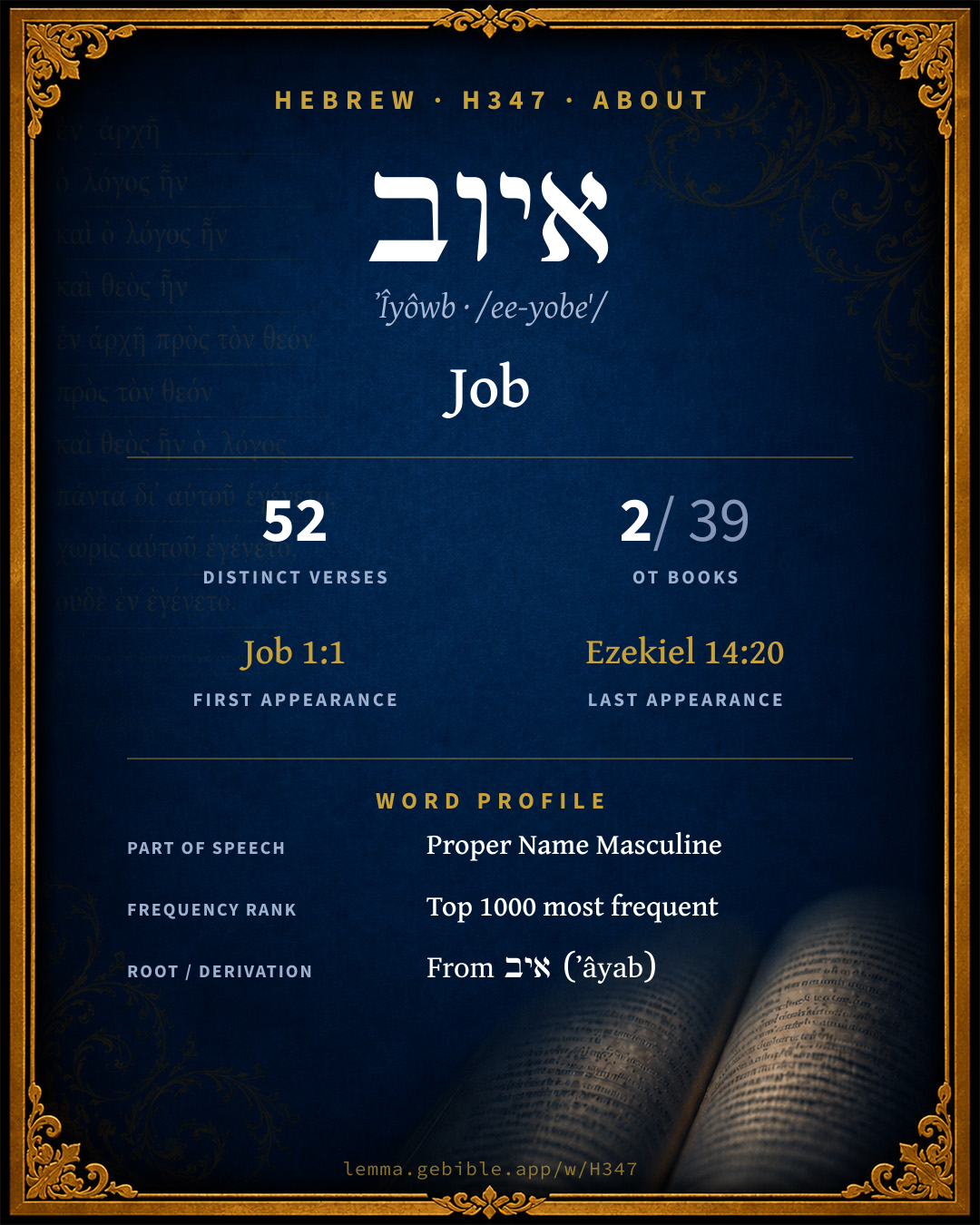
אִיּוֹב
Job
BDB lists 2 entries for ‘Job’ fuller range ↓
Full lexicon entry — Brown-Driver-Briggs (BDB)
From Brown-Driver-Briggs (BDB)
Where this word appears
Grammar key — what these labels mean
Part of speech
- Noun
- A naming word — a person, place, thing, or idea.
Noun type
- Proper
- A name of a specific person, place, or people (e.g. Abraham, Zion, Israel).
Every verse where H347 appears — 52 distinct verses across 2 books. Click any verse to open its interlinear word-by-word view. Verse text shown in the World English Bible for context — . Each verse’s Hebrew form is shown with its reference; the English is not keyword-highlighted, since the data carries no word-level English alignment. Use “Compare translations” on any verse to read it across multiple English versions. This concordance covers the Hebrew Bible; Septuagint (Greek Old Testament) occurrences are not indexed here.
Job 50 verses
- Job 1:1 אִיּ֣וֹב n Proper There was a man in the land of Uz, whose name was Job. That man was blameless and upright, and one who feared God, and turned away from evil.
- Job 1:5 אִיּ֣וֹב אִיּ֔וֹב אִיּ֖וֹב n Proper n Proper n Proper It was so, when the days of their feasting had run their course, that Job sent and sanctified them, and rose up early in the morning, and offered burnt offerings according to the number of them all. For Job said, "It may be that my sons have sinned, and renounced God in their hearts." Thus did Job continually.
- Job 1:8 אִיּ֑וֹב n Proper Yahweh said to Satan, "Have you considered my servant, Job? For there is none like him in the earth, a blameless and an upright man, one who fears God, and turns away from evil."
- Job 1:9 אִיּ֖וֹב n Proper Then Satan answered Yahweh, and said, "Does Job fear God for nothing?
- Job 1:14 אִיּ֖וֹב n Proper that there came a messenger to Job, and said, "The oxen were plowing, and the donkeys feeding beside them,
- Job 1:20 אִיּוֹב֙ n Proper Then Job arose, and tore his robe, and shaved his head, and fell down on the ground, and worshiped.
- Job 1:22 אִיּ֑וֹב n Proper In all this, Job did not sin, nor charge God with wrongdoing.
- Job 2:3 אִיּוֹב֒ n Proper Yahweh said to Satan, "Have you considered my servant Job? For there is none like him in the earth, a blameless and an upright man, one who fears God, and turns away from evil. He still maintains his integrity, although you incited me against him, to ruin him without cause."
- Job 2:7 אִיּוֹב֙ n Proper So Satan went forth from the presence of Yahweh, and struck Job with painful sores from the sole of his foot to his head.
- Job 2:10 אִיּ֖וֹב n Proper But he said to her, "You speak as one of the foolish women would speak. What? Shall we receive good at the hand of God, and shall we not receive evil?" In all this Job didn't sin with his lips.
- Job 2:11 אִיּ֗וֹב n Proper Now when Job's three friends heard of all this evil that had come on him, they each came from his own place: Eliphaz the Temanite, Bildad the Shuhite, and Zophar the Naamathite, and they made an appointment together to come to sympathize with him and to comfort him.
- Job 3:1 אִיּוֹב֙ n Proper After this Job opened his mouth, and cursed the day of his birth.
- Job 3:2 אִיּ֗וֹב n Proper Job answered:
- Job 6:1 אִיּ֗וֹב n Proper Then Job answered,
- Job 9:1 אִיּ֗וֹב n Proper Then Job answered,
- Job 12:1 אִיּ֗וֹב n Proper Then Job answered,
- Job 16:1 אִיּ֗וֹב n Proper Then Job answered,
- Job 19:1 אִיּ֗וֹב n Proper Then Job answered,
- Job 21:1 אִיּ֗וֹב n Proper Then Job answered,
- Job 23:1 אִיּ֗וֹב n Proper Then Job answered,
- Job 26:1 אִיּ֗וֹב n Proper Then Job answered,
- Job 27:1 אִ֭יּוֹב n Proper Job again took up his parable, and said,
- Job 29:1 אִ֭יּוֹב n Proper Job again took up his parable, and said,
- Job 31:40 אִיּֽוֹב n Proper Let briars grow instead of wheat, And stinkweed instead of barley." The words of Job are ended.
- Job 32:1 אִיּ֑וֹב n Proper So these three men ceased to answer Job, because he was righteous in his own eyes.
- Job 32:2 בְּ֭/אִיּוֹב prep + n Proper Then the wrath of Elihu the son of Barachel, the Buzite, of the family of Ram, was kindled against Job. His wrath was kindled because he justified himself rather than God.
- Job 32:3 אִיּֽוֹב n Proper Also his wrath was kindled against his three friends, because they had found no answer, and yet had condemned Job.
- Job 32:4 אִ֭יּוֹב n Proper Now Elihu had waited to speak to Job, because they were elder than he.
- Job 32:12 לְ/אִיּ֣וֹב prep + n Proper Yes, I gave you my full attention, But there was no one who convinced Job, Or who answered his words, among you.
- Job 33:1 אִיּ֣וֹב n Proper "However, Job, Please hear my speech, And listen to all my words.
- Job 33:31 אִיּ֥וֹב n Proper Mark well, Job, and listen to me: Hold your peace, and I will speak.
- Job 34:5 אִיּ֣וֹב n Proper For Job has said, 'I am righteous, God has taken away my right:
- Job 34:7 כְּ/אִיּ֑וֹב prep + n Proper What man is like Job, Who drinks scorn like water,
- Job 34:35 אִ֭יּוֹב n Proper 'Job speaks without knowledge, His words are without wisdom.'
- Job 34:36 אִיּ֣וֹב n Proper I wish that Job were tried to the end, Because of his answering like wicked men.
- Job 35:16 וְ֭/אִיּוֹב conj + n Proper Therefore Job opens his mouth with empty talk, And he multiplies words without knowledge."
- Job 37:14 אִיּ֑וֹב n Proper "Listen to this, Job: Stand still, and consider the wondrous works of God.
- Job 38:1 אִ֭יּוֹב n Proper Then Yahweh answered Job out of the whirlwind,
- Job 40:1 אִיּ֗וֹב n Proper Moreover Yahweh answered Job,
- Job 40:3 אִיּ֥וֹב n Proper Then Job answered Yahweh,
- Job 40:6 אִ֭יּוֹב n Proper Then Yahweh answered Job out of the whirlwind,
- Job 42:1 אִיּ֥וֹב n Proper Then Job answered Yahweh,
- Job 42:7 אִיּ֑וֹב אִיּֽוֹב n Proper n Proper It was so, that after Yahweh had spoken these words to Job, Yahweh said to Eliphaz the Temanite, "My wrath is kindled against you, and against your two friends; for you have not spoken of me the thing that is right, as my servant Job has.
- Job 42:8 אִיּ֗וֹב וְ/אִיּ֣וֹב אִיּֽוֹב n Proper conj + n Proper n Proper Now therefore, take to yourselves seven bulls and seven rams, and go to my servant Job, and offer up for yourselves a burnt offering; and my servant Job shall pray for you, for I will accept him, that I not deal with you according to your folly. For you have not spoken of me the thing that is right, as my servant Job has."
- Job 42:9 אִיּֽוֹב n Proper So Eliphaz the Temanite and Bildad the Shuhite and Zophar the Naamathite went, and did what Yahweh commanded them, and Yahweh accepted Job.
- Job 42:10 אִיּ֔וֹב לְ/אִיּ֖וֹב n Proper prep + n Proper Yahweh turned the captivity of Job, when he prayed for his friends. Yahweh gave Job twice as much as he had before.
- Job 42:12 אִיּ֖וֹב n Proper So Yahweh blessed the latter end of Job more than his beginning. He had fourteen thousand sheep, six thousand camels, one thousand yoke of oxen, and a thousand female donkeys.
- Job 42:15 אִיּ֖וֹב n Proper In all the land were no women found so beautiful as the daughters of Job. Their father gave them an inheritance among their brothers.
- Job 42:16 אִיּוֹב֙ n Proper After this Job lived one hundred forty years, and saw his sons, and his sons' sons, to four generations.
- Job 42:17 אִיּ֔וֹב n Proper So Job died, being old and full of days.
Ezekiel 2 verses
- Ezekiel 14:14 וְ/אִיּ֑וֹב conj + n Proper though these three men, Noah, Daniel, and Job, were in it, they should deliver but their own souls by their righteousness, says the Lord Yahweh.
- Ezekiel 14:20 וְ/אִיּוֹב֮ conj + n Proper though Noah, Daniel, and Job, were in it, as I live, says the Lord Yahweh, they should deliver neither son nor daughter; they should but deliver their own souls by their righteousness.
About this entry
At a glance — auto-summarized from this page’s data, not written by a person. Every figure links to its source below. This summary describes the numbers; it doesn’t interpret them.
איוב (ʼÎyôwb) is a Hebrew name most often rendered “Job.” Job dominates its distribution — 50 of 52 verses. The Hebrew Bible uses it across 52 verses — moderately common. Debuting at Job 1:1, it then recurs through the corpus. The sections below give every occurrence and version rendering.
Gloss history
Strong's 1890 vs modern scholarship
About this word
Strong's H347 catalogs a Hebrew word from the Hebrew Old Testament.
These counts are not copied from any lexicon or concordance. They are computed here, from the morphology-tagged Hebrew Old Testament. What Lemma adds →
- 52
- distinct verses
- The word appears in 52 distinct verses.
- 2 / 39
- OT books
- The word appears in 2 of 39 Old Testament books.
- #658
- by frequency
- Top 1000 most frequent Hebrew words (rank 658 of 8,640 Hebrew words by occurrence).
View all 52 occurrences in the concordance →
By traditional corpus
Conventional, traditional groupings — biblical authorship is debated, so this is a traditional corpus grouping, not an authorship claim. Each share is this word’s portion of its verses in that division of the Hebrew canon. Each figure is a share of the word’s 52 distinct verses.
- Writings (Ketuvim) 50 verses · 96%
- Prophets (Nevi'im) 2 verses · 4%
How translations render this word
Counts come from each version’s own published word-to-Strong’s tagging or interlinear alignment — an approximate guide to how each version renders this word, not a word-level alignment the data otherwise carries. Because each total is that version’s own tagged count, the per-version totals vary from one another and need not match the appearance or distinct-verse counts above. These counts may also differ from a printed concordance because Lemma counts each distinctly tagged rendering and does not collapse phrase taggings into a single head-word total. This is a fixed set of word-tagged versions (KJV, ASV, BSB, ULT) and does not change with the reading translation you choose elsewhere. Each version’s license is shown beside its name below (and on Sources).
- King James Version: Job 44×, Moreover job 2×
- American Standard Version: Job 40×, Job hath 2×
- Berean Standard Bible: Job 43×, Job has 2×, Job’s 2×
- unfoldingWord Literal Text: Job 56×
King James Version Public Domain
Renders H347 across 57 tagged occurrences — most commonly:
Plus 11 renderings that appear only once — usually multi-word phrases or single function words the recovered tagging swept in, not distinct renderings. Not rendered by a distinct English word in 1 further occurrence.
American Standard Version Public Domain
Renders H347 across 53 tagged occurrences — most commonly:
Plus 11 renderings that appear only once — usually multi-word phrases or single function words the recovered tagging swept in, not distinct renderings. Not rendered by a distinct English word in 1 further occurrence.
Berean Standard Bible Public Domain
Renders H347 across 57 tagged occurrences — most commonly:
Plus 10 renderings that appear only once — usually multi-word phrases or single function words the recovered tagging swept in, not distinct renderings. Not rendered by a distinct English word in 1 further occurrence.
unfoldingWord Literal Text CC BY-SA 4.0
Renders H347 across 58 tagged occurrences — most commonly:
Plus 2 renderings that appear only once — usually multi-word phrases or single function words the recovered tagging swept in, not distinct renderings.
Senses in BDB
The 2 senses BDB distinguishes for this word, in lexicon order (not ranked by frequency or importance). The full entry — with sub-senses — is in the Lexicon Entry tab.
- Job = "hated"
- a patriarch, the subject of the book of Job
Word origin
n.pr.m. Job (meaning unknown; Thes √ איב; obj. of enmity, cf. for pass. sense יִלּוֹד; Ew comp. Ara. أَوَّابٌ he who turns (to God); but cf. Di on 1:1; all dub. cf. LagBN 90) Jb 1:1, 5(×3), 8, 9, 14 + 48 textual Jb; Ez 14:14, 20.
— Brown-Driver-Briggs (Oxford 1906, public domain), digitized via Sefaria, supplemented by the OpenScriptures HebrewLexicon (CC BY 4.0). See Sources.
Derived from איב (ʼâyab) (H340) — to be hostile.
Jastrow Dictionary
A second Hebrew/Aramaic lexicon for comparison, covering Aramaic and post-biblical (Talmudic, Targumic, Midrashic) usage that the biblical-Hebrew BDB does not. Matched by lemma rather than by Strong’s number, so a lemma may carry more than one Jastrow headword (shown separately below), and the entries cover usage well beyond the Bible.
אִיֹּוב
- (b. h.) pr. n. m. Job, the personage after whom the Biblical book (ספר א׳) the Book of Job is named. B. Bath. 14ᵇ; 15ᵃ sq. Y. Sot. V, end, 20ᶜᵈ. Nidd. 52ᵃ; 52ᵇ; a. fr.
A Dictionary of the Targumim, the Talmud Babli and Yerushalmi, and the Midrashic Literature (Marcus Jastrow; London, Luzac, 1903) — Public Domain. Digitized via Sefaria. Digitized via Sefaria. Full attribution on Sources.
Forms in the corpus
The 18 distinct written forms H347 takes in the Hebrew Bible, most frequent first — each parse links to that state’s occurrences in the concordance. Hebrew forms include their vowel points and cantillation, so a single lemma takes many written forms.
| Form | Parsing | Example | Uses |
|---|---|---|---|
| אִיּ֗וֹב | Noun, Proper | Job 2:11 | 12 |
| אִ֭יּוֹב | Noun, Proper | Job 27:1 | 6 |
| אִיּ֖וֹב | Noun, Proper | Job 1:5 | 6 |
| אִיּ֑וֹב | Noun, Proper | Job 1:8 | 5 |
| אִיּ֣וֹב | Noun, Proper | Job 1:1 | 5 |
| אִיּֽוֹב | Noun, Proper | Job 31:40 | 5 |
| אִיּוֹב֙ | Noun, Proper | Job 1:20 | 4 |
| אִיּ֔וֹב | Noun, Proper | Job 1:5 | 3 |
| אִיּ֥וֹב | Noun, Proper | Job 33:31 | 3 |
| אִיּוֹב֒ | Noun, Proper | Job 2:3 | 1 |
| בְּ֭/אִיּוֹב | Noun, Proper | Job 32:2 | 1 |
| וְ/אִיּ֑וֹב | Noun, Proper | Ezekiel 14:14 | 1 |
| וְ/אִיּ֣וֹב | Noun, Proper | Job 42:8 | 1 |
| וְ/אִיּוֹב֮ | Noun, Proper | Ezekiel 14:20 | 1 |
| וְ֭/אִיּוֹב | Noun, Proper | Job 35:16 | 1 |
| כְּ/אִיּ֑וֹב | Noun, Proper | Job 34:7 | 1 |
| לְ/אִיּ֖וֹב | Noun, Proper | Job 42:10 | 1 |
| לְ/אִיּ֣וֹב | Noun, Proper | Job 32:12 | 1 |
Same root — word family
Other BDB entries built from the same root as H347, grouped by Strong’s listed origin. These share a root / origin per the lexicon — not necessarily a shared meaning. Each links to that word’s own entry.
Derives from
Shares the same root
Proper names from this root
People and places named from this root — a name, not an additional meaning of the word.
Compare all same-root words → Showing 4 of 5 — not the complete family. 1 of the same-root words is a proper name (a person or place). They share a root, not necessarily a meaning.
Bible dictionary
Public-domain dictionary articles matched to this entry by name (Job). A biblical name can be shared by more than one person or place, so an article may treat several.
Easton's Bible Dictionary · M. G. Easton, 1897
Persecuted, an Arabian patriarch who resided in the land of Uz (q.v.). While living in the midst of great prosperity, he was suddenly overwhelmed by a series of sore trials that fell upon him. Amid all his sufferings he maintained his integrity. Once more God visited him with the rich tokens of his goodness and even greater prosperity than he had enjoyed before. He survived the period of trial for one hundred and forty years, and died in a good old age, an example to succeeding generations of integrity (Ezek. 14:14, 20) and of submissive patience under the sorest calamities (James 5:11). His history, so far as it is known, is recorded in his book.
Smith's Bible Dictionary · William Smith, 1863
the patriarch, from whom one of the books of the Old Testament is named. His residence in the land of Uz marks him as belonging to a branch of the Aramean race, which had settled in the lower part of Mesopatamia (Probably to the south or southeast of Palestine, in Idumean Arabia), adjacent to the Sabeans and Chaldeans. The opinions of Job and his friends are thus peculiarly interesting as exhibiting an aspect of the patriarchal religion outside of the family of Abraham, and as yet uninfluenced by the legislation of Moses. The form of worship belongs essentially to the early patriarchal type; with little of ceremonial ritual, without a separate priesthood, it is thoroughly domestic in form and spirit. Job is represented as a chieftain of immense wealth and high rank, blameless in all the relations of life. What we know of his history is given in the book that bears his name.
(persecuted), the third son of Issachar, (Genesis 46:13) called in another genealogy Jashub. (1 Chronicles 7:1)
Hitchcock's Bible Names Dictionary · Roswell D. Hitchcock, 1869
he that weeps or cries
Classic public-domain reference works; full attribution on Sources.
Septuagint verse parallels
This word appears in 52 verses that also exist in the Greek Old Testament (Septuagint), out of the 52 Hebrew verses it occurs in. You can read those verses in Greek by switching the Old Testament edition to the Septuagint.
Read these verses in the Septuagint
This is a verse-level parallel only — the same verses exist in both the Hebrew and Greek Old Testaments. No word-level Hebrew↔Greek correspondence is claimed: the data carries no such alignment, so no Greek word is shown as this Hebrew word’s translation. Coverage is not total — the Septuagint omits the deuterocanon and renumbers the Psalms, so some Hebrew verses have no direct Greek parallel.