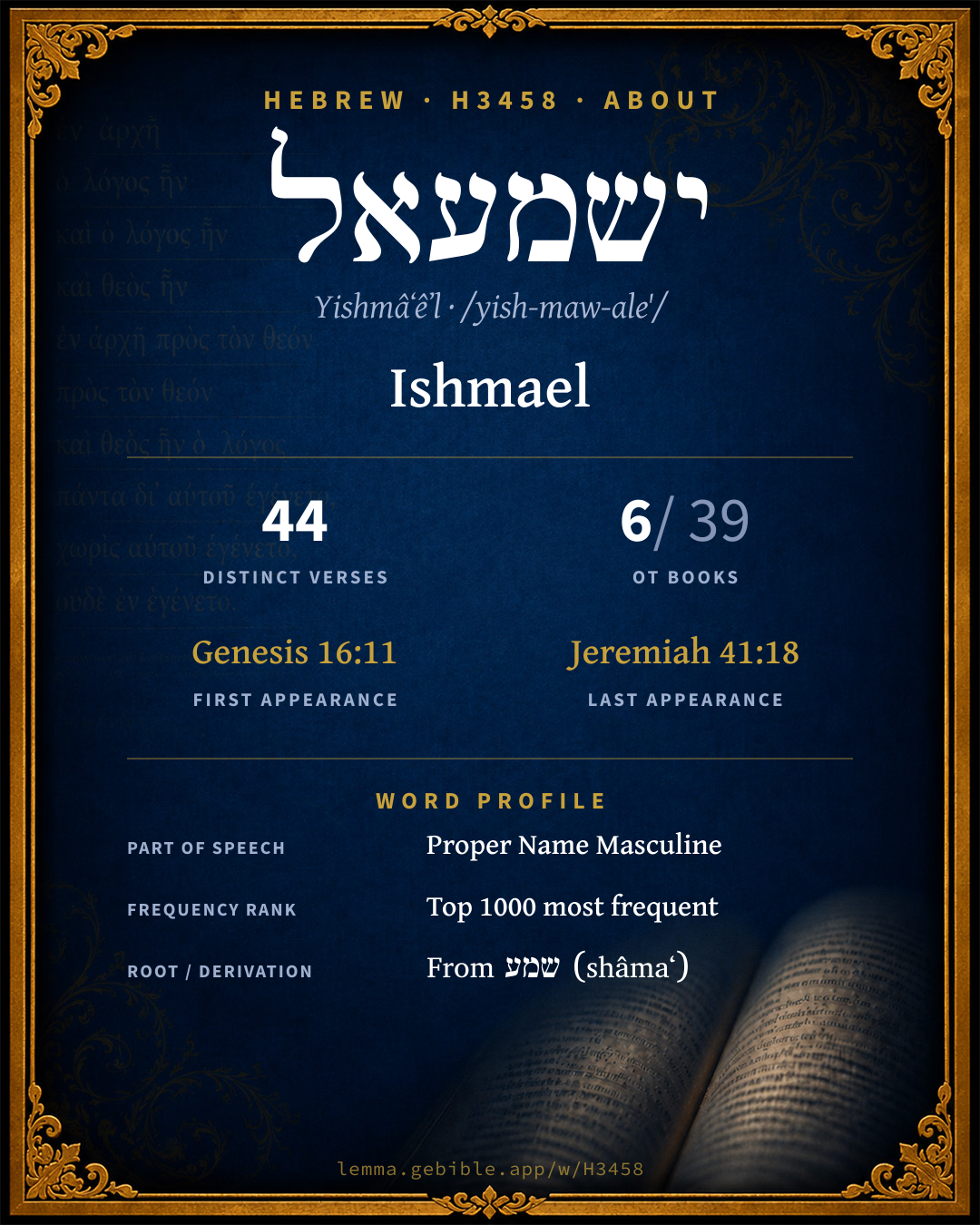
יִשְׁמָעֵאל
Ishmael
BDB lists 7 entries for ‘Ishmael’ fuller range ↓
Full lexicon entry — Brown-Driver-Briggs (BDB)
From Brown-Driver-Briggs (BDB)
Where this word appears
Grammar key — what these labels mean
Part of speech
- Noun
- A naming word — a person, place, thing, or idea.
Noun type
- Proper
- A name of a specific person, place, or people (e.g. Abraham, Zion, Israel).
Every verse where H3458 appears in the Book of Ezra — 1 distinct verse. Click any verse to open its interlinear word-by-word view. Verse text shown in the World English Bible for context — . Each verse’s Hebrew form is shown with its reference; the English is not keyword-highlighted, since the data carries no word-level English alignment. Use “Compare translations” on any verse to read it across multiple English versions. This concordance covers the Hebrew Bible; Septuagint (Greek Old Testament) occurrences are not indexed here.
Ezra
About this entry
At a glance — auto-summarized from this page’s data, not written by a person. Every figure links to its source below. This summary describes the numbers; it doesn’t interpret them.
ישמעאל (Yishmâʻêʼl) is a Hebrew name most often rendered “Ishmael.” Debuting at Genesis 16:11, it then recurs through the corpus. The Hebrew Bible uses it across 44 verses — moderately common. Jeremiah dominates its distribution — 19 of 44 verses. The sections below give every occurrence and version rendering.
Gloss history
Strong's 1890 vs modern scholarship
About this word
Strong's H3458 catalogs a Hebrew word from the Hebrew Old Testament.
These counts are not copied from any lexicon or concordance. They are computed here, from the morphology-tagged Hebrew Old Testament. What Lemma adds →
- 44
- distinct verses
- The word appears in 44 distinct verses.
- 6 / 39
- OT books
- The word appears in 6 of 39 Old Testament books.
- #767
- by frequency
- Top 1000 most frequent Hebrew words (rank 767 of 8,640 Hebrew words by occurrence).
View all 44 occurrences in the concordance →
Most concentrated in
- Jeremiah 19 verses 43%
- Genesis 15 verses 34%
- 1 Chronicles 5 verses 11%
By section of the Old Testament
By traditional corpus
Conventional, traditional groupings — biblical authorship is debated, so this is a traditional corpus grouping, not an authorship claim. Each share is this word’s portion of its verses in that division of the Hebrew canon. Each figure is a share of the word’s 44 distinct verses.
- Prophets (Nevi'im) 21 verses · 48%
- Torah (Pentateuch) 15 verses · 34%
- Writings (Ketuvim) 8 verses · 18%
How translations render this word
Counts come from each version’s own published word-to-Strong’s tagging or interlinear alignment — an approximate guide to how each version renders this word, not a word-level alignment the data otherwise carries. Because each total is that version’s own tagged count, the per-version totals vary from one another and need not match the appearance or distinct-verse counts above. These counts may also differ from a printed concordance because Lemma counts each distinctly tagged rendering and does not collapse phrase taggings into a single head-word total. This is a fixed set of word-tagged versions (KJV, ASV, BSB, ULT) and does not change with the reading translation you choose elsewhere. Each version’s license is shown beside its name below (and on Sources).
- King James Version: Ishmael 45×
- American Standard Version: Ishmael 43×
- Berean Standard Bible: Ishmael 48×
- unfoldingWord Literal Text: Ishmael 27×
King James Version Public Domain
Renders H3458 across 48 tagged occurrences — most commonly:
Plus 3 renderings that appear only once — usually multi-word phrases or single function words the recovered tagging swept in, not distinct renderings.
American Standard Version Public Domain
Renders H3458 across 48 tagged occurrences — most commonly:
Plus 5 renderings that appear only once — usually multi-word phrases or single function words the recovered tagging swept in, not distinct renderings.
Berean Standard Bible Public Domain
Renders H3458 across 48 tagged occurrences — most commonly:
unfoldingWord Literal Text CC BY-SA 4.0
Renders H3458 across 27 tagged occurrences — most commonly:
7 senses and sub-senses in the full BDB
What do BDB’s symbols mean?
BDB uses these scholarly abbreviations:
| Symbol | Meaning |
|---|---|
| 𝔊 | the Septuagint (the ancient Greek translation, LXX) |
| 𝔙 | the Vulgate (the Latin translation) |
| 𝔖 | the Syriac version (the Peshitta) |
| 𝔗 | the Targum (the Aramaic translation) |
| ψ | the Psalms |
| √ | root (the underlying root or stem) |
| ‖ | parallel passage (a synonymous or contrasted parallel) |
| † | the dagger: every passage where the word occurs is cited |
The 7 senses and sub-senses the full Brown-Driver-Briggs lexicon distinguishes for this word, in lexicon order (not ranked by frequency), with BDB’s own verbatim wording and sub-sense lettering. Shown in Hebrew script with BDB’s own scholarly abbreviations. The condensed entry is in the Lexicon Entry tab. See also the Forms in the corpus table below.
- 1. son of Abraham and Hagar Gn 16:11 (name expl. כִּי שָׁמַע י׳ וגו׳), v 15, 16 + 11 times Gn 17:25, 28:9(×2), 36:3 1 Ch 1:28, 29, 31; Ισμαηλ. e.g. Genesis 16:11
- 2. usually Ισμαηλ: murderer of Gedaliah Je 40:8, 14, 15, 16 + 17 times Je 41, 2 K 25:23, 25 (𝔊L Ισραηλ!). e.g. Jeremiah 40:8
- 3. in Benj. 1 Ch 8:38; 9:44. e.g. 1 Chronicles 8:38
- 4. in Judah:
- a. 2 Ch 19:11. e.g. 2 Chronicles 19:11
- b. 23:1. e.g. 2 Chronicles 23:1
- 5. Jew with foreign wife Ezr 10:22, Σαμαηλ, A 𝔊L Ισμαηλ. e.g. Ezra 10:22
Senses from the full Brown-Driver-Briggs lexicon (Brown, Driver, Briggs; Oxford 1906 — public domain), digitized via Sefaria, supplemented by the OpenScriptures HebrewLexicon (CC BY 4.0). Full attribution on Sources.
Word origin
n.pr.m. (Ēl heareth; Sab. יסמעאל Hal 187; on form cf. LagBN 131);—
— Brown-Driver-Briggs (Oxford 1906, public domain), digitized via Sefaria, supplemented by the OpenScriptures HebrewLexicon (CC BY 4.0). See Sources.
Derived from שמע (shâmaʻ) (H8085) — to hear.
Jastrow Dictionary
A second Hebrew/Aramaic lexicon for comparison, covering Aramaic and post-biblical (Talmudic, Targumic, Midrashic) usage that the biblical-Hebrew BDB does not. Matched by lemma rather than by Strong’s number, so a lemma may carry more than one Jastrow headword (shown separately below), and the entries cover usage well beyond the Bible.
יִשְׁמָעֵאל
- (b. h.) pr. n. m. Ishmael,
- 1. son of Abraham; also (as patron.) the people of I., Arabs, Bedouins. [Targ. Job XV, 20, Var. in ed. Lag.]—Gen. R. s. 45 אף י׳ באומות I., too, among the nations (was named before he was born, Gen. XVI, 11). B. Bath. 16ᵇ; Gen. R. s. 59 שעשה י׳ תשובה וכ׳ in as much as I. repented of his evil deeds in his (Abraham’s) life-time; a. fr.—Sabb. 11ᵃ תחת י׳ ולא וכ׳ (v. Rabb. D. S. a. l. note 80 a. Rashi a. l.) rather under I. (Arabic dominion) than under Byzantium; a. fr. [Pes. 118ᵇ מלכות י׳ (Ms. M. a. older eds. הרשעה) a censorial change for רומי, Roman government.] e.g. Genesis 16:11
- 2. I. ben Nathaniah, the murderer of governor Gedaliah. R. Hash. 18ᵇ. Nidd. 61ᵃ; a. e.
- 3. I. b. Kimḥith, a high priest. Yoma 47ᵃ; Tosef. ib. IV (III), 20, v. יְשֵׁבָב
- 4. I. b. Piabi or Pâbi, a priest. Tosef. ib. I, 21; Y. ib. III, 40ᵈ top; Bab. ib. 35ᵇ. Sot. IX, 15; a. e.
- 5. name of several Tannaim, esp. a) I. b. Elisha, redeemed from Roman captivity. Gitt. 58ᵃ. [Ber. 7ᵃ top, prob. his grandfather, a high priest.]—Shebu. II, 5; a. fr.—V. Fr. Darkhé, p. 105 sq.
- 6. I. son of R. Johanan b. B’roka. B. Kam. X, 2. Tosef. Eduy. II, 4; a. fr.—V. Fr. ib., p. 185 sq.—7) name of several Amoraim. Y. Gitt. I, 43ᶜ top; a. fr.—Y. Yoma III, 40ᵈ bot.—V. Fr. M’bo, p. 108ᵇ, sq.
A Dictionary of the Targumim, the Talmud Babli and Yerushalmi, and the Midrashic Literature (Marcus Jastrow; London, Luzac, 1903) — Public Domain. Digitized via Sefaria. Digitized via Sefaria. Full attribution on Sources.
Forms in the corpus
The 17 distinct written forms H3458 takes in the Hebrew Bible, most frequent first — each parse links to that state’s occurrences in the concordance. Hebrew forms include their vowel points and cantillation, so a single lemma takes many written forms.
| Form | Parsing | Example | Uses |
|---|---|---|---|
| יִשְׁמָעֵ֣אל | Noun, Proper | Ezra 10:22 | 9 |
| וְ/יִשְׁמָעֵ֣אל | Noun, Proper | Genesis 17:25 | 6 |
| יִשְׁמָעֵ֖אל | Noun, Proper | Genesis 16:16 | 6 |
| יִשְׁמָעֵאל֙ | Noun, Proper | Genesis 25:13 | 5 |
| יִשְׁמָעֵ֔אל | Noun, Proper | Genesis 16:11 | 4 |
| יִשְׁמָעֵֽאל | Noun, Proper | Genesis 16:15 | 4 |
| יִשְׁמָעֵ֨אל | Noun, Proper | Genesis 28:9 | 3 |
| יִשְׁמָעֵ֤אל | Noun, Proper | Jeremiah 41:7 | 2 |
| וְ/יִשְׁמָעֵ֖אל | Noun, Proper | Genesis 17:26 | 1 |
| וְ/יִשְׁמָעֵֽאל | Noun, Proper | 1 Chronicles 1:28 | 1 |
| וְ/יִשְׁמָעֵאל֙ | Noun, Proper | Genesis 25:9 | 1 |
| וּ/לְ/יִשְׁמָעֵ֣אל | Noun, Proper | 2 Chronicles 23:1 | 1 |
| וּֽ/לְ/יִשְׁמָעֵ֘אל | Noun, Proper | Genesis 17:20 | 1 |
| יִ֠שְׁמָעֵאל | Noun, Proper | Jeremiah 41:10 | 1 |
| יִשְׁמָעֵ֑אל | Noun, Proper | Genesis 28:9 | 1 |
| יִשְׁמָעֵ֜אל | Noun, Proper | 2 Chronicles 19:11 | 1 |
| יִשְׁמָעֵ֥אל | Noun, Proper | Jeremiah 41:9 | 1 |
Same root — word family
Other BDB entries built from the same root as H3458, grouped by Strong’s listed origin. These share a root / origin per the lexicon — not necessarily a shared meaning. Each links to that word’s own entry.
Derives from
Shares the same root
- השמעות hashmâʻûwth H2045 report
- משמע mishmâʻ H4926 rumor
- שמע shᵉmaʻ H8086 to hear
- שמע shêmaʻ H8088 hearing
- שמע shômaʻ H8089 report
Proper names from this root
People and places named from this root — a name, not an additional meaning of the word.
- אשתמע ʼEshtᵉmôaʻ H851 Eshtemoh
- ישמעיה Yishmaʻyâh H3460 Ishmaiah
- שמואל Shᵉmûwʼêl H8050 Samuel
- שמע Shâmâʻ H8091 Shama
- שמעון Shimʻôwn H8095 Simeon
- שמעיה Shᵉmaʻyâh H8098 Shemaiah
- ישמעאלי Yishmâʻêʼlîy H3459 Ishmaelite
Compare all same-root words → Showing 4 of 14 — not the complete family. 7 of the same-root words are proper names (people or places). They share a root, not necessarily a meaning.
Bible dictionary
Public-domain dictionary articles matched to this entry by name (Ishmael). A biblical name can be shared by more than one person or place, so an article may treat several.
Easton's Bible Dictionary · M. G. Easton, 1897
God hears. (1.) Abraham's eldest son, by Hagar the concubine (Gen. 16:15; 17:23). He was born at Mamre, when Abraham was eighty-six years of age, eleven years after his arrival in Canaan (16:3; 21:5). At the age of thirteen he was circumcised (17:25). He grew up a true child of the desert, wild and wayward. On the occasion of the weaning of Isaac his rude and wayward spirit broke out in expressions of insult and mockery (21:9, 10); and Sarah, discovering this, said to Abraham, "Expel this slave and her son." Influenced by a divine admonition, Abraham dismissed Hagar and her son with no more than a skin of water and some bread. The narrative describing this act is one of the most beautiful and touching incidents of patriarchal life (Gen. 21:14-16). (See HAGAR.)
Ishmael settled in the land of Paran, a region lying between Canaan and the mountains of Sinai; and "God was with him, and he became a great archer" (Gen. 21:9-21). He became a great desert chief, but of his history little is recorded. He was about ninety years of age when his father Abraham died, in connection with whose burial he once more for a moment reappears. On this occasion the two brothers met after being long separated. "Isaac with his hundreds of household slaves, Ishmael with his troops of wild retainers and half-savage allies, in all the state of a Bedouin prince, gathered before the cave of Machpelah, in the midst of the men of Heth, to pay the last duties to the father of the faithful,' would make a notable subject for an artist" (Gen. 25:9). Of the after events of his life but little is known. He died at the age of one hundred and thirty-seven years, but where and when are unknown (25:17). He had twelve sons, who became the founders of so many Arab tribes or colonies, the Ishmaelites, who spread over the wide desert spaces of Northern Arabia from the Red Sea to the Euphrates (Gen. 37:25, 27, 28; 39:1), "their hand against every man, and every man's hand against them."
(2.) The son of Nethaniah, "of the seed royal" (Jer. 40:8, 15). He plotted against Gedaliah, and treacherously put him and others to death. He carried off many captives, "and departed to go over to the Ammonites."
Smith's Bible Dictionary · William Smith, 1863
(whom God hears).
+ The son of Abraham by Hagar the Egyptian his concubine; born when Abraham was fourscore and six years old. (Genesis 16:15,16) (B.C. 1910.) Ishmael was the first-born of his father. He was born in Abraham's house when he dwelt in the plain of Mamre; and on the institution of the covenant of circumcision, was circumcised, he being then thirteen years old (Genesis 17:26) With the institution of the covenant, God renewed his promise respecting Ishmael. He does not again appear in the narrative until the weaning of Isaac. At the great feast made in celebration of the weaning, "Sarah saw the son of Hagar the Egyptian, which she had borne unto Abraham, mocking," and urged Abraham to cast him and his mother out. Comforted by the renewal of God's promise to make of Ishmael a great nation, Abraham sent them away, and they departed and wandered in the wilderness of Beersheba. His mother took Ishmael a wife out of the land of Egypt." (Genesis 21:9-21) This wife of Ishmael was the mother of the twelve sons and one daughter. Of the later life of Ishmael we know little. He was present with Isaac at the burial of Abraham. He died at the age of 137 years. (Genesis 25:17,18) The sons of Ishmael peopled the north and west of the Arabian peninsula, and eventually formed the chief element of the Arab nation, the wandering Bedouin tribes. They are now mostly Mohammedans who look to him as their spiritual father, as the Jews look to Abraham. Their language, which is generally acknowledged to have been the Arabic community so called, has been adopted with insignificant exceptions throughout Arabia. The term "Ishmaelite" occur on three occasions: (Genesis 37:25,27,28; 39:1; Judges 8:24; Psalms 83:6) + One of the sons of Azel, a descendant of Saul through Meribbaal or Mephibosheth. (1 Chronicles 8:38; 9:44) + A man of Judah, father of Zebadiah. (2 Chronicles 19:11) + Another man of Judah, son of Jehohanan; one of the captains of hundreds who assisted Jehoiada in restoring Joash to the throne. (2 Chronicles 23:1) + A priest of the Bene-Pashur, who was forced by Ezra to relinquish his foreign wife. (Ezra 10:22) + The son of Nethaniah; a perfect marvel of craft and villainy, whose treachery forms one of the chief episodes of the history of the period immediately succeeding the first fall of Jerusalem. His exploits are related in (Jeremiah 40:7; Jeremiah 41:16) with a short summary. During the siege of the city he had fled across the Jordan where he found a refuge at the court of Baalis. After the departure of the Chaldeans, Ishmael made no secret of his intention to kill the superintendent left by the king of Babylon and usurp his position. Of this Zedaliah was warned in express terms by Johanan and his companions, but notwithstanding entertained Ishmael and his followers at a feast, (Jeremiah 41:1) during which Ishmael murdered Gedaliah and all his attendants. The same night he killed all Zedaliah's establishment, including some Chaldean soldiers who were there. For two days the massacre remained entirely unknown to the people of the town. On the second day eighty devotees were bringing incense and offerings to the ruins of the temple. At his invitation they turned aside to the residence of the superintendent, and there Ishmael and his band butchered nearly the whole number: ten only escaped by offering a heavy ransom for their lives. This done he descended to the town, surprised and carried off the daughters of King Zedekiah, who had been sent there by Nebuchadnezzar for safety, with their eunuchs and their Chaldean guard, (Jeremiah 41:10,16) and all the people of the town, and made off with his prisoners to the country of the Ammonites. The news of the massacre had by this time got abroad, and Ishmael was quickly pursued by Johanan and his companions. He was attacked, two of his bravos slain, the whole of the prey recovered; and Ishmael himself with the remaining eight of his people, escaped to the Ammonites.
Hitchcock's Bible Names Dictionary · Roswell D. Hitchcock, 1869
God that hears
Classic public-domain reference works; full attribution on Sources.
Septuagint verse parallels
This word appears in 41 verses that also exist in the Greek Old Testament (Septuagint), out of the 44 Hebrew verses it occurs in. You can read those verses in Greek by switching the Old Testament edition to the Septuagint.
Read these verses in the Septuagint
This is a verse-level parallel only — the same verses exist in both the Hebrew and Greek Old Testaments. No word-level Hebrew↔Greek correspondence is claimed: the data carries no such alignment, so no Greek word is shown as this Hebrew word’s translation. Coverage is not total — the Septuagint omits the deuterocanon and renumbers the Psalms, so some Hebrew verses have no direct Greek parallel.