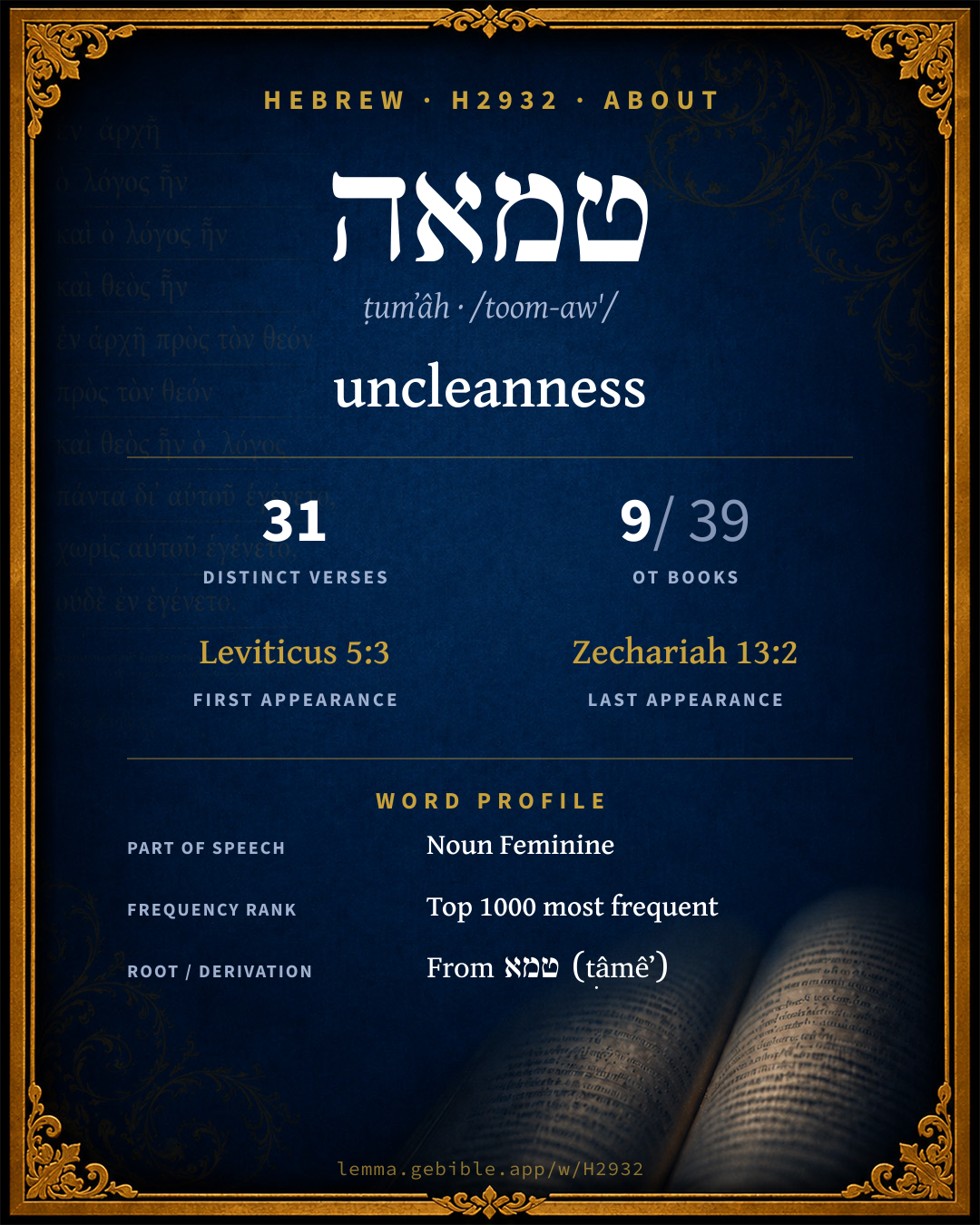
טֻמְאָה
uncleanness
‘uncleanness’ is one of 6 main senses fuller range ↓
Full lexicon entry — Brown-Driver-Briggs (BDB)
From Brown-Driver-Briggs (BDB)
Where this word appears
Grammar key — what these labels mean
Part of speech
- Noun
- A naming word — a person, place, thing, or idea.
Noun type
- Common
- A common noun — a general class of person, place, or thing (“king,” “city,” “water”), not a specific name.
State
- Construct
- A noun bound to a following noun in a possessive / “of” relationship (the construct chain).
- Absolute
- The independent form of a noun, not bound to a following word.
Gender
- Feminine
- Grammatically feminine.
Number
- Singular
- One.
- Plural
- More than one (in Hebrew, generally three or more).
Every verse where H2932 appears in the Book of Leviticus — 14 distinct verses. Click any verse to open its interlinear word-by-word view. Verse text shown in the World English Bible for context — . Each verse’s Hebrew form is shown with its reference; the English is not keyword-highlighted, since the data carries no word-level English alignment. Use “Compare translations” on any verse to read it across multiple English versions. This concordance covers the Hebrew Bible; Septuagint (Greek Old Testament) occurrences are not indexed here.
Leviticus
- Leviticus 5:3 בְּ/טֻמְאַ֣ת טֻמְאָת֔/וֹ prep + n c fs cs n c fs cs + sfx pers 3ms "'Or if he touches the uncleanness of man, whatever his uncleanness is with which he is unclean, and it is hidden from him; when he knows of it, then he shall be guilty.
- Leviticus 7:20 וְ/טֻמְאָת֖/וֹ conj + n c fs cs + sfx pers 3ms but the soul who eats of the flesh of the sacrifice of peace offerings, that belongs to Yahweh, having his uncleanness on him, that soul shall be cut off from his people.
- Leviticus 7:21 בְּ/טֻמְאַ֤ת prep + n c fs cs When anyone touches any unclean thing, the uncleanness of man, or an unclean animal, or any unclean abomination, and eats some of the flesh of the sacrifice of peace offerings, which belong to Yahweh, that soul shall be cut off from his people.'"
- Leviticus 14:19 מִ/טֻּמְאָת֑/וֹ prep + n c fs cs + sfx pers 3ms "The priest shall offer the sin offering, and make atonement for him who is to be cleansed because of his uncleanness: and afterward he shall kill the burnt offering;
- Leviticus 15:3 טֻמְאָת֖/וֹ טֻמְאָת֖/וֹ n c fs cs + sfx pers 3ms n c fs cs + sfx pers 3ms This shall be his uncleanness in his discharge: whether his body runs with his discharge, or his body has stopped from his discharge, it is his uncleanness.
- Leviticus 15:25 טֻמְאָתָ֗/הּ n c fs cs + sfx pers 3fs "'If a woman has a discharge of her blood many days not in the time of her period, or if she has a discharge beyond the time of her period; all the days of the discharge of her uncleanness shall be as in the days of her period: she is unclean.
- Leviticus 15:26 כְּ/טֻמְאַ֖ת prep + n c fs cs Every bed whereon she lies all the days of her discharge shall be to her as the bed of her period: and everything whereon she sits shall be unclean, as the uncleanness of her period.
- Leviticus 15:30 טֻמְאָתָֽ/הּ n c fs cs + sfx pers 3fs The priest shall offer the one for a sin offering, and the other for a burnt offering; and the priest shall make atonement for her before Yahweh for the uncleanness of her discharge.
- Leviticus 15:31 מִ/טֻּמְאָתָ֑/ם בְּ/טֻמְאָתָ֔/ם prep + n c fs cs + sfx pers 3mp prep + n c fs cs + sfx pers 3mp "'Thus you shall separate the children of Israel from their uncleanness, so they will not die in their uncleanness, when they defile my tabernacle that is in their midst.'"
- Leviticus 16:16 מִ/טֻּמְאֹת֙ טֻמְאֹתָֽ/ם prep + n c fp cs n c fp cs + sfx pers 3mp and he shall make atonement for the Holy Place, because of the uncleanness of the children of Israel, and because of their transgressions, even all their sins; and so he shall do for the Tent of Meeting, that dwells with them in the midst of their uncleanness.
- Leviticus 16:19 מִ/טֻּמְאֹ֖ת prep + n c fp cs He shall sprinkle some of the blood on it with his finger seven times, and cleanse it, and make it holy from the uncleanness of the children of Israel.
- Leviticus 18:19 טֻמְאָתָ֑/הּ n c fs cs + sfx pers 3fs "'You shall not approach a woman to uncover her nakedness, as long as she is impure by her uncleanness.
- Leviticus 22:3 וְ/טֻמְאָת֖/וֹ conj + n c fs cs + sfx pers 3ms Tell them, 'If anyone of all your seed throughout your generations approaches the holy things, which the children of Israel make holy to Yahweh, having his uncleanness on him, that soul shall be cut off from before me. I am Yahweh.
- Leviticus 22:5 טֻמְאָתֽ/וֹ n c fs cs + sfx pers 3ms or whoever touches any creeping thing, whereby he may be made unclean, or a man of whom he may take uncleanness, whatever uncleanness he has;
About this entry
At a glance — auto-summarized from this page’s data, not written by a person. Every figure links to its source below. This summary describes the numbers; it doesn’t interpret them.
טמאה (ṭumʼâh) is a Hebrew noun most often rendered “uncleanness.” Not a single-sense word: explore its full sense range. With 31 verses in 9 books, it is a moderately common word in the Hebrew Bible. It concentrates in Leviticus, which alone accounts for 45% of its uses. It first appears in Leviticus 5:3. For the data behind this summary, explore the sense tree and the renderings breakdown below.
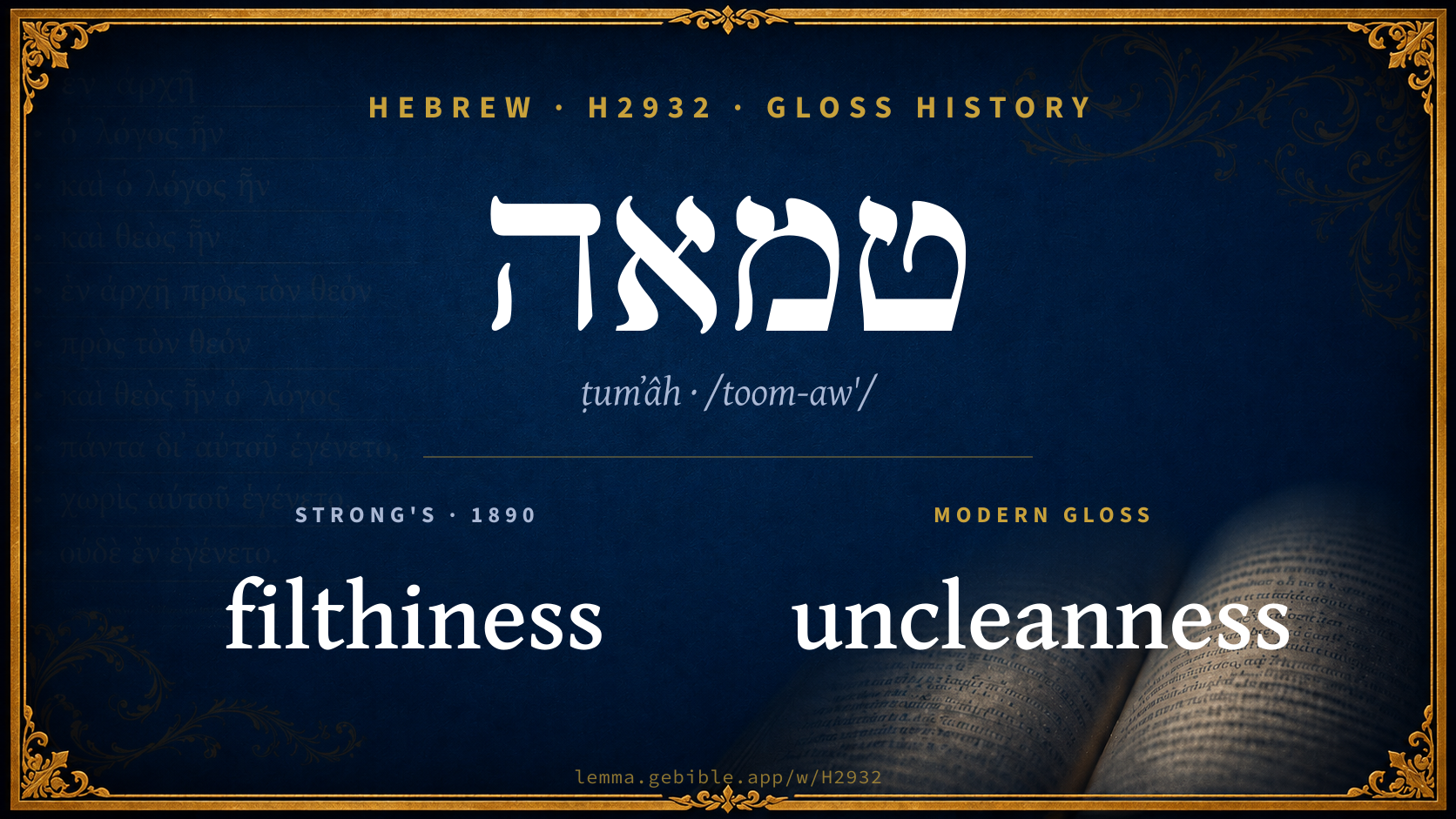
Gloss history
Strong's 1890 vs modern scholarship
About this word
Strong's H2932 catalogs a Hebrew word from the Hebrew Old Testament.
These counts are not copied from any lexicon or concordance. They are computed here, from the morphology-tagged Hebrew Old Testament. What Lemma adds →
- 31
- distinct verses
- The word appears in 31 distinct verses.
- 9 / 39
- OT books
- The word appears in 9 of 39 Old Testament books.
- #990
- by frequency
- Top 1000 most frequent Hebrew words (rank 990 of 8,640 Hebrew words by occurrence).
View all 31 occurrences in the concordance →
By section of the Old Testament
By traditional corpus
Conventional, traditional groupings — biblical authorship is debated, so this is a traditional corpus grouping, not an authorship claim. Each share is this word’s portion of its verses in that division of the Hebrew canon. Each figure is a share of the word’s 31 distinct verses.
- Torah (Pentateuch) 16 verses · 52%
- Prophets (Nevi'im) 11 verses · 35%
- Writings (Ketuvim) 4 verses · 13%
How translations render this word
Counts come from each version’s own published word-to-Strong’s tagging or interlinear alignment — an approximate guide to how each version renders this word, not a word-level alignment the data otherwise carries. Because each total is that version’s own tagged count, the per-version totals vary from one another and need not match the appearance or distinct-verse counts above. These counts may also differ from a printed concordance because Lemma counts each distinctly tagged rendering and does not collapse phrase taggings into a single head-word total. This is a fixed set of word-tagged versions (KJV, ASV, BSB, ULT) and does not change with the reading translation you choose elsewhere. Each version’s license is shown beside its name below (and on Sources).
- King James Version: Uncleanness 15×, Filthiness 5×, Any unclean 3×
- American Standard Version: Uncleanness 8×, Filthiness 5×, Any unclean 3×
- Berean Standard Bible: Uncleanness 14×, Unclean 4×, Impurities 3×
- unfoldingWord Literal Text: Uncleanness 24×, Uncleanness of 5×, Unclean 3×
King James Version Public Domain
Renders H2932 across 37 tagged occurrences — most commonly:
Plus 10 renderings that appear only once — usually multi-word phrases or single function words the recovered tagging swept in, not distinct renderings.
American Standard Version Public Domain
Renders H2932 across 37 tagged occurrences — most commonly:
Plus 19 renderings that appear only once — usually multi-word phrases or single function words the recovered tagging swept in, not distinct renderings.
Berean Standard Bible Public Domain
Renders H2932 across 32 tagged occurrences — most commonly:
Plus 9 renderings that appear only once — usually multi-word phrases or single function words the recovered tagging swept in, not distinct renderings. Not rendered by a distinct English word in 4 further occurrences.
unfoldingWord Literal Text CC BY-SA 4.0
Renders H2932 across 38 tagged occurrences — most commonly:
Plus 4 renderings that appear only once — usually multi-word phrases or single function words the recovered tagging swept in, not distinct renderings.
Senses in the full BDB
What do BDB’s symbols mean?
BDB uses these scholarly abbreviations:
| Symbol | Meaning |
|---|---|
| 𝔊 | the Septuagint (the ancient Greek translation, LXX) |
| 𝔙 | the Vulgate (the Latin translation) |
| 𝔖 | the Syriac version (the Peshitta) |
| 𝔗 | the Targum (the Aramaic translation) |
| ψ | the Psalms |
| √ | root (the underlying root or stem) |
| ‖ | parallel passage (a synonymous or contrasted parallel) |
| † | the dagger: every passage where the word occurs is cited |
The 5 senses and sub-senses the full Brown-Driver-Briggs lexicon distinguishes for this word, in lexicon order (not ranked by frequency), with BDB’s own verbatim wording and sub-sense lettering. Shown in Hebrew script with BDB’s own scholarly abbreviations. The condensed entry is in the Lexicon Entry tab. See also the Forms in the corpus table below.
- 1. sexual Nu 5:19 (P), La 1:9. e.g. Numbers 5:19
- 2. of a foul or filthy mass Ez 24:11 (in a caldron), 2 Ch 29:16 (in the temple). e.g. Ezekiel 24:11
- 3. ethical and religious Lv 16:16 (P), Ez 22:15; 24:13; 39:24; כפר על הקדשׁ מט׳ Lv 16:16 (P); קדּשׁ מט׳ Lv 16:19 (P); טהר מט׳ Ez 24:13; 36:25; הושׁיע מכל ט׳ 36:29; רוּחַ הט׳ unclean spirit, which inspired the prophets to lie Zc 13:2. e.g. Leviticus 16:16
- 4. ritual, of men Lv 5:3(×2); 7:20, 21; 14:19; 15:3(×2), 31(×2) Nu 19:13 (all P), Lv 22:3, 5 (H); of women 2 S 11:4; וַיִּשְׁכַּב עִמָּהּ וְהִיא מִתְקַדֶּשֶׁת מִטֻּמְאָתָהּ v. Dr; a time favourable to conception RSK 276; Lv 15:25, 26, 30 (P), 18:19 (H), Ez 36:17; of meats Ju 13:7, 14. e.g. Leviticus 5:3
- 5. local, of the nations Ezr 6:21; 9:11. e.g. Ezra 6:21
Senses from the full Brown-Driver-Briggs lexicon (Brown, Driver, Briggs; Oxford 1906 — public domain), digitized via Sefaria, supplemented by the OpenScriptures HebrewLexicon (CC BY 4.0). Full attribution on Sources.
Word origin
n.f. uncleanness;—abs. ט׳ Nu 5:19 + 4 times; cstr. טֻמְאַת Lv 5:3 + 4 times; sf. טֻמְאָתֵךְ Ez 22:15 + 2 times etc., + 18 times sfs.; pl. טֻמְאֹת Lv 16:16, 19; sf. טֻמְאוֹתֵיכֶם Ez 36:25, 29; טֻמְאֹתָם Lv 16:16;—
— Brown-Driver-Briggs (Oxford 1906, public domain), digitized via Sefaria, supplemented by the OpenScriptures HebrewLexicon (CC BY 4.0). See Sources.
Derived from טמא (ṭâmêʼ) (H2930) — to be unclean.
Forms in the corpus
The 33 distinct written forms H2932 takes in the Hebrew Bible, most frequent first — each parse links to that state’s occurrences in the concordance. Hebrew forms include their vowel points and cantillation, so a single lemma takes many written forms.
Same root — word family
Other BDB entries built from the same root as H2932, grouped by Strong’s listed origin. These share a root / origin per the lexicon — not necessarily a shared meaning. Each links to that word’s own entry.
Derives from
Shares the same root
Compare all same-root words → They share a root, not necessarily a meaning.
Septuagint verse parallels
This word appears in 31 verses that also exist in the Greek Old Testament (Septuagint), out of the 31 Hebrew verses it occurs in. You can read those verses in Greek by switching the Old Testament edition to the Septuagint.
Read these verses in the Septuagint
- Leviticus 5:3
- Numbers 5:19
- Judges 13:7
- 2 Samuel 11:4
- 2 Chronicles 29:16
- Ezra 6:21
- Lamentations 1:9
- Ezekiel 22:15
- Zechariah 13:2
This is a verse-level parallel only — the same verses exist in both the Hebrew and Greek Old Testaments. No word-level Hebrew↔Greek correspondence is claimed: the data carries no such alignment, so no Greek word is shown as this Hebrew word’s translation. Coverage is not total — the Septuagint omits the deuterocanon and renumbers the Psalms, so some Hebrew verses have no direct Greek parallel.