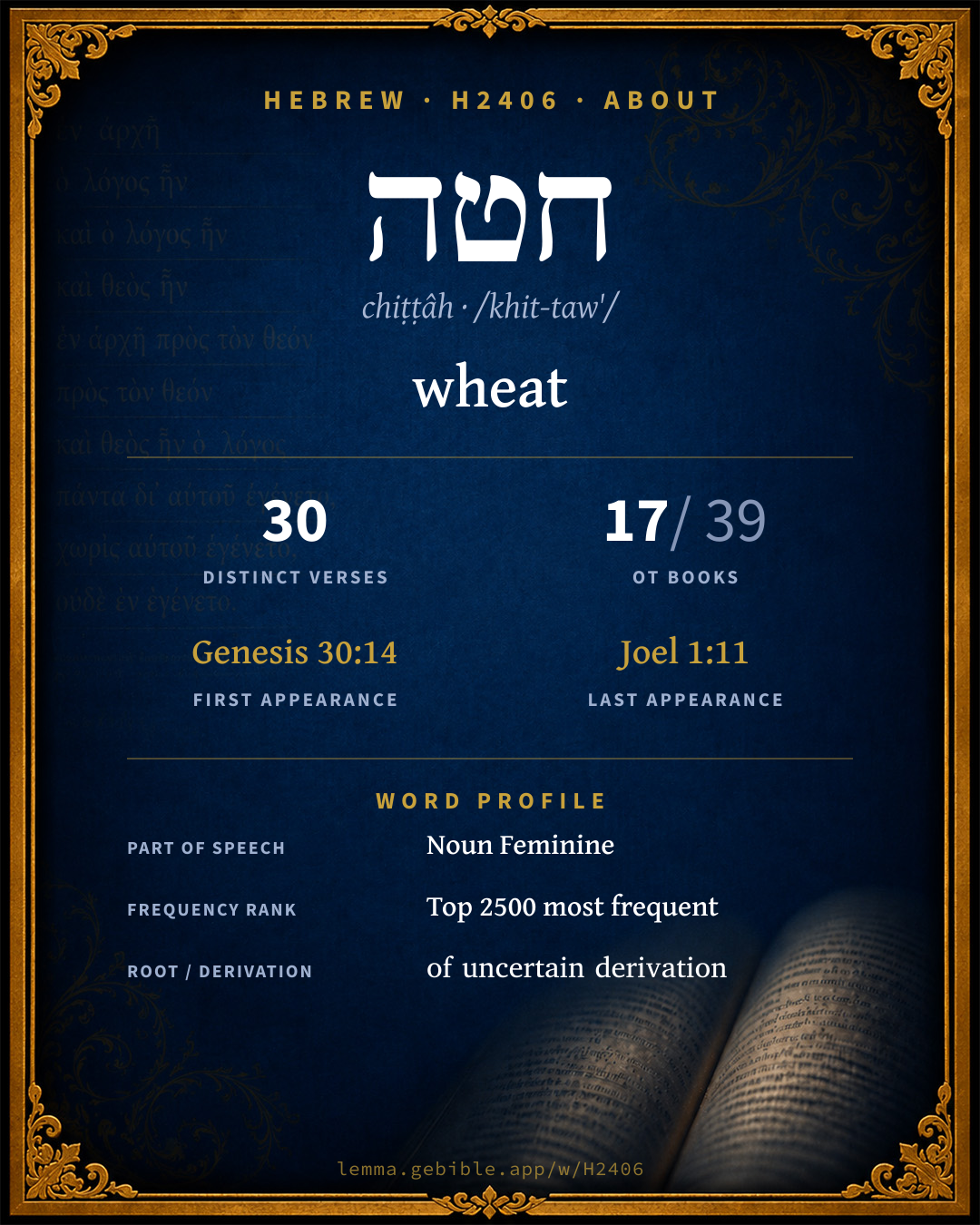
חִטָּה
wheat
‘wheat’ is one of 3 main senses fuller range ↓
Full lexicon entry — Brown-Driver-Briggs (BDB)
From Brown-Driver-Briggs (BDB)
Where this word appears
Grammar key — what these labels mean
Part of speech
- Noun
- A naming word — a person, place, thing, or idea.
Noun type
- Common
- A common noun — a general class of person, place, or thing (“king,” “city,” “water”), not a specific name.
State
- Absolute
- The independent form of a noun, not bound to a following word.
- Construct
- A noun bound to a following noun in a possessive / “of” relationship (the construct chain).
Gender
- Feminine
- Grammatically feminine.
Number
- Plural
- More than one (in Hebrew, generally three or more).
- Singular
- One.
Every verse where H2406 appears in the Book of 2 Chronicles — 3 distinct verses. Click any verse to open its interlinear word-by-word view. Verse text shown in the World English Bible for context — . Each verse’s Hebrew form is shown with its reference; the English is not keyword-highlighted, since the data carries no word-level English alignment. Use “Compare translations” on any verse to read it across multiple English versions. This concordance covers the Hebrew Bible; Septuagint (Greek Old Testament) occurrences are not indexed here.
2 Chronicles
- 2 Chronicles 2:10 חִטִּ֨ים n c fp Behold, I will give to your servants, the cutters who cut timber, twenty thousand measures of beaten wheat, and twenty thousand measures of barley, and twenty thousand baths of wine, and twenty thousand baths of oil.
- 2 Chronicles 2:15 הַ/חִטִּ֨ים ptcl def.art + n c fp Now therefore the wheat and the barley, the oil and the wine, which my lord has spoken of, let him send to his servants:
- 2 Chronicles 27:5 חִטִּ֔ים n c fp He fought also with the king of the children of Ammon, and prevailed against them. The children of Ammon gave him the same year one hundred talents of silver, and ten thousand measures of wheat, and ten thousand of barley. So much did the children of Ammon render to him, in the second year also, and in the third.
About this entry
At a glance — auto-summarized from this page’s data, not written by a person. Every figure links to its source below. This summary describes the numbers; it doesn’t interpret them.
חטה — transliterated chiṭṭâh — is a Hebrew noun carrying the sense “wheat.” Its earliest occurrence is Genesis 30:14. Spanning 30 verses in 17 books, it ranks among the moderately common words of the Hebrew Bible. BDB distinguishes 3 senses for it. Sharing its root, it stands alongside חנטא. See the sense tree, 30-verse concordance, and the renderings breakdown below.
Gloss history
Strong's 1890 vs modern scholarship
About this word
Strong's H2406 catalogs a Hebrew word from the Hebrew Old Testament.
These counts are not copied from any lexicon or concordance. They are computed here, from the morphology-tagged Hebrew Old Testament. What Lemma adds →
- 30
- distinct verses
- The word appears in 30 distinct verses.
- 17 / 39
- OT books
- The word appears in 17 of 39 Old Testament books.
- #1,139
- by frequency
- Top 2500 most frequent Hebrew words (rank 1,139 of 8,640 Hebrew words by occurrence).
View all 30 occurrences in the concordance →
Most concentrated in
- Exodus 3 verses 10%
- 2 Chronicles 3 verses 10%
- Ezekiel 3 verses 10%
By section of the Old Testament
By traditional corpus
Conventional, traditional groupings — biblical authorship is debated, so this is a traditional corpus grouping, not an authorship claim. Each share is this word’s portion of its verses in that division of the Hebrew canon. Each figure is a share of the word’s 30 distinct verses.
- Prophets (Nevi'im) 14 verses · 47%
- Writings (Ketuvim) 10 verses · 33%
- Torah (Pentateuch) 6 verses · 20%
How translations render this word
Counts come from each version’s own published word-to-Strong’s tagging or interlinear alignment — an approximate guide to how each version renders this word, not a word-level alignment the data otherwise carries. Because each total is that version’s own tagged count, the per-version totals vary from one another and need not match the appearance or distinct-verse counts above. These counts may also differ from a printed concordance because Lemma counts each distinctly tagged rendering and does not collapse phrase taggings into a single head-word total. This is a fixed set of word-tagged versions (KJV, ASV, BSB, ULT) and does not change with the reading translation you choose elsewhere. Each version’s license is shown beside its name below (and on Sources).
BDB lists this Strong’s number as 2 distinct words (homographs). Each count above pools all of them and is not split by sense — see the Senses section below. A low-frequency rendering may belong to a different one of those words, not the primary meaning.
- King James Version†: Wheat 25×
- American Standard Version†: Wheat 24×
- Berean Standard Bible†: Wheat 26×
- unfoldingWord Literal Text†: Wheat 27×
King James Version Public Domain
Renders H2406 across 30† tagged occurrences — most commonly:
Plus 5 renderings that appear only once — usually multi-word phrases or single function words the recovered tagging swept in, not distinct renderings.
American Standard Version Public Domain
Renders H2406 across 30† tagged occurrences — most commonly:
Plus 6 renderings that appear only once — usually multi-word phrases or single function words the recovered tagging swept in, not distinct renderings.
Berean Standard Bible Public Domain
Renders H2406 across 30† tagged occurrences — most commonly:
Plus 4 renderings that appear only once — usually multi-word phrases or single function words the recovered tagging swept in, not distinct renderings.
unfoldingWord Literal Text CC BY-SA 4.0
Renders H2406 across 29† tagged occurrences — most commonly:
Plus 2 renderings that appear only once — usually multi-word phrases or single function words the recovered tagging swept in, not distinct renderings.
Senses in the full BDB
What do BDB’s symbols mean?
BDB uses these scholarly abbreviations:
| Symbol | Meaning |
|---|---|
| 𝔊 | the Septuagint (the ancient Greek translation, LXX) |
| 𝔙 | the Vulgate (the Latin translation) |
| 𝔖 | the Syriac version (the Peshitta) |
| 𝔗 | the Targum (the Aramaic translation) |
| ψ | the Psalms |
| √ | root (the underlying root or stem) |
| ‖ | parallel passage (a synonymous or contrasted parallel) |
| † | the dagger: every passage where the word occurs is cited |
The 0 senses and sub-senses the full Brown-Driver-Briggs lexicon distinguishes for this word, in lexicon order (not ranked by frequency), with BDB’s own verbatim wording and sub-sense lettering. Shown in Hebrew script with BDB’s own scholarly abbreviations. The condensed entry is in the Lexicon Entry tab. See also the Forms in the corpus table below.
חטה I wheat, v. sub חנט.
חטה II wheat (NH id., Aramaic חִנְטִין, חִיטְּתָא, ܚܶܛܬܳܐ
Senses from the full Brown-Driver-Briggs lexicon (Brown, Driver, Briggs; Oxford 1906 — public domain), digitized via Sefaria, supplemented by the OpenScriptures HebrewLexicon (CC BY 4.0). Full attribution on Sources.
Word origin
I. wheat, v. sub חנט.
II. n.f. wheat (NH id., Aramaic חִנְטִין, חִיטְּתָא, ܚܶܛܬܳܐ; Arabic حِنْطَةٌ );—abs. ח׳ Ex 9:32 + 6 times; pl. חִטִּים Gn 30:14 + 20 times; חִטִּין Ez 4:9; cstr. חִטֵּי Ez 27:17;—wheat, sg. chiefly poet., of growing wheat Ex 9:32 (E), Dt 8:8 Jb 31:40; Jo 1:11; sown Is 28:25; food-product Dt 32:14 (חֵלֶב כִּלְיוֹת ח׳ kidney-fat of wheat, i.e. the choicest, v. חֵלֶב) חֵלֶב ח׳ ψ 81:17 (cf. 147:14 infr.); elsewhere pl.; wheat as sown Je 12:13; wheat-harvest קְצִיר ח׳ Gn 30:14 (J), Ex 34:22 (JE), Ju 15:1 1 S 6:13; 12:17 Ru 2:23, + 2 S 24:15 where insert according to 𝔊 We Dr; wheat threshed Ju 6:11; 1 Ch 21:20 cf. v 23; measured 1 K 5:25 = 2 Ch 2:9 (חטים מַכּוֹת, read ח׳ מַכֹּלֶת as 1 K 5:25 = wheat for food Th Be Ke after Vrss), v 14; 27:5 Ez 45:13; stored (with barley, oil and honey) Je 41:8; for food 2 S 17:28, חֵלֶב חִטִּים ψ 147:14 (cf. 81:14 supr.); לֹקְחֵי חִטִּים 2 S 4:6 (read סֹקְלָה ח׳ 𝔊 We Dr); סֹלֶת ח׳ fine wheaten flour Ex 29:2 (P); Ez 4:9 (חִטִּין, Aramaic pl.) mixed with barley, beans, lentils, etc., and made into bread.
— Brown-Driver-Briggs (Oxford 1906, public domain), digitized via Sefaria, supplemented by the OpenScriptures HebrewLexicon (CC BY 4.0). See Sources.
Origin: of uncertain derivation
Jastrow Dictionary
A second Hebrew/Aramaic lexicon for comparison, covering Aramaic and post-biblical (Talmudic, Targumic, Midrashic) usage that the biblical-Hebrew BDB does not. Matched by lemma rather than by Strong’s number, so a lemma may carry more than one Jastrow headword (shown separately below), and the entries cover usage well beyond the Bible.
חֻטָּה
- incisor, v. חוֹט.
חִטָּה
- v. חָנַט) [the clean, bright, cmp. פת נקיה, s. v. נָקִי,] wheat-grain, (collect.) wheat. Midr. Till. to Ps. II, 12; Cant. R. to VII, 3 מה ח׳ זו סדוקה as the wheat-grain is slit. Shebu. V, 3 אמר ח׳ if he says ḥittah (in the sing.). Ib. 38ᵃ אפי׳ ח׳ בכלל חטין even ḥittah means a quantity of wheat. Tosef. Ned. III, 7; Y. ib. VI, end, 40ᵃ חי׳ שאני וכ׳ if one vows, ‘I will not taste ḥittah (wheat-grains)’, contrad. to חִטִּין; a. fr.—Pl. חִטִּים, חִטִּין, חִי׳. Ib. Pes. II, 5. Ib. 35ᵃ כוסמין מין ח׳ spelt is a species of wheat; Men. 70ᵃ. Gen. R. s. 15 ח׳ היו ‘the tree of knowledge’ was wheat. Shebu. l. c.; a. fr. e.g. Psalms 2:12
חטי
- [to stroll idly, saunter (v. Fl. to Levy Targ. Dict. I, 4242),] to live in luxury, to be like a nobleman, to be well-dressed, clean &c. (cmp. פנק, פרנק).
- to make look well, polish, dress, cleanse, prepare. Ḥull. 27ᵃ (play on וש̇ח̇ט̇, Lev. I, 5) ממקום שש̇ח̇ חַטֵֹּהוּ from the place where the animal bends (its head, the front of the neck), cleanse it (let its blood run out). Ib. ממאי דהאי חטהו לישנא דדכויי הוא how can you prove that this ḥattehu has the meaning of cleansing?—Ib. ממקום שס̇ח̇ ח̇ט̇הו from where it utters sound, cleanse it. [Cant. R. to VII, 2, v. infra.] e.g. Leviticus 1:5
- 1. to enjoy, to be gratified. Cant. R. to VII, 2 [read:] כל חִיטּוּיִין … שישראל מִתְחַטִּין וכ׳ all luxuries and enjoyments which Israel indulge in and enjoy. Men. 66ᵇ (play on נ̇ת̇ע̇ל̇ס̇ה̇, Prov. VII, 18) נ̇שא ונת̇ן ונע̇לה ונ̇שמח ונִתְחַטֵּא באהבים let us have a conversation, then let us go up and rejoice and delight ourselves with dalliances; Sifra Vayikra, N’dabah, ch. XIV, Par. 13. Men. l. c. (play on נ̇ע̇ל̇ס̇ה̇ Job XXXIX, 13) נ̇וש̇א עול̇ה ונתח̇טא; Sifra l. c. נושא ועולה ומִתְחַטֵּא he (the bird) raises (his wings) and rises and enjoys himself (differ. interpret. in Rashi). e.g. Proverbs 7:18
- 2. to show one’s self a nobleman, to be generous, proud. Cant. R. to VII, 7 שהיה מתחטא על וכ׳ he was generous towards &c. (ref. to Gen. XIV, 23, Dan. V, 17). e.g. Genesis 14:23
- 3. to be imperious, to lord it, to ask petulantly. Taan. III, 8 אתה מתח׳ לפני thou comest petulantly before the Lord כבן שהוא מתח׳ על וכ׳ like a son that lords it over his father &c. Cant. R. to V, 6 (explain. חמק, ib.) נתח׳ וכ׳ he became petulant, he got angry with me.
A Dictionary of the Targumim, the Talmud Babli and Yerushalmi, and the Midrashic Literature (Marcus Jastrow; London, Luzac, 1903) — Public Domain. Digitized via Sefaria. Digitized via Sefaria. Full attribution on Sources.
Forms in the corpus
The 22 distinct written forms H2406 takes in the Hebrew Bible, most frequent first — each parse links to that state’s occurrences in the concordance. Hebrew forms include their vowel points and cantillation, so a single lemma takes many written forms.
Same root — word family
Other BDB entries built from the same root as H2406, grouped by Strong’s listed origin. These share a root / origin per the lexicon — not necessarily a shared meaning. Each links to that word’s own entry.
Derived from this word
Compare all same-root words → They share a root, not necessarily a meaning.
Septuagint verse parallels
This word appears in 28 verses that also exist in the Greek Old Testament (Septuagint), out of the 30 Hebrew verses it occurs in. You can read those verses in Greek by switching the Old Testament edition to the Septuagint.
Read these verses in the Septuagint
- Genesis 30:14
- Exodus 9:32
- Deuteronomy 8:8
- Judges 6:11
- Ruth 2:23
- 1 Samuel 6:13
- 2 Samuel 4:6
- 1 Kings 5:11
- 1 Chronicles 21:20
- 2 Chronicles 2:10
- Job 31:40
- Song of Solomon 7:2
This is a verse-level parallel only — the same verses exist in both the Hebrew and Greek Old Testaments. No word-level Hebrew↔Greek correspondence is claimed: the data carries no such alignment, so no Greek word is shown as this Hebrew word’s translation. Coverage is not total — the Septuagint omits the deuterocanon and renumbers the Psalms, so some Hebrew verses have no direct Greek parallel.