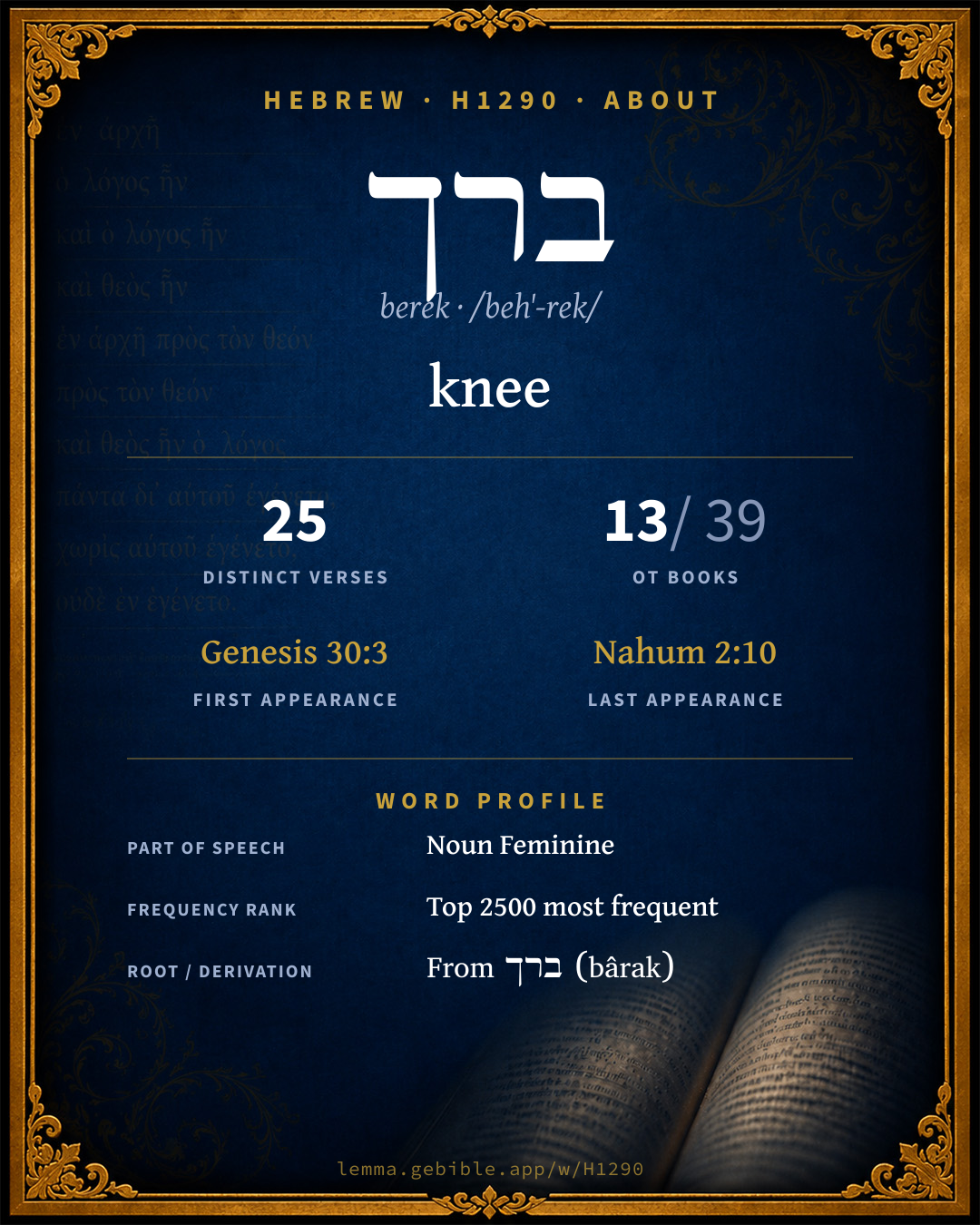
בֶּ֫רֶךְ
knee
‘knee’ is one of 2 main senses fuller range ↓
Full lexicon entry — Brown-Driver-Briggs (BDB)
From Brown-Driver-Briggs (BDB)
Where this word appears
Grammar key — what these labels mean
Part of speech
- Noun
- A naming word — a person, place, thing, or idea.
Noun type
- Common
- A common noun — a general class of person, place, or thing (“king,” “city,” “water”), not a specific name.
State
- Construct
- A noun bound to a following noun in a possessive / “of” relationship (the construct chain).
- Absolute
- The independent form of a noun, not bound to a following word.
Gender
- Feminine
- Grammatically feminine.
Number
- Dual
- Exactly two — for natural pairs and some measures of time.
- Singular
- One.
Every verse where H1290 appears in the Book of 2 Kings — 2 distinct verses. Click any verse to open its interlinear word-by-word view. Verse text shown in the World English Bible for context — . Each verse’s Hebrew form is shown with its reference; the English is not keyword-highlighted, since the data carries no word-level English alignment. Use “Compare translations” on any verse to read it across multiple English versions. This concordance covers the Hebrew Bible; Septuagint (Greek Old Testament) occurrences are not indexed here.
2 Kings
- 2 Kings 1:13 בִּרְכָּ֣י/ו n c fd cs + sfx pers 3ms Again he sent the captain of a third fifty with his fifty. The third captain of fifty went up, and came and fell on his knees before Elijah, and begged him, and said to him, man of God, please let my life, and the life of these fifty your servants, be precious in your sight.
- 2 Kings 4:20 בִּרְכֶּ֛י/הָ n c fd cs + sfx pers 3fs When he had taken him, and brought him to his mother, he sat on her knees until noon, and then died.
About this entry
At a glance — auto-summarized from this page’s data, not written by a person. Every figure links to its source below. This summary describes the numbers; it doesn’t interpret them.
“knee” is the headline sense of the Hebrew noun ברך (berek). First canonically at Genesis 30:3, it enters the text early. With 25 verses in 13 books, it is an uncommon word in the Hebrew Bible. Lexicons map it across 2 senses. It clusters with ברך, ברך and ברכה under a shared root. See the sense tree, 25-verse concordance, and the renderings breakdown below.
Gloss history
Strong's 1890 vs modern scholarship
About this word
Strong's H1290 catalogs a Hebrew word from the Hebrew Old Testament.
These counts are not copied from any lexicon or concordance. They are computed here, from the morphology-tagged Hebrew Old Testament. What Lemma adds →
- 25
- distinct verses
- The word appears in 25 distinct verses.
- 13 / 39
- OT books
- The word appears in 13 of 39 Old Testament books.
- #1,251
- by frequency
- Top 2500 most frequent Hebrew words (rank 1,251 of 8,640 Hebrew words by occurrence).
View all 25 occurrences in the concordance →
By section of the Old Testament
By traditional corpus
Conventional, traditional groupings — biblical authorship is debated, so this is a traditional corpus grouping, not an authorship claim. Each share is this word’s portion of its verses in that division of the Hebrew canon. Each figure is a share of the word’s 25 distinct verses.
- Prophets (Nevi'im) 15 verses · 60%
- Writings (Ketuvim) 6 verses · 24%
- Torah (Pentateuch) 4 verses · 16%
How translations render this word
Counts come from each version’s own published word-to-Strong’s tagging or interlinear alignment — an approximate guide to how each version renders this word, not a word-level alignment the data otherwise carries. Because each total is that version’s own tagged count, the per-version totals vary from one another and need not match the appearance or distinct-verse counts above. These counts may also differ from a printed concordance because Lemma counts each distinctly tagged rendering and does not collapse phrase taggings into a single head-word total. This is a fixed set of word-tagged versions (KJV, ASV, BSB, ULT) and does not change with the reading translation you choose elsewhere. Each version’s license is shown beside its name below (and on Sources).
- King James Version: Knees 17×, All knees 2×
- American Standard Version: Knees 13×, All knees 2×
- Berean Standard Bible: Knees 13×, Knee 3×, Lap 2×
- unfoldingWord Literal Text: Knees 20×, And 2×, Knee 2×
King James Version Public Domain
Renders H1290 across 25 tagged occurrences — most commonly:
Plus 6 renderings that appear only once — usually multi-word phrases or single function words the recovered tagging swept in, not distinct renderings.
American Standard Version Public Domain
Renders H1290 across 25 tagged occurrences — most commonly:
Plus 10 renderings that appear only once — usually multi-word phrases or single function words the recovered tagging swept in, not distinct renderings.
Berean Standard Bible Public Domain
Renders H1290 across 20 tagged occurrences — most commonly:
Plus 2 renderings that appear only once — usually multi-word phrases or single function words the recovered tagging swept in, not distinct renderings. Not rendered by a distinct English word in 5 further occurrences.
unfoldingWord Literal Text CC BY-SA 4.0
Renders H1290 across 28 tagged occurrences — most commonly:
Plus 4 renderings that appear only once — usually multi-word phrases or single function words the recovered tagging swept in, not distinct renderings.
Senses in BDB
The 2 senses BDB distinguishes for this word, in lexicon order (not ranked by frequency or importance). The full entry — with sub-senses — is in the Lexicon Entry tab.
- knee
- weak from fear (figuratively)
Word origin
n.f. Is. 45:23 knee (Assyrian birku Ethiopic ብርክ Aramaic בֶּרֶךְ, ܒܪܽܘܟ; Arabic رُكْنَةٌ ) Is 45:23; du. בִּרְכַּיִם Jb 3:12 + 10 times; sf. בִּרְכַּי etc. Gn 30:3 + 11 times;—knee, knees: מים ברכים water reaching to the knees Ez 47:4; וַתְּנִיעֵנִי על ברכי Dn 10:10; יַכְּכָה בשׁחין רע על הברכים Dt 28:35; כרע על ברכים kneel on knees in worship 1 K 8:54 Ezr 9:5 cf. Is 45:23 1 K 19:18 2 Ch 6:13, in entreaty 2 K 1:13, to drink of a fountain Ju 7:5, 6; שׂם פניו בין ברכיו put his face between his knees in prayer 1 K 18:42; על ברכים upon the knees, Gn 30:3 (E; on תֵּלֵד עַל ב׳ v. PlossDas Weib Aufl. 2. ii. 180 ff. StaZAW 1886, 143 ff.) 50:23 (E) Jb 3:12 Ju 16:19 2 K 4:20 Is 6:12; הוציא מעם ברכים Gn 48:12 (E); knees as seat of strength, weak from terror Jb 4:4 Is 35:3 Ez 7:17; 21:12 Na 2:11; or fasting ψ 109:24.
— Brown-Driver-Briggs (Oxford 1906, public domain), digitized via Sefaria, supplemented by the OpenScriptures HebrewLexicon (CC BY 4.0). See Sources.
Derived from ברך (bârak) (H1288) — to bless.
Jastrow Dictionary
A second Hebrew/Aramaic lexicon for comparison, covering Aramaic and post-biblical (Talmudic, Targumic, Midrashic) usage that the biblical-Hebrew BDB does not. Matched by lemma rather than by Strong’s number, so a lemma may carry more than one Jastrow headword (shown separately below), and the entries cover usage well beyond the Bible.
בָּרַךְ
- 1. to cave out. Denom. בְּרֵכָה, בֶּרֶךְ; cmp. בּוּרְכָּא, בּוּרְכְּתָא.
- 2. (cmp. ברר) to select, point out (cmp. esp. Gen. II, 3) whence to bless (Pi.).—Part. pass. בָּרוּךְ chosen, blessed, praised. הקדוש ב׳ הוא (abbr. הקב"ה) the Holy One, blessed be He. Pes. 118ᵃ; a. v. fr. Ib. 104ᵇ, a. fr. פותח בב׳ וכ׳ he (who prays) opens the benediction with barukh and closes with barukh (i.e. ברוך אתה ה׳). Tosef. Sot. I, 10 ב׳ בכלל, v. כְּלָל; a. fr. e.g. Genesis 2:3
- (b. h.)
- 1. to praise, bless, esp. to recite the due benediction. Ber. VI, 1. Ib. 5 בי׳ על היין having recited the blessing over wine &c. Pes. X, 9 ב׳ ברכת הפסח having recited the blessing over the Paschal lamb. Ib. 5 אנחנו חייבים … לְבָרֵךְ we are bound to … praise &c.; a. v. fr.
- 2. (cmp. נקב) to blaspheme. Snh. 56ᵃ עד שֶיְבָרֵךְ שם בשם until he blasphemes the Lord by His name. Ib. שבי׳ את השם בכינוי who blasphemed the Lord by an attribute.—Part. Pu. מְבוֹרָךְ blessed, praiseworthy. Ber. VII, 3; a. fr.
- 3. *to cut through, to clear virgin ground or forest. Tosef. Shebi. III, 20 ed. Zuck. (Var. מגדר); Y. ib. IV, 35ᵇ bot. מבדין; Y. Sabb. VII, 10ᵃ top המברה, v. בהי h. [Tosef. Shebi. I, 6 מבורכות, v. infra.]
- , Nithpa. נִתְבָּרֵךְ to be blessed (praised); to be increased (v. בְּרָכָה). Y. Ber. IX, 14ᵃ top ויִתְבָּרַךְ and be blessed. Y. M. Kat. I, beg. 80ᵃ if the waters were scanty ונִתְבָּרְכוּ and grew plentiful. Yeb. 63ᵃ; a. fr.
- (denom. of בֶּרֶךְ or בְּרִיכָה) to form a knee, to engraft; esp. to bend a vine by drawing it into the ground and making it grow forth as an independent plant, to sink. Shebi. II, 6; R. Hash. 10ᵇ; a. fr.—Tosef. Shebi. I, 6 אם היו מוּבְרָכוֹת (incorr. מבורכ׳) if they have been sunk before New Year &c.—Yeb. 63ᵃ (allud. to Gen. XII, 3) שתי ברכית טובות יש לי להַבְרִיךְ בך two good shoots (proselytes) have I to engraft on thee, Ruth and &c. (B. Kam. 38ᵇ … פרידות וכ׳). e.g. Genesis 12:3
בְּרַךְ
- Part. Peil בְּרִיךְ blessed. Targ. Gen. IX, 26; a. fr.—Sabb. 67ᵃ, a. fr. קודשא ב׳ הוא the Holiness (Holy One), blessed be He. Cant. R. to. IV, 4; Gen. R. s. 32 הדין טורא בְּרִיכָא this blessed mount (Gerizim, revered by the Samaritans; Deut. R. s. 3 קדיש).
- as preced. Pi.
- 1. to bless &c. Targ. Deut. VIII, 10; a. fr.—Esp. to say grace after meal. Ber. 46ᵃ כי מטי לְבָרוּכֵי וכ׳ when it was time to say grace, he said, Will you please, say grace for us. Y. ib. VI, 10ᵇ מהו למיבָרְכָה בסופה what benediction must be said after it? Ib. bot. לא אנא חכים מברכא I do not know how to say grace after it.—Part. pass. מְבָרַךְ. Targ. Y. II, Gen. XLIX, 2.
- 2. to blaspheme. Targ. Job II, 9.—Snh. 56ᵃ לישנא דברוכי in the sense of blaspheming.
- as preced. Hithpa. Targ. Gen. XII, 3; a. fr.
בֶּרֶךְ
- preced.)
- 1. knee. Y. Ber. I, 3ᵈ top.
- 2. a knee-shaped pole. Taan. 25ᵇ כמלא ב׳ חמחרישה (Var. כוך, v. Rabb. D. S. a. l.) (until the rain penetrates) as far as the knee of the plough enters the soil; Ohol. XVII, 1 בו׳. Kel. XXI, 2 בו׳. [Tosef. Shebi. IV, 20 ברך, v. בְּרִיכָה.]—Du. בִּרְכַּיִם. Ber. 34ᵇ; Meg. 22ᵇ; Shebu. 16ᵇ כריעה על ב׳ the word כרע means falling on one’s knees. [בִּרְכּוֹת, v. בְּרִיכָה.]
בֶּרֶךְ ²
- 1. knee. Targ. Is. XLV, 23.—Pl. בִּרְכַּיָא, בִּרְכֵּי, בִּי׳. Targ. Jud. VII, 6; a. e.—Ber. 6ᵃ הנהו ב׳ וכ׳ those fatigued knees (of scholars) must be ascribed to them (the demons). Pes. 108ᵃ, v. זְגָא.
- 2. = h. בְּרִיכָה. Pl. בִּירְכֵּי shoots, branches. Tam. 30ᵃ top (Var. in Rashi בְּרִיכֵי, Ar. בורכי).
A Dictionary of the Targumim, the Talmud Babli and Yerushalmi, and the Midrashic Literature (Marcus Jastrow; London, Luzac, 1903) — Public Domain. Digitized via Sefaria. Digitized via Sefaria. Full attribution on Sources.
Forms in the corpus
The 24 distinct written forms H1290 takes in the Hebrew Bible, most frequent first — each parse links to that state’s occurrences in the concordance. Hebrew forms include their vowel points and cantillation, so a single lemma takes many written forms.
Same root — word family
Other BDB entries built from the same root as H1290, grouped by Strong’s listed origin. These share a root / origin per the lexicon — not necessarily a shared meaning. Each links to that word’s own entry.
Derives from
Shares the same root
Derived from this word
Proper names from this root
People and places named from this root — a name, not an additional meaning of the word.
- ברוך Bârûwk H1263 Baruch
- ברכאל Bârakʼêl H1292 Barachel
- יברכיהו Yᵉberekyâhûw H3000 Jeberechiah
- ברכיה Berekyâh H1296 Berachiah
Compare all same-root words → Showing 4 of 10 — not the complete family. 4 of the same-root words are proper names (people or places). They share a root, not necessarily a meaning.
Septuagint verse parallels
This word appears in 24 verses that also exist in the Greek Old Testament (Septuagint), out of the 25 Hebrew verses it occurs in. You can read those verses in Greek by switching the Old Testament edition to the Septuagint.
Read these verses in the Septuagint
- Genesis 30:3
- Deuteronomy 28:35
- Judges 7:5
- 1 Kings 8:54
- 2 Kings 1:13
- 2 Chronicles 6:13
- Ezra 9:5
- Job 3:12
- Isaiah 35:3
- Ezekiel 7:17
- Daniel 10:10
- Nahum 2:10
This is a verse-level parallel only — the same verses exist in both the Hebrew and Greek Old Testaments. No word-level Hebrew↔Greek correspondence is claimed: the data carries no such alignment, so no Greek word is shown as this Hebrew word’s translation. Coverage is not total — the Septuagint omits the deuterocanon and renumbers the Psalms, so some Hebrew verses have no direct Greek parallel.