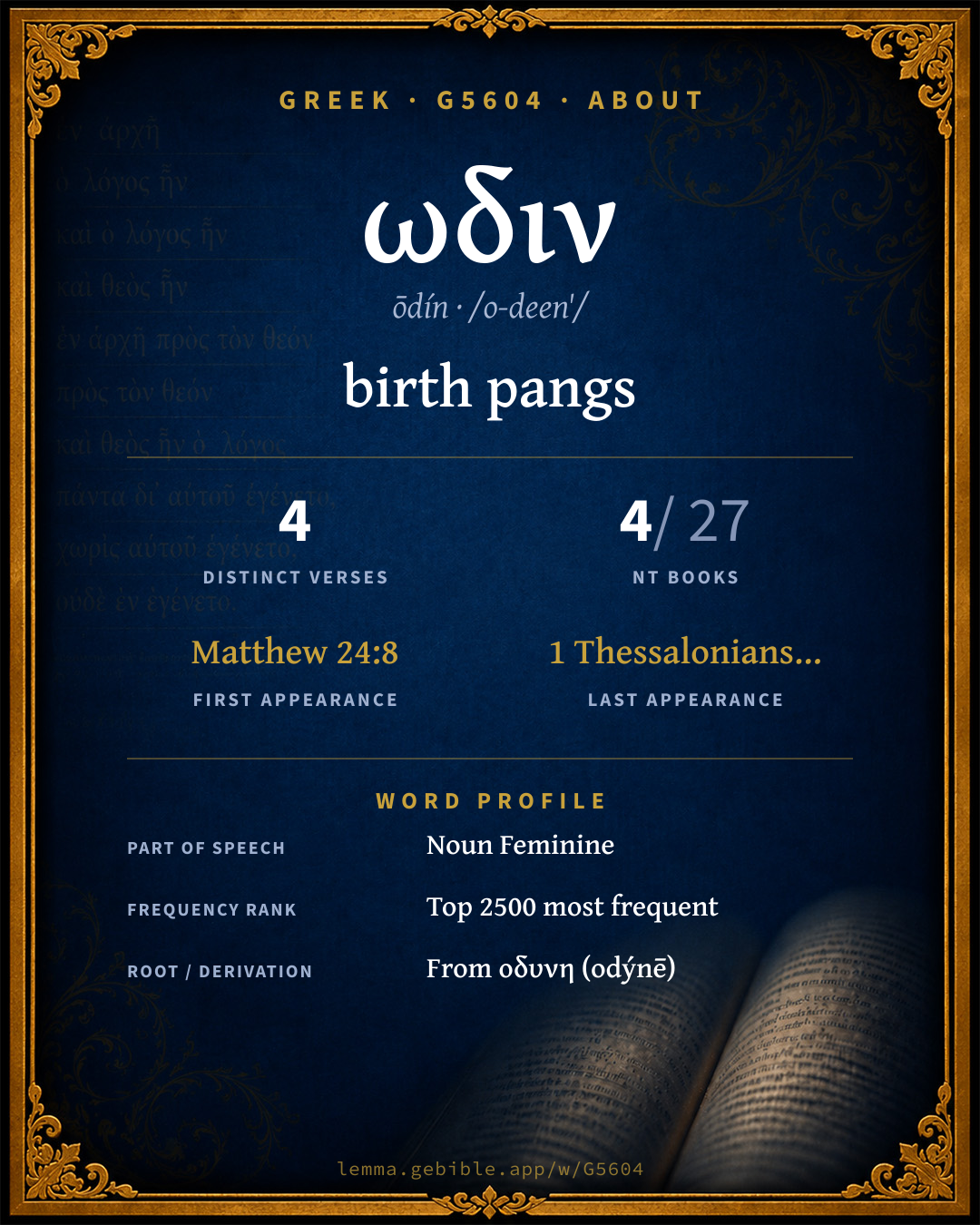
ὠδίν
birth pangs
‘birth pangs’ is one of 2 main senses fuller range ↓
Full lexicon entry — Thayer's Greek Lexicon
From Thayer's Greek Lexicon
Where this word appears
Grammar key — what these labels mean
Part of speech
- Noun
- A naming word — a person, place, thing, or idea.
Case
- Genitive
- The case of source, possession, or “of” — answers “whose / from what.”
- Accusative
- The case of the direct object and of extent.
- Nominative
- The case of the subject (and the predicate nominative).
Gender
- Feminine
- Grammatically feminine.
Number
- Plural
- More than one.
- Singular
- One.
Every verse where G5604 appears in the Book of Matthew — 1 distinct verse. Click any verse to open its interlinear word-by-word view. Verse text shown in the World English Bible for context — . Each verse’s Greek form is shown with its reference; the English is not keyword-highlighted, since the data carries no word-level English alignment. Use “Compare translations” on any verse to read it across multiple English versions. This concordance covers the Greek New Testament; Septuagint (Greek Old Testament) occurrences of this word are not indexed here.
Matthew
About this entry
At a glance — auto-summarized from this page’s data, not written by a person. Every figure links to its source below. This summary describes the numbers; it doesn’t interpret them.
ωδιν — transliterated ōdín — is a Greek noun carrying the sense “birth pangs.” The Greek New Testament uses it only 4 verses. More than a quarter of its appearances fall in Matthew. Debuting at Matthew 24:8, it then recurs through the corpus. Its lexical range runs to 2 senses. See the sense tree, 4-verse concordance, and the renderings breakdown below.
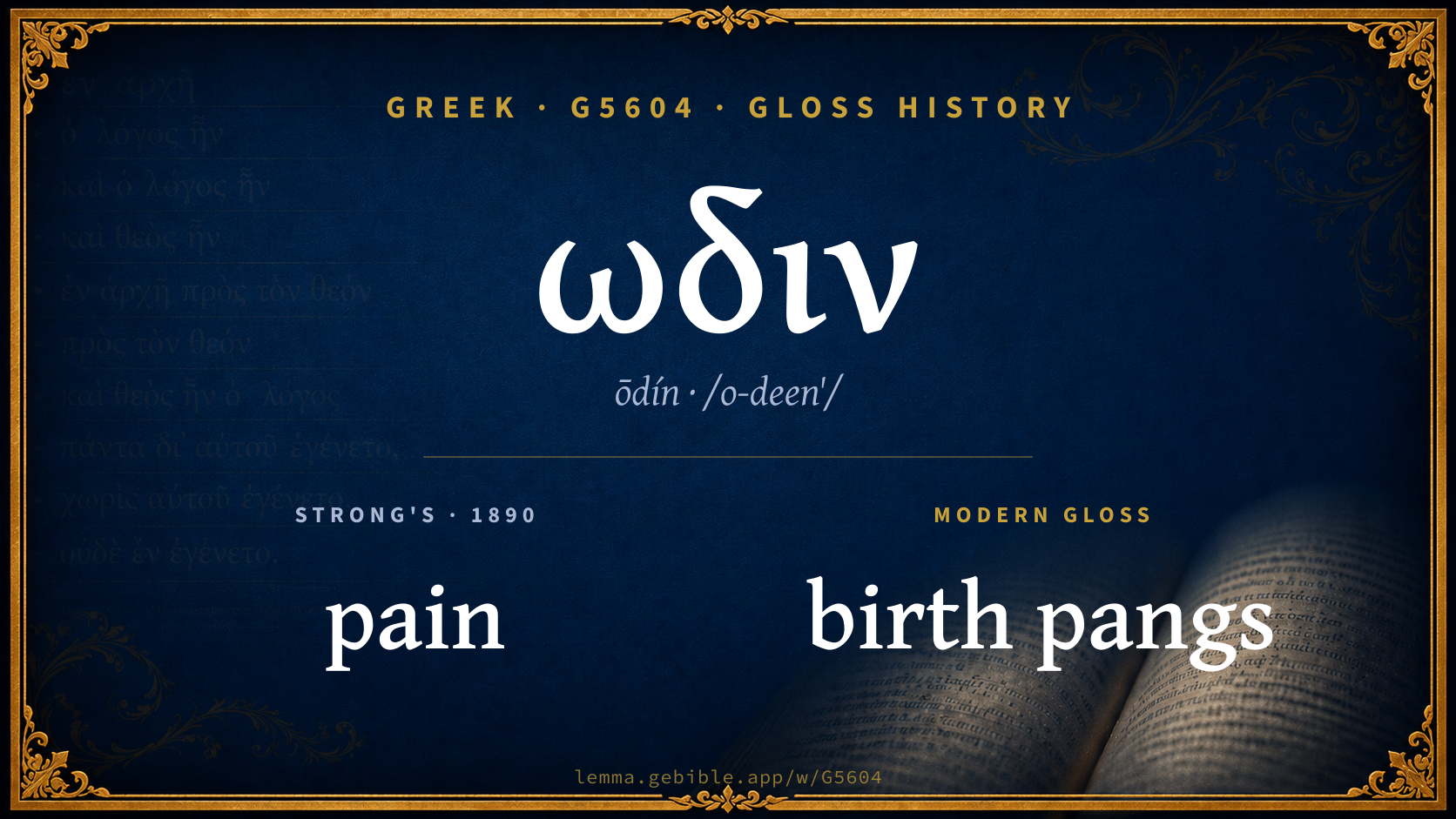
Gloss history
Strong's 1890 vs modern scholarship
About this word
Strong's G5604 catalogs a Greek word from the Greek New Testament.
These counts are not copied from any lexicon or concordance. They are computed here, from the morphology-tagged Greek New Testament. What Lemma adds →
- 4
- distinct verses
- The word appears in 4 distinct verses.
- 4 / 27
- NT books
- The word appears in 4 of 27 New Testament books.
- #1,877
- by frequency
- Top 2500 most frequent Greek words (rank 1,877 of 5,347 Greek words by occurrence).
View all 4 occurrences in the concordance →
By section of the New Testament
By traditional corpus
Conventional, traditional groupings — biblical authorship is debated, so this is a traditional corpus grouping, not an authorship claim. Some books belong to more than one corpus (Luke is in both the Gospels and the Lukan corpus, and so on), so these shares overlap and need not total 100%. Each figure is a share of the word’s 4 distinct verses.
- Gospels 2 verses · 50%
- Lukan (Luke–Acts) 1 verse · 25%
- Pauline corpus 1 verse · 25%
How translations render this word
Counts come from each version’s own published word-to-Strong’s tagging or interlinear alignment — an approximate guide to how each version renders this word, not a word-level alignment the data otherwise carries. Because each total is that version’s own tagged count, the per-version totals vary from one another and need not match the appearance or distinct-verse counts above. These counts may also differ from a printed concordance because Lemma counts each distinctly tagged rendering and does not collapse phrase taggings into a single head-word total. This is a fixed set of word-tagged versions (KJV, ASV, BSB, ULT) and does not change with the reading translation you choose elsewhere. Each version’s license is shown beside its name below (and on Sources).
- King James Version: Sorrows 2×
- American Standard Version: Travail 3×
- Berean Standard Bible: Birth pains 2×
- unfoldingWord Literal Text: Birth pains 2×
King James Version Public Domain
Renders G5604 across 4 tagged occurrences — most commonly:
Plus 2 renderings that appear only once — usually multi-word phrases or single function words the recovered tagging swept in, not distinct renderings.
American Standard Version Public Domain
Renders G5604 across 4 tagged occurrences — most commonly:
Plus 1 rendering that appears only once — usually multi-word phrases or single function words the recovered tagging swept in, not distinct renderings.
Berean Standard Bible Public Domain
Renders G5604 across 4 tagged occurrences — most commonly:
Plus 2 renderings that appear only once — usually multi-word phrases or single function words the recovered tagging swept in, not distinct renderings.
unfoldingWord Literal Text CC BY-SA 4.0
Renders G5604 across 4 tagged occurrences — most commonly:
Plus 2 renderings that appear only once — usually multi-word phrases or single function words the recovered tagging swept in, not distinct renderings.
Senses in Thayer's
The 2 senses Thayer's distinguishes for this word, in lexicon order (not ranked by frequency or importance). The full entry — with sub-senses — is in the Lexicon Entry tab.
- the pain of childbirth, travail pain, birth pangs
- intolerable anguish, in reference to the dire calamities precede the advent of the Messiah
Word origin
Derived from οδυνη (odýnē) (G3601) — anguish.
Akin to G3601 ; a pang or throe especially of childbirth : - pain sorrow travail.
— Strong’s Exhaustive Concordance (1890), public domain.
Forms in the corpus
The 3 distinct written forms G5604 takes in the Greek New Testament, most frequent first — each parse links to that case’s occurrences in the concordance.
| Form | Parsing | Example | Uses |
|---|---|---|---|
| ὠδίνων ōdínōn | Noun, Genitive, Plural, Feminine | Matthew 24:8 | 2 |
| ὠδὶν ōdìn | Noun, Nominative, Singular, Feminine | 1 Thessalonians 5:3 | 1 |
| ὠδῖνας ōdînas | Noun, Accusative, Plural, Feminine | Acts 2:24 | 1 |
Same root — word family
Other Thayer's entries built from the same root as G5604, grouped by Strong’s listed origin. These share a root / origin per the lexicon — not necessarily a shared meaning. Each links to that word’s own entry.
Derives from
Shares the same root
Derived from this word
Compare all same-root words → They share a root, not necessarily a meaning.
Septuagint usage
The same Greek word ωδιν appears 28 times in the Greek Old Testament (Septuagint), across 28 verses in 13 books.
- 28
- LXX occurrences
- Tagged occurrences of this Greek word in the Septuagint.
- 28
- verses
- Distinct Septuagint verses containing this word.
- 13 / 39
- OT books
- The word appears in 13 of the 39 Old Testament books.
Sample Septuagint occurrences
- Exodus 15:14 ὠδίν
- Deuteronomy 2:25 ὠδίν
- 1 Samuel 4:19 ὠδίν
- 2 Samuel 22:6 ὠδίν
- 2 Kings 19:3 ὠδίν
- Job 2:9 ὠδίν
- Psalms 17:5 ὠδίν
- Isaiah 13:8 ὠδίν
- Jeremiah 6:24 ὠδίν
- Ezekiel 7:4 ὠδίν
- Hosea 9:11 ὠδίν
- Micah 4:9 ὠδίν
Septuagint occurrences (same lexeme)
Every verse where the same Strong’s number (G5604) appears in the Greek Septuagint. Verse text shown in the World English Bible for context; the Greek form is the matched word — the English is not keyword-highlighted.
- Exodus 15:14 ὠδίν The peoples have heard. They tremble. Pangs have taken hold on the inhabitants of Philistia.
- Deuteronomy 2:25 ὠδίν This day will I begin to put the dread of you and the fear of you on the peoples who are under the whole sky, who shall hear the report of you, and shall tremble, and be in anguish because of you.
- 1 Samuel 4:19 ὠδίν His daughter-in-law, Phinehas' wife, was with child, near to be delivered: and when she heard the news that the ark of God was taken, and that her father-in-law and her husband were dead, she bowed herself and brought forth; for her pains came on her.
- 2 Samuel 22:6 ὠδίν The cords of Sheol were round about me; The snares of death came on me.
- 2 Kings 19:3 ὠδίν They said to him, Thus says Hezekiah, This day is a day of trouble, and of rebuke, and of rejection; for the children are come to the birth, and there is not strength to bring forth.
- Job 2:9 ὠδίν Then his wife said to him, "Do you still maintain your integrity? Renounce God, and die."
- Job 21:17 ὠδίν "How often is it that the lamp of the wicked is put out? That their calamity comes on them? That God distributes sorrows in his anger?
- Job 39:1 ὠδίν "Do you know the time when the mountain goats give birth? Do you watch when the doe bears fawns?
- Job 39:2 ὠδίν Can you number the months that they fulfill? Or do you know the time when they give birth?
- Psalms 17:5 ὠδίν My steps have held fast to your paths, My feet have not slipped.
- Psalms 17:6 ὠδίν I have called on you, for you will answer me, God: Turn your ear to me. Hear my speech.
- Psalms 47:7 ὠδίν For God is the King of all the earth. Sing praises with understanding.
- Psalms 114:3 ὠδίν The sea saw it, and fled. The Jordan was driven back.
- Isaiah 13:8 ὠδίν and they shall be dismayed; pangs and sorrows shall take hold [of them]; they shall be in pain as a woman in travail: they shall look in amazement one at another; their faces [shall be] faces of flame.
- Isaiah 21:3 ὠδίν Therefore are my loins filled with anguish; pangs have taken hold on me, as the pangs of a woman in travail: I am pained so that I can't hear; I am dismayed so that I can't see.
- Isaiah 26:17 ὠδίν Like as a woman with child, who draws near the time of her delivery, is in pain and cries out in her pangs; so we have been before you, Yahweh.
- Isaiah 37:3 ὠδίν They said to him, Thus says Hezekiah, This day is a day of trouble, and of rebuke, and of rejection; for the children have come to the birth, and there is no strength to bring forth.
- Isaiah 66:7 ὠδίν Before she travailed, she brought forth; before her pain came, she was delivered of a man-child.
- Jeremiah 6:24 ὠδίν We have heard the report of it; our hands wax feeble: anguish has taken hold of us, [and] pangs as of a woman in travail.
- Jeremiah 8:21 ὠδίν For the hurt of the daughter of my people am I hurt: I mourn; dismay has taken hold on me.
- Jeremiah 13:21 ὠδίν What will you say, when he shall set over you as head those whom you have yourself taught to be friends to you? shall not sorrows take hold of you, as of a woman in travail?
- Jeremiah 22:23 ὠδίν Inhabitant of Lebanon, who makes your nest in the cedars, how greatly to be pitied shall you be when pangs come on you, the pain as of a woman in travail!
- Jeremiah 27:43 ὠδίν
- Ezekiel 7:4 ὠδίν My eye shall not spare you, neither will I have pity; but I will bring your ways on you, and your abominations shall be in the midst of you: and you shall know that I am Yahweh.
- Hosea 9:11 ὠδίν As for Ephraim, their glory will fly away like a bird. There will be no birth, none with child, and no conception.
- Hosea 13:13 ὠδίν The sorrows of a travailing woman will come on him. He is an unwise son; For when it is time, he doesn't come to the opening of the womb.
- Micah 4:9 ὠδίν Now why do you cry out aloud? Is there no king in you? Has your counselor perished, That pains have taken hold of you as of a woman in travail?
- Nahum 2:11 ὠδίν Where is the den of the lions, and the feeding-place of the young lions, where the lion and the lioness walked, the lion's cubs, and no one made them afraid?
These are occurrences of the same Greek lexeme (G5604) in the Septuagint — not a translation of any one Hebrew word. The store carries no word-level Hebrew↔Greek alignment, so no Hebrew original is asserted here. Counts come from the recovered LXX Strong's tagging — high-frequency vocabulary is well covered, while rare or late forms may be untagged — so they reflect tagged occurrences and may slightly undercount.