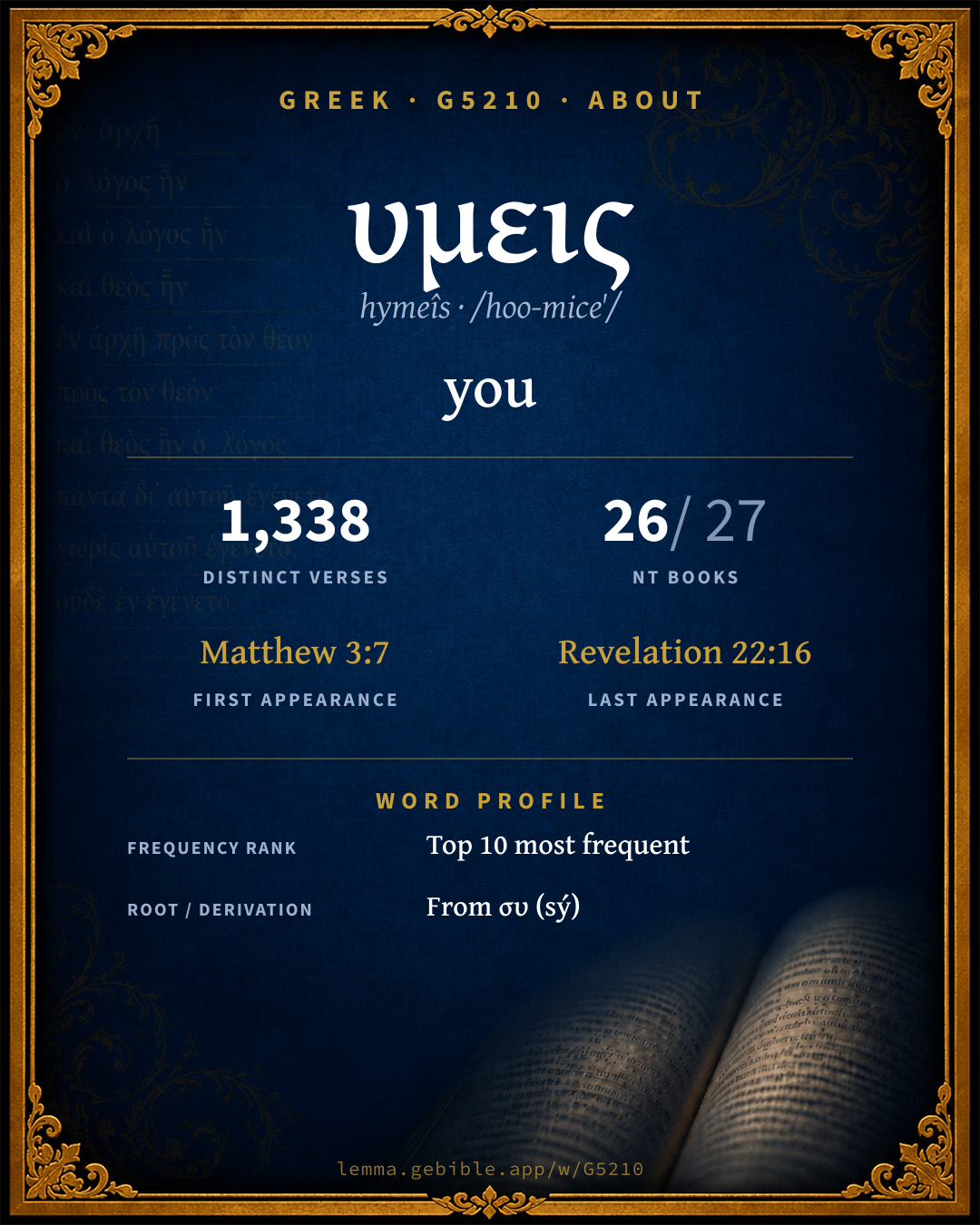
ὑμείς
you
Full lexicon entry — Thayer's Greek Lexicon
From Thayer's Greek Lexicon
Where this word appears
See every Accusative-case word in the Greek New Testament →
Grammar key — what these labels mean
Part of speech
- Personal pronoun
- Stands in for a person already named (“I,” “you,” “he”).
Case
- Dative
- The case of the indirect object, means, or location — “to / for / with / in.”
- Genitive
- The case of source, possession, or “of” — answers “whose / from what.”
- Accusative
- The case of the direct object and of extent.
- Nominative
- The case of the subject (and the predicate nominative).
Person
- 2nd person
- The one addressed (“you”).
Number
- Plural
- More than one.
16 verses where G5210 appears in the Accusative case in the Book of Galatians. Filtered view — show all forms. Click any verse to open its interlinear word-by-word view. Verse text shown in the World English Bible for context — . Each verse’s Greek form is shown with its reference; the English is not keyword-highlighted, since the data carries no word-level English alignment. Use “Compare translations” on any verse to read it across multiple English versions. This concordance covers the Greek New Testament; Septuagint (Greek Old Testament) occurrences of this word are not indexed here.
Galatians
- Galatians 1:6 ὑμᾶς pron 2 acc pl I marvel that you are so quickly deserting him who called you in the grace of Christ to a different gospel;
- Galatians 1:7 ὑμᾶς pron 2 acc pl and there isn't another gospel. Only there are some who trouble you, and want to pervert the Gospel of Christ.
- Galatians 1:9 ὑμᾶς pron 2 acc pl As we have said before, so I now say again: if any man preaches to you any gospel other than that which you received, let him be cursed.
- Galatians 2:5 ὑμᾶς pron 2 acc pl to whom we gave no place in the way of subjection, not for an hour, that the truth of the Gospel might continue with you.
- Galatians 3:1 ὑμᾶς pron 2 acc pl Foolish Galatians, who has bewitched you not to obey the truth, before whose eyes Jesus Christ was openly set forth among you as crucified?
- Galatians 4:11 ὑμᾶς ὑμᾶς pron 2 acc pl pron 2 acc pl I am afraid for you, that I might have wasted my labor for you.
- Galatians 4:17 ὑμᾶς ὑμᾶς pron 2 acc pl pron 2 acc pl They zealously seek you in no good way. No, they desire to alienate you, that you may seek them.
- Galatians 4:18 ὑμᾶς pron 2 acc pl But it is always good to be zealous in a good cause, and not only when I am present with you.
- Galatians 4:20 ὑμᾶς ὑμῖν pron 2 acc pl pron 2 dat pl but I could wish to be present with you now, and to change my tone, for I am perplexed about you.
- Galatians 5:2 ὑμῖν ὑμᾶς pron 2 dat pl pron 2 acc pl Behold, I, Paul, tell you that if you receive circumcision, Christ will profit you nothing.
- Galatians 5:7 ὑμᾶς pron 2 acc pl You were running well! Who interfered with you that you should not obey the truth?
- Galatians 5:8 ὑμᾶς pron 2 acc pl This persuasion is not from him who calls you.
- Galatians 5:10 ὑμᾶς ὑμᾶς pron 2 acc pl pron 2 acc pl I have confidence toward you in the Lord that you will think no other way. But he who troubles you will bear his judgment, whoever he is.
- Galatians 5:12 ὑμᾶς pron 2 acc pl I wish that those who disturb you would cut themselves off.
- Galatians 6:12 ὑμᾶς pron 2 acc pl As many as desire to look good in the flesh, they compel you to be circumcised; only that they may not be persecuted for the cross of Christ.
- Galatians 6:13 ὑμᾶς pron 2 acc pl For even they who receive circumcision don't keep the law themselves, but they desire to have you circumcised, that they may boast in your flesh.
About this entry
At a glance — auto-summarized from this page’s data, not written by a person. Every figure links to its source below. This summary describes the numbers; it doesn’t interpret them.
υμεις (hymeîs) is a Greek word most often rendered “you.” It first appears in Matthew 3:7. It turns up in 1,338 verses across 26 books, one of the most common footprint. From the same root come συ, σε and σοι. For the data behind this summary, explore the sense tree and the renderings breakdown below.
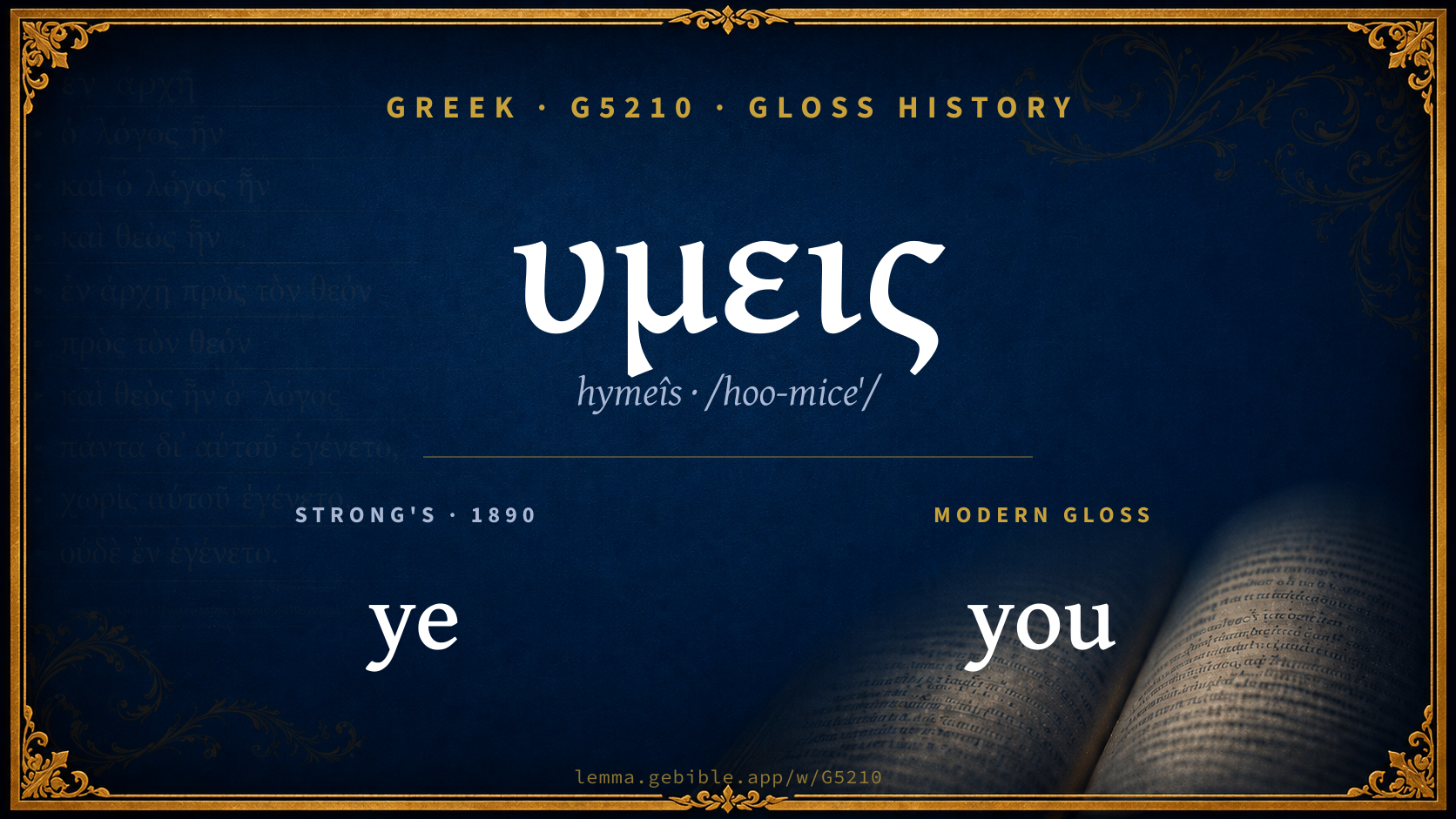
Gloss history
Strong's 1890 vs modern scholarship
About this word
Strong's G5210 catalogs a Greek word from the Greek New Testament.
These counts are not copied from any lexicon or concordance. They are computed here, from the morphology-tagged Greek New Testament. What Lemma adds →
- 1,338
- distinct verses
- The word appears in 1,338 distinct verses.
- 26 / 27
- NT books
- The word appears in 26 of 27 New Testament books.
- #8
- by frequency
- Top 10 most frequent Greek words (rank 8 of 5,347 Greek words by occurrence).
View all 1,338 occurrences in the concordance →
By section of the New Testament
By traditional corpus
Conventional, traditional groupings — biblical authorship is debated, so this is a traditional corpus grouping, not an authorship claim. Some books belong to more than one corpus (Luke is in both the Gospels and the Lukan corpus, and so on), so these shares overlap and need not total 100%. Each figure is a share of the word’s 1,338 distinct verses.
- Gospels 566 verses · 42%
- Pauline corpus 525 verses · 39%
- Lukan (Luke–Acts) 256 verses · 19%
- Johannine 194 verses · 14%
- General (Catholic) Epistles 121 verses · 9%
- Hebrews 28 verses · 2%
- Revelation 9 verses · 1%
How translations render this word
Counts come from each version’s own published word-to-Strong’s tagging or interlinear alignment — an approximate guide to how each version renders this word, not a word-level alignment the data otherwise carries. Because each total is that version’s own tagged count, the per-version totals vary from one another and need not match the appearance or distinct-verse counts above. These counts may also differ from a printed concordance because Lemma counts each distinctly tagged rendering and does not collapse phrase taggings into a single head-word total. This is a fixed set of word-tagged versions (KJV, ASV, BSB, ULT) and does not change with the reading translation you choose elsewhere. Each version’s license is shown beside its name below (and on Sources).
- King James Version: Ye 229×, Do ye 3×, Thither ye 2×
- American Standard Version: Ye 220×, Do ye 4×
King James Version Public Domain
Renders G5210 across 242 tagged occurrences — most commonly:
Plus 8 renderings that appear only once — usually multi-word phrases or single function words the recovered tagging swept in, not distinct renderings.
American Standard Version Public Domain
Renders G5210 across 237 tagged occurrences — most commonly:
Plus 13 renderings that appear only once — usually multi-word phrases or single function words the recovered tagging swept in, not distinct renderings.
Senses in Thayer's
The 1 sense Thayer's distinguishes for this word, in lexicon order (not ranked by frequency or importance). The full entry — with sub-senses — is in the Lexicon Entry tab.
- you
Word origin
Derived from συ (sý) (G4771) — you.
Irregular plural of G4771 ; you (as subject of verb): - ye (yourselves) you.
— Strong’s Exhaustive Concordance (1890), public domain.
Forms in the corpus
The 5 distinct written forms G5210 takes in the Greek New Testament, most frequent first — each parse links to that case’s occurrences in the concordance.
| Form | Parsing | Example | Uses |
|---|---|---|---|
| ὑμῖν hymîn | Personal pronoun, 2nd person, Dative, Plural | Matthew 3:7 | 601 |
| ὑμῶν hymō̂n | Personal pronoun, 2nd person, Genitive, Plural | Matthew 5:11 | 560 |
| ὑμᾶς hymâs | Personal pronoun, 2nd person, Accusative, Plural | Matthew 3:11 | 432 |
| ὑμεῖς hymeîs | Personal pronoun, 2nd person, Nominative, Plural | Matthew 5:48 | 230 |
| Ὑμεῖς Hymeîs | Personal pronoun, 2nd person, Nominative, Plural | Matthew 5:13 | 5 |
Same root — word family
Other Thayer's entries built from the same root as G5210, grouped by Strong’s listed origin. These share a root / origin per the lexicon — not necessarily a shared meaning. Each links to that word’s own entry.
Derives from
Shares the same root
Derived from this word
Compare all same-root words → Showing 4 of 10 — not the complete family. They share a root, not necessarily a meaning.
Septuagint usage
The same Greek word υμεις appears 3 times in the Greek Old Testament (Septuagint), across 3 verses in 1 book.
- 3
- LXX occurrences
- Tagged occurrences of this Greek word in the Septuagint.
- 3
- verses
- Distinct Septuagint verses containing this word.
- 1 / 39
- OT books
- The word appears in 1 of the 39 Old Testament books.
Sample Septuagint occurrences
- Jeremiah 41:17 ὑμεῖς
Septuagint occurrences (same lexeme)
Every verse where the same Strong’s number (G5210) appears in the Greek Septuagint. Verse text shown in the World English Bible for context; the Greek form is the matched word — the English is not keyword-highlighted.
- Jeremiah 41:17 ὑμεῖς and they departed, and lived in Geruth Chimham, which is by Bethlehem, to go to enter into Egypt,
- Jeremiah 51:2 ὑμεῖς I will send to Babylon strangers, who shall winnow her; and they shall empty her land: for in the day of trouble they shall be against her round about.
- Jeremiah 51:25 ὑμεῖς Behold, I am against you, destroying mountain, says Yahweh, which destroy all the earth; and I will stretch out my hand on you, and roll you down from the rocks, and will make you a burnt mountain.
These are occurrences of the same Greek lexeme (G5210) in the Septuagint — not a translation of any one Hebrew word. The store carries no word-level Hebrew↔Greek alignment, so no Hebrew original is asserted here. Counts come from the recovered LXX Strong's tagging — high-frequency vocabulary is well covered, while rare or late forms may be untagged — so they reflect tagged occurrences and may slightly undercount.