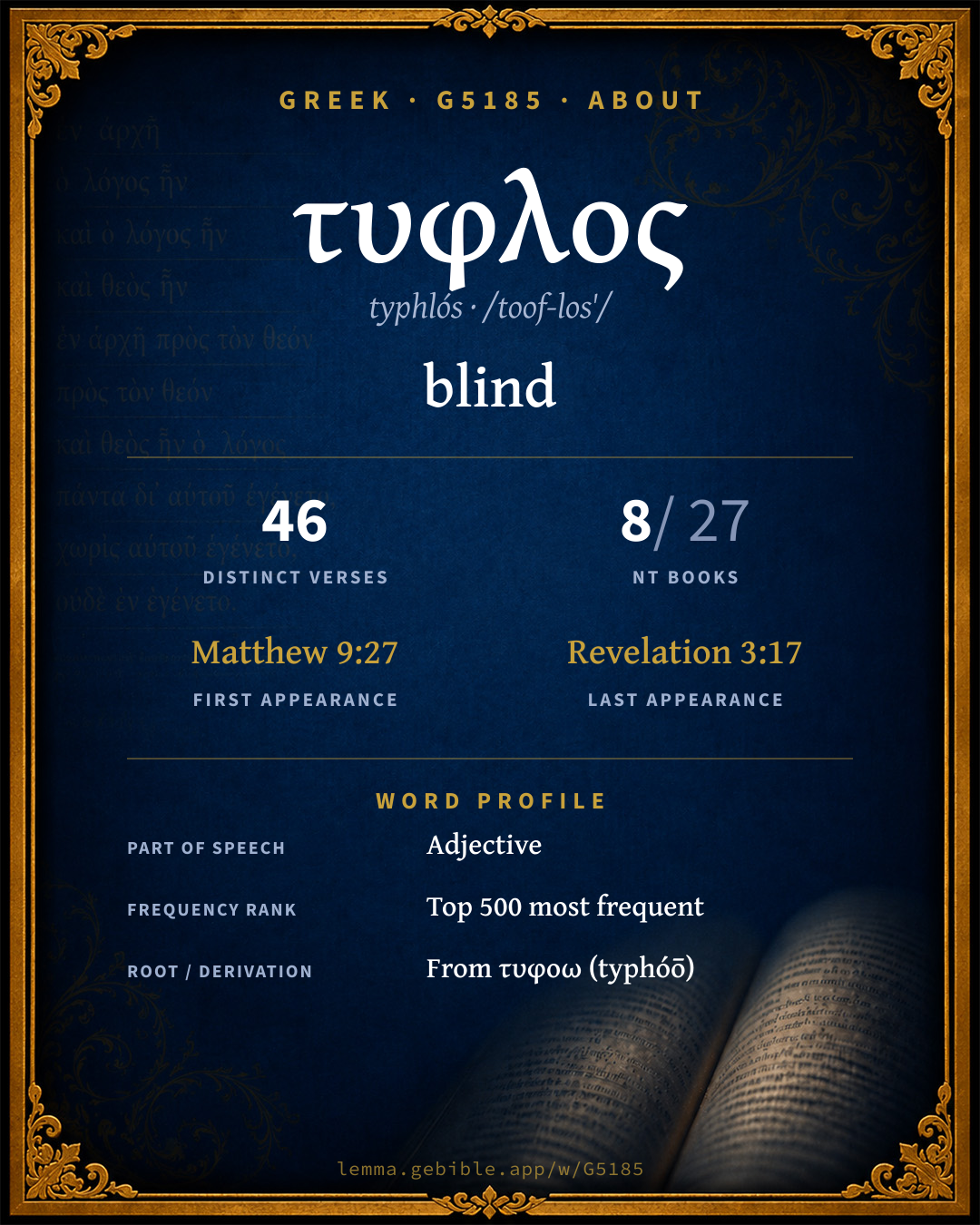
τυφλός
blind
‘blind’ is one of 2 main senses fuller range ↓
Full lexicon entry — Thayer's Greek Lexicon
From Thayer's Greek Lexicon
Where this word appears
Grammar key — what these labels mean
Part of speech
- Adjective
- A word that describes or qualifies a noun.
Case
- Nominative
- The case of the subject (and the predicate nominative).
- Accusative
- The case of the direct object and of extent.
- Genitive
- The case of source, possession, or “of” — answers “whose / from what.”
- Vocative
- The case of direct address (“O Lord”).
- Dative
- The case of the indirect object, means, or location — “to / for / with / in.”
Gender
- Masculine
- Grammatically masculine.
Number
- Singular
- One.
- Plural
- More than one.
Every verse where G5185 appears in the Book of Acts — 1 distinct verse. Click any verse to open its interlinear word-by-word view. Verse text shown in the World English Bible for context — . Each verse’s Greek form is shown with its reference; the English is not keyword-highlighted, since the data carries no word-level English alignment. Use “Compare translations” on any verse to read it across multiple English versions. This concordance covers the Greek New Testament; Septuagint (Greek Old Testament) occurrences of this word are not indexed here.
Acts
About this entry
At a glance — auto-summarized from this page’s data, not written by a person. Every figure links to its source below. This summary describes the numbers; it doesn’t interpret them.
The Greek adjective τυφλος centers on the idea of “blind.” First canonically at Matthew 9:27, it enters the text early. The Greek New Testament uses it across 46 verses — moderately common. John dominates its distribution — 16 of 46 verses. Lexicons map it across 2 senses. Dig into 46-verse concordance and the renderings breakdown below.
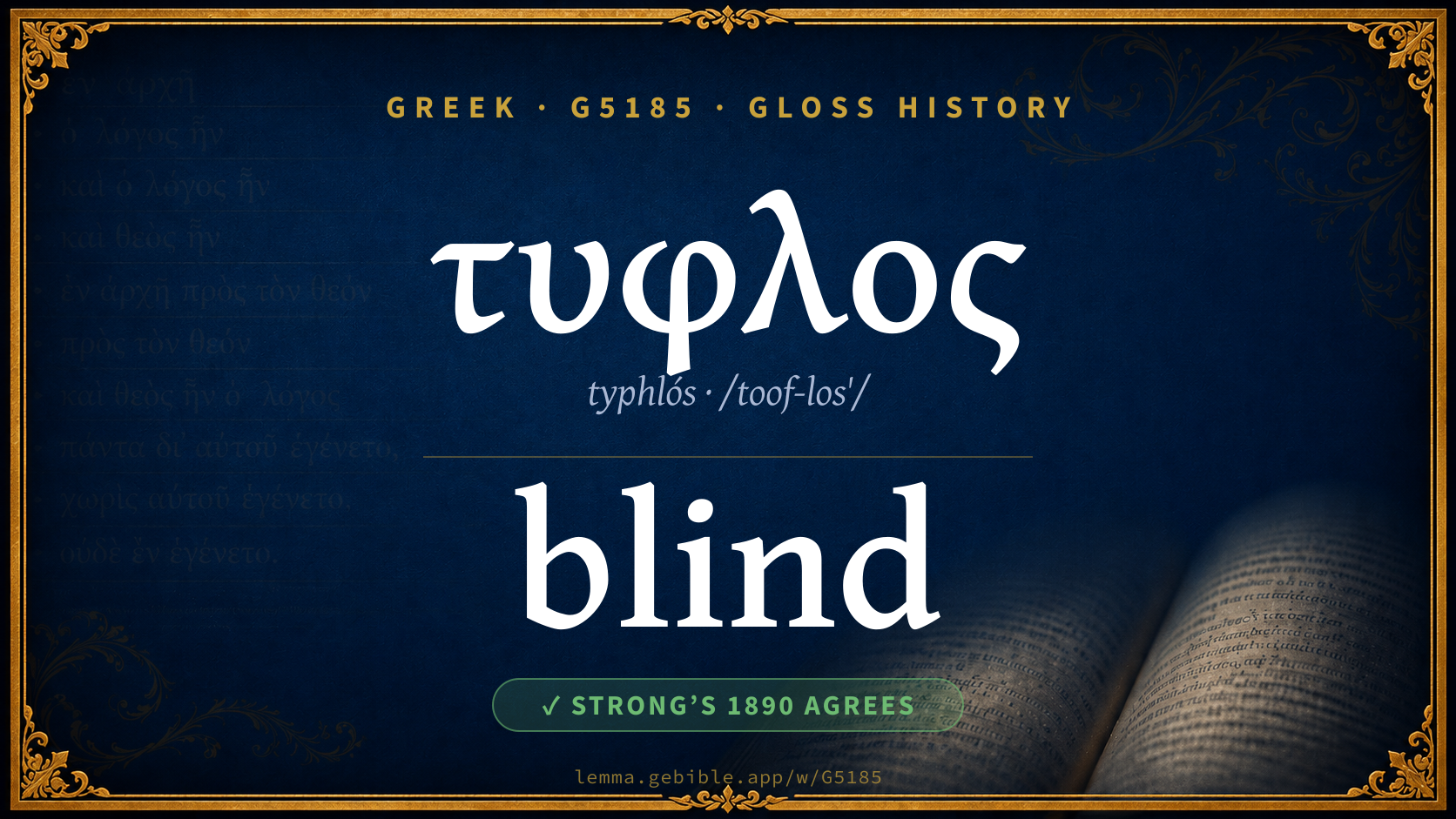
Gloss history
Strong's 1890 vs modern scholarship
About this word
Strong's G5185 catalogs a Greek word from the Greek New Testament.
These counts are not copied from any lexicon or concordance. They are computed here, from the morphology-tagged Greek New Testament. What Lemma adds →
- 46
- distinct verses
- The word appears in 46 distinct verses.
- 8 / 27
- NT books
- The word appears in 8 of 27 New Testament books.
- #310
- by frequency
- Top 500 most frequent Greek words (rank 310 of 5,347 Greek words by occurrence).
View all 46 occurrences in the concordance →
By section of the New Testament
By traditional corpus
Conventional, traditional groupings — biblical authorship is debated, so this is a traditional corpus grouping, not an authorship claim. Some books belong to more than one corpus (Luke is in both the Gospels and the Lukan corpus, and so on), so these shares overlap and need not total 100%. Each figure is a share of the word’s 46 distinct verses.
- Gospels 42 verses · 91%
- Johannine 17 verses · 37%
- Lukan (Luke–Acts) 8 verses · 17%
- Pauline corpus 1 verse · 2%
- General (Catholic) Epistles 1 verse · 2%
- Revelation 1 verse · 2%
How translations render this word
Counts come from each version’s own published word-to-Strong’s tagging or interlinear alignment — an approximate guide to how each version renders this word, not a word-level alignment the data otherwise carries. Because each total is that version’s own tagged count, the per-version totals vary from one another and need not match the appearance or distinct-verse counts above. These counts may also differ from a printed concordance because Lemma counts each distinctly tagged rendering and does not collapse phrase taggings into a single head-word total. This is a fixed set of word-tagged versions (KJV, ASV, BSB, ULT) and does not change with the reading translation you choose elsewhere. Each version’s license is shown beside its name below (and on Sources).
- King James Version: Blind 37×, Blind man 7×, Blind men 3×
- American Standard Version: Blind 30×, Blind man 4×, Blind men 3×
- Berean Standard Bible: Blind 46×
- unfoldingWord Literal Text: Blind 36×, Blind man 5×, Blind men 4×
King James Version Public Domain
Renders G5185 across 53 tagged occurrences — most commonly:
Plus 2 renderings that appear only once — usually multi-word phrases or single function words the recovered tagging swept in, not distinct renderings.
American Standard Version Public Domain
Renders G5185 across 50 tagged occurrences — most commonly:
Plus 8 renderings that appear only once — usually multi-word phrases or single function words the recovered tagging swept in, not distinct renderings.
Berean Standard Bible Public Domain
Renders G5185 across 49 tagged occurrences — most commonly:
Plus 3 renderings that appear only once — usually multi-word phrases or single function words the recovered tagging swept in, not distinct renderings. Not rendered by a distinct English word in 1 further occurrence.
unfoldingWord Literal Text CC BY-SA 4.0
Renders G5185 across 54 tagged occurrences — most commonly:
Plus 3 renderings that appear only once — usually multi-word phrases or single function words the recovered tagging swept in, not distinct renderings.
Senses in Thayer's
The 2 senses Thayer's distinguishes for this word, in lexicon order (not ranked by frequency or importance). The full entry — with sub-senses — is in the Lexicon Entry tab.
- blind
- mentally blind
Word origin
Derived from τυφοω (typhóō) (G5187) — to blind.
From G5187 ; opaque (as if smoky ) that is (by analogy) blind (physically or mentally): - blind.
— Strong’s Exhaustive Concordance (1890), public domain.
Forms in the corpus
The 13 distinct written forms G5185 takes in the Greek New Testament, most frequent first — each parse links to that case’s occurrences in the concordance.
| Form | Parsing | Example | Uses |
|---|---|---|---|
| τυφλὸς typhlòs | Adjective, Nominative, Singular, Masculine | Matthew 12:22 | 12 |
| τυφλοὶ typhloì | Adjective, Nominative, Plural, Masculine | Matthew 9:27 | 8 |
| τυφλοί typhloí | Adjective, Nominative, Plural, Masculine | Matthew 9:28 | 6 |
| τυφλὸν typhlòn | Adjective, Accusative, Singular, Masculine | Matthew 15:14 | 5 |
| τυφλῶν typhlō̂n | Adjective, Genitive, Plural, Masculine | Matthew 15:14 | 4 |
| τυφλοῦ typhloû | Adjective, Genitive, Singular, Masculine | Mark 8:23 | 3 |
| τυφλός typhlós | Adjective, Nominative, Singular, Masculine | Luke 18:35 | 3 |
| τυφλούς typhloús | Adjective, Accusative, Plural, Masculine | Matthew 15:30 | 2 |
| τυφλοὺς typhloùs | Adjective, Accusative, Plural, Masculine | Matthew 15:31 | 2 |
| τυφλοῖς typhloîs | Adjective, Dative, Plural, Masculine | Luke 4:19 | 2 |
| τυφλέ typhlé | Adjective, Vocative, Singular, Masculine | Matthew 23:26 | 1 |
| τυφλόν typhlón | Adjective, Accusative, Singular, Masculine | John 9:13 | 1 |
| τυφλῷ typhlō̂ | Adjective, Dative, Singular, Masculine | John 9:17 | 1 |
Same root — word family
Other Thayer's entries built from the same root as G5185, grouped by Strong’s listed origin. These share a root / origin per the lexicon — not necessarily a shared meaning. Each links to that word’s own entry.
Derives from
Derived from this word
Compare all same-root words → They share a root, not necessarily a meaning.
Septuagint usage
The same Greek word τυφλος appears 24 times in the Greek Old Testament (Septuagint), across 22 verses in 9 books.
- 24
- LXX occurrences
- Tagged occurrences of this Greek word in the Septuagint.
- 22
- verses
- Distinct Septuagint verses containing this word.
- 9 / 39
- OT books
- The word appears in 9 of the 39 Old Testament books.
Sample Septuagint occurrences
- Exodus 4:11 τυφλός
- Leviticus 19:14 τυφλός
- Deuteronomy 15:21 τυφλός
- 2 Samuel 5:6 τυφλός
- Job 29:15 τυφλός
- Psalms 145:8 τυφλός
- Isaiah 29:18 τυφλός
- Zephaniah 1:17 τυφλός
- Malachi 1:8 τυφλός
Septuagint occurrences (same lexeme)
Every verse where the same Strong’s number (G5185) appears in the Greek Septuagint. Verse text shown in the World English Bible for context; the Greek form is the matched word — the English is not keyword-highlighted.
- Exodus 4:11 τυφλός Yahweh said to him, "Who made man's mouth? Or who makes one mute, or deaf, or seeing, or blind? Isn't it I, Yahweh?
- Leviticus 19:14 τυφλός "'You shall not curse the deaf, nor put a stumbling block before the blind; but you shall fear your God. I am Yahweh.
- Leviticus 21:18 τυφλός For whatever man he is that has a blemish, he shall not draw near: a blind man, or a lame, or he who has a flat nose, or any deformity,
- Leviticus 22:22 τυφλός Blind, injured, maimed, having a wart, festering, or having a running sore, you shall not offer these to Yahweh, nor make an offering by fire of them on the altar to Yahweh.
- Deuteronomy 15:21 τυφλός If it have any blemish, [as if it be] lame or blind, any ill blemish whatever, you shall not sacrifice it to Yahweh your God.
- Deuteronomy 27:18 τυφλός Cursed be he who makes the blind to wander out of the way. All the people shall say, Amen.
- Deuteronomy 28:29 τυφλός and you shall grope at noonday, as the blind gropes in darkness, and you shall not prosper in your ways: and you shall be only oppressed and robbed always, and there shall be none to save you.
- 2 Samuel 5:6 τυφλός The king and his men went to Jerusalem against the Jebusites, the inhabitants of the land, who spoke to David, saying, Except you take away the blind and the lame, you shall not come in here; thinking, David can't come in here.
- 2 Samuel 5:8 τυφλός David said on that day, Whoever strikes the Jebusites, let him get up to the watercourse, and [strike] the lame and the blind, who are hated of David's soul. Therefore they say, There are the blind and the lame; he can't come into the house.
- Job 29:15 τυφλός I was eyes to the blind, And feet to the lame.
- Psalms 145:8 τυφλός Yahweh is gracious, merciful, Slow to anger, and of great loving kindness.
- Isaiah 29:18 τυφλός In that day shall the deaf hear the words of the book, and the eyes of the blind shall see out of obscurity and out of darkness.
- Isaiah 35:5 τυφλός Then the eyes of the blind shall be opened, and the ears of the deaf shall be unstopped.
- Isaiah 42:7 τυφλός to open the blind eyes, to bring out the prisoners from the dungeon, and those who sit in darkness out of the prison-house.
- Isaiah 42:16 τυφλός I will bring the blind by a way that they don't know; in paths that they don't know will I lead them; I will make darkness light before them, and crooked places straight. These things will I do, and I will not forsake them.
- Isaiah 42:18 τυφλός Hear, you deaf; and look, you blind, that you may see.
- Isaiah 42:19 τυφλός Who is blind, but my servant? or deaf, as my messenger whom I send? Who is blind as he who is at peace, and blind as Yahweh's servant?
- Isaiah 43:8 τυφλός Bring forth the blind people who have eyes, and the deaf who have ears.
- Isaiah 59:10 τυφλός We grope for the wall like the blind; yes, we grope as those who have no eyes: we stumble at noonday as in the twilight; among those who are lusty we are as dead men.
- Isaiah 61:1 τυφλός The Spirit of the Lord Yahweh is on me; because Yahweh has anointed me to preach good news to the humble; he has sent me to bind up the broken-hearted, to proclaim liberty to the captives, and the opening [of the prison] to those who are bound;
- Zephaniah 1:17 τυφλός I will bring distress on men, that they will walk like blind men, because they have sinned against Yahweh, and their blood will be poured out like dust, and their flesh like dung.
- Malachi 1:8 τυφλός When you offer the blind for sacrifice, isn't that evil? And when you offer the lame and sick, isn't that evil? Present it now to your governor! Will he be pleased with you? Or will he accept your person?" says Yahweh of Hosts.
These are occurrences of the same Greek lexeme (G5185) in the Septuagint — not a translation of any one Hebrew word. The store carries no word-level Hebrew↔Greek alignment, so no Hebrew original is asserted here. Counts come from the recovered LXX Strong's tagging — high-frequency vocabulary is well covered, while rare or late forms may be untagged — so they reflect tagged occurrences and may slightly undercount.