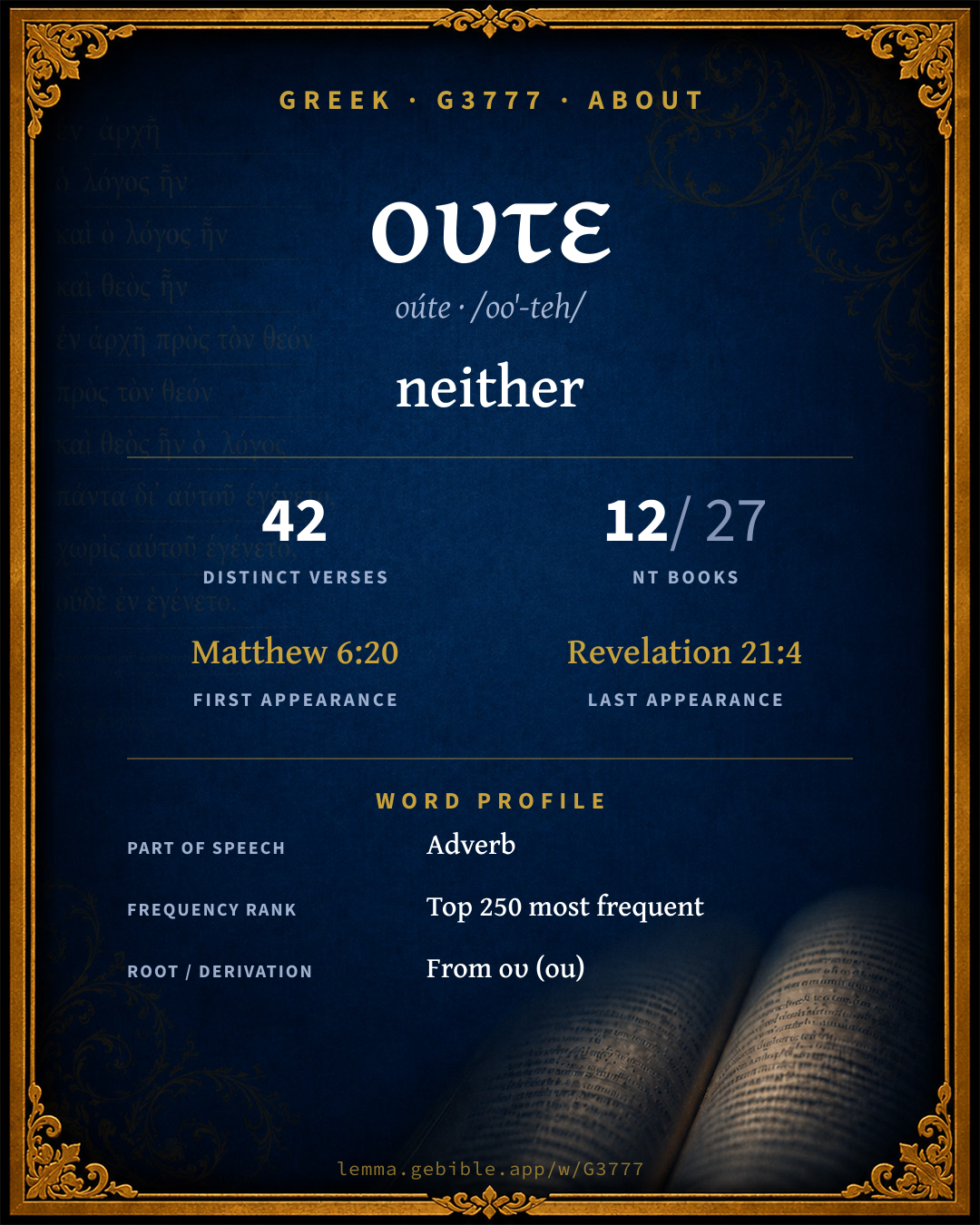
οὔτε
neither
Full lexicon entry — Thayer's Greek Lexicon
From Thayer's Greek Lexicon
Where this word appears
Grammar key — what these labels mean
Part of speech
- Conjunction
- A joining word linking words or clauses.
Degree
- Negative
- Marks a negative form.
Every verse where G3777 appears in the Book of Romans — 2 distinct verses. Click any verse to open its interlinear word-by-word view. Verse text shown in the World English Bible for context — . Each verse’s Greek form is shown with its reference; the English is not keyword-highlighted, since the data carries no word-level English alignment. Use “Compare translations” on any verse to read it across multiple English versions. This concordance covers the Greek New Testament; Septuagint (Greek Old Testament) occurrences of this word are not indexed here.
Romans
- Romans 8:38 οὔτε οὔτε οὔτε οὔτε οὔτε οὔτε οὔτε conj neg conj neg conj neg conj neg conj neg conj neg conj neg For I am persuaded, that neither death, nor life, nor angels, nor principalities, nor things present, nor things to come, nor powers,
- Romans 8:39 οὔτε οὔτε οὔτε conj neg conj neg conj neg nor height, nor depth, nor any other created thing, will be able to separate us from the love of God, which is in Christ Jesus our Lord.
About this entry
At a glance — auto-summarized from this page’s data, not written by a person. Every figure links to its source below. This summary describes the numbers; it doesn’t interpret them.
The Greek verb ουτε centers on the idea of “neither.” Its earliest occurrence is Matthew 6:20. It appears 42 verses across 12 books of the Greek New Testament, among its moderately common vocabulary. It clusters with ου, μη and ου μη under a shared root. Dig into 42-verse concordance and the renderings breakdown below.
Gloss history
Strong's 1890 vs modern scholarship
About this word
Strong's G3777 catalogs a Greek word from the Greek New Testament.
These counts are not copied from any lexicon or concordance. They are computed here, from the morphology-tagged Greek New Testament. What Lemma adds →
- 42
- distinct verses
- The word appears in 42 distinct verses.
- 12 / 27
- NT books
- The word appears in 12 of 27 New Testament books.
- #181
- by frequency
- Top 250 most frequent Greek words (rank 181 of 5,347 Greek words by occurrence).
View all 42 occurrences in the concordance →
Most concentrated in
- Revelation 7 verses 17%
- Acts 6 verses 14%
- Luke 5 verses 12%
By section of the New Testament
By traditional corpus
Conventional, traditional groupings — biblical authorship is debated, so this is a traditional corpus grouping, not an authorship claim. Some books belong to more than one corpus (Luke is in both the Gospels and the Lukan corpus, and so on), so these shares overlap and need not total 100%. Each figure is a share of the word’s 42 distinct verses.
- Gospels 15 verses · 36%
- Johannine 13 verses · 31%
- Pauline corpus 12 verses · 29%
- Lukan (Luke–Acts) 11 verses · 26%
- Revelation 7 verses · 17%
- General (Catholic) Epistles 2 verses · 5%
How translations render this word
Counts come from each version’s own published word-to-Strong’s tagging or interlinear alignment — an approximate guide to how each version renders this word, not a word-level alignment the data otherwise carries. Because each total is that version’s own tagged count, the per-version totals vary from one another and need not match the appearance or distinct-verse counts above. These counts may also differ from a printed concordance because Lemma counts each distinctly tagged rendering and does not collapse phrase taggings into a single head-word total. This is a fixed set of word-tagged versions (KJV, ASV, BSB, ULT) and does not change with the reading translation you choose elsewhere. Each version’s license is shown beside its name below (and on Sources).
- King James Version: Nor 40×, Neither 39×, Yet 5×
- American Standard Version: Nor 49×, Neither 36×
- Berean Standard Bible: Nor 30×, Neither 16×
- unfoldingWord Literal Text: Nor 52×, Neither 26×, Not 6×
King James Version Public Domain
Renders G3777 across 93 tagged occurrences — most commonly:
Plus 3 renderings that appear only once — usually multi-word phrases or single function words the recovered tagging swept in, not distinct renderings. Not rendered by a distinct English word in 2 further occurrences.
American Standard Version Public Domain
Renders G3777 across 92 tagged occurrences — most commonly:
Plus 7 renderings that appear only once — usually multi-word phrases or single function words the recovered tagging swept in, not distinct renderings. Not rendered by a distinct English word in 1 further occurrence.
Berean Standard Bible Public Domain
Renders G3777 across 51 tagged occurrences — most commonly:
Plus 5 renderings that appear only once — usually multi-word phrases or single function words the recovered tagging swept in, not distinct renderings. Not rendered by a distinct English word in 28 further occurrences.
unfoldingWord Literal Text CC BY-SA 4.0
Renders G3777 across 88 tagged occurrences — most commonly:
Plus 2 renderings that appear only once — usually multi-word phrases or single function words the recovered tagging swept in, not distinct renderings.
Senses in Thayer's
The 1 sense Thayer's distinguishes for this word, in lexicon order (not ranked by frequency or importance). The full entry — with sub-senses — is in the Lexicon Entry tab.
- neither, and not
Word origin
Derived from ου (ou) (G3756) — not.
Same root — word family
Other Thayer's entries built from the same root as G3777, grouped by Strong’s listed origin. These share a root / origin per the lexicon — not necessarily a shared meaning. Each links to that word’s own entry.
Derives from
Shares the same root
- μη mḗ G3361 not
- ου μη ou mḗ G3364 by no means
- ουδε oudé G3761 neither
- ουκετι oukéti G3765 no longer
- ουκουν oukoûn G3766 not therefore
- ουπω oúpō G3768 not yet
- ουχι ouchí G3780 not at all
Compare all same-root words → Showing 4 of 9 — not the complete family. They share a root, not necessarily a meaning.
Septuagint usage
The same Greek word ουτε appears 50 times in the Greek Old Testament (Septuagint), across 18 verses in 9 books.
- 50
- LXX occurrences
- Tagged occurrences of this Greek word in the Septuagint.
- 18
- verses
- Distinct Septuagint verses containing this word.
- 9 / 39
- OT books
- The word appears in 9 of the 39 Old Testament books.
Sample Septuagint occurrences
- Exodus 20:17 οὔτε
- Numbers 21:22 οὔτε
- Deuteronomy 4:28 οὔτε
- Job 3:26 οὔτε
- Psalms 58:4 οὔτε
- Isaiah 1:6 οὔτε
- Jeremiah 15:10 οὔτε
- Ezekiel 24:23 οὔτε
- Daniel 2:43 οὔτε
Septuagint occurrences (same lexeme)
Every verse where the same Strong’s number (G3777) appears in the Greek Septuagint. Verse text shown in the World English Bible for context; the Greek form is the matched word — the English is not keyword-highlighted.
- Exodus 20:17 οὔτε "You shall not covet your neighbor's house. You shall not covet your neighbor's wife, nor his man-servant, nor his maid-servant, nor his ox, nor his donkey, nor anything that is your neighbor's."
- Numbers 21:22 οὔτε Let me pass through your land: we will not turn aside into field, or into vineyard; we will not drink of the water of the wells: we will go by the king's highway, until we have passed your border.
- Numbers 23:25 οὔτε Balak said to Balaam, Neither curse them at all, nor bless them at all.
- Deuteronomy 4:28 οὔτε There you shall serve gods, the work of men's hands, wood and stone, which neither see, nor hear, nor eat, nor smell.
- Deuteronomy 5:21 οὔτε "Neither shall you covet your neighbor's wife; neither shall you desire your neighbor's house, his field, or his man-servant, or his maid-servant, his ox, or his donkey, or anything that is your neighbor's."
- Deuteronomy 31:6 οὔτε Be strong and of good courage, don't be afraid, nor be scared of them: for Yahweh your God, he it is who does go with you; he will not fail you, nor forsake you.
- Job 3:26 οὔτε I am not at ease, neither am I quiet, neither have I rest; But trouble comes."
- Job 15:29 οὔτε He shall not be rich, neither shall his substance continue, Neither shall their possessions be extended on the earth.
- Psalms 58:4 οὔτε Their poison is like the poison of a snake; Like a deaf cobra that stops its ear,
- Psalms 74:7 οὔτε They have burned your sanctuary to the ground. They have profaned the dwelling-place of your Name.
- Isaiah 1:6 οὔτε From the sole of the foot even to the head there is no soundness in it: Wounds, welts, and open sores. They haven't been closed, neither bandaged, neither soothed with oil.
- Isaiah 30:5 οὔτε They shall all be ashamed because of a people that can't profit them, that are not a help nor profit, but a shame, and also a reproach.
- Isaiah 48:8 οὔτε Yes, you didn't hear; yes, you didn't know; yes, from of old your ear was not opened: for I knew that you did deal very treacherously, and was called a transgressor from the womb.
- Jeremiah 15:10 οὔτε Woe is me, my mother, that you have borne me a man of strife and a man of contention to the whole earth! I have not lent, neither have men lent to me; [yet] everyone of them does curse me.
- Ezekiel 24:23 οὔτε Your tires shall be on your heads, and your shoes on your feet: you shall not mourn nor weep; but you shall pine away in your iniquities, and moan one toward another.
- Daniel 2:43 οὔτε Whereas you saw the iron mixed with miry clay, they shall mingle themselves with the seed of men; but they shall not cling to one another, even as iron does not mingle with clay.
- Daniel 3:18 οὔτε But if not, be it known to you, O king, that we will not serve your gods, nor worship the golden image which you have set up.
- Daniel 6:23 οὔτε Then was the king exceeding glad, and commanded that they should take Daniel up out of the den. So Daniel was taken up out of the den, and no manner of hurt was found on him, because he had trusted in his God.
These are occurrences of the same Greek lexeme (G3777) in the Septuagint — not a translation of any one Hebrew word. The store carries no word-level Hebrew↔Greek alignment, so no Hebrew original is asserted here. Counts come from the recovered LXX Strong's tagging — high-frequency vocabulary is well covered, while rare or late forms may be untagged — so they reflect tagged occurrences and may slightly undercount.