
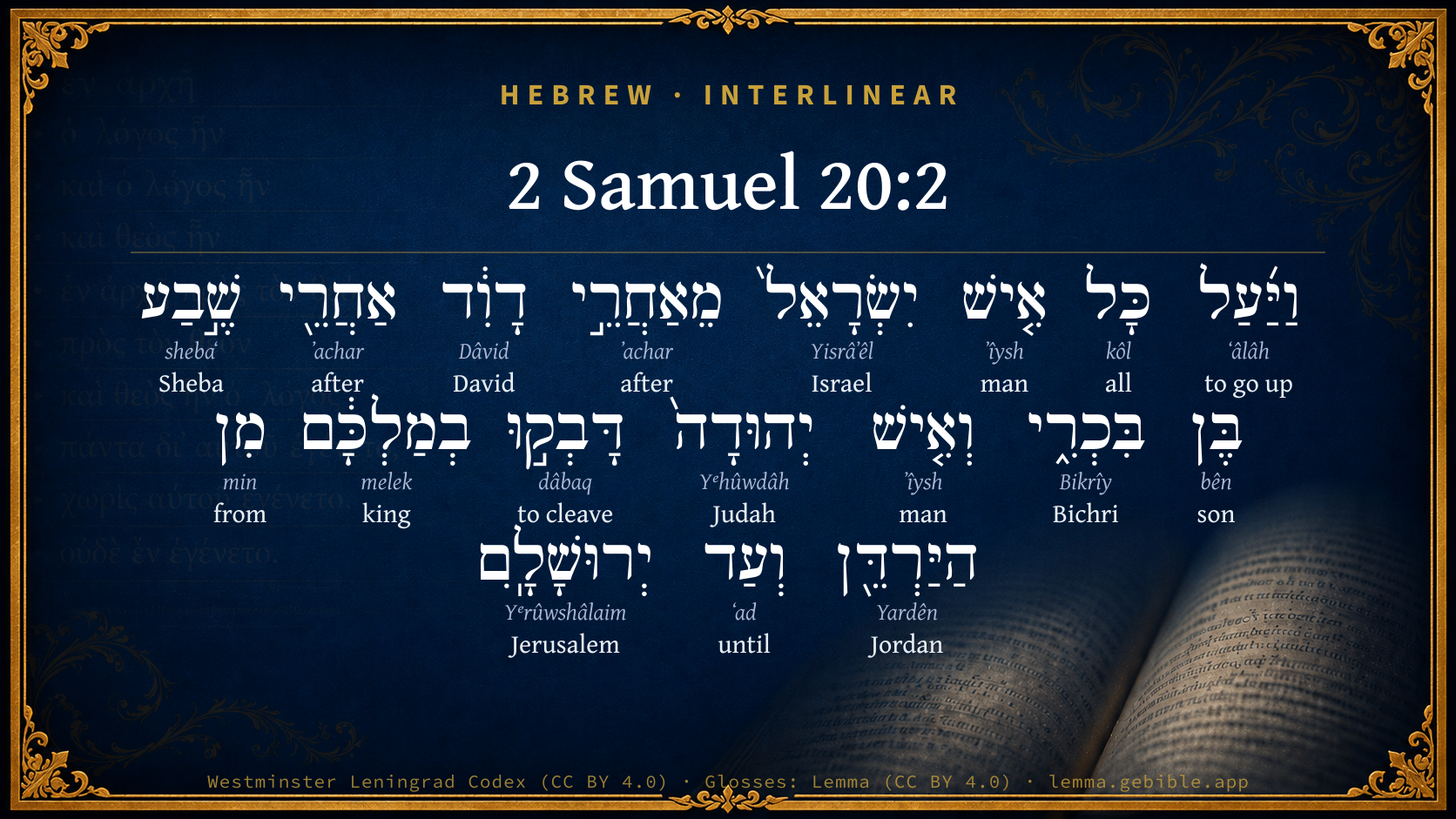
2 Samuel 20:2

Hebrew (Westminster Leningrad Codex) 2 Samuel 20:2 appears in the Hebrew Old Testament. The text above is from the Westminster Leningrad Codex. Each word links to its Strong’s number, a concise gloss, and parsing drawn from the Open Scriptures Hebrew Bible morphology. Click any word for its full Brown-Driver-Briggs (BDB) entry.
Download image
Cite this verse

2 Samuel 20:2 (World English Bible). Public Domain. Lemma interlinear Bible study tool, https://lemma.gebible.app/v/2-samuel/20/2.

Show BibTeX & RIS
BibTeX
RIS
English Translation
So all the men of Israel went up from following David, and followed Sheba the son of Bichri; but the men of Judah joined with their king, from the Jordan even to Jerusalem.
World English Bible · Public Domain
Download a study sheet

One document with this verse’s original text, its word-by-word gloss line, the meaning frame, cross-references with their text, attributed commentary, and full source and license credits — printable, and it pastes into notes with its structure intact.

This verse Autodidact and up

Study sheet (.html) Plain text (.txt)

A passage Seminary Student

Up to 50 verses in one chapter. A passage sheet keeps up to 6 commentary sources and 12 cross-references per verse, in the order this page ranks them, and says so on the sheet whenever that leaves anything out. Ask for a single verse and you get the Autodidact verse sheet above.

Everything on this page stays free to read, with no account — the sheet is a download of what is already on screen, not access to it.

Want to remove ads? Support Godless Engineer
Compare translations 3

The same verse in 3 English versions, stacked beneath the original-language interlinear above. Click any original word for its lexicon entry.

Each is an independent rendering of the whole verse — the interlinear is not word-aligned to these translations.

Highlighted words mark where these versions differ — a whole-verse word diff, not a word-by-word alignment.

  • World English Bible Public Domain
    So all the men of Israel went up from following David, and followed Sheba the son of Bichri; but the men of Judah joined with their king, from the Jordan even to Jerusalem.
  • King James Version Public Domain
    So every man of Israel went up from after David, and followed Sheba the son of Bichri: but the men of Judah clave unto their king, from Jordan even to Jerusalem.
  • unfoldingWord Literal Text CC BY-SA 4.0
    And all of the men of Israel went up from after David after Sheba, the son of Bichri. But the men of Judah clung to their king from the Jordan and to Jerusalem.

unfoldingWord Literal Text — © unfoldingWord, licensed CC BY-SA 4.0. Word-aligned USFM3 via Door43 (git.door43.org/unfoldingWord/en_ult).

Versions to compare (up to 4)

3 of 4 selected

Show all 18 translations

Every available English version of this verse, each an independent rendering of the whole verse.

  • World English Bible Public Domain
    So all the men of Israel went up from following David, and followed Sheba the son of Bichri; but the men of Judah joined with their king, from the Jordan even to Jerusalem.
  • Berean Standard Bible Public Domain
    So all the men of Israel deserted David to follow Sheba son of Bichri. But the men of Judah stayed by their king all the way from the Jordan to Jerusalem.
  • Majority Standard Bible Public Domain
    So all the men of Israel deserted David to follow Sheba son of Bichri. But the men of Judah stayed by their king all the way from the Jordan to Jerusalem.
  • King James Version Public Domain
    So every man of Israel went up from after David, and followed Sheba the son of Bichri: but the men of Judah clave unto their king, from Jordan even to Jerusalem.
  • American Standard Version (1901) Public Domain
    So all the men of Israel went up from following David, and followed Sheba the son of Bichri; but the men of Judah clave unto their king, from the Jordan even to Jerusalem.
  • Revised Version (1885) Public Domain
    So all the men of Israel went up from following David, and followed Sheba the son of Bichri: but the men of Judah clave unto their king, from Jordan even to Jerusalem.
  • Geneva Bible (1599) Public Domain
    So euery man of Israel went from Dauid and followed Sheba the sonne of Bichri: but the men of Iudah claue fast vnto their King, from Iorden euen to Ierusalem.
  • Douay-Rheims (1899) Public Domain
    And all Israel departed from David, and followed Seba the son of Bochri: but the men of Juda stuck to their king from the Jordan unto Jerusalem.
  • Young's Literal Translation Public Domain
    And every man of Israel goeth up from after David, after Sheba son of Bichri, and the men of Judah have cleaved to their king, from the Jordan even unto Jerusalem.
  • Literal Standard Version CC BY-SA 4.0
    And every man of Israel goes up from after David, after Sheba son of Bichri, and the men of Judah have cleaved to their king, from the Jordan even to Jerusalem.
  • Unlocked Literal Bible CC BY-SA 4.0
    So all the men of Israel deserted David and followed Sheba son of Bikri. But the men of Judah followed closely their king, from the Jordan all the way to Jerusalem.
  • unfoldingWord Literal Text CC BY-SA 4.0
    And all of the men of Israel went up from after David after Sheba, the son of Bichri. But the men of Judah clung to their king from the Jordan and to Jerusalem.
  • Darby Bible Public Domain
    Then all the men of Israel went up from after David, following Sheba the son of Bichri. But the men of Judah clave to their king, from the Jordan even to Jerusalem.
  • World Messianic Bible Public Domain
    So all the men of Israel went up from following David, and followed Sheba the son of Bichri; but the men of Judah joined with their king, from the Jordan even to Jerusalem.
  • Webster's Bible Public Domain
    So every man of Israel, withdrawing from David, followed Sheba the son of Bichri: but the men of Judah adhered to their king, from Jordan even to Jerusalem.
  • Free Bible Version CC BY-SA 4.0
    So all the men of Israel abandoned David to follow Sheba, son of Bichri. But the men of Judah accompanied their king all the way from the Jordan to Jerusalem.
  • Bible in Basic English Public Domain
    So all the men of Israel, turning away from David, went after Sheba, the son of Bichri: but the men of Judah were true to their king, going with him from Jordan as far as Jerusalem.
  • JPS Tanakh (1917) Public Domain
    So all the men of Israel went up from following David, and followed Sheba the son of Bichri; but the men of Judah did cleave unto their king, from the Jordan even to Jerusalem.

Literal Standard Version (2020), Covenant Press — licensed CC BY-SA 4.0. Text via the HelloAO Bible API (eBible.org). Unlocked Literal Bible (unfoldingWord) — licensed CC BY-SA 4.0. Text via the HelloAO Bible API (eBible.org). unfoldingWord Literal Text — © unfoldingWord, licensed CC BY-SA 4.0. Word-aligned USFM3 via Door43 (git.door43.org/unfoldingWord/en_ult). Free Bible Version, Dr. Jonathan Gallagher — licensed CC BY-SA 4.0. Text via the HelloAO Bible API (eBible.org).

Word by word

More ways to search: Search by grammar → Find every occurrence → Compare this word →

Practice this passage: Drill this verse → Learn its vocabulary →

בִּכְרִ֑י
Bikrîy
H1075
“Bichri”
Noun, Proper
Part of Speech
Noun
Type
Proper
Full BDB Definition

Origin: from H1069

TWOT: None

Bichri = "youthful" - a Benjamite, father of Sheba - (BDB) the Bichrites
  1. וַיַּ֜עַל ʻâlâh H5927 “and · to go up” Conjunction + Verb, Qal, Sequential Imperfect, 3rd Person, Masculine, Singular
  2. כָּל kôl H3605 “all of” Noun, Common, Masculine, Singular, Construct
  3. אִ֤ישׁ ʼîysh H376 “man of” Noun, Common, Masculine, Singular, Construct
  4. יִשְׂרָאֵל֙ Yisrâʼêl H3478 “Israel” Noun, Proper
  5. מֵאַחֲרֵ֣י ʼachar H310 “from · after” Preposition + Preposition
  6. דָוִ֔ד Dâvid H1732 “David” Noun, Proper
  7. אַחֲרֵ֖י ʼachar H310 “after” Preposition
  8. שֶׁ֣בַע shebaʻ H7652 “Sheba” Adjective, Cardinal number, Feminine, Singular, Absolute
  9. בֶּן bên H1121 “son of” Noun, Common, Masculine, Singular, Construct
  10. וְאִ֤ישׁ ʼîysh H376 “and · man of” Conjunction + Noun, Common, Masculine, Singular, Construct
  11. יְהוּדָה֙ Yᵉhûwdâh H3063 “Judah” Noun, Proper
  12. דָּבְק֣וּ dâbaq H1692 “to cleave” Verb, Qal, Perfect, 3rd Person, Common, Plural
  13. בְמַלְכָּ֔ם melek H4428 “in/at · king · their” Preposition + Noun, Common, Masculine, Singular, Construct + Suffix, Personal, 3rd Person, Masculine, Plural
  14. מִן min H4480 “from” Preposition
  15. הַיַּרְדֵּ֖ן Yardên H3383 “the · Jordan” Particle, Definite Article + Noun, Proper
  16. וְעַד ʻad H5704 “and · until” Conjunction + Preposition
  17. יְרוּשָׁלִָֽם Yᵉrûwshâlaim H3389 “Jerusalem” Noun, Proper

About this verse

These counts appear in no published source. They are computed here, from the morphology-tagged text and Lemma’s own curated glosses. What Lemma adds →

18
words
16
distinct lemmas
Historical
section

Notable vocabulary

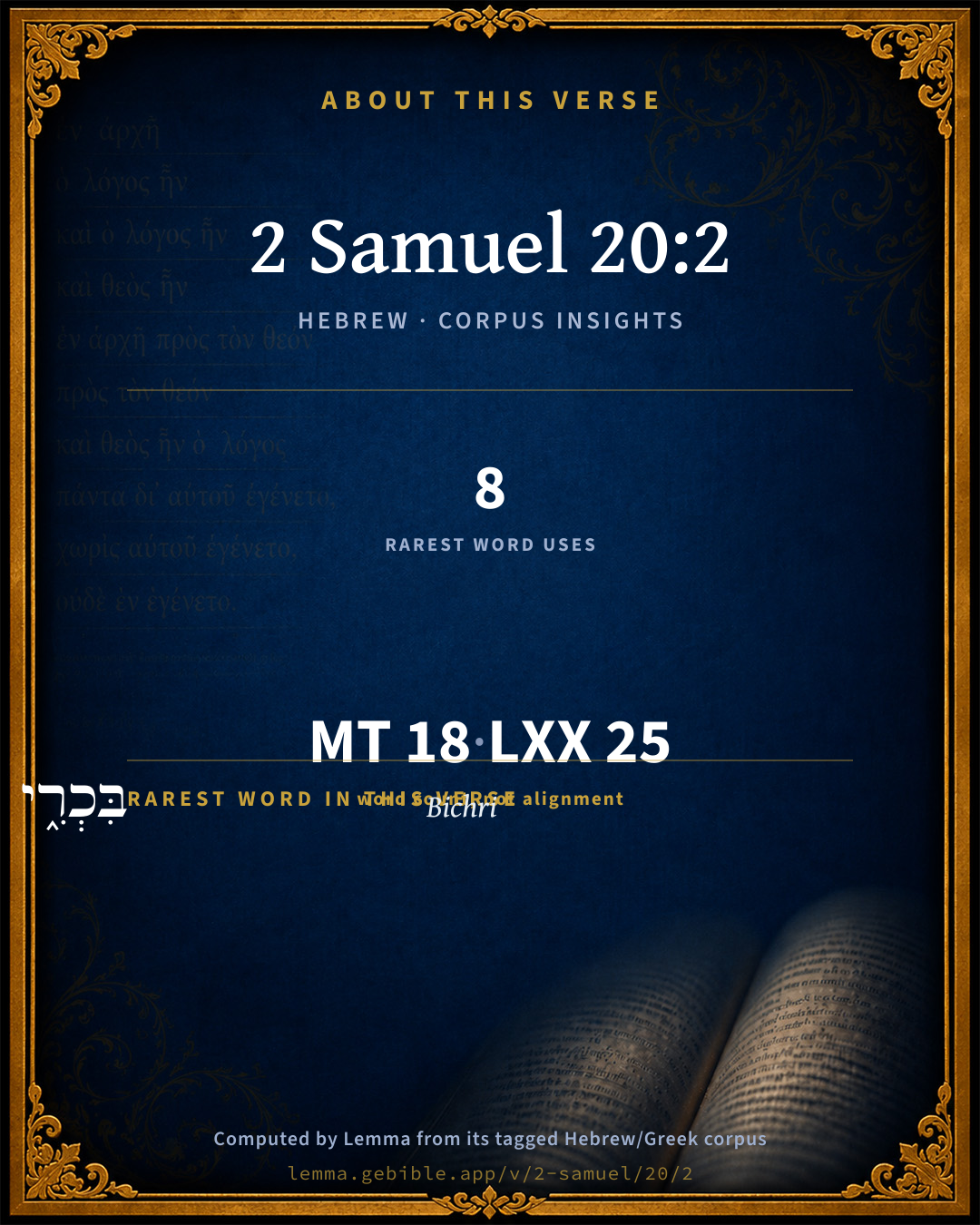
The rarest word here is בִּכְרִ֑י Bichri H1075 — appearing just 8 times in the whole Hebrew Bible.

Shared distinctive vocabulary

בִּכְרִ֑י Bichri H1075 occurs in 8 verses of the Hebrew Bible. Also found in:

Grammatical profile

  • 2 verbs
  • 11 nouns
  • 1 adjective
  • 4 prepositions

Verb forms

  • וַיַּ֜עַל Qal · Sequential Imperfect
  • דָּבְק֣וּ Qal · Perfect

Repetition

Words recur within this verse — often emphatic in Hebrew:

  • אִ֤ישׁ man H376 ×2
  • מֵאַחֲרֵ֣י after H310 ×2

Hebrew & Septuagint length

In English translation the verse runs 33 words from the Hebrew and 31 from the Septuagint (LXX English) — closely comparable.

A rough comparison of the two English renderings, which tokenize alike — not a word-level alignment.

Word counts can differ between the Hebrew and the Greek without any difference in meaning — e.g. the Hebrew direct-object marker אֵת has no separate Greek word, and Greek often adds the article ὁ.

In the original languages it is 18 Hebrew tokens and 25 Greek tokens — but the two are counted differently (Hebrew bundles its prefixes and suffixes into one token; the Greek is in lemma form), so that isn’t a like-for-like length.

Cross-references

8

Topical passages linked to 2 Samuel 20:2 in the Treasury of Scripture Knowledge — connected by theme and wording, ordered by reader-vote popularity; previews shown in the World English Bible.

  • John 6:66–68 At this, many of his disciples went back, and walked no more with him.
  • Acts 11:23 who, when he had come, and had seen the grace of God, was glad. He exhorted them all, that with purpose of heart they should remain near to the Lord.
  • 2 Samuel 19:15 So the king returned, and came to the Jordan. Judah came to Gilgal, to go to meet the king, to bring the king over the Jordan.
  • 2 Samuel 19:40–41 So the king went over to Gilgal, and Chimham went over with him: and all the people of Judah brought the king over, and also half the people of Israel.
  • 2 Chronicles 10:17 But as for the children of Israel who lived in the cities of Judah, Rehoboam reigned over them.
  • Psalms 62:9 Surely men of low degree are just a breath, And men of high degree are a lie. In the balances they will go up. They are together lighter than a breath.
  • Psalms 118:8–10 It is better to take refuge in Yahweh, Than to put confidence in man.
  • Proverbs 17:14 The beginning of strife is like breaching a dam, Therefore stop contention before quarreling breaks out.

Cross-references courtesy of OpenBible.info (CC BY 4.0).

Hebrew and Greek witnesses Masoretic Hebrew ↔ Greek Septuagint

The same verse in the two great witnesses to the Old Testament, shown verse-for-verse.

These are two independent witnesses, not word-aligned to each other, and the Septuagint is shown in lemma (dictionary) form.

Hebrew 2 Samuel 20:2 Masoretic · Westminster Leningrad Codex

וַיַּ֜עַל כָּל אִ֤ישׁ יִשְׂרָאֵל֙ מֵאַחֲרֵ֣י דָוִ֔ד אַחֲרֵ֖י שֶׁ֣בַע בֶּן בִּכְרִ֑י וְאִ֤ישׁ יְהוּדָה֙ דָּבְק֣וּ בְמַלְכָּ֔ם מִן הַיַּרְדֵּ֖ן וְעַד יְרוּשָׁלִָֽם

So all the men of Israel went up from following David, and followed Sheba the son of Bichri; but the men of Judah joined with their king, from the Jordan even to Jerusalem.

World English Bible · Public Domain

Greek LXX 2 Samuel 20:2 Septuagint · lemma form

καί ἀναβαίνω πᾶς ἀνήρ ἰσραήλ ἀπό ὄπισθε δαυίδ ὀπίσω σαβεε υἱός βοχορι καί ἀνήρ ιουδα κολλάω ὁ βασιλεύς αὐτός ἀπό ὁ ἰορδάνης καί ἕως ἰερουσαλήμ

And all the men of Israel went up from following David after Sabee the son of Bochori: but the men of Juda adhered to their king, from Jordan even to Jerusalem.

LXX2012 (modern English Septuagint) · Public Domain

Hebrew: Westminster Leningrad Codex (CC BY 4.0). Greek: Septuagint (public domain); English from LXX2012 (modern English Septuagint) (Public Domain). How the Septuagint differs from the Hebrew →

Targum (Aramaic paraphrase)

1

The Targum is the ancient Jewish Aramaic paraphrase of the Hebrew Scriptures — an interpretive translation, not the Hebrew text itself. Onkelos (literal) and Pseudo-Jonathan (expansive) render the Torah, and Jonathan the Prophets. Coverage is partial: where no permissively-licensed English translation exists for a verse, only the Aramaic is shown. This is verse-level text, not a word-by-word alignment to the Hebrew.

  1. Targum Jonathan Prophets (Joshua–Malachi)
    וּסְלִיק כָּל אֱנַשׁ יִשְׂרָאֵל מִבָּתַר דָוִד לְמֵיזַל בָּתַר שֶׁבַע בַּר בִּכְרִי וֶאֱנַשׁ יְהוּדָה לָווּ עִם מַלְכְּהוֹן מִן יַרְדְנָא וְעַד יְרוּשְׁלֵם:

    (no public-domain English translation for this verse)

    Targum Jonathan — Aramaic: “Mikraot Gedolot” (public domain). English: “Sefaria Community Translation” (CC0 1.0 (public-domain dedication)); “London "Chaldee Paraphrase," 1871” (public domain). Text via Sefaria.

Commentary

Notes on 2 Samuel 20:2 from classic Christian and Jewish commentators (each source and its license shown beneath its notes). The classic Christian expositions comment on the surrounding passage and are grouped to its opening verse, so a note may address several verses; the Jewish commentaries on the Tanakh (Rashi and others) are per-verse, so they appear only where the commentator wrote on this verse.

Lemma curates 59 commentaries, every one of them public domain or Creative Commons licensed, each selected and text-cleaned for this edition rather than reprinted as found. About our sources →

Trapp's Complete Commentary

John Trapp

2Sa 20:2 So every man of Israel went up from after David, [and] followed Sheba the son of Bichri: but the men of Judah clave unto their king, from Jordan even to Jerusalem.

Ver. 2. So every man of Israel.] So fickle and inconstant is that neutrum modo, mas modo, vulgus, the common people. Our Saviour found it so, when their "Hosanna" was so soon changed into "Crucify him, crucify him." All this was for David’s good, that he might trust more in God, and less in the creature.

John Trapp, A Commentary or Exposition upon All the Books of the Old and New Testament (1647–1656) — public domain. Text from a community e-Sword module.

Joseph Benson's Commentary

2Sa 20:2. So every man of Israel went up from after David — Instead of going home, the generality of those Israelites who were present followed their seditious incendiary. But the men of Judah clave to their king — None of them stirred from him, but conducted him from Jordan to Jerusalem. Nor is it to be supposed that all the men of Israel forsook him; but only a very great number of them.

Joseph Benson's Commentary on the Old and New Testaments (1811–1818) — public domain. Text from a community e-Sword module.

The Preacher's Complete Homiletical Commentary

Joseph S. Exell (gen. ed.)

CRITICAL AND EXPOSITORY NOTES.—

“There.” “In Gilgal, at the assembly of the tribes; the word indicates directly the place; indirectly the time of the following history.” (Erdmann). “A man of Belial.” A worthless man. “He was,” says Luther, “one of the great rogues of the high nobility, who had a large retinue among the people, and consideration or name, as Catiline in Rome.” “A Benjamite.” “Probably one of the rabid Sauline party, if he were not, as is possible, of Saul’s own family.” (Erdmann) “To his tents.” “See on 2Sa_19:8.”

2Sa_19:2. “Went up.” “From the plain of Gilgal to the hill country of Ephraim.” (Erdmann).

MAIN HOMILETICS OF THE PARAGRAPH.—Chapter 2Sa_19:41, to 2Sa_20:2

THE REBELLION OF SHEBA

I. The fidelity of those who serve from self-interest cannot be depended on for a single day. All the acts of the men of Israel at this time seem to have been inspired by one consideration only, viz., What line of policy looks most likely to promote our interests? There was no question as to their duty, either to God or man. Hence they rallied to the standard of Absalom when he bid fair to overturn the throne of his father, returned to David when they found they had embarked in a losing cause, and revolted again from him the first moment all did not fall out in accordance with their wishes. So little are those to be depended on who have no higher rule of life, and so greatly are those to be pitied who put their trust in them. “We have ten parts in David,” said they, and, almost in the same breath, We have no part in him. To-day, Hosanna, to-morrow, Crucify.—Henry.

II. The unreasoning discontent of the multitude is the opportunity of the selfish and ambitions leader. There are always men quick to take advantage of the passion and ignorance of their fellow creatures, and to use them as stepping stones for their own aggrandisement. But for the foolish petulance of the men of Israel on this occasion, this son of Bichri would have never had even the pitiful notoriety which he thereby acquired; and there have been many like him in all ages who have only risen from obscurity by similar means. It would have been indeed for the peace of the world if all such reckless men had met with as speedy a downfall as did Sheba, but they have often lived long enough to involve many more in a common ruin. Before men give themselves up to the leadership of another they should consider well whither he is leading them and what guarantees he can give that his motives are pure. But they cannot do this if they themselves are under the dominion of pride and envy, as the men of Israel were at this time. Where any unruly passion is in the ascendant, the voices of reason and conscience are not listened to, and downfall of some kind must come.

OUTLINES AND SUGGESTIVE COMMENTS

Chap, 19, 2Sa_19:41-43. In the conduct of the different tribes on this occasion, we may see a faithful picture of what is every day to be witnessed in the world around us. While some men, although convinced of the proper course to pursue, are still talking about their intentions—are consulting with their own interests—resolving, and hesitating, and again resolving—yet, after all doing nothing effectually; others like the tribe of Judah, when once persuaded of their duty, admit no farther argument on its expediency, but act with promptitude and decision. This forward zeal, however, gave great umbrage to the rest of Israel, for, like other worldly characters, it was not so much the good itself that they desired to see done, as to have themselves the credit of performing it.—Lindsay.

The Preacher's Complete Homiletical Commentary (gen. ed. Joseph S. Exell; Funk & Wagnalls, c. 1892) — public domain (pre-1929). A full-Bible homiletical/sermon-outline anthology covering 65 of 66 books (2 John is absent from the source module). Text from a community e-Sword module.

Geneva Bible (1599)

Geneva Bible translators

From Gilgal, which was near Jordan.

Geneva Bible (1599) marginal notes — public domain. Text via Bolls.life.

Jamieson, Fausset & Brown

Robert Jamieson, A. R. Fausset & David Brown

from Jordan even to Jerusalem--The quarrel had broken out shortly after the crossing of the Jordan, between Judah and the other tribes, who withdrew; so that Judah was left nearly alone to conduct the king to the metropolis.

Jamieson, Fausset & Brown — Commentary Critical and Explanatory on the Whole Bible (1871) — public domain (CC PDM 1.0). Text via the HelloAO Bible API.

Ellicott's Commentary for English Readers

(2) Men of Judah clave.—David’s negotiations with Judah had now resulted in an entire reversal of the position of the tribes towards him; Judah, among whom the rebellion originated, and who had been tardy in returning to their allegiance, were now fierce in their loyalty, while Israel, who had only joined the already organised rebellion, and afterwards had first proposed the return of David, had become alienated and rebellious.

A Bible Commentary for English Readers, edited by Charles John Ellicott (1878–1897) — public domain. Text from a community e-Sword module.

The Cambridge Bible for Schools and Colleges

gen. ed. J. J. S. Perowne

2. went up] From Gilgal in the valley of the Jordan to the hill country of Ephraim.

The Cambridge Bible for Schools and Colleges (gen. ed. J. J. S. Perowne; Cambridge University Press, 1878–1918) — public domain. Text from a community e-Sword module.

John Gill's Exposition

So every man of Israel went up from after David,.... Those that met him on the road departed from him, and went no further with him:

and followed Sheba the son of Bichri; and made him their captain, who was the author of their mutiny and sedition:

but the men of Judah clave unto their king, from Jordan to Jerusalem: never left him, after they had conducted him over Jordan, until they had brought him safely to Jerusalem.

John Gill's Exposition of the Whole Bible (1746–1763) — public domain (CC PDM 1.0). Text via the HelloAO Bible API.

Albert Barnes' Notes on the Bible

From Jordan ... - The men of Israel only escorted David from Jordan to Gilgal, and there left him; but the men of Judah in a body went with him all the way to Jerusalem.

Albert Barnes' Notes on the Bible (1834–1885) — public domain. Text from a community e-Sword/MySword module.

Haydock's Catholic Bible Commentary

Jordan, near which the contest had happened. Some chosen troops attended Seba to the north, while the rest went home. (Haydock)

George Leo Haydock (1774–1849), Haydock's Catholic Family Bible and Commentary, 1859 edition — public domain. Excludes Psalms (Douay-Rheims chapter numbering differs from Protestant) and Deuterocanonical books (Catholic canon only).

Matthew Poole's English Annotations

Every man of Israel, i.e. the generality of those Israelites who were present.

Matthew Poole's English Annotations on the Holy Bible (1683–1685) — public domain. Text from a community e-Sword/MySword module.

Whedon's Commentary on the Bible

Daniel D. Whedon

2. Israel went up from after David — So this second insurrection began before the king had returned to Jerusalem. The elders of the ten tribes, embittered by the fierce words of the Judahites, and emboldened by the sound of Sheba’s trumpet, utterly forsook the king in the plains of Jericho, and left the men of Judah to escort him home alone.

Daniel D. Whedon (gen. ed.), Commentary on the Old and New Testaments (1874–1909) — public domain. Text from a community e-Sword module.

The Pulpit Commentary

So every man of Israel, etc.; literally, so all the men of Israel went up from after David after Sheba. They had come down to Jordan to bring the king back in triumph, but, on finding that the men of Judah had forestalled them, they had a quarrel, and as no one endeavoured to allay it and mediate between them, it ended in open revolt, and they transferred their allegiance to the worthless Sheba. Nothing could more clearly prove the want of cohesion among the tribes, and how little Saul and David had done to knit them together. We need not, therefore, seek for any deep reasons of state, or for proofs of failure in David"s government, to account for the rapid success of Absalom"s rebellion. Israel was a confused mass of discordant elements, kept in a state of repulsion by the sturdy independence of the tribes and their jealousy one of another. Even David"s victories had failed to infuse into them any feeling of national unity, nor did the long glory of Solomon"s reign and the magnificence of the temple succeed better. The kings were not as yet much more than the judges had been leaders in war, but with little authority in times of peace. What is so extraordinary is that David had lost the allegiance of his own tribe; and it now, on returning to its duty, spoiled by its violence the whole matter. The day must have been a great disappointment to David. He was to have gone back conducted gloriously by all the tribes of Israel; but he had fancied that Judah was holding back, and grieving over Absalom. He had secret dealing therefore with it, in order that the day might not be marred by its absence. It came, but only to do mischief; and David went home with only its escort, and with all the rest in open rebellion.

The Pulpit Commentary (1880–1919), ed. H.D.M. Spence-Jones & Joseph S. Exell — public domain. Text from a community e-Sword module.

John Wesley's Explanatory Notes

Every man - That is, the generality of those Israelites who were present.

John Wesley, Explanatory Notes Upon the Whole Bible (1754–1765) — public domain. Text via the GEBible commentary corpus.

Lesson kit

Teaching starters — assembled from the data on this page, not authored interpretation. Every prompt links to the verse data it draws on. Edit before teaching.

2 Samuel, in the Historical, opens this verse with 18 words (16 distinct Hebrew lemmas). Its most distinctive word is Bikrîy (“Bichri”). A historical commentator’s framing appears above. Read the whole chapter for the surrounding context.

Discussion questions

  1. What does “Bichri” (Bikrîy) contribute to the verse as a whole?
  2. How does 2 Samuel 20:1, which shares the word «Bichri», read alongside this verse?
  3. What does the repetition of “man” (2× in this one verse) do in this verse?
  4. These translations render this verse differently; the difference is in the English rendering, not the original. What questions does that raise?
  5. «וַיַּ֜עַל» is a Qal Sequential Imperfect verb. How does that grammatical form shape the action described?
  6. Compare how Trapp's Complete Commentary and Joseph Benson's Commentary read this verse. Where do they agree or differ?

Things to notice

Reading settings

Reading text

Shown beneath each verse's original-language words.

Old Testament
Old Testament edition

Read the OT as the Masoretic Hebrew (MT) or the Greek Septuagint (LXX).

English shown for the Greek Septuagint (in the Hebrew ↔ Greek comparison).

Comparing translations? Open the Compare panel on any verse page to stack up to four side by side.