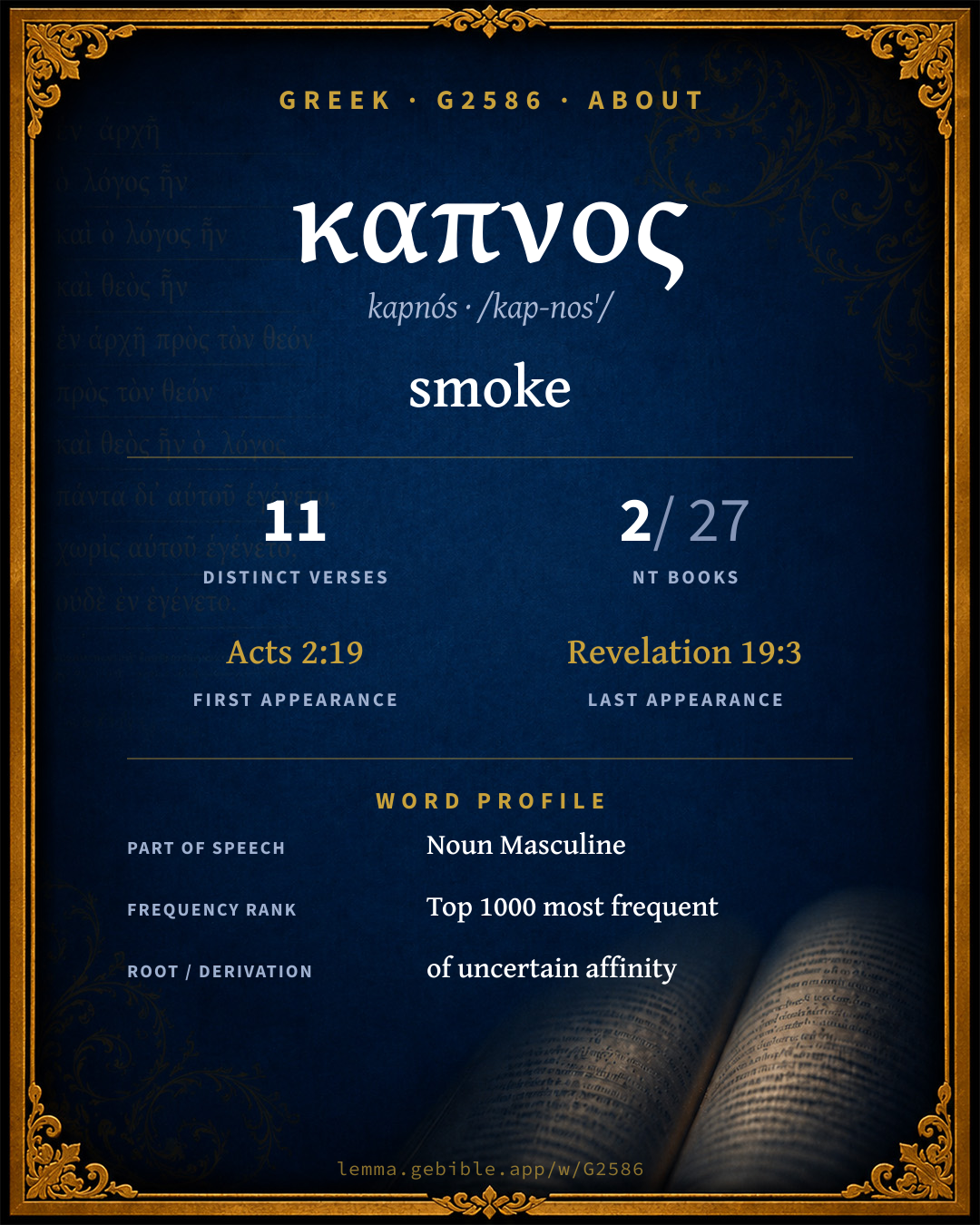
καπνός
smoke
Full lexicon entry — Thayer's Greek Lexicon
From Thayer's Greek Lexicon
Where this word appears
See every Genitive-case word in the Greek New Testament →
Grammar key — what these labels mean
Part of speech
- Noun
- A naming word — a person, place, thing, or idea.
Case
- Nominative
- The case of the subject (and the predicate nominative).
- Genitive
- The case of source, possession, or “of” — answers “whose / from what.”
- Accusative
- The case of the direct object and of extent.
Gender
- Masculine
- Grammatically masculine.
Number
- Singular
- One.
Grammatical forms
- Noun, Nominative, Singular, Masculine 6 times (46%)
- Noun, Genitive, Singular, Masculine 5 times (38%)
- Noun, Accusative, Singular, Masculine 2 times (15%)
Parsed forms decoded from the imported morphology (Robinson–Tischendorf, public domain), counted across 13 parsed occurrences — not distinct verses.
Every verse where G2586 appears — 11 distinct verses across 2 books. Click any verse to open its interlinear word-by-word view. Verse text shown in the World English Bible for context — . Each verse’s Greek form is shown with its reference; the English is not keyword-highlighted, since the data carries no word-level English alignment. Use “Compare translations” on any verse to read it across multiple English versions. This concordance covers the Greek New Testament; Septuagint (Greek Old Testament) occurrences of this word are not indexed here.
Acts 1 verse
Revelation 10 verses
- Revelation 8:4 καπνὸς n nom sg masc The smoke of the incense, with the prayers of the saints, went up before God out of the angel's hand.
- Revelation 9:2 καπνὸς καπνὸς καπνοῦ n nom sg masc n nom sg masc n gen sg masc He opened the pit of the abyss, and smoke went up out of the pit, like the smoke from a burning furnace. The sun and the air were darkened because of the smoke from the pit.
- Revelation 9:3 καπνοῦ n gen sg masc Then out of the smoke came forth locusts on the earth, and power was given to them, as the scorpions of the earth have power.
- Revelation 9:17 καπνὸς n nom sg masc Thus I saw the horses in the vision, and those who sat on them, having breastplates of fiery red, hyacinth blue, and sulfur yellow; and the heads of lions. Out of their mouths proceed fire, smoke, and sulfur.
- Revelation 9:18 καπνοῦ n gen sg masc By these three plagues were one third of mankind killed: by the fire, the smoke, and the sulfur, which proceeded out of their mouths.
- Revelation 14:11 καπνὸς n nom sg masc The smoke of their torment goes up forever and ever. They have no rest day and night, those who worship the beast and his image, and whoever receives the mark of his name.
- Revelation 15:8 καπνοῦ n gen sg masc The temple was filled with smoke from the glory of God, and from his power. No one was able to enter into the temple, until the seven plagues of the seven angels would be finished.
- Revelation 18:9 καπνὸν n acc sg masc The kings of the earth, who committed sexual immorality and lived wantonly with her, will weep and wail over her, when they look at the smoke of her burning,
- Revelation 18:18 καπνὸν n acc sg masc and cried out as they looked at the smoke of her burning, saying, 'What is like the great city?'
- Revelation 19:3 καπνὸς n nom sg masc A second said, "Hallelujah! Her smoke goes up forever and ever."
About this entry
At a glance — auto-summarized from this page’s data, not written by a person. Every figure links to its source below. This summary describes the numbers; it doesn’t interpret them.
The Greek noun καπνος centers on the idea of “smoke.” The word gravitates to Revelation (91%), then Acts. It turns up in 11 verses across 2 books, an uncommon footprint. First canonically at Acts 2:19, it enters the text early. For the data behind this summary, explore the sense tree and the renderings breakdown below.
Gloss history
Strong's 1890 vs modern scholarship
About this word
Strong's G2586 catalogs a Greek word from the Greek New Testament.
These counts are not copied from any lexicon or concordance. They are computed here, from the morphology-tagged Greek New Testament. What Lemma adds →
- 11
- distinct verses
- The word appears in 11 distinct verses.
- 2 / 27
- NT books
- The word appears in 2 of 27 New Testament books.
- #863
- by frequency
- Top 1000 most frequent Greek words (rank 863 of 5,347 Greek words by occurrence).
View all 11 occurrences in the concordance →
Most concentrated in
- Revelation 10 verses 91%
- Acts 1 verse 9%
By section of the New Testament
By traditional corpus
Conventional, traditional groupings — biblical authorship is debated, so this is a traditional corpus grouping, not an authorship claim. Some books belong to more than one corpus (Luke is in both the Gospels and the Lukan corpus, and so on), so these shares overlap and need not total 100%. Each figure is a share of the word’s 11 distinct verses.
- Johannine 10 verses · 91%
- Revelation 10 verses · 91%
- Lukan (Luke–Acts) 1 verse · 9%
How translations render this word
Counts come from each version’s own published word-to-Strong’s tagging or interlinear alignment — an approximate guide to how each version renders this word, not a word-level alignment the data otherwise carries. Because each total is that version’s own tagged count, the per-version totals vary from one another and need not match the appearance or distinct-verse counts above. These counts may also differ from a printed concordance because Lemma counts each distinctly tagged rendering and does not collapse phrase taggings into a single head-word total. This is a fixed set of word-tagged versions (KJV, ASV, BSB, ULT) and does not change with the reading translation you choose elsewhere. Each version’s license is shown beside its name below (and on Sources).
- King James Version: Smoke 13×
- American Standard Version: Smoke 13×
- Berean Standard Bible: Smoke 13×
- unfoldingWord Literal Text: Smoke 13×
King James Version Public Domain
Renders G2586 across 13 tagged occurrences — most commonly:
American Standard Version Public Domain
Renders G2586 across 13 tagged occurrences — most commonly:
Berean Standard Bible Public Domain
Renders G2586 across 13 tagged occurrences — most commonly:
unfoldingWord Literal Text CC BY-SA 4.0
Renders G2586 across 13 tagged occurrences — most commonly:
Senses in Thayer's
The 1 sense Thayer's distinguishes for this word, in lexicon order (not ranked by frequency or importance). The full entry — with sub-senses — is in the Lexicon Entry tab.
- smoke
Word origin
Origin: of uncertain affinity
Of uncertain affinity; smoke : - smoke.
— Strong’s Exhaustive Concordance (1890), public domain.
Forms in the corpus
The 3 distinct written forms G2586 takes in the Greek New Testament, most frequent first — each parse links to that case’s occurrences in the concordance.
| Form | Parsing | Example | Uses |
|---|---|---|---|
| καπνὸς kapnòs | Noun, Nominative, Singular, Masculine | Revelation 8:4 | 6 |
| καπνοῦ kapnoû | Noun, Genitive, Singular, Masculine | Acts 2:19 | 5 |
| καπνὸν kapnòn | Noun, Accusative, Singular, Masculine | Revelation 18:9 | 2 |
Septuagint usage
The same Greek word καπνος appears 22 times in the Greek Old Testament (Septuagint), across 21 verses in 11 books.
- 22
- LXX occurrences
- Tagged occurrences of this Greek word in the Septuagint.
- 21
- verses
- Distinct Septuagint verses containing this word.
- 11 / 39
- OT books
- The word appears in 11 of the 39 Old Testament books.
Sample Septuagint occurrences
- Exodus 19:18 καπνός
- Joshua 8:20 καπνός
- Judges 20:38 καπνός
- 2 Samuel 22:9 καπνός
- Job 41:12 καπνός
- Psalms 17:9 καπνός
- Proverbs 10:26 καπνός
- Song of Solomon 3:6 καπνός
- Isaiah 4:5 καπνός
- Joel 3:3 καπνός
- Nahum 2:14 καπνός
Septuagint occurrences (same lexeme)
Every verse where the same Strong’s number (G2586) appears in the Greek Septuagint. Verse text shown in the World English Bible for context; the Greek form is the matched word — the English is not keyword-highlighted.
- Exodus 19:18 καπνός Mount Sinai, the whole of it, smoked, because Yahweh descended on it in fire; and its smoke ascended like the smoke of a furnace, and the whole mountain quaked greatly.
- Joshua 8:20 καπνός When the men of Ai looked behind them, they saw, and, behold, the smoke of the city ascended up to heaven, and they had no power to flee this way or that way: and the people who fled to the wilderness turned back on the pursuers.
- Joshua 8:21 καπνός When Joshua and all Israel saw that the ambush had taken the city, and that the smoke of the city ascended, then they turned again, and killed the men of Ai.
- Judges 20:38 καπνός Now the appointed sign between the men of Israel and the liers-in-wait was that they should make a great cloud of smoke rise up out of the city.
- Judges 20:40 καπνός But when the cloud began to arise up out of the city in a pillar of smoke, the Benjamites looked behind them; and, behold, the whole of the city went up in smoke to the sky.
- 2 Samuel 22:9 καπνός There went up a smoke out of his nostrils, Fire out of his mouth devoured: Coals were kindled by it.
- Job 41:12 καπνός "I will not keep silence concerning his limbs, Nor his mighty strength, nor his goodly frame.
- Psalms 17:9 καπνός From the wicked who oppress me, My deadly enemies, who surround me.
- Psalms 36:20 καπνός
- Psalms 67:3 καπνός Let the peoples praise you, God. Let all the peoples praise you.
- Psalms 101:4 καπνός A perverse heart will be far from me. I will have nothing to do with evil.
- Proverbs 10:26 καπνός As vinegar to the teeth, and as smoke to the eyes, So is the sluggard to those who send him.
- Song of Solomon 3:6 καπνός Who is this who comes up from the wilderness like pillars of smoke, Perfumed with myrrh and frankincense, With all spices of the merchant?
- Isaiah 4:5 καπνός Yahweh will create over the whole habitation of Mount Zion, and over her assemblies, a cloud and smoke by day, and the shining of a flaming fire by night; for over all the glory will be a canopy.
- Isaiah 6:4 καπνός The foundations of the thresholds shook at the voice of him who called, and the house was filled with smoke.
- Isaiah 14:31 καπνός Howl, gate; cry, city; you are melted away, Philistia, all of you; for there comes a smoke out of the north, and there is no straggler in his ranks.
- Isaiah 34:10 καπνός It shall not be quenched night nor day; the smoke of it shall go up for ever; from generation to generation it shall lie waste; none shall pass through it forever and ever.
- Isaiah 51:6 καπνός Lift up your eyes to the heavens, and look on the earth beneath; for the heavens shall vanish away like smoke, and the earth shall wax old like a garment; and those who dwell therein shall die in like manner: but my salvation shall be forever, and my righteousness shall not be abolished.
- Isaiah 65:5 καπνός who say, Stand by yourself, don't come near to me, for I am holier than you. These are a smoke in my nose, a fire that burns all the day.
- Joel 3:3 καπνός And have cast lots for my people, And have given a boy for a prostitute, And sold a girl for wine, that they may drink.
- Nahum 2:14 καπνός
These are occurrences of the same Greek lexeme (G2586) in the Septuagint — not a translation of any one Hebrew word. The store carries no word-level Hebrew↔Greek alignment, so no Hebrew original is asserted here. Counts come from the recovered LXX Strong's tagging — high-frequency vocabulary is well covered, while rare or late forms may be untagged — so they reflect tagged occurrences and may slightly undercount.