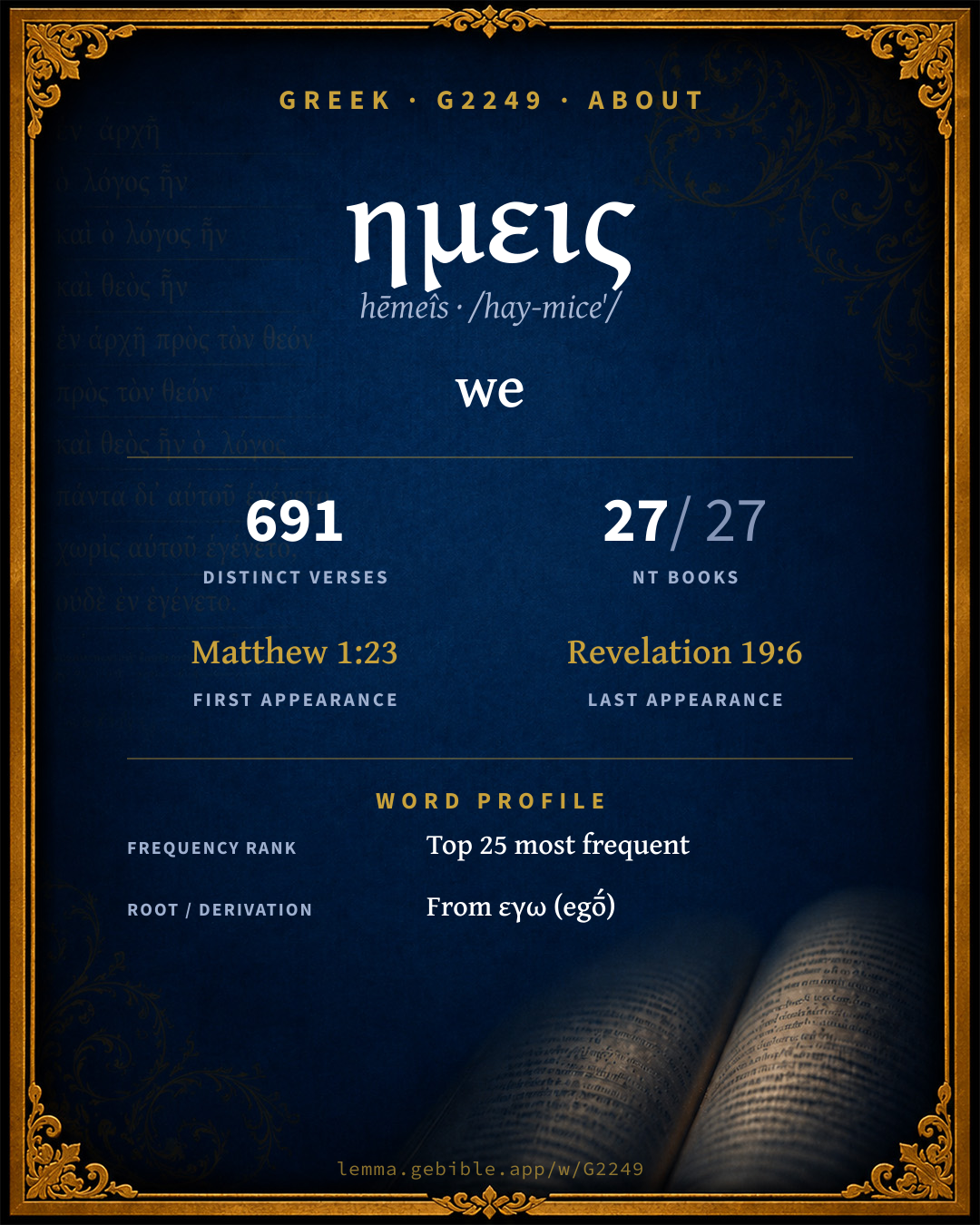
ἡμεῖς
we
Full lexicon entry — Thayer's Greek Lexicon
From Thayer's Greek Lexicon
Where this word appears
See every Genitive-case word in the Greek New Testament →
Grammar key — what these labels mean
Part of speech
- Personal pronoun
- Stands in for a person already named (“I,” “you,” “he”).
Case
- Genitive
- The case of source, possession, or “of” — answers “whose / from what.”
- Dative
- The case of the indirect object, means, or location — “to / for / with / in.”
- Accusative
- The case of the direct object and of extent.
- Nominative
- The case of the subject (and the predicate nominative).
Person
- 1st person
- The speaker (“I / we”).
Number
- Plural
- More than one.
32 verses where G2249 appears in the Dative case in the Book of Acts. Filtered view — show all forms. Click any verse to open its interlinear word-by-word view. Verse text shown in the World English Bible for context — . Each verse’s Greek form is shown with its reference; the English is not keyword-highlighted, since the data carries no word-level English alignment. Use “Compare translations” on any verse to read it across multiple English versions. This concordance covers the Greek New Testament; Septuagint (Greek Old Testament) occurrences of this word are not indexed here.
Acts
- Acts 1:17 ἡμῖν pron 1 dat pl For he was numbered with us, and received his portion in this ministry.
- Acts 1:21 ἡμῖν ἡμᾶς pron 1 dat pl pron 1 acc pl Of the men therefore who have accompanied us all the time that the Lord Jesus went in and out among us,
- Acts 1:22 ἡμῶν ἡμῖν pron 1 gen pl pron 1 dat pl beginning from the baptism of John, to the day that he was received up from us, of these one must become a witness with us of his resurrection."
- Acts 2:29 ἡμῖν pron 1 dat pl "Brothers, I may tell you freely of the patriarch David, that he both died and was buried, and his tomb is with us to this day.
- Acts 3:12 ἡμῖν pron 1 dat pl When Peter saw it, he responded to the people, "You men of Israel, why do you marvel at this man? Why do you fasten your eyes on us, as though by our own power or godliness we had made him walk?
- Acts 6:14 ἡμῖν pron 1 dat pl For we have heard him say that this Jesus of Nazareth will destroy this place, and will change the customs which Moses delivered to us."
- Acts 7:38 ἡμῶν ἡμῖν pron 1 gen pl pron 1 dat pl This is he who was in the assembly in the wilderness with the angel that spoke to him on Mount Sinai, and with our fathers, who received living oracles to give to us,
- Acts 7:40 ἡμῖν ἡμῶν ἡμᾶς pron 1 dat pl pron 1 gen pl pron 1 acc pl saying to Aaron, 'Make us gods that will go before us, for as for this Moses, who led us out of the land of Egypt, we don't know what has become of him.'
- Acts 10:41 ἡμῖν pron 1 dat pl not to all the people, but to witnesses who were chosen before by God, to us, who ate and drank with him after he rose from the dead.
- Acts 10:42 ἡμῖν pron 1 dat pl He charged us to preach to the people and to testify that this is he who is appointed by God as the Judge of the living and the dead.
- Acts 11:13 ἡμῖν pron 1 dat pl He told us how he had seen the angel standing in his house, and saying to him, 'Send to Joppa, and get Simon, whose surname is Peter,
- Acts 11:17 ἡμῖν pron 1 dat pl If then God gave to them the same gift as us, when we believed in the Lord Jesus Christ, who was I, that I could withstand God?"
- Acts 13:26 ἡμῖν pron 1 dat pl Brothers, children of the stock of Abraham, and those among you who fear God, the word of this salvation is sent out to you.
- Acts 13:47 ἡμῖν pron 1 dat pl For so has the Lord commanded us, saying, 'I have set you as a light for the Gentiles, That you should bring salvation to the uttermost parts of the earth.'"
- Acts 15:8 ἡμῖν pron 1 dat pl God, who knows the heart, testified about them, giving them the Holy Spirit, just like he did to us.
- Acts 15:25 ἡμῖν ἡμῶν pron 1 dat pl pron 1 gen pl it seemed good to us, having come to one accord, to choose out men and send them to you with our beloved Barnabas and Paul,
- Acts 15:28 ἡμῖν pron 1 dat pl For it seemed good to the Holy Spirit, and to us, to lay no greater burden on you than these necessary things:
- Acts 16:9 ἡμῖν pron 1 dat pl A vision appeared to Paul in the night. There was a man of Macedonia standing, begging him, and saying, "Come over into Macedonia and help us."
- Acts 16:16 ἡμῶν ἡμῖν pron 1 gen pl pron 1 dat pl It happened, as we were going to prayer, that a certain girl having a spirit of divination met us, who brought her masters much gain by fortune telling.
- Acts 16:17 ἡμῖν pron 1 dat pl Following Paul and us, she cried out, "These men are servants of the Most High God, who proclaim to us the way of salvation!"
- Acts 16:21 ἡμῖν pron 1 dat pl and set forth customs which it is not lawful for us to accept or to observe, being Romans."
- Acts 19:25 ἡμῖν pron 1 dat pl whom he gathered together, with the workmen of like occupation, and said, "Sirs, you know that by this business we have our wealth.
- Acts 19:27 ἡμῖν pron 1 dat pl Not only is there danger that this our trade come into disrepute, but also that the temple of the great goddess Artemis will be counted as nothing, and her majesty destroyed, whom all Asia and the world worships."
- Acts 20:14 ἡμῖν pron 1 dat pl When he met us at Assos, we took him aboard, and came to Mitylene.
- Acts 21:16 ἡμῖν pron 1 dat pl Some of the disciples from Caesarea also went with us, bringing one Mnason of Cyprus, an early disciple, with whom we would stay.
- Acts 21:18 ἡμῖν pron 1 dat pl The day following, Paul went in with us to James; and all the elders were present.
- Acts 21:23 ἡμῖν pron 1 dat pl Therefore do what we tell you. We have four men who have taken a vow.
- Acts 25:24 ἡμῖν pron 1 dat pl Festus said, "King Agrippa, and all men who are here present with us, you see this man, about whom all the multitude of the Jews petitioned me, both at Jerusalem and here, crying that he ought not to live any longer.
- Acts 27:2 ἡμῖν pron 1 dat pl Embarking in a ship of Adramyttium, which was about to sail to places on the coast of Asia, we put to sea; Aristarchus, a Macedonian of Thessalonica, being with us.
- Acts 28:2 ἡμῖν ἡμᾶς pron 1 dat pl pron 1 acc pl The natives showed us uncommon kindness; for they kindled a fire, and received us all, because of the present rain, and because of the cold.
- Acts 28:15 ἡμῶν ἡμῖν pron 1 gen pl pron 1 dat pl From there the brothers, when they heard of us, came to meet us as far as The Market of Appius and The Three Taverns. When Paul saw them, he thanked God, and took courage.
- Acts 28:22 ἡμῖν pron 1 dat pl But we desire to hear from you what you think. For, as concerning this sect, it is known to us that everywhere it is spoken against."
About this entry
At a glance — auto-summarized from this page’s data, not written by a person. Every figure links to its source below. This summary describes the numbers; it doesn’t interpret them.
ημεις (hēmeîs) is a Greek word most often rendered “we.” It first appears in Matthew 1:23. The Greek New Testament uses it across 691 verses — among the most common. Sharing its root, it stands alongside εγω, εμος and εμου. For the data behind this summary, explore the sense tree and the renderings breakdown below.
Gloss history
Strong's 1890 vs modern scholarship

About this word
Strong's G2249 catalogs a Greek word from the Greek New Testament.
These counts are not copied from any lexicon or concordance. They are computed here, from the morphology-tagged Greek New Testament. What Lemma adds →
- 691
- distinct verses
- The word appears in 691 distinct verses.
- 27 / 27
- NT books
- The word appears in 27 of 27 New Testament books.
- #23
- by frequency
- Top 25 most frequent Greek words (rank 23 of 5,347 Greek words by occurrence).
View all 691 occurrences in the concordance →
Most concentrated in
- Acts 109 verses 16%
- 2 Corinthians 81 verses 12%
- Luke 54 verses 8%
By section of the New Testament
By traditional corpus
Conventional, traditional groupings — biblical authorship is debated, so this is a traditional corpus grouping, not an authorship claim. Some books belong to more than one corpus (Luke is in both the Gospels and the Lukan corpus, and so on), so these shares overlap and need not total 100%. Each figure is a share of the word’s 691 distinct verses.
- Pauline corpus 318 verses · 46%
- Lukan (Luke–Acts) 163 verses · 24%
- Gospels 157 verses · 23%
- Johannine 99 verses · 14%
- General (Catholic) Epistles 68 verses · 10%
- Hebrews 25 verses · 4%
- Revelation 14 verses · 2%
How translations render this word
Counts come from each version’s own published word-to-Strong’s tagging or interlinear alignment — an approximate guide to how each version renders this word, not a word-level alignment the data otherwise carries. Because each total is that version’s own tagged count, the per-version totals vary from one another and need not match the appearance or distinct-verse counts above. These counts may also differ from a printed concordance because Lemma counts each distinctly tagged rendering and does not collapse phrase taggings into a single head-word total. This is a fixed set of word-tagged versions (KJV, ASV, BSB, ULT) and does not change with the reading translation you choose elsewhere. Each version’s license is shown beside its name below (and on Sources).
- King James Version: We 118×, Shall we 2×, Us 2×
- American Standard Version: We 117×, Us 3×
King James Version Public Domain
Renders G2249 across 126 tagged occurrences — most commonly:
Plus 4 renderings that appear only once — usually multi-word phrases or single function words the recovered tagging swept in, not distinct renderings.
American Standard Version Public Domain
Renders G2249 across 129 tagged occurrences — most commonly:
Plus 9 renderings that appear only once — usually multi-word phrases or single function words the recovered tagging swept in, not distinct renderings.
Senses in Thayer's
The 1 sense Thayer's distinguishes for this word, in lexicon order (not ranked by frequency or importance). The full entry — with sub-senses — is in the Lexicon Entry tab.
- us, we etc.
Word origin
Derived from εγω (egṓ) (G1473) — I.
Nomitive plural of G1473 ; we (only used when emphatic): - us we (ourselves).
— Strong’s Exhaustive Concordance (1890), public domain.
Forms in the corpus
The 5 distinct written forms G2249 takes in the Greek New Testament, most frequent first — each parse links to that case’s occurrences in the concordance.
| Form | Parsing | Example | Uses |
|---|---|---|---|
| ἡμῶν hēmō̂n | Personal pronoun, 1st person, Genitive, Plural | Matthew 1:23 | 401 |
| ἡμῖν hēmîn | Personal pronoun, 1st person, Dative, Plural | Matthew 3:15 | 168 |
| ἡμᾶς hēmâs | Personal pronoun, 1st person, Accusative, Plural | Matthew 6:13 | 167 |
| ἡμεῖς hēmeîs | Personal pronoun, 1st person, Nominative, Plural | Matthew 6:12 | 122 |
| Ἡμεῖς Hēmeîs | Personal pronoun, 1st person, Nominative, Plural | Acts 20:13 | 4 |
Same root — word family
Other Thayer's entries built from the same root as G2249, grouped by Strong’s listed origin. These share a root / origin per the lexicon — not necessarily a shared meaning. Each links to that word’s own entry.
Derives from
Shares the same root
Compare all same-root words → Showing 4 of 7 — not the complete family. 1 of the same-root words is a proper name (a person or place). They share a root, not necessarily a meaning.