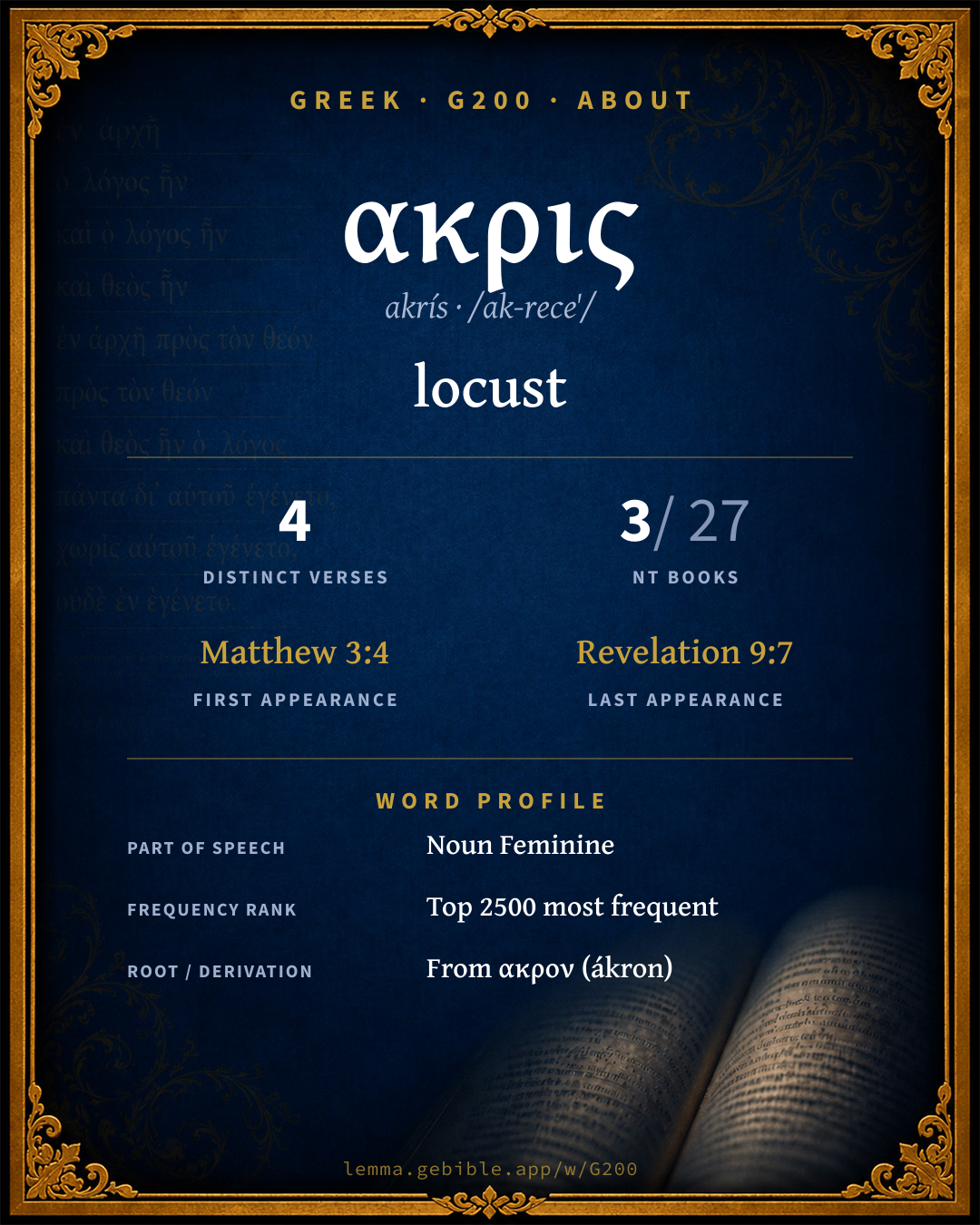
ἀκρίς
locust
Full lexicon entry — Thayer's Greek Lexicon
From Thayer's Greek Lexicon
Where this word appears
Grammar key — what these labels mean
Part of speech
- Noun
- A naming word — a person, place, thing, or idea.
Case
- Nominative
- The case of the subject (and the predicate nominative).
- Accusative
- The case of the direct object and of extent.
- Genitive
- The case of source, possession, or “of” — answers “whose / from what.”
Gender
- Feminine
- Grammatically feminine.
Number
- Plural
- More than one.
Every verse where G200 appears in the Book of Mark — 1 distinct verse. Click any verse to open its interlinear word-by-word view. Verse text shown in the World English Bible for context — . Each verse’s Greek form is shown with its reference; the English is not keyword-highlighted, since the data carries no word-level English alignment. Use “Compare translations” on any verse to read it across multiple English versions. This concordance covers the Greek New Testament; Septuagint (Greek Old Testament) occurrences of this word are not indexed here.
Mark
About this entry
At a glance — auto-summarized from this page’s data, not written by a person. Every figure links to its source below. This summary describes the numbers; it doesn’t interpret them.
ακρις (akrís) is a Greek noun most often rendered “locust.” It occurs a mere 4 verses across Scripture. It clusters heavily in Revelation, which alone accounts for 50% of its uses. Scripture first uses it in Matthew 3:4. It clusters with ακρον, ακριβεστατος and ακροβυστια under a shared root. The sections below give every sense, occurrence, and version rendering.
Gloss history
Strong's 1890 vs modern scholarship
About this word
Strong's G200 catalogs a Greek word from the Greek New Testament.
These counts are not copied from any lexicon or concordance. They are computed here, from the morphology-tagged Greek New Testament. What Lemma adds →
- 4
- distinct verses
- The word appears in 4 distinct verses.
- 3 / 27
- NT books
- The word appears in 3 of 27 New Testament books.
- #1,877
- by frequency
- Top 2500 most frequent Greek words (rank 1,877 of 5,347 Greek words by occurrence).
View all 4 occurrences in the concordance →
Most concentrated in
- Revelation 2 verses 50%
- Matthew 1 verse 25%
- Mark 1 verse 25%
By section of the New Testament
By traditional corpus
Conventional, traditional groupings — biblical authorship is debated, so this is a traditional corpus grouping, not an authorship claim. Some books belong to more than one corpus (Luke is in both the Gospels and the Lukan corpus, and so on), so these shares overlap and need not total 100%. Each figure is a share of the word’s 4 distinct verses.
- Gospels 2 verses · 50%
- Johannine 2 verses · 50%
- Revelation 2 verses · 50%
How translations render this word
Counts come from each version’s own published word-to-Strong’s tagging or interlinear alignment — an approximate guide to how each version renders this word, not a word-level alignment the data otherwise carries. Because each total is that version’s own tagged count, the per-version totals vary from one another and need not match the appearance or distinct-verse counts above. These counts may also differ from a printed concordance because Lemma counts each distinctly tagged rendering and does not collapse phrase taggings into a single head-word total. This is a fixed set of word-tagged versions (KJV, ASV, BSB, ULT) and does not change with the reading translation you choose elsewhere. Each version’s license is shown beside its name below (and on Sources).
- King James Version: Locusts 4×
- American Standard Version: Locusts 3×
- Berean Standard Bible: Locusts 4×
- unfoldingWord Literal Text: Locusts 4×
King James Version Public Domain
Renders G200 across 4 tagged occurrences — most commonly:
American Standard Version Public Domain
Renders G200 across 4 tagged occurrences — most commonly:
Plus 1 rendering that appears only once — usually multi-word phrases or single function words the recovered tagging swept in, not distinct renderings.
Berean Standard Bible Public Domain
Renders G200 across 4 tagged occurrences — most commonly:
unfoldingWord Literal Text CC BY-SA 4.0
Renders G200 across 4 tagged occurrences — most commonly:
Senses in Thayer's
The 1 sense Thayer's distinguishes for this word, in lexicon order (not ranked by frequency or importance). The full entry — with sub-senses — is in the Lexicon Entry tab.
- a locust, particularly that species which especially infests oriental countries, stripping fields and trees. Numberless…
Word origin
Derived from ακρον (ákron) (G206) — end.
Apparently from the same as G206 ; a locust (as pointed or as lighting on the top of vegetation): - locust.
— Strong’s Exhaustive Concordance (1890), public domain.
Forms in the corpus
The 3 distinct written forms G200 takes in the Greek New Testament, most frequent first — each parse links to that case’s occurrences in the concordance.
| Form | Parsing | Example | Uses |
|---|---|---|---|
| ἀκρίδες akrídes | Noun, Nominative, Plural, Feminine | Matthew 3:4 | 2 |
| ἀκρίδας akrídas | Noun, Accusative, Plural, Feminine | Mark 1:6 | 1 |
| ἀκρίδων akrídōn | Noun, Genitive, Plural, Feminine | Revelation 9:7 | 1 |
Same root — word family
Other Thayer's entries built from the same root as G200, grouped by Strong’s listed origin. These share a root / origin per the lexicon — not necessarily a shared meaning. Each links to that word’s own entry.
Derives from
Shares the same root
- ακριβεστατος akribéstatos G196 exact
- ακροβυστια akrobystía G203 uncircumcised
- ακρογωνιαιος akrogōniaîos G204 cornerstone
- ακροθινιον akrothínion G205 first fruits
- αχρι áchri G891 until
Compare all same-root words → Showing 4 of 7 — not the complete family. They share a root, not necessarily a meaning.
Septuagint usage
The same Greek word ακρις appears 30 times in the Greek Old Testament (Septuagint), across 28 verses in 15 books.
- 30
- LXX occurrences
- Tagged occurrences of this Greek word in the Septuagint.
- 28
- verses
- Distinct Septuagint verses containing this word.
- 15 / 39
- OT books
- The word appears in 15 of the 39 Old Testament books.
Sample Septuagint occurrences
- Exodus 10:4 ἀκρίς
- Leviticus 11:22 ἀκρίς
- Numbers 13:33 ἀκρίς
- Deuteronomy 28:38 ἀκρίς
- Judges 6:5 ἀκρίς
- 2 Chronicles 6:28 ἀκρίς
- Psalms 77:46 ἀκρίς
- Proverbs 30:27 ἀκρίς
- Ecclesiastes 12:5 ἀκρίς
- Isaiah 33:4 ἀκρίς
- Jeremiah 26:23 ἀκρίς
- Hosea 13:3 ἀκρίς
Septuagint occurrences (same lexeme)
Every verse where the same Strong’s number (G200) appears in the Greek Septuagint. Verse text shown in the World English Bible for context; the Greek form is the matched word — the English is not keyword-highlighted.
- Exodus 10:4 ἀκρίς Or else, if you refuse to let my people go, behold, tomorrow I will bring locusts into your country,
- Exodus 10:12 ἀκρίς Yahweh said to Moses, "Stretch out your hand over the land of Egypt for the locusts, that they may come up on the land of Egypt, and eat every herb of the land, even all that the hail has left."
- Exodus 10:13 ἀκρίς Moses stretched forth his rod over the land of Egypt, and Yahweh brought an east wind on the land all that day, and all the night; and when it was morning, the east wind brought the locusts.
- Exodus 10:14 ἀκρίς The locusts went up over all the land of Egypt, and rested in all the borders of Egypt. They were very grievous. Before them there were no such locusts as they, neither after them shall be such.
- Exodus 10:19 ἀκρίς Yahweh turned an exceeding strong west wind, which took up the locusts, and drove them into the Red Sea. There remained not one locust in all the borders of Egypt.
- Leviticus 11:22 ἀκρίς Even of these you may eat: any kind of locust, any kind of katydid, any kind of cricket, and any kind of grasshopper.
- Numbers 13:33 ἀκρίς There we saw the Nephilim, the sons of Anak, who come of the Nephilim: and we were in our own sight as grasshoppers, and so we were in their sight.
- Deuteronomy 28:38 ἀκρίς You shall carry much seed out into the field, and shall gather little in; for the locust shall consume it.
- Judges 6:5 ἀκρίς For they came up with their cattle and their tents; they came in as locusts for multitude; both they and their camels were without number: and they came into the land to destroy it.
- Judges 7:12 ἀκρίς The Midianites and the Amalekites and all the children of the east lay along in the valley like locusts for multitude; and their camels were without number, as the sand which is on the sea-shore for multitude.
- 2 Chronicles 6:28 ἀκρίς If there be in the land famine, if there be pestilence, if there be blasting or mildew, locust or caterpillar; if their enemies besiege them in the land of their cities; whatever plague or whatever sickness there be;
- 2 Chronicles 7:13 ἀκρίς If I shut up the sky so that there is no rain, or if I command the locust to devour the land, or if I send pestilence among my people;
- Psalms 77:46 ἀκρίς
- Psalms 104:34 ἀκρίς Let your meditation be sweet to him. I will rejoice in Yahweh.
- Psalms 108:23 ἀκρίς
- Proverbs 30:27 ἀκρίς The locusts have no king, Yet they advance in ranks;
- Ecclesiastes 12:5 ἀκρίς Yes, they shall be afraid of heights, And terrors will be in the way; And the almond tree shall blossom, And the grasshopper shall be a burden, And desire shall fail; Because man goes to his everlasting home, And the mourners go about the streets:
- Isaiah 33:4 ἀκρίς Your spoil shall be gathered as the caterpillar gathers: as locusts leap shall men leap on it.
- Isaiah 40:22 ἀκρίς [It is] he who sits above the circle of the earth, and the inhabitants of it are as grasshoppers; who stretches out the heavens as a curtain, and spreads them out as a tent to dwell in;
- Jeremiah 26:23 ἀκρίς and they fetched forth Uriah out of Egypt, and brought him to Jehoiakim the king, who killed him with the sword, and cast his dead body into the graves of the common people.
- Jeremiah 28:14 ἀκρίς For thus says Yahweh of Hosts, the God of Israel: I have put a yoke of iron on the neck of all these nations, that they may serve Nebuchadnezzar king of Babylon; and they shall serve him: and I have given him the animals of the field also.
- Jeremiah 28:27 ἀκρίς
- Hosea 13:3 ἀκρίς Therefore they will be like the morning cloud, And like the dew that passes away early, Like the chaff that is driven with the whirlwind out of the threshing floor, And like the smoke out of the chimney.
- Joel 1:4 ἀκρίς What the swarming locust has left, the great locust has eaten. What the great locust has left, the grasshopper has eaten. What the grasshopper has left, the caterpillar has eaten.
- Joel 2:25 ἀκρίς I will restore to you the years that the swarming locust has eaten, The great locust, the grasshopper, and the caterpillar, My great army, which I sent among you.
- Amos 7:1 ἀκρίς Thus the Lord Yahweh showed me: and, behold, he formed locusts in the beginning of the shooting up of the latter growth; and, behold, it was the latter growth after the king's harvest.
- Nahum 3:15 ἀκρίς There the fire will devour you. The sword will cut you off. It will devour you like the grasshopper. Multiply like grasshoppers. Multiply like the locust.
- Nahum 3:17 ἀκρίς Your guards are like the locusts, and your officials like the swarms of locusts, which settle on the walls on a cold day, but when the sun appears, they flee away, and their place is not known where they are.
These are occurrences of the same Greek lexeme (G200) in the Septuagint — not a translation of any one Hebrew word. The store carries no word-level Hebrew↔Greek alignment, so no Hebrew original is asserted here. Counts come from the recovered LXX Strong's tagging — high-frequency vocabulary is well covered, while rare or late forms may be untagged — so they reflect tagged occurrences and may slightly undercount.