
Proverbs 30:27

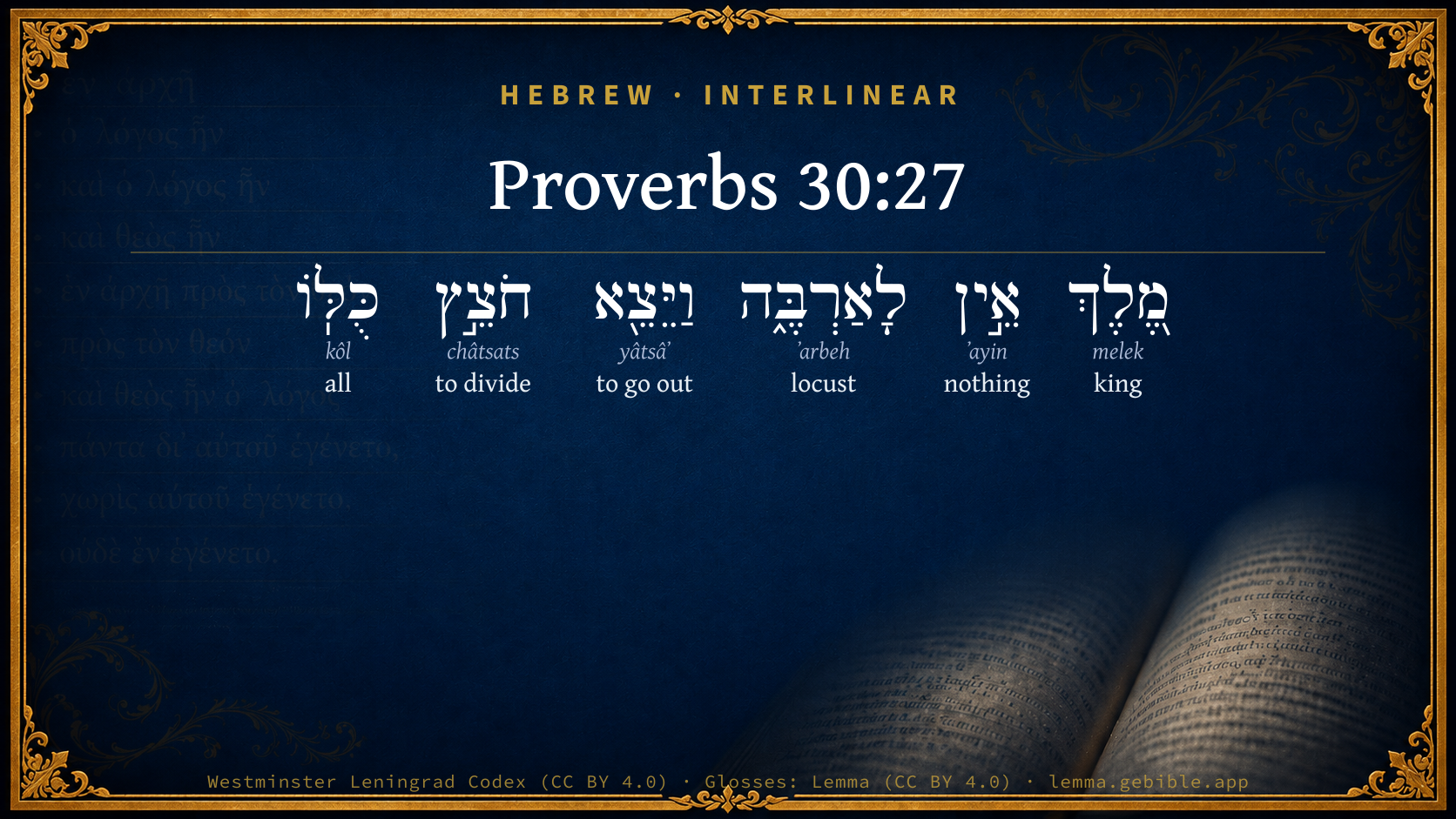
Hebrew (Westminster Leningrad Codex) Proverbs 30:27 appears in the Hebrew Old Testament. The text above is from the Westminster Leningrad Codex. Each word links to its Strong’s number, a concise gloss, and parsing drawn from the Open Scriptures Hebrew Bible morphology. Click any word for its full Brown-Driver-Briggs (BDB) entry.
Download image
Cite this verse

Proverbs 30:27 (World English Bible). Public Domain. Lemma interlinear Bible study tool, https://lemma.gebible.app/v/proverbs/30/27.

Show BibTeX & RIS
BibTeX
RIS
English Translation
The locusts have no king, Yet they advance in ranks;
World English Bible · Public Domain
Download a study sheet

One document with this verse’s original text, its word-by-word gloss line, the meaning frame, cross-references with their text, attributed commentary, and full source and license credits — printable, and it pastes into notes with its structure intact.

This verse Autodidact and up

Study sheet (.html) Plain text (.txt)

A passage Seminary Student

Up to 50 verses in one chapter. A passage sheet keeps up to 6 commentary sources and 12 cross-references per verse, in the order this page ranks them, and says so on the sheet whenever that leaves anything out. Ask for a single verse and you get the Autodidact verse sheet above.

Everything on this page stays free to read, with no account — the sheet is a download of what is already on screen, not access to it.

Want to remove ads? Support Godless Engineer
Compare translations 3

The same verse in 3 English versions, stacked beneath the original-language interlinear above. Click any original word for its lexicon entry.

Each is an independent rendering of the whole verse — the interlinear is not word-aligned to these translations.

Highlighted words mark where these versions differ — a whole-verse word diff, not a word-by-word alignment.

  • World English Bible Public Domain
    The locusts have no king, Yet they advance in ranks;
  • King James Version Public Domain
    The locusts have no king, yet go they forth all of them by bands;
  • unfoldingWord Literal Text CC BY-SA 4.0
    There is no king for the locust, but each of it goes out divided.

unfoldingWord Literal Text — © unfoldingWord, licensed CC BY-SA 4.0. Word-aligned USFM3 via Door43 (git.door43.org/unfoldingWord/en_ult).

Versions to compare (up to 4)

3 of 4 selected

Show all 18 translations

Every available English version of this verse, each an independent rendering of the whole verse.

  • World English Bible Public Domain
    The locusts have no king, Yet they advance in ranks;
  • Berean Standard Bible Public Domain
    the locusts have no king, yet they all advance in formation;
  • Majority Standard Bible Public Domain
    the locusts have no king, yet they all advance in formation;
  • King James Version Public Domain
    The locusts have no king, yet go they forth all of them by bands;
  • American Standard Version (1901) Public Domain
    The locusts have no king, Yet go they forth all of them by bands;
  • Revised Version (1885) Public Domain
    The locusts have no king, yet go they forth all of them by bands;
  • Geneva Bible (1599) Public Domain
    The grashopper hath no King, yet goe they forth all by bandes:
  • Douay-Rheims (1899) Public Domain
    The locust hath no king, yet they all go out by their bands.
  • Young's Literal Translation Public Domain
    A king there is not to the locust, And it goeth out -- each one shouting,
  • Literal Standard Version CC BY-SA 4.0
    There is no king to the locust, || And it goes out—each one shouting,
  • Unlocked Literal Bible CC BY-SA 4.0
    Locusts have no king, but all of them march in rank.
  • unfoldingWord Literal Text CC BY-SA 4.0
    There is no king for the locust, but each of it goes out divided.
  • Darby Bible Public Domain
    the locusts have no king, yet they go forth all of them by bands;
  • World Messianic Bible Public Domain
    The locusts have no king, yet they advance in ranks.
  • Webster's Bible Public Domain
    The locusts have no king, yet go they forth all of them by bands;
  • Free Bible Version CC BY-SA 4.0
    Locusts—they don't have a king, but they all march in line abreast.
  • Bible in Basic English Public Domain
    The locusts have no king, but they all go out in bands;
  • JPS Tanakh (1917) Public Domain
    The locusts have no king, yet go they forth all of them by bands;

Literal Standard Version (2020), Covenant Press — licensed CC BY-SA 4.0. Text via the HelloAO Bible API (eBible.org). Unlocked Literal Bible (unfoldingWord) — licensed CC BY-SA 4.0. Text via the HelloAO Bible API (eBible.org). unfoldingWord Literal Text — © unfoldingWord, licensed CC BY-SA 4.0. Word-aligned USFM3 via Door43 (git.door43.org/unfoldingWord/en_ult). Free Bible Version, Dr. Jonathan Gallagher — licensed CC BY-SA 4.0. Text via the HelloAO Bible API (eBible.org).

Word by word

More ways to search: Search by grammar → Find every occurrence → Compare this word →

Practice this passage: Drill this verse → Learn its vocabulary →

About this verse

These counts appear in no published source. They are computed here, from the morphology-tagged text and Lemma’s own curated glosses. What Lemma adds →

6
words
6
distinct lemmas
Wisdom
section

Notable vocabulary

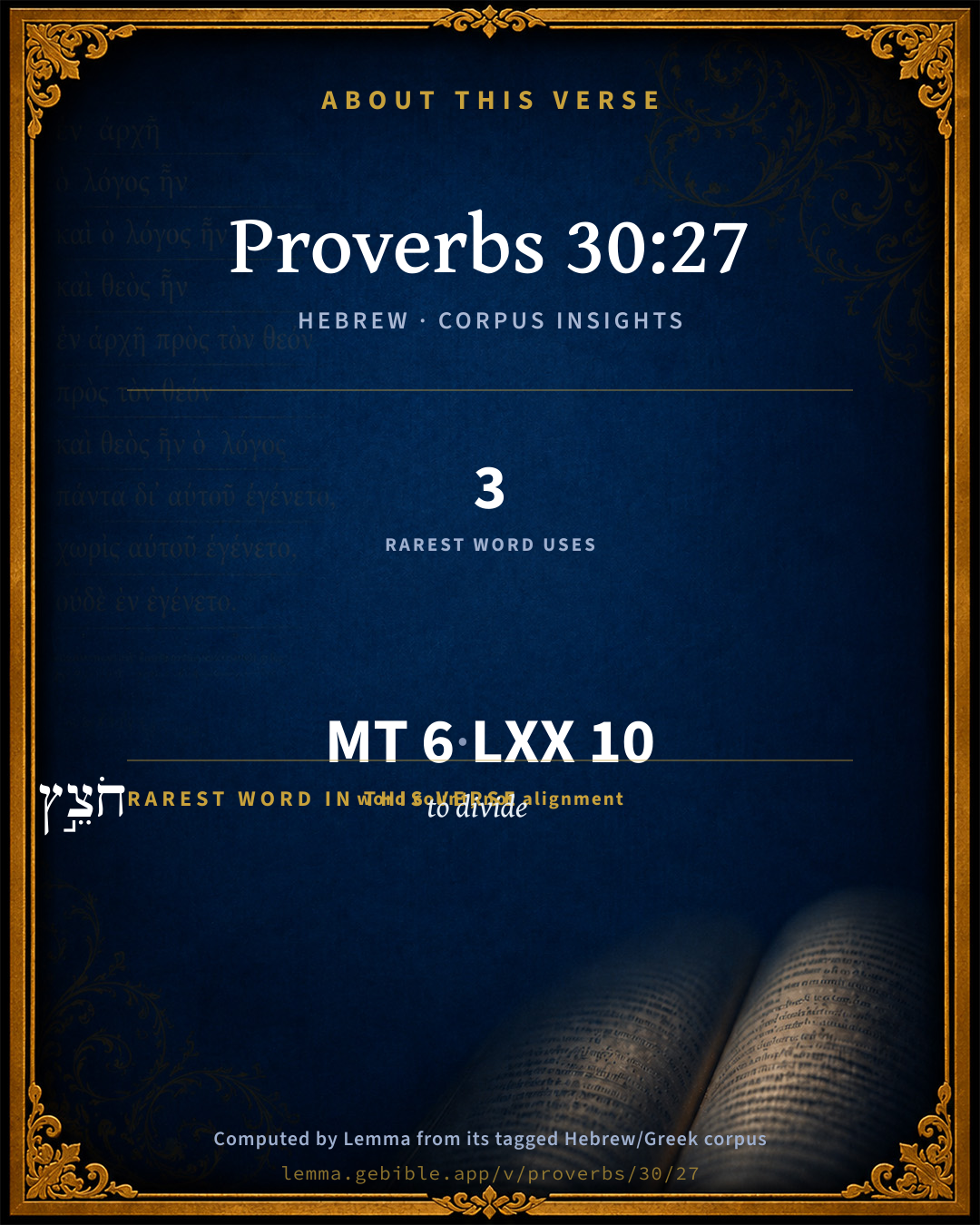
The rarest word here is חֹצֵ֣ץ to divide H2686 — appearing just 3 times in the whole Hebrew Bible.

Shared distinctive vocabulary

חֹצֵ֣ץ to divide H2686 occurs in 3 verses of the Hebrew Bible. Also found in:

Grammatical profile

  • 2 verbs
  • 3 nouns
  • 1 particle

Verb forms

  • וַיֵּצֵ֖א Qal · Sequential Imperfect
  • חֹצֵ֣ץ Qal · Participle Active

Hebrew & Septuagint length

In English translation the verse runs 10 words from the Hebrew and 12 from the Septuagint (LXX English) — closely comparable.

A rough comparison of the two English renderings, which tokenize alike — not a word-level alignment.

Word counts can differ between the Hebrew and the Greek without any difference in meaning — e.g. the Hebrew direct-object marker אֵת has no separate Greek word, and Greek often adds the article ὁ.

In the original languages it is 6 Hebrew tokens and 10 Greek tokens — but the two are counted differently (Hebrew bundles its prefixes and suffixes into one token; the Greek is in lemma form), so that isn’t a like-for-like length.

Cross-references

8

Topical passages linked to Proverbs 30:27 in the Treasury of Scripture Knowledge — connected by theme and wording, ordered by reader-vote popularity; previews shown in the World English Bible.

  • Exodus 10:4–6 Or else, if you refuse to let my people go, behold, tomorrow I will bring locusts into your country,
  • Psalms 105:34 He spoke, and the locusts came, And the grasshoppers, without number,
  • Joel 1:6–7 For a nation has come up on my land, strong, and without number. His teeth are the teeth of a lion, And he has the fangs of a lioness.
  • Joel 2:7–11 They run like mighty men. They climb the wall like warriors. They each march in his line, and they don't swerve off course.
  • Joel 2:25 I will restore to you the years that the swarming locust has eaten, The great locust, the grasshopper, and the caterpillar, My great army, which I sent among you.
  • Exodus 10:13–15 Moses stretched forth his rod over the land of Egypt, and Yahweh brought an east wind on the land all that day, and all the night; and when it was morning, the east wind brought the locusts.
  • Joel 1:4 What the swarming locust has left, the great locust has eaten. What the great locust has left, the grasshopper has eaten. What the grasshopper has left, the caterpillar has eaten.
  • Revelation 9:3–11 Then out of the smoke came forth locusts on the earth, and power was given to them, as the scorpions of the earth have power.

Cross-references courtesy of OpenBible.info (CC BY 4.0).

Hebrew and Greek witnesses Masoretic Hebrew ↔ Greek Septuagint

The same verse in the two great witnesses to the Old Testament, shown verse-for-verse.

These are two independent witnesses, not word-aligned to each other, and the Septuagint is shown in lemma (dictionary) form.

Hebrew Proverbs 30:27 Masoretic · Westminster Leningrad Codex

מֶ֭לֶךְ אֵ֣ין לָאַרְבֶּ֑ה וַיֵּצֵ֖א חֹצֵ֣ץ כֻּלּֽוֹ

The locusts have no king, Yet they advance in ranks;

World English Bible · Public Domain

Greek LXX Proverbs 30:27 Septuagint · lemma form

ἀβασίλευτος εἰμί ὁ ἀκρίς καί ἐκστρατεύω ἀπό εἷς κέλευσμα εὐτάκτως

The locusts have no king, and yet march orderly at one command.

LXX2012 (modern English Septuagint) · Public Domain

On this verse, The Pulpit Commentary discusses the Septuagint’s reading. Read the note in Commentary ↓

Hebrew: Westminster Leningrad Codex (CC BY 4.0). Greek: Septuagint (public domain); English from LXX2012 (modern English Septuagint) (Public Domain). How the Septuagint differs from the Hebrew →

Commentary

Notes on Proverbs 30:27 from classic Christian and Jewish commentators (each source and its license shown beneath its notes). The classic Christian expositions comment on the surrounding passage and are grouped to its opening verse, so a note may address several verses; the Jewish commentaries on the Tanakh (Rashi and others) are per-verse, so they appear only where the commentator wrote on this verse.

Lemma curates 59 commentaries, every one of them public domain or Creative Commons licensed, each selected and text-cleaned for this edition rather than reprinted as found. About our sources →

Trapp's Complete Commentary

John Trapp

Pro 30:27 The locusts have no king, yet go they forth all of them by bands;

Ver. 27. The locusts have no king.] They are all belly, which is joined to their mouths, and endeth at their tails; hence they make such havoc where they come in those Eastern countries. See Joe 2:11, where they are called "God’s great army." For though they have no king to command them, yet they go forth by bands, and march all in a company, to teach men concord and combination in lawful affairs and attempts. For,

“ Coniuncti pollent etiam vehementer inertes. ”

Those locusts in the Revelation (whereby is meant the Popish clergy), have their king Abaddon, the Pope, {Rev 9:11} to whom they appeal from their lawful sovereign; yea, the rebellion of a clergyman against his prince is not treason, saith Sa the Jesuit, quia non est principi subiectus, because he is the Pope’s subject. And when the English clergy whipped King Henry II for a penance for Becket’s death, one of the Pope’s legates said unto him, Domine, noli minari, &c.: Sir, never threaten us, for we fear no menaces of men, as being of such a court as use to command kings and emperors. {a}

{a} Jacob. Revius, De Vit. Pontiff

John Trapp, A Commentary or Exposition upon All the Books of the Old and New Testament (1647–1656) — public domain. Text from a community e-Sword module.

The Cambridge Bible for Schools and Colleges

gen. ed. J. J. S. Perowne

27. by bands] Lit. divided, i.e. not jostling one another like an unorganised rabble, but arranged in well-ordered ranks. Comp. the description of the ordered march of the locusts: “They break not their ranks, neither doth one thrust another.” Joe_2:7-8.

The Cambridge Bible for Schools and Colleges (gen. ed. J. J. S. Perowne; Cambridge University Press, 1878–1918) — public domain. Text from a community e-Sword module.

John Gill's Exposition

The locusts have no king,.... These are small creatures also, yet very devouring ones; and consume the fruits of the earth, wherever they come and light; see Exo 10:13; they are very numerous, and move in large bodies, and yet with great regularity and order; which shows the wisdom there is in them by natural instinct, though they have no king to command, guide, and direct them: in this the mystical locusts differ from them, who have a king, whose name is Abaddon, Rev 9:11;

yet they go forth all of them by bands; the Targum is,

"they are all gathered together as one.''

They get together in one place; they associate and join themselves in bands, and keep together, though they have no ruler over them; an emblem of unity, concord, and harmony, let the form of government be what it will, as the best security to a people: and these creatures, when they move from place to place, they move in a body, in a very regular manner; "in precise order" (u), as the words may be rendered, with great exactness, everyone in his proper place, all in rank and file; and though they have no general to marshal them, yet are in, and march in as good order as the most regular army does. So the Arabic version,

"yet in their army, their affairs and manner are in a beautiful disposition;''

indeed they are God's army, as they are called, Joe 2:25; and it is he that gives them their wisdom, instructions, directions, and commission. It is rendered by some, "everyone cutting"; that is, as Kimchi (w) interprets it, cutting the green grass and trees; or, "every one dividing" (x); that is, to himself, the prey or spoils, as kings do; see Isa 33:4.

(u) Vid. Hilier. Onomastic. Sacr. p. 187. (w) Sepher Shorash. rad. so Stockius, p. 377. "exeidens omnia, herbas, scil. et fruges", Schindler. col. 633. so Ben Melech. (x) "unaquaeque sibi dividens", Bochart; so Schultens.

John Gill's Exposition of the Whole Bible (1746–1763) — public domain (CC PDM 1.0). Text via the HelloAO Bible API.

Albert Barnes' Notes on the Bible

Compare Joe 2:7-8; the most striking fact in the flight of the locust-swarms was their apparent order and discipline, sweeping over the land like the invasion of a great army.

Albert Barnes' Notes on the Bible (1834–1885) — public domain. Text from a community e-Sword/MySword module.

Haydock's Catholic Bible Commentary

Bands, like an army. When one rises or falls, all do the like. They are so numerous in the East, as to darken the sun and spread destruction, Joel i., and ii. (Calmet)

George Leo Haydock (1774–1849), Haydock's Catholic Family Bible and Commentary, 1859 edition — public domain. Excludes Psalms (Douay-Rheims chapter numbering differs from Protestant) and Deuterocanonical books (Catholic canon only).

Matthew Poole's English Annotations

Have no king to rule and order them.

By bands; in great numbers, and in several companies, and in exact order, as is observed in Scripture, as Jdg 6:5; 7:12; Joe 1:6; 2:7, and by other writers.

Matthew Poole's English Annotations on the Holy Bible (1683–1685) — public domain. Text from a community e-Sword/MySword module.

The Pulpit Commentary

The locusts have no king, (Pro_6:7) yet they show discipline, guidance, and order. They go forth all of them by bands; so that Joel (Joe_2:7, Joe_2:8) speaks of them as a well-ordered army, as it were men of war, marching every one on his ways, not entangling their ranks, walking every one in his path. Septuagint, "The locusts are without a king, yet march at one command in good order."

The Pulpit Commentary (1880–1919), ed. H.D.M. Spence-Jones & Joseph S. Exell — public domain. Text from a community e-Sword module.

John Wesley's Explanatory Notes

Bands - Several companies, in exact order.

John Wesley, Explanatory Notes Upon the Whole Bible (1754–1765) — public domain. Text via the GEBible commentary corpus.

unfoldingWord translationNotes

Door43 World Missions Community

lizard

a small reptile that has four legs, a long, slender body, and a tail

translationWords

locust

king

palace

unfoldingWord translationNotes — © Distant Shores Media and the Door43 World Missions Community, licensed CC BY-SA 4.0. Source: git.door43.org/Door43/en_tn.

Lesson kit

Teaching starters — assembled from the data on this page, not authored interpretation. Every prompt links to the verse data it draws on. Edit before teaching.

Proverbs, in the Wisdom, opens this verse with 6 words (6 distinct Hebrew lemmas). Its most distinctive word is châtsats (“to divide”). A historical commentator’s framing appears above. Read the whole chapter for the surrounding context.

Discussion questions

  1. How does “to divide” (châtsats) shape what this verse is saying?
  2. How does Judges 5:11, which shares the word «to divide», read alongside this verse?
  3. The translations on this page render this verse differently — a whole-verse word diff, not a word-by-word alignment. What might account for the different wordings?
  4. «וַיֵּצֵ֖א» is a Qal Sequential Imperfect verb. How does that grammatical form shape the action described?
  5. Compare how Trapp's Complete Commentary and The Cambridge Bible for Schools and Colleges read this verse. Where do they agree or differ?

Things to notice

Reading settings

Reading text

Shown beneath each verse's original-language words.

Old Testament
Old Testament edition

Read the OT as the Masoretic Hebrew (MT) or the Greek Septuagint (LXX).

English shown for the Greek Septuagint (in the Hebrew ↔ Greek comparison).

Comparing translations? Open the Compare panel on any verse page to stack up to four side by side.